My father, dying

In this month’s Poetry magazine, a poem by Kevin Young, one of my favorite poets, caught me by surprise. Sometimes that happens, that twist, that leap, that chill of meaning that is both of the work and not of the work. I’m not sure how to write about this.

You can read the poem, “Pietà” by Kevin Young online here where a blogger has posted the poem. (Note: The poem is not centered in the published version. Subject for another day: centered poetry, pet peeve.)

Who is this “I” in the poem, and who is this “him”? I wondered. The title, Pietà—pity—suggests all those images of Mary cradling the body of her dead son. Whoever the sought-for “him” is, he can’t be found in heaven (“too uppity” and “not enough // music, or dark dirt”), nor in the earth. Death appears in the poem, a boy bounces a ball, and the speaker notices the delay of sound reaching him. Then Young ends: “Father, // find me when / you want. I’ll wait.” Prayer? Elegy? Father or father or both?

Last spring as my father was dying of cancer, I was reading poems, writing poems, drawn to poetry as a form of understanding, a way to process my conflicts and my grief. Poems I’d always loved and taught, from Alfred Lord Tennyson’s “In Memoriam” (his long elegiac sequence about the death of his dear friend) to Li-Young Lee’s stunning first book Rose, had new resonance for me. New pain, new forms of consolation.

Yes, sometimes this is what art does: offers consolation.

I’m not sure how to write about this. It feels, maybe, too personal.

I know I’m seeing dead fathers everywhere. My own keeps showing up in my dreams. I picked up a thin collection of new Scottish poetry when I was in Dublin in July, Intimate Expanses, and the first poem was Alastair Reid’s “My Father, Dying.” “The whole household is pending,” he writes. “I am not ready.” (I remember when the hospice nurse told us my father was on “the imminent list.”) The end of his father’s life, writes Reid, seems the beginning of something else: a “hesitant conversation / going on and on and on.”

In the July/August issue of Poetry, a poem by another favorite poet, Spencer Reece, “The Manhattan Project," a poem that ends, stunningly: “The quietness inside my father was building and would come to define him. I was wrong to judge it. Speak, Father, and I will listen. And if you do not speak, then I will listen to that.”

So I'm thinking about my father, I’m writing about my father. Here’s a draft:

Last Night

Last night, bright moon, dark trees lining each horizon,

armadillo digging up the flowerbed. The yucca’s last buds glow white.

Last night, a nightmare, lame as nightmares come, but

for all that, I woke up calling out for my father’s help. My mother

woke, her soft feet at the door.

Last night, she says, she heard voices, in the house, outside the window,

someone calling her name. It’s like that now.

Last night my dad asked how I got there,

sitting beside his bed, his head against the rail,

his soft focus stare. He says something else

I can’t quite hear, his quiet voice receding, as if

he’s elsewhere, another room. My mom says sometimes he waves

at someone, but no one’s there.

So I’m writing about and to my father. Not pleased with many of them, but writing. Maybe it’s a way to keep that “hesitant conversation” going. I am thinking about all the conversations I never had with him. I am listening to the silence. As I sit here at my desk, the dark shadow of a large hawk keeps crossing the backyard.

-----

For those of you who are writing or have written about illness, USC Sumter is hosting a writing contest (essay and poetry). Download the information here. Deadline is September 16.
Shame On You

I’ve been thinking a lot about shame lately. If this blog had a soundtrack it would be Evelyn Champagne King, 1978, “Shame.” (Yeah, I'm listening to it again while I write. Listen along!)

You can see him, can’t you? That skinny gay kid with bad Barry Manilow hair, dancing in front of his mirror to the eight-track tape….

Maybe I’m thinking about shame because I spent some time in my childhood home earlier this year, sleeping in that bedroom. (The mirror and the eight-track player and the Barry Manilow hairdo are gone now.  It gets better.)

Maybe it’s also because this is Gay Pride week in Columbia—rainbow banners on every street.  Pride is supposed to be the opposite of shame, a way of reclaiming as good an identity that has been, in the past, pathologized, demonized, stigmatized. (I do love those rainbow banners. I remember how excited we were, when I was on the Pride planning committee years ago, and that first gay pride street banner went up. We kept driving by it, smiling.) Pride is shame turned inside out. (A list of Pride events can be found here.)

Mostly, though, it’s because I’ve been working with the Sebastian art show, which I wrote about in an earlier blog. The beauty of the vilified.

Shame is a fundamental emotion of our childhoods—I think that it is amplified for some gay and lesbian kids. Therapists like to draw a distinction between shame and guilt: guilt is what we feel for something we’ve done or haven’t done, but shame is what we feel for who we are. It’s connected to our identities.

Shame can’t be erased or excised or purged. Nope, the residue of it sticks to us, no matter how much we try to wash it away, pretend it's not there. All we can do is transfigure it in some way, use it, understand it, recognize it, learn from it.

And write about it.

So in my poems about Sebastian, I was thinking about how and why we learn from shame, from the ways we’re shamed and the feelings of shame and the ongoing effects of shame. I don’t have answers; I was thinking of my poems as gestures, provocations, explorations, attempts. I was thinking about Sebastian and John O'Hara and Pinhead and Debussy and archery books and ampallangs and the Cowardly Lion. (Dorothy yells at him, “Shame on you,” before he breaks into his song: “It’s sad believe me, missy, when you’re born to be a sissy….”)

I wrote a series of poems or prayers for Sebastian. Here’s the last one of the series:

For Saint Sebastian

Arms, be bound. Legs bound, rope wound.

The rope that binds is shame. The arrow is shame, the bow.

Shame is a wound, shame is a caul. That we may learn the eloquence of shame.

That we may learn that the arrows do not kill you.

The tree stiffens the spine. The arrows do not kill us.


I’m still listening to Evelyn Champagne King. I know she’s singing about something else, but still, those lyrics sing for me. “Gonna love you just the same. Mama just don’t understand….”

- Ed Madden


Jasper Magazine - the Word on Columbia Arts debuts in print in

15 days

Until then, visit us at www.jaspercolumbia.com

and subscribe to this blog by adding your email address to the box at right

Mind Gravy Poetry

Mind Gravy Poetry is the brain child of Columbia newcomer, Al Black, who took things into his own hands when he moved to the city and didn't find a poetry reading series that met his personal needs. (There are several other poetry reading series in town including a Tuesday night session that leans toward slam at the Art Bar and, when university classes are in session, a series that originated out of the MFA program at USC, called The Shark's Parlor.) Al's lovely wife returned to college when their four children got older, completing her Ph.D. from Purdue University at the age of 55, and moving to Newberry College in August 2008 to teach. In Indianapolis, the Blacks' hometown, Al had been very active in the music and poetry scene and he regularly contributed satire to a liberal blog.

Missing his old Indianapolis fun and a venue for sharing written word poetry, Al started Mind Gravy at the now defunct Gotham Bagels a little over a year ago. The site of the readings has changed as businesses closed and the group of regulars grew, and in February the regular reading moved to Artsy Fartsy Art Gallery and Coffee Bar in Cayce.

"We are bursting at the seams," Al says. "Most nights we have 10 or more people standing and we total 40-50 people."

Tonight, Jasper Magazine literary editor, Ed Madden, along with Ray McManus will be the featured poets. Rev. Marv Ward is the musical guest.

A few more things Al would like friends of Jasper to keep in mind:


*We are a free venue & no participants are paid

*We go every Wednesday from 8-10 PM

*We start with a guest musician (original music), followed by the featured poet and then open mic

*We have had featured poets from VA, NC, TN, GA, FL & SC

*70% of the featured poets are page poets, but we have featured performance, slam, dub and hip hop poets in the past

*Our music runs from SC folk/country to R&B, hip hop and everything in between

*Open mic is limited to 2 pieces per person – all types of poetry, all types of music, an occasional dance, once a magician and once a comedian – we try to be positive and encouraging of all levels artistic expression

*We expect to begin webcasting in October – this will widen our market and our reach for featured poets

*Al doesn't feature himself, but sometimes he'll read a piece or two during open mic

*Occasionally, we will have an artist paint during the event

*An interesting note -- about two months ago, the house-mother for a group home for developmentally handicapped women started bringing 6 of the women to Mind Gravy. They come each week, enjoy themselves, leave at 9:30 and are respected & appreciated by our regulars – it is the most unusual thing I have ever seen. (Jasper's heart swelled a little when he read this.)

*The first Wednesday of each month is youth night – adults come, but it is youth performers

*The 2nd & 4th Wednesdays are normal Mind Gravy

*The 3rd Wednesdays Al hosts the Columbia Writer’s Alliance -- same format, but Al is trying to encourage this organization started by African-American women - so we call it Mind Gravy presents Columbia Writer’s Alliance

*Whenever we have a 5th Wednesday, we do it on some special theme – this month has a 5th Wednesday and the theme is percussion; we have some different percussionists coming in and, of course, poetry

*Mind Gravy operates on the premise that cross-pollination of different art forms at the event increases the audience size and diversity, engenders appreciation of differences between art forms; creates an environment that encourages collaboration and, is just a delightfully wonderful time.


Well, those dear readers who are familiar with the mission of Jasper Magazine, know that Al just said the magic words. Collaboration, coming out of our single-disciplinary arts caves, and contributing to and taking inspiration from other artistic genres and communities is a sure-fire way of building and enriching a sustaining community of artists and arts lovers.

Congratulations to Al Black and the participants of Mind Gravy for being pro-active and pro-arts. Be sure to check them out tonight or any Wednesday when you need some words to soothe your soul.

And before you leave us today, please take a moment to look to your right on this screen and go ahead a and subscribe to your daily dose of "What Jasper Said." We don't want you to miss a word.

And please check out our website at www.jaspercolumbia.com.

Thanks, Y'all.

-- cb

Jasper says, "Arms be bound with rope and shame"

One thing about Jasper, he gets his hands dirty. Sometimes he comments about the art he sees and hears, but sometimes he’s got his hands down in it, making something. So sometimes we’ll write about what we’re doing.

So: I’ve been cutting up Jesus. Will I go to hell for this?

I’m working with a collaborative of artists –visual artists, filmmakers, performance artists—on a show called Saint Sebastian: From Martyr to Gay Starlet. The one-night-only gallery show will be Sept. 1 at Friday Cottage Artspace downtown (1830 Henderson). (Yes, we know, we know: same night as First Thursday.) The event was planned in conjunction with SC Gay Pride on Sept 3; the idea was to add an art element to the week of events.


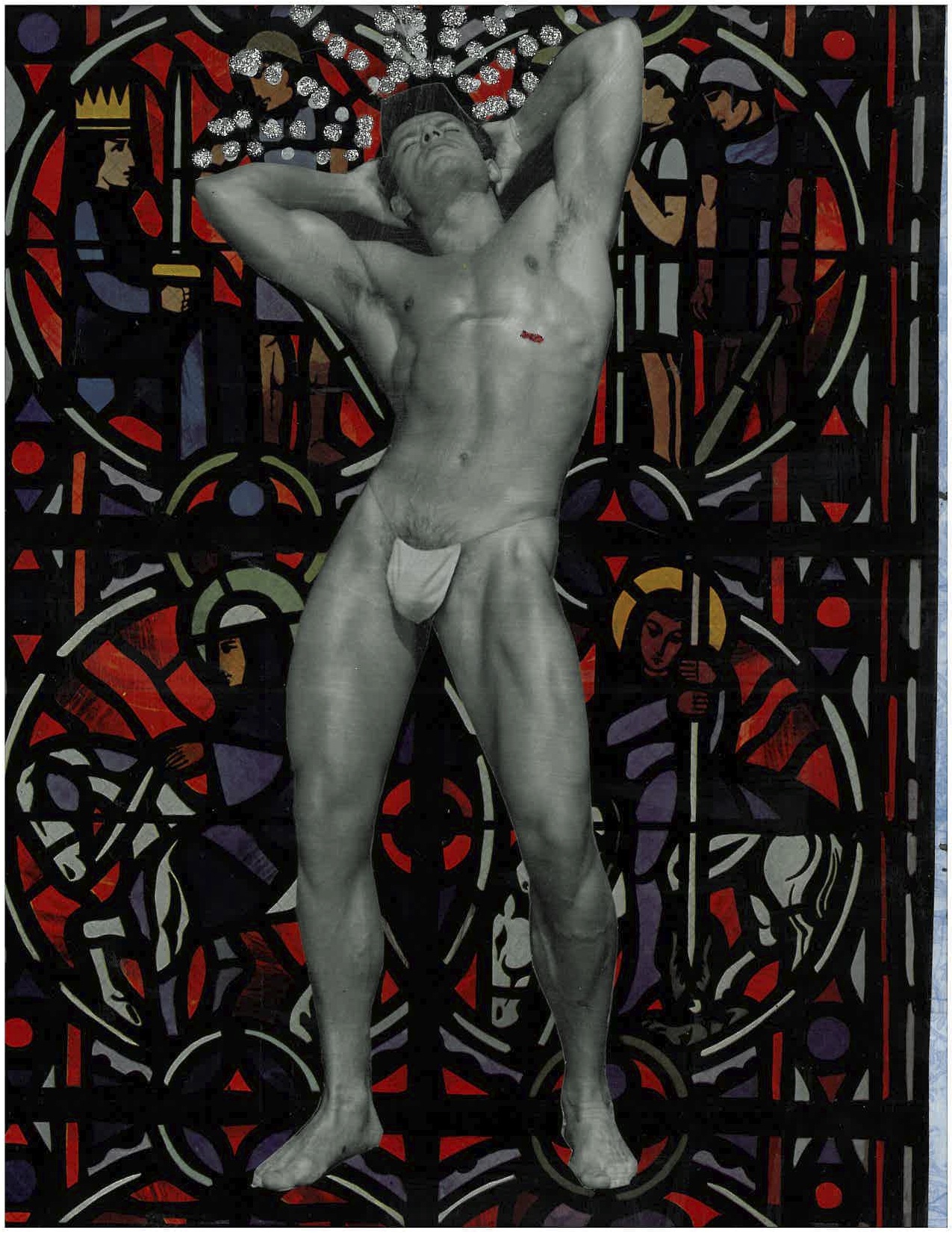
The show, conceived by Alejandro García-Lemos and Leslie Pierce, explores the quirky iconography of Saint Sebastian, martyred twice (the first time didn’t work—Saint Irene pulled all the arrows out), his eyes always raised to heaven but his body writhing across this history of Western art in masochistic ecstasy. How does a Christian martyr become a gay icon? What is it about his story, his image, the representations of his martyred body? (The publicity art—which juxtaposes a male pin-up with stained glass, by Leslie Pierce—captures, I think, some of the weirdness of this icon.)

There’s a great image of Sebastian in the Columbia Museum of Art. The Virgin and Child are pure Byzantine, blue and gold and flat, but Sebastian is looking over the Virgin’s shoulder like the Renaissance, naturalistic, a real body, the cords of his strong neck.

The Sebastian show will include visual art, performance art, photography, film, a small souvenir chapbook of original art and poetry, a DJ, a cash bar, and a couple of boys standing around with arrows.

I’ve been writing poems about Sebastian—some about the image and history, some responding to specific works by the other artists. The interactions and collaborations have been rich and rewarding. (Note to self: there should be more interdisciplinary artist collaborations. Such a great way to generate new work.) A film visually responds to a poem which responds to a print, the film incorporating a voiceover of the poem and the imagery of the print. A photo documents a performance art piece which uses a poem which responds to a print (the poem projected—performance art into film—onto a male body).

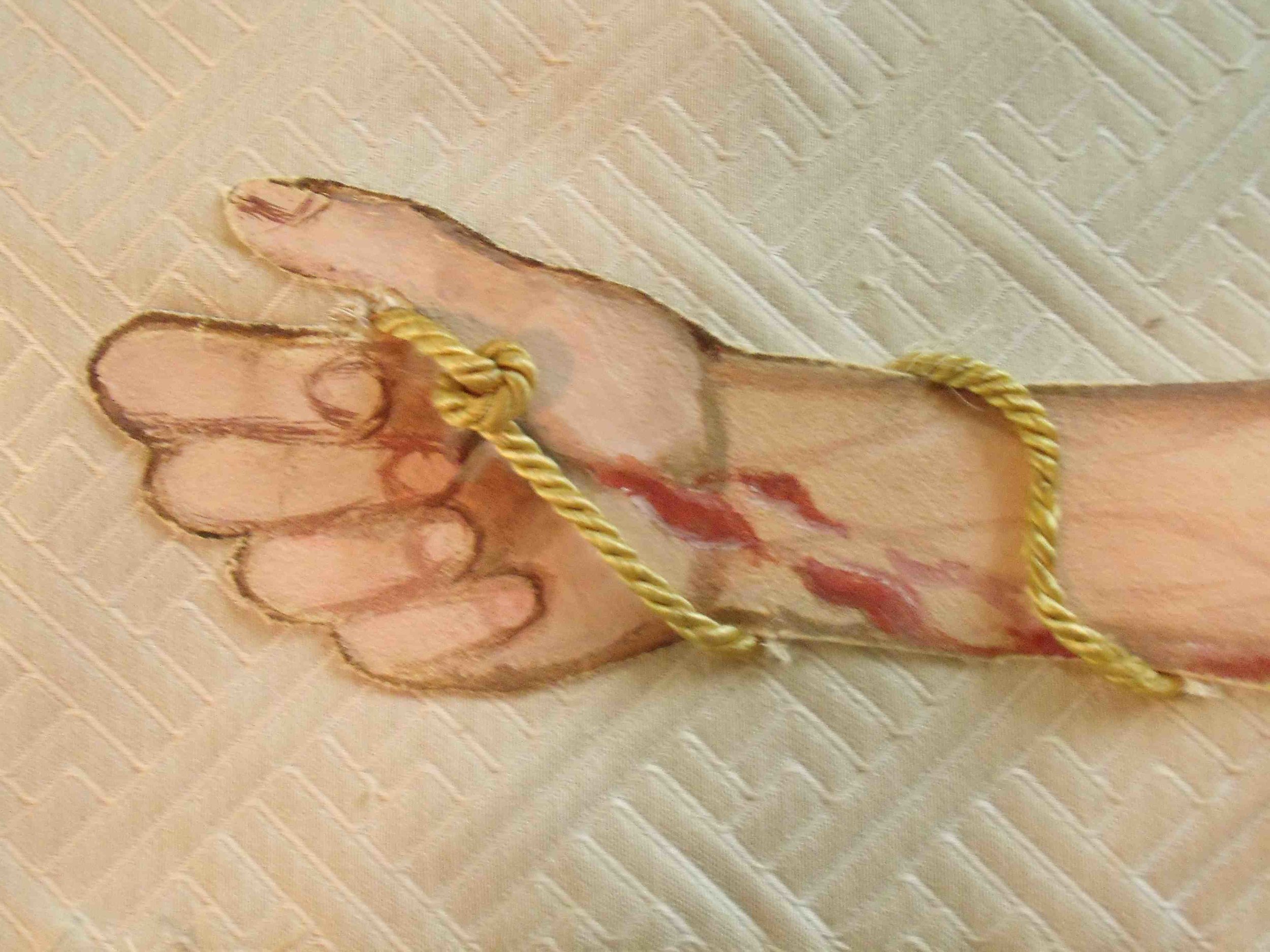
I was asked to turn a small room into a poetry chapel. I’ve got icons, prayer cards (with a prayer to Sebastian.) Among other things, I wanted some prayer banners. My partner found some huge folk religious art canvases at a local auction—interesting because the artist was painting traditional Christian images, but clearly had a special interest in the textures of men’s bodies—the veins on arms, the carefully painted chest hair on an apostle. (And that carefully draped loincloth across the fisher of men, looking so like a wardrobe malfunction about to happen, the hand of Jesus so carefully positioned there, as if he’s about to rip it off.)

So for the banners I cut up bodies—Jesus, apostles, thieves on crosses. Something wicked and vaguely erotic about it. Disembodied arms. An arrow (real arrow) in the side. Wrists bound with golden rope. A prayer. “Arms be bound with rope and shame.”

-- Ed Madden


Poet Cassie Premo Steele responds to artist Bonnie Goldberg

Last year at one of Mark Plessinger's multi-disciplinary arts events at Frame of Mind, the local writer and poet, Cassie Premo Steele, created poetry in response to some of the paintings by artist, Bonnie Goldberg, whose work you saw in Jasper's last message. At Jasper, we love it when artists come together to inspire one another and share their gifts with each other and those of us who are lucky enough to stand and watch.

Here are two of the poems Cassie wrote for that night. For more of Cassie, please visit her at www.cassiepremosteele.com.


Look this way


Look this way, he said,

as she turned her head

away from him, again.


Her own shoulder

makes a better bed

than his ever did.


It took her years

to believe it, though.

His hard bones,


she thought,

were the best

she could do.


Hand on hip,

she finally said

the words: We're through.


For Goldberg's Drawing 202, ‘nude female standing.’


Your daughter turns from you


Your daughter turns from you daily now,

with the grace of a dancer, and somehow

you learn to accept it, that carpet she weaves

and walks away upon each day.


You knew this day would come, even

before she could walk and you spent

hours drumming on her thighs and

humming lullabies. You were preparing.


You saw flashes of it at two and ten,

her rage slicing the way for her to cut

away from you. You were smug

and thought you knew wisdom.


Becoming daughter to mother, we learn cutting.

As mothers, we learn waving goodbye and staying.

The lesson of grandmothering: Crying. Smiling.

Never saying how hard it is to see them leaving.


For Goldberg's Painting 145, ‘promises.’

Cassie Premo Steele is the author of eight books and teaches writing and everyday creativity at The Co-Creating Studio. Check her out at www.cassiepremosteele.com

A poem by Ed Madden

Dream fathers

By Ed Madden

We drive across the bridge, late at night, a hundred feet or so of clattering boards—

no rail, no rim, just jagged planks, and river flowing slow and brown below. The bridge

collapsed last year. I cross it every night in sleep—sometimes alone, sometimes with him—

but always away from home. The bridge's end may veer; each night I go someplace else,

dark cypress swamp on either side. One night my father is the driver and the car.

He opens up the door of his side, and I climb in. I cross the bridge again,

riding in the body of my father.


Dream fathers and more of Ed’s poetry can be found in his most recent book of poetry, Prodigal: Variations, 2011. Ed is the poetry editor for Jasper Magazine.