REVIEW - Trustus's Silence! The Musical is a Hilarious Respite from a Weary World

“A little nonsense, now and then, is relished by the wisest men.”

-WillyWonka - Charlie And The Chocolate Factory

silence group.jpg

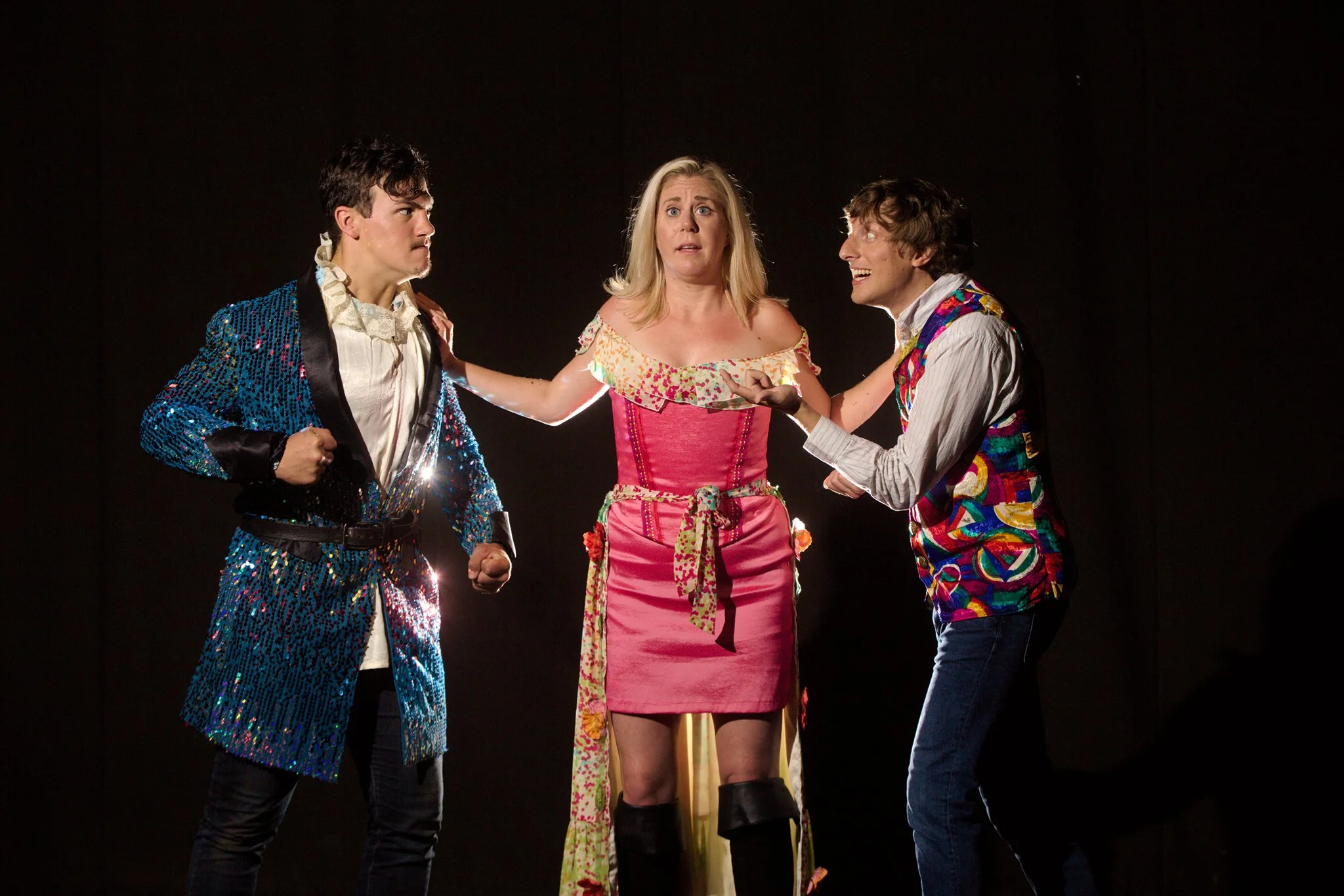
Members of the Silence! cast Sam McWhite, Mike Morales, Kayla Machado, Latrell Brennan, and Abigail McNeely

 When one thinks of The Silence Of The Lambs, words like “hilarious” and “side-splittingly funny” don’t generally come to mind. The classic film, starring Jodie Foster and Sir Anthony Hopkins, sent chills up the spines of movie-goers worldwide, but other than one or two cheeky asides from Hopkins, the movie was a straight-up crime drama/thriller without much comic relief. Such is definitely NOT the case with Trustus Theatre’s season-opener, Silence! The Musical, which serves up an affectionate but irreverent parody of the original.

The plot of the musical follows that of the film fairly closely, but takes advantage of every opportunity to play the situations and characters for laughs. Inside jokes abound, and sassy references to other pop culture staples can be found…if you know where to look. I am going to try and see the show again, as I was so busy laughing and scribbling down notes, I’m sure I missed a few things here and there. Director Jonathan Monk clearly had great fun in using his own celebrated sense of  humour to enhance an already outrageous comedy. Kudos  are also due to Monk for his superb casting, which made the show damn near perfect. (My only caveat is that the script is quite vulgar in spots, which I find delightful, but if sexual slang and twisted characters aren’t your thing, beware.)

As Clarice Starling, Kayla C. Machado is the only character to do a full-out imitation of her film counterpart. In her early-90s bobbed hairdo and makeup, she bears a striking resemblance to Jodie Foster, but the verisimilitude doesn’t stop there. Without ever breaking character, Machado delivers a brilliant rendition of Foster’s distinct dialect, complete with pronouncing her “s” sounds with “sh.” For example, she consistently refers to herself as “Agent Shtarling,” which simply got funnier as the show progressed. I will admit to having feared at first that the convention would get old, much like an SNL skit that runs several minutes too long, but I was wrong. To use another subversive pop culture example, it’s like a running gag on Family Guy that’s funny at first…then it starts to get old…but then it crosses over into hilarious, and you laugh until it’s over. Machado is, ironically, given the number of insinuations about Starling’s (and Foster’s) sexuality, the “straight man,” yet she gets some of the biggest laughs of the evening. One of her finest moments is when she gives a lengthy, incomprehensible, monologue about her detective work, only to be met with a response of “I have no clue what the fu*k you just said” from Robin Gottlieb (more on her in a minute,) and Machado manages to keep a perfectly straight face. (To her credit, Machado and a couple of the other actors did have one “Harvey Korman Experience,” when they all cracked up at some uproariously crude witticism. Rather than being a distraction, this was a positively golden moment when the actors simply couldn’t contain their hilarity, which strengthened the already-solid connection with the audience. Harvey would have been proud. ;-)

Machado and Morales with Robin Gottlieb

Machado and Morales with Robin Gottlieb

As Dr. Hannibal Lecter, Hunter Boyle is at the peak of his game. I attended the show with my friend, local actor Bill Arvay, who declared Boyle’s performance “the best thing I’ve ever seen him do.” While this may have been a bit hyperbolic, given Boyle’s rich resume of memorable characters, I understood the sentiment. Boyle’s Lecter isn’t quite as menacing as Hopkins’, which illustrates the understanding Boyle and Monk had of the character as he fits into this somewhat Bizzaro-World spoof. Boyle is less genius cannibal, and more smartass intellectual, and it works. One of the many tips of the hat to other theatrical works is his prison suit number, 24601. (Les Mis fans, admit it, you were mentally singing it once you noticed the number.) Boyle is still the “Hannibal The Cannibal” from the movie, but he deftly takes the lighter script to heart.  Straight lines are played for laughs, and Boyle had to hold for laughter for at least thirty seconds when Lecter corrected S(h)tarling on the famous “Fava beans and a nice Chianti” line.

Patrick Dodds, whose considerable talent seems to grow and develop with each role he undertakes, manages to create a frightening Buffalo Bill who still fits in with the MAD Magazine atmosphere of zaniness. While making the part  his own, Dodds winks at the character with a few straight-from-the-film bits. Fans of the movie will remember the odd tic of a laugh Buffalo Bill tries to suppress when asking Starling about a missing woman she is seeking. “Was she like, a big, fat, person?” isn’t a funny line per se, but when Dodds adds the brief snicker to his query, the result is a cascade of knowing laughter from the audience. While Dodds is younger and a bit more manic than his screen counterpart, he is a perfect fit (see what I did there?) for the demented lunatic of the stage adaptation.

Dressed in all black, with white floppy ears, the other five actors play “everyone else,” including a flock of lambs, establishing individual characters by adding a jacket, hat, or comparably simple garment. Costume Designer Amy Brower Lown succeeds in maintaining  a specific, cohesive, style without ever compromising the ersatz reality of the script. Lown’s concept is brilliantly supported by LaTrell Brennan, Robin Gottlieb, Abigail McNeely, Samuel McWhite, and Mike Morales, who transition seamlessly from character to character.

As Ardelia, Starling’s roommate and is-she-or-isn’t-she girlfriend, Brennan not only develops a three-dimensional character, but also displays great facility at  delivering a punchline, often remaining perfectly serious during her funniest moments. Gottlieb brings her customary stage presence and overall panache to playing a series of all-male characters. (Another inside joke is set up when Gottlieb appears as Starling’s deceased father, prompting Starling to plead “Papa, can you hear me?” with Yentyl–like wistfulness.) In an uncredited cameo as mental patient Miggs, Gottlieb hilariously re-creates the (in)famous moment when Miggs masturbates and flings the resulting *ahem* substance at Starling, substituting a can of Silly String at a decidedly seminal moment in the show.

Working double duty as Buffalo Bill’s victim, Catherine, and her US Senator mother, McNeely demonstrates an almost chameleon-like ability to morph into completely different appearances. I honestly didn’t realize the roles were done by the same person until well over halfway through.

McWhite’s primary alter-ego of Lecter’s keeper, Dr. Chilton, is less pathetic than the film Chilton, interpreted more as a fast-talking pickup artist than a socially awkward nerd. While we can easily imagine the movie incarnation moping in depression after failing to seduce Starling, McWhite’s Chilton has probably had more successes than failures with women, and displays a delightful “your loss, baby” attitude, likely moving on to his next potential lover.

Morales was the most difficult actor to track, as he, like McNeely, apparently has the ability to shape-shift. I suspect it was he who played the geeky entomologist who also fails to woo Starling with his offer of “cheeseburgers and the amusing house wine.” ( This line is pretty much a throwaway in the movie, but takes on great hilarity when placed in the world of Silence!) Morales also has a most amusing death scene as the ill-fated Officer Pembry. As with the rest of the show, what was frightening and/or grotesque on the silver screen becomes fodder for hilarity onstage.

Sam Hetler’s scenic design is both functional and visually intriguing, creating a unit set that serves as over a dozen locations. Hetler’s work is showing up with growing frequency on Columbia stages, and he never fails to deliver a professional-quality set with a few unexpected flairs. Marc Hurst’s lighting design reinforces Hetler’s fun-house set with dramatic changes in intensity and color, never letting the audience forget that this is a bizarre alternate reality. Particularly impressive were his use of lighting Buffalo Bill’s lair from beneath the playing surface (blending perfectly with Hetler’s dungeon-wall motif,) and a sudden full-stage switch to fuzzy black-and-green to simulate the view from a pair of night-vision goggles. Hurst also helps create locales with projected establishing texts such as “Baltimore Nuthouse” and “Mr. Belvedere, Ohio,” among others.

Machado and Hunter Boyle

Machado and Hunter Boyle

Musical Director Randy Moore lives up to his customary professionalism, making piano, keyboard, and drums sound like a full orchestra. Bravo to Trustus and Moore for utilizing live musicians in a time when far too many theatres are opting for “canned” pre-recorded orchestration. The freshness and obvious communication among the four instrumentalists added another layer of connection to the show, as well as the audience.

Lest there be any doubt, I found Silence! To be a laugh-a-minute roller coaster ride of naughty satire, and left with my sides aching from constant guffawing.  It’s definitely for grown-ups, and never blinks or shies away from that fact, so be prepared. Never before have I seen a dancing vagina ballet, bubble-wrap bulletproof vests, the “Manamana” song used as a diversionary tactic, an imitation of Jodie Foster reciting “she sells seashells by the seashore,” or Hunter Boyle in a fabulous hat and caftan ensemble. (Okay, that last one was a lie.)

Silence! runs through 3 November, and tickets can be purchased online at Trustus.org, or by ringing the box office on (803) 254.9732. Word is spreading, and tickets are likely to be going fast, so reserve your seats soon for this delightfully macabre, oft-profane, “egregiously misrespectful” piece of  theatre that maintains Trustus’ commitment to professional and well-produced art.

Frank Thompson is proud to serve as Theatre Editor for JASPER.

Patrick Dodds as Buffalo Bill - all photos courtesy of Trustus Theatre

Patrick Dodds as Buffalo Bill - all photos courtesy of Trustus Theatre
REVIEW -- OnStage Production's Hairspray is a Jewel Worth the Trip

“…your eyes can deceive you; don’t trust them.”

-Obi-Wan Kenobi,
“Star Wars: A New Hope”

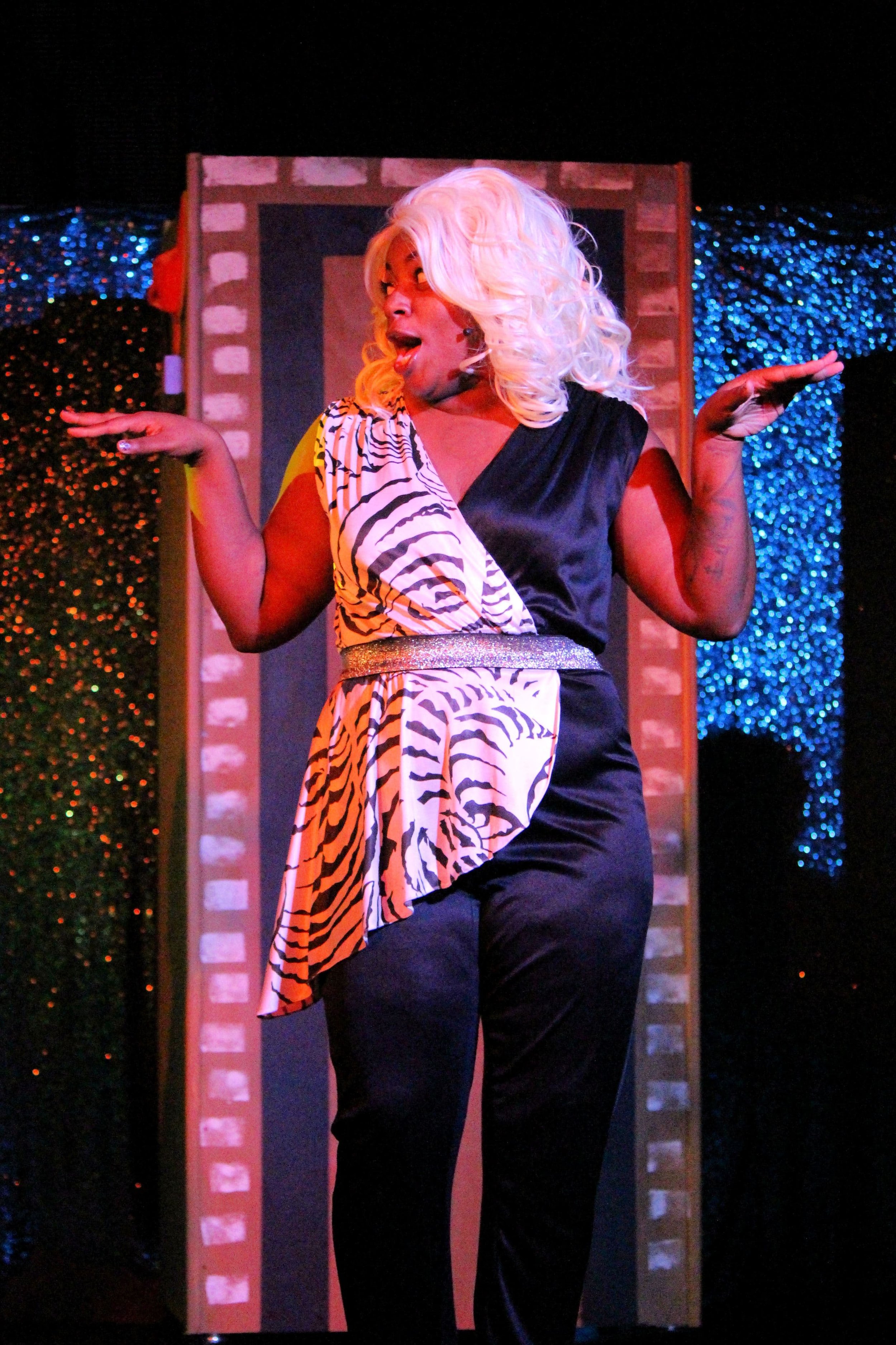
Tracy sends a cheerful "Good Morning, Baltimore!" to her hometown.

Tracy sends a cheerful "Good Morning, Baltimore!" to her hometown.

Okay, I will freely admit that the first couple of times I attended a show at OnStage Productions, my eyes concealed a perfect gem, literally at my feet. When one arrives at The Old Mill in Lexington, it looks like someone converted a couple of ancient warehouses into an upscale brewpub, added a small shop or two, then called it a day. While these establishments do exist, there’s also something quite special just a few feet underground.

Housed in a renovated downstairs area, OnStage has created  the look, feel, and atmosphere of a cozy, hip, Off-Broadway house. The space is a bit cramped, and has a slightly “rough at the edges” feel, as I firmly believe all good playhouses should. Be prepared to sit close to your seatmates, but that’s all part of the aura and style OnStage has created in building what could easily be a 100-seat, upstairs, Greenwich Village theatre. Just set your personal space requirements to “NYC mode,” and you’ll have a blast.


Speaking of blasts, Director Robert Harrelson truly blew us away with Saturday night’s performance of Hairspray, The Musical, which continues its run this Thursday-Sunday. With a cast full of talent, and some most innovative staging, Harrelson makes the show work like a well-oiled machine. The set, though simple in design, effectively creates the show’s various locales through a quartet of four-sided columns, outstanding use of lighting to suggest a specific space, and a never-ending flow of kinetic energy from the cast, who all move things around just in time to be perfectly in place for the next scene. The action of the play never wanes, nor does the seemingly boundless energy of the cast. One of the highest compliments I can give a musical is that it “never stops moving,” which perfectly describes this version of Hairspray.


And of the performance, itself? Well, it had me singing along with half the score, and laughing uproariously, often at the most inappropriate jokes and one-liners. Again, I must sing Harrelson’s praises for DOING THE SHOW AS WRITTEN. Hairspray, the John Waters film which gave rise to the musical, was subversive as hell, made fun of cultural stereotypes, and embraced the taboo with mischievous glee. The musical has toned down a bit of Waters’ signature vulgarity, but keeps its norm-shattering and cheeky storyline intact. Harrelson has not altered the script in any way, nor has he “bleeped out” a single potentially-controversial line. This is Hairspray as it was written to be played, not a sanitized-for-grandma production. (Incidentally, I saw several grandma-types laughing and enjoying the show right along with me.) Bravo for Harrelson for his faithfulness to the work, and the ensuing quality that comes with that integrity.


Charity Gilbert, Laiyah Smith, and Jamila Wicker raise the roof as "The Dynamites."

Charity Gilbert, Laiyah Smith, and Jamila Wicker raise the roof as "The Dynamites."

The cast has some double-casting, with about half the roles being played at all performances, with others alternating between two actors. My friends and I saw “Cast A,” and they delivered a fast-paced, turbo-charged, roller coaster of a ride that I’m sure is matched in quality by “Cast B.”

Leading the cast as Edna Turnbladt is Bradley Watts (who shares the role with Jeffrey Sigley.) Watts is great fun to watch, and throws himself enthusiastically into the part. There’s a definite nod to Harvey Fierstein’s Edna, but Watts makes the role his own, not only vocally, but also through the creation of a slightly softer, somewhat less acerbic Edna than we’ve seen from other productions. Without ever losing the comedy or the no-nonsense personality, Watts gives us an Edna that retains her strength, but never at the cost of her femininity. Her rapport with husband Wilbur, played in both casts by Theodore Reynolds, is spot-on, and the two clearly trust each other as scene partners, creating a snapshot of the trust and affection between Edna and Wilbur. Reynolds is appropriately goofy without ever resorting to mugging for the audience, and makes Wilbur the lovable doofus with great success.

As Tracy Turnbladt, Whitney McDonald shines in a role she is clearly delighted to be playing. Her talent is undeniable, and she’s clearly confident in the character choices she has made. A “plus-sized” social warrior and crusader for justice, McDonald’s Tracy is also quite lovely. (Think Nigella Lawson meets a Designing Women-era Delta Burke, with a dash of Adele thrown in,) and serves as a perfect example of how beauty not only comes from within, but also that outer beauty can take many forms. McDonald allows Tracy a sweetness that never compromises her commitment to equality and progress. As for her vocals, one word. Wow! Harrelson has clearly followed the old theatrical adage of “cast the best singers first,” and McDonald can deliver on a ballad or belt the paint off the back wall, without ever losing pitch or sincerity. (Tracy is played on alternate nights by Katie Edelson.)

As foils for the Turnbladt women, we meet Velma and Amber Von Tussle, a former pageant star, and her beauty-queen daughter, Lisa Baker and Zanna Mills, respectively, who share the roles with Leslie Dellinger and JoJo Wallace. Baker brings down the house with her “Miss Baltimore Crabs” number, and Mills, who demonstrated her skill at playing sweet and innocent as Mary Ann in last season’s Gilligan’s Island: The Musical, shows that she can play “mean girl” Amber with equal aplomb. Mills also makes her debut as a choreographer in this production, and the result is a series of well-rehearsed, toe-tapping, fun choreography that almost pulls the audience members into the aisles to boogie down.

As David LaTorre performs with both casts, I can quite literally say that there isn’t a weak (L)ink in the show. (Thanks, folks, I’ll be playing here all week.) In what could easily be a standard, Richie Cunningham-esque boyfriend role, LaTorre find’s Link’s humanity in every sense of the word. Neither Superboy nor “bad boy,” Link finds himself at several personal and ethical crossroads, and LaTorre conveys well his sense of conflict, as well as his desire to do what is right, even if it costs him. Ara-Viktoria Goins is a somewhat sexier Motormouth Maybelle than devotees of Hairspray may be used to, but it works brilliantly with the character’s believe-in-yourself philosophy. Goins, like McDonald, has a huge voice that can shake the rafters, as well as purr seductively, as she demonstrates in her performance of “Big, Blonde, and Beautiful.”


Ara-Viktoria Goins as Motormouth Maybelle.

Ara-Viktoria Goins as Motormouth Maybelle.

Much of the social statements in Hairspray center around the budding romance between Seaweed Stubbs (Joshua Wright) and Penny Pingleton (Camryn Harsey, alternating with Kari Tilghman.) Seaweed is black, Penny is white, and it’s 1962, so there’s plenty of era-based controversy over their relationship. While never preachy or heavy-handed, their story strikes at the core message of the play, which is that what’s on the outside doesn’t matter. Both performers approach the material with a light touch, but their message of social justice, equality, and the strength of unity comes through loud and clear. Wright and Harsey both bring strong voices and considerable stage presence to their roles.

Debra Leopard and Mark DiNovo, as usual, turn in memorable, fully-realized, enjoyable characters. While Leopard is a hoot as Penny’s religious-fanatic mother (and also shines in a smaller role as the High School principal,) DiNovo had me doubled over with laughter every time he took the stage. His two “bonus” roles in “Good Morning, Baltimore” and “The Big Doll House” are absolute side-splitters, and his lame-clad Mr. Spritzer is a delight. Linda Lawton Brochin serves up a couple of hilarious cameos, and Karlton Timmerman’s Corny Collins hits all the right notes as a smarmy-but-charming dance show host, and manages to show off a very nice singing voice, as well.

Were there a few negatives? Yes, but none that marred the experience. The musicians (yes, Hairspray utilizes live musicians, which I strongly support) could be a bit overpowering at times, but to be fair, we were seated fairly close to them. A couple of the soloists had to struggle with a note that was too high or too low, and I occasionally missed a lyric or two. There was one small glitch during a scene change, but by the time I even noticed, it had been corrected.

OnStage Productions is a short, 20-minute drive from Downtown Columbia, and I strongly encourage everyone to make that drive. Hairspray is slick, polished, well-paced, and provides a subtle reminder of the importance of equality and acceptance in society.


Hairspray concludes its run this Thursday-Sunday. Tickets can be purchased by visiting www.onstagesc.com

Frank Thompson is Theatre Editor for Jasper.

Next up for the Jasper Project?

Keith Tolen is our first featured artist in the

Tiny Gallery Series

Thursday, October 4th in

Studio #7 of Tapp’s Arts Center https://www.facebook.com/events/975033929365281/

REVIEW: South Carolina Shakespeare Company's The Liar

“Tell me lies, tell me sweet little lies…”

-Fleetwood Mac

the liar.jpg

 Due to Hurricane Florence, The Liar will end its run tonight!

There are plenty of lies in South Carolina Shakespeare Company’s production of The Liar, previously scheduled to run through Saturday at Columbia Music Festival Association, and not all of them are sweet or little. Actually, there are some absolute whoppers thrown down in this hilarious prevarication-palooza, which playwright David Ives has skillfully translated and peppered with contemporary references, some Shakespeare here and there, and just a hint of sympathy for the eponymous character. Based on the 1644 French comedy, Le Menteur, by Pierre Corneille, the plot is a delightful confection, with a storyline straight out of an episode of Three’s Company. Misunderstandings and mistaken identities abound, lechery is played for laughs, and the bungling anti-hero grows increasingly frantic as his schemes unravel. A somewhat deus ex machina conclusion solves everything by play’s end, and The Liar becomes an honest man…perhaps.


The show opens with a hilarious introduction by Cliton, manservant to Dorante, (who is the titular liar.) As Cliton, Sam Hetler  hits the bull’s-eye with his interpretation of the servant who is much more intelligent than his master. Though this archetype is a stock character in farce, Hetler brings a freshness and sincerity to the role. His is the only character to “break the wall” and address the audience, until Dorante concludes the show with a brief address. Hetler’s opening monologue is part rap, part straight pentameter, and part free-style. Were it not for his period costume (more on that in a minute), one might mistake him for the hands-down winner of an open-mic poetry slam. With his witty delivery and slightly-put-upon demeanor, Hetler masterfully draws the audience into the tale from the very beginning.

Played by SCSC regular, Jeff Driggers, Dorante is an eager young man who abandons his study of  Law to experience all the pleasures and diversions of Paris. (In a delicious twist of irony, Dorante is practically incapable of telling the truth, while Cliton has a comparable inability to tell a lie.) As Dorante, Driggers is a veritable dervish for most of his stage time. Constantly in motion, telling one falsehood after another, with his anxiety growing with every close call, I couldn’t help thinking of The Music Man, and how Driggers is surely destined to play Professor Harold Hill someday. His energy is seemingly boundless, and his delivery and timing are outstanding. My one complaint was that occasionally he spoke so quickly in his con-man patter, I had a difficult time catching each word, but his absolute commitment to the role and slightly over-the-top physicality left no doubt as to his meaning.


Soon enough, he meets two lovely young women, Clarice (Hillary MacArthur), and her friend, Lucrece (Mary Miles). Immediately proving himself a BS artist extraordinaire, he regales the ladies with stories of his battlefield heroism against the German Army. He immediately falls for Clarice, only to misunderstand when Lucrece’s maid, Isabelle, (Brittany Hammock, who turns in a delightful double role) describes her mistress as “the most beautiful one,” and sets his cap to win his inamorata, whom he now thinks is named Lucrece. The three female actors have no difficulty in keeping up with their male castmates, delivering unique, individual, characters who manage to create a cohesive trio (quartet?) without sacrificing or diluting any of their differences. Miles’ Lucrece is appropriately befuddled, without ever resorting to caricature, and uses her facial expressions to communicate just as clearly as her voice. As always, her time onstage is professional and artfully crafted. (After the show, I commented to Miles that if ever I open a playbill and see her name, I know to expect a high-quality performance, and The Liar was no exception.) As Clarice, MacArthur demonstrates not only comedic proficiency, but also an ability to play her unhappy moments with authenticity, while never compromising the overall texture of the silliness surrounding her. Although frequently distressed, MacArthur also provides a sort of calm within the chaos, treating the audience to a layered and complex character. Hammock, with a distinctive half-flowing, half-braided hairdo adding to the illusion, also plays Isabelle’s twin sister, Sabine, who just happens to be Lucrece’s maid. Though played by the same actress, the two roles are somewhat Jekyll-and-Hyde in their differences. Hammock proves that she can play sweet and salty with equal aplomb, and creates two characters with easily-identifiable differences in style and temperament, though I wouldn’t have minded a tiny costume change, such as a hat or scarf, to further punctuate the duality of the roles.


Things get even more turned-around when we meet Alcippe, Dorante’s best friend. Did I mention that Alcippe is engaged to Clarice? The traditional Comedie –Francaise misconceptions and mutually cloudy understandings leave Alcippe constantly vacillating between fury and thick-headed amiability. As played by Josh Kern, Alcippe has the capacity to turn his emotions on a dime (centime?) and clearly revels in playing a hothead and a pleasant fop. Having worked with Kern several times over the last seven or eight years, I have enjoyed watching a kid with a hell of a lot of raw talent grow into a seasoned pro who is quickly mastering his craft.


Also in the melee are Alcippe’s friend, Philiste (Morgan Wood) and Dorante’s father, Geronte (Douglas McConnell), who further complicate matters through relaying inadvertent half-truths and misinformation (Philiste), and arranging for Dorante to marry Clarice, whom Dorante thinks is named Lucrece. While these two roles are somewhat smaller than the rest, both Wood and McConnell make the most of their onstage moments, matching the rest of the cast in skill and commitment to the “reality” of the script.


A story about a midnight boat ride, a hilariously mimed duel, and countless moments of ensuing confusion add to the insanity, with a tidy-if-contrived happy ending for everyone. Director Scott Blanks clearly had a good time creating the frenetic insanity of the piece, yet never allows the chaos to go too far off the rails. Discipline and precision are essential when half the characters are frequently out of control, and Blanks expertly keeps the lunacy tightly blocked and well-rehearsed.

Costume Designer Janet Kile made the interesting choice of dressing each character in a combination of classical and contemporary fashion. (Kern’s plush blue great-coat and Driggers’ ornate vest work particularly well with blue jeans.) While not at all distracting, the costumes helped establish the timelessness of the plot, as does modern scene-change music. (Lady GaGa’s “Bad Romance” was an especially nice touch.) As Cliton, Hetler was the only character to appear in all-period dress, which served his character well, as he not only opens the show by addressing the audience, but comments frequently on the wild events that sweep him along for the ride.


The Liar is a perfect show for those who love classic farce, but it never shies away from its moments of modernity. Playwright David Ives not only translated, but also re-wrote parts of the script, adding multiple modern-day terms and expressions. As with Kile’s costumes and the 21st century music, the dialogue occasionally reinforces the message that similar shenanigans go on in 2018 as went on in 1645.


-FLT3

Frank Thompson is proud to serve as JASPER’s Theatre Editor, and can be reached via email at FLT31230@Yahoo.com

REVIEW: Misery is Optional at Trustus Theatre

"Rest assured there isn’t a weak or underdeveloped character or a wasted moment." - Frank Thompson

Director and Co-Writer Dewey Scott-Wiley

Director and Co-Writer Dewey Scott-Wiley

Words were spoken, hearts were broken, but now I hope you see it was the whiskey talking, not me.”  - Jerry Lee Lewis

--

Though The Killer’s famous ditty about the perils of drinking was considered humorous in the 1950s (and still has a great tune), it’s no longer acceptable to laugh at alcohol/drug induced misbehavior. That’s why I was so pleasantly surprised at how much I laughed during Misery Is Optional, running tonight through Sunday at Trustus Theatre. Developed through the Midlands Tech-based Harbison Theatre Incubator Project, Misery Is Optional is a collection of vignettes and short monologues, taken verbatim from interviews with those suffering from chemical addiction. Their stories are often tragic, but Director Dewey Scott-Wiley wisely includes moments of hilarity throughout the show, without ever abandoning the seriousness of the disease or its impact on its victims and those in their personal orbits. Scott-Wiley’s staging is simple and minimalist, placing the focus squarely on the people and their experiences. While often colorful and eccentric, the many characters embodied by the cast of four are never lampooned or made into cartoonish figures. Scott-Wiley adds a glaze-thin layer of heightened reality at just the right moments, and at other times deals with stark reality head-on. The result is an immersive, emotionally engaging, and accurate-yet-respectful look at the world from the addict’s perspective. Character changes are done seamlessly onstage, with a simple change of hats or donning a pair of glasses, etc.
 

Co-Writer, Christine Hellman

Co-Writer, Christine Hellman

The cast is uniformly strong, and features Scott-Wiley, alongside Christine Hellman, Arischa Conner Frierson, and Jason Stokes. This ensemble of four well-known Columbia actors flows seamlessly from one character to the next. Many are recurring, while others we glimpse only once. From well-heeled society alcoholics to homeless heroin addicts, the entire socio-economic spectrum is explored, subtly driving home the point that addiction cuts across all cultural lines. There is no linear plot, per se, but there is an unmistakable thematic arc, taking us from the darker, hopeless stories through the process of intervention and treatment, and ending on a bright note of hope.

Each of the four performers presents a chameleon-like ability to seamlessly navigate the waters of dialect, social class, education level, and a spectrum of emotions, which will likely leave each theatre-goer with his or her favorite characters, so I won’t prejudice anyone by sharing mine. Rest assured there isn’t a weak or underdeveloped character or a wasted moment. Scott-Wiley utilizes a circular-pattern style of blocking throughout the show, which creates a perpetually kinetic atmosphere. Whether physically or emotionally, there is always motion, and the overall pacing and fluidity of the show are clearly well-rehearsed and perfected.

Misery Is Optional is a non-season special event, being hosted by Trustus, so there are only three more chances to catch it. I would urge anyone who enjoys good theatre to experience this production. This isn’t a “Hey kids, don’t do drugs” Afterschool Special, nor does it speak only to those in recovery. It has a message, but it’s also a fascinating, funny, and enjoyable show.

REVIEW: Jon Tuttle's Boy About Ten at Trustus Theatre

A talent for drama is not a talent for writing, but is an ability to articulate human relationships.” 

-Gore Vidal

Boy about ten.jpg

John Tuttle is, by any standard, a man with a talent for writing, but after seeing the world premiere of his play, Boy About Ten, I can affirm that he is also quite adept at articulating human relationships. Indeed, the oft-troubled intertwining of Boy About Ten’s dysfunctional, but (somewhat) connected nuclear family of four, drives the plot of Tuttle’s work, taking a well-written piece to the level of a performance bristling with all the sharp edges relationships can provide. This is not to suggest that the production currently running at Trustus is without laughter or light-hearted moments. It may be a tragicomedy, but Boy About Ten doesn’t hesitate to let the tragic cede the stage to the comedic in a legitimate, story-faithful way. In his program notes, Trustus Artistic Director, Chad Henderson, comments that “this play has undergone a more involved development process than our previous Playwrights Festival winners or commissions,” which no doubt contributed to the feeling of polish and streamlining found in the script. I managed to make notes on some of the truly standout lines, but by no means is my list comprehensive.


The play opens with D’Loris (Lonetta Thompson), a kindhearted but world-weary social worker, dealing with what is clearly a family in distress. She is trying to prepare Todd (Tommy Wiggins), the elder son, to go to his mothers’ house for a week. Todd is obviously troubled in multiple ways, but is largely nonverbal, using a set of oversized headphones to drown out the conflict which surrounds him, while hiding his face behind his chin-length bangs.  As usual, Thompson creates a fully-realized, textured character, who has flaws as well as sincerely caring nature. I never tire of seeing Thompson onstage, as she is always completely immersed in and committed to her character and the moment. It would have been the easy way out to depict D’Loris as either a hyper-idealistic Wonder Woman, or as a “honey, I’ve seen it all,” world-weary cynic, but Thompson chose to create someone in-between, and in the process, gave the audience a layered, complex, and realistic performance. Kudos also to Wiggins, a former Trustus Apprentice Company member, making his mainstage debut. Though Todd doesn’t speak much, especially in the early scenes, his body language, movement style, and a sort of self-embrace clearly establish him as a damaged human being, doing his best to avoid his psychic pain. When it is revealed that he is a self-cutter/burner, it is a bit of a shock, but totally believable for the character he has, by that point, made three-dimensional. I suspect we’ll be seeing much more of Wiggins on the Trustus stage in seasons to come, and I look forward to watching his development as an actor.


The arrival of Tammy (Jennifer Hill), lightens the mood by, ironically, introducing the least likeable of the five characters. Hill’s Tammy is brash, flashy, loud, and obnoxious, fancying herself far above the rest of the family. She dresses herself in designer clothing, while a couple of mentions are made of the kids’ clothes coming from Goodwill, and she personifies the cliche of the “helicopter parent,” dispensing screechy advice and criticism thinly veiled as “encouragement.” Hill’s comedic timing is absolutely spot-on, and she brought Friday night’s house down with such well-penned verbal spewings as “I was once a Sweet Potato Queen, now I’m a Cyclops!” (It seems that Tammy has a glass eye, which is broken, requiring her to wear an eye patch.) Clearly proud of her somewhat meager accomplishments, she touts having played Yum-Yum in a community college production of The Mikado, along with a few other small successes, in an attempt to impress D’Loris, who is eventually prompted to ask “what the hell is wrong with you people?” The moments of conflict between Tammy and D’Loris establish a curious dynamic. Tammy, in her own twisted, control-freak way, wants the best for her children, while D’Loris tries to help establish exactly that, which eludes the self-centered Tammy.

One gathers fairly quickly that Tammy is at her ex-husband’s house to swap out the younger son, Timmy, (Daniel Rabinovich), who is a straight-A, rule-abiding, do-gooder, complete with Webelos Scout uniform, and practically a stranger to Todd, and the two react somewhat cautiously to each other. (I may have missed an important line or mention of the situation, but it is clear that the brothers have not spent much time together.) Rabinovich demonstrates an actor’s sensitivities quite impressively, especially for a young actor. His character arc may well be the most dramatic in terms of growth and change, and he handles it like a true pro. As with Wiggins, this is a young man to watch.

Once all is settled, Timmy is left alone with his father, Terry. Played by Trustus mainstay, Paul Kaufmann, Terry is an affable, childlike n’ere-do-well, whose love for his sons manifests in an “at my house, there are no rules” dynamic. (When asked by Timmy if they can attend an Imax film or visit the Planetarium, Terry immediately scoffs at the thought of an educational outing, at least in the traditional sense.) Kaufmann, without ever breaking the established reality of the play, or mugging to the audience, brought to life an enchanting man-child, reminiscent of Tom Hanks in Big, with a dash of Bertie Wooster and Falstaff tossed in. To Timmy’s growing amusement, the two of them chug Cheerwine (no sodas allowed at Tammy’s house), fight ludicrous pretend war games against “Vagicilla, Dark Queen of the Nether Regions” (inspired, no doubt, by Tammy), and Timmy frequently receives his father’s military decorations, which may or may not be legit. It was at this point that I began to wonder about the show’s eponymous title. Was Timmy the Boy About Ten, or was his father? Had the parent/child dynamic between them already shifted before the action of the play began? Kaufmann, incidentally, scores one of the biggest laughs in the show while telling Timmy about his days in an ersatz KISS cover band. “You can always tell when chicks dig you. They chew their gum at you…like meat!”


A brief in-one scene gives us our sole glimpse of life at Tammy’s house, when the focus is, both literally and figuratively, on Todd, who is passively receiving an unwanted haircut from his mother. A special tip of the hat to Lighting Designer Laura Anthony, for transforming a simple floor lamp into a “where were you on the night of the robbery?” beacon. This is an occasion upon which the lighting truly made the scene for me. We, the audience, are semi-blinded by the intensity of the same light shining into Todd’s eyes, and subject to the same jabber from Tammy. Like a police officer in a bad, made-for-TV crime drama, she prattles on and on about how Todd should want to be “normal” and make friends “like all the other boys,” painting a Leave It To Beaver lifestyle, which will supposedly emerge with a haircut and a suit from Goodwill. Interrogation/indoctrination and “tough love” establish an uneasy coexistence at Tammy’s house, and the two children she raised reflect that. Timmy’s unblinking obedience earns him praise, so he obeys. Todd, whom I assumed to be somewhere on the autism spectrum, is unable to deal with what his senses perceive as blinding light and a barrage of impossible commands. Though short, this scene impacted me. I began to wonder through whose eyes we were seeing any given situation, and then viewing each scene from each character’s angle. Thank you, Jon Tuttle, for this (I’m guessing) three-page scene, which widened the lens through which I saw the rest of the play. Though she was the antagonist of the scene, it allowed a glimpse into Tammy’s desperate desire for a “normal, happy, family,” and humanized her for me.


I won’t go into too much detail about the second act, as it is, essentially, a minefield of spoilers, and much of what happens requires the elements of shock and surprise to work. While not without laughs, the second act takes a somewhat darker turn, with a grim family story, involving animal abuse, being revealed. (*While no violence is depicted onstage, a gruesome monologue could be mildly to moderately triggering for some.*) Terry childishly endangers his and Timmy’s lives at the end of act one, the aftermath of which, we see in act two. Todd returns, neatly trimmed and besuited, but still distant, albeit with the occasional smile of hope. Toward the end of the play, we discover that Terry suffered physical wounds far worse than Timmy’s while saving the boy from the dangerous results of his (Terry’s) recklessness. Romantic impossibilities are pondered and argued, D’Loris loses another crumb of her idealism, but hangs on to hope, Timmy takes his first step toward adult cynicism, Tammy reveals some game-changing information, and the family is left as we found them; bruised and battered, but oddly okay. The playwright leaves us with the idea that life will simply go on, and with the insanity and bizarre love in this family, who can even speculate on the eventual outcome?


Director Patrick Michael Kelly has taken an artfully written play, refined by much workshopping, and brought to the stage a world of slightly-heightened reality, never losing sight of the connecting themes of family and what it truly means to care for someone.


So, who is the Boy About Ten? I have my suspicions that each character, with the exception of D’Loris (who serves as the impartial observer and voice of reason) is that boy. Perhaps that answers my earlier question, and tips us off that the show is seen from D’Loris’ perspective.

Boy About Ten is an engaging, thought-provoking, and most enjoyable play, and a worthy addition to the Tuttle ouvre. Only four performances remain, so get your tickets now!

-- Frank Thompson

~~0~~

Tickets can be purchased online at Trustus.org , or by calling the Trustus Theatre box office on 803.254.9732

Remaining performance dates are:

Wednesday, August 22 – 7:30pm

Thursday, August 23 – 7:30pm

Friday, August 24 – 8:00pm

Saturday, August 25 – 8:00pm

Frank Thompson is the theatre editor for Jasper Magazine - contact him at flt31230@yahoo.com

~~0~~

JOIN THE JASPER GUILD TODAY AND SEE YOUR NAME IN THE NEXT ISSUE OF JASPER MAGAZINE

RELEASING FRIDAY SEPTEMBER 21 AT THE NEW STORMWATER STUDIOS

The Jasper Project is a non-profit all-volunteer organization that provides collaborative arts engineering for all disciplines of arts and artists in the South Carolina Midlands and throughout the state. Please help us continue to meet our mission of validating the cultural contributions of all artists and growing community within the arts by becoming a member of the Jasper Guild .  We'll print your name in the magazine, thank you on social media, and love you forever!

www.JasperProject.org

More New Art from Trustus - FEST 24

"We think it’s important for Trustus, a non-profit that is supported and funded by the community, to give back to the community."

- Chad Henderson

trustus 24.jpg

Jasper loves art for art's sake and we love new art -- so you know we're going to be excited about what Trustus has cooked up for next weekend -- a FREE 24 hour theatre festival.

What a joy to see a non-profit arts organization that, like all of us, could really use a little more cash in their lives, say - hey - let's get a bunch of playwrights, directors, and actors together and throw a festival just for the hell of it and, just to spread the love around a bit more, let's open up the theatre and make it free to whoever can legally fit into the joint.

In other words, let's do what we love because we love it and that's it. No applications, no guidelines, no submission fees, no goddamned bureaucracy allowed. 

Thirty-five artists writing, directing, and performing because they just can't help themselves.

Here's what Trustus artistic director Chad Henderson had to say when we questioned him about the festival.

~~ 

Jasper: How did you choose the participating playwrights and directors?

Henderson: As we approached revisiting this fun event, we knew we wanted to engage playwrights from the community. Each of these writers is constantly writing and creating narratives. Folks in Columbia may know them in different ways, but it will be a great chance to introduce some new voices in local playwriting as well let folks learn something new about local theatre artists who are usually participating in the theatre in other ways.

For example, Paul Kaufmann is known around town as a wonderful actor, but he’s also a creative writer. Robbie Robertson is known for screenplays and commercials, but he’s also penned local comedies and wrote the book for a musical that’s been workshopped in NYC. Tangie Beaty is a prolific Columbia playwright who produces her work with her popular company – WOW productions. Trinessa Dubas is a passionate theatre artist who recently self-produced her script “The T—y Diaries.” Charlie Finesilver is constantly writing and in the past few years he’s been getting his work produced at Manhattan Repertory Theatre in NYC.

As for directors, we wanted a mix of directors who work at Trustus and who work elsewhere in the community. Our directors this year are Jonathan Monk (who will be directing our season opener, SILENCE!), Martha Kelly (who will be directing MOTHERHOOD OUT LOUD in the spring at Trustus), Robin Gottlieb (who’s directing a revival of 5 LESBIANS EATING A QUICHE this spring), Jocelyn Sanders (who’s directed a lot of work at Trustus and who’s been directing great productions at Workshop Theatre), and Ginny Ives (who’s studied under Dewey Scott-Wiley and is making her Trustus debut – she’s also currently in Memphis).


Jasper: Who are some of the actors we can look forward to seeing?

Henderson: We’ve got a great group of actors who are convening for FEST 24. They’re familiar faces from the Trustus Company as well as some folks who have been seen on other stages in Columbia. Among them are some of your favorites like Jennifer Hill, Krista Forster, Freddie Powers, Samuel Hetler, Amy Brower Lown, Christine Hellman, Jared Rogers-Martin, Mahogany Collins, Jon Whit McClinton, Mary Miles, Brittany Hammock, Russel Sanders, Trell Brennan, Kevin Bush, and the multi-talented Chris Cockrell.


Jasper: How does this project benefit the theatre community and theatre patrons?

Henderson: Creating theatre is a process that usually takes place over 2-3 months in markets our size. Production teams meticulously make creative decisions that are intended to tell the story with the utmost clarity. Actors have weeks to create their performances and find connections. And playwrights…? Well playwrights can often take as long as they want to get their story on paper.

So, with a 24-hour theatre project like this, the entire theatre-making process is crammed into 24 glorious hours of intense goal-setting. What’s great about events like these is that it is a moment of elevated trust and collaboration. Artists are often working with new co-collaborators, and it’s a rush to the finish line without having months to develop creative relationships.

Patrons who attend festivals like this are often sitting on pins and needles, just like the artists involved. They know that everything is completely new, under rehearsed, and that anything can happen during the performance. Everyone is gathered under the theatre’s roof for something new. If you ask me, the feeling is really special. 


Jasper: Why did you decide to make this a free event? 

Henderson: The major reason we wanted to make this a free event is because everyone who’s working on it is volunteering. This event is focused on community and creativity, so we didn’t want there to be a barrier to keep the community from experiencing it. We think it’s important for Trustus, a Non-profit that is supported and funded by the community, to give back to the community. While seating is limited, 45 people will have the chance to experience Fest 24. We suggest getting to the Side Door Theatre early. First come, first served.

We hope that we’ll have a packed theatre, and incentive to do the event annually.


Jasper: Will the bar be open?

Henderson: We will indeed have the Side Door bar selling beer, wine, and our regular concessions during the event!


Paul Kaufmann

Paul Kaufmann

Chris Cockrell

Chris Cockrell

Robbie Robertson

Robbie Robertson

Latrell Brennan

Latrell Brennan

Robin Gottlieb

Robin Gottlieb

Jasper Magazine Welcomes New Theatre Editor - Frank Thompson

Frank Thompson wine.jpg

The Jasper Project is delighted to announce the addition of Frank Thompson to the editorial staff of Jasper Magazine effective immediately. Frank will serve in the role of Theatre Editor. You can learn more about Frank below.

FRANK THOMPSON holds a BA from The University of Alabama, and a JD from Cumberland School of Law. Originally from Alabama, Frank's two great passions in life have always been writing and the theatre, and he is excited to embark on this new journey, combining the two.

Frank had an auspicious start to his writing career at age 8, with a story printed in an ARCHIE comic book, to the far loftier achievement of having his short story, 'Que, published in A SENSE OF THE MIDLANDS by Muddy Ford Press, Frank has never stopped scribbling down his thoughts and hoping someone will read them. Along the way, he has written several plays for children, produced by Tuscaloosa Children's Theatre, (more years ago than he cares to admit,) short essays and observations for his college newspaper, radio comedy and original sketches for Tuscaloosa's Z-102 and FOX96 radio stations, where he also worked as on-air talent, theatre reviews for the Birmingham theatre website, (ebhm.org), local spots for WBHM, (Birmingham's NPR affiliate), and is currently working on his first book, tentatively titled "A CANCER SPOUSE'S SURVIVAL GUIDE," chronicling his wife's successful battle with breast cancer, from a husband/caretaker's point of view.

In the Columbia blogosphere, Frank's writing can be found on "The Goodlife Blog" for Goodwill Industries "Broke In Columbia," and in JASPER.

Theatrically, Frank has performed professionally with THE LOST COLONY, Birmingham Childrens' Theatre, and was cast as General Glossop in the first non-Equity national tour of JEKYLL & HYDE, again, more years ago than he prefers to recall. Before moving to Columbia in 2010, Frank was active since childhood in the the Birmingham, AL, theatre community, serving seven years as Artistic Director for CenterStage, and three years in the same capacity with Theatre LJCC. As a performer, his favourite roles include Freddie in NOISES OFF, The Proprietor in ASSASSINS, Igor in YOUNG FRANKENSTEIN, Thurston Howell III in GILLIGAN"S ISLAND:THE MUSICAL, and Gomez Addams in THE ADDAMS FAMILY: THE MUSICAL.

Directorially, he is most proud of his work on THE KING AND I, and CAT ON A HOT TIN ROOF (Birmingham), and AROUND THE WORLD IN EIGHTY DAYS, CHICAGO, Ho! Ho! Ho!, and PEOPLE ARE STRANGE, a cabaret which he produced and co-wrote (Columbia.)

Frank is proud to serve as Vice-President of Workshop Theatre's Board of Trustees, and has presented his one-week sketch comedy class, "Funny By Friday" at Trustus Theatre and Fine Arts Center of Kershaw County.

He is also a Certified Teaching Artist with South Carolina Arts Commission.

A Conversation with Heathcliff

Jasper noticed a new face on the performance art scene and thought we should remember our manners and give him a proper welcome and introduction. Here's a peek at a conversation we just had with this lovely older gentleman, Heathcliff.

jonathan Monk as Heathcliff.jpg

Hi Heathcliff! We understand that you’re having a show this weekend at Trustus Theatre and we thought you might want to introduce yourself to the Jasper readers. Would that be OK?


JASPER: Can you tell us how old you are, where you’re from, and how you ended up in Columbia, SC?

HEATHCLIFF: Absolutely. Now, Cindi, most of my pictures make me seem younger, but I am actually 78 years old and have the wig to prove it. I don’t want to give away the particulars of my birth as my show will elaborate on that topic via shadow puppetry. I try to explain everything with shadow puppetry if I can help it - you should see the first draft of my answers to these questions! As for how I ended up in Columbia, my accompanist Wanda has spoken of its smiling faces and beautiful places for quite some time. I had to come see what all the fuss is about!


JASPER:  What line of work are you in and what do you like most about it?

HEATHCLIFF:  I suppose it could be considered more of a square and less of a line, but I am in the storytelling and empathy business. I think we are all young at heart, and I love giving people permission to exist in a ridiculous world for a time. Right now more than ever, we need to be reminded of our unique capacity to enjoy each other’s company.


JASPER:  As a gentleman of advanced age you must have some great memories. Will you share a little something special with our readers?

HEATHCLIFF: Yes, there was this one time…(falls asleep)


JASPER:  You also must have met lots of famous people – do you know Diane Keaton perchance? What do you think about her?

HEATHCLIFF: Oh my goodness, yes. Diane is an old friend - we share a mutual love of clown paintings, and she is directly responsible for my leaving the business for a decade. I don’t hold it against her because she was trying to help - I will go into more direct detail in my show. Diane, if you’re reading this, no hard feelings.


JASPER:  Now, who is Wanda and why is she horning in on your show?

HEATHCLIFF: I actually play the horn in the show! Wanda is the lovable green squeak toy with a smile in the picture. She is my accompanist and soul mate, and she can play any instrument in the world. She is shy so she normally pre-records everything for our shows. She also was rumored to have had a secret affair with Tom Jones in the 70s, but I’ll let her tell you about that.


JASPER:  On a scale of 1 – 17, with 1 being boring and 17 being whoopee, how naughty will your show be this weekend?

HEATHCLIFF: I leave the math to my team of accountants, but I will say that I believe humor is the best medicine. If you weaponize humor or constantly go for the low hanging fruit, it turns into something that can actually make you unhealthy. But since I’m old, I have to occasionally reach for the apple that’s in front of me. Now I’m hungry. The short answer is, there are no swear words or “blue humor” as we used to call it. I’d rate it PG: Probably Good.


JASPER:  I think we may have some mutual acquaintances. Have you ever heard of a fellow who goes by the name of Jonathan Monk and a lady named Krista Forster? What do you know about these folks?

HEATHCLIFF: Oh my goodness! Jonathan Monk is my manager, though we never seem to be in the same place at the same time. Krista Forster looks shockingly similar to my distant relative Sheila Murphy of Janitorial Services. These two, I’m told, have been working to devise a new comedic piece in town - I can’t wait to see it.


JASPER: Anything else you’d like to tell our readers about your upcoming show?

HEATHCLIFF/JONATHAN MONK: Hi Cindi, this is Jonathan Monk. Heathcliff had to make an emergency trip to Zesto’s. Regarding the show, I’d like to say this is a fantastic opportunity for me to continue to explore a character I created in 2003 during my time as a Musical Theatre major at Carnegie Mellon. While Heathcliff the character is known for his embellishments regarding the truth, I have been fortunate enough to perform as Heathcliff in Pittsburgh at The Andy Warhol Museum, in NYC at Emerging Artists Theatre, Don’t Tell Mama and 54 Below, and in Martha’s Vineyard at the Grange Hall Theatre. What’s exciting to me about this new show is this is the first time Heathcliff has incorporated other human characters. Wanda (his accompanist) is a puppet, so it’s refreshing to be able to discover and interact with other characters in Heathcliff’s world: a mix of Mister Rogers, Pee Wee’s Playhouse and Andy Kaufman, with a dash of Red Skelton. I am thankful and excited to be able to premiere a new Heathcliff show here in my hometown!


Shows are this Friday at 11:15pm, Saturday at 3pm, and Saturday at 8pm. Tickets are $10 / each and will be sold at the door.
http://trustus.org/event/healthcliff/


Cindi Boiter is the executive director of the Jasper Project and a big fan of new performing arts. Reach her at Cindi@JasperColumbia.com

REVIEW: Hir at Trustus Theatre is an exceptional study in cultural constructs

By Cindi Boiter

Libby Campbell stars in Hir

Libby Campbell stars in Hir

Taylor Mac’s dark comedy Hir, playing at Trustus Theatre’s Richard and Debbie Cohn Side Door Theatre, is a play not everyone in Columbia is going to be ready for. And that’s a shame. Because mixed into the comedy and irony and more than a few truly exquisite lines of dialogue may be some answers to the questions so many of us keep raising our fists to the sky and shouting. Questions like How, as in How did our culture get into the mess we’re in? And What, as in What are we going to do fix it?

But playwright Taylor Mac, also an author, actor, singer-songwriter, director, drag artist, Pulitzer Prize finalist, MacArthur fellow, and recipient of a slew of additional accolades, knows something not all of us want to admit, and something some of us aren’t even capable of understanding – that the culture we have constructed isn’t working, it hasn’t worked for a long time, and it may have never worked very well to begin with.

We enter into the world of Hir after the protagonist Paige, played brilliantly by Libby Campbell-Turner, has already made this realization. Having bought into the American dream of a house in the suburbs, a cookie-cutter marriage, and two darling boys supposedly guaranteeing a happily-ever-after, Paige has already found the folly in her actions given that her husband has inflicted pretty much every kind of abuse at his disposal on her, one of her sons is an arrogant young transsexual, the other a washed up military man with a penchant for doing drugs in all the wrong places (you’ll get this later), and home-sweet-home is built on a landfill, complete with clandestine pipes emitting dangerous gases. But rather than fight the reality as it presents itself to her, as so many Americans are wont to do, Paige has not only accepted, but embraced her new reality and at times appears to celebrate it.  

When her oldest son Isaac, played by Tristan Pack, returns from war to find the family unit he left behind in a state of comfortable chaos, (Dad had a stroke and appears on stage at curtain wearing clown make-up and a lady’s housecoat, his sister is now his brother, and all housekeeping has been abandoned), Paige and Isaac clash over her newly open-minded life philosophy. In trying to reassert the patriarchal structure that governed the family prior to his leaving he enlists the aid of his brother Max, played by Sebastian Liafsha, who had previously rejected all gender roles prescriptions but suddenly declares himself trans-masculine. Isaac relies on the tried and true performative guideposts of masculinity—rhetoric, denigration, intimidation, confederation, and, ultimately, violence—in his attempts to restore what he considers order to the household. But in a jaw-dropping final scene Mac exposes patriarchy for the paper tiger anyone who has ever studied the social sciences knows it to be. A simple human construct and nothing more.

Directed by Lindsay Rae Taylor, a third-year MFA Directing Candidate at USC with a pedigree that belies her academic status, (the Royal Academy of Dramatic Arts and Tisch), there is great nuance in Campbell’s treatment of Paige and it’s easy to see these two powerhouse theatrical artists working well together. Campbell brings the personal insight of having grown to maturity enduring the silliness of performative masculinity her whole damn life and applies that experience to her interpretation of Paige. While her performance teeters toward madcap at times, and the character could have been played closer to unhinged, Campbell keeps her version of Paige grounded, self-aware. In many ways Paige is a feminist prophet and Campbell plays the prophet comfortably.

Cleverly enough, it is Max’s story (previously Maxine’s) that provides the foundation on which the larger story is built. Liafsha, a student at White Knoll High School, is a charismatic young actor who plays Max as youthfully arrogant about hir enlightenment. It is from Max that Paige learns key terms that help her navigate the “paradigm shifts” of her new world. In fact, it is the adaptation of the newly created pronoun hir, a combination of him and her, which gives the play its title.

Ripley Thames convincingly plays the role of stroke victim Arnold, Paige’s husband, with generosity and humility. Costume designer Jessica Bornick effectively dresses Thames’ character in just about as unflattering a costume as any man could manage wearing and Thames does it with ease. The chaos of the setting is created by Sam Hetler who keeps the audience on edge wondering if the players might fall into the dishevelment of the set or be squashed by a falling mattress.  Patrick Michael Kelly, Tyler Omundsen, and Logan Davies provide sound, lighting, and scenic design, and Barbara Smith is the stage manager.

It should also be said that this writer had the pleasure of seeing Taylor Mac perform three years ago at Spoleto Festival in Charleston and judy’s one-person cabaret show at the Woolfe Street Theatre was profoundly transgressive then. (Mac uses the pronoun judy rather than him/her.) The fact that Mac’s Hir is playing in Columbia at all is a telling tribute to Trustus Theatre and proof, once again, that Trustus is the shiny glint on the steel blade that keeps the Columbia performing arts scene in the 21st century.

See this play and talk about it when it’s over. Let yourself question the efficacy or futility of the constructs Hir draws into question—masculinity, homemaking, institutionalized education, college, and more, but mostly patriarchy and how “the whole alphabet of gender” undermines it so damningly.

Hir runs through June 9th and tickets are available at Trustus.org


Cindi Boiter is the executive director of The Jasper Project and editor of Jasper Magazine

PREVIEW: Together We Are Making a Poem in Honor of Life - Opening at Piccolo Spoleto Tonight

Together.jpg

Columbia natives Dean Poynor and Monica Wyche are returning to South Carolina this month, bringing a new play to 2018 Piccolo Spoleto Festival in Charleston, with their theatre collective, The Salvage Company.


Poynor and Wyche met years ago while both were company members at Trustus Theatre, where they performed together in BUG, THE ROCKY HORROR SHOW, and WONDER OF THE WORLD, as well as with the We’re Not Your Mother’s Players improv comedy group.  Since then, Poynor has become an award-winning playwright with his plays produced in New York, Nashville, Minneapolis, and more. Wyche has worked steadily in film and TV, landing roles on shows including Law and Order:SVU, Blindspot, The Defenders, The Looming Tower, and a recurring role as ‘Rita Laslen’ on Hulu’s The Path.


The Salvage Company has performed in Australia, Key West, New York, and now returns to the Piccolo Spoleto Festival for the second time with Poynor’s staggering play, TOGETHER WE ARE MAKING A POEM IN HONOR OF LIFE.  The play follows a mother and father as they navigate a series of support group meetings after losing their child in a school shooting. Told in a fragmented storytelling style, this play follows them – both individually and together – as they struggle to remember what they’ve lost. But as they come closer to comprehending the tragic event that took their child, they find it more and more difficult to connect with each other. This intimate two-person drama explores what it means to be a parent in the face of unimaginable loss.


This play is Poynor’s personal response to the shootings at Sandy Hook Elementary School, and other acts of violence against children. Poynor says, “As a father, I am affected by these events in unexpected ways. I am especially interested in the idea of potential, and the grammatical construction ‘would have been.’  I recognize the hope and hopelessness buried in these words, and I believe the stories we tell become vital touchstones in answering the question of ‘How do we keep on going?’”


TOGETHER WE ARE MAKING A POEM IN HONOR OF LIFE is an immersive (but not interactive) theatrical experience, with the audience actually joining the actors in the circle of support group chairs. Because of this intimate staging, seating is limited to fifty people per performance.  Already, the Charleston City Paper has named the show one of the top three theatre performances to see at the festival. (https://m.charlestoncitypaper.com/CultureShock/archives/2018/05/01/piccolo-tickets-on-sale-now-heres-what-you-should-see)


A special invited preview for members of the Charleston chapter of Moms Demand Action will take place on Friday, May 25th, with a talkback after the show. Public performances will take place Saturday, May 26th at 2:00 and 7:00, Sunday, May 27th at 4:00, and Monday, May 28th at 7:00. Tickets are $21, and are available at www.piccolospoleto.com or at www.thesalvagecompany.com.


Review: Workshop Theatre's String of Pearls

Frank Thompson is a frequent theatre critic for JASPER, who is reviewing for his "home theatre.” Mr. Thompson wishes to freely disclose that he is employed as Box Office Manager for Workshop, is a frequent director with the company, and serves as Vice-President of the Board of Trustees. He has put on his blinders for what he thinks is a fair and unbiased review, and will do his best to deliver.

string of pearls.jpg


STRING OF PEARLS

 Presented by Workshop Theatre at Columbia College’s Cottingham Theatre, runs this Wednesday-Saturday at 8pm and Sunday at 3pm. Tickets can be purchased by calling (803) 799.6551


****


   A “McGuffin” is a term used mostly in film, to describe a single object or event around which a story revolves. The titular jewels in Workshop Theatre’s String Of Pearls serve just such a purpose, as a bevy of female characters find their disparate lives impacted by the temporary stewardship of a string of perfect pearls. Through the passing of several decades, we see the pearls elicit joy, sorrow, confusion, and hope, along with a multitude of different emotions and reactions from twenty-seven women, played by an ensemble of six actresses. Ellen Rodillo-Fowler, Cathy Carter Scott, Christine Hellman, Krista Forster, Sandra Suzette Hamlin-Rivers, and Alyssa Velazquez, each at the top of her game, manage to create believable, three-dimensional characters, some of whom we get to know quite well, and others we glimpse for only a moment or two. Each, however, helps to move along the plot, and there is scarcely a wasted word in the script, which makes for a streamlined, well-paced production.

  Director Zsuzsa Manna has obviously put a great deal of thought and research into bringing each character, no matter how minor, into her overall vision. Watching the chameleon-like changes each actress made physically, vocally, and stylistically, truly created the illusion of a much larger cast. (Having known, and/or worked with most of the cast, even I had to occasionally squint and ask myself “now which one is that?”) Special commendation to Costume Designer Alexis Docktor, who created multiple eras and class levels, each of which were appealing and period-appropriate. Helping her create the magic is Wig Designer, Christine Hellman, whose skills clearly are not limited to performing. At one point, Velasquez, a natural brunette, sported thick, flowing, blonde locks that could have easily passed for a 1970s’ Farrah Fawcett hairdo, and Rodillo-Fowler’s scruffy pink punk ‘do is a true work of retro art.

   The set is simple, but effective. Two small platforms, a handful of moderately-sized props, and two elegant sheer curtains provide the representation for dozens of locales. Minimalism works well with this script, allowing the acting to shine as the central focus. Scenic and Sound Designers, Zsuzsa Manna and Dean McCaughan, respectively), have taken a subtle and most effective approach, with minor changes of lighting and/or the tiny ding of a single bell completely transforming the scene.

   Lest I seem completely biased, I will say that String Of Pearls is not flawless. At Sunday’s matinee, a line or two got dropped, but quickly corrected, and the occasional entrance seemed a bit late, most likely due to costume change issues, which tend to smooth out by any show’s second weekend.

   A word to parents, the extremely conservative, and the easily-offended. String Of Pearls contains a fair amount of grown-up dialogue, some of it extremely straightforward, and several adult situations. And yes, the pun you’re probably chuckling about right now is, indeed, mentioned in detail. (You may want to leave the pre-teens at home for this one, and let them enjoy Workshop’s June production of Shrek, Jr. )

   Columbia College’s Cottingham Theatre is a comfortable, easily-located facility (just GPS 1301 Columbia College Drive, and you’ll be able to drive straight to the door), and the acoustics are top-notch. Even stage whispers could be easily heard. The sight lines are clear, and the seats a bit small, but comfy. That said, it’s an older building without all the fancy bells and whistles that have now become industry standard, and has a slightly-frayed-at-the-edges feel, though I personally find that to be a charming asset to any theatre.

   String Of Pearls is a perfect show for those seeking an intelligent, funny, grown-up look at life. It made me think of the internet meme with words for familiar, but difficult-to-describe, feelings, specifically sonder, which is "the realization that each random passerby is living a life as vivid and complex as your own." Originally from the Dictionary of Obscure Sorrows, sonder has now entered the vernacular, and it was sonder that I felt while watching the show. One object, twenty-seven complex individuals, and one hilarious, poignant, thought-provoking trip through a cornucopia of human experiences.

-FLT3

21 May, 2018

REVIEW: The Restoration's Constance - An Original Musical

by Jon Tuttle

Constance for Trustus.jpg

Eight years and several iterations after its 2010 debut, the Restoration’s Constance is finally and fully on its feet at Trustus, and it is a monolith.  


A fictional musical saga set in Reconstruction-era Lexington, the play defies summation except to say they’re all there, all those primal southern tropes, like bigotry, miscegenation, old money, zealotry, revenge, hypocrisy, and violence.   It’s unwieldy and exhausting and overwhelming and an excellent example of what theatre is for. 


It’s elemental, is what it is.   It begins with fire—the actual fire set by Sherman’s troops in 1865 at St. Stephen’s Church—and ends in flood, the drowning of an entire town by an embittered native son.   It is earth, in its emphasis on home and land and the genius of place.    And it is air, or rather ayre, an aural palette of (how to describe it?) Americana/heartland/folk balladry. 


That Constance is a protracted labor of love between two old friends--Trustus Artistic Director Chad Henderson and The Restoration founder Daniel Machado--becomes obvious in its attention to detail and commitment of resources.   Henderson wrote the book, quilting together Machado’s songs with dialogue so assured you can’t hear the writing.  In directing it, he deployed many of the theatrical gadgets in his Swiss Army knife.  And he hired Tom Beard, always a pro, as musical director, and Jessica Bornick, whose costumes are terrific.  The result is a multi-media, multi-modal theatrical tsunami, more akin to Bernstein’s Mass than to the last musical you saw.


The flood scene, for instance, is magnificently effectuated by the “floating” of church pews by members of the ensemble.   The fire is a combination of lighting mayhem, percussive stomping, urgent strings and

choreography.   Virtually every scene introduces a fresh visual element--Brechtian projections, newsreel footage, scrim silhouettes, a cascade of flying paper, and (this was brilliant) an unruly mob armed with creepy flashlights marauding the auditorium.  Meanwhile, hanging ominously on the back wall: heavy ropes, impossible to ignore in a play about race.


And there are unmistakable references to Our Town, appropriate in such a panoramic homage to our town, such as the adult Constance’s observation of herself at different ages, or the funeral scene, or in Paul Kaufman’s (riveting) Reverend Harper, at first a unifying and benevolent consciousness presiding over these affairs like Wilder’s Stage Manager,  later reduced by time and tribulation to a ragged, wild-haired, raging alcoholic howling about the “Werewolf of Ballentine” and looking as horrifically grizzled as Steve Bannon on a good day.   


The cast itself is colossal, consisting of twenty-five actors led by Trustus veterans Kaufman and, in the role of the adult Constance Owen, Vicky Saye Henderson, whom I cannot review fairly because her singing beguiles me.   I think, however, she might be magnificent because what I wanted most was more of her.  


And here begin my apprehensions.  


The play is actually two, each its own act.  In the first, we meet teenage Constance (played by Brittany Hammock) and her love interest, the mixed-race Aaron Vale (Mario McClean).  So convincing is their chemistry, so harmonious their voices, so solid their performances, that the play is never better than when they are on stage.  Indeed, their scenes together provide the evening’s best moments and melodies (like “I Can’t Stop Wanting You”).  If such actors are the inheritors of Trustus’ reputation, then the theatre is in excellent hands. 


But the first act is so long as to test the limits of the even the most heroic middle-aged prostate.   This being a work-still-in-progress, further pruning is likely to be done.  A good place to start, so say I, would be the subplot involving a local troupe’s production of Othello, which seems to ape Waiting for Guffman and features the embarrassing caricature of a flaming primo uomo.  Or perhaps the glimpses we are given into the troubled marriage of Col. and Mrs. Palmer, he a pompous developer with an eye for the colored help, she a pious shrew competing for his attention.   To be fair, their story is actually quite compelling, particularly as it is embodied by Stan Gwynn and Len Marini, but it tries to compete with the real story here, that being Constance and Aaron’s, whose secret wedding in a short, lovely benedictory would have made an excellent act-closer.  And should have.  


Better there, so say I, than much later, at Aaron’s death scene, and for two reasons.  One is that it’s odd.  No sooner has he suffered an infarction than he calls for his guitar, sits up, and begs Constance, through song, not to “let my music die with me.  Don’t let it go into the ground with me.  Write it down, write it down, write it down for me.”   It’s a fine piece of music, but it would have made more sense had it been sung a capella, since he’s, you know, dying.  And until that point he hadn’t really identified so strongly with his music.  He took more pride, or so I thought, in his skills as a builder.   


At any rate, I was sorry to see him go, partly because I really liked him, but mostly because I knew the play had just created for itself a considerable structural challenge.  Conventional Dramatic Wisdom dictates that a second act must trump the first; it must quicken the themes and conflicts already established and more deeply develop its characters.   But now a romantic lead was dead, so that story was over.  Where to now? 


Conventional Dramatic Wisdom can be wrong, of course. Witness Robert Schenkkan’s 1992 Pulitzer Prize-winning The Kentucky Cycle, a play very similar in texture and scope.  It’s actually nine different, barely-connected plays spanning two-hundred years and running six hours.  It shouldn’t work, but it does, and Constance shares its DNA.   And it attempts the same sort of narrative teleportation:  in Act II we are introduced to Thomas Vale, Constance and Aaron’s quadroon son, who now becomes our protagonist because Constance is glimpsed only rarely.


In an opening duet, ten-year-old Thomas (Henry Melkomian) and his friend Henry (Christopher Hionis) sing (quite well) that “I don’t understand” why race would separate people, and that refrain interweaves gracefully through the rest of the play, which is essentially a catalogue of young Thomas’ frustrations. These are (a) the death, in war, of Henry; (b) unrequited affection for Willodean, on account of the one-drop rule; (c) the foreclosure on the family home, and (d) there’s this hooker.   And so the stage is set for the violent climax, and when it comes, it’s a cathartic sensory spectacle played out before Constance’s eyes so that the full measure of her loss can be realized.   The whole act has the shape of a perfectly plausible plotline, the closing of a long and vicious circle, really the story of the South itself.


And yet….


Perhaps there are again too many distractions.   At one point, for instance, two of Colonel Parker’s mill hands interrupt a New Year’s Eve party bearing a bag of bloody cotton testifying to the death of Flora, the object of his unreconstructed lust.   But because the contents of the bag better resemble the offal of a difficult liposuction, his grief seems comical.  And then, for instance, there’s a song about Little Round Shoes, which “I don’t understand.”    And the cast turns over almost completely, as generations do, and I get that, but I kept wondering where Constance went.   When in the coda she is discovered, years later, recounting her story to a stranger on a train, she feels like a stranger on a train. 


And yet, and yet.


“Constance” means fidelity, commitment, perseverance, which perhaps explains the sensation of comfort attendant to our last encounter with her.   It is comforting, at play’s end, to look back upon her life and see so many familiar stories there, and so much sorrow, and more than that, so much goodness. 


The theatre’s purpose is tell stories of other people so that we can find designs for living our own real stories—which are unwieldy and exhausting and overwhelming.  They are epic poems, is what they are, and one ought to appreciate a piece of art that sings one.   


Constance may become a permanent part of Trustus’ repertoire, a play it can return to in years to come, and it ought to, because it’s uniquely theirs, and it’s ours, and it’s really quite extraordinary. 


Jon Tuttle is Professor of English and Director of University Honors at Francis Marion University and former Literary Manager at Trustus Theatre, where his play BOY ABOUT TEN will premier in August.


REVIEW: Flight at USC is a Needed Addition to American History and Drama

"We are weightless and unbound by gravity ..."

Flight.jpg

Flight, conceived and directed by Steve Pearson and written by Robyn Hunt, is not an easy play. To start with, it is an historical drama exploring a subject about which little history has been written. Its fictional characters, who lived lives split between the theatrical stage and the aviation hangar, are based loosely on actual female aviation pioneers whose lives were similarly fragmented. Add to this a deep thematic attachment to the work of Anton Chekov, and top it with a singular character whose place in time and space is hard to peg, and the result is nothing less than a study in complexity. But bear with the play’s construct, lean into its sometimes surprising interludes into dance and theatrics, stay with the play, and, ultimately, the viewer is delivered a simple and straightforward message, which is this: Though women are remembered too often for the performative work they do, (and there is a performative nature to far too much of the work of women), it is the unlauded milestones women have made—the ones accomplished when they were not being watched, critiqued, or directed—that have produced the greatest resonance, not just for the individual women themselves, but for humanity writ large.

A production of the University of SC Department of Theatre and Dance, Flight is making its second appearance in Columbia. First presented in 2009 by department professors Pearson and Hunt, Flight took wing on a national tour during which its script was tightened and refined by the playwright Hunt. It returns to Columbia this month with some of the original cast who also served as original researchers into the history and culture of women in aviation upon which the play is based.

The story of two French actress/aviators and a similarly ground-breaking woman documentarian, Flight takes the audience into an airline hangar in which the women appear to be constructing a plane in preparation for a trailblazing flight from Paris to Moscow. In fact, over the course of the play, the actors actually (re)assemble a ¾ scale replica of an early monoplane called the Bleriot XI, (previously hand-fashioned by Pearson). Always in motion, Madeleine, played by Gabriela Castillo, and Sophie, played by Kimberly Gaughan, create strong supporting roles for one another as their characters are juxtaposed in disposition and delivery, with Gaughan as intensely restrained—think tempered drama just below the surface of her character’s personality—as Castillo is light and optimistic. These women require no sympathy, despite the unaccommodating culture in which they work and live. They are empowered by their own dignity and dedication to their science. Gaughan and Castillo do their characters ample justice and should be proud of their work.

As the documentarian Alisse, playwright Hunt lends a diligent gentility to her character—so composed, so professional in the face of adversity—and her blending of the kind of maturity one can only admire with her easy manipulation of the stage, floating in and out of the machinations of filmmaking and the cultural machinations of womanhood are deliberate and nuanced.

Eric Bultman plays the part of the oft aloft Jean Luc, a prescient and somewhat ethereal combination of mystic and mechanic who seems to represent not only science but a more benevolent patriarchy than the one in which the women operate, offering a fluid form of interactive narration that has a grounding effect for the audience. Bultman is inordinately well-suited for the authoritative presence his character demands and, particularly in his tango with Hunt, which seems to so beautifully marry science to art, exhibits an easy command of the stage.

In the role of Gerard, a good-natured compatriot of the women from the theatre, Nicolas Stewart faces challenges in displaying a sense of comfort with his character’s physical form, lacking variability from the easy-going persona to which he so frequently returns. Still, there is much to look forward to in this young actor’s future.

The gradual materialization of an almost full-sized airplane on the stage aside, the rest of the set, also created by Pearson, is sparse but strong, exhibiting a captivating design element in its color and texture. Even more engaging is the costuming of the characters, designed by Lisa Martin-Stuart and Kristy Hall, which makes no apparent concessions to convenience or cost in the adherence to authenticity. It is satisfying to see period costuming so thoroughly implemented with no tell-tale signs of the 21st century sneaking out from around the edges.  A light and lovely score accompanies the play’s progress.

It is cliché to say that Flight reminds us of how far we have come yet how far we still need to go, but it must be said. These powerful characters leave us with the optimistic words that we, as women, are weightless and unbound by gravity. But until we transcend, or at a minimum reconfigure, the performance of womanhood as culture demands it, we may never fully get off the ground.

Flight is at the Center for Performance Experiment and runs through April 29th.

Cindi Boiter is the executive director of the Jasper Project and editor of Jasper Magazine.

REVIEW: Fun Home - The Queer Musical I Did Not Know I Needed

by Connie Mandeville

fun home banner.jpg

When I told my partner she was lucky enough to be my date to a musical that had a lesbian lead character, she was less than thrilled. “A musical?” she asked. Her skepticism was understandable. Accurately portraying the complexity of coming out on a stage through song and dance seems farfetched. But as we watched Alison Bechdel’s story unfold, we both saw parts of our own stories, our own struggles, but also our own victories in her experiences.


Fun Home depicts the story of a queer woman who grew up in a rural Pennsylvania town during the 1960s and 1970s. It also follows her journey of discovering her sexual orientation as a college student at Oberlin College in the 1980s. Based on the tragicomic memoir, the story is told by an adult Alison (performed by Robin Gottlieb) while she forces herself through both the happy and painful memories of growing up and coming out of the closet ultimately to write her book. These memories are portrayed through flashbacks with a small Alison (performed by Clare Kerwin) and a college-aged Alison (performed by Cassidy Spencer), and as revealed in the opening scene, these flashbacks are clouded by her father’s (performed by Paul Kaufmann) suicide. Although Alison is the center of the narrative, Fun Home is also the story of her parent’s tumultuous relationship because of her father’s bisexuality and extramarital affairs which led to his death. Her father’s experience living in the closet is touching, but her mother (performed by Marybeth Gorman) triumphs as the tragic hero of the tale because of the sacrifices she made not only to maintain appearances of a perfect nuclear family, but also to keep her family together.


What is so refreshing about the coming out story and queer experience in Fun Home is the balance of both the blissful excitement and the excruciating heartbreak of discovering one’s sexual orientation. It is not an exploitation of queer pain, but instead a celebration of self discovery which is emphasized by solos wonderfully performed by Kerwin and Spencer. From Alison’s nervousness and excitement to attend her first Gay Straight Alliance meeting, to her feelings of validation at her very first sighting of a butch woman, this is more than just the story of her parent’s rejection when she first came out to them. Alison even has a moment of complete ecstasy the first time she sleeps with another woman, a moment so groundbreaking she burst out into song about changing her major to sleeping with her new girlfriend. Although the pains and pleasures of coming out are weaved together to create an accurate representation, Alison’s masculine gender expression is often conflated with sexual orientation which is inaccurate and borderline transphobic. A young girl rejecting dresses and other gender stereotypes does not always lead to a lesbian identity, and there are many transmen who date men.


In the wake of the MeToo Movement, there were aspects of Fun Home that were problematic. Her father is a teacher who had sex with male students who were underage, which is not only statutory rape, but it also perpetuates the stereotype of gay men preying on young men. Her father’s predatory behavior is never fully addressed except for one flippant comment from her mother. It is understandable to overlook her father’s abuse of power not only because of the circumstances of his death, but also because it is difficult to fairly judge someone you love so much. Additionally, Fun Home, both the tragicomic and musical, was created before the MeToo Movement went viral so the writers most possibly lacked the social context to delve into Alison’s father’s crimes.


Despite the tragedies of Alison’s life, Fun Home is not a depressing tale. Instead, the brutally honest depiction of coming out as a lesbian in a rural area was the queer musical I did not know I needed. 

Trustus Theatre to Open Tony Award Winning Musical - FUN HOME - featuring Robin Gottlieb

“What would happen if we spoke the truth?” 
- Alison Bechdel

fun home.jpg

Trustus Theatre continues its dedication to bringing important theatre to Columbia with their production of Fun Home, an acclaimed and award-winning Broadway musical to their Thigpen Main Stage this spring. The musical is a masterful expansion of Alison Bechdel’s graphic memoir of the same name about being able to live in your truth, whatever it may be. 

When her father dies unexpectedly, graphic novelist Alison dives deep into her past to tell the story of the volatile, brilliant, one-of-a-kind man whose temperament and secrets defined her family and her life. Moving between past and present, Alison relives her unique childhood playing at the family’s Bechdel Funeral Home, her growing understanding of her own sexual orientation, and the looming, unanswerable questions about her father’s hidden secrets. Fun Home is a refreshingly honest, wholly original musical about seeing your parents through grown-up eyes.

Fun Home’s book and lyrics were written by Lisa Kron with music by Jeanine Tesori. Based on Bechdel's graphic memoir (2006), Fun Home was the winner of several awards at the 2015 Tony Awards including Best Music, Best Score (Jeanine Tesori & Lisa Kron), and Best Book of a Musical (Lisa Kron). Fun Home also won the New York Drama Critics’ Circle Award, Obie Award, Lucille Lortel Award, Outer Critics Circle Award, and the Off-Broadway Alliance Award for Best Musical.

Trustus Theatre Artistic Director Chad Henderson is excited to help bring this musical to life on Trustus Theatre’s stage as the play's director.  “I directed the production at Pure Theatre in Charleston, SC earlier this year. It sold out and is coming back to Pure for Piccolo Spoleto. So right on the heels of directing that production, I’m returning to my home theatre and working with a great team of Columbia actors and designers. I can already tell that this will be a very different production because all of the artists involved in the project are bringing their own unique reactions to the piece to the table.

“At the heart of Fun Home is a story in which we can all see ourselves," Henderson says. "Examining the truth of our past, looking past the myths we create about our parents when we’re younger, dealing with the societal challenges of being our most authentic selves—these are themes that many of us can relate to. These ideas are explored through the eyes of a lesbian cartoonist who, 20 years after her father’s suicide, is finally ready to look deeper into her relationship with her family and dissect the things she never understood. On the surface, Fun Home could seem like a tragic evening in the theatre. However, the beauty of this piece is that it’s incredibly uplifting and provides us with a feeling of hope by the end.”

Paul Kaufmann, of Season 33’s A Bright Room Called Day, will be playing the role of Bruce Bechdel, Alison’s father. “Playing Bruce is a great challenge,” says Kaufmann. “He’s a character who’s put himself in such a scary and difficult position, and his actions cause great upheaval in his family. Despite that, he somehow has to try and justify his actions to himself. He is deeply in denial about the costs of creating those justifications. He’s trapped himself and ultimately is not successful in finding ‘a way through’ as he sings in one lyric," Kaufmann says. 

"Fun Home is such a ‘Trustus show’—with a small cast and a thoughtful, deep, and beautiful play that cries out for sensitivity and compassion—it’s an honor to perform it. My fellow cast mates, several of whom I’ve had the pleasure to work with for years, are phenomenal actors and singers. Our young cast mates are top notch—they’re really dedicated and are doing an amazing job. Randy Moore is teaching us the complicated but beautifully layered score and Chad is guiding us through this intricate piece with a strong vision. The process of putting it together so far has been truly rewarding.”

Paul Kaufmann

Paul Kaufmann

Cassidy Spencer is bringing the role of one of the three Alisons, Medium Alison, to life. “I think my favorite part about playing Medium Alison is how clumsy and awkward this character is in an endearing way that we can all relate to,” says Spencer. “She often seems to unabashedly say things that many of us think or otherwise, she illustrates feelings that we’ve all experienced, like powerful crushes on our peers or intense nerves. This character is so honest and so charming, and I’m thrilled to bring her to the stage. ...this show is vastly beautiful—not only in its music and story—but in its characters, its message, and its subject area. It drew immense attention when it came to Broadway and I think it’s fantastic that Trustus is bringing the musical to Columbia.”


fun home robin.jpg

Stay after the shows on Friday, March 30 and on Friday, April 6 to enjoy an improv comedy show from the very same group that brought you the holiday comedy A Christmas Miracle at the Richland Fashion Mall: The Mothers. Tickets for the comedy show will be sold at the door for $10 ($5 for students) and are all general admission.

REVIEW: Proof by the Newberry Community Players Makes the Drive Worthwhile

“If I go back to the beginning, I could start it over again. I could go line by line; try and find a shorter way. I could try to make it... better.” - David Auburn, Proof
 

proof.jpg

There are times when really fine art happens in an elegant theatre with velvet curtains, lush seats, champagne in the lobby, and thousands of people sharing the experience with you. And there are other times when the mustiness of an old theatre is almost overwhelming, your seat is tentative at best, you’re drinking a fuzzy navel wine cooler, and few more than two dozen people share the space. And I’m here to tell you that setting in no way lessens the art if the art is good. And the art was good last night at the Ritz Theatre in downtown Newberry where the Newberry Community Players presented Proof, a play by David Auburn.

Really good.

Directed by Courtney Cooper, a recent Pennsylvania transplant to Chapin, Proof is an older play – it premiered in 2000, winning the Pulitzer and multiple Tony Awards in 2001 – that still holds up well due to the tightness of the dialogue and the timelessness of issues it both touches on and full out embraces, including family dynamics, mental health, gender inequality, and more. In the less than two decades since the play came out our cultural acceptance of (and curiosity about) the vast spectrum of mental health, idiosyncrasies, and function has changed exponentially as we recognize a much broader spectrum of mental capabilities and nuance than ever before. The story of a family both dealing with the end game of mental health issues for Robert, the family’s patriarch, and possibly (fearfully) also looking at the beginning of the same issues for Catherine, the youngest daughter, Proof  is offered in two acts with the single simple set of a back porch and small yard. Additional characters are Claire, an older daughter/sister, and Hal, Robert’s graduate student. With the exception of Claire, all the characters are high level mathematicians and the primary conflict is the discovery (proof) of who wrote a ground breaking proof about prime numbers.

Having seen this story twice before – once on Broadway when the lead role of Catherine was played by Anne Heche and that of Hal was played by Neil Patrick Harris, aka Doogie Howser, and again on film when the respective roles were played by Gwyneth Paltrow and Jake Gyllenhaal – it was impossible not to compare the treatment of the characters by both the director and players. For my money, I’d readily toss both the brooding Paltrow and the manipulative Heche off the stage in exchange for the honesty and vulnerability Amy Brower brings to the part. Where both stars created a sense of annoyance in the viewers, probably due to the difficult personalities they created in the character of Catherine, Brower portrays a character with which one can identify and empathize. I felt the anxiety of her fear that she, too, may carry the same imperfections as her father. (With Heche and Paltrow, I almost wanted them to!) Her body language and costuming also helped move the story 18 years into the future.

Playing the role of Robert, Catherine and Claire’s mathematical genius of a father, Lee O. Smith took great pain, too, in making the character his own, offering theatrical skills one would never expect to find in a musty old theatre in Newberry. The scene in which Catherine ultimately reads from his notebook and the response Smith gives was nothing short of mesmerizing. In many ways Smith channels Kevin Pollock if Pollock were a better actor.

Tabitha Davis plays the role of Claire, the older sister you love to hate, with admirable smugness and condescension and Brava to her for that, while Sam Hetler in the part of Hal, is the man-boy you want to do the right thing by Catherine. We’ve seen Hetler’s work behind the scenes at several theatres in town and it was good to see him front and center where he belongs.

Proof runs through February 24th at the Ritz Theatre at 1511 Main Street in Newberry and tickets are only $12. For more information go to theritzonline.com or call 803-597-1636.


-Cindi Boiter

REVIEW: USC's The Crucible by Frank Thompson

”If you choose to open the door, turn to page 83.

If you choose to go down the stairs, turn to page 61.

If you choose to go up the stairs, turn to page 40.”


   Those of us of the age of “that or thereabout” will certainly remember the captivating grade-school series of Choose Your Own Adventure books. For those who don’t, these gems were as close as possible to “print-interactive.” Instead of being read in linear fashion, they asked the reader to make a decision from two or three options, (following a starter page, in which a specific situation was established), and then gave directions to a page elsewhere in the book, based upon that decision.

   It likely isn’t often that a production of The Crucible evokes memories of childhood reading-list favorites, but the many layers and perspectives of director Robert Richmond’s production, currently running at USC’s Longstreet Theatre, kept bringing me back to the concept of choosing my own adventure. In brief, there’s a hell of a lot going on, a reasonable amount of character ambiguity, and a wonderful opportunity for the theatre-goer to take an active role in the processing and interpretation of the director’s and actors’ art. With this in mind, and with hopes that you’ll read all three, regardless of your choice, here are your three options:

. If you think The Crucible is an indictment of the corrosive potential of religious group-think, go to paragraph 1.

. If you think The Crucible is a statement on current events, go to paragraph 2.

. If you think The Crucible is a clear-eyed observation of humanity’s inherent nature, go to paragraph 3.


1. Written as Arthur Miller’s great middle finger to McCarthyism, The Crucible may have used religious mania as a metaphor for the “Red Scare”, but its themes and imagery are now practically literal, and unsettlingly close to the times we currently face. If 81% of Evangelicals support causes and individuals who undermine the bedrock of their self-proclaimed Christianity, a once-mainstream religion has lost its way through suspicion and hate. In his role as Reverend Hale, Kaleb Edward Edley does a commendable job representing the voice of religious tolerance and reason, only to be ignored by most as too dismissive of the influence of evil and the supernatural. While Judge Danforth (well-played by Richard Edward III), has the occasional moment of civility, and even (albeit ersatz) kindness, his, like those around him, is a cherry-picked religion, laser-focused on sin and punishment. The New Testament seems tangential, at best, in the reality inhabited by these characters, with grace and forgiveness mentioned infrequently, and usually wrapped within several layers of condemnation. One need only watch a few minutes of conservative religious television or read the philosophies of most mainstream Evangelical groups to see that a subculture of judgementalism and harsh theology comparable to that of the 1620s thrives in today’s interpretation of scripture. Though not every conservative religious congregation espouses hate, suspicion, and intolerance, that element is becoming more mainstream. (I won’t go off on a tangent, but will simply say that there are plenty of examples of “traditional” churches teaching hate from the pulpit, and they’re merely a YouTube search away.) The “witches” of Salem may now appear as the homeless, the poor, the LGBTQ community, or any other oppressed group under the thumb of archaic and backward religious beliefs. While we see several members of the community start out as decent, protective, neighbours, they soon descend to back-biting and accusations against one another, each claiming moral purity. As the play proceeds, especially in the second act, the social fabric of Salem dissolves as the audience watches, and a faux-Christian mob mentality takes over. Particularly effective in demonstrating this dissolution is Hunter Boyle, as Francis Nurse. When we first meet Nurse, he is a gruff, but reasonable man, the husband of Erica Tobolsky’s Rebecca Nurse, who may be the only woman in Salem who places the value of medicine and science over homespun theology. (Tobolsky, incidentally, does a masterful job of playing a woman literally centuries ahead of her time. Her commitment to the reality of the 1620s, while still presenting a modern face of religious tolerance, brings to mind a sort of John Pavlovitz-esque figure, railing against a growing communal intolerance, while attempting to actually follow the teachings of Christ. Kudos to Tobolsky for an exceptionally nuanced performance.) As the final scenes progress, we see Boyle devolve from a rustic-but-endearing rural husband to an anger-filled man determined to save his wife from what has become a theological kangaroo court. Far from just the Taliban and Westboro Baptist, similar examples of religious mob mentality and its destructive potential can be found throughout history, and Boyle’s angry-yet-resigned second act aura provides a chilling insight into what could, can, and has happened before. Eventually, through manipulation and a “creative” interpretation of Christianity, one is left with the idea that the extremists have managed to normalize a dystopian religion and culture.

2. It would be impossible to view the events of The Crucible without at least a perfunctory nod to the similarities between the political structure of Salem and that of 2018 America. An absolutist offshoot of Christianity has managed to gain control of the religion, Church and State are dangerously intertwined with each other, and women’s rights are under their greatest attack since the 1970s. An authoritarian regime of government has aligned itself with churchgoers of the darkest and most suspicious nature. Those of (or without) faith are shouted down, often with nonsensical rhetoric, and a vague militarization of faith has become vogue in conservative circles. In a simple, yet highly effective bit of outfitting, costumer Molly Morgan has dressed David Neil Edwards (who turns in a disturbingly accurate alt-right Ezekiel Cheever) in the quasi-military getup so favored by Tea Party types and Doomsday cult militia members. Most of all, the nature of truth and reality are constantly questioned, both by the script and the production. In a world in which “alternative facts” has become a household expression, one finds a particular apprehension at watching various women branded as witches and men as liars or scoundrels, when the truth (usually) is quite different. Reality as defined by those in power is not reality, be it in the 17th or 21st century. One may call dancing in the rain a Satanic ritual, but that doesn’t make it so, no matter how vehemently the authorities may insist.

3. In its most basic and fundamental structure, The Crucible is about hypocrisy, humankind’s fallibility, self-importance, and the dehumanizing capacities of fear and mistrust. It speaks loudly and with a pointed, accusing finger at fanaticism, selfishness, negative joinerism, and a corrupt clergy-cum-government. In telling his story, playwright Arthur Miller also displays examples of the best and worst of humankind. I was particularly impressed with the emotional and psychological development of the main love triangle. As John Proctor, Darrell Johnston establishes a decent, if flawed, man who has transgressed against his marriage vows with  Abigail Williams (Kimberly Braun), and lives under the eyes of his suspicious wife, Elizabeth Proctor (Libby Hawkins.) Johnston gives perhaps the most powerful performance in a show full of them, especially in his final courtroom meltdown. Having been figuratively tortured by his guilt, and literally worked over by the authorities, he delivers a passionate, enraged, terrified, and yet completely logical argument for his refusal to sign a confession that would make him free, choosing the gallows over sullying his name. Braun matches him step-for-step with a quiet pathos, feeling guilt and rejection simultaneously. As the wronged wife, Hawkins shows an admirable restraint in avoiding shrewishness or even very much of a scolding tone with her husband. She is wounded, but quietly and calmly wounded. Each of these performers work beautifully in tandem, without a single moment of wasted time or movement. We see, through the evening, a cameo or several by each of the Seven Deadly sins; lust, greed, envy, sloth, anger, gluttony, and pride. One character or another displays at least two or three of each, or faces consequences for having so done. Human nature is, apparently, timeless as well as universal.

   I could go on and on about dozens of other possible interpretations of this production, but it would be a monumental task that could easily fill a book. In summation, I will say that director Robert Richmond displays his signature attention to small details and stunning visuals to bring freshness and originality to this oft-told tale. This production of The Crucible is successful in many ways, most of all in its “newness.” The audience member truly believes that these people are experiencing these events for the very first time, which, in the reality of the script, of course they are. A frequent criticism of mine when reviewing classic/older works is that they’re so well-known, the actors seem to more or less acknowledge that the audience knows the story, and turn in good, but stale performances. Such is not at all the case here. Filled with talented students, as well as a few members of the cream of the local theatre community (Jennifer Moody Sanchez, Katrina Blanding, Terrance Henderson, and the aforementioned Boyle), this cast is 100% committed to verisimilitude and consistency in character.

   Full disclosure: I am not a huge fan of Arthur Miller’s work, but I was absolutely mesmerized by this production. From the opening notes of Tituba (Katrina Blanding)’s haunting chant just after curtain, to the shouts of “so-and-so was seen with the devil” in one of the more dramatic moments of the show, to the chills-up-the-spine final moment, the production held my attention, and motivated me to re-read the script sometime soon. Take it from me, even if Arthur Miller isn’t your cuppa, USC’s The Crucible will keep you glued to the story.

REVIEW: A Bright Room Called Day by Frank Thompson

“It was the best of times, it was the worst of times, it was

the age of wisdom, it was the age of foolishness, it was the

epoch of belief, it was the epoch of incredulity, it was the

season  of  Light,  it  was  the  season  of  Darkness,  it  was  the 

spring  of  hope,  it  was  the  winter  of  despair,  we  had 

everything before us, we had nothing before us, we were

all  going  direct  to  Heaven,  we  were  all  going  direct  the 

other way—in short, the period was so far like the present

period…”


-Charles Dickens

“A Tale Of Two Cities”


   After seeing Trustus Theatre’s production of A Bright Room Called Day on opening night, I have made it a point to “talk up” the show as much as possible, but (with sincere regret) I have just now been able to write a review. With all due apologies and a promise not to make a habit of late-posting, I would like to now offer my thoughts on what may be the most riveting show I’ve seen at Trustus since August: Osage County, a couple of seasons ago. There are two remaining performances, Friday and Saturday, 2 and 3 February. In brief, you need to see one (or both) of them.

   While a completely different show in almost every way, A Bright Room Called Day does have a quite literal kinship with its predecessor. August: Osage County was the last show directed at Trustus by its beloved founder, the late Jim Thigpen, and his daughter, Erin Wilson, masterfully directs A Bright Room Called Day. This is the first of Wilson’s work I have seen, and it’s quite clear that both her professional training and the lessons she no doubt learned at the knee of her father have come together to create an insightful, skilled directorial eye and style all her own. Wilson’s attention to the small details of movement and human interaction in a confined space creates a pleasantly cozy feeling in the early scenes, which slowly morphs into a trapped, claustrophobic aura by the end of the performance. (Ironically, as fewer people occupy the room, it seems to grow smaller and more prisonlike.) 

   Pulitzer-winning playwright Tony Kushner wrote A Bright Room Called Day in the 1980s, outraged at then-President Reagan for his (Reagan’s) lack of any apparent concern over the AIDS crisis. (Indeed, Reagan is invoked in the modern-day side story that serves as a point of comment on the main story. More on that in a moment.)


   Though Reagan was the bete noir when the show was penned, Wilson has, without changing the script, clearly suggested that we examine the politics of 2018 and what’s going on all around us. The story, while interesting, is an oft-told one. A group of what might well have been called “undesirables” share good times together, only to be divided both philosophically and literally by the rise of The Third Reich. The scenes set in early 1932 could easily have been played in a contemporary 2016. Liberalism seems firmly established, there’s toasting and optimism (the show opens on a New Year’s Eve celebration), and the charmingly eccentric group of characters we meet are leading happy, bohemian lives and freely share their common views as well as their disagreements without rancor. There’s an opium-addicted film star, a devout Communist, a homosexual man-about-town, a one-eyed film-maker, and a seemingly meek actress of lesser fame, who owns the apartment and revels in their company.
 

   As the scenes and time progress, we sense a growing feeling of unease as Germany begins to undergo a multitude of bad decisions and changes for the worse. Through dialogue and a positively masterful use of projected titles, we follow the Nazi party’s initial defeats, its growing influence, and President von Hindenburg’s eventual hesitant appointment of Adolf Hitler as Chancellor. From there begins the inevitable unraveling of the social fabric, both large-scale and among the small circle of leftists who inhabit the small apartment.

   Without beating the metaphor to death, or even mentioning his name, the “Trump as Hitler” theme rings loud and clear, speaking not only to the skills of the director and cast, but also to the timelessness of Kushner’s script. The 1930s scenes are intercut with a series of 1980s monologues by a young woman of high-school age (remember the side story?), who writes daily hate-mail letters to President Reagan, and offers a great deal of commentary that is just as applicable today as it was in the days of The Love Boat and the Commodore 64 computer.

   The second act brings to the forefront the horrors of Berlin in the early 1930s. The Reichstag fire, book-burnings, and the official opening of Dachau are mentioned, one of the characters suffers a beating, another essentially chooses to collaborate, still another flees for his safety, and Agnes, the owner of the flat, wonders aloud if she will ever leave.

   There are also other visitors to the apartment, none terribly welcome. A pair of friendly-but-don’t-push-us bureaucrats visit Agnes to “encourage” her to rethink her upcoming performance of a skit involving a “Red Baby”, complete with painted baby doll to emphasize the message. There can be tremendous intimidation in ersatz kindness and calm, and the actors in these roles convey just that.

   The story takes two turns toward surrealism in the characters of Die Alte (which, thank you Google, translates to “the old” or “the ancient”) and Gottfried Swetts, who just happens to be Satan. As the representatives of the otherworldly, each is clearly defined as unique in the reality of the main story. Die Alte is wraithlike, eerie, and seems to move freely about within the darkness. Swetts, by contrast, is dressed spiffily in an expensive-looking suit and topcoat. (A word to the wise: don’t pet the Devil’s dog.) At first the inclusion of these characters seemed out-of-place to me, but upon further reflection, what could be more appropriate than vaguely malevolent absurdity in a play about a historically significant collapse of reason and sanity?

   By now you have probably noticed that I haven’t mentioned any actors by name. That’s because director Wilson and her team have produced an almost-flawless piece of ensemble theatre by a cast of top-tier performers. There is no “standout” because this group contains no weak links. The roles are superbly cast, and the chemistry amongst them is clear. Therefore, I offer my congratulations and unfettered praise to Krista Forster, Jonathan Monk, Jennifer Hill, Becky Hunter, Alex Smith, Mary Miles, Frederic Powers, Elena Martinez-Vidal, Paul Kaufmann, and Avery Bateman. Each of you truly disappeared into your characters.

   Danny Harrington does a commendable job with the set, somehow making a pre-war German flat and a 1980s classroom cohesively exist on the same stage. In what may or may not have been a deliberate choice, one of the paintings on Agnes’ wall is partially obscured by what seems to indicate either fallen plaster or water damage. This image spoke strongly to me, and seemed an apt representation of how none of the characters, from the most innocent to the most evil, ever seemed to grasp the larger issues, or “see the whole picture” if you will.

   With one final apology for being so late in turning in my homework, I strongly encourage anyone who hasn’t yet seen A Bright Room Called Day to catch one of the two remaining performances. You’ll leave thinking.

Reviewer Frank Thompson

Reviewer Frank Thompson

REVIEW: Trustus's A Christmas Miracle at The Richland Fashion Mall by Frank Thompson

“ Why is this important? Well, the only way to create unique theatrical experiences here in Columbia is to create them ourselves. Otherwise, everything being produced in town would be a restaging of an already produced work.” - -Trustus Artistic Director, Chad Henderson


While I will admit to loving the classics, even I sometimes want something newer than A Charlie Brown Christmas or Miracle On 34th Street. Let’s face it, there hasn’t been a new addition to the Holiday canon since A Christmas Story got adapted for the stage, and even then, we could all recite along with Ralphie and The Old Man. Well, leave it to the good folks at Trustus to present a fresh, hilarious, and oft-heartwarming story with A Christmas Miracle at The Richland Fashion Mall. Along with the “God bless us ev’ry one” moments, A Christmas Miracle At The Richland Fashion Mall contains just enough salt and vinegar for those of us who have seen too many saccharine-laden Hallmark movies or grade-school Christmas concerts.


Much of this salt and vinegar comes in the form of Mandy (Clayton P. King) and his partner (both business and personal), Laurel, played by the venerable Gerald Floyd, who celebrates his 72nd role with …Richland Fashion Mall. They bicker, they snipe at each other, and only occasionally does the act give way to a legitimate moment of tenderness. Their banter is flawless, and their stage chemistry undeniable. I do hope to see King and Floyd opposite each other soon.

Another excellent pairing by director Abigail McNeeley is that of Krista Forster as cynical Noelle, and Alyssa Velasquez as the optimist who thinks the mall can remain open. As with King and Floyd, they often argue, but their sense of friendship is undeniable. (Okay, weird and undeniable.) As much as they all deny it, this group of employees in a dying mall (kept open only by a bookstore/monolith “Farnes And Floble”) share a connection through their shabby, much-maligned workplace.

Preach Jacobs shines as the mall custodian/narrator, who may just be the wisest man in the place. His character doesn’t interact very much with the others, providing a sort of detached, Everyman’s perspective. Jacob’s soothing baritone and gentle nature immediately establish him as a voice of calm and reason.

Jared Rogers-Martin (Darrell), Allison Allgood (Player 1), and Samuel Traquina (Player 2) , all turn in excellent performances, but to say too much about them would be to ruin the Deus ex Machina ending. Just please take my word for it. These three manage to keep up with the rest of the cast, in smaller roles. EVERY performer onstage in …Richland Fashion Mall is a consummate professional.

The set, costumes, and production values were certainly up to Trustus’ high standards. As always, the popcorn is on hand, good cheer fills the room before and after the show, and there’s a feeling of a family assembling as patrons take their seats.

And the script, itself? Written by local comedy troupe, The Mothers, A Miracle at Richland Fashion Mall is full of my type of humour (irreverent and a little inappropriate), and I found it delightful. It does, however, toward the end, feel a bit like an SNL skit that went on too long. All ends well, but if it had so done twenty minutes sooner, it would’ve been perfect. A bit of editing here and there, and this show would be the ideal antidote for those in sugar-shock over the last five Rankin-Bass Claymation Christmas tales broadcast every ten minutes.

A Christmas Miracle At The Richland Fashion Mall is a hilarious, well-crafted, and oftentimes touching holiday treat. Like salted caramel, there’s just enough spice to cut through the sugar. Make it a part of your Yuletide this year! You might even want to follow Gerald Floyd’s wise advice:

“Less talkin’, more drinkin’! I wanna get my nog on!”

See the show. I promise you’ll have fun.

Clayton King and Gerald Floyd - photo courtesy of Trustus Theatre

Clayton King and Gerald Floyd - photo courtesy of Trustus Theatre