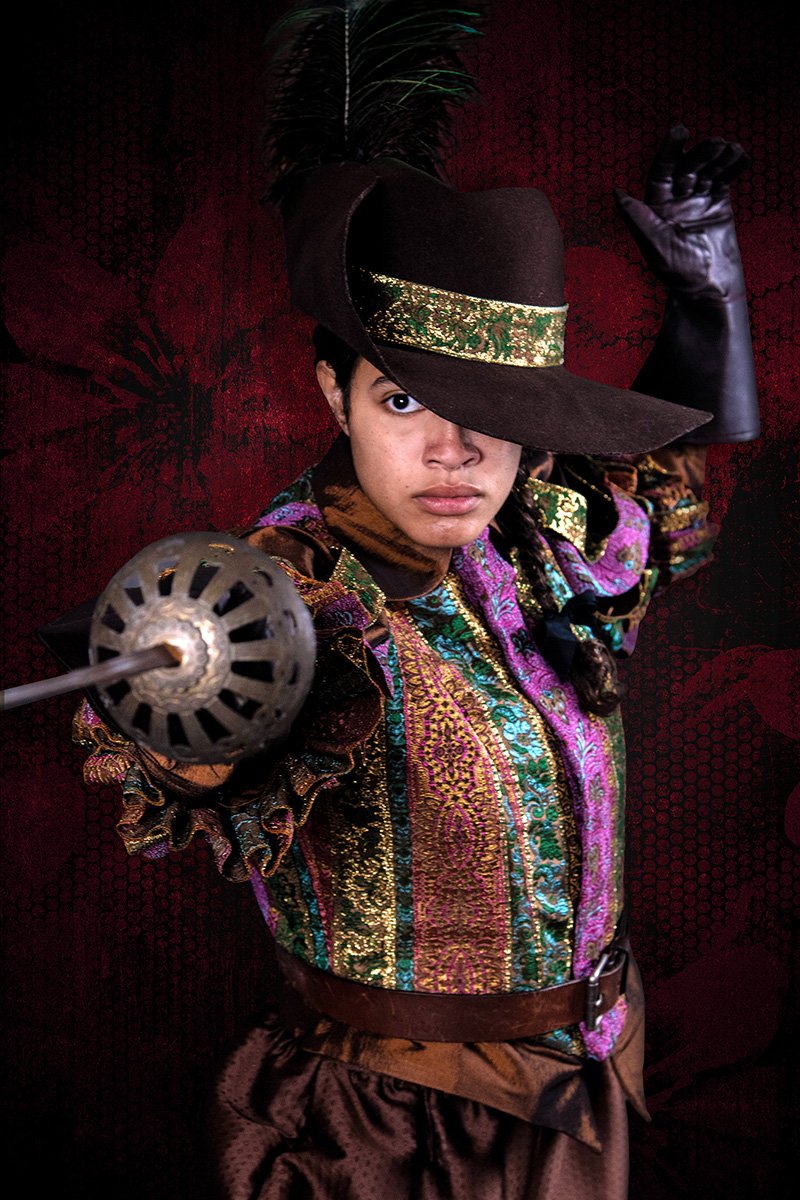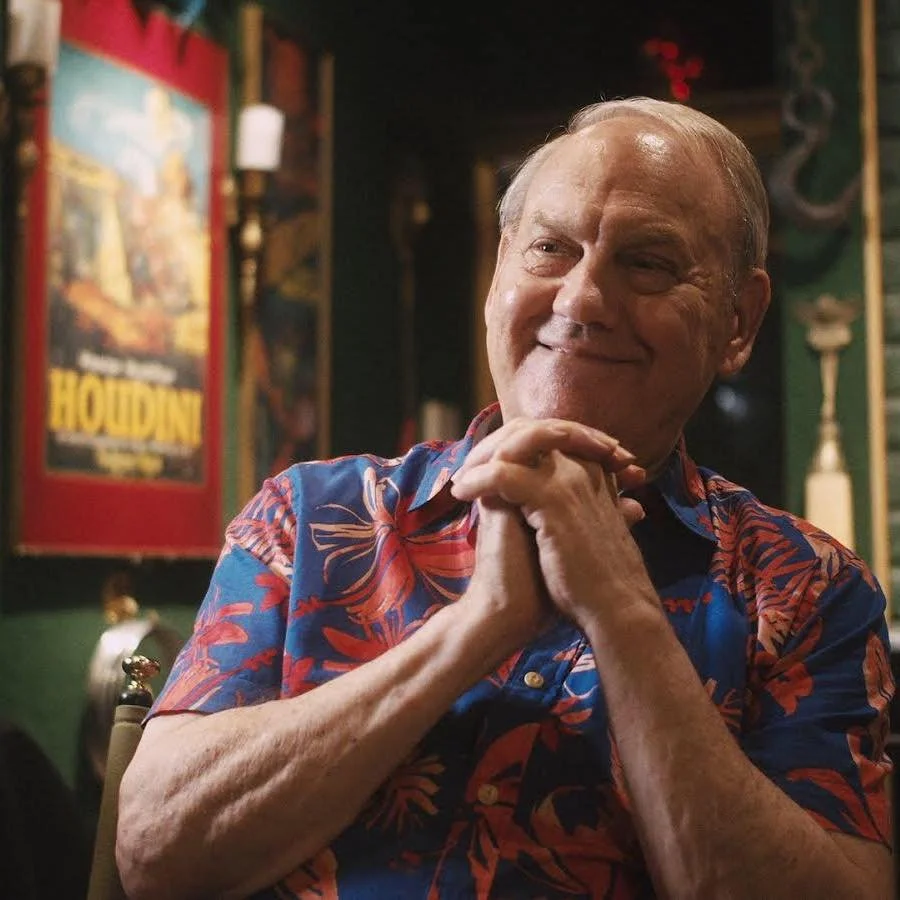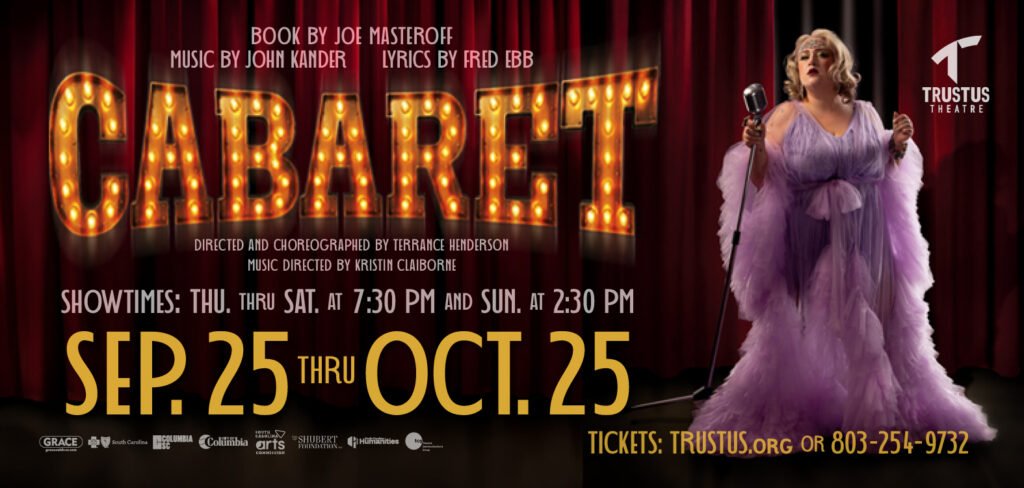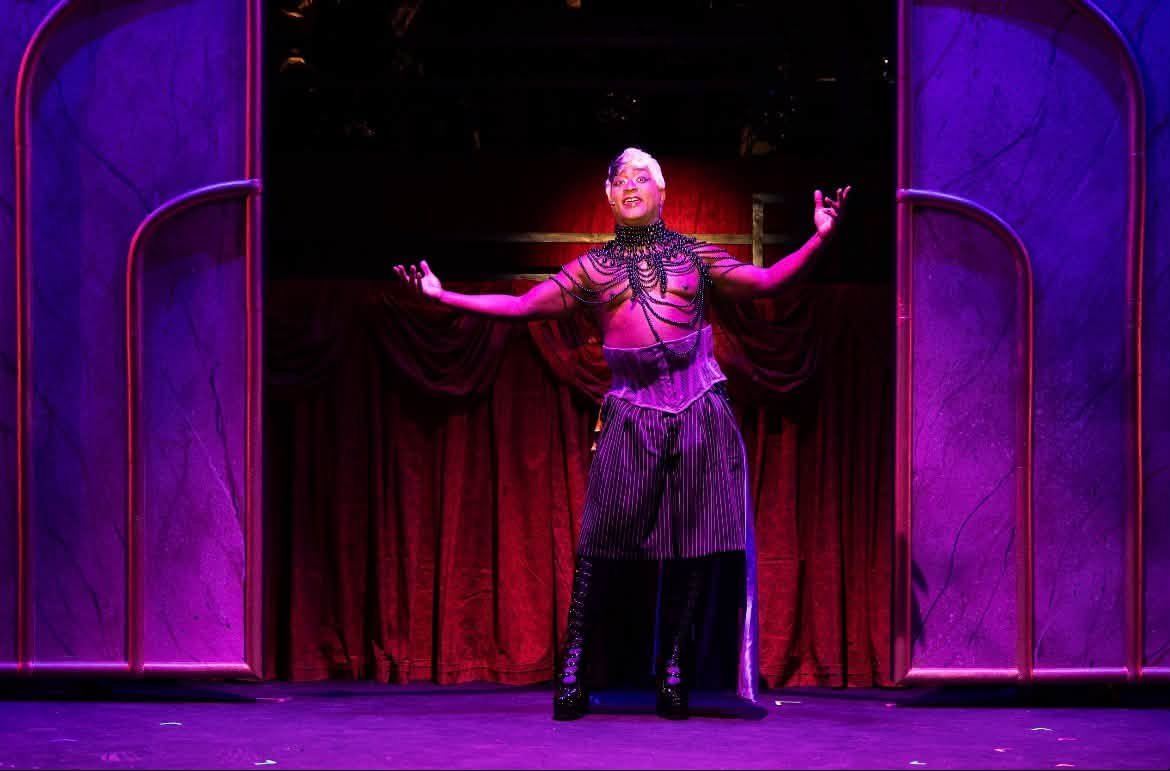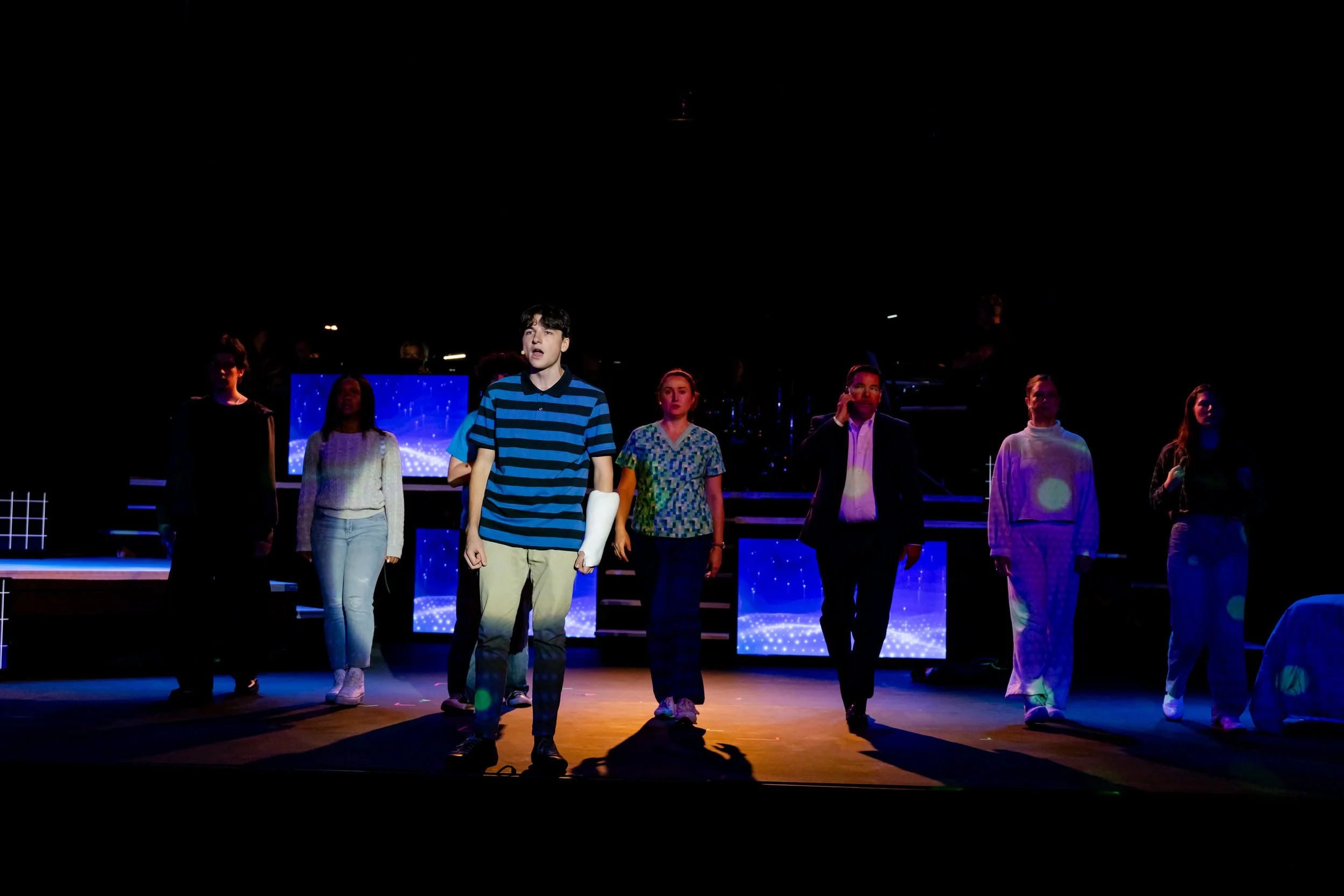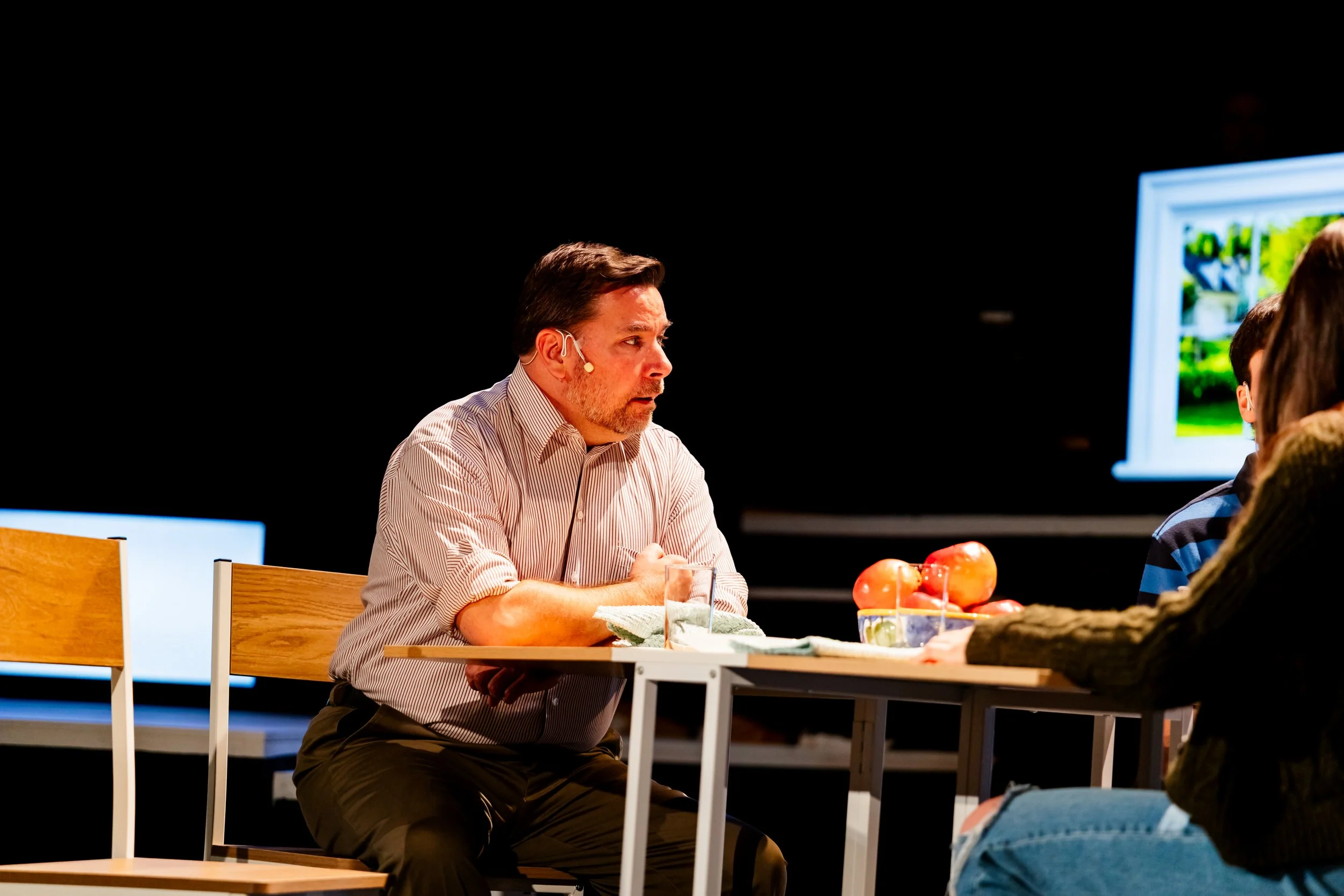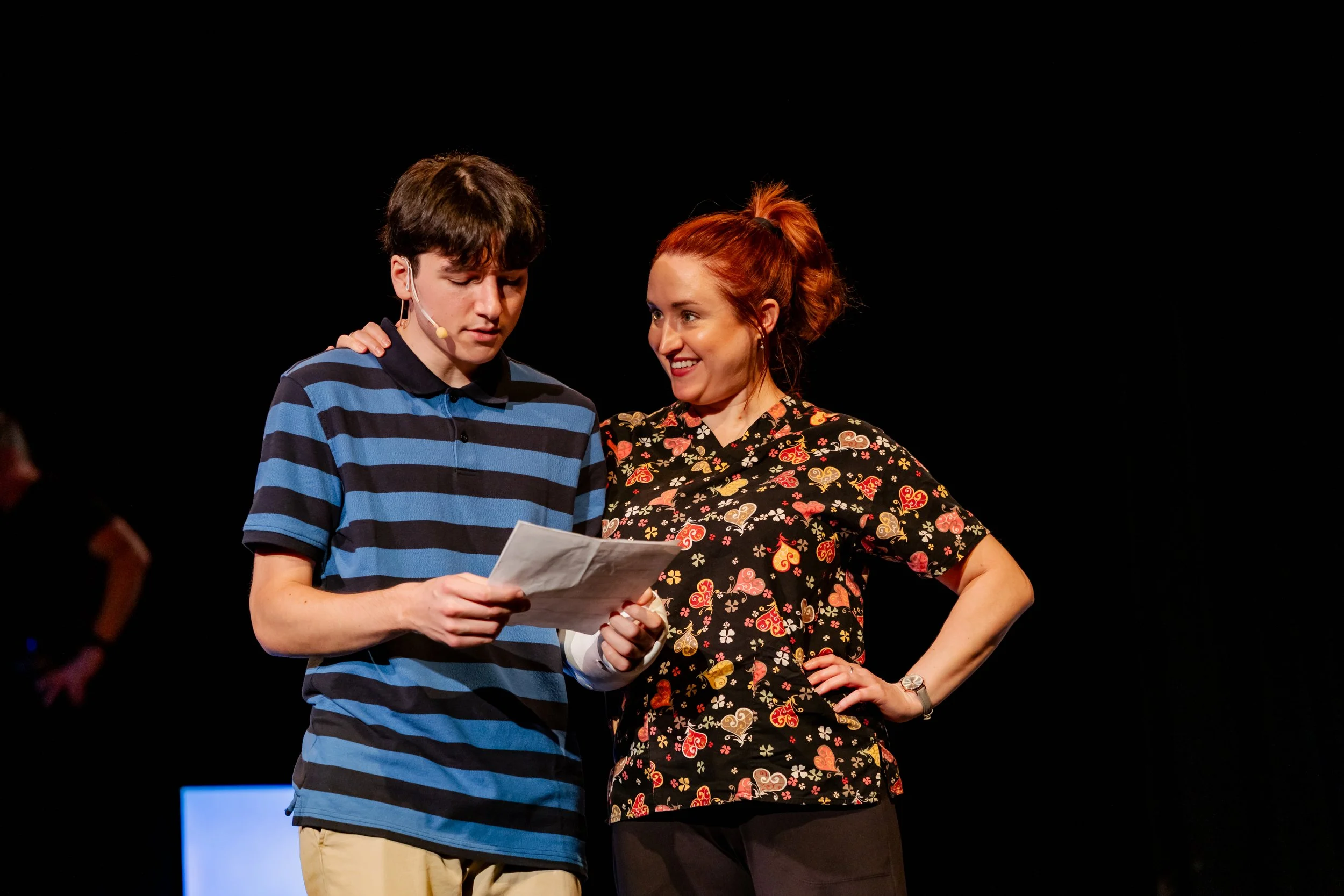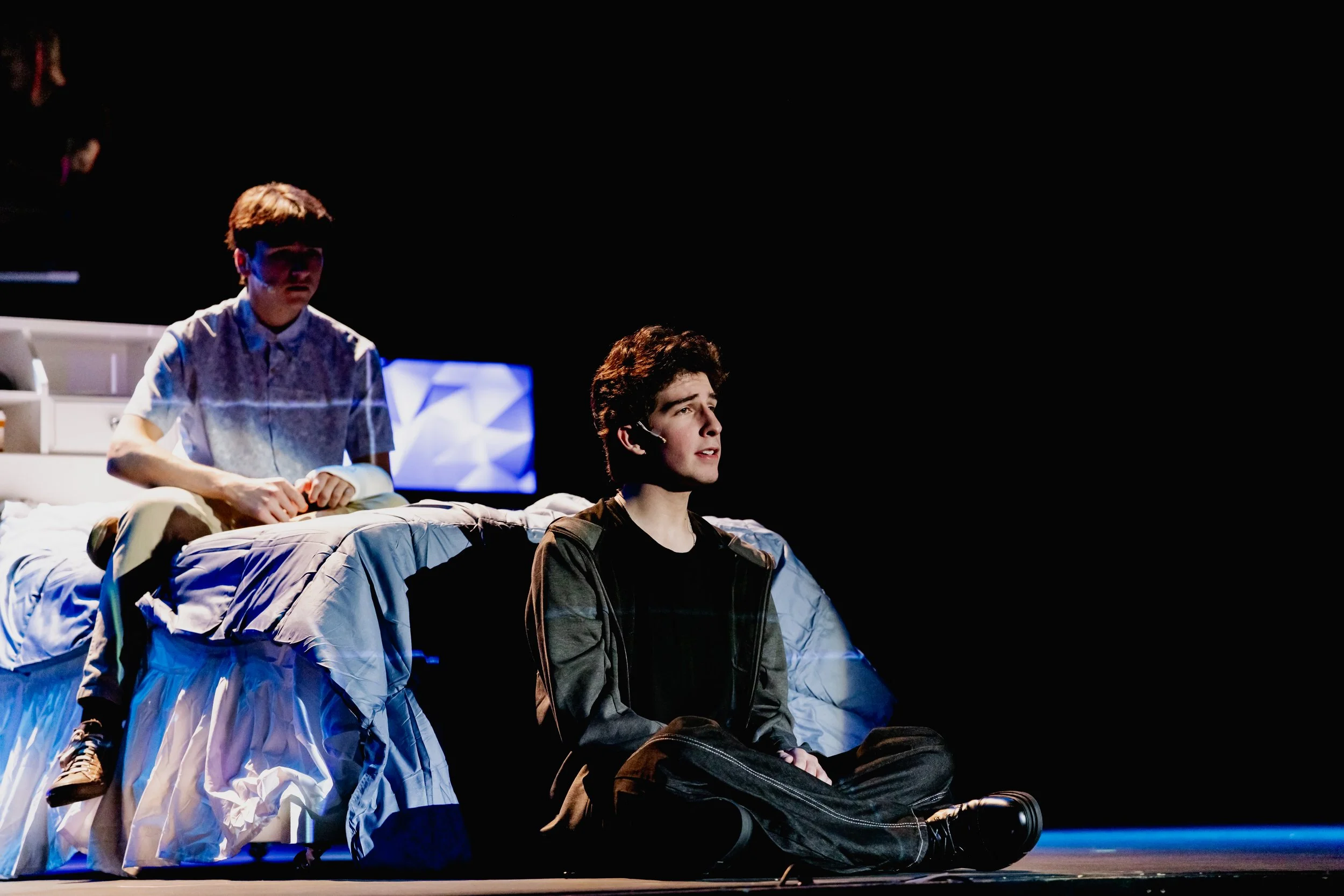

REVIEW: The Squirrels at Trustus Theatre by Clayton King

As the lights went down on The Squirrels, currently on stage at Trustus Theatre, I turned to the person sitting next to me and said, “I need to process what I just saw.” The play’s message is simple, but the plot is challenging to explain, in the same way that our current socio-political situation is simple, but deceptive and convoluted. Still, it is easy to recommend this show as a must-see for Columbia audiences.

Rather than attempting to explain the entire plot, suffice it to say Robert Askins’ script seems to invite questioning. The play offers a rich, comedic view of a darker understory in which small animals exist in a civilization (‘squirld’) that mimics the ‘world’ at large. The strong parallels between this heretofore unknown society of mammals and our current climate are unmistakable. And all while, the audience is entertained with fast-paced dialogue and action.

The Scientist, played by Jonathan Monk, opens the show with a combination pre-show speech and educational primer on the world of squirrels. The slide show includes Trustus’ season flyer, and the audience is thanked for its open-mindedness in coming to see this show. In his “lesson,” the Scientist remarks:

“And you’re like musical. Okay. Thinky play about thinky things all the way from New York. Sure. Duh. Then what’s this? Squirrels? Other people might go, ‘BAWHA? A play about squirrels? What?’ Not you. You said, ‘Okay.’ You said, ‘I’m curious.’ You said, ‘Give me some.’ And some you shall have. Buckle up, you discerning patron of the arts. Because we are going to get scientifical, because SQUIRRELS ARE FASCINATING.

From this moment on, the basic tenet of theatre that audiences are invited to “suspend disbelief” becomes the top order, as one often forgets these are actual humans on the stage portraying actual squirrels. The absurdity of it all wraps itself around you while constantly pulling you into the world of these animals.

Jonathan Monk’s comedic timing and ability are in full force and alone are worth the price of admission.

Director Martha Hearn has assembled a wonderful cast to tell this story, and the production quality is outstanding. The audience is aptly and elegantly transported into this ‘squirld,’ with the cast adopting the behavior, mannerisms, and sounds of squirrels so completely that “suspending disbelief” was easy. Each actor dons an absurd, enormously fluffy tail as a means of self-identification, which only furthers the premise of both ridiculousness and creative genius.

Jonathan Monk’s comedic timing and ability are in full force and alone are worth the price of admission. This is rivaled only by his sinister and Machiavellian portrayal later as Scuridae. Add to that Terrance Henderson’s masterful performance as Sciurus, the aging head of an established, wealthy family of grey squirrels. He is both funny and appalling as he struggles to keep his sanity, family, and large cache of nuts. He has the power, and as the top squirrel in his tree, Sciurus resists sharing his hoard with the hungry, fox squirrels.

In a sort of “rebel with a cause” flair, Patrick Dodds (Carolinensis) earnestly leads his squirrels in an insurrection and quest to secure nuts for his group's basic needs. His forbidden love interest, Chordata, is Sciurus’ daughter and the heart of the play. Courtney Sims’ portrayal of the character is sympathetic and guides the audience through the play, embodying a character who struggles to find balance and fairness with a strong will and full heart.

A standout as Rodentia, Abigail Lee McNeely loves her adopted father, Scurius, with an impure adoration that antagonizes her adopted mother’s status as the tree matriarch. Rodentia’s wantonness is a pathological cover for her loneliness and need for affection, as she is an outsider living on the inside of a dynasty. In the role of Mammalia, the matriarch of the Scurius clan, Erin Wilson offers both a caring, warm-hearted mother figure and a hard, brutal side on full display as the play closes -- think of an iron fist wrapped in a velvet glove. The audience experienced a euphoric moment, reminiscent of King Joffrey’s dramatic death (non-sequitur reference to Game of Thrones), as she struck the killing blow. It was jubilant and met with thunderous applause!

 Rounding out the cast are ensemble players Olivia Wamai and Nicole Perez, who serve as members of the insurrection and help move the action along with fluidity.

Everyone on stage so expertly embodied what one would consider “typical” squirrel behavior; it was uncanny and highly entertaining. The cast had a wonderful play space to work with on Corey Langley’s imaginative and effective sets. The scale of all the spaces on stage reminds us that we are watching squirrels (human-sized ones) in places like tree-top lairs, underground havens, and bird houses. Costume designer Rachel Turner creatively meets the challenge of providing character-appropriate garb for each player. And did I mention the tails? Character makeup suggests an animalistic appearance without becoming a caricature in motion. Light and Sound Design by Laura Anthony Robbie and Jacob Olano, respectively, were perfect for the task of enhancing the production.

One must also give a huge nod to Kathleen Pennyway, who serves as the production’s Intimacy Coordinator. The prolific world of squirrels includes a great deal of mating (“mukking”), and this idea was evident, daring, and sensitively handled. Likewise, Patrick Michael Kelly’s fight choreography effectively captured what one would envision with squirrels fighting over nuts and dominance.

While there is a lot of information and machination to try to describe in The Squirrels, I can only say “go see it!” It is thought-provoking, comical, emotional, and ultimately, hopeful. The show’s runtime is two hours and 40 minutes, with a 15-minute intermission, yet the performances, individual and collective, are where the experience soars. In fact, after the show ended to an immediate standing ovation, I glanced at my watch and was surprised at the time; I had no idea how much time had passed and never felt a lull.

If Southern Gothic and theatre of the absurd had a love child, it would be The Squirrels. The telling of prejudice, inequality, and basic needs is the main point that resonates with most people today. The show runs April 17-May 3, and tickets are available online at trustus.org.

Review: The Hiding Place is a Story That Still Resonates - By Jane Turner Peterson

Anyone who opposed the German regime risked being taken and punished. Sound familiar?

The Hiding Place, now playing at Soda City Theatre in West Columbia, is a haunting true story set during World War II in a quiet Dutch town. Directed by Debra Leopard, it tells the story of Corrie, Betsie, Willem, and Casper ten Boom—a Christian family who run a century-old watch shop and secretly shelter Jewish refugees in their home. As the Nazi occupation tightens its grip, the ten Booms create a hidden room within their house, forming part of an underground network that helps Jews escape arrest. Their courage and faith are put to the ultimate test when their efforts are discovered, leading to arrest, separation, and imprisonment in brutal concentration camps. It’s a stirring and heartbreaking look at the horrors faced by those persecuted by the Nazis, regardless of whether they were Jewish. Anyone who opposed the German regime risked being taken and punished. Sound familiar?

A.S. Peterson’s stage adaptation of Corrie ten Boom’s autobiographical book can feel somewhat disjointed, shifting between past and present. It’s easy to see the challenge of condensing such a far-reaching story into a stage production that moves across multiple locations. Even so, the script remains faithful to the source material. Soda City’s set design team, Debra Leopard and Todd Moles, make strong use of a limited space, creating effective playing areas. Costumes by Joanna Shaw and props by Lindsay Brown, Mark DiNovo, Debra Leopard, and Tracy Rice are well executed, and scene transitions are handled smoothly. There were some issues with the sound system—something not uncommon with body mics. It does raise the question of whether a stronger emphasis on vocal projection might better serve productions where sound consistency can be a challenge.

There are moments when the pacing lags slightly, but the emotional beats land well, providing enough tension to keep the audience engaged. The story itself is powerful and, at times, unsettling, with depictions and references to the violence and cruelty endured by those in the camps. Because of this, it may not be suitable for children under 12 or for those sensitive to such material. The production does not shy away from its truth.

Karen Herschell leads the cast as Corrie ten Boom, delivering a compelling and deeply human performance. She guides the audience through Corrie’s memories with clarity and emotional depth, capturing fear, doubt, resentment, and love in equal measure.

Bill Arvay brings warmth and strength to the role of Casper ten Boom. His portrayal of the family patriarch reflects both his deep devotion to his daughters and his steadfast faith.

Gayle Stewart’s Betsie ten Boom is filled with grace and quiet strength, serving as a spiritual anchor for those around her during their imprisonment.

Peyton Shumpert brings a heartfelt sincerity to young Corrie, delivering her lines with clarity and strength.

Within the large ensemble, several performances stand out: Ripley Thames as Pickwick, the loyal friend and co-conspirator; Shauna Lair as the chilling Hitler Youth, Otto; Bill LaLima as Lt. Richter, who interrogates Corrie; and Len Lesslie, whose German officer is convincingly menacing.

The cast also includes Mia Burke, Mark DiNovo, Nathan Wright, Olivia Nuvallie, Gina Saviola, Barry Smith, Rae Kostal, Katie Godfrey, Chiara LoBianco, Chase Umbarger, Bennett Shaw, Gail Carter, and Sabrina Schroeder.

The Hiding Place runs through April 19 with limited performances at Brookland Methodist Church in West Columbia. Tickets are available at sodacitytheatre.org.

 Jane Turner Peterson is the Theatre Editor for Jasper Magazine and a member of the board of directors for the Jasper Project.

Meet Jasper Board Member Jane Turner Peterson!

MEET JASPER!

JANE TURNER PETERSON

The Jasper Project is dependent upon its hard working board of directors to make our world go ‘round. In addition to sharing a wealth of information from their own experiences, the Jasper Project board is, what is called in the world of non-profits, a “working board.” Emphasis on the word WORK.

You’ll see our board members delivering Jasper Magazines, greeting and ringing up art sales at any of our gallery spaces, hauling bags of ice, cases of wine, and trays of food at our receptions and events, as well as planning, setting up for, and cleaning up after those events. Our board of volunteers also plan and program those parties! They schedule art exhibitions, review plays, install art, make labels, read plays, screen films, program concerts, write checks, balance the budget, communicate with their unique contacts, and so much more.

Every board member is attached to at least one of Jasper’s primary projects (Jasper Magazine, galleries, Play Right Project, 2nd Act Film Project, or any of our one-off projects like the Degenerate Arts Project we just finished up or our upcoming Peter Lenzo Retrospective and Remembrance which will open at Stormwater Studios on April 3rd.)

New board members are officially elected into their seats at our annual board retreat in January, though when potential new board members come along throughout the year, we invite them “to date” Jasper until the next retreat. This gives the potential director time to learn how Jasper works and decide whether they can see themselves as part of our motley crew. And the reciprocal works for Jasper.

In January 2026, Jasper voted in 7 new directors to join our already existing board of 14 sitting members. Over the next few weeks we will be introducing these amazing people to you via Jasper Online. We invite you to check back here daily to MEET JASPER, and we will introduce you to the hard-working and talented individuals who make up the Jasper Project Board of Directors.

Meet Jane Turner Peterson!

Jane Turner Peterson is a retired marketing professional in the non-profit sector with an arts background. She holds a BA in Theatre from the University of South Carolina. She has been involved in arts marketing in several areas, including graphic design, advertising, and sales, since the 80s. She was most recently the Director of Communications at Washington Street UMC in Columbia. Jane has been involved both on stage and as a director in the local theatre scene for numerous years. Jane is excited to begin her journey with Jasper to be a part of an organization whose mission reflects her love of the arts.

Jane is the Theatre Editor for Jasper Magazine and the project director for the Play Right Project. She also serves on the Project & Planning Committee, the Marketing Committee, and the Magazine Committee.

Welcome Jane!

REVIEW: Clayton King Reviews Town Theatre's The Secret Garden for Jasper

In The Secret Garden at Town Theatre, a team of theater artists use a wealth of talent to the task of bringing Frances Hodgson Burnett's beloved 1911 children's novel to the stage. The 1991 Tony award-winning musical's script and lyrics are by Marsha Norman, with music by Lucy Simon, who packed a lot of story into the script. The show won three Tony awards, including Best Book of a Musical, Best Featured Actress in a Musical, and Best Scenic Design.

The show leaves no stone unturned in telling the story of how a 10-year-old orphan, Mary Lennox (Bailey Bostic*), wins the love of her distant, widowed guardian, her uncle Archibald Craven (Lanny Spires), even as she finds her own self-worth by communing with nature in the locked garden of the uncle's vast Yorkshire estate. A catalyst for her journey comes from the character of Collin (Ezra Lindley*), Mary’s 10-year-old cousin and the bedridden, spoiled, and sickly son of Archibald Craven. Both children handled these complicated roles with equal aplomb. Other supporting roles included Martha, a housemaid (delightfully portrayed by Ashton Boland), and her brother, Dickon (unsurprisingly well done by Nathan Jackson). As the production moves forward, the performers are charged with unveiling many story threads and themes.

Under the direction of Jane Cato, the cast has accomplished their basic mission. Performances by actors with named roles were robust, and the deceptively difficult musical score was aptly led by Musical Director Michael Simmons, with a small band that delivered an orchestral sound. It was particularly nice to see the band on stage. In full disclosure, I was part of a production of The Secret Garden almost two years ago, which gave me insight into the wealth of information presented and devices used to convey it; because of this, some moments were easier for me to understand than for some other audience members with whom I had the opportunity to chat at intermission and after the show.

The production uses a combination of flashbacks and “past into present” devices to tell the tale. The production at Town Theatre offers a credible if sometimes confusing adaptation. Included in the ensemble were the Restorers, a group of dancers that appeared throughout the production, played by Whitney Allen, Meryn Creasman, Taryn Davis, Laura-Louise Rice, Lauren Sudduth, and Bethany Truel. As a theatrical device, this was especially effective in two places: the opening scene, where the spread of Cholera in Mary’s home in India kills everyone she knows, and in “Wick,” when Dickon (ably performed by Nathan Jackson) shows Mary that nurturing a garden can bring it (and humans) back to full life. Also in the ensemble are the Dreamers – ghosts from Mary’s past who serve as a kind of Greek chorus, carrying the score’s intricate, haunting musical themes and often interacting directly in scenes. In Town’s production, the Dreamers handle the score evenly and are played by Emily Banks, Gavin Slusher, Karly Minacepelli Shorter, Sam Derrick, Ethan Wilson, Caroline Lindler, Connor Etcheson, Emily Grace McIntyre, Sadie Slusher, and Gracelynn Wall (Young Mary).

Lanny Spires shines as Archibald Craven and is known to Columbia audiences for his strong vocals, offering a beautifully poetic, tortured soul as he tackled both musical and thematic demands. It was odd, though, that as a hunchback, he appeared without a hump and was encumbered with a cane. This limited his otherwise flawless performance. Lily (Carley Campbell Siglin*) in ghost form delivered soaring vocals and set the tone of the show in the opening, as she hauntingly beckoned, “Come to my Garden.”

Archibald’s younger brother and keeper of the estate (Austin Means) was solid in his vocal performance, and Carol Beis (unsurprisingly) nailed both the accent and character as Mrs. Medlock, the estate’s housekeeper.

Ashton Boland was absolutely delightful as Martha, a housemaid who gently pushes Mary to become more independent, and Todd Gustafson as Ben Weatherstaff, the head gardener at the estate, was delightfully crotchety and caring at the same time. Ezra Lindley, as Collin Craven, was another delight, rambling with questions or telling a story as children are wont to do.

Jeremy Hansard’s set was part representative and part literal, mixing a ramshackle, declining sort of house/garden combination and providing several staging areas in an effective way. Lighting, while sometimes too dim, was quite effective in setting the mood as performers moved to various spaces that included both indoor and garden locations. I should note that Town Theatre’s fairly recent practice of having a cast member record the preshow speech delights audiences, and last night was no exception.

Heather Gonzalez's costumes were a standout, providing period-appropriate garments, and had the Dreamers, all costumed in ghostly white, making it easy to distinguish ghosts from humans.

Apart from a few “opening night” issues with microphones or costumes, The Secret Garden is a success, and everyone involved should be proud. The audience sometimes had trouble locating the show's pulse in a few areas. For example, unlike traditional musicals, The Secret Garden does not employ full-scale production numbers. While the dancers were clearly enjoying their time on stage, I found that they sometimes distracted from other poignant moments, such as “I Heard Someone Crying” and “Quartet.” Both songs are individual soliloquies, performed introspectively by the principal characters. So much movement on stage took away from the strength of what each of these characters was relating to the audience. Early on, I was momentarily confused when Mary first got dressed and donned a white dress. Then, while I was trying to make sense of this, she added a richly colored coat, which instantly answered the question. At times while using the spaces available, scenes felt separated a bit too far making them hard to follow. Audiences should be prepared for a longer-than-usual running time, but the show's pace keeps them engaged and wondering what the resolution to Mary’s situation will be.

*The show runs March 13-29, with Caitlin Thomas White alternating as Lily, Molly Adams as Mary, and Carter Ellingson as Collin.

(Editor’s Note: In the original post the name Gracelynn Wall was inadvertently omitted. We apologize for this error.)

REVIEW: Jane Peterson Reviews Guys and Dolls at Workshop Theatre

Dames, Dice, and Plenty of Charm: Guys & Dolls at Workshop Theatre

Workshop Theatre raised the curtain Friday night on Guys & Dolls, the beloved musical comedy set against the colorful backdrop of 1950s New York, and the audience could not have been more receptive. The show traces its roots to the short stories of Damon Runyon, brought to the stage by Abe Burrows and Jo Swerling, with the irresistible score and lyrics of Frank Loesser. The production first dazzled Broadway on November 24, 1950, earning the Tony for Best Musical the following year, and later inspired a 1955 film featuring Frank Sinatra, Marlon Brando, Jean Simmons, and Vivian Blaine.

At its heart, the story follows two incorrigible gamblers who find themselves wagering on something far more unpredictable than dice — love. Sky Masterson (Evan Cook) accepts a bet from Nathan Detroit (Frank Thompson) that he can't convince straight-laced Salvation Army missionary Sarah Brown (Sara Slaughter) to join him on a spontaneous trip to Cuba. Meanwhile, Detroit is doing everything in his power to avoid walking down the aisle with his long-suffering girlfriend Adelaide (Maegen Hodges), a dancer at the Hot Spot nightclub. The two storylines weave together through a lively mix of gamblers, showgirls, Salvation Army meetings, and one memorable Cuban detour.

Workshop's production delivers a genuinely good time. The music is bright and infectious, though at times the music threatened to drown out the vocals — which is a pity, because the singing across the cast was commendably very strong.

Frank Thompson brings Nathan Detroit to life with wonderful energy, capturing the character's perpetually flustered, shifty charm as he scrambles to find a venue for his floating craps game while staying one step ahead of the law. His vocals were solid throughout, particularly in the duet Sue Me alongside Maegan Hodges, whose voice was simply outstanding. Hodges deserves real credit for holding her own in some of the more demanding passages, and her portrayal of the lovably scatterbrained nightclub performer was both sharp and thoroughly entertaining. Her turn with the Hot Box girls in A Bushel & A Peck was a genuine crowd-pleaser.

Sara Slaughter was a standout as the buttoned-up Sarah Brown, bringing a sharp comic sensibility and a wonderfully expressive face to the role. Her rendition of If I Were a Bell was a real highlight.

Evan Cook's take on Sky Masterson carried all the Brando-inflected cool the role demands — self-assured and magnetic, it's a performance well worth the price of admission on its own. His scenes opposite Slaughter were especially fun, and their duets ranked among the evening's best moments.

The gambling fraternity — George Dinsmore as Benny, Joshua Diveley as Nicely-Nicely, Davis Herndon as Harry the Horse, and Julian Deleon as Big Jule — gave the show much of its texture and flavor. Each brought something distinct to their role, and the ensemble felt cohesive and committed. The "confession" scene was another high point, and Deleon's turn as the menacing Chicago gangster was particularly fun to watch.

The ensemble featured Lisa Baker, Dylan Livingston, Sophie Legare, Caroline Leonard, Blythe Long, Abby Mathias, Ann McGaha, James Nolan, Absalom Oliver, Elizabeth Rawson, Katie Rooney, Joey Weaver, Dara Younce and Tyler Zangler, whose portrayal of the policeman added some great comedic moments.

The vocal performance of the night, for this reviewer, belonged to Rich Fisher as Arvide Abernathy, Sarah's grandfather. His solo More I Cannot Wish You was quietly moving and left a lasting impression — here is a performer worth watching. Also deserving of mention were Joshua Dively's spirited Sit Down, You're Rocking the Boat, and the entire ensemble’s rousing rendition of Luck Be a Lady Tonight.

Director Bakari Lebby kept things brisk and lively, moving the show along at a confident clip. That said, a couple of production details gave pause. A push-button pay phone appearing as a set piece was a noticeable anachronism — period-appropriate props shouldn't be difficult to source for a show so firmly rooted in its era. Similarly, one particular wig felt like an afterthought, lacking the period styling that the rest of the costumes — which were largely on point — carried off so well. On the technical side, Patrick Faulds' set and lighting design served the show admirably, Kathy Seppamaki's music direction was crisp and capable, and Katherine Brown's choreography kept the stage energized. Additional crew included Hayle Barry (assistant director), Jeni McCaughan (producer), Andie Nicks (costumes), and Adeline Huggins (stage manager).

Guys & Dolls runs through March 28th at Workshop Theatre. Tickets can be purchased online at workshoptheatreofsc.org or by calling the box office at 803-799-6551. Workshop Theatre is located on the Columbia College campus in the Cottingham Theatre, at 1301 Columbia College Drive, Columbia, SC.

Jane Turner Peterson


REVIEW -- Village Square Theatre's SCHOOL OF ROCK by Jane Turner Peterson

Young Performers Rock the Stage in School of Rock at Village Square Theatre

Get ready for some good rock ’n’ roll…performed on stage by kids! Yes, kids! School of Rock the Musical, with music by Andrew Lloyd Webber, kicked off Friday night at Village Square Theatre in Lexington. Along with a superior band in the pit—Patty Boggs (drums), Nigel Grant (guitar), Camille Jones (piano), and Katie Miller (bass)—the young performers who make up the onstage “School of Rock” band absolutely rocked the house.

Directed by David LaTorre, Village Square Theatre’s artistic director, this high-energy rock musical is great fun for audiences of all ages. While the original School of Rock film leaned heavily on the antics of its adult lead, the stage version puts a stronger spotlight on the students and their families. LaTorre’s direction keeps the large production moving smoothly and energetically. With a cast of 35+—and several roles double cast—this was no small undertaking. Yet the ensemble remained fully engaged throughout the show, always in character and clearly listening and reacting to one another onstage.

Though a number of adults appear in the production, the majority of the cast is made up of teenagers and younger performers. If these young actors continue their involvement in community theatre, the future of the art form in our area looks very bright.

Based on the 2003 film School of Rock, this musical (originally based on a book by Julian Fellowes (known for Downton Abbey, and The Gilded Age) was adapted for the stage by Mike White. The show premiered on Broadway in 2015 at the Winter Garden Theatre. The story follows struggling rock singer and guitarist Dewey Finn (Taylor Diveley, who—after being kicked out of his own band—impersonates his geeky friend, Ned Schneebly (John Carter), a seasoned substitute teacher, to land a high paying job at a prestigious prep school. When he discovers his students’ musical talent, Dewey secretly forms a rock band with the students and sets his sights on the winning the Battle of the Bands. Needless to say, he is not your average teacher!

The musical moves at a brisk pace, with numerous scene changes handled efficiently by the cast and crew. Add in live instruments both onstage and in the pit, and the result is a production that demands serious stamina and energy from everyone involved. Thanks to LaTorre’s strong direction, the show hits the mark.

As Dewey Finn, Taylor Diveley is perfectly cast. His energy and enthusiasm propel the show, and his rock ’n’ roll persona—along with some solid vocals—keep the momentum going. Diveley is simply a joy to watch. John Carter fits perfectly in the role of a semi-nerdy friend, whose girlfriend, Sophie (D’Asia White) nags him about his loser friend, Finn.

Shelby Sessler nearly steals the show as the tightly wound principal Rosalie Mullins. Her vocal power and impressive range shine throughout the performance, and she deftly reveals several sides of the character as the story unfolds.

Several young musicians deserve special recognition. Alex Lease, who plays Zack in both casts, portrays the talented young guitarist desperate for his father’s approval, delivering some seriously impressive electric guitar work, better than many adult performers. Leo Portney brings equally strong skills to the drum kit, with drum solos that are a highlight of the show. Keyboardist Westin Black and bassist Allison Wengerd are similarly terrific.

Another standout is Mackenzie Bruder as the delightfully bossy and rule-loving Summer. Her confident stage presence, comedic timing, and sharp characterization add plenty of fun to the production.

Kudos also go to the entire ensemble of band members and classmates, including Lydia Reed, Grace Carlton, Jo Davis, Jack Carlton, Zach Cieri, Jackson Livingston, Catherine Cieri, Scarlett Ellingson, Soph Carlton, Ciara Nash, Kate Bruder, Eliot Stewart, Janely Burgos, Finn Carlton, Selah Lyle, Graham Gibson, Alyssa Presutto, Reese Catalanotto, Mackenzie Miller, Pete Roberts, and Scarlett Powell. Each performer brought strong character work and plenty of enthusiasm to the stage.

The adult roles are capably handled by Andrew Coston, Will Dowd, Eric Jewell, Max Ferro, Zanna Mills, Tracey Lease, Megan Stewart, Chris Bender, and John Carter.

Depending on what night you go, there are a slew of other young actors in the other cast. They include Ethan Schalund, Grace Bender, Aleah Headen, Brighton Dunbar, Rilyn Boehme, Hunter Gibson, Cully Srikanth, Logan Blackledge, Emily Sippel, Charlee Gay, Adalynn Williams, Genevieve Savage, and Emma Grace Simpson.

Choreography by Maggie Pszenny is lively and well suited to the production, adding to the show’s overall energy. The production is produced by Tricia Miller, and musical direction by Julia Turner keeps the rock sound tight and exciting. It’s clear that everyone involved poured their hearts into this production.

If you’re ready for a fun night filled with great rock ’n’ roll—and a chance to see the promising future of community theatre and young performers—make plans to catch School of Rock: The Musical at Village Square Theatre in Lexington. The show runs through March 22. Tickets are available at villagesquaretheatre.com or by phone at 803-359-1436.

REVIEW: Chapin Theatre Company's HOW TO SUPERVISE WOMEN

By Cindi Boiter

At the Jasper Project, we are committed to supporting, promoting, and celebrating new art wherever we can find it. Last night I found an outstanding example of new theatre just down the road from me at Chapin Theatre Company in the dress rehearsal for Lou Clyde’s new play, How to Supervise Women.

A tight two-act comedy, How to Supervise Women features an equally tight ensemble cast of loveable characters who make one of the most important cultural changes in the history of American women cogently understandable even for folks who might be hesitant to identify as feminists. Set in an aircraft assembly plant in San Diego in 1942, the play introduces us to four women who, though demographically different, find commonality and community during World War II. The women are answering the call to leave their lives as homemakers and take on the responsibilities of the men in the workforce who left to fight in the war.

The playwright does a fine job of representing four recognizable domestic situations in the backgrounds of her lead characters. Shirley Kaminski, played by Debra Haines Kiser, is a widow with three sons serving overseas. The wisdom of knowing what is at stake in the country weighs heavily on Shirley, but Clyde gives her the defense mechanism of humor, which she readily shares with her cohort, helping them all to cope. Loretta Beutel, played by the perpetually cute Zanna Mills, is a young woman with a secret reflective of the limited options available to women at the time. Millie Kram, played by Jill Brantley, is a young mother with a third baby on the way and a husband overseas.

But my favorite character was Joyce Johnson,  a young Black woman who starts out relegated to the role of custodian but clearly has much more to offer Consolidated Electronics, if not the world. Played by poet, singer, songwriter, and now actor, Alyssa Stewart, Joyce is aware of the power her almost invisibility in the workplace affords her and uses it to her and her work mates’ advantage. But Joyce is all-seeing. Her smirks, chuckles, and knowing glances are priceless. Having worked for years at Consolidated Electronics, her awareness that poor women and women of color were already a part of the labor force long before the war even started, informs her approach to her job and to dealing with the men in supervisory positions. Let’s hope Alyssa Stewart, the actor, finds herself on another stage soon!

Speaking of the men, the characters Herman Mueller, played adorably by Jack Bingham, and his supervisor and the play’s antagonist George Perroni, played by CTC executive director Jim DeFelice, served the play’s narrative well. While George’s character is somewhat informed by the stereotypical mid-century husband, who offers much sound and fury on the job but ultimately submits to his powerful wife, DeFelice gives his role the kind of humility that makes his character receptive to growth and change. George’s long-awaited epiphany that women are strong, capable, and let’s face it, amazing is facilitated by the pure kindness of Herman’s character. In his words and actions, Herman consistently conveys the message that everyone is really just doing the best that they can under world-altering conditions. In this role, Bingham could not have been more authentically open and vulnerable. I look forward to seeing Bingham on a local stage again, as well.

The cast is rounded out by Samantha Hansford playing the role of Phyllis and Barry Smith as the announcer/messenger, both of whom took smaller roles and made them meaningful. Jamie Carr Harrington directed the play with sound and lights by Simon Marchant. Tiffany Dinsmore and Abby Mathias did an excellent job with costume design, not only remembering to make the characters’ shoes fit the time period but giving some of the characters charming spectator styles that made even a non-shoe person like me swoon a little.

Similarly, Jane Peterson took no short-cuts with the show’s props, putting her graphic design skills to good use wherever she could. To that end, don’t miss the pin-up calendar she designed for the first act! (Full disclosure, Peterson is a member of the Jasper Project board of directors and theatre editor for Jasper Magazine.) And kudos again to DeFelice and Dinsmore for creating an appropriately industrial set complete with uncomfortable aluminum chairs à la The Whig.

How to Supervise Women is more than a comedic play. Lou Clyde has created a rich narrative full of grace notes that subtly pepper the play with hints that give nuance to the culture in which the story is set. Whether it be an off-the-cuff comment by a female character that after working a double shift she still works a third shift when she gets home, or notes left in the women’s un-locked lockers with messages like, “Broads belong on their backs,” or the bathroom signage that changes from MEN to WOMEN to POWDER ROOM, How to Supervise Women is a portrait of a period in American history that spurred changes in gender roles, workplace dynamics, the way women viewed their value, and so much more.

In her Playwright’s Note, Lou Clyde writes, “My mom was one of the six million women who worked in a factory while my dad served in World War II. … This play is meant to honor these trail-blazing women who proved they could not only do the jobs of men but do them well.” Not only does How to Supervise Women accomplish Clyde’s mission, but it does so with an abundance of humor and theatre artists who bring their meticulously designed characters to life with sensitivity and finesse.

Go see How to Supervise Women at Chapin Theatre Company

February 7,12,13,19, and 20 at 7:30 pm

and February 8, 14, 15, 21, and 22 at 3 pm.

Visit Chapin Theatre Company for tickets.


REVIEW: Village Square Theatre’s 12 Angry Jurors Demonstrates the Power of Diversity in the Live Theatre Experience

by Amanda McSwine with Cindi Boiter

Village Square Theatre’s current production of 12 Angry Jurors  has a storied past. Originally written by Reginald Rose as a teleplay titled Twelve Angry Men that premiered on CBS in 1954, the now well-known tale of the power and contagion of reasonable doubt was adapted as a stage play, a film, and a different stage play written by a different writer during the first decade of its life. While many viewers think of Twelve Angry Men as the 1957 film directed by Sidney Lumet featuring an ensemble cast that included Henry Fonda and Jack Warden, the loose premise of the play has inspired everything from parodies likeTwelve Angry Elvises to TV shows like Sesame Street, Murder She Wrote, and Happy Days (“12 Angry Fonzies”) that used the practice of entertaining reasonable doubt as the loose structure for a weekly episode. A 2015 star-studded, sketch parody written by Amy Schumer for her series, Inside Amy Schumer, garnered rave reviews as it debated the question of whether Schumer was “hot enough” to have her own show. Village Square Theatre’s straight production of 12 Angry Jurors is a thoughtful and inclusive update to the original that better resonates with a contemporary audience. 

The show opens in the jury room of a seemingly clear-cut murder case—so clear-cut, in fact, that before we even meet the jury, the bailiff tells the audience that the defendant “doesn’t stand a chance.” As our jurors enter, we see the intentionality of director Glenn Farr in his selection of a diverse cast. Almost any member of the audience may see themselves represented. 

As the jurors begin to deliberate, we witness a clash of perspectives and an unveiling of biases. We see how the jurors negotiate with each other—and themselves-–as their worldviews are put to the test. In this age of echo chambers and curated algorithms, 12 Angry Jurors invites us to sit with the discomfort of differing opinions.

Katie Mixon’s compelling performance as Juror #3 (played in the original film by Lee J. Cobb) captures the defensiveness, anger, and desperation that surfaces when deeply held beliefs are challenged. Charles Zuber’s heated monologue as Juror #10 (played in the film by Ed Begley, Sr.), exposes the danger of how using rhetoric that includes terms like “those people” can turn bias into blind prejudice and discrimination.

The VST ensemble included LaQuana Aldridge, Tristan Brown, Beth DeHart, Will Frierson, Pat Gagliano, Kathleen Godwin, Rae Kostal, Kyle Mason, Jeff Sigley, and Brian Teusink. And, while all of the performers give their characters life with feeling and depth, as well as diversity, there were some production elements that were lacking. While many of the costume choices supported the director’s intention to set the piece “outside the normal timestream,” a handful of accessories distracted from this illusion due to their distinct association with a specific time period. 
I appreciated the minimalist set which kept the focus on the exchanges between the jurors and the system in which they existed. But pacing was awkward at times. I would have liked for the cast to have found a smoother rhythm in order to better build tension during heated exchanges. 

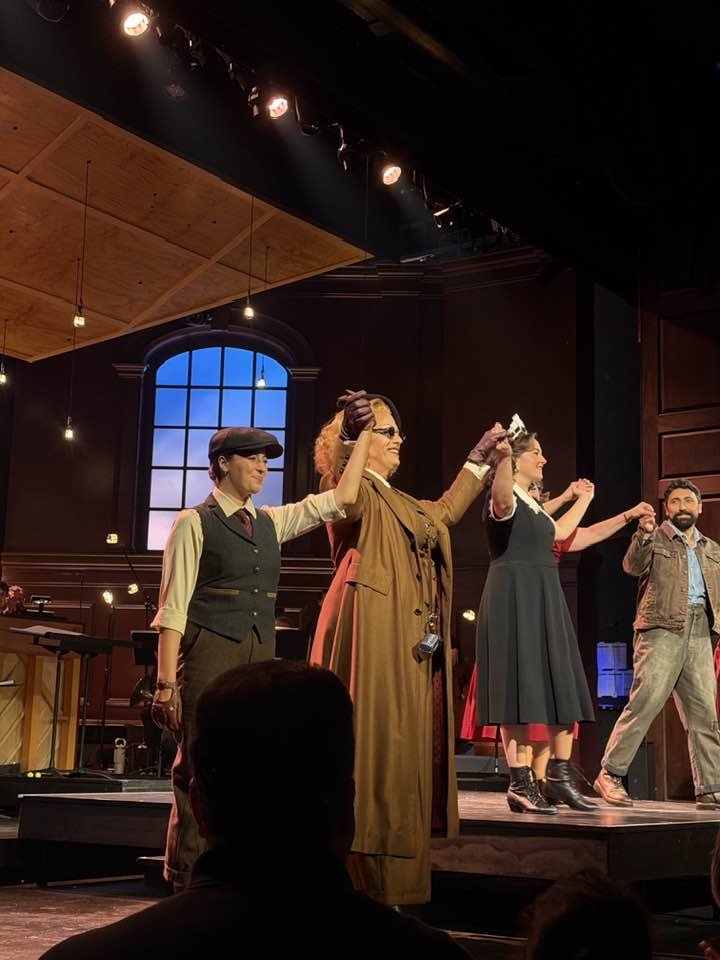
Overall, Village Square Theatre’s production of 12 Angry Jurors is a timely examination of the strength it takes to stand alone in the face of overwhelming odds, and the courage it takes to put aside one's pride and change one’s mind.

12 Angry Jurors runs through February 1. An additional show has been added on Thursday, Jan. 29 to accommodate the cancellation last week due to weather. For tickets call 803-359-1436 or visit the theatre’s website online.


REVIEW: A Deadly Good Time - Over My Dead Body Delivers Laughs at Town Theatre By Jane Turner Peterson

Town Theatre’s production of Over My Dead Body by Michael Sutton and Anthony Fingleton is a delightful throwback to some of Agatha Christie’s murder mysteries. While it takes place in the 1990s, it evokes the feel of old-school whodunit plays. Skillfully directed by Allison McNeely, Over My Dead Body is a comedy-mystery that borders on farce, with some wonderful physical and situational comedy moments. There are several great twists in the plot that make the production even more fun. The entire cast was fun to watch.

The story is set in England and revolves around three elderly founding members of a mystery/crime writers’ literary club: Dora Winslow (Kathy Hartzog), Trevor Foyle (Bill DeWitt), and Bartie Cruikshank (Clayton King)—collectively known as the “Murder League.” A new, young writer, Simon Vale, has joined their ranks, and they are not fond of him. Vale makes fun of their old-fashioned style of writing, while the League mocks his inappropriate language used to describe his murders. The play spoofs the whodunit genre as the three members of the “Murder League” attempt to plan and execute the perfect crime to boost their careers—only to have their old-fashioned methods go comically wrong.

As the married couple Trevor Foyle and Dora Winslow, DeWitt and Hartzog bring their wonderful chemistry to full force. Having played opposite one another many times over the years, the pair are always a delight to watch. Their timing and delivery are spot-on. Clayton King’s Bartie adds a delightful dose of eccentric energy to a character who is shrewder than he first appears.

Wayne Wright’s portrayal of Vale strikes just the right mix of snobbery and cockiness to make you distrust—and dislike—his character. The club’s butler, played by Steve Reeves, adds another layer of comedy to the production. His slow-moving, dim-witted portrayal of the aging servant is fun, and even more commitment to the character would have been welcome. The murder victim—Simon Vale’s utterly despicable American literary agent, Leo Sharpe—is played by the imposing Sam Chamberlain, who dives into the role with great enthusiasm and makes you dislike him from the moment he appears.

Rounding out the production is the star-struck detective, Chris Kruzner, whose portrayal of the slightly dim-witted investigator, reminiscent of Jacques Clouseau (The Pink Panther), is spot-on. His self-assured partner, Sergeant Trask, portrayed by Chavous Camp, is also fun to watch. Together, the two make a strong comedic pairing.

Big kudos to the entire set, costume, and prop crew—Nathan Jackson, Jeremy Hansard, Julian Harley, Shannon Willis Scruggs, and Jodie Harris—whose work was very well done and served the production beautifully. Town Theatre is lucky to have such a wonderful space. A few technical elements could be tightened up, but it is live theatre, after all.

If you’re looking for a fun, lively evening at the theatre, this one is for you. Over My Dead Body runs Thursdays through Sundays until Feb. 1. For tickets or more information, visit towntheatre.org.

REVIEW: The Comeuppance Delivers a Fearless, Ensemble-Fueled Night By Jane Turner Peterson

Trustus Theatre’s Side Door production of The Comeuppance, by Branden Jacobs-Jenkins, is a modern-day dramedy set in Washington, DC. It’s an intense evening of angst, truths, secrets, and lasting friendships, as a group of five diverse millennials gather for a pre–20th high school reunion party for their “gang” of misfits—known as MERG (Multi-Ethnic Reject Group). Think of the play as a grown-up The Big Chill. This particular group of friends has faced a lot in their lifetimes so far, including 9/11 and COVID, to name just a couple. Some of these friends see each other on a fairly regular basis; others have not been together in nearly 13 years.

While alcohol—and a little pot—soothe some, others find themselves stuck in the past with doubts, unrequited love, anger, and regret. Each character has been shaped by history and by time itself. The group’s anchor, Ursula, has lost an eye due to diabetes and has endured tremendous loss; Kristina, a doctor and vet, numbs herself with alcohol to escape the pressures of being a mother of five stuck in a suffocating marriage; Emilio is a bitter, brilliant artist who has self-exiled to Europe; and Paco, a veteran suffering from PTSD, is treated as an outsider and haunted by abuse from his high school years. Each character breaks the fourth wall, speaking directly to the audience about mortality and the stories they tell themselves to survive.

Be prepared: the play runs two and a half hours with no intermission. Yet it never feels indulgent or slow. The momentum of the piece is part of its power, and it is difficult to imagine where an intermission could even exist without disrupting the emotional current. Ginny Ives’ direction honors the depth and complexity of this script. Her fluid use of the intimate Side Door Theatre at Trustus (a 50-seat space) allows the audience to feel like silent members of the group, fully immersed in their reunion.

Patrick Dodds delivers a riveting performance as Emilio, capturing both the character’s caustic wit and profound ache. His opening monologue—where he reveals that we may know him as Death—is haunting, intimate, and immediately pulls the audience into the world of the play. Dodds sustains this emotional precision throughout the evening with a richly layered performance.

Jessica Francis Fichter shines as Caitlin, bringing emotional clarity and vulnerability to a character torn between nostalgia and disappointment. Her performance is filled with subtle shifts that reveal Caitlin’s longing, regret, and unresolved affection, grounding the play with honesty and heart.

Tashera Pravato brings warmth, strength, and a deeply human gentleness to Ursula. As the emotional center of the group, she radiates compassion and quiet resilience, giving the production its moral and emotional anchor.

Ellen Rodillo-Fowler fully commits to the chaos of Kristina, delivering a fearless performance that is at once biting, funny, and heartbreaking. Her portrayal captures both the bravado and the devastation of a woman unraveling, making Kristina’s pain impossible to ignore.

Mario Haynes gives Paco a moving sense of restraint and inner conflict. His performance thoughtfully conveys the weight of PTSD and long-held wounds, allowing Paco’s vulnerability and dignity to emerge with authenticity and care.

Jonathan Adriel adds resonance and gravitas as Simon, the friend who is only heard on the phone and who cancelled on them at the last moment. His rich voice and grounded presence bring an unexpected depth to the ensemble and underscore the themes of erasure, reinvention, and accountability.

The chemistry among the cast is exceptional. Their relationships feel lived-in, volatile, and deeply rooted, creating an ensemble that is emotionally transparent and compelling from start to finish.

The set, designed by Trustus company member Dewey Scott Wiley, is ideally suited to the space and supports the storytelling beautifully. Costumes and props are equally strong and specific. I highly recommend seeing this powerful and affecting production. The Comeuppance runs Thursdays-Sundays through Feb. 1 at the Side Door Theatre. Showtimes are at 7:30 p.m. Tickets are available at trustus.org or by calling 803-254-9732.


REVIEW: Town Theatre’s A CHRISTMAS CAROL: THE MUSICAL Shines! By Jane Turner Peterson


Don’t wait another minute—head to Town Theatre’s website or pick up the phone now! Tickets will go fast for this dazzling production of Charles Dickens’ A Christmas Carol the Musical, and you do NOT want to miss it. This spectacular musical, directed by veteran Jerry Crouch, is guaranteed to fill you with holiday cheer from the moment the curtain rises. With masterful choreography by Christy Shealy Mills and gorgeous vocals shaped by music director Kathy Seppamaki, this show is easily one of the standouts of 2025. 

Featuring music by Alan Menken, lyrics by Lynn Ahrens, and a book by Mike Ockrent and Ahrens, this adaptation remains one of the most beloved versions of Dickens’ classic—and Town Theatre’s massive, talented cast brings every note and moment to life with heart and precision. 

We follow Ebenezer Scrooge on his iconic Christmas Eve journey as the Ghosts of Christmas Past, Present, and Future visit him. Each encounter is beautifully realized, reminding us all of the timeless power of reflection, redemption, and the true meaning of Christmas. 

With a cast of more than 50 adult, teen, and child performers, this production is nothing short of impressive. Crouch’s direction is seamless, moving the company through polished scenes and picture-perfect vignettes. The multi-level set is both stunning and functional, transitions are smooth and choreographed, and the use of the trapdoor (a fan favorite!) adds a delightful theatrical flair. The period costumes are exquisite, adding authenticity and charm to every scene. 

The dance numbers alone are worth the price of admission. “Link by Link” and “Dancing on Your Grave” light up the stage with thrilling choreography and ensemble work, while “Mr. Fezziwig’s Annual Christmas Ball” bursts with joy and energy. Christy Shealy Mills—with some help from her daughter Zanna Mills—delivers showstopping choreography that elevates these big dance moments into true highlights of the night. 

Tracy Steele delivers a brilliant performance as Ebenezer Scrooge, effortlessly capturing every comedic beat and emotional turn. His vocals shine, his presence commands the stage, and his transformation is deeply satisfying to watch. Additional standout performances include Jerimy Woodall as Marley, Zanna Mills as the luminous Ghost of Christmas Past, Gavin Slaughter as the exuberant Ghost of Christmas Present, and Ashton Boland as the chilling Ghost of Christmas Future. And don’t miss Gina Saviola’s delightful moments as Mrs. Mops! 

This is the holiday production to see this season. A Christmas Carol runs December 5–21. Tickets are available by phone at 803.799.2510, online at towntheatre.com, or in person at the theatre from noon to 5 p.m., Tuesday–Friday, at 1012 Sumter Street in downtown Columbia. 

Make it part of your family’s holiday tradition—get your tickets today!

REVIEW: Chapin Theatre’s A Seussified Christmas Carol Sells Out Before Opening!** by Jane Peterson

One thing I always hope to do as a reviewer is to help boost ticket sales for local productions. Community theatres rely on us to keep their mission of bringing quality theatre alive. In this case, though, it is a true “snooze, you lose” situation—A Seussified Christmas Carol by Peter Bloedel sold out before opening night. It’s a shame Chapin Theatre isn’t extending the run for one more weekend, because this delightful production deserves to be seen by even more people. Drawing from the genius of two of my favorite authors—Charles Dickens and Dr. Seuss—this show blends the best of both worlds to retell the story of Ebenezer Scrooge and his transformation, complete with Marley’s ghost and the ghosts of Christmas Past, Present, and Future.


Before I go on, here’s a tip: jump on Chapin’s 2026 fall membership deal! It’ll save you some money and guarantee your seat for next season. You can find all the details at chapintheatre.org.


A Seussified Christmas Carol follows Scrooge—the meanest, stingiest man in town—as he discovers his heart and soul through encounters with the spirits. He’s forced to face his selfish ways and ultimately embraces love, family, and the true spirit of Christmas. All of this is told through the wacky rhyming couplets of Dr. Seuss, making for a charming and whimsical experience. A stage full of young actors, mixed with seasoned performers of all ages, worked together wonderfully to bring this magical story to life. I smiled from start to finish.


Directed by Bonnie Hill Lyon, the large cast is expertly anchored by Gerald McWilliams as Scrooge, whose facial expressions and comic timing fit this miserly character perfectly. And yes—it’s “The Scrooge,” as he was once a rock star in his youth! Narrators 1 and 2 (think Thing 1 and Thing 2), played by Leah Gilbert and Emma Lyon, brought terrific energy and agility to their roles, guiding us through the story. Lonnie Owen—who must be nearly seven feet tall—was a fantastic contrast as Scrooge’s determined nephew, Beadheaded Fred. His booming presence and the chorus of children mimicking his laugh made him a standout Seuss-inspired character. Other notable performances include Scott Anderson as poor, anxious Bob Crachett, father of Timmy Lou Hoo, and Abby Mathias, who showed wonderful comedic range as both the Ghost of Christmas Past and Mrs. Cratchet.


The minimal cubic set and props by Sandy Steffan, along with costumes designed by Abby Mathias, were a perfect fit for this playful production. Chapin also made excellent use of their projection system thanks to the smart design work of Chris Harre. Choreographer Meredith Boehme kept the large cast moving smoothly and magically through the intimate space.


This talented ensemble also includes Luke Anderson, Christian Banks, Meredith Boehme, Rilyn Boehme, Gigi Cunningham, Lauren Dawkins, Nathan Dawson, Perry Dawson, Caroline Futch, Leah Gilbert, Lindsey Kelso, Nicole Kingsley, Len Lesslie, Gabriel Lyon, Faith Magann, Garrett Martin, Leo Owings, Audrey Roberts, Charleston Stalker, and Beaux Tyler.


Chapin Theatre’s 2026 season will feature:


How to Supervise Women by Lou Clyde — Feb. 6–22

Nana’s Naughty Knickers by Katherine DiSavino — May 14–31

Mary Poppins by Julian Fellowes — July 16–26 (Harbison Theatre)

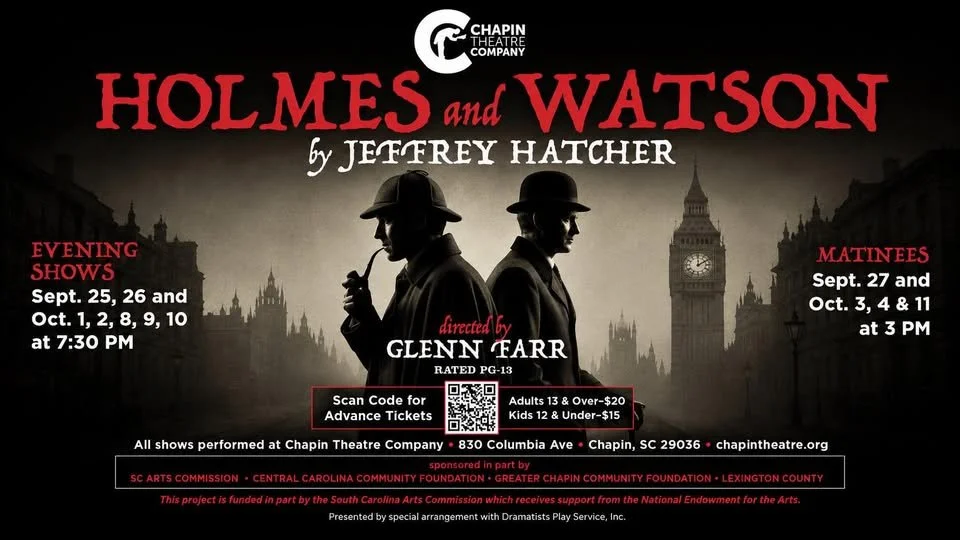
Holmes and Watson by Jerry Hatcher— Sept. 25–Oct. 11

Holiday Show — Dec. 3–13


For memberships or individual tickets, visit chapintheatre.org.

REVIEW: A Heartfelt and Hilarious Start: Second Samuel Kicks Off Columbia Soda City Theatre’s First Season by Jane Turner Peterson

Second Samuel is the kind of show that reminds you why community theatre matters. It makes you laugh, makes you think, and makes you feel connected — to the characters, to the town, and to each other. -JTP

Columbia’s newest theatre company has officially arrived — and what a debut! Located inside Brookland United Methodist Church in West Columbia, Soda City Theatre launches its very first season on a high note with Second Samuel, delivering a show that’s both laugh-out-loud funny and surprisingly moving.

Directed by Jeff Sigley, Pamela Parker’s Second Samuel takes us to a small Georgia town in the 1940s, where life seems simple… until it isn’t. When a beloved resident, Miss Gertrude, passes away, her friends and neighbors discover a secret that rocks their little community to its core.

This play may be set in another time, but its themes are as relevant as ever. One of the cast members, Ripley Thames, summed it up perfectly — Second Samuel touches on “the trifecta” of issues that still challenge us today: homophobia, racism, and prejudice toward people with disabilities. And somehow, the show manages to explore all of that with humor, warmth, and a whole lot of heart.

Sigley’s direction really shines here. He uses the stage cleverly to create three locations — the Bait and Brew, the beauty salon, and Miss Gertrude’s front porch — and the smooth scene transitions, supported by smart lighting, keep things flowing beautifully. The set design makes great use of the space, and the period-appropriate costumes and props (kudos to Joanne Shaw and team!) really help transport the audience to the 1940s.

Now, let’s talk about this cast — because hats off here.

First, keep an eye on Cash Conroy. His performance as B Flat, the young autistic man who narrates the story, is simply stunning. He brings so much heart and honesty to the role, guiding the audience through the story with charm and depth. It’s no surprise he’s already been in several local youth productions — this young actor is definitely going places.

The rest of the cast is just as strong. Debra Leopard is a joy as Omaha Nebraska — her timing is impeccable, and it’s wonderful to see her back on stage. Nathan Wright had the audience in stitches as June Cline, the town caretaker, with his expressive reactions and storytelling flair. Ripley Thames made Mr. Mozel perfectly intolerable (in the best way), and Bill Arvay brought a grounded, easy energy as Doc.

In the beauty shop scenes, Gayle Stewart (Marcella) and Ginny Walker (Ruby) were a hoot, trading zingers, and sass with Tammy Smith as the bigoted Jimmie Dean. And rounding out the Bait and Brew gang — Roderick Haynes (U.S.), Mark DiNovo (Frisky), and Barry Smith (Mansel) — each added their own spark to the mix.

All in all, Second Samuel is the kind of show that reminds you why community theatre matters. It makes you laugh, makes you think, and makes you feel connected — to the characters, to the town, and to each other.

If this production is any indication, Soda City Theatre has an exciting road ahead. Here’s to a fantastic start and many more stories to come!

Catch Second Samuel at Columbia Soda City Theatre before it’s gone. Performances run November 8, 13-15 at 7:30 pm and on Sunday, Nov. 9 at 3:00 pm. For tickets and more information, please visit their website at sodacitytheatre.com.


REVIEW: Workshop Theatre's THE MINUTES - By Jon Tuttle

In a few weeks we’ll gather with friends and family ‘round our family hearths and dining room tables to celebrate the original Thanksgiving, one of our most joyous holidays, which commemorates a brief détente during bloody upheavals between the Pilgrims, who did not wear all black and big buckles, and the Wampanoag tribe, who had been decimated by leptospirosis, Europe’s most lucrative export, and which starred Squanto, who having escaped slavery in Europe, assisted the pilgrims only as a means of gaining political advantage.  We will recall that the main course was probably venison and waterfowl, not turkey, and that in 1621 there were in the colonies no potatoes, sweet or otherwise, no bread, no gravy, no scrumptious desserts, and that after the three-day truce, all the old hostilities were renewed, and all of these truths were buried when the occasion was fictionalized during the Civil War, when President Abraham Lincoln, seeking détente, declared it a holiday.

In preparation, go enjoy Workshop Theater’s production of The Minutes, running through Sunday, November 9, at Cottingham Theatre, a play which pillories our desperate presumptions of civility and harmony and is really quite astounding.

The Minutes is by Tracy Letts, who in 2007 received a Pulitzer Prize for his play August: Osage County, which has been produced locally and in 2013 was adapted for the screen. The Minutes was nominated for the Pulitzer and for a Tony Award after having moved to Broadway in 2022. His other plays, most of them originating at Chicago’s renowned Steppenwolf Theatre, include Killer Joe (1993) Bug (1996), and the brilliant Man From Nebraska (2003), which is about a man searching far and wide for the purpose and fulfillment that is literally sitting in the chair across from him. Letts has become, in addition to being an accomplished actor, one of our finest playwrights.

Therefore, when you see this play, make sure your expectations are high.

At first, you will feel you’ve been tricked. The play presents as a city council meeting in the town of Big Cherry, a middling little burgh about fifty miles from Anywhere, USA. The meeting is as vapid and fatuous as any you’ve ever attended. The council members are all recognizable types—the Old Codger, the Neurotic, the Social Crusader, the Stolid Secretary, The Righteous Gasbag, and the Probably Drunken Visionary—who proceed, following the Prayer, and according to Robert’s Rules of Order, from one tedious agenda item to the next, culminating in the Closing Ceremony. The whole thing comes across, at first, as a harmless cartoon satirizing our best civic intentions.

Our Mr. Blake, played with aplomb by Brandon Campbell, proposes a new “Lincoln: Smackdown!” cage-fighting event to be staged during the town’s annual Heritage Festival, Abe Lincoln having had nothing to do with the town’s founding, but cage fighting being a crowd-pleaser. Our Mr. Hanratty (Marshall Spann, also excellent) lobbies for a new fountain in the village square fully accessible to his crippled/handicapped/disabled/impaired sister, which leads to a debate about inclusion versus costs, idealism versus practicality. Yawn. The most scandalous topic, for a while, is the apparent resale of lost and stolen bicycles by the town’s sheriff.

But then, but then….

The trick being played here is that this meeting only seems boring. It’s the same trick Thornton Wilder played on us in Our Town, which for two acts shows us how empty and mundane our lives are--but then, but then, in the third act, reveals their immensity.

There are two extraordinary moments in The Minutes that reveal the play’s bait-and-switch gadgetry, one of which I will spoil. It is the spontaneous re-enactment, by the council members, for the benefit of newcomer Mr. Peel, of the Battle of Mackey Creek, upon which Big Cherry was founded. Amazingly, breathtakingly, they assume many dozens of roles—farmers, hostile Sioux, American militia—pantomiming the heroic rescue of little Debbie Farmer, who would grow up to be the town’s wealthy matriarch, by one heroic soldier, Otto Pim, who for his valor would earn the Medal of Honor, and so “the Town of Big Cherry is Saved!”

That moment was greeted on the night I attended by an enthusiastic roar from the audience, which was small because the performance was competing with game seven of the World Series and the University of South Carolina football game, the irony of which I will return to later. The point here is that, from this point out, director Patrick Michael Kelly reveals just how deft he is at theatrical sleight of hand. Kelly is well-known and rightfully respected in the midlands as a meticulous, scrupulous orchestrator of theatrical events, and this production can only add to his reputation. From this point out, the play was utterly stunning.

The other extraordinary moment I will not spoil, except to say that it occurs in flashback, when ousted council member Mr. Carp (Glenn Rawls, whose native honesty and compassion suit his character well) re-educates the council about the town’s actual founding and the myths that have been piled upon it since. “We have built this town upon a fiction!” he declares, and so reveals his colleagues as uninformed at best, ruthless hypocrites at worst.

Had the play stopped there, it would have been fulfilling, if perhaps a bit too easy, too moral, because it reveals to us what we already know: that America has always and is still now dancing as fast as it can to validate old lies and invent new ones. Kelly chose to direct The Minutes because, he says, with each news cycle, it keeps becoming more relevant:  “In our era of misinformation, disinformation, and alternative facts, in a country that is deeply divided despite our common humanity, this play skewers national and local politics and blurs the line between parody and truth.”

Kelly cites, as an instance, the recent controversy surrounding the nineteen Medals of Honor given to American soldiers who, at the 1890 Battle of Wounded Knee, slaughtered 300 Lakota men, women, and children, many of them after they had been promised mercy. About the carnage, American general Nelson Miles, who arrived a few days after, noted he had “never heard of a more brutal, cold-blooded massacre.”  In reaffirming the validity of the soldiers’ medals, current Secretary of War Pete Hegseth announced that “this decision is now final, and their place in our nation’s history is no longer up for debate.”

But the play does not stop there—at the revelation about the Battle of Mackey Creek. Instead, it twists back upon itself and implicates us, as citizens in the gallery, as hypocrites as well, showing us our willing complicity in historical revisionism, because we prefer, over truth, our “cocoon of comfort and safety.”  That climactic sequence is enacted by the town’s Mayor Superba, played here and well by John Brunty, who also transforms before our eyes from one thing into something very other. Resplendent, at the beginning, in his red blazer, he looks more like a game show host and comports himself as the voice of reason and moderation. But then, but then, at the end, he declares that “history is a verb” and gathers the council in a horrific, chilling, primal, brutal closing ceremony worthy of Shirley Jackson.

Though I found the acting existed at times on different levels, the cast did a fine job of creating a unified ensemble out of disparate characters who find safety in numbers. Among my favorites were the sanctimonious Mrs. Innes (Carol Beis,), who proclaims, “you all know how I adore low-income children,” and the manipulative Mr. Breeding (Laurens Wilson), whose every posture reveals exaggerated self-worth. Particular mention must be made of Cameron Muccio, whose Mr. Peel, though earnest and guileless, performs an honest interrogation of the council’s motives, only in the end to be subsumed, and also the set designed by Patrick Faulds, which in its cherrywood stolidity and attention to surface detail becomes its own character.

I returned from the play too late to catch the Gamecocks’ loss to Ole Miss, which is a shame, because like every other American, I like the ritual of a familiar story. I did manage to catch the last two incredible innings of game seven, during which the announcers proclaimed that the name Will Smith—the Dodger catcher who hit a game-winning solo homer—will live in our history forever, provided it does not get confused with the other Will Smith, whose name now lives in infamy, and even though two years from now most of us will have completely forgotten who won the 2025 World Series, though it must have been the Yankees.

Because history is indeed a verb. Because it is constantly changing, depending on who’s telling it, it requires persistent inquiry, which is different from denial. The Minutes warns us of this, because outside the committee room, it’s been raining for days, and won’t stop.


Remaining Show Dates & Times:

Wed, Nov 5 - 8:00 pm

Thu, Nov 6 - 8:00 pm

Fri, Nov 7 - 8:00 pm

Sat, Nov 8 - 8:00 pm

Sun, Nov 9 - 3:00 pm

BUY TICKETS HERE

Cottingham Theatre

1301 Columbia College Drive


Jon Tuttle was for many years a professor and administrator at Francis Marion University and is the author of THE TRUSTUS COLLECTION, which gathers six of his plays produced by Trustus Theatre, and SOUTH CAROLINA ONSTAGE, a representative history of theatre in the Palmetto state. He is a member of the board of directors for the Jasper Project. 

16 Brand New Films by SC Indie Filmmakers -TONIGHT @ Jasper's 2nd Act Film Project

There is so much to be proud of about this project that it is hard to know where to start. So, in no particular order, let’s just jump in!

#1 - What about our fabulous poster from local artist extraordinaire Cait Maloney — How Cool is That? Check out Cait’s other work at the link above and hit her up if you ever want graphics that rock the socks off your audience! (You’re barefoot now, aren’t you?)

#2 - Having already produced 84 films from some of SC’s most talented and creative indie filmmakers, Jasper’s 2025 2nd Act Film Project raised the number of accepted entries this year to 16, bringing our total number of films produced across the years by our 2nd Act Film Project to 100!

#3 - In keeping with the Jasper Project’s policy of NEVER charging any artist a fee to submit or show their work, not only is it FREE for filmmakers to enter our 2nd Act Film Project, but Jasper gives all participating filmmakers a modest, but meaningful, $100 stipend to use freely at their own discretion. Need a new piece of equipment to make your film? Use this stipend to help you rent or buy it! Want to make your film punch higher with cool props or costuming? Here’s a hundred bucks to help out! Want to treat your cast & crew to dinner or celebrate with a wrap party? The pizza is on us!

#4 - Thanks to our generous sponsors, Jasper is able to award $2250 in cash prizes to our winning filmmakers in the following categories:


$500 PRODUCER’S AWARD

$250 BESTSCRIPT

$250 BEST DIRECTION

$250 BEST CINEMATOGRAPHY

$250 BEST ACTOR

$250 BEST EDITING

Plus, we bring the folks who come out and support the project with their ticket purchases into the action by giving them a voice in who takes home the big bucks via the

$500 Audience AWARD

(Each audience member is issued one ballot to cast on the film of their choice!)

#5 – Speaking of our Generous Sponsors, we are incredibly proud of the trust they have placed in us to use their funds wisely and for the good of the Arts. Thank you so much for making tonight possible to

Precision Garage Door

Bill Schmidt

FIT Columbia

Rikard and Protopapas

Marketing Performance

And, of course

Coal Powered Filmworks

#6 - Finally, we are still dismayed to have received an unsolicited financial award of $5000 from our sisters & brothers in the Krewe de Columbi-Ya-Ya! We thank you. We love you. We honor you.

And to that end, we are immeasurably proud that, more than a year ago, we decided to rename our TOP film award for the 2nd Act Film Project to the

TOM HALL INDIE SPIRIT AWARD!

There are still a few seats left in the 400 seat Harbison Theatre, but if you don’t have your ticket yet, you should get one now by CLICKING HERE!


Our Call for Jasper's 2026 Play Right Series is Officially Open -- Deadline Feb. 28, 2026

The Jasper Project announces the 6th cycle of its Play Right Series, a collaboration between area theatre artists and Jasper Community Producers—or theater aficionados, supporters and even newcomers. The project will culminate in summer 2026 with the staged reading of a brand-new South Carolina play. 

Submitting A Play

The play submission window is now open. 

  • Playwrights must be residents of South Carolina currently and during the summer of 2026.

  • The winning playwright must be present for development sessions with Community Producers in Columbia during the summer, 2026 (specific dates to be determined later), and must agree to offer program credit to The Jasper Project at any subsequent productions or publications.

  • Plays may address any topic, using language appropriate to the subject matter; we are not, however, considering musicals or children’s plays. 

  • Plays should have no more than 5 cast members, though cast members may play more than one role.

  • Submissions must be one-act plays, 45-75 minutes in length, typed according to industry-standard format (see our Sample Format). 

  • Please include, as a cover sheet, a brief bio of the playwright and description of the play, including cast size and any unusual technical demands, bearing in mind that smaller and fewer are usually preferable.

  • One submission per playwright, please.

  • Please submit your play no later than midnight on February 28, 2026,  to playrightseries@jasperproject.org


Play Selection

When the submission window closes on February 28, 2026, the Play Right Series committee will read and select a play for development through the spring and summer. “Development,” in this case, means round-table readings with paid actors and directors that are attended by Community Producers and Professional Others, followed in the summer by rehearsals and presentation in early September 2026. 

The process will be facilitated by Jasper’s Community Producers—community members and theatre aficionados invested in the development process and supportive of the state’s literary and theatre talent. In exchange for a modest financial contribution, Jasper Community Producers will be offered insider views of the steps and processes inherent in creating theatrical art by attending readings, rehearsals, informative talks, and presentations, including conversations with the actors, director, playwright, stage manager, costumer, and sound and lighting designer. The result: Community Producers learn about the extensive process of producing a play and become invested personally in the production and success of the play and its cast and crew, thereby becoming diplomats of theatre arts.

Busted Open by Ryan Stevens (2025)

One of the perks of winning the Play Right Series Project is having your play published in book format and filed with the Library of Congress. AND, we give you a large stack of books to distribute to the producers, directors, and family members of your choice!

(Don’t forget your Mom!)

Check out the plays Jasper has already published:

Moon Swallower by Colby Quick (2022)

Therapy by Lonetta Thompson (2023)

Let It Grow by Chad Henderson (2024)

At the Jasper Project, we LOVE facilitating new art from ALL the arts disciplines! Our Play Right Series is just one of the many projects that allow us to do so.

Spread the Word! Spread the Love! Make New Art! Make Columbia an Arts-Centric Home for Us All!

REVIEW: Dracula, A Comedy of Terrors by Jerry Crouch

Dracula, A Comedy of Terrors, opened Friday night, October 3rd at Chapin Theatre Company and grabbed the audience by their throats, tickling their collective funny bones, sucking every laugh possible from the applauding fans. In the slapstick, standup comedy tradition of Mel Brooks and Monty Python, this silly spoof of Bram Stoker's classic 1897 vampire novel is dazzlingly acted out by five of the most versatile actors Columbia theatre has to offer. Four playing a brew of manic, murderous multitude of roles, not unlike last Chapin Theatre season's role-switching The 39 Steps where the starring lead male then was none other than this show's fang-tastic director, George Dinsmore.

This 90-minute blood-thirsty play offers these actors—Debra Kiser, David Fichter, Frank Thompson, Katie Mixon and Josh Kern—the challenge of a theatrical lifetime,  throwing puns, punchlines, and naughty innuendos against the ever-changing castle walls amid the nimble narrative, with lightning quick costume changes (some hilariously done on stage) and with a plethora of accents! The big character role winners by a Transylvanian mile are Fichter and Kiser, blending proper British and German accents along with a variety of other dizzy dialects and personalities making for a madcap cocktail of fun. But let's toss kudos of garlic-laced funeral wreaths to the entire cast of this bawdy farce.

David Fichter is a dead-on hoot playing the misogynistic Dr Westfeldt, who begins as the arch-nemesis of Kiser's strict, straightlaced German Van Helsing. But their second act reactions take a decided turn for the better. Fichter's loony, bug-eating, straight-jacketed Renfield almost steals the night's spotlight from Kiser's redhead coiffed Mina, a desperate date-deprived spinster in need of some serious orthodontal intervention. Fichter also manages to step into the role of a salty Sea Captain with both actors early on, becoming ferocious howling wolves along with Mixon.

Mixon is the epitome of the courageous but romantically confused heroine, Lucy Westfeldt, hitting every nuanced note and her role switch to the kleptomaniac mental nurse, Kitty, is a delicious surprise. Mixon also plays a rowdy carriage driver in the opening scene. Master comedian, Frank Thompson plays the night's straight man in the role of the cowardly real estate agent, Jonathan, and in one scene (with a bow to Sesame Street) plays three characters at once in the guises of the Scottish Lord Cavendish, the very British Worthington, and the Texan, Lord Havemercy. Thompson also easily polished off the double roles of a scurvy Bosun and a drunken Gravedigger. 

But with all the night's multiple role switching, is the leading actor short-changed playing only a single role? Hardly. Josh Kern in the sexy buff role of Dracula proves a deadly, charming centerfold and an equal opportunity romancer of both Lucy and even her intended, Jonathan Harker. As Harker, Thompson enjoys a late act romantic renovation after his rendezvous with Kern which proves to be a neck-biter twist. Earlier this season, Kern perfectly played the comic lead of Paul in Barefoot in the Park, so here, his sly, narcissistic, revisited take on this horror icon shows his considerable versatility on the Chapin stage in two radically different performances in one season. Bravo!

Special honors goes to Dracula Producers, Jim DeFelice and Tiffany Dinsmore for bringing this comedy gem to their Chapin stage. The beautiful, facile set, sound, costume, props, and dramatic projection designs are ambitious, but all laser quick transitions came off with nary a hitch on opening night.

Dracula, A Comedy of Terrors 
Adapted by Gordon Greenberg and Steve Rosen plays for two more weekends
October 3, 4, 9-10-11 and 16-17-18 at 7:30 pm evening performances with 
October 12 and 19 on Sunday 3:00 pm matinees.

Chapin Theatre Company is located at 830 Columbia Avenue, Chapin 29036
For tickets: 
chapintheatre.org    [803] 240-8544


Two More Nights to See Titus Andronicus for Free and Break Your Mind When You Think About Shakespeare Forever

by Cindi Boiter

Last night, I popped by Earlewood Park amphitheater to scope out the situation for our little party that is seeing South Carolina Shakespeare Company's Titus Andronicus tomorrow night (and to get hugs from my kids). I only stayed 30 minutes, but wow. Full disclosure that director Chad Henderson is my son-in-law, but I’ve got to say that he and his team have really pulled off something brilliant with this production. It’s absolutely out of the box —innovative and surprising and a little surreal.

For example, in the photo below, we see Jennifer Hill in the role of Tamara, Queen of the Goths, but behind her we see the imposing face of Darion McCloud as Aaron, her lover, projected onto the draped screen as he delivers yet another menacing line.

In this photo we see Catherine Hunsinger, in the role of Lavinia, the daughter of Titus Andronicus, on the actual stage but also projected behind her giving the audience a larger than life look after an unspeakable act has befallen her character. Evidently this is the work of videographer Adrian Williams with Megan Claxton pulling focus.

The cast also includes Stann Gwynn (as Titus), Tracy Steele, Richard Edward, Christopher Cockrell (as Saturnius), Marshall Spann, Chris Aimone, Brandon Martin, Dakota Walker, Tristan Brown, young Aden Cobb, Sunni Greene, Brittany Bierman — you probably know many of these folks yourself. But Bonnie, my daughter, was explaining that every night of this multi-media production, all these actors - the whole cast and crew, plus some noble volunteers - have to break down the stage and load out all the equipment, only to load it back in the next afternoon.

If this isn’t dedication to one’s art, I’m not sure what is.

And by the way, the event is free. All you have to do is roll up like I did last night. Parking was easy in the lot and there are designated spots along the road. Head to the small covered pavilion with picnic tables and then just follow the winding sidewalk down to the amphitheater. It’s a short walk. The amphitheater has concrete seating so I’m taking a tailgating chair and, since it’s supposed to be fall Saturday night, I’ll take a blanket, too as well as some vino (Vino Garage is 2 minutes away) and cheese and stuff for a nice pre show picnic. I hope we get to see a lot of friends there!

Titus Andronicus will be performed tonight and tomorrow,

October 3rd and 4th at 8 pm.

For more info about the SC Shakespeare Company visit their website at www.shakespearesc.com or shoot them an email at info@shakespearesc.com.