
In his autobiography, Timebends, playwright Arthur Miller described McCarthyism—the hysteria that gripped postwar America in the 1950s—as “the inexorable march of the cheerful totalitarian patriots” who reprehended “all that was not simple to understand, all that seemed foreign, all that implied something slightly less reassuring than that America stood innocent and pure in a vile and sinister world beyond its borders.” During the attendant hearings before the House Un-American Activities Committee, Miller “saw the civilities of public life deftly stripped from the body politic like the wings of insects or birds by maniac children, and great and noble citizens branded traitors.”
During that dark chapter in American history—engineered by Senator Joseph McCarthy (R-WI) on behalf of his party—Miller was called to answer for his involvement with left wing intellectual circles and to surrender the names of his commie comrades. Whereas some of his contemporaries, including friend and collaborator Elia Kazan, willingly surrendered their integrity, Miller refused to “use the name of another person to bring trouble on him.” He was therefore convicted, in 1957, of contempt of Congress, a decision whose reversal the following year triggered the dismantling of the HUAC and caused Edward R. Murrow to conclude that “No one can terrorize a whole nation unless we are all accomplices.” By then, McCarthy had been condemned by the Senate and had died of cirrhosis.
In the meantime, Miller’s The Crucible (1953) had opened Broadway and won the Tony Award for Best Play. It was not the first play to compare the HUAC to the Salem Witch Trials of 1692; there were at least three others preceding it, including William Carlos Williams’ Tituba’s Children (1950). But it was by the far the most commercially successful and the only one we still turn to when we need it most.
“No one can terrorize a whole nation unless we are all accomplices.” — Edward R. Murrow
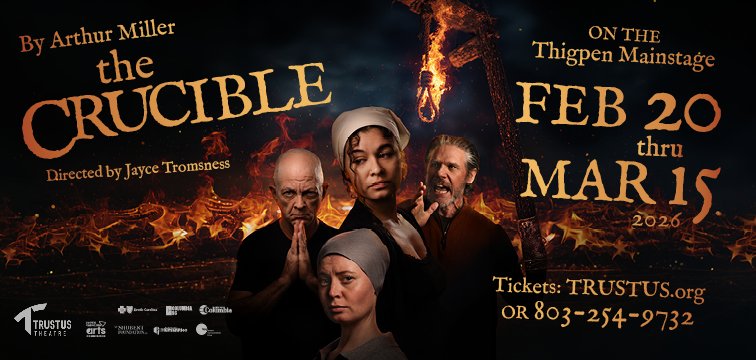
Hence Trustus Theatre’s current production, which opened on Friday, February 20, to an utterly thunderstruck audience. It is magnificent. There is indeed so much to admire here that it’s hard to know where to begin, so much to say about each element that it will be hard to know when to stop.
For instance, the acting. The ensemble of nineteen is perfectly choreographed, wholly worthy of one another, and up to the heady challenge posed by Miller’s dialogue, which on the page can smack of melodrama but becomes in their performances nigh operatic. Names must be named: Jason Stokes, as John Proctor, inhabits the play’s moral center of gravity with an authority gradually leavened with vulnerability. Stokes’ delivery of Proctor’s famous speech at the end—the one about names being the last vestiges of legacy—is the pitch perfect crescendo it should be. As Proctor’s goodwife Elizabeth, Ashley Rose Montondo is the deep well of fortitude from which he has always drawn and, ultimately, marvelously, his jury. Around them, invisible but powerful social forces constrict like nooses, beginning with the Puritan clergy, namely Reverends Parris (played by William Paul Brown), who is nefarious, and Hale (Asaru Buffalo), whose attempts at honorability demonstrate Miller’s desire not to blame religion for absolutely everything.
Through the courts’ machinations, the play reveals the worst of America’s timeworn banes: superstition, ignorance, hypocrisy, litigiousness, sanctimony, greed, jingoism, and above all, the threat to bodily autonomy, which starts with the women but comes, like vengeance, for everyone.
That blame lies largely with his magistrates. Cameron Muccio portrays Judge Hawthorne as an embarrassingly sycophantic Lindsey Graham-like jurist made tumescent by his new power, and this, lest it reads otherwise, is a high compliment. Muccio proves an apt intern for Steve Harley’s Judge Danforth, whom Miller, in his research, found so sadistic as to be a primary evil. As a primary evil, Harley is superb, primarily because he’s not playing evil at all. Rather, his Danforth is a man so blindly committed to Puritan jurisprudence that he would gladly “hang ten thousand that dared to rise against the law, and an ocean of salt tears could not melt the resolution of the statutes.” As unfortunate stooges of the court, Logan Keller (as bailiff Ezekiel Cheever) and Adam Hobbs (as marshall John Willard) ably demonstrate the depths to which good men might sink in order to save their own skins. Through the courts’ machinations, the play reveals the worst of America’s timeworn banes: superstition, ignorance, hypocrisy, litigiousness, sanctimony, greed, jingoism, and above all, the threat to bodily autonomy, which starts with the women but comes, like vengeance, for everyone.
At stake in all of this is civilization itself, represented here by the townsfolk of Salem, to whom we’ll turn in a minute. First, though, we must admire the writing. Miller’s legacy needs no championing; he is arguably the foremost American dramatist of the past hundred years—superior, yes, to Eugene O’Neill, owing to the latter’s hopelessness. Miller is, conversely, very hopeful. He believes in America’s virtue, and so many of his plays (see also Death of a Salesman, All My Sons, The Price, The American Clock, A View From the Bridge), are embodied warnings about the menace America poses to itself. When you go see The Crucible, which you must (it runs through March 15), watch the way menace metastasizes from rumors and abstractions in the world outside to visitors standing in our dining room.
And so now to the townsfolk, beginning with the least able to defend themselves, like the dispossessed Martha Corey and Sarah Good, (both played by Catherine Bailey); or Ann and Thomas Putnam (Brittany Hammock and Adam Hobbs again) as parishioners so desperately devout they’ll swallow anything; or Francis and Rebecca Nurse (Stann Gwynn and Ilene Fins), he a man powerless to stop the murders sanctioned by his neighbors, she an unreproachable pillar of the community and the best gauge of the magistrates’ bloodlust.
This reviewer cannot explain how [Hunter] Boyle manages to create such a complex, compelling and complete character, and so concludes it must be sorcery.
Here, a whole paragraph must be devoted to Giles Corey, in history a savvy farmer versed (after much experience) in courtroom protocol, in the play a sometimes comic but ultimately wily and triumphant martyr for the growing resistance against the court. Corey’s execution and last words, though reported only indirectly onstage, still somehow linger long after the play is over, which testifies to the authority Hunter Boyle brings to the role. This reviewer cannot explain how Boyle manages to create such a complex, compelling and complete character, and so concludes it must be sorcery.
Which brings us, at last, to the witches. The witches are not witches, sorry, they’re just girls, but they writhe exquisitely and do creepy things and are responsible for the most unnerving scene this reviewer has ever witnessed on any stage. They are Mercy Lewis (played by Meagan Aubuchon), Betty Paris (Chloe Newport), Susanna Walcott (Maryssa Drake), and their Jamaican squad leader Tituba (Nicole Perez). Particular mention must be made of Kate Anderson’s portrayal of Mary Warren and Kaeleigh Miller’s of Abigail Williams. Abby is, in history as in the play, the primary architect of the horror visited upon Salem, a girl motivated less by piety than puberty, but made somehow remarkably beguiling in Miller’s portrayal. Mary begins the play as Abby’s accomplice, but then bravely attempts to save Salem from itself until she is undone by the most unnerving scene this reviewer has ever witnessed on any stage. The actors playing these five witches, though younger, rise to the level of professionalism evinced by their more experienced castmates and complete an ensemble that is collectively and unequivocally the star of the show.
Credit for this magic trick goes to director Jayce Tromsness, a Trustus veteran from the Thigpen era and a well-traveled actor/playwright/designer/educator/musician/maybe a witch. In his hands, The Crucible is a perfectly realized theatrical event. It begins with a barely audible but still disturbing audio of an interrogation, and ends with a devastating tableau you will not see coming and will never unsee. Each scene along the way begins with characters staring at us accusingly, which frankly we deserve. When you go see it, which you must, watch the way lighting designer Marc Hurst deploys shadows, silhouettes, even apparitions to cast a spell, but also explosive flashes to shock us out of it. Watch the way costumer Adai’Shun Cook transports us from the 17th century into the 21st. Watch the scene design, particularly the eerily Kandinsky-esque scrims and flats (Tromsness again) manipulate atmosphere. Listen to the sounds (Tromsness again, he’s a witch) particularly the cheerful non-existent bird in the most unnerving scene this reviewer has ever witnessed on any stage. And oh: pay close attention to the color red.
And consider, when you go, which you must, Eric Bentley’s observation, in The Dramatic Event, about the timelessness of The Crucible: “One sits before this play with anything but intellectual detachment. At a moment when we are all being ‘investigated,’ or imagining that we shall be, it is vastly disturbing to see indignant images of investigation on the other side of the footlights. Why one wonders aren't there dozens of plays each season offering such a critical account of the state of the nation?”
NB: As The Crucible includes triggering images/social issues, it is not appropriate for all ages. Tickets are $35, or $32 for seniors/students/military.
Jon Tuttle is a member of the Jasper Project’s Board of Directors and the author of The Trustus Collection and South Carolina Onstage.