

Becci Robbins
She sits at the corner of Elmwood and Marion, low-slung and unassuming, a stone’s throw from the red dome marking the old lunatic asylum on Bull Street (not to be confused with the other domed asylum, on Gervais). Unless you’re looking for her, she’s easy to miss. The hand-painted sign out front is dimly lit and reads simply GROW — Grass Roots Organizing Workshop.
It’s Thursday evening, and traffic is thinning on Elmwood Avenue. The setting sun is reflected in the building’s front window, streaking it copper and gold. The door is propped open, letting in a blessed breeze and a slow trickle of musicians setting up for the night’s show.
Chris trundles in with his upright, fires up the sound system, adjusts mics, turns on some background music, classic jazz. Antron and Ken come in, carrying music stands and their saxophones, followed by Dionne, who sets up her keyboard under the unblinking gaze of a pensive MLK. Joe makes several trips to his car to set up his drum kit. Geoff unpacks his guitar and settles onto a stool in the corner. Seitu makes the rounds, dispensing hugs, and pleasantries. Sara wanders in with a bag of tangerines and fresh outrage about the day’s news.
My husband, Brett Bursey, stocks the bar and preps the cash drawer. I rearrange the tables that were moved when the peace group met here two days ago, and plug in the sound-activated disco lights. I set out fresh water and ice. Wash grapes, slice pound cake, arrange cookies on a platter.
I never tire of the ritual, or the people. By now, they feel like family, and this corner of Columbia feels like home. For three years, we have gathered here twice a month for jazz workshops. In August, we added blues to the menu, so we now offer live music every Thursday night. It is a joyful noise — loud enough to mute, if only for a few hours, the freak show raging outside.
The free jam sessions have cultivated a loyal following, with seasoned professionals sharing the stage with young talent. There is a generosity of spirit on stage and in the audience that favors participation over flawless performance. Because you never know who is going to show up, the shows are always fresh. Sometimes, they are pure magic.
A friend calls it therapy. She is not alone. So many of us are craving connection in these socially fractured and politically dangerous times. Gathering like this feels like resistance.
The regulars begin to arrive. Patricia and William secure their favorite table in back. The single ladies gravitate to the stuffed chairs by the window. There’s lovely Toni, and radiant Maris, and sweet Fran with her street-wise Pomeranian, Tito. There’s Nancy and Curt, who plays a mean sax. Our former neighbor, Stan, has brought with him a visiting relative. Femi stops by the bar to donate two bottles of Cabernet. Others leave offerings on the food table. The snacks and beverages are free, but an old-school piggy bank welcomes donations.
By now, most visitors know that GROW is meat-free, for reasons listed on a sign next to the kitchen (in short because we care about the planet, animals, and public health). To help drive the point home, there is a picture of a pig wearing a flower crown that reads, ransom-note style, KiLL the PAtriaRchy, NoT PiGs.
First-timers are as easy to spot as tourists in Rome. They stand in the back or perch on the settee in the hall, taking it all in. The variegated crowd. The raft of musicians up front. The handouts by the door promote meetings and events. The shelves stuffed with history books and biographies. The walls are papered with flyers, postcards, and old posters — No Nukes, ERA YES, Save the Whales, Bob Dylan, Bob Marley, Jimi Hendrix — and portraits of Che, Robert Smalls, Frederick Douglass, Sarah and Angelina Grimké.
A large chart illustrates the state’s gerrymandered legislature, a grim pictograph of our rigged system.
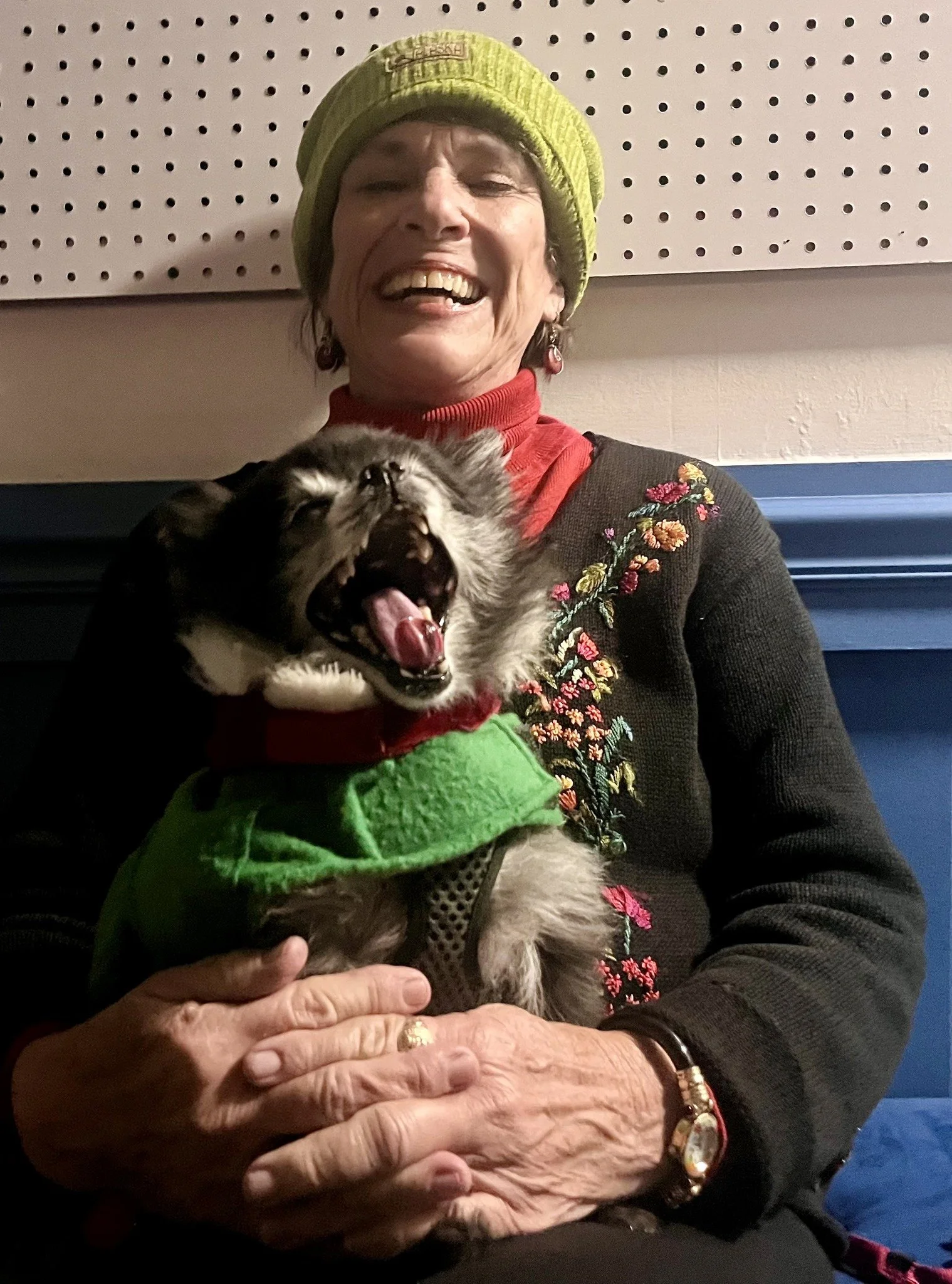
Fran Cardwell with Tito — Photos courtesy of the author
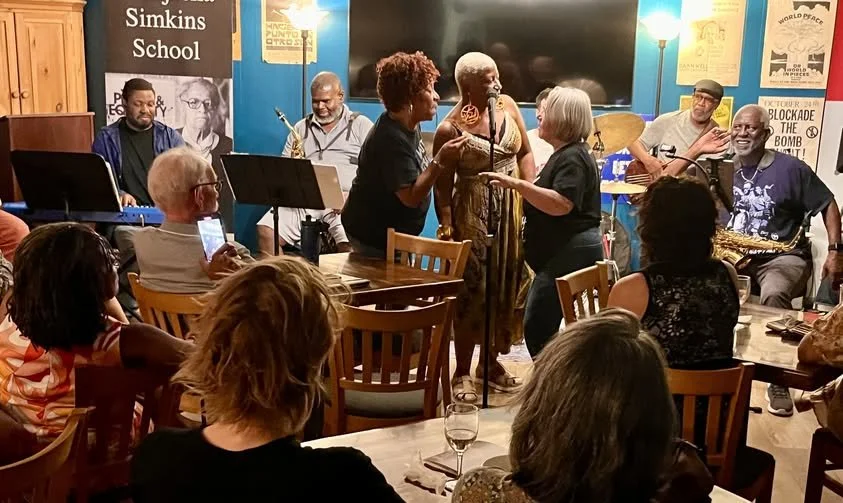
Most of the posters hung in the original GROW, a worker collective that was a hub of progressive activism from the late ’70s through the early ’90s. Longtime Columbia residents will remember the building behind the old ballpark with the mural of the Incredible Hulk smashing through the front wall.
Started by veterans of the anti-war and anti-nuclear movements, GROW sustained itself by running a cafe and a print shop. It expressed itself by publishing its own journals — Harbinger and, later, POINT, a monthly newspaper that for 10 years happily skewered the Palmetto State’s bad actors and power elite.
In 1996, GROW started the SC Progressive Network, a coalition of organizations with a shared belief that we are stronger united than separate, when we collaborate, share resources, and show up for each other, even when it’s hard. Especially when it’s hard.
While the Network has evolved over the years, its core mission remains the same: to power a movement for social and political reform that benefits us all, not just the monied few. Politically, we are anti-partisan and choose our legislative battles with care.
Strategically, we focus our time and energy on South Carolina. As we say, “We can’t change DC until we change SC.”
In 2009, the Network leased the Modjeska Simkins House, keeping offices and holding meetings there for a decade, until the home was converted to a museum. Simkins had mentored and inspired the activists at GROW in the 1980s, so it seemed a perfect fit. And it was while it lasted.
We were homeless for a while, but after an extensive hunt for a place to call our own, the Network came full circle back to Marion Street, buying the property next door to the Simkins House in 2019 — just in time for the pandemic.
The timing seemed awful but, in hindsight, the lockdown gave us time to renovate the building properly and the incentive to install a quality AV system to allow for remote meetings and programming. The investment has served the Network well.
In 2015, the Network launched a school to instruct students of all ages and interests a people’s history of South Carolina — the stories that have been whitewashed or erased altogether — and practical tools for being effective organizers and citizens. We named it the Modjeska Simkins School to honor the woman who showed us how it’s done. Turns out, she had started a leadership institute in the ’40s, with a curriculum eerily mirroring our own.
In February 2026, we will open enrollment for our 11th session, which will run from March through June. Students from across the state will meet Monday nights in-person at GROW and at satellite sites in other towns, and on Zoom from anywhere. During the semester, the school offers Deep Dives on most Sundays that feature writers, historians, and filmmakers. The programs are free and open to the public.
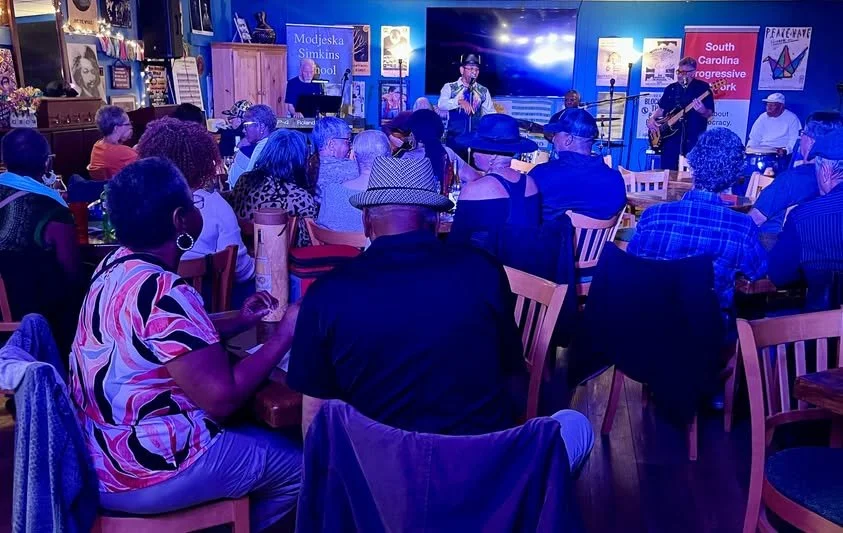
It’s last call. It’s been a great ride tonight. Lots of new faces in the audience and onstage. Dickie and Shannon took turns at the keyboard. Seitu did some inspired scat, and Steve wrung the juice out of his flute. Margaret broke hearts with her torch song. Sara torched Elon Musk and “rich people having a ball; rich people fucking us all.” And Cesar, the Louisiana bluesman and harmonica master, broke out his washboard for a call-and-response number that had the room on its feet.
As the clock inches toward 10, the band launches into “Sugar,” its regular closing number. Nobody gets up to leave, not until the last note is played. Even when the lights go up and the show is over, people linger.
The band packs up, the helpers have done all they can, and finally the parking lot empties. I take the trash out and roll the recycling bin to the curb. The porch lights are on at the Modjeska House next door. I think about all the people who sat with her there over the years, from Thurgood Marshall in the ’40s to a young Brett in the ’70s. I wonder what she would think of the school, the hippies she mentored. I wonder, too, what she would make of her rebranding. Once called a commie and ostracized from the organization she started, she has now been embraced by the establishment as a civil rights icon.
I head inside for one last look around. Leisa Marie, a friend from the original GROW days, helps me lock up. Before heading to her car, she gives me a hug and says, “You have built a fine house.”
I smile and nod. Yes, yes, we have.

Becci Robbins is Communications Director for the SC Progressive Network.
This article appeared in the Fall 2025 issue of Jasper Magazine.