Clay Artist Vanessa Hewitt Devore Kicks Off New Virtual Tiny Gallery Series for the Jasper Project

vanessa.png

The Jasper Project kicked off our Tiny Gallery Series back in October, 2018 with the express purpose of affording artists an opportunity to show a selection of their smaller pieces of art at affordable price points. With a variety of work priced at $250 or less, our shows have attracted seasoned buyers and budding art collectors alike, featuring top Columbia-based artists like Thomas Washington, Christopher Lane, Michael Krajewski, Olga Yukhno, and Eileen Blyth.

While safety concerns related to COVID-19 may prohibit us from welcoming artists and their patrons in person, Jasper is excited to announce a new component of the Jasper Project – the Virtual Tiny Gallery Series! Upcoming artists include Lucas Sams, Gina Langston Brewer, Lindsay R. Wiggins, and more later as the year progresses.

Today, we’re delighted to announce our first Virtual Tiny Gallery artist – Columbia-based clay artist, Vanessa Hewitt Devore. Devore grew up in Columbia before attending Winthrop University, the place she fell in love with ceramics. After kindling that relationship, she made it concrete with an MFA in Ceramics from GSU in Atlanta.

Vanessa art.jpg

Devore isn’t the only artist in her family, though. In fact, she is a fourth-generation artist—her great grandmother was a painter; her grandmother was a potter and painter; her father is glass artist, Steve Hewitt; and her mother is renowned artist and educator, Mana Hewitt (one of our featured artists at the Supper Table, whose metal-worked place setting for Eartha Kitt became the cover of the book, Setting the Supper Table).

The work Devore creates is often inspired by her love of nature, plants, and animals. Some of her earliest memories are of her grandmother’s backyard. “Every day, [I] would help her plant and tend her flowers, and she would point out to [me] all the different birds and animals that would visit her garden,” Devore says. 

Beyond pottery, Devore has experimented with stained glass and metalsmithing and is drawn to needlework and quilt making. “Colors and simple shapes really appeal to me,” she says. “My ideas center around creating a whimsical, fun object.”

All the work exhibited in the Tiny Gallery show is porcelain, carved using the sgriffitto technique, and made on the same wheel on which her grandmother once threw.

In her collection of 8 pieces, including bowls, vases, and jars, Devore demonstrates her color mastery with hues of terracotta and turquoise traced in black amongst a stark textured white background. According to Devore, “I like that my objects are usable, and I hope the work I make makes people smile.” 

You can see Devore’s work on the Jasper Project website until Monday, July 13th. All purchases can be made directly from the site. Upon purchasing, your info will be shared with the artist to arrange delivery of the artwork.

*Are you an artist interested in showing your work for a Virtual Tiny Gallery show? Email Tiny Gallery Manager Christina Xan at JasperProjectColumbia@gmail.com.

An Interview with Board Member Bert Easter on the Jasper Project Galleries at Meridian

With the Street Gallery concept, the public can visit the Jasper Project Galleries windows and not have virus concerns.  Viewing artwork at these windows can be done safely from the sidewalk; someone could even drive by and take a peek at the artworks from their car. 

-Bert Easter

Board Member, The Jasper Project

Bert Easter - courtesy of Ed Madden

Bert Easter - courtesy of Ed Madden

Last April, The Jasper Project opened a new gallery in a prominent downtown Columbia building. Though the Meridian Building opened its doors in 2004, it was built from the facade of the 19th century Consolidated Building. This coalescence of elements externally can also be found internally, through the art featured in the lobby and the display windows that line Sumter and Washington Streets.


courtesy Historic Columbia

courtesy Historic Columbia

I was able to chat with fellow board member Bert Easter, who started and organized the gallery, about what this first year has been like, what artists are currently being featured, and how the public can interact with this significant space and the art within it.


JASPER: It’s been just over a year now that you’ve been working on the Meridian. How has it been?

EASTER: I really have had great luck with the Meridian hosting and being very helpful with my little idea.  It’s actually been a lot of fun, and some work, pulling together artwork to offer in downtown Columbia. And we have been very lucky to develop a partnership with Virginia Scotchie of USC to show student work alongside her artwork.

JASPER: What made you first walk past this building and think, “This is the place for a gallery”?

EASTER: I saw the windows as a missed opportunity for both the city and the arts community.  When I approached the Meridian, I was pleased that they were excited with this idea and even offered the additional space of the grand lobby area to be opened up for local artists. 

JASPER: Did you have any specific goals for it then?

EASTER: I hoped then, and now, that at the Meridian we would have business folks who might see, connect with, and purchase local art.

JASPER: With such a great pool of artists in Columbia, how do you select artists to meet the gallery’s goals?

EASTER: Thus far I have contacted the artists and helped select artwork that I hope works well and complements the other artists’ work.  I try to also have a few pieces that challenge the traditional ideas of artwork – to offer abstract paintings or a brutalist sculpture or a pottery vase that you would never use for flowers.   

JASPER: Have you had any highlights in this journey of merging art styles and voices?

EASTER: Pulling together Assemblages by Susan Lenz, with plastic assembled work by Kirkland Smith, alongside found metal items sculptured by Andy White was one of my favorite window displays show in our first show.  I have also enjoyed showing pottery by Paul Moore with carved palmettos on the side of the vases placed by landscape paintings.  

JASPER: Well other than great art, what should people expect when going to the gallery?

EASTER: The windows are just like storefront windows for a department store.  They are lighted at night, and I actually tell folks that the windows look better at night from the street and sidewalk.  The lovely Main Street lobby is limited to weekday business hours (8-6) due to the security concerns of the Meridian. Currently, once you enter through the revolving doors on Main, you’ll find pottery on pedestals by Virginia Scotchie and USC students and paintings on canvas by Nikolai K Oskolkov.

 JASPER: Has COVID-19 impacted the way people visit the gallery?

EASTER: With the Street Gallery concept, the public can visit the Jasper Project Galleries windows and not have virus concerns.  Viewing artwork at these windows can be done safely from the sidewalk; someone could even drive by and take a peek at the artworks from their car. 

JASPER: You mentioned it briefly before, but if people want to stop in or drive by, what artists can they expect to find currently? And how long will the current artists be up?

EASTER: The current show has 10 different artists being offered with a large collection of paintings by Nikolai Oskolkov in each of the 3 galleries on this block. We have been switching out artwork every 3 months so that we would have 4 shows each year.  When the virus hit, we stopped, and the current show has been left up, but I plan to switch out the artwork after the virus is less of a concern. This show includes art by Nikolai K Oskolkov, Bohumila Augustinova, Michael Krajewski, Eileen Blyth, Virginia Scotchie, and USC students from the School of Visual Art and Design. 

JASPER: What should people do if they see one of these pieces of art and fall in love with it?

EASTER: The signage will provide the cost of the artwork and my cell number where folks are able to ask any questions, arrange for me to come to the Meridian and meet with them, or to arrange purchase of the artwork. As far as pricing, we have offered original artwork starting with prices at $200 and going up to $2,500.  

JASPER: Well, to round all this out, tell me: Columbia is a city full of artists & galleries — what makes the gallery at the Meridian special?

EASTER: We have established this partnership with the Meridian to offer artwork outside the gallery setting to bring local artworks to the people who might not visit galleries with the intention of purchasing artwork – in a hope that downtown folks might see, connect, and enjoy art by local working artists.  We think that the display window setting might allow someone just headed out to a meeting, dinner, or a local church service to view artwork in downtown Columbia.

The Jasper Galleries at Meridian is located at 1320 Main Street. If you’re feeling cooped up at home and want to feel inspired, take a drive down Washington or Sumter Street and see the selection of artists that Property Manager Amy Reeves stated “brought life to our windows”, and maybe even take a piece home to keep you company.

 -Christina Xan

Christina Xan is a writer, a doctoral student at the University of SC, and a member of the board of directors of the Jasper Project where she manages the Tiny Art Gallery Project.

The Jasper Project operates public space galleries at Harbison Theatre, Motor Supply Company Bistro, and the Meridian Building in downtown Columbia. If you’re interested in developing a gallery area in your public space, or you’d like to exhibit your art, please contact Laura Garner Hine, Bert Easter, Christina Xan, Cindi Boiter, or Wade Sellers.

To support the work of Jasper, including articles like the one above,

please consider becoming a member of the Jasper Guild at www.JasperProject.org

JP Galleries .jpg

Jasper Project Galleries Adds New Location at Motor Supply Company - Curated by Laura Garner Hine

JP Galleries .jpg

The Jasper Project is pleased to add Motor Supply Company Bistro in Columbia’s historic Vista to our growing list of Jasper Project Galleries, including Harbison Theatre Gallery and the Meridien Building Sreetside Galleries (curated by Bert Easter) at Washington and Sumter Streets in downtown Columbia.

Jasper Project board member and Jasper Magazine visual arts editor Laura Garner Hine will be curating the series for the Jasper Project and is opening the series with a selection of her own work beginning this week.

Below, please find an excerpt from a story featuring Hine written in 2019 for Jasper Magazine by Christina Xan.

Laura Garner Hine

Laura Garner Hine

Though many people struggle to decide on a career path, Hine knew she was going to be an artist for as long as she can remember. “It's my strongest sense,” Hine says, “There was never a question, my whole life.” 

Hine started seriously studying art as soon as she became cognizant of her choice to commit to it. Upon graduating high school, when she got a scholarship for USC, she knew immediately she was going major in art studio. “I didn't know what I was going to focus on yet,” she recalls, “but eventually it became oil painting. You can make it so many different things.”

Hine is indebted in large part to her mentor, Pam Bowers. She remembers her and Bowers harvesting dirt from which they would make their own paints: “I felt like I was doing alchemy,” she said. This is when she ended up minoring in art history.

laura 3.jpg
laura 2.JPG

After Hine graduated, she studied abroad in the Netherlands. While there, she heard of a conservation course happening in Maastricht, and she decided to go – a decision that would change her life. Hine reflects on her first experience with conservation: “It was the marriage, to me, of all the things that I'd loved: art history, that alchemy, and the science behind art.”


Although this trip was the first time Hine had experienced conservation hands on, she believes she was always meant to conserve art. She remarks that, “I think I'm in the business of seeing. Everybody has the capacity to look, but there's merit and thought behind really seeing. It's kind of a fantastical thing.”

Hine believes her relationship to seeing beyond the surface of an image or object is really what led her to first her path as an artist and then her job as a restorator, a process she is incredibly lucky to be a part of: “It's quite meditative,” she ponders, “I think it transcends you into this moment of this dissolving of perception, and you become one with it.”

The process of conserving and restoring art is a multistep process, and it’s not formulaic. However, there is a system to work through. First, Hine has to do research, find out what the materials are and what they're sensitive to. After preliminary research, Hine begins testing to deduce what would be safest to use on the art piece. Grime or dirt can be removed with something as simple as distilled water to something as damaging as toluenes, but Hine avoids using anything toxic unless it’s absolutely necessary.

Laura 4.jpg
laura 1.jpg

Sometimes, though, the painting is further compromised. If there is a tear or severe damage, Hine must remedy that first. These losses need to be fixed by covering cracks and shaping areas that have lost texture. Last, it’s time to color correct, which is where “the fun starts” for Hine and where her jobs as artist and restorator most closely overlap. When just a little color is missing, she looks at the surrounding area and mimics, but if something major like a face is missing, then she has to do more detailed research to create an impression as close to the original as possible. From start to finish, on average, it takes Hine around 8 hours to restore a painting.

Hine worked at the CMA as an Assistant Preparator for two years, but now she works full time for Carolina Conservation. For her, restoring art is just as intimate as creating it: “I want to hear the paintings talk to me. I want to know what they've seen. I'm a firm believer that energy never dies. People always come back through the ethers.” This conversing is one aspect that strongly connects Hine’s restoration and personal creation.

Hine laughs when trying to pin point herself as an artist, claiming people will go into a show of hers and think the art is from multiple different artists. One continual tether Hine has with her art, however, is her sensitivity and how once something has touched her, she has no choice but to create in inspiration of it. “My inspiration can be pretty; it can be grotesque,” she muses, “Any moment that arrests you, whether it's disgust or awe, I like those moments.”

While she might feel all over the place as an artist, she feels a strong importance in her work: “I think that what really inspires me is how people are inspired by me. I feel that anybody I meet likes to listen to my story, and I like to listen to their story.”

-Christina Xan

Motor Supply Co logo.jpg

Motor Supply Company Bistro is located at 920 Gervais Street in Columbia, SC’s historic Vista

Find out more about Motor Supply at

www.motorsupplycobistro.com

To support the work of Jasper, including articles like the one above, please consider becoming a member of the Jasper Guild at www.JasperProject.org

Corona Times - Profile of Portraitist Lori Isom

…as if a worldwide virus killing thousands of people weren't enough, now the news of not one, but a string of black people being killed by police and others in succession - Breonna Taylor, Ahmaud Arbery, George Floyd. … I went numb.

— Lori Isom

——-

Jasper continues to check in with Columbia artists to see how we’re all doing during these strangely hypnotic times in which we’re living. Jasper editor Cindi Boiter had the opportunity to chat with Columbia-based portrait artist and fascinating human being, Lori Isom.

Here’s what we learned from Lori.

Artist and baker Lori Isom

Artist and baker Lori Isom

JASPER: You and I met when you joined the Supper Table arts team last year, and I know you are originally from Brooklyn and that you studied at Parsons School of Design. What else can you tell our readers about your background and how you came to live and work in Columbia?

LORI ISOM: I like to tell people that I've had experience with just about all the arts. I had a love of drawing from a young child, and a strange obsession with cooking programs like The French Chef with Julia Child.  I studied fashion illustration in high school and then portrait and figure drawing at Parsons.  Due to an injury that my dad sustained on his job, I was unable to afford to continue going to Parsons, but I felt it was serendipitous because I'd really been wanting to explore my newest obsession which was dance! I went on to study and perform for several years, even creating and performing with my own dance company.   I did go back to college eventually, Hunter College, but again got pulled away following the siren's song of show business.  I spent about two decades of my life as a performer which included some touring and living in different states.  I've acted in several plays, done musical theater, appeared in a handful of T.V. commercials, and even a couple of music videos.

I have lived in Columbia on a few different occasions. My parents left New York and moved here in the late ‘80s, and it was kind of a respite for me at times. During one of those stays I began to earnestly pursue my art again.  I had the opportunity to exhibit my work, created a small business as a portrait artist, and taught children’s' art classes.  I eventually met my husband at Fort Jackson. He was a Drill Sergeant there, and I would set up at the PX to do portrait drawings and paintings of the cadets and other military personnel.   As a result of him being in the military, we lived in a variety of places, and I would navigate my way into the art community so that I could continue to work as an artist.  We moved back to Columbia in 2011 and have been here ever since.

JASPER: Do you consider yourself to be primarily a portraitist? What medium do you prefer?

LORI ISOM: I do consider myself to be a portraitist. I have always been interested in the anatomy of the human face and figure.  Capturing different expressions is also something that I'm very passionate about because facial expressions and body language are instantly relatable.   That said, for my non-commissioned work, I prefer natural expressions rather than posed. My preferred medium is charcoal - it's what we worked with the most in school because knowing how to draw was essential.  Also, to be honest, I really find having to mix colors to get the right skin tone and values to be tiresome.  Charcoal is so immediate, and uncomplicated.  I also really enjoy a simple number two pencil - the retractable kind because the point is always sharp.

Woman 12 by Lori Isom

Woman 12 by Lori Isom

JASPER: You've just finished up a beautiful project called Grey Matters. Can you tell us about this work - how the project presented itself to you, how long you worked on it, what your work entailed, and where we can see it?

LORI ISOM: A few years ago, it began becoming obvious that my aged parents would start to require more of my attention and help than just a few short years before. Of course, as time moved on, their mental and physical health continued to decline which made them increasingly reliant on me. These are my parents and I would do anything I could to maintain their quality of life, however I didn't realize it at the time how deeply I was being affected by their deteriorating health issues.  Simultaneously, I started looking at my own life and asking myself questions like am I pleased with where I am at this stage of my life? And, more importantly, WHO am I at this point in my life'?

The "Grey Matters - Women in Progress" series developed out of the reality that I had in fact crossed over into a new age group.  I was now a senior, and that was a shock to my system.  I started journaling my feelings and sought out voices of other women whom I could relate to and receive inspiration from.  So, I went to social media and asked women of my age group and beyond if they would send me photos of themselves participating in things that brought meaning to their lives, of course getting their permission to utilize them in a series that I was going to be working on.  It took the better part of 2019 to do the paintings, however, it might not actually be completed.  The work is not currently on display, but I did exhibit them this past February in North Charleston at the City Gallery. 

Woman 4 by Lori Isom

Woman 4 by Lori Isom

JASPER: And I understand that not only our current COVID-19 situation, but also the myriad other challenges humanity is now facing has brought a new influence on your work. What can you tell us about what you've been pursuing lately?

LORI ISOM: Indeed. The onslaught of the Corona virus was something I took very seriously right from the start.  No one had to persuade me to take precautions since I'd started following the news about it quite early on.  As a matter of fact, they laughed at me at my job because I came in talking about it AND wearing a mask as soon as I was able to get one! A couple of weeks later as more information started coming out on an ongoing basis, the laughing subsided.  I was, however, taken aback by the initial lack of response, and then the slowness of action by my employer.  It confirmed for me how much you must take ownership of your own behavior and actions.  No person or entity can do your thinking for you. If you see things going on around you, and you try to seek out as much information about it, then you have to weigh it through your own filter, and do what's best for you.  I learned that from my momma!

Then, as if a worldwide virus killing thousands of people weren't enough, now the news of not one, but a string of black people being killed by police and others in succession - Breonna Taylor, Ahmaud Arbery, George Floyd. Then toss in the performance of the young woman making a call to the police alleging that an African American man was assaulting her in the park, as she practically hanged her dog on live video.  I went numb.

So, one of the pieces that I recently finished is a self-portrait drawn in charcoal over a background of words that are partially covered by white gesso.  Words like climate control, racism, poverty, mass shootings, and other issues of the day. It's drawn on mixed media paper that I fashioned like a piece of loose-leaf paper.  The current title is "What Will We Teach Them. What Will They Learn", but it may change.  Right now, I've been taking photos of as many people as I can - all ethnicities, ages, and backgrounds - with their faces behind masks.  I'm still waiting for inspiration from my muse for this one!

JASPER: Your work is so empathetic, sincere, and authentically moving. When something as horrible as the murder of George Floyd happens, are you compelled to address it with art? To do so must be heart-crushing - does it help or hurt more? Do you have advice for others who are grappling with how to use their art to try to place such wrong-minded act of inhumanity somewhere in their world?

LORI ISOM: Thank you for that beautiful compliment.  I would say that in the past, I never really tried to express my feelings in response to anything I'd seen or heard about in the news or elsewhere.  Honestly, I felt incapable of taking my emotions about something external and successfully interpreting them on canvas. Even now, it continues to be a learning process for me; but at least I'm no longer running from it. I allow myself time to sit with my feelings in response to something that captures my attention and figure out how to best interpret those feelings in a way that's sincere and honest. I also find it helpful to write down ideas, descriptive words, and random thoughts about a new piece, even if they seem unrelated. I suppose the biggest piece of advice I would offer other artists is to keep working through things that are uncomfortable for you. 

JASPER: What drives you as an artist? What makes you create?

LORI ISOM: As an artist, I am driven by the need to express something in a different way each time I venture to my easel.  I don't ever want to feel that my work is stagnate and predictable.  When I see the work of artists who I admire, or listen to music that moves me, or read something that uplifts me, that's what keeps me wanting to create and keep improving.  I really want to know how far I can go as a creative person.

Woman 2 by Lori Isom

Woman 2 by Lori Isom

JASPER: What is your favorite piece that you have created during our sheltering in?

LORI ISOM: During our time of sheltering in, I have been drawing or painting something pretty much every day. I've had the pleasure of doing several commissioned charcoal and pencil drawings, and finally completed and delivered a large painting of two sweet little boys. 

However, there are a couple of original pieces that I really enjoyed doing, each for a different reason.  One is titled "Teaching My Sons to Swim" and the other is called "Banjo".  The first piece was inspired by an old photograph I found amongst my parents' enormous photo collection.  It seems to be from around the 1940s or 50s, and it has three young boys and an older man, all in swimming trunks.  The photo is taken in front of one of those backdrops that used to be so popular in that era.  The idea came to me that this man, who I felt could be their father, wanted to teach his sons something as basic as swimming. This seemingly ordinary skill that he could pass on to them, could not only save their lives, but possibly could help them see themselves and their place in the world differently.

The second piece, "Banjo" is a friend’s dog that I had just recently had the pleasure to meet. I completely fell in love with this lively creature, and he was the first doggie that I'd had close contact with since the loss of my own dog a couple of months earlier.  I took several pictures of him and couldn't wait to do a painting that would capture his joyful personality.

Teaching My Boys to Swim by Lori Isom

Teaching My Boys to Swim by Lori Isom

JASPER: Where can we see more of your work now and in the future?

LORI ISOM: As of this moment, I have several pieces hanging at the public library on Assembly Street in downtown Columbia.  However, due to Covid 19, the library has been closed for the last couple of months.  I'm not sure what their plan is regarding the artwork that's been hanging during this time.  I post work quite frequently on my Facebook page (Lori Starnes Isom) and on my Instagram page (artinthenow). 

-Cindi Boiter

Cindi Boiter is the editor of Jasper and the founder and ED of the The Jasper Project. To support the work of Jasper, including articles like the one above, please consider becoming a member of the Jasper Guild at www.JasperProject.org

Corona Times - Inside Clay Wooten's Celebration of the Life & Heart of Anastasia Chernoff

“Honestly I couldn't believe it when they reached out to me about this and I was extremely honored.” — Clay Wooten, sculptor

Artist Clay Wooten pictured with his sculpture, “Her Heart,” honoring our late friend, artist, gallerist, and arts advocate, Anastasia Chernoff

Artist Clay Wooten pictured with his sculpture, “Her Heart,” honoring our late friend, artist, gallerist, and arts advocate, Anastasia Chernoff

Last week, One Columbia for Arts and Culture announced the completion and installation on Senate Street in the Congaree Vista of the latest piece of public art to punctuate the landscape of Columbia, SC.

“Her Heart” is a metal wire sculpture of a human heart, designed and created by Clay Wooten to honor the late Anastasia Chernoff, who died in 2016 after an extensive battle with cancer. Anastasia was an artist who used her gallery space on Main Street, Anastasia and Friends, to sometimes show her own quirky and imaginative sculptures, but primarily to exhibit the work of artists friends, old and new.

Wooten was selected by Chernoff’s family to design and create the memorial which was funded through contributions from family and friends.

According to One Columbia, the organization “provided administrative support in accepting contributions and working with family members and close friends to assist in the selection and installation of the piece.”

While everyone looks forward to the opportunity to gather together to welcome the art to the city in an official celebration and dedication, the Jasper Project wanted to take a moment to chat with sculptor Clayton Wooten and get some inside information on the creation of this important and moving work.

Here we go —

Jasper: Hi Clay, thanks for talking to Jasper, and thanks for adding another interest point to the growing collection of public art in Columbia. This piece is special to so many of us because it honors our late beloved friend and colleague, Anastasia Chernoff. What can you tell us about your relationship with Anastasia?

Wooten: My relationship with Anastasia started when her daughter Lauren (Melton) and I became friends back in 2010. I would go to dinner parties at her house, she was always welcoming friends into her home. The amount of amazing art she had really blew me away.  I met a lot of creative people at these parties. She then asked me to exhibit some of my paintings in her gallery and of course that was an honor in itself. 

Jasper: How did it feel to be the artist selected to honor someone so beloved by her community?

Wooten: Honestly I couldn't believe it when they reached out to me about this and I was extremely honored. I felt excited and nervous at the same time, I knew that I would have to create a piece that represented her contributions to the art community in Columbia.

Jasper: Tell us about how you arrived at the concept of your sculpture. Did you receive direction from Anastasia’s family, One Columbia, or the Vista Guild, or were you able to approach the project carte blanc?

Wooten: The first time I met with the committee, they explained to me that I would have complete artistic freedom. I sat down and thought about Anastasia and came up with three or four concepts. When I presented the sketches to the group a unanimous decision was reached almost immediately. I then created a small scale model of the sculpture that was used to drum up interest in the last show held at Anastasia and friend’s gallery. 

Model of “Her Heart”

Model of “Her Heart”

Jasper: Can you share some of the specifics of the piece with us? Like – how long did you work on it? How large is it? How much does it weigh? What is the material?

Wooten: The heart is made of 1/4 inch steel rod. I used a number of different methods to bend the rods but ultimately ended up using my hands and some elbow grease to get the shape I wanted. I worked on it for several months on and off. It took longer than I thought but in the end i'm very happy with the finished product. It stands over 12 feet tall and 9 feet wide, weighing around 150 pounds and that does not include the two large stands that connect to the sides. 

Jasper: How did you arrive at painting the piece with sparkling lavender? Is the color representative?

Wooten: The sculpture is actually powder coated in that sparkling lavender color, thanks to the guys over at the Stuyck company. The committee wanted to go with a lavender because it was Anastasia’s favorite and we thought it would blend well with the natural greens surrounding the location.

Jasper: What kind of upkeep of the sculpture require? Is it malleable at all? Will it change with age and weathering?

Wooten:  I'm hoping the sculpture will last forever! I'm sure it will see some discoloring and rust over the years but it will not need much maintenance.

“Her Heart” by Clayton Wooten

“Her Heart” by Clayton Wooten

Jasper: I know the pandemic has kept us from celebrating the official unveiling of the sculpture, but we hope to be able to come together to celebrate your art and all the visions Anastasia left us with soon. Are there any plans for this yet?

Wooten: We are still waiting to see how all this plays out and have not planned the official unveiling.

Clay - Anastasia.jpg

Jasper: Where can we see more of your work and what’s your next project?

Wooten:  I build and design exhibits at EdVenture Children's Museum as a full time job so you can see some of my work there. I also have a woodworking instagram @spruce_creations along with my art page @wooo10_art.

Thanks Clay!

By Cindi Boiter

Cindi Boiter is the editor of Jasper and the founder and ED of the The Jasper Project. To support the work of Jasper, including articles like the one above, please consider becoming a member of the Jasper Guild at www.JasperProject.org

Anastasia Chernoff, photo credit unknwon

Anastasia Chernoff, photo credit unknwon

Corona Times - Have you met Noah Van Sciver?

“Noah Van Sciver is an Ignatz award-winning cartoonist who first came to comic readers’ attention with his critically acclaimed comic book series Blammo. His work has appeared in Spongebob comics, Teenage Mutant Ninja Turtles, the Best American Comics, as well as countless graphic anthologies. Van Sciver is a regular contributor to Mad magazine and has created many graphic novels including The Hypo, Saint Cole, and the three part Fante Bukowski series.”

- Fantagraphics — Publisher of the World’s Greatest Cartoonists

Noah Van Sciver

Noah Van Sciver

Of the unending ways in which one can tell a story, comics, cartoons, and graphic novels number among the most fascinating and yet, possibly, the most underappreciated.

This writer’s experience with graphic storytelling began, like most people’s, when I was a kid in the ‘60s and early ‘70s and my allowance was just enough to purchase two issues of Archie Comics from the gift shop at the airport where my father worked. I loved Betty and hated Veronica. By the time I had lost interest in Jughead and the gang I had fallen in love with a nerd-boy who read and collected every single copy of Classics Illustrated he could find. Sadly, the boy’s parents threw away his comics collection when he went away to college, but happily, he and his new family, our family, have replaced all but one issue.

I also remember the naughtiness of Robert Crumb’s Fritz the Cat from when I was too young to understand how Fritz wanted to occupy most of his time, (getting stoned and getting laid), but I didn’t see the film until I was much older.

The next time I think I thought about comics was in 2003 when the strange, but mesmerizing indie film, American Splendor, came out. The film American Splendor was a biopic on the day-to-day life of Harvey Pekar and was taken from the series of comix by the same title. In addition to the Sundance Film Festival Grand Jury Prize it won a slew of additional awards.

Since then, actually starting before then I’m sure, comix and graphic novels, even the underground kind, have played a much more mainstream role in literary culture. The little this writer knows about that culture has led me to the conclusion that there is so much more to learn., and I’m working on it.

To that end, I asked Columbia-based cartoonist/illustrator Noah Van Sciver to answer a few questions for the Jasper Project blog as an entree to a more detailed profile of the multiple award-winning author which will be published later this year in Jasper Magazine.

Let’s get started.

Preorder for 12/15/20 see below

Preorder for 12/15/20 see below

JASPER: Hi Noah and thank you for agreeing to talk with the Jasper Project. First, am I using the correct terminology? Do you describe yourself as a cartoon artist or something else?

NOAH: Hello! Yeah, I describe myself as a Cartoonist around most people and an Illustrator around anyone i’m trying to impress.

JASPER: How did you become interested in this work? I know you were influenced by R. Crumb who gave my generation Fritz the Cat and Mr. Natural. Can you speak to that influence and others?

NOAH: Well, I’m from a family that read a lot of comics. My father was a comics reader since he was a child and continues still. So he took myself and my brothers to the comic shops with him and from as far back as I can remember we all had our own collections. I drew my own cartoons in notebooks growing up, mostly to amuse friends of mine, but it was after seeing the documentary “Crumb” that I realized that this was something you could do seriously. And since then I’ve been publishing my stories and luckily have built a small cult-following of readers.

JASPER: You were born in New Jersey, but am I correct that you got your start in Denver? Can you tell us about starting out and how you were able to break into the art form?

NOAH: Yeah, I moved to Denver when I was 22 and immediately began self-publishing small comic books with a xerox machine, which I’d sell or give away on the street or in coffee shops, record stores or boutiques. Doing that brought me to the attention of the Alternative weekly newspaper (Westword) who hired me to draw a weekly comic strip, which I did for the next 7 years, all the while writing graphic novels and submitting to book publishers. It was an obsessive period of time but all of the hard work got me a lot of attention within the world of graphic novels and I soon began making a living from my comics.

Van Sciver’s debut graphic novel, 2012 — Ranked #1 on MTV Geek's "Best Graphic Novels of 2012" — One of Library Journal's "Best Books of 2012: Graphic Novels" — Ranked #3 (tie) on Boing Boing's "Best Damn Comics of the Year" surv…

Van Sciver’s debut graphic novel, 2012 — Ranked #1 on MTV Geek's "Best Graphic Novels of 2012" — One of Library Journal's "Best Books of 2012: Graphic Novels" — Ranked #3 (tie) on Boing Boing's "Best Damn Comics of the Year" survey

JASPER: Like many of our most successful artists you are self-taught, right? Can you talk about your auto-didacticism and how you accomplished it?

NOAH: Oh yes, I am a self-taught artist and I’m still learning. I learned by carrying composition notebooks with me and drawing at every chance I could. I recommend using cheap notebooks to draw in because the more expensive and beautiful the sketchbook, the more pressure you’ll feel to draw great. But you can’t draw great. You have to draw bad for a long time, and you have to do it often!

JASPER: I’m curious about your process. What is your workday like and how do completed comics come to you? What comes first, the words or the drawings, or do they happen at the same time?

NOAH: I try to work from 9-5 like most jobs. I wake up in the morning, answer emails and sit at my desk to write or work on a drawing that’s in progress. I write visually with loose drawings. When it comes to my comics I need to think on paper.With comics you need to think visually, because so much of it depends on what the art is doing. But if I’m working on a true story I’ll spend most days taking notes and drawing doodles in a notebook before I feel confident enough to jump into the drawing part.

 JASPER: How has the COVID-19 pandemic affected your work in terms of creation,  content and marketing?

NOAH: I think the affects will mostly reveal themselves over the year— I did have a new graphic novel released on the day the bookstores closed down so that was a big dent, and I had another book held up until autumn because of the closures. So much of the book events planned for 2020 have been canceled. Instead I’ve spent my time at home in front of my desk or in my office drawing a new story about my first apartment and first roommate, which was a helpful distraction. Another thing I’ve done is to start a Youtube channel to record casual conversations with cartoonists that I admire and that’s been helpful as a way to check in with each other during this isolation.

2929 — "At its deepest, Fante Bukowski stands as a commentary on hordes of recognition-hungry artists with nothing to say, but as a straight parody, Fante Bukowski is hilarious enough to summon tears." — Paste Magazine

2929 — "At its deepest, Fante Bukowski stands as a commentary on hordes of recognition-hungry artists with nothing to say, but as a straight parody, Fante Bukowski is hilarious enough to summon tears." — Paste Magazine

JASPER: You are a busy artist. Can you tell us about the projects you are working on now and how we can see more of your work?

NOAH: I’m currently working on a graphic novel called Joseph Smith and his Mormons all about the origins and foundations of the Church of Jesus Christ of Latter-Day Saints. It’s a history that I’m personally invested in learning, after being partly raised in the church (and later leaving). Besides that mostly just illustration work that comes my way!

JASPER: I also know that you have quite a few accolades to your name. R. Crumb said of your 2016 graphic novel, “I thought [My Hot Date] was one of the best autobiographical comics ever.” Take this opportunity to brag a bit about your accomplishments.

NOAH: (Ha ha ha) Well, it’s been an uphill battle for most of my time drawing comics, but there have been some successes. I’ve won a few awards, I’ve done some artist’s residencies, and I’ve traveled all over the world because of what I draw, but it’s true there is nothing quite like getting praise from people whose work you’ve admired for so long.

JASPER: There’s a lot to know about the world of cartooning, comics, and graphic novels – will you talk with me again for a more in-depth interview to be published in Jasper Magazine?

NOAH: Of course! Anytime you want!

 To order books by Noah Van Sciver please visit

Fantagraphics.com

To follow Noah’s blog please visit

Noah's Blog

columbus003 (1).jpg

By Cindi Boiter

Cindi Boiter is the editor of Jasper and the founder and ED of the The Jasper Project. To support the work of Jasper, including articles like the one above, please consider becoming a member of the Jasper Guild at www.JasperProject.org

Laurie McIntosh's Beautiful Swimmers at Stormwater Studios

ARTIST LAURIE MCINTOSH OPENS EXHIBITION OF NEW WORK “BEAUTIFUL SWIMMERS” AT COLUMBIA’S STORMWATER STUDIOS

Laurie Mcintosh.jpg

Visual Artist Laurie McIntosh will open a new showing of work called “Beautiful Swimmers” at Columbia’s Stormwater Studios, 413 Pendleton Street, February 27 through March 8, 2020 with an opening reception on February 28 from 5 – 8 pm. “Beautiful Swimmers” is a collection of more than a dozen mostly large-format oil paintings in addition to a brilliant display of papier mâché life from the sea.


Formerly of Vista Studios - Gallery 80808 from 2010 until 2016, McIntosh founded Northlight Studio in Camden, SC in 2016 where she currently works and paints. McIntosh is a SC native who earned a BA in Fine Art from the University of SC in 1982 and went on to train at the Center for Creative Imaging, Penland School of Crafts, and more. Previous noteworthy exhibitions include “All the In-Between: My Story of Agnes,” which served as the inspiration for an annotated art book written by the artist in 2012, the SC State Museum 30th Anniversary Juried Exhibition in 2019, and a number of juried and invitational solo and group shows throughout SC. In 2019 McIntosh was commissioned to create public art for the “Art Bus” for Comet Public Transportation, also in Columbia, and, in 2018, she exhibited a solo show, “Environmental and Poetic Abstractions” at the Fine Arts Center of Kershaw County.


laurie mcintosh swimmers.jpg

An aquaphile by nature, the artist’s concept for the exhibition “Beautiful Swimmers” came from her passion for weightlessness and the freedom from physical and mental burden it implies. “My mom made me take synchronized swimming when I was a kid in Greenville, SC,” McIntosh says, and images of the art form appear in this collection. Recognizable figures from her 2012 series All the In Between also reappear. “Upon the winding down of my last series, ‘Environmental Abstractions,’ she continues, “I had a strong desire to simplify my images, introduce more pattern and invent more space within the painting. In the process of sketching and pushing these ideas around, figures, pattern, and open spaces began to make the images feel very light and weightless and my swimmers began to immerge.”

laurie mcintosh swimmers 2.jpg

McIntosh’s “Beautiful Swimmers” offers the viewer a world of two-legged, four-legged and no-legged creatures expressed through an assortment of art mediums, inviting the viewer to suspend gravity and dive into an art setting where their terrestrial troubles will temporarily float away.


For more information on artist Laurie McIntosh please visit her website at lauriemcintoshart.com and to learn more about Stormwater Studios visit stormwaterstudios.org.

Opening at 701 CCA -- Greenville artist Kent Ambler: Into the Wood

Kent Ambler.JPG

In March 2020, 701 Center for Contemporary Art in Columbia, S.C., will open a solo exhibition of Greenville, S.C., artist Kent Ambler, presenting woodcuts, related sculptures, and architectural installation of woodblocks. The exhibition, entitled Into the Wood, will run from March 12 – April 26, 2020. The opening reception is Thursday, March 12, 7:00 – 8:30 p.m., preceded by an artist’s talk at 6:30. 

Ambler is one of South Carolina’s most prolific and successful woodcut artists. His work impresses art professionals and more casual art lovers alike. Ambler’s surroundings provide his subjects, whether they are birds, dogs and goats; trees, mountains and neighborhoods; ice cream; or beer and bananas. His approach is intuitive and aesthetic rather than conceptual. 

The exhibition will be Ambler’s largest solo exhibition to date, with his largest-ever three-dimensional component. The show will present three dozen woodcut prints, 20 woodcut-collage house sculptures, and an installation of a shed-sized house structure built from old, carved wood blocks. 

“My work is autobiographical,” Ambler says. “It is derived from my life and surroundings, my observations. It usually starts with an observation or a quick sketch. While the imagery in my art is generally subject- or object-oriented, the visual appearance of each piece is of most importance to me. I try not to overthink or over-plan my work. I generally do my best work when my brain is ‘turned off’, so to speak. I am inspired by the simplicity of idea and image addressed by genuine folk artists.”

Hammond, Indiana, native Ambler (b. 1970) has been a full-time artist since 1997. He has had dozens of exhibitions, including solo shows in Alabama, North Carolina, South Carolina, Massachusetts, Maryland, Tennessee, New York, Michigan and Virginia, as well as Taiwan.  Ambler is represented by eight galleries throughout the country and sells his work at high-end art fairs throughout the Southeast and beyond. He received a BFA from Indiana’s Ball State University in 1992 and did graduate studies at Clemson University in 2001-2002.

“Kent is an interesting case as an artist who is deeply respected by his peers for the quality and breadth of his work, and at the same time appeals to a very wide audience,” said 701 CCA board chair Wim Roefs, who curated the exhibition. “The everyday nature of his subject matter certainly helps with this appeal since it provides easy entry points into the work. But at the same time, Ambler often presents an interesting take and surprising angle, the latter literally and figuratively. And there’s a good bit of humor in the work, too, both in the imagery and in his use of text. The work possesses a lot of energy and movement, and shows mastery of the woodcut medium -- giving the work a raw quality, too.”

Opening Reception: Thursday, March 12, 7 – 8:30 pm

Artist Talk: Thursday, March 12, 6:30 pm

Exhibition: March 12 - April 26, 2020

Admission: Free; $5 suggested donation 

701 Center for Contemporary Art

701 Whaley St., 2nd Floor, Columbia, SC 29201

JAY Visual Arts Finalists Share Their Influences - Michael Krajewski, Chris Lane, and Olga Yukhno

by Christina Xan

All three of our nominees for Jasper Artist of the Year in Visual Arts have had incredible years, together participating in a plethora of solo shows in and out of the state, juried art competitions, and artist-in-residence positions – many of which resulted in awards.

Keep reading to get to know our nominees and to find out which artists have inspired them throughout their artistic endeavors.

MICHAEL KRAJEWSKI

MICHAEL KRAJEWSKI

Michael Krajewski is a self-taught artist from Columbia, South Carolina. His style has been described as Neo expressionist, but he is less concerned with labeling than with creating from an authentic, mindful space and expressing what he's feeling and experiencing in the moment. He works in mixed media and has experimented with everything from video / multimedia integrations to painting live on models.

Krajewski is humbled and excited to be nominated and is thankful to everyone who has supported his work in this year and the past (so much so he woke up early and answered questions for this article in a record 2 minutes).

CHRISTOPHER LANE

CHRISTOPHER LANE

Born in Minnesota in 1968, Lane has been creating stories in his art for decades. His works often offer historical, political or spiritual narratives, and each painting can usually be broken down into several separate paintings or scenes yet are cohesive in theme.  He uses symbolism, colors, and double imagery, along with many other techniques, to create an elaborate narrative on canvas.  His goal: to draw the viewer into the work, seeing something for the first time, each time. 

Lane is thankful for the opportunity of this nomination, especially this year in which he put thousands of hours towards his solo exhibition Resist Division, which speaks directly to our current political crisis. As he says, “To receive recognition for this body of work gives me hope that society can put aside their differences and work together to advocate for a resistance of the divisive leadership our present government offers.”

OLGA YUKHNO

OLGA YUKHNO

Originally from Russia, Yukhno is now the Gallery Director for the School of Visual Art and Design at UofSC. After dabbling in multiple art forms, Yukhno found a home in ceramic sculpting, where she feels that she has no limits. She can create anything that she can – and can’t – imagine. No two of her completely handmade pieces are ever identical. She is influenced by the way the human mind works, and her work ranges from jewelry to sculptures.

Yukhno is happy to be nominated, especially in 2019. This year is special for her; she says, “I was able to create and exhibit several bodies of work that represent very important topics for me, such as social justice, division in our society and, of course, the theme that I feel particularly passionate about - dementia and other neurodegenerative conditions.”

Inspiration

I asked all three of our JAY nominees what artist, big or small, has been the biggest influence in their artistic careers. From three people, I discovered an array of unique inspirations.

Looking back on his career, Lane recognizes inspiration from a plethora of artists and time periods. However, he states his biggest artistic influence is Salvador Dalí. Lane comments that “Dalí’s work is deeply complex and forces one to truly contemplate it.” Beyond just the canvas, Dalí shared a unique love with his muse, his wife Gala. Lane shares this connection with his own partner, Lisa.

While their names might not be as vastly known as Dalí, Yukhno remembers two just as important artists, her Russian mentor, Nikolaj Mickhailovich Vdovkin; and North Carolina Sculptor, Lisa Clague. These figures are hallmarks in Yukhno’s work, as she states, “not only did they allow me the privilege to learn from them, but they also helped me find my voice and my own path in art, supporting me creatively and personally.”

Muses don’t have to come from names you can find on gallery walls, though. For nominee Krajewski, his biggest inspiration is his older brother, Joe, who created art when he was younger and inspired Krajewski to begin drawing as well. Family is a corner stone for Krajewski, as he elaborates, his parents, George & Eveline, “always encouraged me to explore my imagination.”

Whether family, mentors, local artists, or the prominent names we’ve come to know and love, one of the biggest lessons to learn from our Jasper nominees is that inspiration for art can come from anyone. It can be from the Van Gogh print you keep on your wall or from the way you remember your mother’s smile. Whatever it is, always be willing to take that chance and create something all your own, just like these artists do every day.

To get tickets for the JAYS ceremony and see which visual artist takes the prize, join us this Friday evening at the White Mule.

We’ll have tasty treats from SCOTT HALL CATERING and more:

https://jasperjays.bpt.me/?fbclid=IwAR33tRaJsPg_nE5AT9C9zTtD0SrmbnPqILqtrL-cwtcHvD1U82jQN00S29Q

JAYS 2020.png

PREVIEW: Eileen Blyth Opens New Show - The Shadow Line - at Stormwater Studios

Cait Patel talks with Eileen Blyth about her show opening this week at

Stormwater Studios

Eileen  the shadow line 1.jpg

Stormwater Studios is a community gallery and studio space housing 10 resident artists. Among those residents is Eileen Blyth, a staple in the Columbia art scene for close to 30 years. In her upcoming exhibition, she seeks to explore the relationship between line and shadow in her abstract paintings and sculpture. The Shadow Line, at Stormwater. Set to open Tuesday, January 21st, the show will display somewhere between 30 and 40 pieces of her latest work. The opening reception will be held at Stormwater on Wednesday, January 22, from 5-8 pm and the show closes on Sunday, February 2nd at 4:00 pm.


Who is Eileen Blyth?

Eileen graduated from the College of Charleston with a bachelor’s degree in Studio Art. Shortly after graduating, she moved to Columbia, where she pursued coursework at the University of South Carolina in graphic design and illustration. She worked for several years for a local typography company in Columbia. She has had many other exhibitions around South Carolina in galleries such as Gallery 808 in Columbia, Art and Light Gallery in Greenville, and Carolina Gallery in Spartanburg. You may also have seen her metal drum sculptures in Columbia as part of a public art initiative.

 What is the show about?

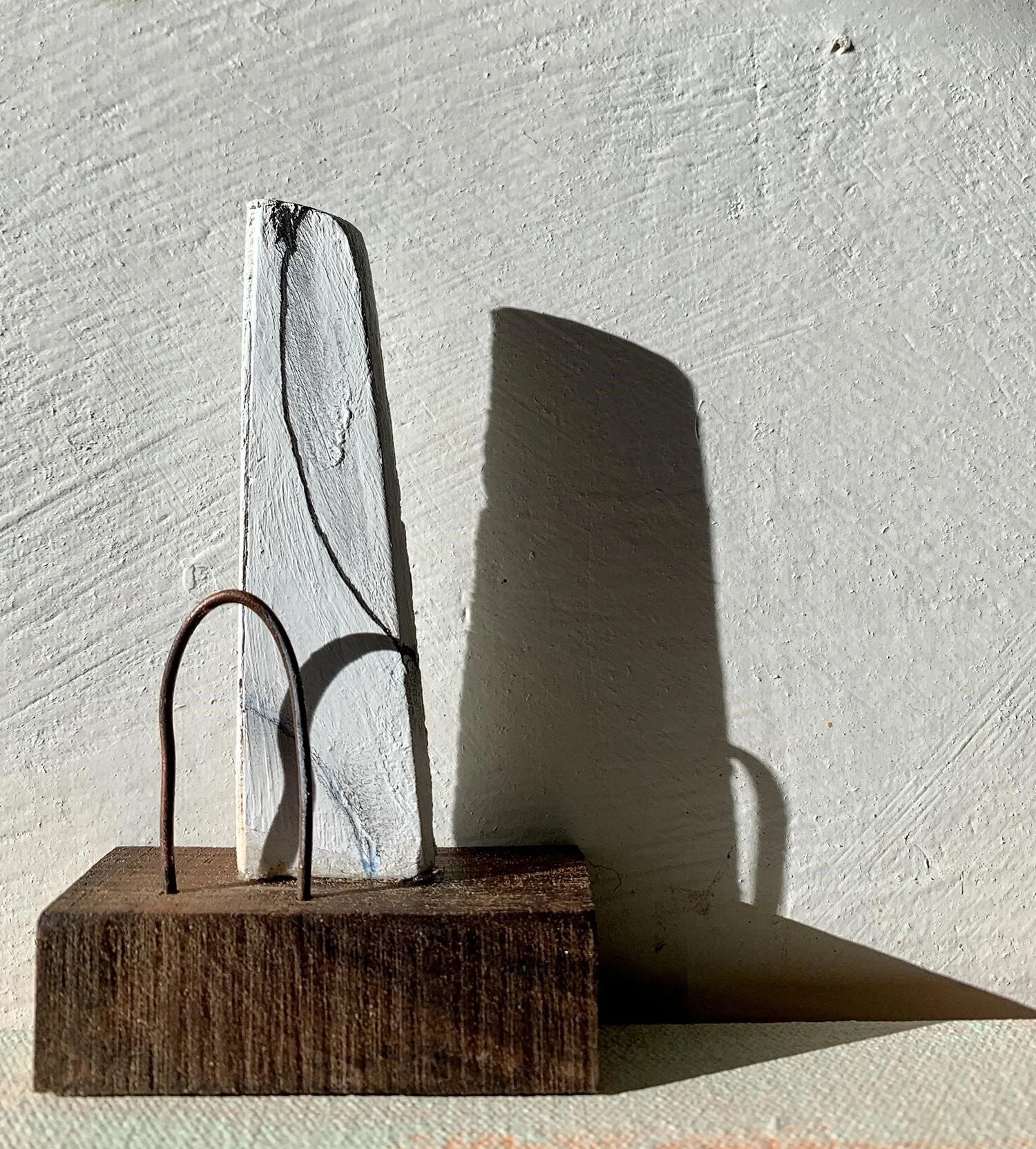
Her show, The Shadow Line, will display a variety of abstract sculptures and paintings that communicate with one another. Blyth’s sculptures are composed almost entirely of objects extracted from found pieces. She works primarily with wood, metal, and cement. The juxtaposition of the paintings and sculptures are quite visually interesting and leave the viewer wanting to know more. For her, the repeated reflection of shapes and lines throughout her work is almost a subconscious theme. Her paintings are colorful abstracts with fine, elegant lines that echo in her sculptures. The relationship between the two is clear and compelling. Blyth says she’s inspired by the way the light comes through the window of her studio and informs how she views her own work. She seeks to answer questions such as, “How does the lighting and shadow of a piece inform how it is understood?” and “How does the relationship between a painting and a sculpture affect the viewer?” Her goal is to intrigue the viewer to ask themselves what they are truly seeing, whether real or perceived. The simple lines, shapes, colors, and shadows of her work will do just that.

Eileen  the shadow line 2.jpg

What is one of her favorite “found” objects in the show?

 A few of the sculptures in the exhibition were produced from molds she bought at a garage sale held by the SC State Museum. When asked how the molds were used originally, she says they were likely for small structural pieces of the old cotton mill such as nuts and bolts. She uses them to create castings in cement to fabricate simple and unique shapes that she can use as an individual piece, or in conjunction with metal or wood to create a finished work. The combination of the hearty cement shapes with a delicate metal line produces something that is truly visually fascinating.


Eileen  the shadow line 3.jpg

How does this show differ from previous exhibitions?

 Blyth says this show could be considered in some ways less intentional than previous shows. She is largely influenced by the stimulus of her surroundings and says this affects how she starts to paint or sculpt from moment to moment. Often times, she may start with an idea that ends up changing and evolving as she goes through the creative process.

 What’s up next for Eileen?

Blyth says she isn’t quite sure what’s up next for her and that excites her. She wants to take a step back and look at the progression of her work over the past year and possibly go back to the basics of drawing and sculpting. She is also exploring the idea of taking time to travel and be open to where that may lead her next.

 by Cait Patel

For more about her show visit

https://www.stormwaterstudios.org/event/eileen-blyth


For more information about her work visit

http://www.eileenblyth.com/


Jasper Project and Harbison Theatre at MTC Bring Art Exhibitions to Lobby Gallery

Artist - MTC Graduate Anthony Lewis

Artist - MTC Graduate Anthony Lewis

In an exciting partnership with Harbison Theatre at Midlands Technical College, Jasper is pleased to announce a series of art exhibitions in the Harbison Theatre lobby’s gallery space.

Last year, the Jasper Project worked with Harbison Theatre to exhibit several shows, beginning with Camden native and retired educator Keith Tolen’s work. Having enjoyed the collaboration so much we have developed a full season of exhibitions for the 2019-2020 art season, which started with the installation of the Supper Table in early September and runs through summer 2020.

Beginning with the continued exhibition of Kirkland Smith’s Supper Table Portraits, which will remain on display until early November, we follow up with an exhibition by photographer Kathryn Van Aernum titled Common Ground.

A Young Sara Leverette by Kirkland Smith

A Young Sara Leverette by Kirkland Smith

Van Aernum’s photographic subjects range from the mundane to the sublime, and she continues to cultivate a sense of spaciousness, curiosity, humor and wonder in her work  through the exploration of themes such as Reclamation; Ubiquity (her CocaCola® series); and Common Ground. While photography is her main medium, she is also an accomplished watercolorist, mixed media and book artist. She teaches classes in photography, creative process, watercolor, and journal making. Her work has appeared in juried competitions, and group and solo exhibits in Key West, FL; Boulder, CO; Fort Collins, CO; Ann Arbor, MI; and Columbia, Spartanburg and Lake City, SC. and is in many private collections throughout the US. Most recently, she was one of 19 Columbia artists whose work was juried into ArtFields 2019. Find her on the web at KvanaStudios.com KathrynVanAernum.com.

About This show Van Aernum says, “Most of the images in Common Ground were gathered on my morning and evening walks with my dog Noah. I live in Midlands Terrace in Columbia, but he and I will frequently hop in the car and walk in other neighborhoods for a change of scenery. There are a few photos from other SC locations, and a 2018 trip to Greece. Living in a city, man-made surfaces are the predominant element I come in contact with. With no sandy beaches, mountains, or vast vistas for inspiration, I often look down to the ground. As I allowed pavement, asphalt, cobblestones and concrete to become my muses, abstract “paintings” created by the interaction of time, weather, earth and humans began to reveal themselves. All the artificial terrains portrayed have one thing in common: to facilitate human flow and interaction. What I hope to offer here is a surprising, whimsical, striking, and maybe even beautiful meditation on the surfaces we share in common.”

Jasper and Harbison Theatre will celebrate the opening of Van Aernum’s exhibit on Friday, November 15th at 6 pm in conjunction with a stellar performance by Motown Superstar Thelma Houston. (Reception – free; Concert tickets at harbisontheatre.org.)

Artist Kathryn Van Aernum from the Common Ground collection

Artist Kathryn Van Aernum from the Common Ground collection

Following the Van Aernum exhibition, acclaimed artist Stephen Chesley’s art will be exhibited in January and February 2020, with an opening reception on January 24th, 2020 at 6 pm in conjunction with a performance by Akintunde and Joey I.L.O.

Stephen Chesley was born in Schenectady, New York in 1952. He exhibited a natural proclivity for drawing and art almost as soon as he could hold pastel and pencil which were often Christmas gifts from his family. Growing up in Virginia Beach in the late 1950s he was exposed to the Beat Generation of musicians, artists, and writers when Virginia Beach was still a seasonal seaside resort. Self motivated, he continued with his drawing and small paintings along with exposure to local artists throughout elementary and high school and into college. His collegiate exposure led to a meld of art and science with degrees in Urban Studies and a Masters Degree in Urban Planning in 1980 from the school of Architecture at Clemson University. Graduating in a deep national economic recession Chesley turned back to his art. Spending 5 years on rivers and sea islands to explore his asthetic, subject matter, influential painters, and styles, Chesley’s paintings and art work began to move to the foreground. Recognized in 1981 by the Columbia Museum of Art as an emerging talent, he went on to win top 100 in the first National Parks competition of 1987, exhibiting at the Smithsonian, and in 1996 a National Endowment for the Arts, Southeast Regional Fellowship, Southeast Center for Contemporary Art. Chesley has continued his work, characterized as poetic realism, along with welded and carved sculptural pieces in addition to joint works illustrating Archibald Rutledge short stories and WS Merwin’s poem, ”Palm” for the Thomas Cooper Society’s Thomas Cooper Medal for WS Merwin in 2012.

Stephen Chesley

Stephen Chesley

Arts photographer Kevin Kyzer will exhibit in March and April, 2020 with an opening reception on March 21st, 2020 in conjunction with the wildly popular MTC Show-Off.

Artist Kevin Kyzer’s photo of dancers Claire Richards Rapp and Bonnie Boiter-Jolley

Artist Kevin Kyzer’s photo of dancers Claire Richards Rapp and Bonnie Boiter-Jolley

Anthony Lewis is an emerging self-taught visual artist and a resident of Columbia, South Carolina. Anthony was born in raised in Camden, NJ.  The owner of Alewisproject,LLC, Lewis will exhibit in May and June 2020.

Anthony Lewis

Anthony Lewis

And closing out the season we will be featuring Ginny Merett. Ginny currently uses collage techniques to create portraits and figurative works of art that are best described as a mix of surrealism and whimsy. Ginny’s work has won several awards and accolades. She is the cover and featured artist in The Jasper Magazine Spring 2019 edition; and received First Place and Second Place Awards at the Rosewood Art and Music Festival, Best in Show at Time for Art sponsored by the Jasper Project; and participated in Women Speak Art Gallery at SC State Library 2017, Artfields 2019, and numerous other exhibits.

Women in Hats by Ginny Merett

Women in Hats by Ginny Merett

Information on artists talks and additional opening receptions are TBD. Stay tuned to www.JasperProject.org and https://www.harbisontheatre.org/ for updates and information.

Supper Table Spotlight: Ebony Wilson and Malie Heider

We’re featuring the artists from the Supper Table project throughout the summer. This is the 23rd in our series on Supper Table Artists!

Still from Ebony Wilson’s film honoring Sarah Leverette

Still from Ebony Wilson’s film honoring Sarah Leverette

Sarah Leverette was, and is, a powerful inspiration to women in and outside of South Carolina, having spent her life breaking glass ceilings wherever she went, from the Civil Air Patrol to the School of Law at USC, where she was the first female law professor. She passed only shortly over a year ago, but her accomplishments will not soon be forgotten.

Tasked with turning Leverette’s long & varied career into one short film is Ebony Wilson. Since 2012, Wilson has written, directed, produced, and edited her own original works, most notably the 2017 feature Sci-Fi Drama, 2025: Prelude to Infusco. In the process of undertaking countless projects and workloads, Wilson has managed to sell her work, build brand engagement for her clients, and nurture long relationships with those around her. She owns and operates her independent production company, Midnight Crow Pro- ductions, and is the founder and administrator of the Columbia Film Community. The Supper Table project will be Ebony’s third collaboration with the Jasper Project.

As Wilson approached ideas for her film on Leverette, what struck her the most was how influential Leverette was/is for women. Still today, women struggle with issues of motherhood, glass ceilings, and the legacy they will be able to leave behind. Leverette is a constant force that reminds women they can leave whatever mark on the world they choose to. Thus, Wilson decided not to make a biopic about Leverette but instead to explore how Leverette’s legacy affects women now, in 2019 and beyond.

Ebony Wilson

Ebony Wilson

Bringing Sarah Leverette to life on the stage is Malie Heider. Heider grew up in Columbia, where she began studying acting with Mary Lou Kramer. Since then, she has enjoyed acting, studying, and teaching theatre in a variety of places up and down the East Coast, as well as China, Japan, and Indonesia. In Columbia, she has worked at Trustus Theatre, Workshop Theatre, the University of South Carolina, the South Carolina Shakespeare Company, the Arts at Shandon, and SCETV, most recently in Betsy Newman’s documentary production on Belle Baruch.  

Heider remarks that she’s in awe of what Leverette did in her life and the fact she did it for so long. Leverette was 98 when she passed, and Heider believes, as do many others, that if Leverette was alive today, she would still be avidly working to keep breaking glass ceilings and to make it possible for others to do so as well. Heider also wonders about what Leverette had to give up in terms of personal life and family in order to throw herself so completely into her work and mentorship. Heider hopes that this passion, determination, and sacrifice comes across in her performance.

Malie Heider

Malie Heider

Wilson’s complete film and Heider’s performance will be available for viewing at both opening events for the Supper Table. Our Trustus Theatre event is sold out, but our nearly identical second opening event is Sunday, September 8th, at Harbison Theatre, and tickets start at $15.

Supper Table Spotlight: Eileen Blyth and Katly Hong

We’re featuring the artists from the Supper Table project throughout the summer. This is the 22nd in our series on Supper Table Artists!

Still from Katly Hong’s film on Althea Gibson

Still from Katly Hong’s film on Althea Gibson

Althea Gibson was the first black athlete to break racial barriers of international tennis, specifically when she became the first black American to win a Grand Slam title. Additionally, Gibson was a golfer, a singer, and a black woman trying to have access to the same rights and activities as everyone around her, through doing what she did best – playing tennis.

Eileen Blyth is the visual artist who created a place-setting for Gibson. Blyth is a Columbia artist known for her paintings and found art sculptures. Originally from Charleston, Eileen has always thought of herself as a painter. She earned her BA from the College of Charleston and studied graphic design at the University of South Carolina. She is inspired by the moment of creation when there is a sudden shift into a space of knowing and composition falls into place. Blyth’s studio is located at Stormwater Studios in Columbia, and her work is represented by Carol Saunders Gallery in Columbia, Camilla Art Gallery in Hilton Head, and Art & Light Gallery in Greenville.

Eileen Blyth

Eileen Blyth

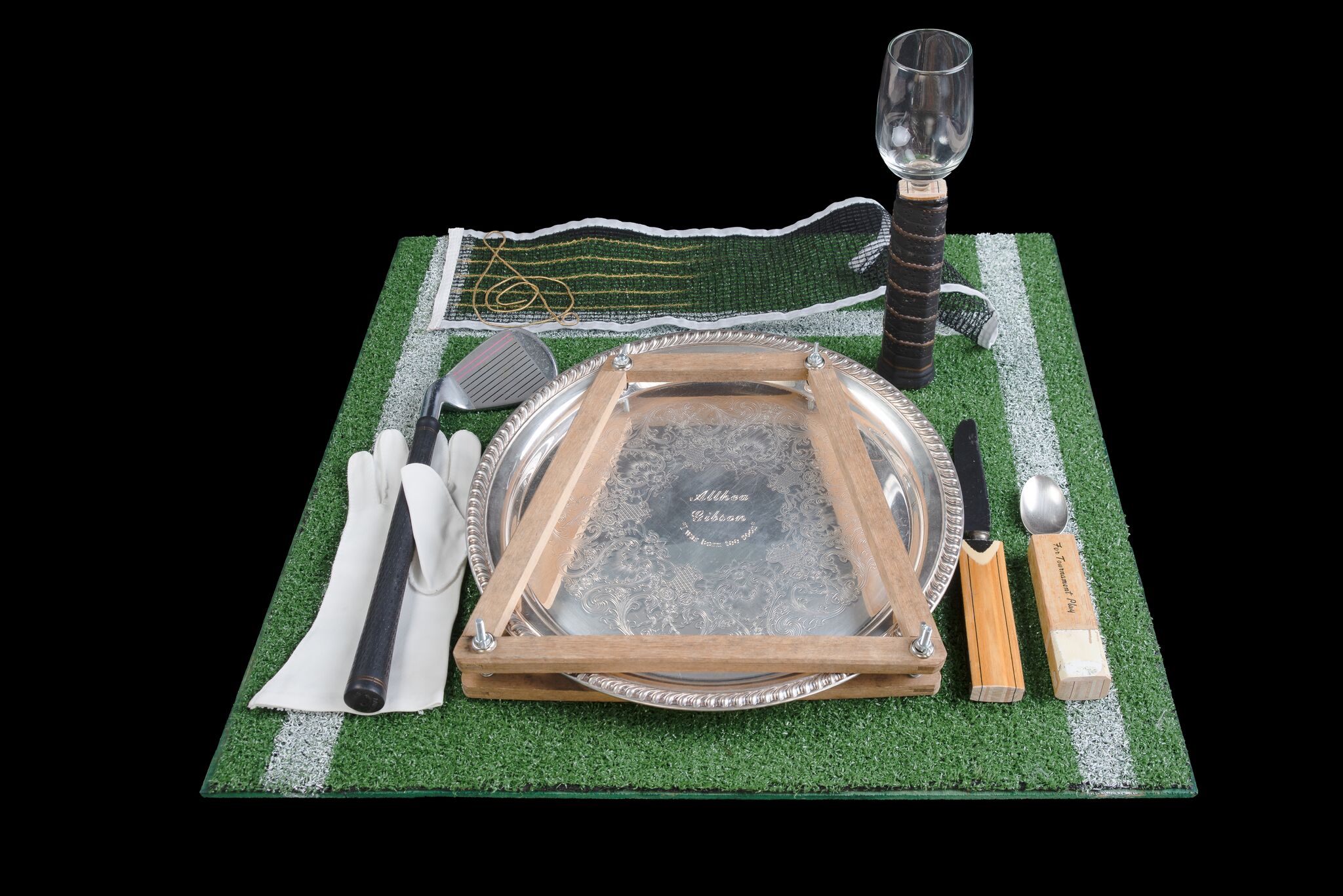
Blyth’s place-setting is heavily inspired by Gibson’s tennis career, which is what brought her to fame, but also contains elements of Gibson’s other achievements. For example, the background of Blyth’s place-setting is modeled after a tennis court, and both the frame on her platter as well as the handle of her goblet come from disassembled found tennis rackets.

Blyth said that she “liked the metaphor for serving and service both on the court and at the clubs she was allowed to play in but not go in” that is represented by the frame on the platter as well as the glove holding the golf club.

The platter itself is engraved with Gibson’s name and the quote: “She was born too soon”.

supper table eileen althea.jpeg

Turning Gibson’s full life into a short film is Katly Hong. She is an interdisciplinary artist who regularly pivots between visual, media, and performance art. For the Supper Table, Hong was enthralled by the challenge of honoring Gibson’s incredible athleticism and her determination to be somebody in a time of segregation and open discrimination.

Katly Hong

Katly Hong

Hong’s film uses animation and music to honor Gibson’s life. While the film’s animation mainly focuses on Gibson’s tennis accomplishments and accolades, the music in the background is Gibson’s own from the music career she embarked on later in life.

Supper Table Spotlight: Flavia Lovatelli and Jocelyn Sanders

We’re featuring the artists from the Supper Table project throughout the summer. This is the 21st in our series on Supper Table Artists!

Flavia Lovatelli

Flavia Lovatelli

It’d be nearly impossible to give a complete list of adjectives describing Supper Table honoree Mary McLeod Bethune. In her lifetime, Bethune was an educator, activist, businesswoman, and political advisor. She was friends to the Roosevelts and referred to by FDR as “The First Lady of the Struggle” for her tireless advocacy for black communities in America. Is it possible to contain all that is Bethune into a single place-setting? A single theatrical performance? Even if not, with incredible artists like these, we’ve come as close as possible.

Flavia Lovatelli is a local artist who created our Supper Table place-setting for Bethune. Passionate about collecting what society typically views as the “throwaways,” she is an artist who creates innovative, imaginative artwork using recycled goods. Originally from Northern Italy, she moved to the states in 1979, where she founded the Art Ecology Group, a movement of sustainable artists. She was one of four artists chosen to represent Sustainable Charlotte during the Democratic National Convention in 2012, and her work has won several awards including the CharlotteArtPop.

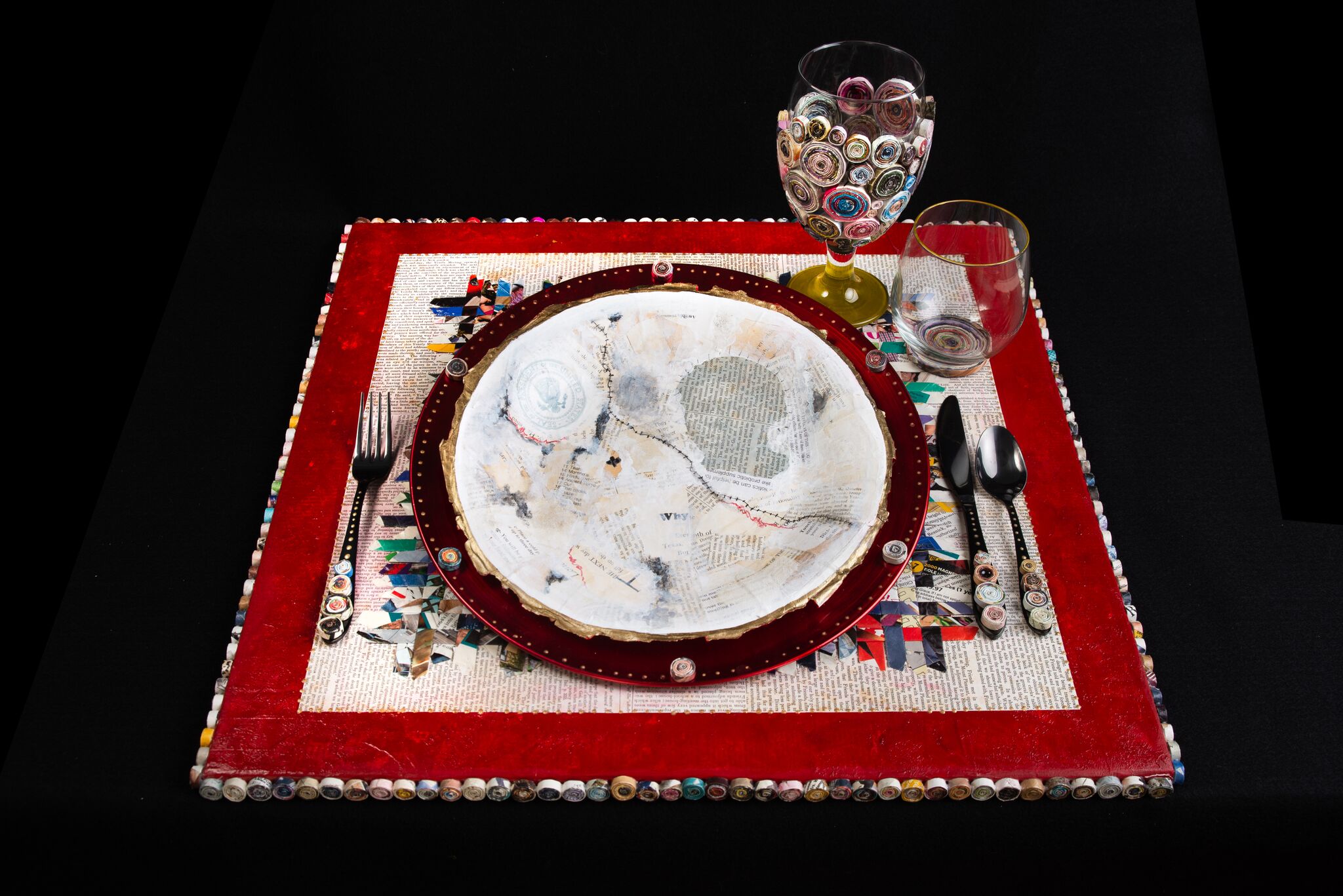
As a paper artist, Lovatelli used recycled magazine paper and textbooks for her place-setting, the textbook pages specifically representing Bethune’s passion for education, the foundation of her activism. The color red is prominent within the piece and “represents the strife, anger, passion and fight the African American community have suffered in History which fueled Mary’s causes” while the gold represents Bethune’s work in the political spectrum.

Overall, Lovatelli hopes that from her place-setting, people see the “incredible life, full of achievements and strides Mary McLeod Bethune had.”

Supper Table Flavia final.jpeg

Tasked with using her body and voice to present the life of Bethune is native Columbian, Jocelyn Sanders. Sanders has been actively engaged in theatre ever since graduating from college. She was employed for several years at Trustus Theatre as Box Office Manager. While working with Trustus, she was also one of the original founding instructors of the African American Acting Workshop, which was later renamed the Multi-Ethnic Acting Workshop. She left Trustus and went on to teach; her last teaching position was with Eau Claire High School where she instructed teachers in integrating the arts into their curriculum.

Sanders is a director and an actor, having worked in numerous productions in the city. Some of her most memorable productions she’s directed are Crowns and A Wedding Band, with Trustus Theatre, and A Lesson Before Dying and The Color Purple, with Workshop Theatre.

Jocelyn Sanders

Jocelyn Sanders

Sanders has reflected on how different the times were when Bethune was an activist versus today, and believes that if Bethune were alive now, she would look around and still see a whole lot of work to be done. In her performance, she hopes to show the empowering nature of Bethune when she was alive as well as use it as a challenge to pick up our own crosses today and continue the work she once started.

Lovatelli’s complete place-setting and Sanders’ performance will be available for viewing at both opening events for the Supper Table. Our opening night event is Friday, September 6th, at Trustus Theatre (almost gone!), and tickets start at $50. Our second opening event is Sunday, September 8th, at Harbison Theatre, and tickets start at $15.

 -Christina Xan

The Supper Table is made possible by a generous grant from

Central Carolina Community Foundation

CCCF.jpg

Supper Table Spotlight: Qiana Whitted and Annette Dees Grevious

We’re featuring the artists from the Supper Table project throughout the summer. This is the 20th in our series on Supper Table Artists

Qiana Whitted - photo Michael Danzler

Qiana Whitted - photo Michael Danzler

Known by Martin Luther King Jr. as “The Mother of the Movement,” Septima Clark was an educator and civil rights activist who spent her life fighting for literacy and equality for black Americans. Two Supper Table artists had the task of speaking life into Clark’s story, one through written word and the other through spoken.

Qiana Whitted is the literary artist who wrote a non-fiction literary essay about Septima Clark’s life. Whitted is the Director of the African American Studies Program at the University of South Carolina. Her research focuses on African-American literary and cultural studies, American comics, and graphic novels. Her recent book, EC Comics: Race, Shock, and Social Protest, explores representations of race and racism. She is also the author of “A God of Justice?”: The Problem of Evil in Twentieth-Century Black Literature and co-editor of Comics and the U.S. South. Additionally, Whitted is editor of Inks: The Journal of the Comics Studies Society and chair of the International Comic Arts Forum. She is the mother of two children, Naima and Alex.

The following is an excerpt from her essay:

Clark began her career during World War I on Johns Island at a school with over 130 students. Miss Seppie, as the Gullah folk called her, would go on to teach across the Carolinas, from rural classrooms in Mars Hill and McClellanville to Avery Normal Institute in Charleston and Booker T. Washington School in Columbia. After school hours and on weekends, Clark turned her attention to the needs of her students’ parents and grandparents. She helped local residents to write letters and speeches, fill out applications and mail-order forms, and organize sewing circles, immunization drives, and handwriting clinics. While her own training at Avery emphasized a pedagogy that embraced racial uplift ideology and respectability as core values, those early years as a teacher challenged her assumptions about the realities of social and economic inequality and demanded from her a different kind of resourcefulness. Clark gained a profound appreciation for adult literacy training, deploying what historian Katherine Mellen Charron calls “educational camouflage” to transform classroom basics into acts of recognition and resistance against white supremacy. Clark’s experience on Johns Island sowed the seeds for the Citizenship Schools, a grassroots educational initiative in the South that combined practical literacy with voter registration, civics instruction, and community action.

It was Clark’s advocacy on behalf of students and teachers that transformed her into a freedom fighter. Her first steps included taking part in the NAACP campaign to allow black teachers to be hired in Charleston’s public schools. Canvassing door to door with fellow teachers, and even a few sixth-graders, Clark tirelessly gathered signatures for the successful petition. She was inspired by black women activist educators such as Mary McLeod Bethune to expand her reach within teachers’ associations and women’s clubs during the 1930s. She helped to integrate the central board of Charleston’s YWCA and made a point to forge relationships with white-led civic organizations that focused on school reform and health promotion. When it came to education for citizenship, Clark was concerned by the way many Progressive era initiatives encouraged students to exercise their rights without disrupting the status quo of segregation. Therefore, when given the opportunity to develop her own curriculum, Clark modeled her endeavors after local education reformers such as Wil Lou Gray and Booker T. Washington’s principal, C.A. Johnson. She listened closely to the needs of black adult learners, respected their experiential knowledge, and nurtured their aspirations, whether they required help reading the newspaper or understanding election laws.

Annette Dees Grevious

Annette Dees Grevious

Embodying these words in the Supper Table theatrical performance is Annette Dees Grevious. Grevious is an Associate of Professor of Speech and Drama at Claflin University, where she has served as Theatre Program Coordinator and Director of the Theatre Ensemble for 17 years. She received an MFA in Theatre Performance from the University of Louisville and a BA in Theatre from Brenau University. Grevious has been performing professionally for more than two decades. She has performed with and on the following South Carolina theatre companies and stages: Trustus Theatre, Art Forms and Theatre Concepts, Inc., and Motion FilmWorks.

Septima Clark is a name full of such power yet a name so little known. In her performance, Grevious hopes to not only represent the struggles and success of Clark’s life but tell her story in a way that will ensure no one forgets her name again.

To read the rest of Whitted’s essay, located in our book Setting the Supper Table, and to see Grevious’ performance of Septima Clark, come to one of our opening events on either September 6th at Trustus (almost gone!) or September 8th at Harbison.


 -Christina Xan


Supper Table Spotlight: Christina Xan, assistant project director - by Cindi Boiter

We’re featuring the artists from the Supper Table project throughout the summer. This is the 19th in our series on Supper Table Artists

Christina reading her own poetry at Girls Block 2019

Christina reading her own poetry at Girls Block 2019

Christina Xan came to the Jasper Project by way of playwright and academician Jon Tuttle who, though he directs the honors program at Francis Marion University and lives in Florence, is a founding member of the Soda Citizen Auxiliary (no, there is no such thing as this). Jon introduced Christina to me when she first came to grad school at USC. The next year, Christina approached me about serving as an intern with Jasper and we were delighted to bring her and all her talents on board.

To say Christina fit right in would be an understatement. To say she pitched right in would be even more of an understatement.

In the year Christina has been involved in the Jasper Project she has risen to every challenge presented to her. An avid blogger, Christina has shared her writing, photographic, graphic design, administrative, editorial, and immense personable skills with Jasper and our friends with generosity and enthusiasm.

When it came time to invite writers to join the Supper Table project as essayists, there was no question in my mind that the young artist should be included. In addition to writing about Eartha Kit, Christina also stepped in when we needed someone to take over writing about Mary McLeod Bethune.

But Christina’s most profound impact on the project has been in her role as assistant project director — in other words, assistant to me. So I know of what I speak. I jokingly say that when Christina came on board (and she actually is on the board of directors for the Jasper Project now) it was like I grew another arm. But that doesn’t really cover it. Having Christina’s assistance has been great, but it has been the gifts she has offered via her insights, contributions, attitude, and enthusiasm that have made the difference in this project. Every time I felt like I was drowning Christina would be there to tap me on the head and remind me the water wasn’t really that deep. Every time she would meet a new artist on the team she suddenly had a new best friend. Her kindness and selflessness have magnified the element of love and mutual appreciation that has so characterized this project tenfold. Working with Christina has been an absolute joy.

Christina and author Dorothy Allison -Deckle Edge 2019

Christina and author Dorothy Allison -Deckle Edge 2019

Christina Xan is a poet, playwright, photographer, and adjunct professor of English. She graduated with an MA from the University of South Carolina, where she is now pursuing her doctorate. Her work has been published by Snow Island Review and Z House Publishing, and her play Glass was turned into a short film that toured SC festivals in 2017. Her art is influenced by her life, as each story contains a different element of herself, and she is inspired by the concepts and questions people usually hide away from.
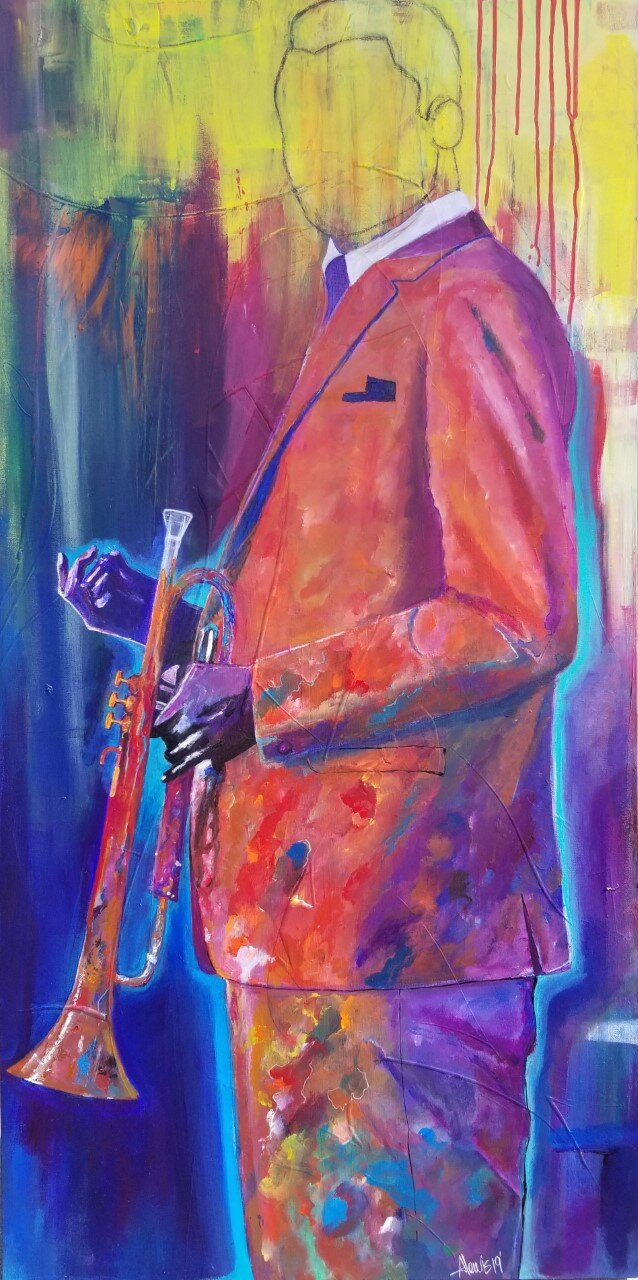
Christina with FMU mentor Jon Tuttle

Christina with FMU mentor Jon Tuttle

-Cindi Boiter

Supper Table Spotlight: Tonya Gregg and Bonita Peeples by Christina Xan

We’re featuring the artists from the Supper Table project throughout the summer. This is the 18th in our series on Supper Table Artists

Visual Artist Tonya Gregg

Visual Artist Tonya Gregg

Alice Childress – playwright, novelist, actress. Born in Charleston, Childress dedicated her life to telling the stories of black Americans, specifically portraying the have-nots of society. Her reach was so vast, author Mary Helen Washington refers to her as “the only African-American woman to have written, produced, and published plays for four decades.”

Tasked with creating the place-setting for Childress is Tonya Gregg. Gregg is a painter who studied at the Maryland Institute College of Art where she became the first full-time art student to be featured in New American Paintings. Her paintings navigate different narratives relating to popular culture, class, consumption, colorism, ancient mythology, and interwoven topics related to black girls and women. She has had solo exhibitions in multiple places locally and has exhibited in several different countries throughout the world.

Gregg explored Childress’ work and specifically found inspiration from her play The Wedding Band, a story of an interracial relationship. This is exactly what Gregg wanted to contemporize in her place setting. She used acrylic paint to create a pop-art effect on both a ceramic plate and mug. Specifically, the artist says her place-setting “is intended to invite people to the Supper Table and provide conversation, comfort or healing within this theme.”

Supper Table Alice Childress by Tonya Gregg.jpeg

An artist putting Childress into conversation with her own body is Bonita Peeples, a theatre artist who is portraying Childress in the Supper Table theatrical performance. Peeples’ acting debut was performing a monologue of one of the greatest women in history, Madame C.J. Walker. She is a wife, a mother, and a working actor. She is a member of Kaufmann Forensic Actors, the NiA Theatre Company, and serves on the board of the Columbia Children’s Theatre.

Bonita Peeples

Bonita Peeples

Peeples recently reflected on how wonderfully human Childress was. When she would cast her plays, for example, if she had to choose between two friends auditioning for a role, she would be so fearful of hurting a relationship, she would scrap the entire project. While this could be seen as a weakness, Peeples believes it is actually a strength – proof that Childress’ love for others trumped all, a lesson that still can be learned today.

Gregg’s completed place-setting and Peeples’ performance will be available for viewing at both opening events for the Supper Table. Our opening night event is Friday, September 6th, at Trustus Theatre (going fast!), and tickets start at $50. Our second opening event is Sunday, September 8th, at Harbison Theatre, and tickets start at $15.


 -Christina Xan

Supper Table Spotlight: Bohumila Augustinova and Jocelyn Walters-Brannon

We’re featuring the artists from the Supper Table project throughout the summer. This is the 17th in our series on Supper Table Artists

Bohumila Augustinova - visual artist

Bohumila Augustinova - visual artist

Elizabeth Evelyn Wright lived less than 40 years but accomplished more in that time than most will do in 80. Wright was constantly motivated by the lack of education for her fellow black Americans, and instead of waiting around for a solution, she created one. She opened school after school, and even after those who wanted her to fail burned eight separate schools, she successfully founded what we know today as Voorhees College.


Honoring Wright’s journey with her copper-wire place-setting for the Jasper Project’s the Supper Table is visual artist Bohumila Augustinová. Augustinová was born and raised in Czechoslovakia, now the Czech Republic, but she came to the United States in 1998. She has a degree in fashion design, and after winning Runaway Runway, she quickly became part of the Columbia art scene. In 2015, she took over curating responsibilities at Anastasia and Friends Gallery. Augustinová is the leader of Yarnbombers of Columbia and is the art curator for Motor Supply Company Bistro. She works at the Columbia Art Center where she both makes art and teaches art to others.


Augustinová’s place-setting represents several elements of Wright’s life. For example, Elizabeth Evelyn Wright was biracial; she had a black father and a Cherokee mother, so the artist chose two different colors of wire that she wove together. This wire is woven into a flower, the edges of which are shaped like the flames of the arson fires that destroyed many of Wright’s schools, and the center of which represents her final success – Voorhees.


Supper Table Bohumila.jpg


Portraying Elizabeth Evelyn Wright for the theatrical component of the premiere is Jocelyn Walters-Brannon. Walters-Brannon is a South Carolina native and believer in the power of creative individuals to manifest joy and understanding into the world. She serves as Director of The Palmetto School of Protocol and earned a BA in Journalism and MA in Public Administration from the University of Georgia. Walters-Brannon has served on numerous artistic boards and committees, including Trustus Theatre, Columbia Children’s Theatre, Vibrations Dance Company, and the East African based In Movement. Her favorite stage credits include roles in Rent, Ain’t Misbehavin’, and Caroline, or Change.


Jocelyn Walters-Brannon

Jocelyn Walters-Brannon

Walters-Brannon finds Wright’s untimely demise particularly interesting. Wright was sick for numerous years before dying at the young age of 34. What she did in that time is testament to what people can do when they put actions to thoughts and words, but it also sparks the question, “What would she have done if she only had time?” This question is driving Walters-Brannon as she finalizes her performance of Wright.


To see Augustinová’s place-setting on Wright, Walters-Brannon’s interpretation of her life, and the chance to get a copy of a book or t-shirt, come to one of our opening events on either September 6th at Trustus (going fast!) or September 8th at Harbison.

-By Christina Xan

Supper Table Spotlight: Writer Kristine Hartvigsen and Actor LaTrell Brennan


We’re featuring the artists from the Supper Table project throughout the summer. This is the 16th in our series on Supper Table Artists

Literary Artist Kristine Hartvigsen

Literary Artist Kristine Hartvigsen

Althea Gibson is mostly remembered as a tennis player, and for good reason. She was the first black athlete to break racial barriers of international tennis, specifically when she became the first black American to win a Grand Slam title. Beyond this, though, Gibson was a golfer, a singer, and a woman, a human. She was a black woman trying to be a human being that had access to the same rights and activities as everyone around her, not through activism but through existing and doing her work.


The literary artist who captured Gibson’s life for the Supper Table is Kristine Hartvigsen. Former assistant editor of Jasper Magazine as well as a number of publications in the SC Midlands, Hartvigsen is an author who finds beauty in the human condition, using words to express raw stories of love, loss, hurt, anger, lust, envy and more. She currently holds a position at Piedmont Technical College as a public information specialist, but she has done much journalistic work throughout her years. Hartvigsen has had her literary work published in multiple outlets, including State of the Heart, Fall Lines, and more. She authored To the Wren Nesting, a poetry chapbook published by Muddy Ford Press, and she was twice a finalist at the SC Poetry Initiative. She is currently working on her next book, The Soul Mate Poem.
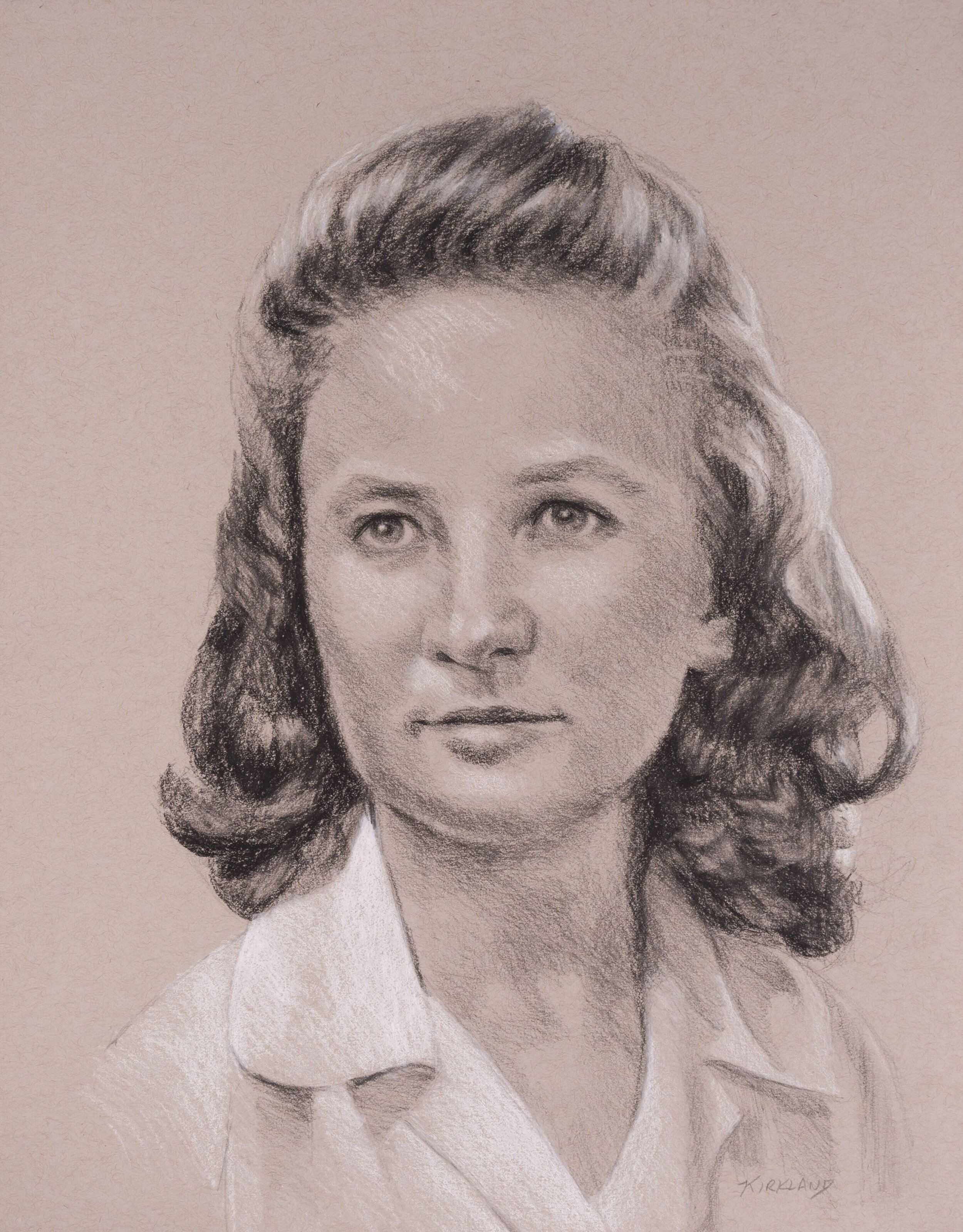
 

The following is an excerpt of Hartvigsen’s essay on Gibson written for the upcoming book, Setting the Supper Table, which will be launched on Friday night, September 6th at the Supper Table premiere event at Trustus Theatre:


Singles success at Wimbledon in 1956, however, was not meant to be for Althea. She had unwittingly exhausted herself in the tournaments played on the way to the All England Club. U.S. government officials were pleased overall with Althea’s world tour. She had conducted herself according to traditional conventions and represented her country well. She was more consistent and less nervous. Most importantly, she had done nothing to harm America’s equal rights image around the world. The U.S. Supreme Court had just declared bus segregation unconstitutional, so the country was on a race-relations roll.
 

Fast forward to 1957, arguably the pinnacle year in Althea’s tennis career. She was absolutely focused on Wimbledon above all other tournaments. She wouldn’t make the same mistake twice and made sure to be well trained and well rested before crossing the pond. Before it was all over, Althea was poised in Centre Court facing Darlene Hard in the final. This was the moment. In near triple-digit heat, it took Althea only 50 minutes to overwhelm Hard in two sets and win the singles crown. It seemed almost surreal as officials from the All England Club unfurled the red carpet at courtside, and Queen Elizabeth, who had witnessed it all, approached.


As cameras clicked rapid-fire, Althea executed her perfectly practiced curtsey, and Queen Elizabeth shook her hand before presenting the iconic Venus Rosewater platter. She was the first black Wimbledon champion in the tournament’s history. That evening at the time-honored Wimbledon ball, Althea delivered her acceptance speech, saying: “In the words of your own distinguished Mr. Churchill, this is my finest hour. This is the hour I will remember always as the crowning conclusion to a long a wonderful journey.” At the insistence of guests at the ball, Althea sang “If I Loved You” and “Around the World.” It was like a true-life fairy tale.


Taking this power and putting into a physical performance is LaTrell Brennan. Brennan is a professional stage, film, and voice over actor with over ten years of experience. She is a Trustus Theatre company member and has been seen in productions such as Silence! The Musical (Ardelia), Fun Home (Joan), Barbecue (Marie), and In the Red and Brown Water (Shun). Some of her film credits include Crosswalk, which won the 2013 Second Act Film Festival Audience Award, and Foundation, which won the 2012 University of South Carolina Campus MovieFest Best Drama Silver Tripod Award. For the latter film, she also won the Best Actress Silver Tripod Award and was a Best Actress Golden Tripod finalist at the 2012 Hollywood Campus MovieFest.


LaTrell Brennan

LaTrell Brennan

Theatre artist LaTrell Brennan has been looking back on the life of Althea Gibson and at the nature of her existence to prepare for her role as Gibson in the upcoming performance of Gathering at the Table, the performative aspect of the Supper Table premiere to be held first at Trustus and then at Harbison Theatre on September 6th and 8th respectively. Gibson never wanted to be an activist; she just wanted to play tennis. She wanted to work at what she loved, wanted to be good at it, for what she could do, not for the color of her skin. Yet, everyone expected Althea to be an activist, to use her experiences of racial discrimination to fight back against a country that only wanted her when she was their winner. However, Althea Gibson chose to use her body to fight her own battles instead of her voice to fight others. Whether this is a weakness or a strength or a culmination of both, this is what Brennan hopes to highlight in her performance.


To read the rest of Hartvigsen’s essay, located in our book Setting the Supper Table, and to see Brennan’s performance of Althea Gibson, come to one of our opening events on either September 6th at Trustus (going fast!) or September 8th at Harbison.

Supper Table Spotlight: Lori Isom and Faye Riley

We’re featuring the artists from the Supper Table project throughout the summer. This is the 15th in our series on Supper Table Artists

Septima Clark. A name that should not only be known but revered in the minds of all those living in our country, especially in South Carolina. However, not nearly enough know her name. A 20th century educator and civil rights activist, Clark spent her near 90 years fighting for literacy and equality for black Americans. She developed literacy and citizenship workshops, which she called “Citizenship Schools” in order to educate black individuals on how to not just vote but to fight for their right to vote, to fight for their voice. Her relentless and passionate activism during the height of the Civil Rights Movement led her to be known by Martin Luther King, Jr. as "The Mother of the Movement".


Fortunately, two of our artists have dedicated and are dedicating their visual arts to ensure the name of Septima Clark is quick to all our tongues. Our place-setting artist for this task is Lori Isom. Isom has experienced a varied career as an artist, dedicating years to professional dancing, singing and acting. A figurative and portrait artist for over 20 years, she has been commissioned to do hundreds of individual & family portraits. Her work has been featured in a plethora of places including American Art Collector. She recently completed a one-year artist residency for the City of North Charleston, during which she had the privilege to work on several community-focused projects.

Lori Isom

Lori Isom

For her place-setting, Isom used a round baking sheet that she discovered at a local thrift store to represent her own love of baking in the project. Isom recalls that, in creating the piece, she “felt that although [Clark] was certainly a brave, dynamic trailblazer with incredible fortitude, she also seemed to be simple and understated.” Therefore, the artist chose a style for her plate that represented this simplicity. The plate features a portrait of Clark against a red, white, and blue background to represent her fight for voting rights. Colors of red, black, and green are also present to pay homage to her African roots. Quotes from Clark decorate the border of the plate.


supper table isom.png

Complementing the style of this place-setting, is a film by artist Faye Riley. Riley has a PhD in Theatre and Film from the University of Kansas and is a teacher, writer, and filmmaker based in Columbia. She has created ten short films and has taught scriptwriting for ten years. Her influences include Agnes Varda, Georgia O’Keefe, Ed Small, and her parents. She is consistently creating and working on new projects and has a feature film in New York in addition to this project.

Faye Riley

Faye Riley

For her film, Riley has selected a handful of archival materials on Clark. She has combined footage, photographs, and quotes masterfully with different soundscapes to represent, in 90 seconds or less, 90 years of passion and love. The aesthetic simplicity of utilizing these found images and recordings of Clark is able to do exactly what needs to be done – tell us who Clark is while proving she was, and still is in spirit, a force to be reckoned with.


Isom’s place-setting and Riley’s film will be on view at both opening events for the Supper Table. Our opening night event is Friday, September 6th, at Trustus Theatre, and tickets start at $50. Our second opening event is Sunday, September 8th, at Harbison Theatre, and tickets start at $15.

- Christina Xan