
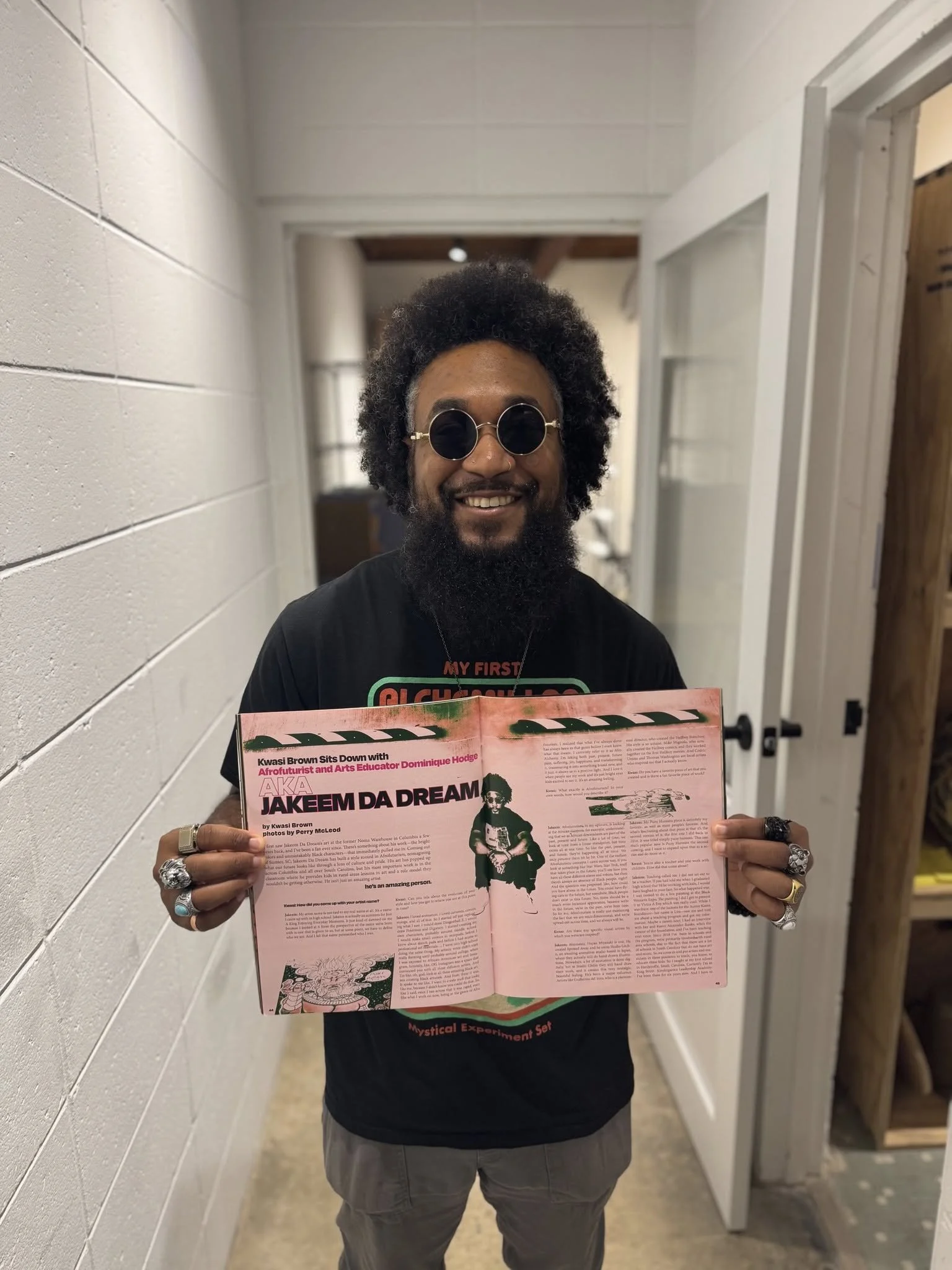
I first saw Jakeem Da Dream’s art at the former Noma Warehouse in Columbia a few years back, and I’ve been a fan ever since. There’s something about his work—the bright colors and unmistakably Black characters—that immediately pulled me in. Coming out of Sumter, SC, Jakeem Da Dream has built a style rooted in Afrofuturism, reimagining what our future looks like through a lens of culture and pride. His art has popped up across Columbia and all over South Carolina, but his most important work is in the classroom where he provides kids in rural areas lessons in art and a role model they wouldn’t be getting otherwise. He isn’t just an amazing artist he’s an amazing person.
~~~~~
Kwasi: How did you come up with your artist name?
Jakeem: My artist name is not tied to my real name at all. It's a name I came up with in high school. Jakeem is actually an acronym for Just A King Enjoying Everyday Moments. It just kind of dawned on me because I looked at it from the perspective of the name we're born with is one that is given to us, but at some point, we have to define who we are. And I felt that name personified who I was.
Kwasi: Can you talk about the evolution of your style and how you got to where you are at this point in time?
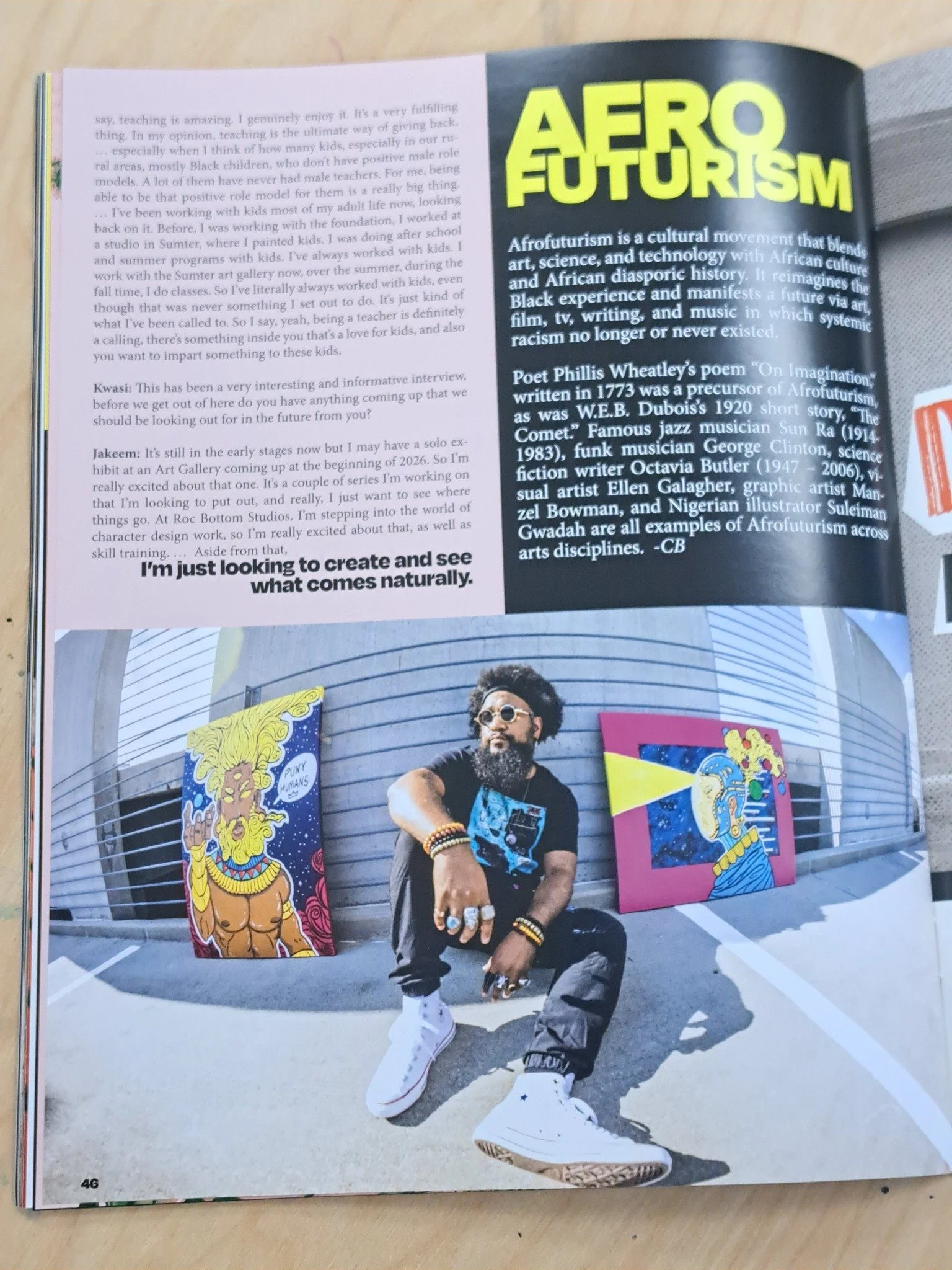
Jakeem: I loved animation. I loved cartoons, comics, manga, and all of that. So I started off just replicating what I saw. I would draw Dragonball Z. I would draw Pokémon and Digimon. I started creating my own characters, probably around middle school. I would make small comics in notepads, before I knew about sketch pads and before I had access to professional art materials. ... I went into high school doing the same thing. My artistic voice didn't start really forming until probably around college, when I was exposed to African American art and Instagram, honestly, like, OG Instagram was a space that connected you with all these different artists. And I'm like, oh, god, look at all these amazing Black artists creating Black artwork. And from there it was, It spoke to me like, I want to create stuff that looks like me, because I didn't know you could do that. So, like I said, once I ran across that it was rapid, even like what I work on now, being in the genre of Afro futurism, I realized that what I've always done has always been in that genre before I even knew what that meant. I currently refer to it as Afro Alchemy. I'm taking both past, present, future pain, suffering, joy, happiness, and transforming it, transmuting it into something brand new, and it just, it shows us in a positive light. And I love it when people see my work and it’s just bright eyes kids excited to see it. It's an amazing feeling.
Kwasi: What exactly is Afrofuturism? In your own words, how would you describe it?
Jakeem: Afrofuturism, in my opinion, is looking at the African diaspora, for example, understanding that we as African descendants are part of the past, present and future. Like a lot of time, we look at time from a linear standpoint, but time exists all at one time. So like the past, present, and future, they're happening all at once. We only perceive them bit by bit. One of the earliest Afrofuturistic concepts I came across was, if you look at something like Star Wars, Star Trek, stuff that takes place in the future, you'll see how you have all these different aliens and robots, but then there's always an absence of Black people, right? And the question was proposed, like, how could you have aliens in the future. You could have flying cars in the future, but somehow, Black people don't exist in this future. No, there should be a much more balanced appearance, because we're in the future, we're in the past, we're here now. So for me, Afrofuturism is really just examining the fact that we are multidimensional, and we're spread out across time, and we always will be.
Kwasi: Are there any specific visual artists by which you were/are inspired?
Jakeem: Absolutely, Hayao Miyazaki is one. He created Spirited Away and he owns Studio Ghibli, an amazing animation studio based in Japan, where they actually still do hand drawn illustrations. Nowadays, a lot of animation is done digitally, but at Studio Ghibli they still hand draw their work, and it creates this very nostalgic, beautiful feeling. He's been a major influence. Artists like Guillermo del Toro, who is a phenomenal director, who created the Hellboy franchise. His style is so unique. Mike Mignola, who actually created the Hellboy comics, and they worked together on the first Hellboy movies. And Cedric Umoja and Thomas Washington are local artists who inspired me that I actually know.
Kwasi: Do you have a favorite piece of art that you created and is there a fan favorite piece of work?
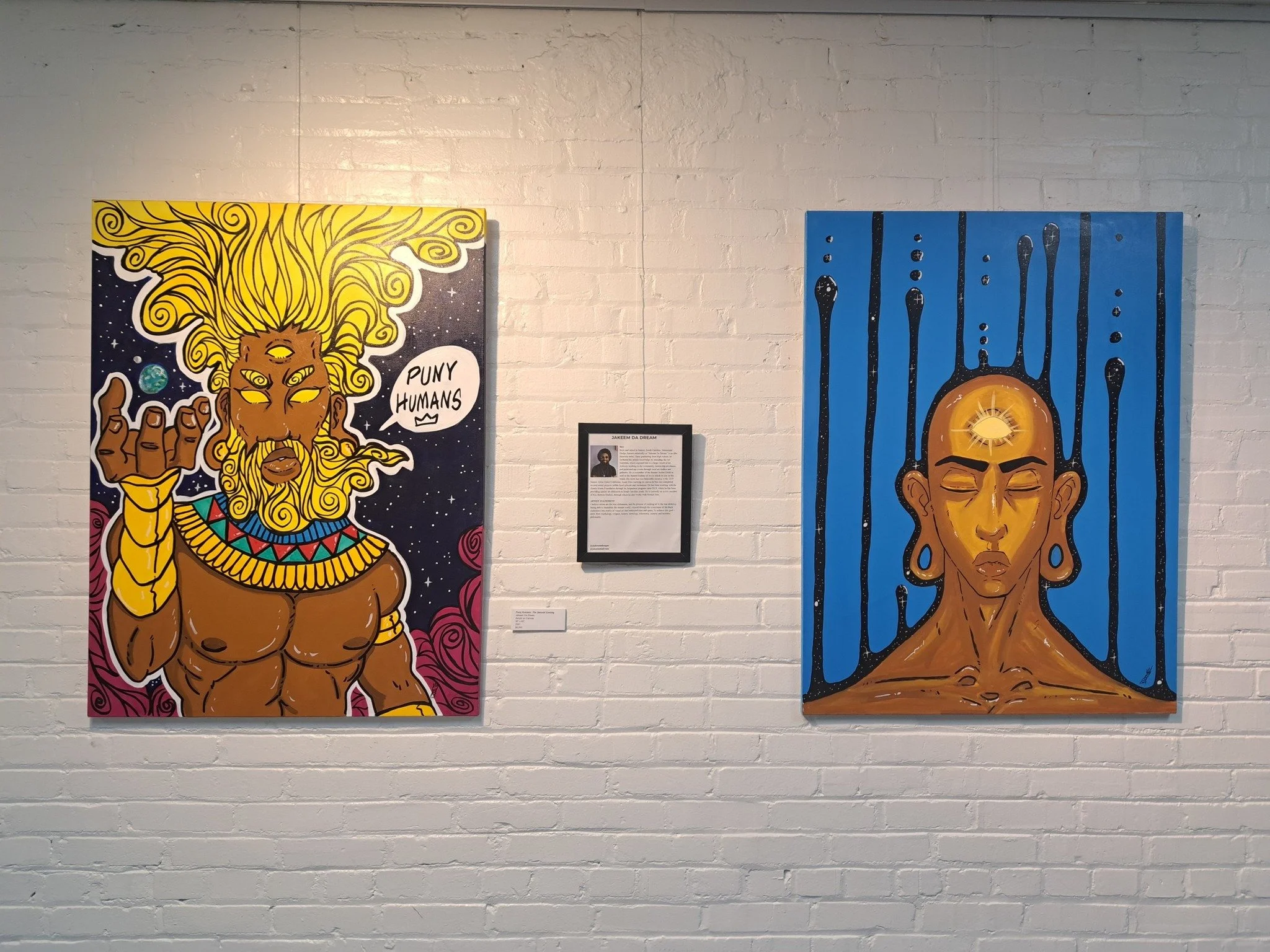
Jakeem: My Puny Humans piece is definitely my favorite, as well as most people's favorite. And what's fascinating about that piece is that it’s the second version of it, the first one I did back in 2016. It was titled simply puny humans. This one that's popular now is Puny Humans the second coming, and I want to expand upon that as a series and do more in it.
Kwasi: You're also a teacher and you work with children. How did that come about?
Jakeem: Teaching called me. I did not set out to be a teacher. If you had told me when I graduated high school that I'd be working with kids, I would have laughed in your face. So what happened was, I was invited to do a live painting at the Black Women’s Expo. The painting I did I got to present it to Vivica A Fox which was really cool. While I was there, one of the liaisons for the Auntie Karen foundation--her name is Lisa—saw me and told me about a teaching program and got my information. Maybe a month later, I had an interview with her and Karen Alexander Banks, who's the creator of the foundation, and I've been teaching ever since. Since 2018 I've been in schools and the program, we're primarily involved with rural area schools, due to the fact that there are a lot of schools in South Carolina that do not have art and music. So we come in and put artists and musicians in these positions to teach, you know, to educate these kids. So I taught at my first school in Hardeeville, South Carolina. Currently I'm in King Street Kindergarten Leadership Academy. I've been there for six years now. And I have to say, teaching is amazing. I genuinely enjoy it. It's a very fulfilling thing. In my opinion, teaching is the ultimate way of giving back, … especially when I think of how many kids, especially in our rural areas, mostly Black children, who don't have positive male role models. A lot of them have never had male teachers. For me, being able to be that positive role model for them is a really big thing. … I've been working with kids most of my adult life now, looking back on it. Before, I was working with the foundation, I worked at a studio in Sumter, where I painted kids. I was doing after school and summer programs with kids. I've always worked with kids. I work with the Sumter art gallery now, over the summer, during the fall time, I do classes. So I've literally always worked with kids, even though that was never something I set out to do. It's just kind of what I've been called to. So I say, yeah, being a teacher is definitely a calling, there's something inside you that's a love for kids, and also you want to impart something to these kids.
Kwasi: This has been a very interesting and informative interview, before we get out of here do you have anything coming up that we should be looking out for in the future from you?
Jakeem: It’s still in the early stages now but I may have a solo exhibit at an Art Gallery coming up at the beginning of 2026. So I'm really excited about that one. It's a couple of series I'm working on that I'm looking to put out, and really, I just want to see where things go. At Roc Bottom Studios. I'm stepping into the world of character design work, so I'm really excited about that, as well as skill training. … Aside from that, I'm just looking to create and see what comes naturally.
Afrofuturism is a cultural movement that blends art, science, and technology with African culture and African diasporic history. It reimagines the Black experience and manifests a future via art, film, tv, writing, and music in which systemic racism no longer or never existed.
Poet Phillis Wheatley’s poem “On Imagination,” written in 1773 was a precursor of Afrofuturism, as was W.E.B. Dubois’s 1920 short story, “The Comet.” Famous jazz musician Sun Ra (1914-1983), funk musician George Clinton, science fiction writer Octavia Butler (1947 – 2006), visual artist Ellen Galagher, graphic artist Manzel Bowman, and Nigerian illustrator Suleiman Gwadah are all examples of Afrofuturism across arts disciplines.