
Answer: This 17th century playwright pits the blind arrogance of toxic masculinity against feminine righteousness, telling a story of love, betrayal, and revenge through threats of violence and cross-dressing concealment of identity, in a voice that continually whispers innuendo and out the other.
Question: If your Final Jeopardy response is “Who is William Shakespeare,” I suggest you try to allow your patriarchal assumptions to serve as foreshadow.
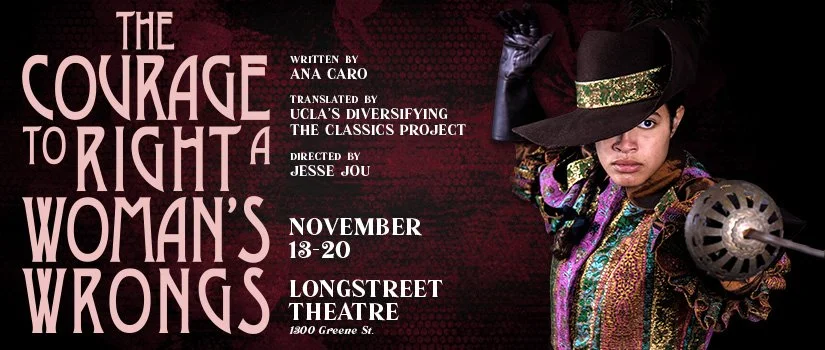
Ana Caro was a writer of the Spanish Golden Age and The Courage to Right a Woman’s Wrongs is her most well-known surviving play. The production by the University of South Carolina’s Department of Theatre and Dance at USC’s Longstreet Theatre is a translation of UCLA’s Diversifying the Classics Project and is directed by Associate Professor Jesse Jou. Only two of Caro’s plays survive, and while we are unsure of the precise dates of her life, we know she was taken before her time by the plague. In this tale, when Leonor is discarded by her betrothed Don Juan, she refuses to suffer the indignity of accepting shame. Instead she disguises herself as a valiant swordsman, Leonardo, and sets off to restore her honor, exact revenge, and bring her rogue lover to justice.
Our protagonist, Leonor/Leonardo is played by Isnerys Carrasquillo, and the target of her pursuit Don Juan is played by Asher Thompson. Their committed performances drive our core story. The new interest of the fickle Don Juan, the Countess Estela, played by Destiny McCorvey, her cousin Lisarda, played by Lucia Ramos Calleros, Don Juan’s principle competitor for Estela’s affection, Don Fernando, played by Lucas Alvarado-Barahona, and Ludovico, a prince drawn into Leonardo’s subterfuge, played by Billy McNeill, round out the core of our story.
They all courageously face the challenge of performing a new translation of a four-hundred-year-old play in heightened language, in the round, on a set so minimal, its only structure was four small movable benches. Egba Evwibovwe’s minimalist set suggests changes in locale/mood through an overhead decorative structure that interacted with Jim Hunter’s Lighting Design. Helen Ryser’s costume design was very detailed and set us in the seventeenth century in a deliciously flamboyant way. And the color palette of each character helped us track quick shifts in the story. Patrick Michael Kelly designed a rich surge of storming sound to establish our reality, the rest left to the players.
It quickly becomes clear that Director Jesse Jou has opted for this open, unstructured setting to better facilitate the rapid shifts and changes of Spanish Comedia. The comic heroes of our story are the clowns, Tomillo, played by Conner Belin, Flora, played by Lilly Thompson and Ribete, played by Chloe Newport. They interject themselves throughout the narrative to great comic effect. Some measure of their action is unique to this production as much of the humor was locally topical. The clowns were comic relief in the truest sense. Whenever they briefly had the stage to themselves, the audience noticeably relaxed from the effort of following an intricate story.
All nine of these performers clearly trust their director, Jesse Jou and their fight choreographer, Patrick Michael Kelly, and their Stage Manager, Jacob Groetsch. Their movement, anchored in intention, made their environment real. Chloe Newport gave a standout performance. Her comic timing was razor sharp and she moved with such specific intention that she made each scene more true.
Columbia is profoundly blessed that USC has the courage and commitment to find and bring to us such important scripts. Hopefully, further collaboration with UCLA’s Diversifying the Classics Project will yield more literary treasures, but until then you should get to Longstreet Theatre at 1300 Green Street in Columbia before November 20, to experience a classic for the first time.