
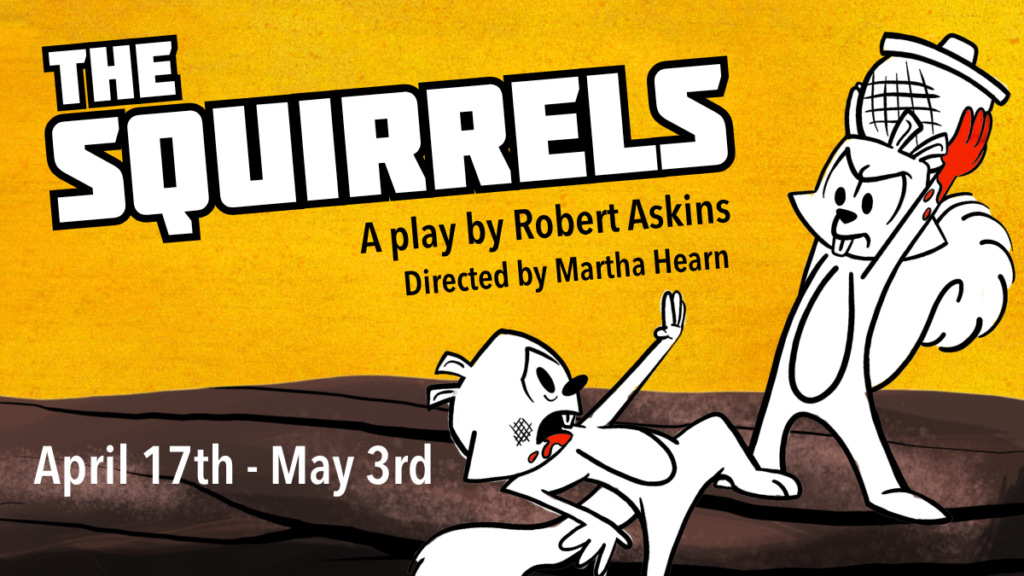
REVIEW: The Squirrels at Trustus Theatre by Clayton King

As the lights went down on The Squirrels, currently on stage at Trustus Theatre, I turned to the person sitting next to me and said, “I need to process what I just saw.” The play’s message is simple, but the plot is challenging to explain, in the same way that our current socio-political situation is simple, but deceptive and convoluted. Still, it is easy to recommend this show as a must-see for Columbia audiences.

Rather than attempting to explain the entire plot, suffice it to say Robert Askins’ script seems to invite questioning. The play offers a rich, comedic view of a darker understory in which small animals exist in a civilization (‘squirld’) that mimics the ‘world’ at large. The strong parallels between this heretofore unknown society of mammals and our current climate are unmistakable. And all while, the audience is entertained with fast-paced dialogue and action.

The Scientist, played by Jonathan Monk, opens the show with a combination pre-show speech and educational primer on the world of squirrels. The slide show includes Trustus’ season flyer, and the audience is thanked for its open-mindedness in coming to see this show. In his “lesson,” the Scientist remarks:

“And you’re like musical. Okay. Thinky play about thinky things all the way from New York. Sure. Duh. Then what’s this? Squirrels? Other people might go, ‘BAWHA? A play about squirrels? What?’ Not you. You said, ‘Okay.’ You said, ‘I’m curious.’ You said, ‘Give me some.’ And some you shall have. Buckle up, you discerning patron of the arts. Because we are going to get scientifical, because SQUIRRELS ARE FASCINATING.

From this moment on, the basic tenet of theatre that audiences are invited to “suspend disbelief” becomes the top order, as one often forgets these are actual humans on the stage portraying actual squirrels. The absurdity of it all wraps itself around you while constantly pulling you into the world of these animals.

Jonathan Monk’s comedic timing and ability are in full force and alone are worth the price of admission.

Director Martha Hearn has assembled a wonderful cast to tell this story, and the production quality is outstanding. The audience is aptly and elegantly transported into this ‘squirld,’ with the cast adopting the behavior, mannerisms, and sounds of squirrels so completely that “suspending disbelief” was easy. Each actor dons an absurd, enormously fluffy tail as a means of self-identification, which only furthers the premise of both ridiculousness and creative genius.

Jonathan Monk’s comedic timing and ability are in full force and alone are worth the price of admission. This is rivaled only by his sinister and Machiavellian portrayal later as Scuridae. Add to that Terrance Henderson’s masterful performance as Sciurus, the aging head of an established, wealthy family of grey squirrels. He is both funny and appalling as he struggles to keep his sanity, family, and large cache of nuts. He has the power, and as the top squirrel in his tree, Sciurus resists sharing his hoard with the hungry, fox squirrels.

In a sort of “rebel with a cause” flair, Patrick Dodds (Carolinensis) earnestly leads his squirrels in an insurrection and quest to secure nuts for his group's basic needs. His forbidden love interest, Chordata, is Sciurus’ daughter and the heart of the play. Courtney Sims’ portrayal of the character is sympathetic and guides the audience through the play, embodying a character who struggles to find balance and fairness with a strong will and full heart.

A standout as Rodentia, Abigail Lee McNeely loves her adopted father, Scurius, with an impure adoration that antagonizes her adopted mother’s status as the tree matriarch. Rodentia’s wantonness is a pathological cover for her loneliness and need for affection, as she is an outsider living on the inside of a dynasty. In the role of Mammalia, the matriarch of the Scurius clan, Erin Wilson offers both a caring, warm-hearted mother figure and a hard, brutal side on full display as the play closes -- think of an iron fist wrapped in a velvet glove. The audience experienced a euphoric moment, reminiscent of King Joffrey’s dramatic death (non-sequitur reference to Game of Thrones), as she struck the killing blow. It was jubilant and met with thunderous applause!

 Rounding out the cast are ensemble players Olivia Wamai and Nicole Perez, who serve as members of the insurrection and help move the action along with fluidity.

Everyone on stage so expertly embodied what one would consider “typical” squirrel behavior; it was uncanny and highly entertaining. The cast had a wonderful play space to work with on Corey Langley’s imaginative and effective sets. The scale of all the spaces on stage reminds us that we are watching squirrels (human-sized ones) in places like tree-top lairs, underground havens, and bird houses. Costume designer Rachel Turner creatively meets the challenge of providing character-appropriate garb for each player. And did I mention the tails? Character makeup suggests an animalistic appearance without becoming a caricature in motion. Light and Sound Design by Laura Anthony Robbie and Jacob Olano, respectively, were perfect for the task of enhancing the production.

One must also give a huge nod to Kathleen Pennyway, who serves as the production’s Intimacy Coordinator. The prolific world of squirrels includes a great deal of mating (“mukking”), and this idea was evident, daring, and sensitively handled. Likewise, Patrick Michael Kelly’s fight choreography effectively captured what one would envision with squirrels fighting over nuts and dominance.

While there is a lot of information and machination to try to describe in The Squirrels, I can only say “go see it!” It is thought-provoking, comical, emotional, and ultimately, hopeful. The show’s runtime is two hours and 40 minutes, with a 15-minute intermission, yet the performances, individual and collective, are where the experience soars. In fact, after the show ended to an immediate standing ovation, I glanced at my watch and was surprised at the time; I had no idea how much time had passed and never felt a lull.

If Southern Gothic and theatre of the absurd had a love child, it would be The Squirrels. The telling of prejudice, inequality, and basic needs is the main point that resonates with most people today. The show runs April 17-May 3, and tickets are available online at trustus.org.

REVIEW: The Revolutionists at Trustus Side Door Theatre - A Lesson (or Two) in History Reviewed by Jane Peterson

The Revolutionists, written by Lauren Gunderson at Trustus Theatre’s Side Door Theatre is a vibrant blend of humor, intensity, and bold historical imagination. Gunderson is known as one of the most produced playwrights today. Set during the tumultuous Reign of Terror in 1793 France, the play introduces us to four women—three of whom were real historical figures—who grapple with the injustices and struggles of their time. Their conversations, filled with passion, rebellion, and hope for a better world, feel surprisingly relevant given the political unrest in our country today.

The first of these women is Olympe de Gouges (Kathleen Arcovio Pennyway), a French playwright and activist who fought for women’s rights. As de Gouges declares, she is “happy that my plays piss off the right kind of people.” She is approached by Marianne Angelle (Courtney Sims), a fictional character who symbolizes the Haitian rebels and revolutionaries of the time. Angelle persuades de Gouges to write pamphlets supporting the abolition of slavery, particularly in Haiti, where the enslaved are fighting for their freedom. Alongside them is Charlotte Corday (Nicole Perez), the infamous assassin of revolutionary Jean-Paul Marat, who justifies her act of violence by accusing Marat of inciting mass murder. Poised for her execution, Corday seeks de Gouges’ help to craft a memorable last line before killing Marat in his bathtub. Finally, there is the deposed Marie Antoinette (Elane Werren), who wants de Gouges to rewrite her story in a way that will make the people love her again. She desperately seeks “better press” in the wake of her fall from grace.

Written by Laura Gunderson, the play is dialogue-heavy and, at times, could benefit from some tightening. However, the cast delivers the material with such verve and energy that it’s hard to look away. The actors frequently break the fourth wall, drawing the audience into the action, and this direct engagement never feels forced. Kudos to director Martha Hearn for expertly utilizing the intimate space of the Side Door Theatre, ensuring that every audience member feels like part of the action. Hearn's character direction is particularly strong, bringing out the best in each performer. Courtney Sims, as Marianne Angelle, is the standout performer of the evening. Her deeply emotional portrayal brings richness and depth to her character, making her both powerful and poignant. Elane Werren, as Marie Antoinette, follows closely behind, showcasing impressive comedic timing and playful expressions that add much-needed levity to an otherwise heavy narrative. Werren shines in her humorous moments, making Antoinette’s desperation both tragic and entertaining.

Although some of the set changes can be a little clumsy—an ongoing challenge in a small space—the overall design works well and does not distract from the performances. The minimalism of the set complements the play’s focus on character and dialogue. The Revolutionists not only serves as a fascinating history lesson but also acts as a timely meditation on the fight for justice, equality, and freedom. The language can be strong, so if you are sensitive to rough language, you may want to consider that.  I appreciated how the play encouraged me to revisit French history and the revolutionary women who shaped it. The show runs through February 1 at Trustus Theatre. With limited seating, be sure to grab your tickets soon at trustus.org!

REVIEW: TRUSTUS THEATRE'S STUPID FUCKING BIRD

Trustus Theatre opened Aaron Posner’s Stupid Fucking Bird down on Lady Street on February 9th, under the direction of the theatre’s Executive Director, Jessica Francis Fichter. This play, which is advertised as “kinda based on” Anton Chekhov’s The Seagull, is a 2.5-hour experience that is “kinda” a comedy that explores family, love, unfulfilled potential, freedom, destruction, and art (all present in the source material on which it was kinda based). Trustus’ production is a winning moment for the theatre with a talented ensemble, adventurous technical execution and a team that not only had a deep understanding of what they wanted to try to do, but the expertise to make it a reality.  

Chekhov’s play is not essential to the audience’s engagement with Bird. Academics (read: theatre nerds) will enjoy the fun game of compare-and-contrast that this work allows, but the non-historian will be plenty occupied with experiencing the characters’ journeys, interacting with the actors in an environment without a fourth wall, exploring a dialogue regarding the authentic self and inviting their brains to ask, “what is art, why do we make it and why is it vital…or is it?”   

Stupid Fucking Bird concerns a stormy front of romantic and emotional entanglements amongst a family and their friends gathered at a large beach house. Conrad (Patrick Dodds) loves Nina (Cassidy Spencer), but Nina pines for Trigorin (Laurens Wilson) who is dating Conrad’s mom, Emma Arakdina (Erin Wilson). But wait, there’s more! Conrad’s platonic pal Mash (Martha Hearn) languishes for Conrad, and Dev (Cameron Muccio) swoons for Mash. The term “love triangle” doesn't suffice to explain the plot. Perhaps the geometrists in the crowd can do the math.  

As with all Chekhov and related materials, there must be an estate. Enter Dr. Eugene Sorn (Hunter Boyle), for whose attention all of these lover-friends are wrestling. Sorn is the only character who doesn’t have a love interest and is quite often the only sensible person in the room. Sorn’s questioning of whether we are ever our authentic selves is a particularly salient moment in the play.  

While there is a lot of frustration in watching these characters chase their misguided obsessions, the rewarding part of the Stupid Fucking Bird is the opportunity to engage in a discussion about art. Trustus is no stranger to material that has asked Columbia audiences to engage in this conversation (i.e. Yasmina Reza’s Art and Stew’s Passing Strange), and this type of work starts the dialogue within the walls of the theatre that evolves into colorful debate once you’ve cozied up to a bar afterwards.  

Trustus’ Bird has an excellent cast - not a weak link on stage. These are talented actors tackling challenging material, and they are in complete ownership of the proceedings. Patrick Dodds’ has played a wide range of roles since his first appearance at the theatre in 2011, but his portrayal of Conrad has probably been one of the most demanding jobs he’s taken on - and he delivers. Dodds succeeds in making us believe in his journey from obsession to destruction. His monologue towards the end of the first act, combined with the tech that was used, is jarring in the best kind of way.  

Erin and Laurens Wilson, in the roles of Emma and Trig, are a grounding and necessary presence for this cast which otherwise portray forlorn nihilists who refuse to stop thwarting themselves. Cameron Musccio makes a welcome debut on the Thigpen Main Stage with his Dev being an incredibly endearing straight-man-who-gets-the-laughs. Cassidy Spencer and Martha Hearn, as Nina and Mash respectively, turn in anchored performances. Hunter Boyle as Dr. Sorn exhibits more control and firmness than we’ve seen in recent years, and it is a delightful change of pace that leaves us hoping to see Boyle explore more roles like this - because it’s really really good.  

The production team deserves high marks for a finely-tuned scenic,  lighting, media, and sound design package. From moons that seamlessly cross the entire stage, to the simplicity of scene titles - Matt Pound has used different media outputs to make something quite complicated seem seamless. Paired with Marc Hurst’s sizzling lighting and Teddy Palmer’s use of the space as an abstraction of frames - these elements truly make you feel like you’re watching a production that was tailored down to the last stitch. We would also like to note that there is even a Shen Yun poster hidden in the mix (which can lead to a tangential conversation about art after the show). 

Though some music levels could be increased to improve audience-immersion throughout and tattoos could be better covered-up (or not covered?) as to not distract, Stupid Fucking Bird is a tight vehicle for the actors, designers, and audience. This is probably due to the work of Director Jessica Francis Fichter. We are very glad her voice is more prominent in Columbia’s theatre scene these days and look forward to more.  

If you’re into light comedic fare that intends to entertain by way of jazz hands, this is no play for you. However, if you’re just the slightest bit adventurous, enjoy conflict and the promise of a post-show arts salon: trust Trustus with this play. This is the kind of work that the theatre’s co-founders intended the theatre to produce, and true to form - whether you actually like the play or not - this is the only place you can experience work like it in these parts. Stupid Fucking Bird runs through February 24th at Trustus (520 Lady St.), and you can get your tickets to make up your own mind about this production at www.trustus.org

(edited 2/11/24)