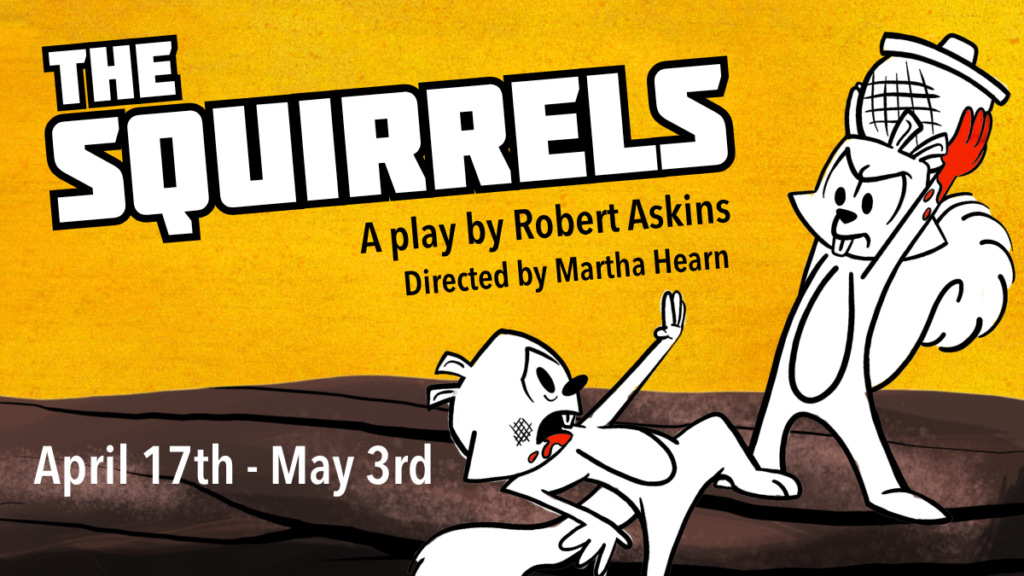
As the lights went down on The Squirrels, currently on stage at Trustus Theatre, I turned to the person sitting next to me and said, “I need to process what I just saw.” The play’s message is simple, but the plot is challenging to explain, in the same way that our current socio-political situation is simple, but deceptive and convoluted. Still, it is easy to recommend this show as a must-see for Columbia audiences.
Rather than attempting to explain the entire plot, suffice it to say Robert Askins’ script seems to invite questioning. The play offers a rich, comedic view of a darker understory in which small animals exist in a civilization (‘squirld’) that mimics the ‘world’ at large. The strong parallels between this heretofore unknown society of mammals and our current climate are unmistakable. And all while, the audience is entertained with fast-paced dialogue and action.
The Scientist, played by Jonathan Monk, opens the show with a combination pre-show speech and educational primer on the world of squirrels. The slide show includes Trustus’ season flyer, and the audience is thanked for its open-mindedness in coming to see this show. In his “lesson,” the Scientist remarks:
“And you’re like musical. Okay. Thinky play about thinky things all the way from New York. Sure. Duh. Then what’s this? Squirrels? Other people might go, ‘BAWHA? A play about squirrels? What?’ Not you. You said, ‘Okay.’ You said, ‘I’m curious.’ You said, ‘Give me some.’ And some you shall have. Buckle up, you discerning patron of the arts. Because we are going to get scientifical, because SQUIRRELS ARE FASCINATING.
From this moment on, the basic tenet of theatre that audiences are invited to “suspend disbelief” becomes the top order, as one often forgets these are actual humans on the stage portraying actual squirrels. The absurdity of it all wraps itself around you while constantly pulling you into the world of these animals.
Jonathan Monk’s comedic timing and ability are in full force and alone are worth the price of admission.
Director Martha Hearn has assembled a wonderful cast to tell this story, and the production quality is outstanding. The audience is aptly and elegantly transported into this ‘squirld,’ with the cast adopting the behavior, mannerisms, and sounds of squirrels so completely that “suspending disbelief” was easy. Each actor dons an absurd, enormously fluffy tail as a means of self-identification, which only furthers the premise of both ridiculousness and creative genius.
Jonathan Monk’s comedic timing and ability are in full force and alone are worth the price of admission. This is rivaled only by his sinister and Machiavellian portrayal later as Scuridae. Add to that Terrance Henderson’s masterful performance as Sciurus, the aging head of an established, wealthy family of grey squirrels. He is both funny and appalling as he struggles to keep his sanity, family, and large cache of nuts. He has the power, and as the top squirrel in his tree, Sciurus resists sharing his hoard with the hungry, fox squirrels.
In a sort of “rebel with a cause” flair, Patrick Dodds (Carolinensis) earnestly leads his squirrels in an insurrection and quest to secure nuts for his group's basic needs. His forbidden love interest, Chordata, is Sciurus’ daughter and the heart of the play. Courtney Sims’ portrayal of the character is sympathetic and guides the audience through the play, embodying a character who struggles to find balance and fairness with a strong will and full heart.
A standout as Rodentia, Abigail Lee McNeely loves her adopted father, Scurius, with an impure adoration that antagonizes her adopted mother’s status as the tree matriarch. Rodentia’s wantonness is a pathological cover for her loneliness and need for affection, as she is an outsider living on the inside of a dynasty. In the role of Mammalia, the matriarch of the Scurius clan, Erin Wilson offers both a caring, warm-hearted mother figure and a hard, brutal side on full display as the play closes -- think of an iron fist wrapped in a velvet glove. The audience experienced a euphoric moment, reminiscent of King Joffrey’s dramatic death (non-sequitur reference to Game of Thrones), as she struck the killing blow. It was jubilant and met with thunderous applause!
Rounding out the cast are ensemble players Olivia Wamai and Nicole Perez, who serve as members of the insurrection and help move the action along with fluidity.
Everyone on stage so expertly embodied what one would consider “typical” squirrel behavior; it was uncanny and highly entertaining. The cast had a wonderful play space to work with on Corey Langley’s imaginative and effective sets. The scale of all the spaces on stage reminds us that we are watching squirrels (human-sized ones) in places like tree-top lairs, underground havens, and bird houses. Costume designer Rachel Turner creatively meets the challenge of providing character-appropriate garb for each player. And did I mention the tails? Character makeup suggests an animalistic appearance without becoming a caricature in motion. Light and Sound Design by Laura Anthony Robbie and Jacob Olano, respectively, were perfect for the task of enhancing the production.
One must also give a huge nod to Kathleen Pennyway, who serves as the production’s Intimacy Coordinator. The prolific world of squirrels includes a great deal of mating (“mukking”), and this idea was evident, daring, and sensitively handled. Likewise, Patrick Michael Kelly’s fight choreography effectively captured what one would envision with squirrels fighting over nuts and dominance.
While there is a lot of information and machination to try to describe in The Squirrels, I can only say “go see it!” It is thought-provoking, comical, emotional, and ultimately, hopeful. The show’s runtime is two hours and 40 minutes, with a 15-minute intermission, yet the performances, individual and collective, are where the experience soars. In fact, after the show ended to an immediate standing ovation, I glanced at my watch and was surprised at the time; I had no idea how much time had passed and never felt a lull.
If Southern Gothic and theatre of the absurd had a love child, it would be The Squirrels. The telling of prejudice, inequality, and basic needs is the main point that resonates with most people today. The show runs April 17-May 3, and tickets are available online at trustus.org.
