In a few weeks we’ll gather with friends and family ‘round our family hearths and dining room tables to celebrate the original Thanksgiving, one of our most joyous holidays, which commemorates a brief détente during bloody upheavals between the Pilgrims, who did not wear all black and big buckles, and the Wampanoag tribe, who had been decimated by leptospirosis, Europe’s most lucrative export, and which starred Squanto, who having escaped slavery in Europe, assisted the pilgrims only as a means of gaining political advantage. We will recall that the main course was probably venison and waterfowl, not turkey, and that in 1621 there were in the colonies no potatoes, sweet or otherwise, no bread, no gravy, no scrumptious desserts, and that after the three-day truce, all the old hostilities were renewed, and all of these truths were buried when the occasion was fictionalized during the Civil War, when President Abraham Lincoln, seeking détente, declared it a holiday.
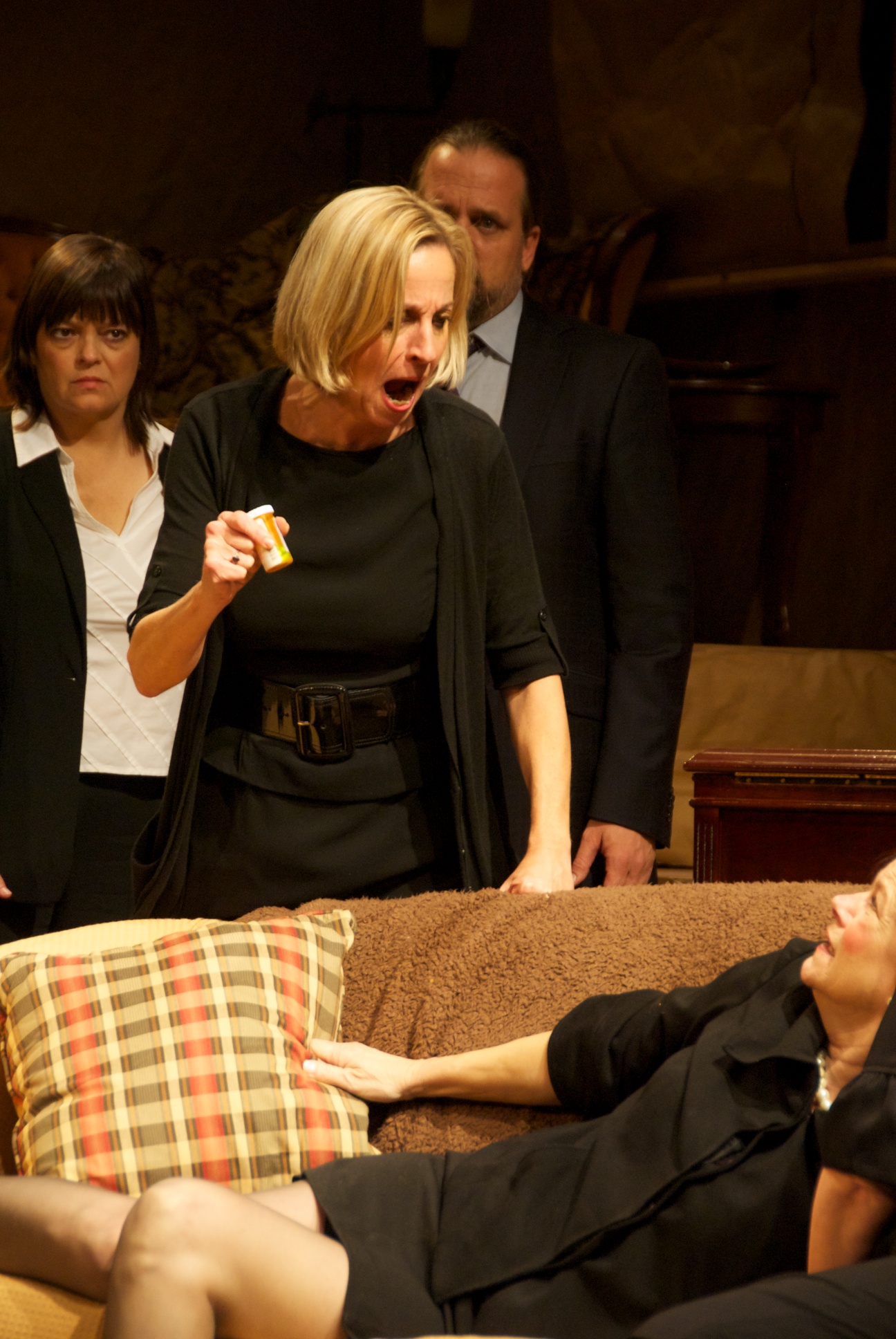
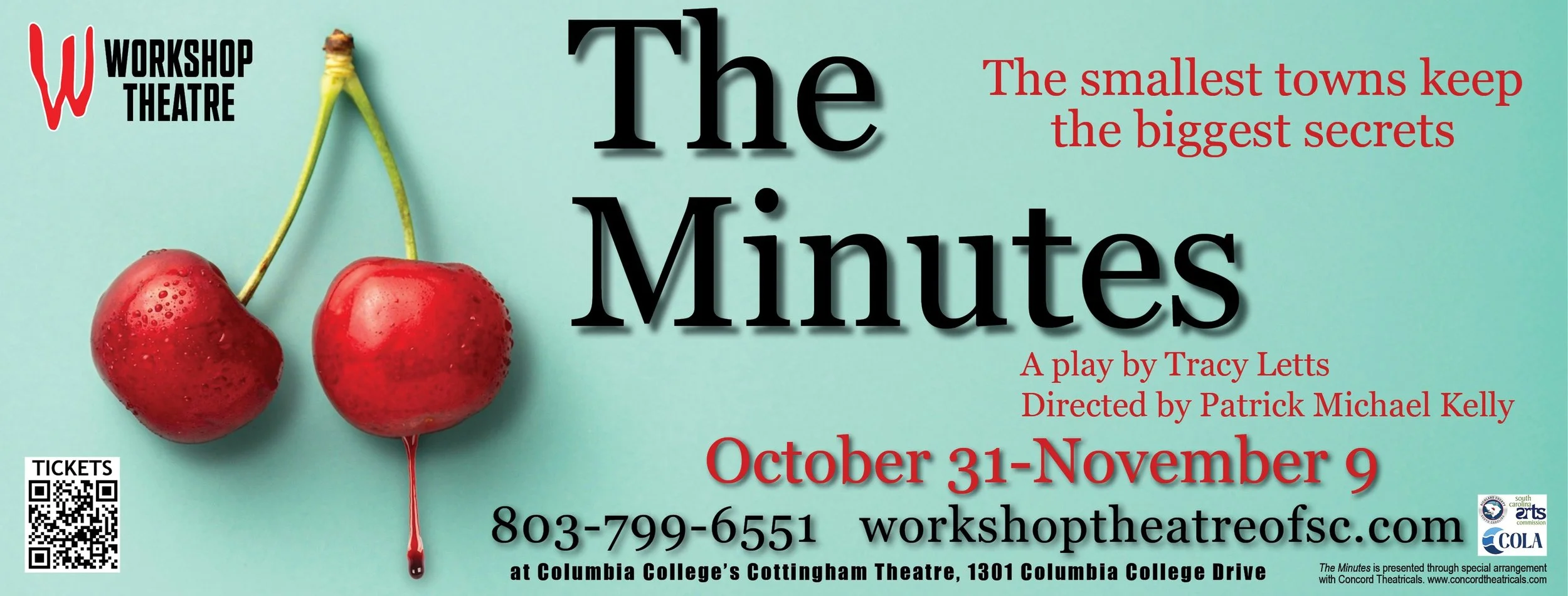
In preparation, go enjoy Workshop Theater’s production of The Minutes, running through Sunday, November 9, at Cottingham Theatre, a play which pillories our desperate presumptions of civility and harmony and is really quite astounding.
The Minutes is by Tracy Letts, who in 2007 received a Pulitzer Prize for his play August: Osage County, which has been produced locally and in 2013 was adapted for the screen. The Minutes was nominated for the Pulitzer and for a Tony Award after having moved to Broadway in 2022. His other plays, most of them originating at Chicago’s renowned Steppenwolf Theatre, include Killer Joe (1993) Bug (1996), and the brilliant Man From Nebraska (2003), which is about a man searching far and wide for the purpose and fulfillment that is literally sitting in the chair across from him. Letts has become, in addition to being an accomplished actor, one of our finest playwrights.
Therefore, when you see this play, make sure your expectations are high.
At first, you will feel you’ve been tricked. The play presents as a city council meeting in the town of Big Cherry, a middling little burgh about fifty miles from Anywhere, USA. The meeting is as vapid and fatuous as any you’ve ever attended. The council members are all recognizable types—the Old Codger, the Neurotic, the Social Crusader, the Stolid Secretary, The Righteous Gasbag, and the Probably Drunken Visionary—who proceed, following the Prayer, and according to Robert’s Rules of Order, from one tedious agenda item to the next, culminating in the Closing Ceremony. The whole thing comes across, at first, as a harmless cartoon satirizing our best civic intentions.
Our Mr. Blake, played with aplomb by Brandon Campbell, proposes a new “Lincoln: Smackdown!” cage-fighting event to be staged during the town’s annual Heritage Festival, Abe Lincoln having had nothing to do with the town’s founding, but cage fighting being a crowd-pleaser. Our Mr. Hanratty (Marshall Spann, also excellent) lobbies for a new fountain in the village square fully accessible to his crippled/handicapped/disabled/impaired sister, which leads to a debate about inclusion versus costs, idealism versus practicality. Yawn. The most scandalous topic, for a while, is the apparent resale of lost and stolen bicycles by the town’s sheriff.
But then, but then….
The trick being played here is that this meeting only seems boring. It’s the same trick Thornton Wilder played on us in Our Town, which for two acts shows us how empty and mundane our lives are--but then, but then, in the third act, reveals their immensity.
There are two extraordinary moments in The Minutes that reveal the play’s bait-and-switch gadgetry, one of which I will spoil. It is the spontaneous re-enactment, by the council members, for the benefit of newcomer Mr. Peel, of the Battle of Mackey Creek, upon which Big Cherry was founded. Amazingly, breathtakingly, they assume many dozens of roles—farmers, hostile Sioux, American militia—pantomiming the heroic rescue of little Debbie Farmer, who would grow up to be the town’s wealthy matriarch, by one heroic soldier, Otto Pim, who for his valor would earn the Medal of Honor, and so “the Town of Big Cherry is Saved!”
That moment was greeted on the night I attended by an enthusiastic roar from the audience, which was small because the performance was competing with game seven of the World Series and the University of South Carolina football game, the irony of which I will return to later. The point here is that, from this point out, director Patrick Michael Kelly reveals just how deft he is at theatrical sleight of hand. Kelly is well-known and rightfully respected in the midlands as a meticulous, scrupulous orchestrator of theatrical events, and this production can only add to his reputation. From this point out, the play was utterly stunning.
The other extraordinary moment I will not spoil, except to say that it occurs in flashback, when ousted council member Mr. Carp (Glenn Rawls, whose native honesty and compassion suit his character well) re-educates the council about the town’s actual founding and the myths that have been piled upon it since. “We have built this town upon a fiction!” he declares, and so reveals his colleagues as uninformed at best, ruthless hypocrites at worst.
Had the play stopped there, it would have been fulfilling, if perhaps a bit too easy, too moral, because it reveals to us what we already know: that America has always and is still now dancing as fast as it can to validate old lies and invent new ones. Kelly chose to direct The Minutes because, he says, with each news cycle, it keeps becoming more relevant: “In our era of misinformation, disinformation, and alternative facts, in a country that is deeply divided despite our common humanity, this play skewers national and local politics and blurs the line between parody and truth.”
Kelly cites, as an instance, the recent controversy surrounding the nineteen Medals of Honor given to American soldiers who, at the 1890 Battle of Wounded Knee, slaughtered 300 Lakota men, women, and children, many of them after they had been promised mercy. About the carnage, American general Nelson Miles, who arrived a few days after, noted he had “never heard of a more brutal, cold-blooded massacre.” In reaffirming the validity of the soldiers’ medals, current Secretary of War Pete Hegseth announced that “this decision is now final, and their place in our nation’s history is no longer up for debate.”
But the play does not stop there—at the revelation about the Battle of Mackey Creek. Instead, it twists back upon itself and implicates us, as citizens in the gallery, as hypocrites as well, showing us our willing complicity in historical revisionism, because we prefer, over truth, our “cocoon of comfort and safety.” That climactic sequence is enacted by the town’s Mayor Superba, played here and well by John Brunty, who also transforms before our eyes from one thing into something very other. Resplendent, at the beginning, in his red blazer, he looks more like a game show host and comports himself as the voice of reason and moderation. But then, but then, at the end, he declares that “history is a verb” and gathers the council in a horrific, chilling, primal, brutal closing ceremony worthy of Shirley Jackson.
Though I found the acting existed at times on different levels, the cast did a fine job of creating a unified ensemble out of disparate characters who find safety in numbers. Among my favorites were the sanctimonious Mrs. Innes (Carol Beis,), who proclaims, “you all know how I adore low-income children,” and the manipulative Mr. Breeding (Laurens Wilson), whose every posture reveals exaggerated self-worth. Particular mention must be made of Cameron Muccio, whose Mr. Peel, though earnest and guileless, performs an honest interrogation of the council’s motives, only in the end to be subsumed, and also the set designed by Patrick Faulds, which in its cherrywood stolidity and attention to surface detail becomes its own character.
I returned from the play too late to catch the Gamecocks’ loss to Ole Miss, which is a shame, because like every other American, I like the ritual of a familiar story. I did manage to catch the last two incredible innings of game seven, during which the announcers proclaimed that the name Will Smith—the Dodger catcher who hit a game-winning solo homer—will live in our history forever, provided it does not get confused with the other Will Smith, whose name now lives in infamy, and even though two years from now most of us will have completely forgotten who won the 2025 World Series, though it must have been the Yankees.
Because history is indeed a verb. Because it is constantly changing, depending on who’s telling it, it requires persistent inquiry, which is different from denial. The Minutes warns us of this, because outside the committee room, it’s been raining for days, and won’t stop.
Remaining Show Dates & Times:
Wed, Nov 5 - 8:00 pm
Thu, Nov 6 - 8:00 pm
Fri, Nov 7 - 8:00 pm
Sat, Nov 8 - 8:00 pm
Sun, Nov 9 - 3:00 pm
BUY TICKETS HERE
Cottingham Theatre
1301 Columbia College Drive
Jon Tuttle was for many years a professor and administrator at Francis Marion University and is the author of THE TRUSTUS COLLECTION, which gathers six of his plays produced by Trustus Theatre, and SOUTH CAROLINA ONSTAGE, a representative history of theatre in the Palmetto state. He is a member of the board of directors for the Jasper Project.