REVIEW—Pater Noster and the Mission of Light By Wade Sellers

The entire cast carries you through the film, but Bickel’s tongue-in-cheek record store comedy turned blood-soaked escape film pays off in a great way that I haven’t seen in any level of filmmaking in quite some time. 

Mike Amason stars as Pater Noster in Pater Noster and the Mission of Light

Simply put, Chris Bickel knows how to hit you in the face with his movies. His third micro-budget indie feature, Pater Noster and the Mission of Light, is a wonder of what pure will, a solid vision, dedication from indie-film lovers, new technology, and a load of talent can create in the current indie-film world. An end card after the credits states that Pater Noster and the Mission of Light was made in West Columbia for what you can buy a used car for. Bickel gives that number as $20,000. Every dollar of that budget ends up on the screen along with pints of blood and sweat from a crew that found a labor of love, and a cast that is both seasoned and practically pulled off the street. 

On the surface Pater Noster and the Mission of Light is a cult film. Pater Noster and the Mission of Light is a 70s religious group that has been off-the-grid for decades. What they do have is a slightly sought after catalogue of self-produced music that is worth a lot of cash to collectors. That’s how we meet Max, played by newcomer Adara Starr. Max works at the local indie record shop when a local vinyl trader tries to cash in one of his Pater Noster records and not so subtly mentions that he has a secret spot where more of the Pater Noster catalog sit. Max sweet talks and slips the collector a few bucks and hits the store herself, hoping to cash in. Max does find the stash and heads back to the record shop with her PNATMOL find. 

After bragging to store owner Sam, played perfectly sly and bitter by Bickel regular Morgan Shaley Renew and her co-worker and friend Abby, played smartly by another familiar face to Bickel films Sanethia Dresch, Max and Abby head to Max’s house to get high and soak in the Pater Noster find. Later, the co-workers hit a blood-soaked show featuring a local thrash metal band “Lunacide,” filled in by Columbia area band and Metal Blade recording artist Demiser. Filling out the group of friends is Gretchen and Lunacide drummer Jay Sin, played by Shelby Lois Guinn and Josh Outzen, respectively. Bickel’s curation of this group is a great homage to past horror film friend group dynamics. The friends head back to Max’s for a post-show afterparty. Max finds a mutual Pater Noster lover in Jay Sin and the Mission of Light mystery grows from there. With a brilliant cameo by the saxophone swinging 80s film icon Tim Cappello as Dennis Waverly, a conspiracy filled radio host leaning heavily on Art Bell, the friends get a stern warning of swimming in the Pater Noster pool. Moments later, another mysterious call is received from supposed Pater Noster surrogates, and the next morning the friends are in a car being chauffeured to the Pater Noster compound.

He mixes his blood with the blood spilled later in the film.

Bickel wastes no time getting his group of friends, and the audience, into the meat of the white robed, smile just a bit too wide, Pater Noster welcoming committee and their compound. Soon getting us in front of reclusive Pater Noster himself. Mike Amason plays Pater Noster, and brilliantly chews every line of dialogue Bickel gives him through to the end of the film. Once the friends enters the interior of the Pater Noster compound, that’s when Bickel starts cocking his fist further back, readying it for the audience’s face. 

Pater Noster and the Mission of Light’s greatest strength is Bickel’s growth as a filmmaker and growing chops as an editor. His willingness to inject a fair amount of tongue-in-cheek humor in the first half of the film also loosens up the audience for the bloodbath to come. He mixes his personal experiences working in a local indie record store with locally known Columbia fixtures, name play, and street addresses that will only resonate with locals. This makes the movie better because it adds Bickel’s personal roots with his loosely fictional settings and characters in the films. He mixes his blood with the blood spilled later in the film. 

Adara Starr stars as Max in Pater Noster and the Mission of Light

As the film gets into its 20th minute, the pacing seems to slow a bit- not boring, but methodical. Make no mistake Pater Noster is a micro budget B-Movie, but Bickel doesn’t rush the story. With B films there is pressure to get the blood before the eyes of the audience as soon as possible. And that audience is quick to give up and walk away. Bickel does a fantastic job of allowing us to know what we need to know with each of the characters as we get to the first level of the last act. 

Technology is the other advantage Bickel has with his third film. The visual look of the first half of the film is what it needs to be, nothing fancy, straightforward. There is no pretention here. When we move into the insanity of the third act, Bickel starts to flex the experience he has gained from his previous two features. Losing his Director of Photography two weeks prior to the first shoot day, Bickel took control of the camera himself. For a movie with a decent budget this can be incredibly stressful, for an indie horror feature with a 20k budget and 100 or so volunteers, off and on, crew members, you lose years off your life.  

Visually the last act is a bit of a marvel. Lit just enough to set the tone but not distract, the direction and camera work create an atmosphere of insanity. Bickel’s slow(ish) pacing at the top of the film is balanced with a frenetic pacing at the end. Somehow, he makes this digestible. Add a soundtrack of aural horror and everything blends into a beautifully psychotic escape sequence by those left alive. He successfully takes the audience into the maddening world that Capello’s radio host warns us about. Yes, there is blood. Gallons more than in previous Bickel films. But as the deaths mount when the Pater Noster cult reveals their true intentions, and their naked bodies, the audience can only grip their seats tighter and move closer to the screen. I viewed the film at a private screening with a small audience of 25 or so. We all gleefully soaked it in with the slyest grins on our face. 

A last-minute addition for the lead role, Adara Starr brilliantly turns Max from a cherub faced 20 something into a Carrie-esque crazed young woman over the film’s 90 or so minutes. All other supporting friends make the most of their life-or-death moments with no fear. Intentional or not, Bickel’s casting of the round-faced Starr contrasts her beautifully against her sharply featured friends.

This is the type of indie movie that is possible now. The camera that Bickel used is affordable to everyone. It allows capturing beautiful images in low light. It allows a filmmaker with Bickel’s experience and talent to create the horrific moments he makes in this film. Would a larger budget have served him well, of course. But how much larger? These movies aren’t made for a wide audience. They certainly are made with a pure love and Bickel’s love for the medium is caked all over Pater Noster. You can see Tobe Hooper and the Texas Chainsaw Massacre here. You can see some Rosemary’s Baby mixed in with Friday the 13th, even a taste of Clerks (if unintentional). And you can imagine the many gruesome horror titles that Bickel knows, and we don’t, that he is wearing on his sleeve at every part of the production process. 

Morgan Shaley Renew, Adara Starr, and Shelby Lois Guinn in Pater Noster and the Mission of Light

Pater Noster and the Mission of Light is a wild punch in the face of a horror film, and I suggest seeing it no matter your taste in movies. It’s a testament to the new way filmmakers can make the film they love in the city or town they live in. The entire cast carries you through the film, but Bickel’s tongue-in-cheek record store comedy turned blood-soaked escape film pays off in a great way that I haven’t seen in any level of filmmaking in quite some time. 

The Nickelodeon’s indie film roots no longer exist in this city and it is time to seek other outlets.

Pater Noster and the Mission of Light has its world theatrical premiere at the Independent Picture House in Charlotte on October 5th. The film is mixed in 5.1 Dolby Digital surround sound. It will stream on Night Flight during the month of October. 

The film features a soundtrack created by musicians local to Columbia, South Carolina. Prior to the film’s release, Bickel premiered music videos for each song of the soundtrack. These videos will be available on the Blue Ray release in 5.1 Dolby. An 18-minute short film prequel will also be included on the Blue Ray. 

Pater Noster and the Mission of Light is premiering in Charlotte, North Carolina and not Columbia. The Charlotte premiere is due to the Nickelodeon Theatre, located on Main Street in downtown Columbia and Bickel’s preferred theatre for the premiere, not being able to find time in their schedule to screen the film. There has been a lot of back and forth through social media about this situation, and reasonable arguments can be made from both sides. 

As an independent filmmaker who has made his living as a filmmaker in Columbia for 25 years, my take is simple. You can’t be taken seriously as a supporter of independent filmmakers and independent films in the city you operate if you don’t have a plan in place to screen local filmmakers and their work at a reasonably short moment’s notice. 

No film on the Nickelodeon’s current schedule starts past 9:30pm. Pater Noster is a perfect midnight film. The first showing in Charlotte, 100 miles away, sold out in a few hours. The Nickelodeon has deep roots in the independent film community in this city. It is where most local filmmakers, including myself, first saw their work on a theater screen. The Nickelodeon staff should be seeking out and celebrating local filmmakers. The answer should not be “we won’t have room for a few months” but should be “we will make this work.” I would gladly like to pop my head in to a 9:30 screening of Beetlejuice 2 on an upcoming Monday screening to count heads. The Nickelodeon’s indie film roots no longer exist in this city and it is time to seek other outlets.


Pater Noster and the Mission of Light 

Written and directed by Chris Bickel


Starring

Adara Starr as Max

Sanethia Dresch as Abby

Morgan Shaley Renew as Sam

Shelby Lois Guinn as Gretchen

Josh Outzen as Jay Sin

Mike Amason as Pater Noster

REVIEW -- Trustus Theatre's Workshop Premiere of Dandelion: An Original Musical

by Chad Henderson

Trustus Theatre opened its doors on Friday, August 9th to a sold-out audience that had been long-anticipating the first downbeat of Dandelion. This original musical was created by composer and lyricist Colleen Francis and book writers Jessica Fichter and Sean Riehm, with some additional music and lyrics from Hailee Beltzhoover-Zuniga and Bill Zeffiro. This work is a slick and well-devised exploration of trauma, mental illness, and the sinewy bonds of family. It will move you, you will relate to one or more of the characters in this multi-generational story and it will actually make you laugh quite a bit. So, if you’re reading this to find out if you should see Dandelion at Trustus - then let me go ahead and direct you to their website to buy tickets: trustus.org. Your Columbia artists are in your own backyard creating something new and you don’t have tickets yet? Shame on you. This is why we can’t have nice things in this town. The show runs through August 25th, so you’ve got plenty of chances to experience Dandelion and stick around for talkbacks after every performance if you wish.  

Now, for posterity, I will pontificate about the production as it stood on opening night. (As this is a workshop production, that means it can and probably will change on its journey to the next production. Hell, it might have already changed before the second weekend.

Dandelion tells the story of a teenager named Jane and her family. They live in Georgia, USA. Jane’s mother, Lilah, has endured a long struggle with mental illness and opioid addiction. Jane’s parents have split up, but her fun-loving parrothead of a father is still in the picture. At an impasse with Lilah, Jane’s brother Jordan has also left the house and raises a family away from his mother’s illness. So, this leaves Jane as the sole caretaker of her mother for quite some time, but she finds solace in the company of her best friend Gabbie as they begin the process of applying for college and going to the prom. Will Lilah find a pathway to a healthier life? Will Jane make the move to North College without her mother getting in the way? Are the systems that are supposed to protect those with mental illness totally fucked in America? Well, the audience will hope for the best as the inevitable answers to these questions are revealed. All the while, we’ll keep truly wishing the best for these characters, because they’re all really likable (and word on the street is that the story is based on an actual family from around these parts).  

On the road to this workshop production, one would assume that the script has undergone alteration and subtraction. The end result is a satisfyingly paced production that is dense but moves with plenty of locomotion. The play’s translation from page to stage was directed by co-book writer Jessica Francis Fichter (and Trustus Executive Director), and it is a winsome evening in the theatre through her collaboration with music director Steven Gross, choreographer Terrance Henderson and the production’s design team.

left to right Stann Gwynn, Sadie Wiskes, Katrina Garvin, and Sean Stephens photo by Thomas Hammond

Colleen Francis’ music and lyrics are clearly the result of an industry professional. Her work in her career spans from country to hip hop, and if you listen to Franky C (her performer name) you will joyfully experience music that would be at home on top 40s stations. The songwriter’s prowess comes front and center with the haunting “Lullaby” that serves as the introduction of Lilah’s mental illness, and one of the play’s most useful devices: the utilization of three actors to personify the character’s depression, rage, and paranoia. This storytelling gambit seems to have given Francis the permission to dive into some inventive places with numbers like “Nightmare,” “Throwing Me Away” and, truly one of the strongest of the production, “Bottom of a Bottle.” These tunes feel connected and original to this musical. Also noteworthy is “Not the Perfect Daughter,” which is a moving solo from Jane that boasts a memorable melody and hook.  

With Francis’ ability to be a songwriting chameleon, it was somewhat surprising that the team behind the show desired to lean into some of the more prosaic tropes of modern musical theatre. Much of the music that doesn’t center around Lilah’s internal journey sounds like some other song you’ve heard from some other musical in recent history, and sometimes even the moments in the show can seem (intentionally?) echoic. For example, with the device of having a present-day and younger Jane to demonstrate the story’s links to the past - one could remember Alison Bechdel in Fun Home. It was also hard to ignore the similarities between the Act II opener and Next to Normal’s “My Psychopharmacologist and I” - right down to the waltz and the list of side effects in the lyrics that end in “death” (or “use could be fatal” in N2N). It is entirely possible that a different approach to the arrangements or orchestrations could bring something unique to the sound of the show.

Left to right Mel Driggers and Hannah Bonnett — photo by Thomas Hammond

There are plenty of theatre fans that love the familiar, and Dandelion will ultimately feel safe with a cutting edge here and there to jar the viewer on occasion. The team and the cast give this new work sturdy legs to stand on, because it is indeed tight, well-crafted, and realized by professionals with proven track records. That is undoubtedly why the audience connected to the characters, pulled for them, related to them, and wiped the tears from their eyes as they stood for an ovation that was well-deserved by the cast and all in the show’s orbit.  

Speaking of the cast: new work can be stressful, fast-paced and a bit disorienting - but this group didn’t flinch. The quartet of Katrina Garvin (Lilah) and the voices in her head played by Kristin Claiborne, Terrance Henderson and Brittany Hammock provide the thrills in this story - both narratively and musically. As these characters build into moments of destruction (literally), the group illustrates the expanse of Lilah’s inner-struggle and how powerful her illness can be when confronted by others. Katrina as Lilah uses her toolbox to keep the character teetering on the brink of a possible breakthrough, while believably navigating the waters of hitting rock bottom (we hope they record  “Bottom of the Bottle” so we can relive her powerhouse performance).  

The Three Voices — Brittany Hammock, Kristin M. Claiborne, and Terrance Henderson - photo courtesy of Trustus Theatre

It must also be mentioned that the Three Voices get to play a grab-bag of other characters in the story, especially in “Welcome to Your New Life.” Some of these briefly-lived creations are some of the funniest in the show. Case in point: Brittany Hammock as Carla, the college tour guide. Some of the laughter she generated lasted longer than the built-in holds-for-chortle. 

New to the Trustus stage is guest artist Hannah Bonnet in the role of Jane. Bonnet is a magnetic performer, and she does a commendable job of holding the audience’s hand throughout the story and bringing them along. Jane’s best friend Gabbie is played by local actor Mel Driggers, who gets to play the clown a lot in this performance. Driggers’ Gabbie is an homage to all of our best friends in high school, and the friend who pushed us harder because they truly loved us. Seeing these two actors work together presents much needed levity between some of the darker moments. However, we did wonder if there might be more signaling in the playing of Jane that shows how her mother’s conditioning has set in over 18 years. Beyond her own guilt as a caretaker, what else is the character escaping in herself? 

Also in Jane’s sphere are her father Daniel (Stann Gwynn), her brother Jordan (Sean Stephens) and the memory of her younger self played by Sadie Wiskes. Young Sadie is there to show us Jane’s innocence, the child before the veneer is chipped away - and she does a lovely job. Stann Gwynn and Sean Stephens’ characters provide a lot of the uncomplicated familial love for Jane, though both characters have clearly abandoned her in some form or fashion. Both actors shine throughout the proceedings, but their turns in the chaotic “Get Your Shit Together” really turns up the energy on stage and the anxiety in the audience.  

The show’s title references an endearing moment early on in the play where Lilah tells the young Jane that when you blow a dandelion and make a wish, that your “wishes have wings.” I might be compelled to pick up the next few dandelions I come across. I hope I won’t jinx it by publishing it here, but I think I’ll wish for the following: 

  1. More original plays and musicals by local artists

  2. More producing organizations presenting new works 

  3. Audiences showing up for new work

And I think to myself, what a wonderful world. Check out the show's dedicated website, see Dandelion and enjoy the conversation afterwards. 

REVIEW: Letters to Karen Carpenter by Richard Allen Taylor - Reviewed by Lawrence Rhu

The heart of Richard Allen Taylor’s new collection, Letters to Karen Carpenter (Main Street Rag, 2023), is “Undeliverable,” the first of its four sections. There Taylor apostrophizes the late singer of poignant hits and anthems of romantic promise like “Close to You” and “It’s Only Just Begun,” as he struggles directly with his book’s core premise and challenge. The intimate beauty of Carpenter’s voice, combined with the pathos of her early death due to complications of anorexia nervosa, often served Taylor and his late wife, Julie, as a compelling soundtrack to their life together, especially during her last days when she was dying of leukemia.


In “Recruiting You, Karen, as a Pen Pal,” Taylor acknowledges his own mother’s quiet disappointment in him for rebuking his daughter’s impulse to address her dead grandfather during a Thanksgiving prayer. Thus, Taylor both confesses and disavows his paternal inclination to lay down the law about communication with the dead. Such religious inhibitions give way to imaginative play audible in this poem’s title and its transformation of “a brass lamp” into a magic lamp that delivers his late mother’s “unsolicited advice.” Moreover, that maternal heirloom, duly capitalized in the next poem, names the record company that released the Carpenters’ first single, Magic Lamp.


You’ll recall that, before there was writing, Orpheus sang as he descended to rescue Eurydice from the land of the dead. Those who turn the feelings such a story relates into compelling songs or poems can deeply affect us. We understand what they are saying, or we know that, someday soon enough, grief will teach or remind us, and we will understand again. In Letters Taylor achieves such effects in representing the process of grief and mourning. His serious yet playful approach enables him to bear the weight of such heavy loads both honestly and nimbly. The epistolary form opens a space for tones of confidentiality and intimate exchange. It puts Taylor in conversation with addressees who are out of reach but familiar and loved. Of course, there are darker sides to such imaginary conversations, and Taylor does not pretend otherwise. In a down-to-earth way, he expands our horizons, so they include mercy and gratitude along with suffering and loss. You can hear it in “Note to Karen about Mortality,” the opening poem of Letters:


                        I watch a lone hawk ride thermals, rise

                        without effort—and think of mortality’s leaden

                        weight, sloughed off like last year’s molting.

                        Not that I believe in reincarnation. Not that I

                        disbelieve. I mean the hawk reminds me

of you, and my wife—who loved your music.


“Undeliverable,” the book’s second section, represents raw encounters with the Grim Reaper in “Chemotherapy” and “Untitled Poem about Dying,” as mute acknowledgment of the limits of language reveals in the first word of the latter poem’s title, “Untitled.” In the following quote, the memorable simile, “like a canal lock,” provides the title for a poem about a waiting room where caregivers bide their time while cancer patients undergo tests and procedures on the day after Valentine’s Day: “The room has filled and emptied many times today, // like a canal lock passing ships into the darkness.”

Though the book’s first two sections display Taylor’s resilience and wit in the face of daunting loss, its final two sections, “Postcards” and “Change of Address,” give those qualities freer range and greater opportunity to shine in his lines. Taylor’s elegiac imperative inspires many poems, but it also leaves room for hope and recovery as well the play of language that gives delight.

-Lawrence Rhu

Lawrence Rhu is the Todd Professor of the Italian Renaissance emeritus at the University of South Carolina. He has written books and essays about the American and European Renaissances, and he edited Shakespeare’s The Winter’s Tale for the Evans Shakespeare series from Cengage. His poems have appeared in Poetry, Two Rivers, South Florida Poetry Journal, Forma de Vida, Jogos Florais, Quorum, Fall Lines, Pinesong, and the Poetry Society of South Carolina Yearbook. In 2018-19, three of his poems received named awards from the Poetry Society of South Carolina. A fourth, “Reading Romance with a Lady Killer,” received the 2018 Faulkner-Wisdom Poetry Award from the Pirate’s Alley Faulkner Society in New Orleans. In 2019, his unpublished poetry collection, “Pre-owned Odyssey and Rented Rooms,” was runner-up for that Society’s Marble Faun Award. In 2020, Conversations: The Journal of Cavellian Studies published or reprinted a dozen of his poems together with his essay on poetry and philosophy, “Other Minds and a Mind of One’s Own.”

REVIEW: Frankie and Johnny in the Clair de Lune

Frankie and Johnny in the Claire de Lune

Trustus Side Door Theatre

April 11 – 20, 2024

The play opens on a darkened apartment, with a couple making love. After working together for several weeks Frankie, a waitress has agreed to a date with Johnny, a short-order cook, and the two have ended up in Frankie’s one-room walk-up apartment. Johnny (played by Jason Stokes) has fallen madly, absurdly, head-over-heels in love with Frankie (Marybeth Gorman Craig). Frankie thinks this is an absurd notion. She’s had a lovely evening but would be happiest if Johnny would just get dressed and leave so she could get in her pj’s and eat ice cream and watch television. 

The evening unfurls as our two world-weary, battered souls talk and listen and question and argue about love and the notion of love, and whether any of us are really and truly prepared to meet the love of our lives, that one soul without whom we cannot live. A late-night classical music radio station provides the score, complete with a velvet-voiced deejay. 

Johnny is persistent and obnoxious and relentless and meddling and romantic, and he NEVER SHUTS UP in his quest to convince Frankie that she is in fact his soulmate. There were several times when I wanted her to push him out the window or split his head open with an axe. He’s just adorable. This may be the best work I’ve seen from Stokes, and I’ve seen him in any number of roles. His shading, his timing, his nuance, his unending enthusiasm is all spot on. 

I’m not sure how Marybeth Gorman Craig is able to pull off world-weary and luminous at the same time, but she does it beautifully. Her Frankie has been burned and disappointed by men over and over. Her skepticism is as relentless as Johnny’s enthusiasm. She would like to believe him, but her experiences won’t let her. Yet.           

When I first heard this was being produced in the Side Door, I was  concerned that it would be too “cozy” for this show. In fact it’s the perfect space. We feel as claustrophobic as Frankie. Jayce Tromsness’ scene design and Erin Wilson’s set dressing is true to tiny NYC apartments. There’s a working kitchen! I love a working kitchen on stage; Frankie’s need for a late-night nosh (cold meatloaf sandwiches – delish) resulted in real meatloaf sandwiches ON TOAST. (I went home and made toast after the show.)  There’s a later scene where Johnny whips up a western omelet; there is a soupçon of menace to his chopping skill. 

For any of you who might hesitate to see this show because you’ve heard that there would be  NAKED PEOPLE onstage, relax. There are no naked people onstage in this production, and it didn’t affect the story one iota.

 We’ve all had those all-nighters, where we argued and made up and loved and snacked and made discoveries about ourselves and each other and made love again until the sun rose. Hopefully, we’ve sometimes even had “the most beautiful music ever written” as a soundtrack. Erin Wilson has given us a lovely, lovely show. Frankie and Johnny are tired and resigned and hopeful and hopeless. You don’t necessarily get a “happy ending,” but you don’t get a sad one, either. I was sad and hopeful and wanted a cigarette at the end of the evening.

Sadly, you only have 4 more chances to see this production: April 17 – April 20 at 8:00 p.m. There is limited seating in the Side Door Theatre so make your reservations now. Tickets may be purchased online or by calling the theatre at 803-254-9732. Beer and wine are available for purchase in the lobby.


REVIEW: The Visit at USC Theatre and Dance

THE VISIT

USC Department of Theatre and Dance

April 5 - 12

This writing is woefully late for a number of reasons; none of them particularly good, and for that we do apologize. However, the excellent work by everyone involved deserves an acknowledgement.

USC Theatre and Dance closed out the season with Friedrich Dürrenmatt’s The Visit, and what a production it was. The piece was first produced in 1956 in Zürich, Switzerland, and was adapted for British audiences in a production directed by Peter Brook and starring Alfred Lunt and Lynn Fontaine. After touring Britain in 1957 – 58, the play was taken to Broadway. Ingrid Bergman and Anthony Quinn starred in a film adaption in 1964, and Kander and Ebb (along with a book by Terrance McNally) flipped it into a musical starring Chita Rivera in 2001. In 2020, Tony Kushner’s  new English language adaptation was produced in London.

The story takes place in the “somewhere in Europe” village of Güllen, a village which has not fallen on hard times, but under them. A miserable, poverty-stricken, dingy little hamlet. The one bright spot is the impending visit of Claire Sachanassian, the wealthiest woman in the world. Claire grew up in Güllen, and the townspeople are hopeful and desperate that she will provide them with much needed financial assistance. The scene opens with villagers, desperate to make a good impression, frantically preparing for Ms. Zachanassian’s arrival. And arrive, she does.

As a young girl, Claire fell in love with Anton Schill, who has grown up to be a model Güllenite – a successful shop keeper with a devoted wife and children, and on his way to becoming the next Bürgermeister. Alas, young Claire finds herself  with a brӧtchen in the oven. Her beloved Anton abandons her, denies his paternity, and turns the townspeople against her. She is run out of town in shame. Claire will gift the town and each of its citizens a grand fortune, in exchange for the life of the man who abandoned her. Anton’s life is about to go to hell in a ham biscuit.

Revenge is a dish best served cold…

Rachel Vanek, a Sophomore (repeat – A SOPHMORE) nailed the role of Claire. She moves like a glacier across the stage – all icy, brittle perfection. I have no doubt that if you touched her, you’d get frostbite. Cruella Deville notwithstanding, there is a shimmer of that very young woman who was shamed by the people of Güllen so very long ago, and Claire begins to win us over. Vanek’s Claire is the Ice Princess personified. (She does not “Let it Go”). I look forward to seeing this young performer in other productions.

Olan Domer plays Anton Schill to smarmy excellence. If you met him in a bar, you’d keep your cocktail covered. His expression when he realizes that he is the fee for Güllens future  prosperity is priceless. Domer played the equally smarmy Karl Lindner in USC’s production of A Raisin in the Sun earlier this year.

There truly isn’t a weak link in this cast. Maggie Davisson as Bobby, Claire’s assistant, Dominic DeLong-Rodgers as the Bürgermeister, Cameron Eubanks, the village doctor, Didem Ruhi, the priest, Elaine Werren as Fraü Schill, and Elizabeth Wheless as the teacher were all very well-cast. Along with the rest of the ensemble, many of whom were double and triple cast, the story builds in intensity and suspense. I must mention Koby Hall and Rafe Hardin, who play the two blind men. Not only are they hysterically funny (until we learn how they came to be blind), but they are also blind and on stilts.

Lindsay Wilkinson’s costume design is amazing. Working with Kristy Hall, she develops a costume plot which is a bit art-deco, a bit Weimar Republic, a bit Picasso, and a smattering of A Clockwork Orange…. It was fascinating to watch the costumes change  as the characters  wearing them changed. Her use of patterns and color brought another dimension to the production.

The stage at Drayton Hall is massive, and the set/lighting/sound designers (Ashley Jensen, Lorna, Young, Danielle Wilson) filled it completely. The use of beautifully painted scrims allowed the set to change completely with a light cue. The sound was very well done. The train station serves as a focal point, and the sounds and the smokestacks turned me into a gleeful five-year old kid again. (I must confess I so wanted Claire to burst into “Don’t Cry for Me, Argentina” when she stepped out onto the balcony.)

The Visit is not only a story of revenge, but also a warning tale about avarice, integrity, loyalty, and the effects of soul-searing capitalism. Director Craig Miller, a USC alum, brought all of this together in an entertaining, provocative production. The only negative to this show is the all too short length of its run.

USC’s Department of Theatre and Dance has long been a contributor to some of the very best of Columbia theatre. Its students and faculty share their talents with theatres throughout the city. Many of them have gone on to teach, perform, and share their gifts on stages and in schools across the country.

REVIEW: Trustus Theatre's Blues for an Alabama Sky

If there was ever a question whether or not Katrina Garvin is the first lady of Columbia theatre, that question is put to rest in perpetuity with her performance in the role of Angel in Pearl Cleage’s 1995 play, Blues for An Alabama Sky, which opened on March 15th at Trustus Theatre.

Having seen Garvin perform for years now, we knew to expect excellent work from this multi-talented actor, but this particular part allows Garvin the latitude to flex all her chops, from the exuberant and sometimes drunken highs, to the still wistful, but resigned lows. While Blues for the Alabama Sky is not a musical, we do get a nice sampling of Garvin’s considerable vocal talent, which punches up the storyline, making the character of Angel, an out of work singer, even more authentic.

Blues for an Alabama Sky is set in 1930, during the waning days of the Harlem Renaissance, a period of time well after the Great Migration and World War I, but smack in the middle of the Great Depression when the multitudes of Black families and artists who had fled from the South to Harlem were feeling the pressure of unemployment, scarcity, and cultural exploitation by wealthy whites. The play takes place after Garvin’s Angel has just been fired from the famous Cotton Club, Harlem’s pantheon of racial exploitation where Black performing artists like Duke Ellington and Billie Holliday were predominantly featured, but Black audiences were not allowed to enjoy their shows.

As a drunken and hilarious Angel is escorted home by her friend and on-again off-again roommate, Guy, flawlessly played by Lamont Gleaton, a stranger encounters the two and offers to assist Guy in getting Angel safely home. Guy is a gay costume designer in Harlem, but he dreams of traveling to Paris to design wardrobe for the famous ex-pat entertainer, Josephine Baker. The stranger is Leland, also exceptionally well-played by Equity actor, Samuel James Pygatt, who is a conservative Alabama carpenter visiting Harlem after the death of his wife and baby in childbirth. Leland lingers a bit as Guy and Angel go upstairs to Guy’s apartment where next door neighbor and social worker, Delia, played by Courtney Sims helps Guy settle Angel down. Delia is an employee of famed birth control activist Margaret Sanger and hopes to help Sanger establish a family planning clinic in Harlem. The next day we also meet Sam, played by William Paul Brown, who is an obstetric physician at a Harlem hospital with a complicated moral compass and a penchant for partying with his friends.

Over the course of the next eight stage weeks we see Angel faced with a number of choices about who controls her future; herself, or the pre-designed culture in which she lives that stacks the deck against a Black woman in a white man’s world. In fact, every character in the play is faced with a similar choice to one degree or another. Will Guy continue to be hopeful of a better future? Will Leland be controlled by his conservative religious roots? Will Delia continue to work for reproductive freedom despite a senseless backlash of violence and destruction? And will Sam compromise his personal values for a friend?

Blues for an Alabama Sky is a study in conflict, represented by the straightforward resignation of the blues versus the progressive complexity of jazz. Traditionalism versus progressivism. Forbearance versus optimism. Guy and Delia versus Leland. And Angel, who vacillates between all positions but must decide her own fate, whether she wants to or not, with Sam left to suffer the consequences of his friend’s not-always-steady decisions.

Blues for an Alabama Sky is also a study in history with notable icons of Black history surfacing in the dialogue and lending even more authenticity to the fictionalized story. In addition to Guy’s preoccupation with Josephine Baker, the friends also attend a party thrown by artist Bruce Nugent in honor of writer Langston Hughes. Margaret Sanger was the founder of Planned Parenthood. Booker T. Washington was the founder of the Tuskegee Institute (University) where Sam went to school. Adam Clayton Powell, Sr. was the founder of the Abyssinian Baptist Church in Harlem, the largest Protestant Church in the US at the time and the church that Delia attends, and his son, Adam Clayton Powell, Jr. who began preaching at his father’s church in 1937 before becoming a member of Congress and advocate for Black voting rights, is teased as her potential suitor.

Opening Night for Blues for an Alabama Sky demonstrated an exceptionally solid cast, well-coached by veteran director Terrance Henderson. The use of alternative entrances to the stage brought the audience into the action from the beginning when Garvey’s Angel caused an appropriate but humorous stir as she made her way, with some intentional effort, to her place. And I’m just going to say it. Katrina Garvey looked beautiful in that black evening dress with bright red lipstick. As my viewing companion said, “She was adorable!”

Kudos to whoever did hair and makeup, as well as to costume designer Tashera Pravato, who dressed Garvin chicly, Sims orthodoxly per Delia’s character, Gleaton snappily with just the right amount of panache, Brown professionally but with a fabulous broad brimmed hat, and Pygatt like the country man come to Harlem that his character was.

Scenic and property design was handled by Ashley Jensen and G. Scott Wild, respectively, who created a textured and cozy period set that kept the audience exploring the details through the inordinately long pauses between acts. Lighting was designed by Mark Hurst and board operation was by William Kirven, with Trinessa Kirby assisting Henderson in direction, and stage management courtesy of Chastity Shell and Elizabeth Houck.

As can happen with live theatre, opening night suffered just a couple of flubs that were evident to the audience; an unavoidable lighting board crash, leading to one of those long pauses mentioned above, and a precocious doorknob. Making the best of the unfortunate doorknob situation, Lamont Gleaton improvised a solution, and he did so with a flourish, inspiring the audience to applaud the actor for both his ingenuity and his style!

This writer fell in love with all the characters with the exception of Pygatt’s Leland, whose job was not to make us love him. Henderson and his cast made us identify with the characters and care about them. The play, though almost 30 years old and set in 1930, holds up disappointingly well as American society still grapples with a woman’s right to control her own body, queerness, and racial equity. Some things are certainly better, but they are far from fixed!

Complementing the play in the Trustus lobby is an art exhibition by Columbia-based visual artist Thomas Washington. Washington’s mesmerizing art is also a study in contrast as it is both brooding but magical, dark but hopeful. And his price points for this show are more affordable than they should be. To see more of Washington’s work, visit his Jasper-sponsored exhibition, Love Quest, at the 701 Whaley Community Hallway Gallery or at Jasper’s Big Tiny Gallery at Richland Library through April 19th. Collect this artist’s work while you can afford it!

Blues for an Alabama Sky runs through March 30th on the Thigpen Main Stage at Trustus Theatre. For tickets, go to the Trustus website.

REVIEW: Workshop Theatre's CATS

CATS finds success with a cast that exhibits unflinching commitment to the task at hand (and they seem to be having a rather good time while they’re doing it).

Workshop Theatre of South Carolina opened their production of Andrew Lloyd Webber’s CATS last weekend, starting a three-week run of this show which ran for 18 years on Broadway. As the resident community theatre troupe at Columbia College’s Cottingham Theatre, the Workshop presentation is a special collaboration between Workshop and the Columbia College Dance Education and Dance Studies program - creating a unique opportunity for community actors and dance students to work together. 

Based on T.S. Eliots Old Possum’s Book of Practical Cats, Webber’s CATS has been performed for over 40 years and had a feature film adaptation in 2019. For those reasons, we’ll spare you a synopsis and move right along.  

CATS, under the direction of Julian Deleon, finds success with a cast that exhibits unflinching commitment to the task at hand (and they seem to be having a rather good time while they’re doing it). This ensemble, which consists of over 35 performers, hits their marks, are constantly engaged in catlike activities, and ultimately offers an energetic performance that feels dutifully rehearsed.  

Actors Bobby L. Rogers (Munkustrap), Katherine Brown (Bombalurina), Carly Siegel (Demeter) and Blythe Long (Jellylorum) hold the audiences’ hands (read: paws) throughout the production as their characters are charged with introducing us to many of the characters or informing the viewers about the history and traditions of the Jellicle Cats. All four performers have truly lovely voices that are fitting for Webber’s vocal score, and they all lead the proceedings with poise and control that makes the audience feel welcome to their secret society.  

Lisa Baker, as Grizabella, does an admirable job in this production. Baker’s performance of “Memory” satisfies fans of the song due to her powerful vocals and purr-fect tone (sorry, we had to) that throws comforting nods to the Betty Buckley performance we’ve heard countless times over the last four decades.  

The performances of Nathan Jackson (Mungojerrie) and Jessica Roth (Rum Tum Tugger) are also winning moments for this production. Jackson’s Mungojerrie feels incredibly familiar to folks who have experienced the original production of this piece. He’s fun, mischievous, and quite comfortable with his dance duties. Roth’s Rum Tum Tugger deviates from the usual characterization that mixes Tom Jones with glam rockers of the 80s and provides audiences with a Janis Joplin-esque rock-n-roller that is delightful when she takes the show over.  

Without a doubt, Choreographer Erin Bailey was responsible for a larger part of the production than is usual with most musical theatre works. Bailey has created a lot of movement for the cast that allows the trained dancers to wow us when they take the spotlight, and for the “movers” in the cast to look their best throughout most of the production. While some moments aren’t as successful as others, there is a lot of varied movement throughout the production and your eyes don’t get tired seeing a large cast execute it.  

To that end, Emily Jordan (Victoria on March 9th), Katherine Brown (Bombalurina) and Jack Thompson (Mistoffilees) gave us professional performances in regard to dance in the production. They lend Bailey’s work the talent that it desires, and they give longtime CATS fans a glimpse into the choreographic focus with which the show originated.  

Music Director Taylor Dively, in his first time navigating the music for a full-length musical, shows promise in that the vocals of CATS are rather good - especially when regarding the soloists. However, the sound design makes the proceedings uncomfortable at times as the sopranos are too high in the mix - which can make certain moments feel like a caterwaul rather than the good blend coming from stage. On March 9, the band was unfortunately not meeting the cast’s performance level, as the show began with wrong notes on the keyboards, destroying the iconic opening melody. These sorts of accidents occurred often throughout the evening, leaving us hoping that the musicians will realize that they are being paid to be there, and should therefore be just as prepared as the cast who is donating their talent. 

Ultimately, despite the efforts of the cast, this production suffers from a design concept that simply does not work. The show has been promoted as “not your mother’s CATS” - and this is truthful advertising. Our mother’s CATS had humans in fully committed feline-wear, and the illusion worked rather well to make such a bizarre concept a Broadway and West End hit. Workshop’s cats have painted noses with headbands or hats that have “cat ears” attached. Our mother’s CATS had fun set pieces that allowed the cast to create a train out of oversized junk pieces laying around the set along with other moments of inventive whimsy. Workshop’s cats had bare bones structures with some castored scaffolding that left us thinking we were watching CATS on a scaled down set of RENT. The show asks for many moments of reveal, surprise, inventiveness and magic that, in this production, were simply absent. We were not tricked into thinking Macavity was in disguise as Old Deuteronomy. We did not believe we had witnessed magic when Mistoffelees motioned for the cast to wheel Old Deuteronomy back on stage when he’s supposed to be miraculously summoned. The same lack-of-illusion applies when Grizabella is wheeled off stage left as she finally ascends to the Heaviside Layer. Where’s the thrilling sleight of hand? The possibility of that felt lost in the first 30 seconds when a crew member, portraying a human in the wrong alley, walked across the stage making it clear the felines were the same scale as he.  

Cast member Harrison Ayer’s bio briefly and aptly reads that Ayer “is a human, acting like a cat dressed like a human.” That’s pretty much what you get with this directorial concept. If it was a big idea that didn’t come to fruition due to the immensity of the project, then it can be forgiven. However, if this production meets the vision of those who created it - then perhaps this CATS shouldn't have been let out of the bag. Doing “different” is welcome, but only when there’s a relatable or inventive perspective that exposes something newly relevant or unexpected about a cherished work.


We always invite patrons to challenge our reactions by taking the time to see the work themselves. Art is entirely subjective, and you may have a very different experience. If you want to see a fully committed cast giving you undeniable energy in tandem with some rather talented dancers that are performing one of the theatre industry’s most successful works, then you should book your tickets to see Workshops’s production of CATS. The show runs through March 23rd at Cottingham Theatre on the campus of Columbia College. You may buy tickets at www.workshoptheatreofsc.com. Also, don’t forget that the theatre is taking donations for animal shelters, so be sure to bring some treats, litter, or toys with you.

REVIEW: USC'S A RAISIN IN THE SUN Offers "A Masterclass" by Turner and Sanders

A Raisin in the Sun is the story of the Youngers, a Black family, living in poverty in the South Side of Chicago in the 1950s. It is the story of the “American Dream,” and the true ability, and the cost, of achieving that dream. Lena (Jocelyn Sanders), her son, Walter Lee, Jr. (De’On Turner) and his wife Ruth (Aaliyah Broadwater), her daughter Beneatha (Fiona Schreier), and Walter Lee and Ruth’s son Travis (Dorian Mitchell)  live together in the same run-down apartment Lena and Walter Lee Sr. moved into right after their wedding. There is a shared bath down the hallway.

The Senior Mr. Younger has recently died, and the family is waiting on the arrival of a life insurance check for $10,000.00. A life-changing sum. Each family member has a different dream for the money – Mama and Ruth dream of owning a home, Walter Lee wants to purchase a liquor store in order to become a successful businessman, and Beneatha dreams of going to medical school.

Walter Lee is employed as a chauffeur, and chafes at the restrictions imposed on him by his color and his demeaning position. He sees purchasing a liquor store as the way out and up. Lena, a God-fearing, church-going woman, is utterly opposed to both the sale and consumption of alcohol; it becomes very clear very early that the insurance money will never be used to achieve Walter Lee’s dream. Lena and Ruth, each domestic workers, yearn to move out of the dingy apartment and into a “real” home. The small determined potted plant in the kitchen window represents Lena’s wish for a garden of her own. College student Beneatha is trying to fight the stereotypes of Black women, the oppression of the Black community, and is questioning the religious beliefs with which she has been instilled from birth. Travis is an adorable ten-year old kid being spoiled into oblivion by his doting and over-indulgent grandmother. But wait! There’s more! Ruth is pregnant. Yes. Conflict and confrontation abound.

Lena finally has had enough of the bickering. She leaves the house and, on her return, advises the family that she has purchased a home. In Clybourne Park. A very white neighborhood. (Why buy a house in a white neighborhood? Because it was less expensive than a home in a Black neighborhood.)

“I do not use the term tour de force lightly… It is the only phrase I can use to describe De’ On Turner’s performance”

I do not use the term tour de force lightly. Or even ever. It is the only phrase I can use to describe De’ On Turner’s performance as Walter Lee Jr. His frustration of being a young, intelligent, able-bodied, poverty-stricken Black man is inextricably intertwined with his frustration with trying to achieve his dreams of success. The coiled-up energy inside is barely/rarely concealed. Turner paces the stage with the fluidity of a cat, and is by turns loving, seductive, impish, frustrated, angry, and desperate. He is explosive and, at times, both frightening and frightened. I have seen Mr. Turner onstage a number of times; he improves exponentially with each role.

Jocelyn Sanders is a gift to the stage, and it’s been too long since she’s been on one. Her many directorial outings are well-received, but it is a joy to watch her create one of the theatre’s most enduring characters. Her Lena is loving and tired and frustrated and hopeful. Her musings on her late husband are so vivid that he becomes an unseen yet very present member of the cast. Her heartbreak over the loss of her Walter Lee Sr. is palpable; the family’s chance at achieving the aforementioned “American Dream” exists at the cost of the life of the family patriarch.

Sanders and Turner together is a masterclass. To watch two consummate actors play off  each other is mesmerizing. I truly found myself on the edge of my seat. Columbia has always had a bountiful supply of amazing actors; this is your chance to watch two of the best in action.

“Jocelyn Sanders is a gift to the stage”

Aaliyah Broadwater was able to hold my attention simply by walking across stage. Her love for her husband and her family is ever present, as is her utter exhaustion – both physical and emotional. Fiona Schreier is a fierce Beneatha! On fire to change the world, refusing to marry her current wealth suitor, and learning and understanding more about her heritage from an African exchange student. (Sometimes you also want to smack her for being so self-centered, but … such is youth.)

Michaelmikkel Wright and John Ballard play George Murchison and Joseph Asagai, respectively. Beneatha’s beaus, they provide two entirely different points of view of the Black experience. The son from a wealthy family, George is good looking, shallow, and conceited. He takes no pride his African heritage and has no interest at all in Beneatha’s intellect. (Fortunately, he is only the proverbial “passing fancy.”) Joseph is the absolute opposite. A student from Nigeria, he takes great pride in his lineage and hopes to go back and make a difference in his village.

Mylea Pressley was an absolute hoot as the nosy neighbor, Mrs. Johnson. She barges into the Younger’s apartment, makes herself at home, and proceeds to advise them of the mistake they are making in moving to an all-white neighborhood. She “just happens” to have a newspaper article about the bombing of a home in that neighborhood. She will not be surprised if she sees the Youngers meet the same fate. Her commentary might be seen as jealousy, but it represents the fear of some people to make a change, especially a difficult one. Mrs. Johnson seems quite content with the status quo and doesn’t understand the need to change anything, particularly if it might be dangerous. Pressley’s timing is excellent. Her program bio states this is her first role in a straight play. I hope isn’t her last.

Rowland Marshall is Bobo, one of Walter Lee’s boon companions. He comes to Walter Lee to give him the bad news that the two of them have been had, and both of them have lost all of their money. Marshall’s stance and delivery was exactly that of someone who (along with WL) has made a truly idiotic decision and has to confess the failure. You really hope Bobo’s wife is kind when he tells her the news. Olan Domer plays Karl Lindner, the sole white character. Lindner represents the Clybourne Park “welcome committee.” He is exactly as you would expect him to be and Domer portrays him as smarmily as he is.

There was some “hesitation” from some of the characters early on, but as the play progressed each actor became less halting and more confident, and the lines flowed more smoothly. This was the cast’s first night in front of an audience. It does take a moment to find the rhythm of a show when you add audience responses.

The set, the sound, the costumes were all beautifully executed. (I love a working sink onstage!)  However… having something real to drink in those coffee cups would be excellent. I understand not having any liquid in the beer bottles, but please give the coffee drinkers something to sip.

Lorraine Hansberry’s A Raisin in the Sun debuted on Broadway in 1959, when she was a mere babe of 29. It was the first play written by a Black woman to be produced on Broadway, the first Broadway play with a Black director (Lloyd Richards), and, with the exception of one character, the first Broadway play with a Black cast. In 1959. It took nearly two years to come up with funding to produce the play which went on to win 4 Tony awards, the New York Drama Critics’ Circle “Best Play” of 1959, and a Pulitzer prize.

Ms. Hansberry was born into a politically active family; her father established one of the first Black savings banks in Chicago and was a successful real estate businessman. Mr. Hansberry did purchase a home in a white neighborhood, having won the right to do so after he challenged a Supreme Court decision against integration.

Many thanks to Ron Himes for bringing this classic piece to life. Raisin addresses issues which were prevalent in the 1950s and which still exist today, albeit in a more insidious fashion.

Stephanie Milling, Chair of the Department of Theatre and Dance, PROMISED that the seats in Longstreet will be re-upholstered. From her lips to (insert the name of your chosen deity’s) ears.

A Raisin in the Sun runs through Friday, March 1st at Longstreet Theatre. Three acts with one intermission. Trust me, it does not feel like three acts. Parking is always at a premium around the University, so leave home early to get a space. This weekend there is also a show (“She Loves Me”) at Drayton Hall, a performance by the SC Philharmonic at the Koger Center, and there are women’s and men’s basketball games scheduled. Good luck with that.


A RAISIN IN THE SUN

University of South Carolina Department of

Theatre and Dance

Longstreet Theatre

February 23 – March 1

REVIEW: TRUSTUS THEATRE'S STUPID FUCKING BIRD

Trustus Theatre opened Aaron Posner’s Stupid Fucking Bird down on Lady Street on February 9th, under the direction of the theatre’s Executive Director, Jessica Francis Fichter. This play, which is advertised as “kinda based on” Anton Chekhov’s The Seagull, is a 2.5-hour experience that is “kinda” a comedy that explores family, love, unfulfilled potential, freedom, destruction, and art (all present in the source material on which it was kinda based). Trustus’ production is a winning moment for the theatre with a talented ensemble, adventurous technical execution and a team that not only had a deep understanding of what they wanted to try to do, but the expertise to make it a reality.  

Chekhov’s play is not essential to the audience’s engagement with Bird. Academics (read: theatre nerds) will enjoy the fun game of compare-and-contrast that this work allows, but the non-historian will be plenty occupied with experiencing the characters’ journeys, interacting with the actors in an environment without a fourth wall, exploring a dialogue regarding the authentic self and inviting their brains to ask, “what is art, why do we make it and why is it vital…or is it?”   

Stupid Fucking Bird concerns a stormy front of romantic and emotional entanglements amongst a family and their friends gathered at a large beach house. Conrad (Patrick Dodds) loves Nina (Cassidy Spencer), but Nina pines for Trigorin (Laurens Wilson) who is dating Conrad’s mom, Emma Arakdina (Erin Wilson). But wait, there’s more! Conrad’s platonic pal Mash (Martha Hearn) languishes for Conrad, and Dev (Cameron Muccio) swoons for Mash. The term “love triangle” doesn't suffice to explain the plot. Perhaps the geometrists in the crowd can do the math.  

As with all Chekhov and related materials, there must be an estate. Enter Dr. Eugene Sorn (Hunter Boyle), for whose attention all of these lover-friends are wrestling. Sorn is the only character who doesn’t have a love interest and is quite often the only sensible person in the room. Sorn’s questioning of whether we are ever our authentic selves is a particularly salient moment in the play.  

While there is a lot of frustration in watching these characters chase their misguided obsessions, the rewarding part of the Stupid Fucking Bird is the opportunity to engage in a discussion about art. Trustus is no stranger to material that has asked Columbia audiences to engage in this conversation (i.e. Yasmina Reza’s Art and Stew’s Passing Strange), and this type of work starts the dialogue within the walls of the theatre that evolves into colorful debate once you’ve cozied up to a bar afterwards.  

Trustus’ Bird has an excellent cast - not a weak link on stage. These are talented actors tackling challenging material, and they are in complete ownership of the proceedings. Patrick Dodds’ has played a wide range of roles since his first appearance at the theatre in 2011, but his portrayal of Conrad has probably been one of the most demanding jobs he’s taken on - and he delivers. Dodds succeeds in making us believe in his journey from obsession to destruction. His monologue towards the end of the first act, combined with the tech that was used, is jarring in the best kind of way.  

Erin and Laurens Wilson, in the roles of Emma and Trig, are a grounding and necessary presence for this cast which otherwise portray forlorn nihilists who refuse to stop thwarting themselves. Cameron Musccio makes a welcome debut on the Thigpen Main Stage with his Dev being an incredibly endearing straight-man-who-gets-the-laughs. Cassidy Spencer and Martha Hearn, as Nina and Mash respectively, turn in anchored performances. Hunter Boyle as Dr. Sorn exhibits more control and firmness than we’ve seen in recent years, and it is a delightful change of pace that leaves us hoping to see Boyle explore more roles like this - because it’s really really good.  

The production team deserves high marks for a finely-tuned scenic,  lighting, media, and sound design package. From moons that seamlessly cross the entire stage, to the simplicity of scene titles - Matt Pound has used different media outputs to make something quite complicated seem seamless. Paired with Marc Hurst’s sizzling lighting and Teddy Palmer’s use of the space as an abstraction of frames - these elements truly make you feel like you’re watching a production that was tailored down to the last stitch. We would also like to note that there is even a Shen Yun poster hidden in the mix (which can lead to a tangential conversation about art after the show). 

Though some music levels could be increased to improve audience-immersion throughout and tattoos could be better covered-up (or not covered?) as to not distract, Stupid Fucking Bird is a tight vehicle for the actors, designers, and audience. This is probably due to the work of Director Jessica Francis Fichter. We are very glad her voice is more prominent in Columbia’s theatre scene these days and look forward to more.  

If you’re into light comedic fare that intends to entertain by way of jazz hands, this is no play for you. However, if you’re just the slightest bit adventurous, enjoy conflict and the promise of a post-show arts salon: trust Trustus with this play. This is the kind of work that the theatre’s co-founders intended the theatre to produce, and true to form - whether you actually like the play or not - this is the only place you can experience work like it in these parts. Stupid Fucking Bird runs through February 24th at Trustus (520 Lady St.), and you can get your tickets to make up your own mind about this production at www.trustus.org

(edited 2/11/24)


REVIEW: Exit, Pursued by a Bear - Trustus Side Door Theatre

January 18 – 27

Written by Lauren Gunderson

Directed by Ginny Ives 

(Trigger warning – this script tackles the issue of domestic violence.)

Exit, Pursued by a Bear is Trustus’ Side Door’s current offering. Nan has finally had it with her husband Kyle’s physical and emotional abuse, and paybacks are hell. Assisted by her forever “ride or die” bestie, Simon and her new friend, a stripper named Sweetheart, Nan hatches a plan to teach Kyle the lesson of his life. Kyle comes home, tosses back a drink, and passes out in his favorite chair. Nan enters and proceeds to duct-tape him to said chair. When he comes to, he is made to watch Nan, Simon and Sweetheart act out scenes from a marriage – his marriage to Nan. Nan lets him know from the start that the “final act” is to cover the room with honey and venison (acquired through Kyle’s illegal hunting techniques), then leave Kyle to be devoured by bears.

I love bears. Always have. Dancing Bear on Captain Kangaroo, and Pooh Bear. Smokey the Bear. Yogi Bear and Booboo. Paddington. The list of cute, adorable bears goes on and on. B-HP’s mascot was a bear. (Go Bars!!!). Real bears, on the other hand, are not particularly cute and adorable. Shakespeare used a bear quite cleverly in A Winter’s Tale  - from whence cometh the title at hand. (Duh.) As a recovering Baptist, I will remind you that God sent bears to devour the small children who mocked the prophet Elisha (2nd Kings 2:23 – 24). Timothy Treadwell and his girlfriend learned the hard way that bears are not our friends. I digress…

Kyle is sore afraid. As the evening progresses, he beseeches Nan not to follow through with her plan. He begs, he pleads, he coerces. He pulls out all the tricks that charming, attractive, magnetic abusers have up their sleeves, and  many times Nan very nearly succumbs to his charms. Simon and Sweetheart are there to make sure she doesn’t.

The “who are theys” in this production are Liza Hunter as Nan, Isabella Stenz as Sweetheart, and Bryent Taylor Marshall as Kyle. Clint Poston, a veteran of numerous Trustus productions, rounds out the cast as Simon. All four of these actors inhabit their characters with passion, humor, doubt, and determination. Some of the action in this play is ridiculous, absurd and over the top, but Ginny Ives’ direction, combined with the skills of each of these actors, creates very believable characters. We know these people. We, at least I, grew up with these people. Sweet, timid Nan; macho, violent, angry Kyle, “I’m gonna be an actress!” Sweetheart; and loyal, brave, and fearless Simon. Lord love all these people who grew up in the rural South. Bless their hearts, and I mean that with every fiber of my being. It ain’t easy bein’ weird. Especially when it’s the Kyles of the world who are considered “normal.”

Hunter’s Nan is the human version of a bunny rabbit. Sweet and fluffy and you just want to smoosh her widdle cheeks together and boop her nose! And then you realize this bunny has teeth. She moves from floofy bunny to Monty Python bunny with precision.

Isabella Stenz is so refreshing as Sweetheart, the stripper whose ambition is to be a real actress. She stays committed at every moment. Take a second to watch her when she isn’t the focus of the action.

Clint Poston is the cheerleading bestie we all want. From high camp to deadly serious, Poston’s Simon is  the best sidekick ever. And the boy got some stems. Just saying. 

Bryent Taylor-Marshall as the utterly horrid Kyle. Argh! He is an awful, reprehensible, hot-tempered card-carrying NRA member (wait, no. He’s too cheap to pay the dues), Fox-watching abusive redneck. And he is so cute and sweet and apologetic and coercive. I wanted to release him from his duct tape shackles, but I also wanted to bash his head against rocks.

I anticipated a “Misery” moment. Not gonna tell ya.

Dewey Scott-Wiley’s set is true. I know that trailer. The rutted driveway leading from the tar and gravel road up to the front porch. (We don’t see it, but we know it’s there). The deer head mounted on the wall. The hideous recliner. Absolutely evocative of rural upstate Georgia. (And South Carolina).

Sound and lighting design fit this production perfectly. The use of projections for scene changes and some narration is excellent.

A fun evening. Nothing but Bonfires.


Housekeeping: The show runs right at 90 minutes without intermission. Plan accordingly. The Side Door is an “intimate” space, so watch your feet so as not to trip up the actors. Get there early as the space fills up quickly. Beer, wine, soft drinks, and snacks are available for purchase.

Curtain is at 8:00 p.m. so don’t be late. There’s no sneaking into this space. Tickets are $22.50 - $25.00.


If you or someone you love is a victim of physical or emotional violence, please don’t suffer in silence. The National Domestic Violence Hotline number is 800-799-7233. Sistercare’ s 24-hour crisis line is 803-765-9428. The Women’s Shelter can be reached at 803-779-4709. And yes, there is help for men who are victims. Oliver Gospel Mission at 803-254-6470, the National Domestic Violence Hotline, and the SC Department of Social Services are available to you. The play is funny. The issue is not.

On a Musical Mission The Musical Method Bringing An Indie Film to the Big Screen

When it came time to plan his third indie horror film project, Columbia filmmaker Christopher Bickel admits that he took an unusual route to get to the upcoming Pater Noster and the Mission Of Light, which involves a psychedelic thrift store record find that leads the main characters to a forgotten but murderous cult. 

Rob and Shauna Tansey, who supplied all the cool cars in Bad Girls sent me a message one day, at a point where I still had not figured out what I was going to do for the next movie,” Bickel says. “They had acquired an old school bus that they were planning on painting in psychedelic colors, like Ken Kesey’s ‘Furthur’ bus, and told me if I ever needed it for a movie, they’d have it available. So basically, I wrote a movie around the bus.” 

In Bickel’s creative mind, if you have a bus that looks like a hippie cult transport vehicle, you obviously need a cult to ride in it, and if it’s truly psychedelic, the music should be as well. 

“I based some of it off of The Source Family, a famous cult that had their own house band called Ya Ho Wa 13, and I found one of their records at a thrift store around that same time so I was obsessing over that rare, valuable record–so I wanted the cult in my movie to be like that, and have their own band.” 

Bickel spent many years immersed in the punk and noise scene via his time with In/Humanity, Guyana Punchline, and Anakrid, so his thoughts went immediately to what the music that band might make would be like, and for that part of the process, he called in his many musical friends.

“Before the script was even done I knew that there was going to be an album’s worth of music from the ‘band’ in the movie, so I started asking around, told them what I wanted to do–that I wanted it to sound like music a cult would have made in 1972, if they were a little ahead of their time, and these are some of the themes in the movie–and I asked them all to get together and bring in their ideas for songs.” 

The sessions at the Jam Room included a cast of musicians in and around Columbia, from Sean Thomson to Marshall Brown, Joe Buck Roberts, Stan Gardner, Kevin Jennings, Gina Ercolini, Alex McCollum, Darby Wilcox, Kevin Brewer, Tom Coolidge, and more, over what Bickel describes as a ‘miraculous’ two days. 

“It should have been awful, but I feel like it’s the best record that’s ever come out of Columbia,” Bickel says. “Everyone showed up the first day and all the songs they had come up with were great. Everyone just played on each other’s stuff, adding parts, and locking in quickly. We came up with the basic bones for the entire album in those two days.” 

As part of the promotional push to finish financing the film production and distribution, Bickel shot individual music videos for the album tracks and began releasing them once a week in November–two are out so far, with another due each week until they are all available online.

“Come Out and Sing, Father,” sets the scene perfectly of a slightly off kilter, cult choir sing-along. It’s a composition by guitarist and songwriter Joe Buck Roberts, who sings the lead atop a chorus of multiple voices and instruments including a zither, flute, violin, and more. 

“A World Of Our Own,” increases the psychedelia with a song composed and sung by Stan Gardner that echoes the ‘80s paisley underground, but with a more danger-filled undercurrent. 

It is the multiple levels of input from musicians such as Gardner, Roberts, and others that makes Bickel heap praise on how things turned out. 

“There are three people that I think are mega-geniuses who worked on the music–not that everyone wasn’t amazing,” Bickel says. “Sean Thomson, Joe Buck Roberts, and Marshall Brown. Sean has a couple of instrumental pieces that he did which are perfect for the film, and Marshall gets the psychedelic stuff but he also gets the pop stuff and he and Sean both can just come up with so much on the spot, for songs they didn’t even write, had just heard for the first time and their parts just came right out.” 

Of the remaining tracks yet to see full release, there are some that verge on Hawkwind psych-metal, hippie flower power era songcraft powered by Greenville’s soulful alt-country singer Darby Wilcox, and plenty of trippy, cult-ish chanting and vocalizing. Tim Cappello, the shirtless sax player from the ‘80s movie The Lost Boys, plays sax on one song, even. It’s a heady mixture of musical montage-making that’s potent even without the eventual pairing of the film visuals.  

The craziest part of this story isn’t that a bunch of cool music got made for an indie film, however. It’s that the film isn’t even done, and Bickel himself hasn’t quite figured it all out yet.

“The film is not edited yet, and I haven’t put it all together so I’m not exactly sure where the music will fit, or even if all of it will fit,” he admits. “There will be some pieces that may not be in the movie at all, but I still consider them part of the ‘world’ of the film.”  

It is that world-building that is the most intriguing part of making this film, Bickel adds, and how each step has led to the next in its creation. 

“It was important to me that I had the world established first,” he says. “I have the short film in the can, ‘Wunderlawn,’ and the music kind of informed what we did for the short film, and then the short film has informed what we did in the feature. When we came together to do the shooting for the feature, there was already a world established for the actors to draw on for their performances.” 

So, why do it in such an odd sequence? For Bickel, it comes down to one word: money. 

“In a way it would make a lot more sense if the music came out closer to the release of the movie,” he says. “Because I don’t have any money, I have to raise money to finish the movie and the music has been the best way to support that effort– ‘Here’s something entertaining for free, and if you like it you can buy the record of it and if you buy the record of it that will pay for finishing the movie, which is the ultimate goal.” 

Each film he has made, Bickel has raised the stakes, and the budget, to realize his vision for the next one. 

“The first two were around $15-16,000 budgets, just enough to pay the actors and feed everybody. This one is coming in around $20-25,000,” He reveals. “Some of that came from donations before we started, there was also a little profit from Bad Girls and then the rest is what I’m trying to raise now. It would be nice if I could make enough to keep doing them.”

REVIEW – The Legend of Georgia McBride at Longstreet Theatre

The show runs from November 10-17 starting at 8p.m. with matinees on the 11th and 12th at 3 p.m.


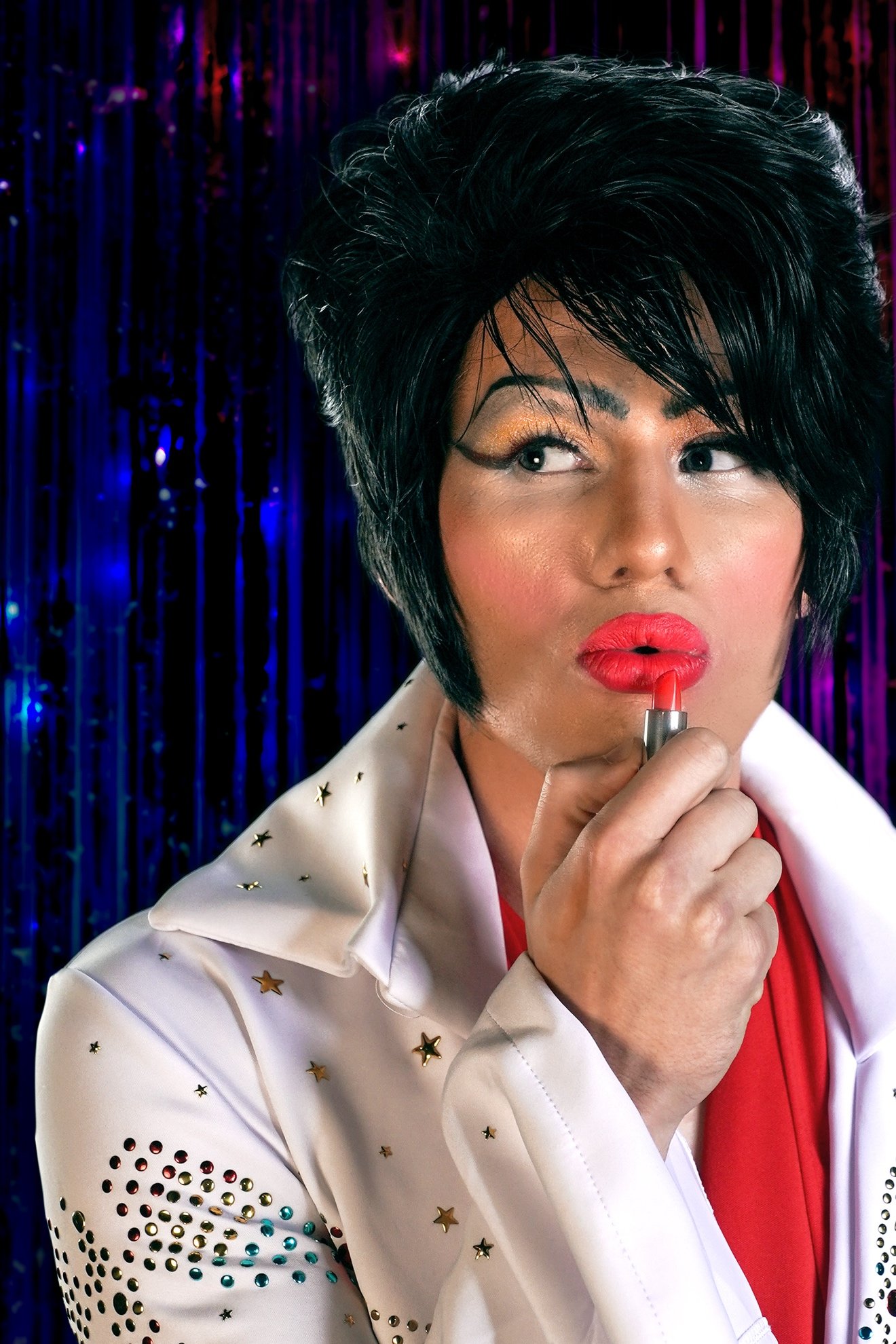
Georgia McBride opens on Casey, performing his Elvis impersonation act at Cleo’s, a dive bar in Panama City FL. Casey is a rather decent “Elvis” (though Casey’s estimation of his skill is higher than mine). Casey, bless his heart, believes he is on the proverbial cusp of stardom. So certain is he of his impending fame that he purchases a new white jumpsuit befitting The King. After the show Casey heads home to his wife, Jo, only to have his excitement flattened by her pronouncement that the rent check bounced – again – because of Casey’s propensity to use the debit card before checks have cleared. The young couple is threatened with eviction. Not only are they unable to make ends meet, they aren’t able to make those ends wave at each other. Jo unleashes her frustration on Casey and storms out of the room. She returns moments later to announce, proof in hand, that she’s pregnant. Casey is over the moon happy and exuberantly embraces Jo, proclaiming that they will be the best parents “since Mary and Joseph”. Jo reminds him that “their kid died”…

Casey returns to Cleo’s the next night and performs for the usual small house. Afterwards the club owner, Eddie, tells Casey that the club is going in a new direction in an effort to increase business. Eddie has hired his cousin Bobby to be the nightly performer. Casey pleads for another chance which Eddie cannot/will not give. Enter Bobby, aka Miss Tracy Mills - a tall, gorgeous, awe-inspiring drag queen, followed by her co-star, Rexy (full name Anorexia Nervosa. She’s Italian.) Casey is devastated. Tracy suggests he stay on as bartender, which he grudgingly agrees to do. After all, he now has a family to support. In an unsurprising twist, Rexy gets absolutely totally thoroughly and completely wasted before going onstage. Eddie storms in and demands that Casey go on in her place – not as “Elvis”, but as Rexy’s “Edith Piaf”. Casey has never heard of Piaf. Quelle surprise.

Rexy’s binge results in Miss Tracy Mills’ split-second funny clever and “how the hell did she do that” transformation of Casey from Florida cracker to drag queen. Using padding, pantyhose, false eyelashes, a wig, and non-stop performance tips, Tracy deftly “creates” Edith Piaf (well…sort of….). (The last time I saw a transformation like that was watching Jim E. Quick and John Erlanger in Greater Tune at Longstreet.).

Casey is not thrilled with doing drag. He is after all a straight white guy from rural Florida. He has no firsthand knowledge of the art of drag or of the gay community. However, he manages to stumble through his act and somehow the audience buys it. He starts bringing home enough money to pay all their expenses with money left over.

He is embarrassed by what he’s doing and so does not tell Jo.  As far as she knows he has a really good bartending gig.  He is caught out in the lie but I’m not giving up any spoilers there.

This show could easily have been a contrived caricature. In the deft hands of Jessica Fichter and Terrance Henderson (Director and Choreographer/Drag Consultant, respectively), Matthew López’s script is a study in not just the art of Drag (and it is an art) but in humanity.  Casey treats this as an “act” only. Tracy explains that it’s far more than an act for her and for Rexy and for countless other drag queens. When Rexy re-enters, she gives an explosive monologue on the true meaning of the art; “Drag is a Protest”. (Ms. Fichter’s director’s notes in your program explain the historical importance of drag far better than I can here. Read it.)

I saw the show’s preview. There were some halting deliveries at the beginning but those few were quickly smoothed out as the show progressed. Every member of the cast deserves kudos. Terrance Henderson (Miss Tracy Mills) is a gift. He creates a Tracy who is sharp-tongued, witty, and acerbic but who is also caring, empathetic, and (dare I say) motherly. Keyontaye Allison is Rexy, a most bodacious, assertive, fractious drag queen. Rexy’s monologue (mentioned above) is fierce. Anyone who listens to that speech will never again treat drag as “fluff”. Dear Jo, Casey’s truly long-suffering wife, is played by Morgan Passley. Her Jo is frustrated, but she is married to a human bubble machine. Being the only “adult” member of a marriage is a thankless task, but Ms. Passley’s Jo is also funny, clever, and kind. John Ballard plays Jason, the landlord/neighbor/friend faced with evicting Jo and Casey. He balances his conflicting “roles” beautifully. (He also really knows how to fall off the arm of a sofa.) David Britt either had an absolute blast playing Eddie, or he’s an even better actor than I know him to be. His character grows and transforms as much as Casey’s. And Casey, the reluctant drag queen. In the hands of Koby Hall Cayce goes from head-in-the-clouds, youthful Elvis impersonator to a splendid Georgia McBride. His “ah-ha!” moment when he suddenly recognizes his drag “persona” is wonderful to see. 

Brava to Ashley Jensen, Lindsay K. Wilkinson, Lorna Young, Danielle Wilson, Makenzie Payne, Marybeth Gorman. Lamont Gleason, Valerie Pruett, and Lisa Gavaletz. Every aspect of this production deserves applause. I’d forgotten how much I love Longstreet Theatre. Ms. Jensen’s set design utilizes the levels and the voms and takes advantage of every corner of the space. Costumes, makeup, lights, sound, and traffic direction were spot on. A very special thanks to Terrance Henderson. He and Ms. Fichter make a formidable team. I truly don’t know how this show could’ve been produced without the two of them. (If you missed their “Little Shop of Horrors” at Trustus earlier this year, I hate it for you.)

This show was just delightful. And thought-provoking. And gorgeous. Don’t miss it. 

Notes: There is considerable construction going on along Main Street between Greene and College Streets, so those on-street parking spots are gone. There is after-hours parking in the Wardlaw College lot next to Drayton Hall. The production runs about 2 hours with no intermission, so keep that in mind whilst having another cocktail before the show.

Georgia McBride at USC’s Longstreet Theatre a Fiercely Funny Celebration of the Art of Drag

From our friends at USC Theatre and Dance —

USC’s historic Longstreet Theatre is about to get even more legendary as the theatre program presents the fiercely funny Off-Broadway hit The Legend of Georgia McBride, November 10-17.

Show times are 8 p.m. Tuesday through Saturday, with additional 3 p.m. matinee performances on Saturday, November 11 and Sunday, November 12.  Admission is $15 for students, $20 for UofSC faculty/staff, military, and seniors 60+, and $22 for the public. Tickets may be purchased online at sc.universitytickets.com. Longstreet Theatre is located at 1300 Greene St.  Enter from the rear breezeway off Sumter St. The Legend of Georgia McBride contains adult themes and mature language, and is not suitable for children.

Tony®-winning playwright Matthew Lopez’ hit Off-Broadway comedy is a glittering, music-filled story of identity and acceptance, described as “stitch-in-your-side funny” (The New York Times) and “a glorious tribute to the art of drag” (Variety). Lopez’s story centers on Casey, an aspiring Elvis impersonator struggling to make it in showbiz.  He’s broke, facing eviction, and just found out his wife is pregnant. To make matters worse, he’s about to lose his only gig at a local dive bar to a much more successful drag act. The only way he can survive? Ditch “The King” and learn to embrace his inner Queen!

Two guest artists are leading the production. Jessica Francis Fichter, Executive Director of Columbia’s Trustus Theatre, returns to the USC stage as director, having recently helmed USC’s production of Little Shop of Horrors. Terrance Henderson, an award-winning theatre and dance artist, director, teacher and Equity Advisor, is choreographing, while also consulting the company on the art of drag. He’s additionally embodying the onstage role of Miss Tracy Mills, the seasoned performer who guides Casey on his journey to legendary queendom. 

“It’s super meta,” says Henderson, a veteran drag performer, of his dual roles in the production. “I appreciate that in the play we get to see Tracy take Casey through the basics of drag performance, and that a lot of the things I’m teaching the actors are being spoken about in the play.”

For Henderson, at the heart of drag is the art of theatre.  “It’s like a mini play in six minutes,” he says. “I’m using all these devices of the body, physicality, choreography, costume, make-up, props…It’s all storytelling.”

“It’s an art form that needs to be celebrated,” says Fichter, “and deserves respect at this moment in time. This play is even more timely now than when it was written in 2014.”

Joining Henderson in the cast are undergraduate actors Koby Hall (as Casey), Keyontaye Allison, John Ballard, and Morgan Passley. David Britt, a senior theatre instructor at USC, is taking on the role of bar owner Eddie. Designers for the production are MFA theatre design students Ashley Jensen (scenic), Lindsay Wilkinson (costume), and Lorna Young (lighting), with undergraduate Makenzie Payne designing make-up and guest artist Danielle Wilson designing sound.

“This play is, first and foremost, a comedy,” says Fichter. “The one-liners, the banter between the characters, the 20-minute drag show in the middle of the play… if you are a lover of theatre or art, and a lover of fun, dancing, and joy, this is a really good play for you.”

“You get to witness these drag performances while also experiencing the evolution of someone’s drag journey up front and in person,” adds Henderson. “It’s a visceral experience that lifts the story and drag itself, too.”

For more information on The Legend of Georgia McBride or the theatre program at the University of South Carolina, contact Kevin Bush by phone at 803-777-9353 or via email at bushk@mailbox.sc.edu


REVIEW: A New Brain at Workshop Theatre

William Finn’s 1998 Off-Broadway musical, A New Brain, paints an autobiographical portrait of a struggling writer who, while attempting to pen two children’s show songs, suffers a rupture of the arteriovenous malformation in his brain. Upon realization he needs a life-threatening craniotomy, he has to reckon with what he has yet to accomplish as musician, son, and lover.

Workshop Theatre’s production relies on a cast rife with Workshop veterans, and even those new to Workshop are not new to the stage. This stands out in the production, and each cast member brings a take on their character that feels real and lived in. Jocelyn Sanders makes good decisions as director, and though there are places where the play falters, it overall shines. 

In terms of elements that don’t work as well, let’s get the major one out of the way: the screens are weird. The set design itself, led by Patrick Faulds, is bare but works for the small stage. The stage is set with two Plexiglas walls with a major object or two (like a hospital bed) that shifts in the foreground. Two small screens on either side of the stage are used to flesh out the background, and they are certainly unique and at times fun, but they are ultimately awkward and distracting. They are a bit too small to really serve as a backdrop and seemed confused in purpose. At times they display what would be in the background of the scene, like Gordon’s messy apartment; however, there are moments where they show elements already on stage. For instance, the hospital room screen shows an empty bed even though there is already one stage, or when Mr. Bungee – the frog – is on stage, there is also a cartoon frog on the screen. Additionally, one of the two screens unfortunately failed about 30 minutes into the show, showing an error sign, which was eventually turned off and had to be fixed during intermission. Of course, technical errors happen all the time, but it seemed like an avoidable issue when, with the intimate stage, strong props, and solid blocking, the set design works just fine on its own. 

The other background elements work well. At times, the stage feels crowded, but this claustrophobia works with the tone of the musical. There were a few moments of stillness, but for the most part, Saunders’ direction and Crystal Aldamuy’s choreography works at ensuring there’s movement across the stage. Further, the lighting, also led by Faulds, keeps the stage and characters consistently well-lit. The live band is fantastic, and the sound—managed by Dean McCaughan—is overall good. The balance of the live music and the singing is great; however, when many people are singing at once in background, the central solo can be hard to understand. In terms of costuming, Andie Nicks picks outfits that all seem appropriate to the respective characters. A highlight is Mr. Bungee, whose green suit, multicolored vest, and frog head fit the character perfectly. A weak point is the Homeless Lady’s clothes that, while good in general styling, are far too pristine for a homeless woman: unwrinkled and unstained.

 When this show shines, though, it really shines, and the highlight of this show is, without a doubt, the singing. The production had a vocal coach (Lou Boeschen), and it shows. Nearly all notes are hit (with a few occasional weak soprano notes), most of the actors’ notes are consistently supported, and the harmonies are fantastic. Similarly, the acting is good, though not as stellar as the vocals. The actors are overall better singular versus together, with chemistry being a weaker point. This being said, each actor brings a special take to their relative character that makes each one a joy to watch on stage. 

Taylor Diveley as Gordon is great as main character—strong on vocals with good comedic timing. He often uses micro expressions that shine among Gordon’s typically flat affect, and he does a good job of building his expressions as the character grows over the production. The mom, Mimi (Kathy Seppamaki), and the best friend, Rhoda (Grace Farley), were good, but they didn’t stand out until their scenes in Gordon’s coma dream. The mom lacked some variation in emotion earlier in the show, but her tone of gentle acceptance in her final solo brought heart. Farley as Rhoda was fantastic in the puppet scene, showing prowess in facial expression, vocals, and body language—a definite show highlight.  

The nurses helped flesh out the humor and added variation. Heather Hinson, who plays the “thin nurse” (as well as the waitress and an assistant to Mr. Bungee) has great body language and is fun to watch on stage. Adai’shun Cook, who plays the “nice nurse,” is genuinely hilarious and really plays with his voice as instrument—though sometimes he can be a bit hard to understand. Gordon’s boyfriend, Roger (Craig Allen), serves as a nice foil to Gordon, and Allen does a good job at embodying the character—particularly during the “Sailing” scene—but the audience may end up wishing for a stronger connection between the couple. Pat Gagliano as the doctor and Mr. Bungee is solid at the former but really shines at the latter, with a sardonically honest take on the character that really works well. The Minister’s (Samuel Eli McWhite) presence feels very neutral on set, but his vocal prowess is evident.

The standout in the cast, however, is Sheldon Paschal as Lisa the Homeless Lady. Her facial expressions are fantastic, and she really knows how to play the crowd. She is in control of her body and her voice, and both her scenes breaking the fourth wall and interacting with characters on stage are strong. Her vocals were wonderfully supported, and she has a great mix with a light vibrato—her solo “Change” won several rounds of applause from the crowd.

Overall, this is a play with heart. Sound, lighting, set design, and blocking may not be standout but are solid—save for the screens. The individual characters feel understood, realized, and nuanced, even if the chemistry could have been worked on. Regardless, patrons are in for a treat in witnessing these vocals. Fans of the production should enjoy this local take, and those unfamiliar with the musical are still likely to find it a fun and worthwhile way to spend 2 hours of their weekend.


REVIEW: Stilt Girl Chapin Theatre Company

Izzy's dream is to make it in New York, but ever since an “incident" at an audition, auditions have dried up.  She eeks by on a part-time job at a cleaning company and has just discovered she’s been temporarily evicted from her roommate’s sofa. When she realizes the condo she and her bestie Jonathan (oops, “Stephon”) are cleaning, she comes up with the notion to spend the week in the condo, with the rationale that she'll deep clean the place during her stay. When Tina and Debi and their friend Therese arrive quite unexpectedly from Atlanta to celebrate their five-year survival of breast cancer, hilarity ensues, but so does a delightful evening of friendship, confession, optimism, and charm.

Zanna Mills’ Izzy is delightful to watch. Mills’ timing, and her skill at physical comedy – even when she’s stock still – is excellent. Her “floor work” is hysterical. Josh Kern is fabulous as Jonathan/Stephon. He throws himself into a belly dancing routine which had me truly laughing aloud, and that doesn’t happen too often. Debra Haines Kiser and Jane Turner Peterson play Atlanta bosom buddies Debi and Tina and it’s easy to believe these two have been friends for life. Their timing, their commitment to character, and their ability to toss off delicious throwaway lines is excellent. Jane Turner Peterson is a theatrical gem and it’s good to see her getting back onstage after a long absence. Her face is made of rubber, and she is fearless in her actions and reactions. She completely embraces her inner #ShimmyChick. She is gleeful. Jacob Cordes is Debi’s grandson, Max. His transformation from a concerned, uber-cautious grandson to someone willing to loosen up and “go with the flow” is seamless.

Jami Carr Harrington was certainly gifted with an excellent troupe of actors to bring Lou Clyde’s play to life. Working to put an original piece onstage is no easy task but these artists have succeeded in producing a delightful evening of theatre. Corey Langley’s set is exactly as a generic New York City Airbnb condo would look. The décor is perfectly bland and modern, except for one specific piece of décor which you won’t be able to miss.

There were a few times when volume was an issue. The theatre is small, and the audience seating is almost an extension of the stage so it’s easy to fall into a more conversational volume. I was seated in the middle of the house so I imagine some in the back row might have had difficulty hearing some of the dialogue. There were some scene changes when the music stopped rather abruptly when the lights came back up; a fadeout would have been more effective and less jarring. The Mancini was perfectI must confess I was pleasantly surprised. I fully expected Stilt Girl to be yet another Steel Magnolias knock-off about Southern Women of a certain age. I was dead wrong. There is nothing stereotypical about Lou Clyde’s script nor the characters these actors have so deftly brought to life. I regret that scheduling didn’t allow me to see the show earlier in its run. There are only 3 performances left, and the brevity of this piece is to allow this to be published in time for more readers to see it and made the decision to spend an evening in Chapin this weekend. The house seats 82, and there were only 5 empty chairs last night. The show lasts 2 hours, including a 15-minute intermission.

It is a drive, not gonna lie. Give yourself plenty of time to get there for the 7:30 curtain. There is a lot of construction on I-26 (quelle surprise), there are lots of orange and white barrels, and it’s dark out there! Wine is available for a donation, so do bring a little piece of money. The theatre is also taking donations for the South Carolina Oncology Association, which makes funds available to women who are unable to pay for cancer treatment.

Stilt Girl plays tonight and tomorrow night at 7:30 p.m., and on Sunday afternoon at 3:00 p.m.


Regarding our reviews ...

Regarding our reviews, given the intimacy of the South Carolina midlands theatre community, we issue our reviews anonymously and sometimes collaboratively.  We stand behind our reviewers because we trust the credentials that qualify these reviewers to do their jobs.

In order to fully grasp the intention of a review, we also encourage our readers to do just that – read the review rather than the social media comments about the review which may misrepresent the actual message of the review or the manner in which it is presented.   

-The Jasper Project

To that end, let us direct you to a particularly salient essay from OnStage Blog

We Should Review Community Theatre … Honestly

by Skip Maloney

There is, and as far as I have been able to determine, always has been a problem with reviews of community theater productions. While the quality of the productions under scrutiny can vary widely from very, very good to very, very bad, community theater reviews always seem to err on the side of caution, which, in general, tends to produce an essay that tries hard, often too hard, to be nice.

The fault lies in the nature of an often unspoken relationship between the media that publish such reviews and the community it serves. Appearing in a local newspaper, or sometimes as commentary on a local radio station, community theater reviews (not all, but many) proceed from the assumption that since the local performers and production staff are unpaid, it's unfair to measure the performance with the same yardstick used to assess a more professional offering, which is nonsense.

While local theater companies operate under obviously tighter budget constraints, there is no single aspect of a theatrical production that is defined by the amount of money that can be thrown at it. I've witnessed productions that were mounted with the aid of millions of dollars on Broadway that worked better in community theater productions with far less to spend.

Equus comes to mind as a prime example. I've seen professional productions of it on Broadway (most recently with Daniel Radcliffe in the role of Alan Strang), and a variety of regional, professional theater productions and none were as effective as a community theater production of it that I witnessed in a 50-seat, small-old-schoolhouse in Reading, Massachusetts.

In a way, local theater reviews are hampered by a mindset, which asks the question, "Well, what can you expect?"

It's community theater, right? Local, unpaid performers and staff can't be expected to create a product with anywhere near the level of professionalism exhibited by companies that do this sort of a thing for a living.

This is nonsense, too; a particularly insidious form of nonsense, because it can affect the local performers and staff who mount local productions and end up believing that there's no way they can do professional work, and after all (they think), it's really just about being involved.

No one is expecting professional work, so why bother trying to achieve it?

Enter your local theater reviewer, who, bearing all of this in mind, tries to be nice. Makes comments about a particularly good individual performance, or the good lighting, or whatever it takes to "accentuate the positive, eliminate the negative and (not) mess with Mr. In-Between."

God forbid that a reviewer should note that a particular performer appeared to have no idea what they were doing, or that a trumpet player in the band couldn't hit a lot of the notes they were expected to, or that the production, in general, failed, fundamentally, to deliver the promise of a given script.

Ignore the fact that a performer in a minor role appeared incapable of paying attention to what was going on around them unless, and until they had lines to deliver.  And above all, never say "bad," "awful," or "horrendous" because the fragile egos of the people on and backstage will be incapable of dealing with it: might even write a nasty Letter to the Editor saying "How dare you?"

This equation does far more disservice to a community than the mere fact of a bad production, because it has a way of lowering expectations, on both sides of the proscenium arch. A local theatre patron reads a "nice" review, goes to the see the show, and assumes because the reviewer knew what they w talking about, that what they're witnessing is a good production, even if, in truth, they end up bored out of their skulls, anxious to get back out on the street and check for messages on their cell phones.

While the performers get to bask in the glow of the nice things said, they move onto the next production, secure in the knowledge that they're doing good work, when, perhaps, they're not.

Recently, having witnessed a particularly bad, horrendous, and just awful production of a play,  I was surprised by a local writer's nice, even glowing review. It wasn't even a play. It was an evening of original material sketch comedy, with trivia questions (???!!) thrown into the middle of it, presumably to keep the audience engaged, because there was very little else going on with the ability to do that.

Opinions are, of course, like certain body parts. Everybody's got them, but I saw at least half a dozen people texting during the production. Oh, they courteously had the ringtones and alerts silenced, forgetting that the glowing screen reflected on their faces was just about as rude as any noise their phone could make. And my wife, who is generally much easier to please, called it the "worst production (she) had ever seen in (her) life."

Misguided attempts to be "nice" are only part of the problem. Another component of this issue is incompetence on the part of the reviewer. Locally-based reviewers are often pressed into service with little or no background in theater, or understanding of what makes a production work, or not work, as the case may be. Such inexperience manifests itself in a review that criticizes the ingredients of a theatrical 'meal,' without ever comprehending the important, central role of the 'cook,' known as the director.

It is a critical subtlety of the art form and any attempt to write about it; a production stands or falls on the merits of the person at the helm.

In film, as proposed by the French, this is known as the "auteur" theory, stating that a film's director is the "author" of the piece; that what makes it pleasurable or not is directly attributable to the director. The theory holds to theatrical work, as well, which is where the assumption that there's some essential difference, related to expectations, between professional and community theater work breaks down.

A good stage director has to do two essential things: cast well, and assure that the basic conventions of any staged production are met. In so doing, a good stage director can direct less-than-professional performers to understand that acting is not just about learning lines and navigating the stage without bumping into furniture.

A good stage director will be able to assess the production capabilities of the group with which they work and tailor the production design to those capabilities (this has to start with a company's awareness of what it can and can't do when it comes to selecting a play to produce). Given those essential tasks, there is no reason why a director, and through him/her, the performers and staff associated with a production, cannot produce a highly professional show.

An understanding of this clears the path to a journalist's keyboard, allowing him/her to assess the quality of a production without fear that a less-than-nice review will somehow damage the value of the effort that was put into it. If you're ever tempted or asked to write a theater review about a community theater production, you'll do both the theater folk and your community a great service if you're brutally honest.

Employ the above-mentioned triad of negative words if a given production has earned them. It'll have a way of improving the work that you see, and elevating your community's awareness of the best that theater has to offer.