The Columbia Broadside Project - Tonight

broadside

“Originally we planned on it being a much smaller project that just the three of us and maybe another friend or two would work on. Then we kept saying, ‘I bet so and so would like to work on this. And it went from there.”

Twenty-eight artists and poets come together for The Columbia Broadside Project under the organization of Darien Cavanaugh. The local writer with an MFA from USC had an interest in broadsides since young adulthood through the influence of collaborations by historic and contemporary poets and artists. After seeing a broadside featuring a poem by Albert Goldbrath and a couple beers with friends, the inception of The Columbia Broadside Project began.

“I had plans to start an annual broadside contest at Yemassee, but I got my MFA and left USC before I ever really made any moves on that. Then a few years ago Matt Catoe, Blake Morgan, and I were sitting on the back porch drinking beers and talking about ways we could work together,” Cavanaugh explained. “Morgan was teaching visual art at USC, and Catoe was in that program. I had started getting some poems published in little magazines and journals again. I went inside and grabbed a couple of broadsides and said, ‘How about we do something like this?’"

Three years of planning in, The Columbia Broadside Project is now in its second year and being exhibited at The Columbia Museum of Art after a show at Tapp's Arts Center last year. Through an open call for poets and artists, Cavanaugh was able to gather people to collaborate and work together.

“I don't really judge the aesthetics or style of the work, I just want some evidence that they work fairly regularly. If you can't show me anything you've done recently, and there aren't too many lines on your CV to suggest some creative productivity, then I'm not going to have much faith in you actually working with whoever I partner you with. I want this project to represent a range of styles and aesthetics, from accomplished poets and artists as well as up and comers. I think we do a good job of that,” Cavanaugh says. “That's one of my favorite parts of this project -- seeing all the different styles of art next to each other. So it terms of selecting participants, I just need to know that you'll produce. I'm not here to judge what you produce.”

The artists and poets, after being randomly paired, come together not necessarily to mimic, but rather to create an interpretive relationship.

“There's always a lot in the painting that's not in the text, and vice versa. This connects you to the work in different ways, brings different memories and senses into play. Sometimes when I think of one of the paintings, I'll remember a line from the poem,” Cavanaugh says.

All formalities and explanations aside, this is not merely some attention-seeking project for Cavanaugh. As a self-described “nerd,” Cavanaugh connects with all art, but mostly with writing.

“We live in a cold and isolating world. The arts remind us not only that there is some beauty out there but also that we're capable of creating some of it,” Cavanaugh says. “I've always seen reading and writing as an act of forgiveness, a process of forgiving yourself and others. A good story tricks you into empathizing with characters you might not like by portraying them as complex, vulnerable human beings that you can connect with on some basic level.”

This collective project has its opening reception tonight at The Columbia Museum of Art from 7 to 11. Tickets are $5 for CMA members and $7 for general admission and can be purchased at https://3162.blackbaudhosting.com/3162/tickets?tab=2&txobjid=7df94408-31d7-4f9e-a346-88327b4bead1.

“I just want to throw a blanket thank you out to the Columbia arts scene and everyone who worked on and helped promote this project in any way. This really is a collaborative effort, not just by the artists and writers involved but also by dozens of other people who encourage and inspire us,” Cavanaugh appreciatively states. “I hope that this project introduces artists and writers to a broader audience here in Columbia and maybe even a little beyond our city.”

by Haley Sprankle

Jasper Does Spoleto - part 4, Chamber Music & Chinese Opera

16853683562_50c36dce4a_z By: Kyle Petersen

One of the many amazing things about Spoleto is the diversity in its music programming, spanning from its acclaimed chamber music series and contemporary opera to noise-jazz and traditional folk music, with everything in between also being represented. While we’ve already written about the charming performance given by Americana duo Emmylou Harris & Rodney Crowell early on in the festival, we’d like to talk briefly about some of the more highbrow (and quite excellent) music we’ve also been enjoying here.

Bank of America Chamber Music

18168010158_84f3b5bb2e_z

We caught Program IV of this series last Wednesday and could not have been more satisfied with the experience. Programming director and violinist Geoff Nutall is a stylish and witty emcee whose rapport with the audience was worth the ticket price alone. Leading the patrons through the eclectic line-up of compositions with flair and poise, he kept the audience at ease even as the performances themselves set us back.

Alternating between uber-traditional fare (Mozart’s Sonata in G Major, K. 379, Beethoven’s An die ferne Geliebte, op. 98, and Bach’s Brandenburg Concerto no. 2 in F Major, BWV 1047) and more adventurous compositions from Huang Ruo, whose Chinese performance art opera Paradise Interrupted is also featured at the festival, and 20th century Russian composer Alfred Schnittke, the program’s variety and shifts in tone and texture presented a fascinating window into the historical breadth of chamber music as well hinting at all of the possibilities and potential that still exist for the format. Nutall and pianist Pedja Muzijevic opened with the virtuosic flurry of notes required for Mozart sonata, only to be followed up by the unusual instrumentation (violin, cello, voice, djembe, bassoon, pipa) required for Ruo’s “Flow… (I and II),” a folk-indebted piece that showcased the pipa, a traditional Chinese lute that we would later also hear used to great effect in Paradise Interrupted.

Next was the husband-and-wife team of baritone Tyler Duncan and pianist Erika Switzer, who took us through the Beethoven song cycle. The couple gave an assured performance, aided by Nutall’s helpful note that the English translation of the lyrics were printed in the program.

My favorite piece on the program, though, was Schnittke’s austere, enigmatic Hymn II, a piece which saw double bassist Anthony Manzo and cellist Christopher Costanza carefully align the movements of their bows as they produced fragile, ghostly timbres and atonal harmonies that prickled the spine.

The concert closed with an ensemble performance of the popular (and canonical) Brandenberg Concerto, with the slight twist of an E-flat clarinet, played by Todd Palmer, taking place of the traditional piccolo trumpet. The performers gave a lovely rendition of the tune, although audience members are more likely to remember the slapstick improv brought on Nutall and, between movements, oboist Austin Smith, who ostentatiously paused the performance to clean out his instrument.

It’s also worth noting that there was a beautiful moment between movements when a scattering of applause broke out, a bit of a faux paus in classical music performances. Not only did the audience, after some uncertainty, begin clapping along with those that jumped the gun, but they were urged on by Nutall, tradition be damned. It was a giddy feeling, and emphasized the warm balance of world class musicianship and casual relatability that defines the series.

Paradise Interrupted

17985328465_f51b6405be_z

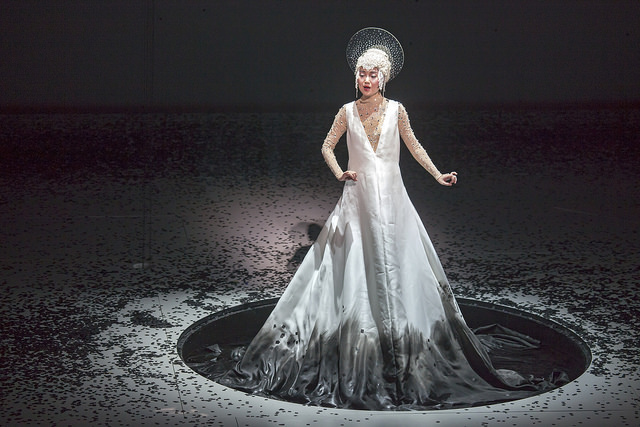
Later that day we caught the evening performance of Ruo Huo and Jennifer Wen Ma’s opera. It’s a bit of an abstract, high-concept piece that melds Chinese traditions with Western idioms that takes place in a dreamlike landscape. The music was breathtaking, particularly the gorgeous performances delivered by Qian Yi, the show’s star, and countertenor John Holiday, whose voice continues to haunt me, but it was hard not to get lost in the cerebral excellence of the set design. Many might remember Wen Ma name from her work on the 2008 Beijing Olympics, where she directed and designed the opening and closing ceremonies, and her work here has a similar mesmerizing effect. Using a large white performance space and unorthodox lighting, as well as a host of large props and trap doors, a vividly unreal world emerges and disappears over the course of the opera that has to function and opera differently given the limitations of each venue it’s performed at. It’s hard not to note that this kind of immersive, multidisciplinary approach is actually what’s needed in an art form too often grasping tenuously to its past.

Chatting About Conundrumfest with Cecil Decker

11012990_10103149984792147_4398794782459226255_n Conundrum Music Hall is celebrating its 4th birthday on June 13th with a humdinger of a party, Conundrumfest, a blitzkrieg of a festival featuring 15 bands, 3 comedians, 4 artisans, and 2 food trucks.

Jasper staff writer Michael Spawn caught up with Cecil Decker, a key organizer of the festival who runs sound at the venue and fronts the nerd-rap group Autocorrect along with a variety of noise projects, to chat a bit about the festival. For full details, check out their Facebook event page here.

Jasper: Pretend that I don’t know anything about Conundrumfest and have no idea what it is. Tell me what it is in the simplest way possible.

Cecil Decker: Well, Conundrum is turning four years old and I wanted to have, like, a party, because I like parties. And we decided the best way to do that would be do gather up a bunch of people who have been involved with Conundrum a lot in some way, whether or not their actually involved in working there. People that have just played there so much that it feels like they’re just a part of the place, you know? It’s  a party for anyone who has ever been a part of Conundrum to celebrate it’s still being around.

J: So are you masterminding this thing?

CD: Myself and Jeremy from Daddy Lion, Jeremy Joseph, we’re both sort of the evil masterminds—the brain trust of putting it together. It was sort of an idea I had and I was like, ‘I can’t do this alone.’ And Jeremy had done Villa Villa Cola last year, which was a huge success, and I said, ‘Well, he clearly had a little more experience in this than me.’ You know, I’m used to a little three-band rock show. I don’t if I can handle a fifteen-band all day extravaganza. So he’s been a huge help and between Indie Grits and Conundrumfest it’s been an eventful Spring.

J: How long have you been planning this?

CD: We planted the seed in Tom’s mind probably in January. January and February. Then we kind of backed off a little bit until late March and it’s been sort of full blast since then, just contacting bands, and then you re-contact the bands, because it’s that thing like, ‘You know that thing we talked about two months ago? Can you still do that?’

J: Did you get all the bands that you wanted? Were there any no-thank-yous or no-can-dos?

CD: There were some no-can-does. There weren’t any no-thank-yous. There were, I think, two that couldn’t do it. But it was like, ask everyone and make the event as long as it needs to be for all the bands.

J: What is it about Conundrum itself? What do you think separates it from a New Brookland Tavern or an Art Bar?

CD: Well, as a musician, Conundrum sounds really good. I know there’s some aesthetic and vibe you get from other small venues, but Conundrum sounds really good. Like, the stage sounds good and the room sounds good, and that’s a huge point of pride for us first and foremost.

J: And by us, you mean. . .?

CD: The whole Conundrum consortium. I’m a sound geek and I run sound there. There’s Tom and there’s Jeremy and a couple other people who are behind the scenes. I just mean the Conundrum staff.

J: Is your appreciation for Conundrum purely acoustical?

CD: Well, we’re not a bar, right? Because we’re not first and foremost a bar, we make our money on bringing the arts to people rather than having music shows and selling a lot of liquor. The entire vibe of the places comes from that. You don’t have a show where. . .it will never be Bey’s, right? There’s never a show where you’re playing and there’s not a single person listening. When people roll through, they’re like, ‘Oh, you’re a music venue!’ And I’m like, ‘Yes, you booked a show here.’ So that’s the number one thing. We’re trying to be more arts inclusive. We have artists setting up shop at Conundrumfest—painting and crafts and things they’ve made and we do more film events. It’s still a music hall in name because that’s our primary thing, but we definitely try to be more inclusive to all the arts. The Soda City Cirque did an amazing show there recently. So it’s definitely a place where you don’t ever know what you’re going to see but you know it’s going to be really interesting. We try to bring types of programming that you wouldn’t get at Art Bar or New Brookland. That probably works because we’re smaller than them. It’s a really infinite room and it feels good to be there.

Darling Dilettante: Literature Edition by Haley Sprankle
Remember those books you were supposed to read for school? (Notice how I said “supposed.”) You were forced to analyze, break down, and summarize each story full of heightened, seemingly ancient language. Then, essay after essay, you decided that you never wanted to hear anything about those books (that you probably didn’t even read to begin with) ever again. Well, surprise! I’m here to talk to you about them.

As a student who hated (and still often does) being assigned reading and told how to think of it, I found every way possible to avoid reading books by classic authors like Charles Dickens, William Faulkner, and even sometimes the beloved playwright Mr. William Shakespeare himself. I found it difficult to believe that these books that were written for entertainment were meant for this type of scrutiny instead of paying attention to the beauty of the narrative.

As I got older, however, I swallowed my pride and attempted to participate the way I was expected to in class. I didn’t read everything—and no, kids, I won’t divulge my secrets to success academically in this subject—but I did discover writing that I would soon fall in love with.

My love of literature began while reading Ernest Hemingway’s In Our Time. This compilation of seemingly unrelated short stories initially struck me as a piece that I would not likely deign to read, but I quickly fell in love with the puzzle and challenge of finding the subtext of the stories. Then, like most every high school student, I was handed F. Scott Fitzgerald’s The Great Gatsby. The layered symbolism and tragic love story—one that would later be added to poor Leonardo DiCaprio’s repertoire of characters who die in the pursuit of their love—drew me in immediately. My senior year, we read Kate Chopin’s The Awakening, a tale of female empowerment and self-discovery with an adulterous twist that surprised me with its controversial subject matter of the time.

After high school, I began to pursue literature of my own accord, and have fallen in love with so many stories that are so often written off as classwork. In the hopes of continuing this pursuit fervently, and that others may join me, I have created a summer reading list. Crazy, right? I have plenty of teachers who would be shocked and can attest to my historical hatred of them, but I am a changed woman. All jokes aside, here is a list of books I’ve either started to read, should be embarrassed that I haven’t read, or simply take a genuine interest in because that’s what books are for:

  • Wuthering Heights by Emily Bronte
  • Pride and Prejudice by Jane Austin
  • Jane Eyre by Charlotte Bronte
  • This Side of Paradise by F. Scott Fitzgerald
  • Sense and Sensibility by Jane Austin
  • To Kill a Mockingbird by Harper Lee
  • A Tale of Two Cities by Charles Dickens
  • The Picture of Dorian Gray by Oscar Wilde
  • The Scarlett Letter by Nathaniel Hawthorne
  • The Sun Also Rises by Ernest Hemingway

While this is a rather ambitious list to tackle over the summer, it also shows me that no matter how intelligent I might think I am, there is a sea of knowledge that I’ve clearly just dipped my toe in. I hope to delve into this world of books, both old and new, throughout the summer and the year, and I hope that you’ll join me!

Leave a comment if you have any book suggestions, or to update your progress on the list!

Haley Sprankle

Some Words on Words by Kirby Knowlton

Every time my grandmother goes to the movies, she tells me about the previews. She tells me in detail about the ones that caught her interest, how maybe she’ll go see this one or that one when it comes out, almost a promise of more previews for her to tell me about. This is what she always says: Can you believe theres still new movies coming out? It amazes her that all the ideas haven’t been thought of yet, that people are still out there creating and recreating. Among so much change and after so much time in her life, she still loves movies. Columbia-born Terrance Hayes wrote a line that I’m always coming back to. His poem “God is an American” starts simple, with the honesty of saying what you’ve been meaning to this whole time. “I still love words.” I think of this first line when my grandmother is amazed that she still has movies to see, when in reading a new poem or short story, I find traces of one I’ve read before, when I’m thinking to myself in the car or shower. I’m always thinking about this line because it’s one of the truest that I’ve read, and like my grandmother admires the people writing and creating new movies, I admire Hayes for starting with something that seems so obvious.

Hayes has been writing for a long time. Humans have been writing much longer than that. Language is all we have to explain our thoughts, our ideas, our beliefs. When everyone has to share the same building blocks, isn’t it amazing every single time something new is created? Or when something old is recreated? Because that’s all we’re doing. Creating and borrowing and rearranging and making new again. After so much has already been written, I still love words. That I can dismantle the words of another, host them in my head, the car, the shower, until I can use them as building blocks of my own.

Later in the poem, Hayes writes, “Schadenfreude may be the best way to name the covering / of adulthood, the powdered sugar on a black shirt.” I am not an adult, though I’m getting there in the way we try to remember forgotten words: desperately without success, and then in single, random moments, it’s all right there. There are days we don’t have words for. There are days we have four-letter words for. There are moments we can’t get through but to borrow joy from another person’s pain, small cruelties to hold onto like a smooth stone in your pocket. There are moments when I need someone else’s words to understand what’s happening. Yes, schadenfreude because everyone is a little bit of an asshole at their core. But also schadenfreude through words, reading about the past pain of another to benefit your present.

I’m not yet an adult, but my patience is already wearing thin. When someone says what they’ve been meaning to say, I still love words. When a stranger on the street says something kind instead of harassing, I still love words. When I read something to help guide the way, I still love words. “A word can be the boot print / in a square of fresh cement and the glaze of morning.” A word can be anything, and we owe it everything. Where would we be without them, our little building blocks to create nations, suggest movies, or reflect on what they’ve given us?

Read the full poem here: https://www.guernicamag.com/poetry/three_poems_1/


Kirby Knowlton was a Jasper intern for the 2014-2015 year and is a rising sophomore at USC.

Jasper Does Spoleto - part 3, Emmylou Harris & Rodney Crowell @ TD Arena Review

18119446382_c215a82ce5_z There’s always something a bit odd about seeing music outside of its natural context. For the organic folk and country made by Americana royalty Emmylou Harris & Rodney Crowell, the music is best heard in a small listening room or, barring that, a cozy theater.

That disconnect might be why it felt a little awkward for the first few songs the duo played with their five-piece backing band on Tuesday night. Opening with a cover of Lucinda William’s “I Just Wanted to See You So Bad” and few other more rollicking numbers, the music sounded both a little thin and a little boomy in TD Arena, hardly descriptors that naturally come to mind when thinking about either artist’s work. Crowell and Harris handled whatever sound struggles there might have been gracefully though, and things settled in after a while.

The duo, whose musical partnership dates back to 1975, when Crowell wrote a few songs and played rhythm guitar in Harris’s The Hot Band, were touring in support of their two duo records, the Grammy Award-winning Old Yellow Moon from 2013 and the recently-released The Traveling Kind, so a decent chunk of the set covered songs from those records, but there seemed to be relatively little formula for how the show unfolded. The ease with which Harris, 68, and Crowell, 64, led their band and joked playfully in between songs drew the show as close as it could to that listening room vibe, and it was clear how and why these guys are world-class entertainers. Both are still in such fine vocal form that you almost forget how many years they’ve been at it, even as they jokingly remind you of their long history. Upstate native Fayssoux McLean, who sang harmonies on those early Hot Band records, was in attendance and got a couple of shout-outs from Harris, but there was relatively little ceremonial about the proceedings as the two talked about playing in a hotel lobby at the Kerrville Folk Festival a few weeks ago and kidded Spoleto about having a festival indoors.

The informality of presentation was belied by the fairly studied nature of the songs themselves. Harris still, forty years later, grounds much of set in the songs of Gram Parsons, with “Return of the Grievous Angel” and “Love Hurts” both given lovely readings with Crowell taking the place of Parsons and Harris re-creating the unforgettable harmonies that dominated those recordings. Other highlights include her plaintive interpretation of Townes Van Zandt’s “Pancho & Lefty” and a mesmerizing encore of Parson’s “Hickory Wind,” which she told the audience she only plays when performing in South Carolina. Much of the material on the new record sounded positively effervescent as well, with the elegiac “The Traveling Kind,” the classic country shuffle “No Memories Hanging Round” and the Harris ballad “Higher Mountains” being particular standouts.

These more tender moments were balanced by a clearly talented backing band that played purposefully restrained for much of the evening only to charge through a few dazzling solos near the end of the set. Australian lead guitarist Jedd Hughes was particularly spectacular, throwing down a boisterous rock solo at the end of the night that nearly upended the even-keeled signature performance style that Crowell and Harris are known for.

When the duo returned for the “Hickory Wind”/”Old Yellow Moon” encore, though, a hushed reverence returned to the proceedings. Hearing voices this good, playing songs this good, was ultimately all this night was about.

The Oddities of Sein Zum Tode: A Q&A with Bassist Jamie Clark About the Band's Video for "Worse Than Catholic"

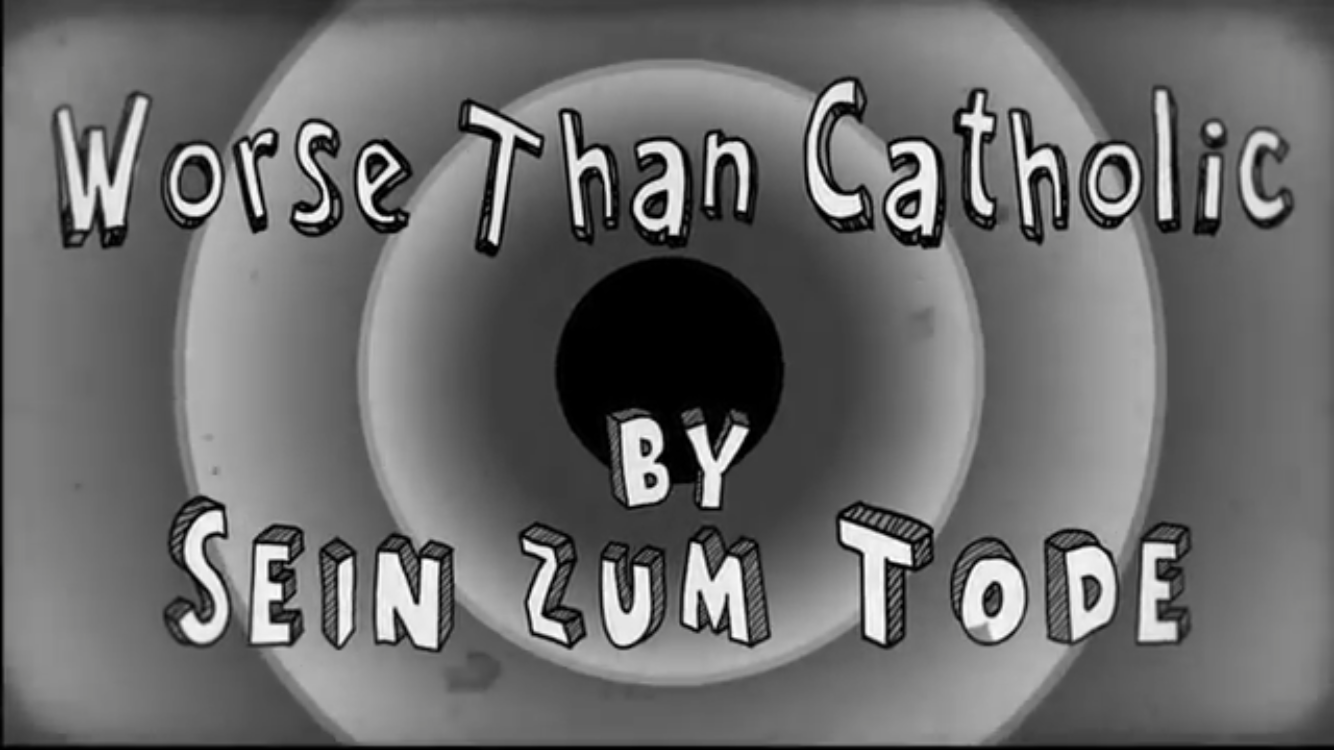
20150527_142440000_iOSBy: Michael Spawn Sein Zum Tode’s music is not for the faint of heart. The Columbia trio (Jon Scott—guitar, David Scott—drums, Jamie Clark—bass) is one of the most interesting and aurally challenging bands in the city, and likely the whole Southeast. You’ll typically find them on a bill of metal acts, but to reduce Sein Zum Tode to that genre is something of a cop-out. The sheer mathematical and virtuosic intricacies in every song put them in a class truly all their own. In preparation for their upcoming EP, “Siamese Second Cousins Never Removed,” which will see its official release this Friday at New Brookland Tavern, Jasper spoke with bassist and video director Jamie Clark about his video for “Worse Than Catholic,” an animated fever dream that plays like an old Warner Brothers cartoon set in purgatory and can be viewed below.

Jasper: What is your history with Sein Zum Tode?

Jamie Clark: I actually play bass guitar in Sein Zum Tode. I’ve been playing with them since about 2005. Jon and David handle the majority of songwriting. This allows a level of separation between my videos and their ideas, which I think leads to some interesting interpretations.

J: When and how did you become interested in directing videos?

JC: I’ve been working with multimedia in one form or another since the mid-‘90s. Back then—editing footage of animals to Pantera’s “Fucking Hostile” for a high school biology assignment—the process to get something from the computer to the television was painstaking and expensive. Once I was reintroduced to digital media in college—around 2001—I was amazed at how simplified it had become. I instantly started writing short films and coming up with video projects, which is something I’ve kept up with off and on ever since. Being part of the music scene meant I had an unlimited supply of friends who would love videos. Taking on music videos always seemed like a fun break from filmmaking because their short in length, a lot of your pacing decisions are already made for you, and you don’t have to record on-set audio.

J: What was the original concept for the “Worse Than Catholic” video and how close to that concept is the finished product?

JC: Something that I hear a lot about Sein Zum Tode is the music sounds completely random and chaotic. Since I’ve actually had to write out all of these parts and learn them on bass, I know there’s a very deep, intricate structure to the songs. My goal was to come up with a concept that articulated that structure. Making it animated allowed us to go as crazy as we wanted to go. I had been inspired by shows like Superjail! on Cartoon Network that feature incredibly long and detailed animated chase scenes where things are happening and scenes change so quickly you often have to go back and rewatch. My writing partner and I sat down with a spreadsheet of all the different parts of the song and talked about how we could start tying them all together into a single narrative. To that end, I think the finished product is exactly what we set out to create.

J: Who is your writing partner?

JC: Russell Sanders, the star of the video. I met him when he was studying acting at USC back in 2005 and we’ve co-produced just about everything I’ve worked on since. I handle most of the directing and he handles most of the acting, but we’re both equally active in getting projects to completion. He ran camera on the last video we did for Sein Zum Tode , “Mansteam,” when I had to be on camera.

J: What program did you use to make the animation?

JC: For this project I worked almost exclusively in Adobe After Effects, with a bit of help from Photoshop. Jon and David both have a history of drawing weirdo creatures, so I asked them to draw me as many as they could. I got stacks and stacks of pages, which I then scanned into the computer. Then in After Effects you build something that kind of looks like a paper doll—a creature with an individual head, body, arms, legs, etc. Handling the animation in After Effects means you have to do every little frame-by-frame animation, and much more animation by math. “On frame one have the bat be on this side of the room, and by frame 115 have him on this side,” and the computer fills in the rest. The scene where he’s riding on the mine cart actually almost destroyed (trying to think of a word other than “derailed” to avoid puns) the entire project. When it came time to actually render the video, After Effects was giving me the error, “Sorry, this background is too large.” I didn’t know how to fix is short of starting over again, so I put the project aside for a number of months while I hid under my bed. Once I finally got over my fear and looked into it, it was a pretty simple fix and we were back on track. Even with the fix, it took about 48 hours to render the video every time. There’s nothing worse than not using your computer for two days, finally having a copy of the finished product, and finding an error in the first two seconds.


https://www.youtube.com/watch?v=U0N7qfRAgAs

Jasper Does Spoleto - part 2 The Globe's Romeo and Juliet by Haley Sprankle

16606006773_2db8f4851d_c  

There I sat, at the tender age of seven, watching Baz Luhrmann’s 1990s adaptation of Romeo and Juliet while following along with the text to make sure the actors didn’t veer too far from the source material.

During my most awkward stage, at the age of 13, I went to the local high school’s production of the same classic play after reading it in class.

At 16, I saw a talented friend of mine, Danielle Peterson, beautifully perform the titular female role in the Lab Theatre at USC.

In the height of my teenage angst, at the age of 17, I watched Luhrmann’s rendition again on Valentine’s Day because “love isn’t a reality,” and because it had become a personal favorite of mine throughout the years.

Fast forward to May 2015 and I’m experiencing the Globe Theatre’s touring production of the same play that had so ingratiated itself into my life at Charleston’s Spoleto Festival and I am in awe.

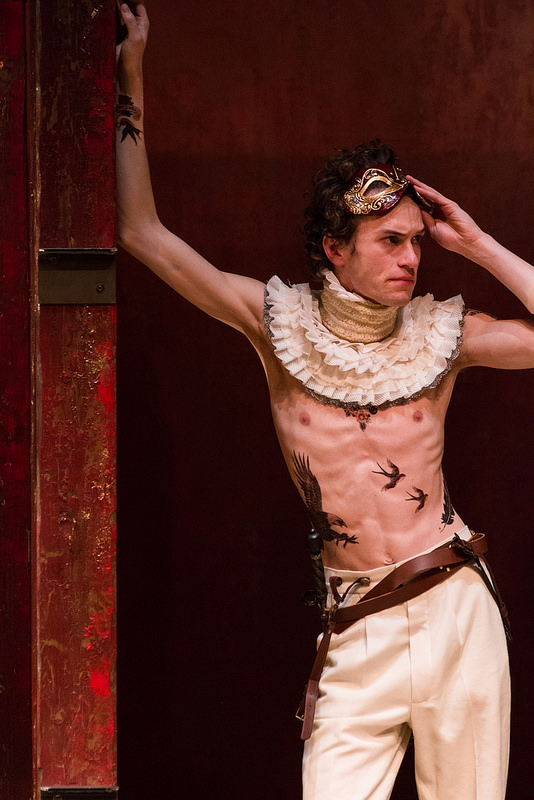
Most every moderately educated person in the world knows the tale of the star-crossed lovers who (spoiler alert) commit suicide to preserve their love despite their families’ brawling hatred for one another. This allows great room for interpretation when producing the renowned play, as most Shakespearian works do. Directors Dominic Dromgroole and Tim Hoare masterfully crafted this production for Shakespeare’s Globe Theatre’s travelling company and had a brilliant cast to support their concept.

16689557634_294aeb9be6_b

With just a cast of eight, on a bare-bones set, and with simplistic costume pieces similar to an indie-folk band’s attire with some added Shakespearian accents, the directors were able to transform the stage and present the text so eloquently.

Each actor, sans the two portraying the titular roles (Samuel Valentine and Cassie Layton), assumed multiple parts, distinguished by their garb, accents, and physicality. This automatically sparked my interest as I tried to find the pattern in which the directors grouped characters for each actor. Seemingly, with the patterns I detected, the pairings either highlighted the juxtaposition between characters, or the vast thematic similarities between them.

Steffan Donnelly took on the roles of Mercutio, Prince, and Apothecary, representing a character in control of the immediate present, a character in control of life, and a character in control of death. Matt Doherty adopted the roles of Tybalt, Paris, and Lord Montague, all of which are men who hinder Juliet’s pursuit of Romeo; Tybalt for his hate, Paris for his own pursuits, and Lord Montague for his name. Steven Elder played Lord Capulet and Friar John (the Friar who failed to deliver the urgent message to Romeo), the two men directly culpable for Juliet’s failed love. Sarah Higgins portrayed Nurse, Lady Montague, and Balthazar and Hannah McPake portrayed Lady Capulet and the Chorus. These characters, while vastly important in the performances, are often victims of their circumstance. Finally, Tom Kanji adopted the roles of Friar Laurence and Benvolio, the two characters who act merely out of benevolence.


The minimalist aesthetic was visually and thematically pleasing. The set was a mere skeleton, enabling actors to move freely about the space without the restriction of location. This also played into the directors’ concept that Romeo and Juliet are representative of the whole world, not simply two young lovers. The uniform white, khaki, and oxford costumes each actor donned eased the flow when switching from character to character while matching the set’s rustic, earthy vibe.

The directors also cut the play so that scenes, featuring Romeo and Juliet’s separate lives, happen in tandem with each other. This allowed the audience to draw parallels between the young lovers’ expressed thoughts and ideas while also quickening the pace. One of the most impressive actions resulting from this tactic was a beautiful transition where Kanji changed from Friar Laurence to Benvolio before the audiences’ eyes at the drop of a robe.

Overall, the production was beautifully crafted with each actor a master of her and his performance. I was completely entranced for the entirety of the show, from beginning to end. While I am still merely in the beginning of my theatrical training and knowledge of Shakespeare, the little seven-year-old girl inside me following along with the text gave this production her seal of approval.

The production runs May 27-June 7. Call the Dock Street Theatre box office at (843) 577-7183 for tickets!

Jasper Does Spoleto -- Reviews, Recountings, & Recommendations, part 1 in a series

This year, Jasper has a number of editors and writers on the Spoleto scene in hot and humid Charleston, SC, bringing readers up-to-the-minute reviews and recommendations for how best to program your daytrips and overnighters to the Holy City for some of the best international art to come this way since, well, last year's festival. Also, in the great tradition of fringe festivals worldwide, Piccolo Spoleto also offers the opportunity to see works by both emerging and established artists, both local and from fields afar, for a ticket price that is often significantly less than the often-hefty priced Spoleto festival entrance fees.

___

Streetcar-Compressed-2

A Streetcar Named Desire

Jasper's Picks for this year's festival included the Scottish Ballet's new interpretation of Tennessee Williams' classic Southern drama, A Streetcar Named Desire.

Set to a sultry score by Peter Salem, Scotland's national ballet company cast a spell over the audience at the College of Charleston's Sottile Theatre with an adaptation that was so engaging if was difficult to pay attention to the quality of the dancers' techniques. But when this reviewer could remember to cast a critical eye toward such important building blocks to a successful performance as feet articulation, port de bras, positioning, and execution, she found there was little lacking in the caliber of dancer this company brought to the stage.

A minimalist set consisting primarily of clever lighting and rectangular boxes, some also lit, allowed for  a fluidity that progressed the story of Blanche DuBois, her sister Stella, Stella's man Stanley, and the literally deconstructed Belle Reve plantation along at a surprisingly rapid pace.  With the women costumed in silky chemises and the men in long pants and classic sitting-on-the-stoop-having-a-smoke-and-drinking-a-beer undershirts, and the Charleston humidity fresh on this viewer's bare shoulders, it was easy to be transported to the French Quarter of New Orleans, to find oneself listening for a distant and melancholy saxophone tune to drift by on the wind, to take a deep breath and find filé on the nose. Such was the success of the Scottish Ballet's authentic adaptation of this classic tale. - cb


___

2015SleepingBeauty_web2

Sleeping Beauty

Italy’s Carlo Colla and Sons Marionette Company charmed festival audiences with its production of Cinderella in 2010, and returned this year to share their performance of another classic fairy-tale,  Sleeping Beauty.

With 165 meticulously handcrafted puppets and costuming and scenery stunningly hand-painted to complement the story, Eugenio Monti Colla recounts this tale of Aurora with her curses and blessings bestowed according to the original 1697 telling by Charles Perrault, The Sleeping Beauty in the Wood.   

Truly a story for the ages, the performance leaves children mesmerized by the lively marionettes and the tale they weave, and adults enchanted by beauty and intricacy of the tiny actors, which are works of art in and of themselves. - cb

 ___

Coming Up -- Haley Sprankle writes about her love affair with Romeo and Juliet, Kyle Petersen writes about opera and chamber music, and Cindi Boiter writes about two Piccolo Spoleto events

Services for York Country Artist Clyde Eugene Merritt

Everyone is welcome to the service for friend and artist Clyde Eugene Merritt, this Friday, May 29 at 9:30 a.m. at the original Chapel of St. Mary Catholic Church, 902 Crawford Road, Rock Hill, SC 29730.  

clyde

York County Artist Dies

York County artist Clyde Eugene Merritt died peacefully Saturday morning, May 16, 2015.

Born November 30, 1936, his early childhood was spent in Columbia, S.C.   Most of his adolescent and adult life Merritt lived in Fort Mill and Rock Hill, eventually on Confederate Avenue and later at Pilgrim’s Inn as one of its first residents.  In his declining years he moved to Yorktowne Village, now Agape Senior, an assisted living facility in York, S.C.   Though he worked a number of jobs during his life from bag boy to shoe shine man to janitor in a local movie theatre, Merritt is best remembered for sitting at “his” table at Watkins Grill in downtown Rock Hill where for nearly ten years he created thousands of drawings.  He was a kind and loving man, embraced by those who knew him for his remarkable memory and keen wit.

Merritt’s drawings were included in collections and exhibitions throughout the world from London to Tokyo to Paris to Lausanne.  In the U.S. he was included in the collections of Duke University’s Nasher Museum, the Museum of York County, and the South Carolina State Museum.  His drawings represented a rare singular, original vision and spoke to the connection between hand and eye, between mind and pen, between heart and paper.  Merritt’s work was recently featured in the UNC Press publication The New Encyclopedia of Southern Culture: Volume 23, Folk Art.  There is also a photo essay about him in Mario Del Curto’s publication The Outlandersfeaturing artists from around the globe.  Regardless, since the 2001 death of one of his major advocates, Swiss curator and writer Geneviève Roulin, little has been seen of Merritt’s work.

Since his drawing was there for everyone to see from the first carefully conceived line to the last, his work was very accessible.  Sharing with others was part of his creative process. As drawings were completed, he gave them away or sold them for spare change. This was his business and he was a self-acknowledged “hard working man.”  Between the years of 1992-2012 his drawings were identified by a progression of signatures or “autographs” including Gene’s Art to Gene’s Art Inc. to Gene’s Art Museums Inc.   The drawings served as his business cards.  Merritt’s drawings employed subjects we all knew from popular culture including movie and TV stars, country music artists, politicians and people that he cared about. And he cared about people.

With his passing it is important to note that many of us really did not know this quiet man who once walked daily from his Confederate Avenue home to regular stops along the way where he visited other hard working, everyday people. Stops included the barber shop, the dry cleaners, the loan company, Hardees, the car dealership, Scuba Adventures, the pawn shop, the arts council, and, of course Watkins Grill.  Later he would find hard working people at Pilgrims Inn, Yorktowne Village and Agape.  It was these folks who realized, who knew, and who loved his special genius, just as he loved them.  And yes, Gene would walk every day and would bring a small smile to anyone still willing to smile. So thank you Clyde Eugene Merritt.  We love you; your hard work is done.

Courtesy of Tom Stanley


Opening at if ART: PETER LENZO & JOE SCOTCHIE–LENZO

Lenzo Peter & Joe,jpeg

The breakthrough for the ceramic sculptures for which Columbia artist Peter Lenzo now is known nationally came in 2000 from his then four-year-old son Joe. Lenzo was making face jugs steeped in Southern tradition when his son asked whether he could stick all kinds of stuff into Lenzo’s ceramic heads. He could and in the process set his father on a course that would result in highly embellished, at times frightening ceramic figures and faces adorned with found and created objects sticking in and out of bodies and faces that are at times unrecognizable as the face jugs from which they originate. The adornments range from ceramic shards to found or purchased porcelains dolls, animals, pipe heads, trains, shoes, roosters or Virgin Mary statues and snakes, leaves, sticks and other things that Lenzo makes himself. For its June exhibition, if ART Gallery will show 22 ceramic sculptures that Lenzo and his son, the now 19-year-old Joe Scotchie-Lenzo, created together in 2000–2002. The exhibition, Peter Lenzo & Joe Scotchie-Lenzo: Origins 2000–2002, will open June 5 and run through June 27. The opening reception is Friday, June 5, 6 – 9 p.m. A gallery talk by Lenzo and Scotchie–Lenzo will be Saturday, June 20, 2:00 p.m. The exhibition will be accompanied by a catalogue.

“I made my dad famous,” Scotchie-Lenzo used to say about his dad.

“He started saying that right away,” Lenzo says. In truth, Lenzo already had a considerable reputation with other kinds of work – cabinet-like altarpieces filled with found objects and personal mementos. But in the late-1990s, Lenzo no longer could make such pieces as brain damage from a bicycle accident in his youth had caught up with him, and he increasingly suffered from seizures. Working with a table saw and other power tools to create the altars was an accident waiting to happen. As a result, Lenzo had switched to clay exclusively, making Southern-style face jugs. While Lenzo loved making traditional face jugs, he also worried about abandoning the fine art world from which he came. The new work inspired by his four-year-old bridged the gap. “Working with Joe gave me a direction to go in when I didn’t know where to go. I wouldn’t say Joe made me famous, but he made me sane.” Peter Lenzo (b. 1955) is a widely recognized ceramic sculptor with a national profile. The New York City native, who grew up in Detroit, was selected for the 1995 and 1998 South Carolina Triennial exhibitions at the South Carolina State Museum in Columbia; the 2011 exhibition Triennial Revisited and the 701 CCA South Carolina Biennial 2011 and 2013, all at 701 Center for Contemporary Art in Columbia; and Thresholds, a 2003 exhibition of Southeastern art dealing with religion and spirituality that traveled extensively throughout the Southeast. Lenzo’s work is in several museum collections, including at the South Carolina State Museum, the Mint Museum in Charlotte, N.C., and the Renwick Gallery at the Smithsonian Museum in Washington, D.C. His solo exhibitions include those at the Spartanburg (S.C.) Museum of Art, the European Ceramic Work Center in Den Bosch, The Netherlands, Great American Gallery in Atlanta and Ferrin Contemporary gallery in Massachusetts.

Press Hard - You Are Making Seven Copies by Peter Lenzo & Joe Scotchie-Lenzo

Lenzo and his work have been featured in numerous books, exhibition catalogues and articles about ceramic sculpture and Southern art. They include the Threshold catalogue, 500 Figures In Clay (2005), Robert Hunter’s Ceramics in America (2006) and Poetic Expressions of Mortality: Figurative Ceramics From the Porter–Price Collection (2006). He holds an MFA from Wayne State University in Detroit and used to teach at the University of South Carolina, Columbia. Joe Scotchie-Lenzo (b. 1996) has been making and selling ceramic sculptures off and on since he was four years old, although he hasn’t produced any in three years. One co-production with his dad is in the collection of the Smithsonian’s Renwick Gallery. One of his individual works is in the South Carolina State Museum collection. Scotchie-Lenzo is a native and resident of Columbia, where he is a business major with an interest in retail and clothing at the University of South Carolina.

June 5 – 27, 2015

Artist’s Reception: Friday, June 5, 6:00 – 9:00 p.m. Gallery Talk: Saturday, June 20, 2:00 pm

Gallery Hours: Weekdays, 11 a.m. – 7 p.m.; Saturdays, 11 a.m. – 5 p.m.; & by appointment

For more information, contact Wim Roefs at if ART: (803) 238-2351 – wroefs@sc.rr.com

if ART Gallery, 1223 Lincoln St., Columbia, SC 29201


Concert Review: Toro y Moi @ Music Farm Columbia

Photo by Jordan Young If the University of South Carolina marketing department was wise, they would have had a slew of cameras capturing footage of Chaz Bundick (Class of 2009), a.k.a Toro y Moi, taking the Music Farm Columbia stage this past Wednesday.

Not only is Bundick himself one of those irresistible success stories that colleges love to repeat--the beginnings of Toro y Moi were planted during his years enrolled at the school, and he’s skyrocketed in the music world since he graduated and released his debut LP Causers of This in 2010--but there were other reasons to trumpet this moment. After all, the Music Farm sits mere blocks away from campus, and it’s ushered in a wave of concerts over this past year that could sway hip college kids to attend, emphasizing the cosmopolitan nature of Columbia and the opportunities afforded here that, say, that school down the road in the Upstate cannot. Plus, although Bundick now resides in Berkeley, California, he has consistently noted his South Carolina roots, taking local bands on tour with him in the region and helping out in various ways, including offering a tune for a benefit compilation for Fork & Spoon’s Aaron Graves battle with cancer and producing (and releasing on his imprint) singer/songwriter Keath Mead’s debut.

And, if they had had those cameras, they might have noticed that, in the range of colors splashed onto the indeterminate black lines that served as a backdrop, there were briefly moments when garnet appeared, giving the effect of the band playing behind a USC logo.

150513 ToroyMoi JYoung 5

All carping aside though, the show was excellent. Keath Mead opened up with his soaring, 70s-inspired melodies and guitar jams. Stripped of the warm, reverb-laden production of the record, Mead and his band felt almost from another era, in the best way possible. While the set got a bit soggy with ballads in its midsection, they opened and closed with some rockers that had the rather sizable crowd agreeably bobbing their heads.

Still, they were clearly stoked to see their hometown heroes return. In addition to Bundick, the live version of Toro y Moi features a host of familiar faces from Columbia’s music scene, including guitarist Jordan Blackmon, drummer Andy Woodward, and bassist Patrick Jeffords, with only recently added keyboardist Anthony Ferraro foreign to the Palmetto state. The band is ridiculously tight and quite adept at transforming the funky, synth-laden pop tunes that Bundick usually crafts alone in the studio into immersive, sweaty workouts, but it was hard to deny the impact of the more rock-oriented (and excellent) recent LP What For? had on the show. Tracks like “Empty Nesters” and “Half Dome” saw Bundick pick up an electric guitar for the first time in Toro, giving long-time fans a glimmer of his days The Heist & the Accomplice and Taxi Chaps while at the same time giving his sets a more varied sense of room to rise and fall, live and breathe.

150513 ToroyMoi JYoung 1

Bundick, always a shy presence on stage, seemed to find energy in the shifts between guitar and his array of keyboards, and his voice was in fine form throughout. The addition of yet another album to his catalog also seems to offer his live shows, for the first time, a true greatest hits feel. Only the choicest cuts from his earlier efforts made appearances as the group delved deeply into the new material. Highlights included the giddy power-pop blast of the aforementioned “Empty Nesters,” the Michael Jackson-esque jam “New Beat,” and the rippling one-two punch of the encore of “So Many Details” and “Say That,” two of the best tracks off of 2o13's Anything in Return.

In truth, though, it was hard to note exceptional moments in such a consummately professional show that also managed to revel so much in the slinky grooves that are indelible from Bundick’s output. It was difficult to stop moving for the nearly 90 minute set that Toro y Moi threw down, and I’d bet not a single soul left unhappy.

Here’s hoping the presence of the Music Farm Columbia with get Bundick and company back here more often now. -Kyle Petersen


Review: Annie Get Your Gun at Village Square Theatre by Melissa Ellington

annie get your gun

After the original version’s success in 1946, a Tony Award-winning revival of Annie Get Your Gun (with libretto revised by Peter Stone) opened on Broadway back in 1999, starring Bernadette Peters and Tom Wopat. As a graduate student living in New York City at the time, this reviewer was pleasantly surprised by the complexity of a fictionalized depiction of celebrated sharpshooter Annie Oakley’s success in Buffalo Bill’s Wild West show and her romance with star Frank Butler. Any self-respecting musical theatre kid grows up to be familiar with numbers like “There’s No Business Like Show Business” and “I Got the Sun in the Morning.” Yet Annie Get Your Gun offers more than toe-tapping favorites, with a challenging book that provokes questions about treatment of Native Americans and considers the nuances of gender roles in professional and personal relationships.

As produced by Village Square Theatre, Annie Get Your Gun (music and lyrics by Irving Berlin, book by Herbert and Dorothy Fields as revised by Peter Stone, and orchestrations by Larry Moore) succeeds on multiple levels. From the sprightly, inviting opening number to the vibrant finale, Annie Get Your Gun is sure to please longtime fans of the musical along with audience members who are new to the show.

In the pivotal role of Annie Oakley, Candice Pipkin proves a formidable comedienne with a gorgeous voice. Pipkin captivates the audience as she balances homespun hijinks with tender sincerity, a key factor in realizing Annie’s character. She is a performer of great charisma and endearing pluck, just right for the indefatigable Oakley. Pipkin’s enchanting strength as both an actor and a vocalist emerges in dynamic numbers like “You Can’t Get a Man with a Gun” as well as poignant songs such as her exquisite rendition of “I Got Lost In His Arms.”

With the appealing Chris Kruzner in the role of Frank Butler, Pipkin shares lovely vocals punctuated by comedic mischief in entertaining numbers like “The Girl That I Marry,” “An Old Fashioned Wedding,” and “Anything You Can Do.”

The delightful Melissa Hanna (Winnie Tate) and Brian Andrews (Tommy Keeler) sparkle in a romantic subplot, while Eliza C. Spence delivers saucy and conniving energy as Butler’s assistant Dolly Tate. The engaging ensemble features Robert Bullock as the capable, businesslike Charlie Davenport, Jeff Sigley as a splendidly costumed Buffalo Bill Cody, Drew Tyler (Pawnee Bill), and Dick White (Chief Sitting Bull). Annie’s younger siblings are played with lively sweetness by Miranda Campagna, Emily Grace McIntyre, Peyton Sipe, and Cameron Eubanks, who shine in the lilting charm of “Moonshine Lullaby.”

Talented director Debra E. Leopard collaborates with a valuable production team, including Becky Croft (Executive Producer), Matt Marks (Technical Director), and Stephanie Nelson (Stage Manager). Camille Jones provides expert musical direction, and the band members (Jones, Jim Hall, and Eddie Bird) bring Berlin’s beloved songs to life with flair. Not only do Hanna and Pipkin play lead roles, they also function as choreographers (with Jeff Lander), crafting a variety of crowd-pleasing dance numbers, including “I’ll Share It All With You” and “Who Do You Love, I Hope.”

The large cast is costumed beautifully by Nancy Huffines and Heidi Willard. Clever set designs work effectively to convey numerous locations, from a steam train to a cattle boat to the Hotel Brevoort, with various other stops in between. Ensemble members collaborate on fluid and efficient scene changes, particularly impressive with a show of this scope and size.

Led by the extraordinary star power of Pipkin, the Village Square cast and production team have achieved an enjoyable production of Annie Get Your Gun. (Audience members with younger children will want to be aware that the show includes some mild language and a few suggestively racy moments.) Performances will take place on May 15 and 16 at 7:30 pm and May 16 and 17 at 3:00 pm. For tickets and more information, contact 803-359-1436 or visit www.villagesquaretheatre.com.

Call for Bus Poems!

bus poetry

Columbia. A city, a community, a home. Columbia has been a home to all of us and now it’s time to tell it’s story. What is your story of Columbia?. How would you tell the city's story? What story would you tell? Where did you go? What did you see? What conversation did you hear? What did you taste? What is your Columbia? Who is your Columbia? Columbia’s poet laureate, Ed madden is holding a poetry competition to put poems on Columbia Comet buses All are welcome to submit!

Madden originally had the idea because in major cities poetry is printed on lots of the major transits. He thought it would be cool to bring that to Columbia and show what a vibrant city Columbia is, with all its culture and art. Madden explains what he is looking for in the poems, “I love quirky and sonically dense poetry. Hoping for a diversity of voices. Poems that help us think about who we are and who we might be.” Madden really believes in the togetherness of Columbia. He’s looking for poems that really capture the voice of the city. Stories about places or overheard conversations. “I really want specificity, and I want poems that give me a very particular portrait of he city. Like what is your take on the city? What I want are honest, accurate, sensory descriptions of who we are and where we are”.

Madden became the Poet Laureate of Columbia this year and was excited to take on the role. He was selected in January 2015 by the City of Columbia. He is to serve for four years and is tor promote and and strengthen the arts of the city. A Laureate is expected to write poetry for different events and represent their particular area. It is a rather prestigious title. He says he doesn’t rely purely on inspiration though. He believes that poetry is work and comes about when you put something into it. He is hoping that the poetry submitted really gets to the heart of what Columbia is.

Poems can be a maximum of 10 lines and must fit the theme “The Story of Columbia”. Longer poems may be considered for a related book that will be published by OneColumbia. All poems must be submitted to poetlaureate@onecolumbiasc.com by July 15th.

by Grace Fennell

South Carolina State Museum's Carolina Makers Exhibit Features Instrument Makers from Columbia

Carolina Makers by: Erika Ryan

The SC State Museum’s newest exhibit, Carolina Makers, opened April 18th, and it features South Carolina makers that specialize in everything from metal working to clothing designers to instrument crafters. The exhibit is free with general admission or museum membership--tickets can be purchased here.

Jasper got the chance to talk to the only two Columbia-based instrument makers featured in the exhibit, Damir Horvat and Greg Alexander, about their background in the field, their specialties, and what it means to take part in this art exhibition.

Jasper: How long have you been building instruments, and what got you into the business?

 Damir Horvat: I make string instruments — violins, violas, cellos, and bows — and I restore them.  What got me into the business is that I’m a third generation violin and bow maker — both my father and grandfather used to do it. It’s hard to say how long I’ve been doing it, but I can probably say for the last 18 to 20 years.

Greg Alexander: I started making guitars about seven years ago. I was 21 at the time, and my dad was a furniture builder. I had these books called Foxfire books — they’re basically books about simple living styles in the Appalachian mountains back in the day, and there’s a blueprint for a banjo, so I started to build that banjo. With all the tools I had, I was able to make it much nicer. Then I got an apprenticeship with a guy in Charlotte named Ari Lehtela, and he’s been making guitars for 20 or 30 years. I had an apprenticeship with him for three years, then I moved here and I’ve had a job here for about four years now.

Jasper: How are handmade instruments better than factory made ones? Do they produce better sounds?

Damir Horvat: They produce better sounds and they’re custom made to the specific needs of the customers. If the customer orders the instrument looks and type of sound, and I can deliver exactly what the customer wants.

Greg Alexander: Absolutely. It depends, but like what I built for the museum were electric guitars, and you’re definitely going to have differences in that just because of the wood quality. The wood is especially important with an acoustic instrument, there’s no question that a handmade instrument would knock out a factory made one every single time. They’re going to choose cheap wood, and the wood is the only thing getting you the tonal quality. If you don’t pay attention to the wood when you’re working with it, you’re not going to have a quality instrument, basically.

Jasper: How long does it take you to build an instrument and what is the process like? What materials do you use?

Damir Horvat: The materials we use in instrument making are three very specific woods: maple, for the back and ribs; spruce, for top; ebony, for the accessories and the fingerboard. And it takes about two to three months (to make a violin), but a cello takes longer: about six months.

Greg Alexander: Well, it depends — but the electric guitar I just built for the museum took me about two months. It takes about six months for an acoustic instrument. But, this isn’t necessarily what I do with all my time—I’m also a student and I do other things—so I just get to it when I can. I have a different approach for both, because if I’m doing an acoustic instrument, I’m going to follow a traditional blueprint that’s maybe 100 years old, but if I’m building an electric instrument, I’m probably going to design from scratch myself and be as creative as I can.

Jasper: Can you describe a personalized instrument you’ve made for someone?

Damir Horvat: Well, for example, right now I’m making a violin that’s going to have a lot of Celtic motifs, and this is for a person that loves Irish music. It’s hard to describe, but people usually bring me a picture and tell me, “I want my instrument to look like this,” and I usually make it identical to the picture. But as far as the sound goes, they can decide whether they want a darker or brighter sound, and it can also be custom tailored for the player.

Greg Alexander: The guy I mentioned, Ari Lehtela, he has an acute interest in eastern music and eastern instruments, and he basically approaches his building as a hybrid between east and west, with the six-string guitars as the western model, and sitar or any of those types of eastern instruments, he’ll sort of blend them together. He’ll take different tuning and temperament with different scales… and he’ll blend the two together, and that’s definitely come out in my building too. The guitar I just built for the museum is a seven-string, fretless guitar and the bridge that the strings sit on is modeled after a sitar bridge.

Jasper: What kind of an asset are handmade instruments in a local arts community?

Damir Horvat: Well, it’s an art, so you could ask the same thing to a painter or sculptor, but instruments are different from that because local musicians are able to utilize my services and use my instruments as well as restore their own instruments, because part of my business is the restoration and preservation of historical instruments. So, local musicians from throughout South Carolina and surrounding states come to me to upkeep their old instruments or ask me to make a new one for them.

Jasper: What does it mean for you and your career to be featured in an exhibit like Carolina Makers?

Damir Horvat: It’s an honor — it’s a chance to display my work to the public. I’m hoping to increase the understanding about instrument making just by people looking at the instruments, and also people possibly calling to inquire about making instruments for them, or simply calling to ask about the instrument making process. It’s not only a display of my own work, but also I’m hoping to raise awareness about what makes a handmade instrument different from a factory instrument, and there is quite a bit of difference there that hopefully people will notice — and if not, they can ask me about it.

Greg Alexander: It’s an honor, honestly. I’ve been doing this for seven years, and most of the guys that are in the exhibit and get recognized have been doing this for decades. It took a lot of hard work on their behalf. I guess this has given me the confidence to continue.


Upon Further Reflection - USC Photography Exhibit at 80808

photo by Samantha Hardin  

One cannot be an artist in isolation. This is the outlook of USC photography professor Kathleen Robbins and the students of her program. “In order to make work you have to have a dialogue, you have to be able to talk to people about it. People have to see it. If you’re wanting to be a professional artist or someone who participates in the art world, then you have to be a part of an active community, and so part of that is not just participating in the arts community but also giving back.” She feels that it is necessary for students to support each other and show their work. She wants them to be active in the arts community so they can thrive as artists. Art is meant to be shared.


Every year the hardworking students of University of South Carolina’s photography program hold an exhibit to share photography pieces they have been working on over the course of two years. The show is entitled “Upon Further Reflection” a name conceived of and agreed upon by the students themselves. It is about wanting people to take the time to reflect upon the content and substance of their art, and also about moving forward. For most of the students this is a very contemplative time in their lives, with graduation fast approaching. They hope that the viewer reflects upon their work but they are also reflecting on their own lives and experiences.


There is no theme to the show. Each piece is unique to the individual student. Each of them with their own style and story, often taking their own experiences and channeling them into their art to be expressed in a format that can be enjoyed by the community.


Robbins explains how the photography world has grown into something much different than when she was a student, how there is much more opportunity for photographers to make themselves known than there was possible in years past. “Well for one the students have to be incredibly brave.” explains Robbins, “They are exposed to a certain amount of visibility and criticism that wasn’t even imaginable when I was in school. Several of them are experiencing a pretty considerable amount of success at a young stage in their career. They’re getting exposure on the internet for one and on really renowned blogs and so people are familiar with their work outside of the university in a way that wasn’t possible when I was in school.” She feels that these experiences are teaching them how to navigate their careers as artists.


That’s what she hopes they take away. She hopes they they keep with them the skill-set they need to function as professional artists, the ability to collaborate and stay active with the arts community. She wants them to continue to use the knowledge she’s given them and find happiness through it. “As long as they’re still making photos, that’s enough for me.” she says, “I hope that years down the line they haven’t lost sight of why they do it.”


“Upon Further Reflection” will be held Friday May 1st from 5pm- 8pm at Vista Studio- Gallery, 80808 Lady St.

To Thine Own Self Be True: USC Senior Ryan Stevens Produces Original Play

player-1 “It’s a meditation on hard work and why we dedicate ourselves to careers. It’s a question of the self vs. a higher cause, whether it’s better to be honest or successful, and an insight into the travails, stresses, and rewards of life in the theater and the arts in general,” University of South Carolina senior Ryan Stevens says, describing his new original play. “And it’s funny.”

Introspection? Theatre? Humor? What more could you want from a play? That’s exactly what you’ll get from Stevens’s new work Player King in the Lab Theatre at USC, and you’ll get it in verse, too!

“…I decided the concept of the play had to be big, ostentatiously so…and I decided to write it in verse. From there I figured, even though I’m not a theatre major, I’ve learned so much and gained so much from the people in the University’s Theatre Department, professors and students alike, that this would need to be a sort of thank you note/love letter to theatre and to these past four years. So I made it about actors. And in verse,” Stevens says.

Not only is Stevens the esteemed playwright, but he is also directing his piece.

“It’s been a very interesting dynamic because 'writer Ryan' only knew so much, and now 'director Ryan' has to come in and be the intermediary between the actors, audience, and whatever that lunatic writer was trying to say,” Stevens explains. “Directing it has shown me both just how loopy lines become when you have to say them out loud, and also shown me just how smart actors are. When we’re rehearsing, these actors are connecting dots and analyzing subtext that, unless my memory is horrible, I never thought of while writing the thing. They’re basically doing alchemy, making something out of what I assumed was nothing, but I guess like those old-time ‘alchemists’ they’re actually just really good at finding what they need to find and putting it on display.”

1

The “alchemists” that Stevens describes include some veterans of the theatre department, some beloved improvers, and some new to the university’s stage.

“I’m working with a lot of actors I’ve collaborated with in the past, and a lot that I’ve gotten see perform before and was very excited to work with, and a few who have never performed on a USC stage before, but even with such diversity of experience, everyone in the cast is giving a hundred percent in rehearsals,” Stevens says. “I think it comes from the fact that I’m encouraging them to go wild, and be sure they’re having fun, because they’re the ones who will have to go out and perform it four times, not me, so they might as well enjoy it. A lot of the actors involved come from an improv background, so while the text is pretty stiff (verse’ll do that), we’re discovering a lot of places of wiggle room, experimenting a lot with actions and nonverbal communication and the like. There are twelve actors with twelve distinct and fine senses of humor, and the results of all this mixing have been spellbinding.”

All in all, this production is the perfect denouement for the last four years Stevens has spent at the university.

“It’s a really fulfilling experience. I get to spend four hours every day collaborating with these people who are very dear friends, yes, but also just brilliant artists, and we get to put our heads together and create something worthwhile. This play opens two weeks before I graduate, so in many ways Player King is a very overt symbol for my finishing my college career, but who am I to complain when the process is this enjoyable,” Stevens says. “To get to put something like this on, to get to have posters and interviews and press releases, all about something that I strung together over a year ago, is nothing short of a dream come true. It’s the best closing note I could ever envision for my college career, and I never thought I’d be so lucky as to get to do this project with so many of the people that have made college so great for me.”

Player King runs April 23-26 at the Lab Theatre. The show starts at 8 p.m. and tickets are only $5 at the door for “Fakespearian fun for the whole family, another chance to see just how amazing the undergraduate talent of USC is, and a very passionate thank you note to the arts, from a farm boy with a keyboard.”


Review: The Secret Garden at On Stage Productions by Melissa Ellington

secretgarden Frances Hodgson Burnett’s book The Secret Garden has inspired numerous adaptations for stage and film. The classic story follows the metamorphosis of lonely orphan Mary Lennox, a miserably difficult child who blooms into a compassionate leader. Entrusted to the care of her ailing uncle Archibald Craven, Mary defies the stern housekeeper Mrs. Medlock and scoffs at kind Martha and the other maids. As the youthful gardener Dickon Sowerby teaches Mary about the transformative power of nature, the girl bonds with his large family. When granted her wish for a piece of earth to plant seeds and grow living things, Mary knows exactly what she wants: to find the key that opens the door to a secret garden where her aunt perished many years before. Mary’s discovery of her mysterious cousin Colin leads to a touching reunion and redemption of the garden, as well as Mary herself.

Broadway fans will likely remember the 1991 Tony award-winning musical by Marsha Norman and Lucy Simon. However, On Stage Productions presents a different musical of The Secret Garden with their current offering. This upbeat version showcases music and lyrics by Bill Francoeur and book by Tim Kelly, proving a suitable choice for the On Stage team.

As with other On Stage shows appreciated by this reviewer, director Robert Harrelson delivers an enjoyable production and inspires confidence in the actors. The cast represents a wide range of ages and artistic backgrounds, which becomes a significant strength through Harrelson’s effective direction. Sincere camaraderie shines in the performance as children and adults work together to tell a beloved story.

Experienced musical director John Norris guides the cast successfully, while remarkable producer Mandy Tenney accomplishes the countless achievements associated with an ambitious theatrical endeavor. The admirable commitment typical of On Stage events is evident as several team members pull double duty both on and off stage. Melissa Berry-Rogers provides sprightly choreography and also performs a lovely dance interlude; Gail Carter serves as Stage Manager while contributing a moving performance as Colin’s mother. Anne Snider and Chris Cheatham play important characters as well as designing scenery and lighting.

Caroline Quinn is excellent in the pivotal role of Mary. She communicates a convincing journey from despising wretch to blossoming triumph, displays an appealing singing voice, and even shares a nifty tap number. Her earnest and believable portrayal illuminates songs like the solo (and later duet) “Secret Garden.”

Tucker Privette tackles the role of Colin with vigor, creating an audience-pleasing performance that is entertaining and poignant. Led by the enchanting Ingram Trexler as Mrs. Sowerby, likeable siblings Dickon (John Carter) and Martha (Hayward Moak) invite Mary into their comforting world, aided by the rest of the good-natured family (Dominick Campbell, James Rabon, Mia Coats, and Ella Johnson). The delightful Sowerby clan presents a standout musical sequence along with Mary, “One Big Happy Family,” one of several numbers that highlight Trexler’s gorgeous voice.

Cheatham crafts an appropriately haunted portrayal of Archibald Craven, while Tim Privette becomes a forceful Dr. Craven. Debb Adams (Cook), Snider (Mrs. Medlock), Julie Smoak (Mrs. Crawford), Alexandra and Murphey White (Kanchi), Michelle Privette (Nurse), Brighton Grice (Chorus/Bellmaid), and Gloria Edlam (Chorus/Servant) give valuable performances that help to convey this compelling tale. Considerable care has been taken with the details of costumes (Gina Cotton and Harrelson), scenic design (Snider and Harrelson), lighting and sound (Cheatham and Zach Tenney). In the pre-show welcome, Harrelson warned that the play can be a “tearjerker,” and he was quite correct. A longtime fan of Burnett’s book and familiar with other stage and film adaptations, this reviewer was nevertheless surprised by the emotional impact of the final scenes and gratified by the actors’ unabashed investment in their roles.

Attending an On Stage performance is a rich experience. An environment of warmth and welcome pervades the theatre from the moment an audience member walks in the door. Thoughtful touches like actors distributing flowers after “Take a Flower to the Fair” mean a lot to viewers, especially young ones (including this reviewer’s enthralled seven-year-old). Through The Secret Garden, On Stage Productions shares an irresistible invitation with the community: Join this “One Big Happy Family” for a satisfying sojourn into a magical garden in an inspiring theatre. Performances will take place at 7:30 p.m. on April 23, 24, and 25 and at 2:30 p.m. on April 26. Visit www.onstagesc.com for tickets and information, or call (803) 351-6751. On Stage Productions is located at 680 Cherokee Lane in West Columbia, SC.

Sea of Art: The Vista Guild Presents New Public Work by Stephen Chesley for Artista Vista

11149702_970983956245674_7724630643826704813_o By Haley Sprankle
“Public art, by its nature, is meant to enhance the quality of life and perhaps stimulate a dialogue within a community on many levels—to search for ways to make life richer for all within the urban fabric,” local artist Stephen Chesley says.

Recently, Columbia has seen an influx in public art works popping up, along with a myriad of different local arts festivals. While Columbia is not always thought of as a cultural hub of the East Coast, the artistic tides have been raised high thanks to the help of groups like One Columbia and Vista Guild.

“Columbia's public art collection is steadily increasing and we've certainly seen an uptick lately,” One Columbia’s Executive Director Lee Snelgrove adds. “One Columbia has more projects in the works for various areas of the city and there are other organizations such as the Vista Guild and the University of South Carolina that are interested in adding more permanent public art. With all the new construction and development, I'm anticipating many more opportunities.”

This year, Chesley unveils his new public art sculpture at the Artista Vista gallery crawl, commissioned by the Vista Guild. The sculpture will reside on Lady Street.

11182183_970984096245660_5903533662417464440_n

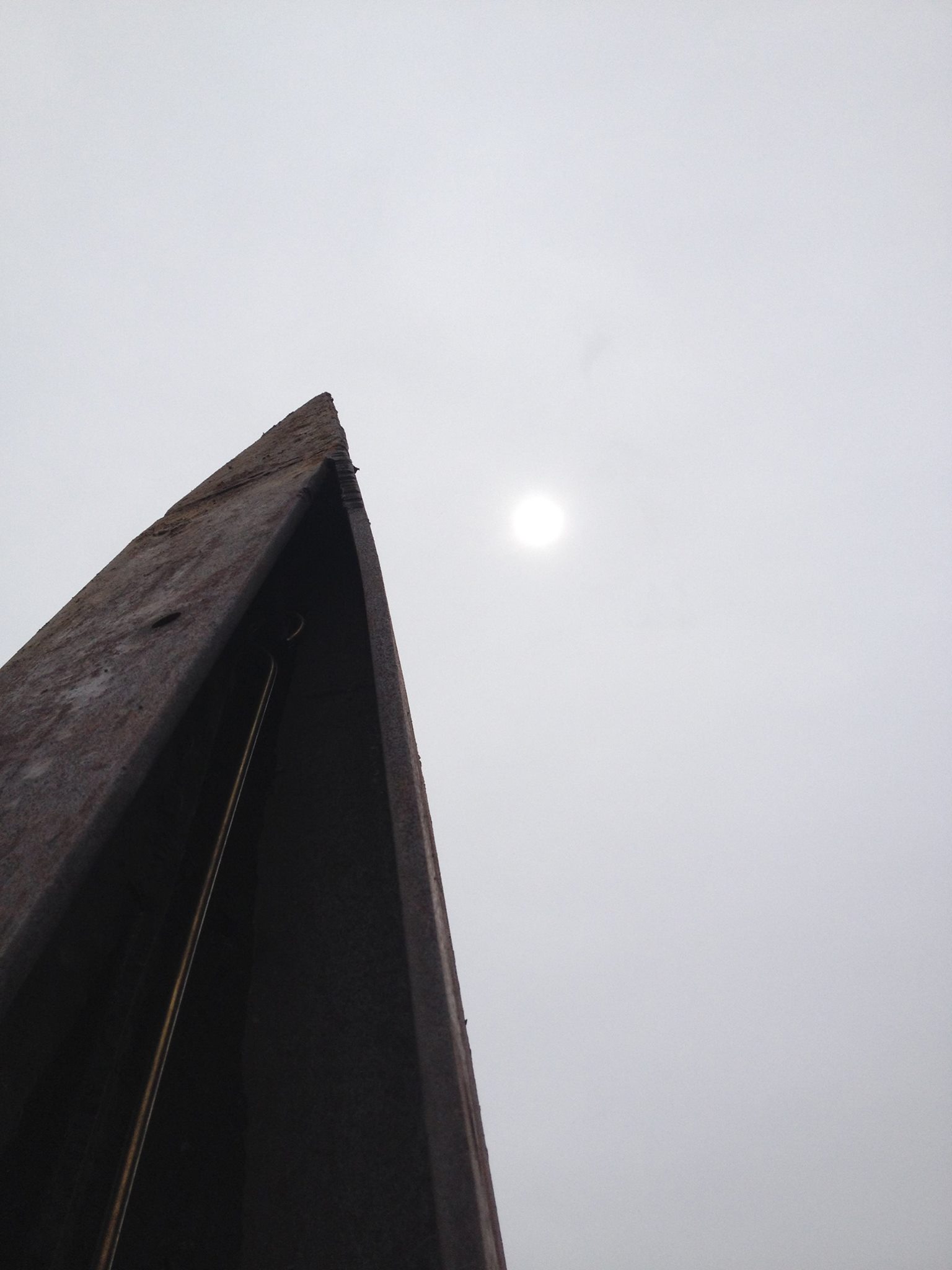
“The sculpture evolved from a project which salvaged the steel from the demolition of the City Garage around 2004, so the materials in the sculpture are recycled. The title of the piece is ‘Cedar’s Fog,’” Chesley explains.

With its triangular base suggesting a ship’s hull and a wind bell within representing the frequency of a fog buoy, this piece offers a balance of industrial and acoustic elements.

“This piece references my affinity for the ocean and the poetic lyricism of cedars,” Chesley discloses. “The sentinel quality and quiet strength of the cedars reflects a stewardship of nature--The dignity of living things.”

This representation of the dignity of living things through Chesley’s work further enhances the aesthetic of the city while providing a rebuttal to the notion that South Carolina lacks cultural growth and development.

“Having this work on public display is a way of sharing its symbolism and adding to the elevation of art and culture in the city--a respite perhaps from the demands of the times and free to contemplate and enjoy--it may help to instill a sense of character and place for the Vista,” Chesley hopes.

This wave of hope for the arts in Columbia washes over the city as local artistic presence increases.

“For me as a citizen of Columbia, it's really great to see public art that is unique and of high quality. I love the idea of the city in which I live expressing itself through public art, and I really enjoy encountering art in my daily life,” Snelgrove says. “But, in my role at One Columbia, I feel that more public art being installed represents Columbian's collective creativity, talent and support for the arts. Public art is a sign to visitors and citizens that we are a culturally vibrant place to live and work.”

The Artista Vista gallery crawl will be April 23-25, showcasing artists and galleries in the Vista along with the premier of “Cedar Fog.” The event is free, so come out and support local art and celebrate the growing culture in the city.

“I would venture to say future of Columbia as a destination point will be enhanced by its level of culture and stewardship of its natural resources,” Chesley says. “It is up to us to plant and nurture now, so that future generations will have fruit.”

Preview: Indie Grits 2015, Day 4

IG-Logo It's Saturday at Indie Grits!

That means the Love, Peace, & Hip-Hop festival is already in full swing on the 1700 block of Main Street. The event boasts a bevy of genuine headliners like Nice & Smooth, Monie Love, and Big Gipp (of The Goodie Mob) but is worth attending largely because of it's family-friendly celebration of the vibrancy and importance of hip-hop culture. Various vendors and non-profits will be dotting the sidewalks as DJs, B-Boy dance crews, and hip-hop visual artists gather together in the spirit of DJ Afrika Bambaataa's "4 pillars of hip-hop."

Jasper is particularly stoked for Big Gipp though--Goodie Mob is one of the key outfits in the Atlanta hip-hop scene of the 1990s, and is still one of the most influential outfits in defining "The Dirty South" sound for a genre too-often thought of in terms of East Coast (NYC) vs. West Coast (LA).

https://www.youtube.com/watch?v=KiuEFG0ZBd8

There's also a full day of screenings to take advantage of! The full schedule is at available at the Indie Grits website here, but it's worth noting how many blocks of shorts are available today--the Embarrassing Love block at 2pm, People Portraits at 2:30, Four Minute Film Frenzy at 4pm, Heritage in Drift at 4:30pm, Burdens of the Past at 8:30pm, and Summoning the Supernatural at 9pm. These blocks are a great chance to experience the full range of filmmaking possibilities and thrive off their juxtaposition to one another, something which is commonplace (and great) a film festival but that we don't often experience otherwise.

We attended Burdens of the Past yesterday and can personally recommend that block. It's mostly a collection of portraits of people you would likely scorn--a murderer, child molester, and campus preacher--but each vignette is lovingly rendered and looks to find the depth of humanity in its subject matter. It also showcases the range of motivations and possibilities inherent in making shorts too.

Vidia Propa

Features tonight include Western at 6pm, a nonfiction take on the genre that still simmers prominently in our national imagination, and Vida Propia, which sounds like a heartbreaking observational documentary of first-generation Mexican immigrants struggling to survive in North Carolina. The latter screens at 6:30pm.

Also going on tonight in the second performance of this year's Spork in Hand Puppet Slam! It's hard to say what exactly will happen at this anything-goes, adults-only collection of puppetry pieces, but Prairie Willows will be performing and puppeteers from around the Southeast will be showcasing the incredible creative abundance of their art form. That starts at 7pm.

https://vimeo.com/124048183

Then there's the closing party at 10pm, where you can get down with all the filmmakers to the tunes of Mechanical River and Infinitikiss. We would say that's a wrap on Indie Grits, but there's more stuff in store for tomorrow, when festival winners will screen throughout the day...

https://www.youtube.com/watch?v=M8qxDh4b9so