From our friends at Stormwater Studios:
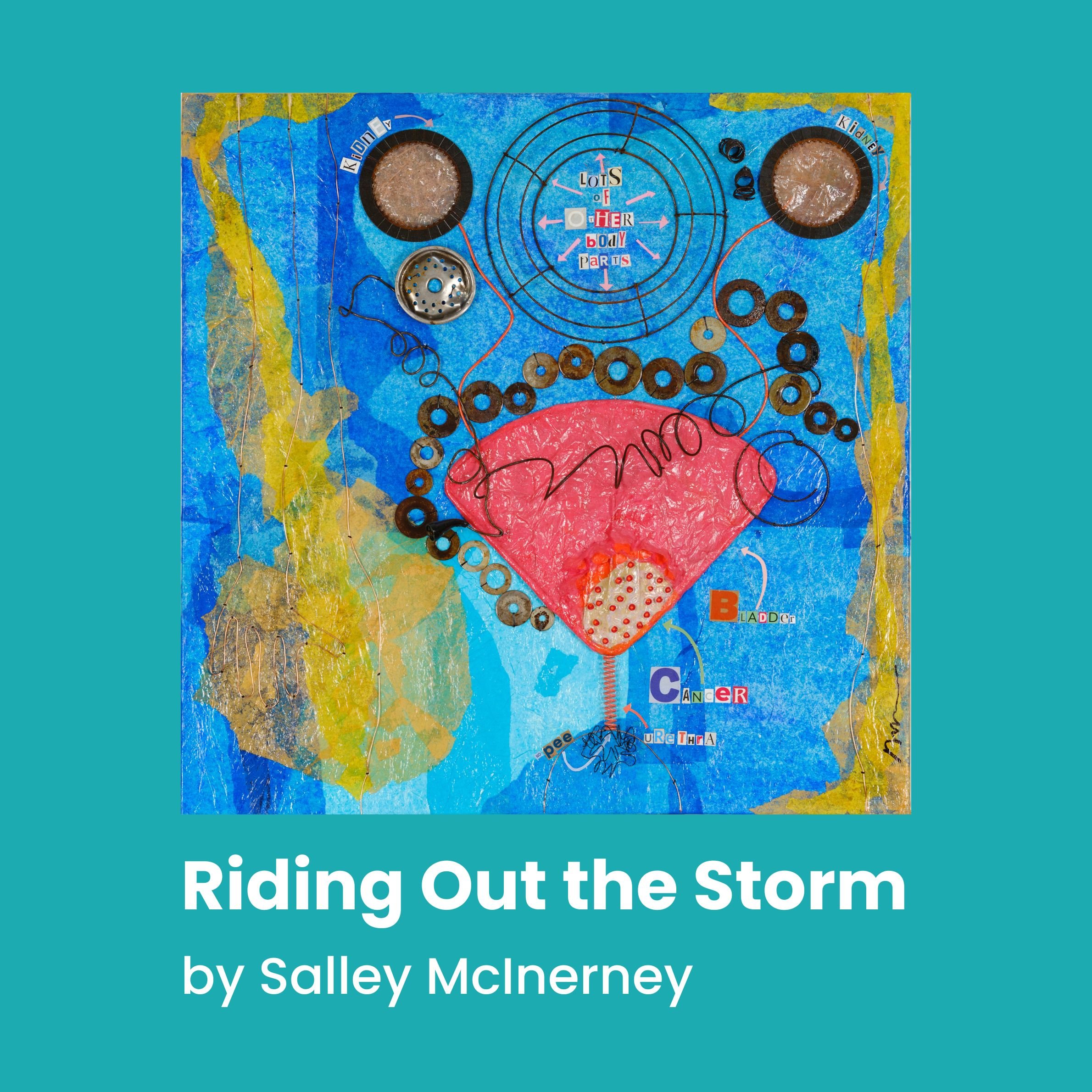
Riding Out the Storm is an unflinching visual and literary exhibition chronicling artist and writer Salley McInerney’s journey through bladder cancer and divorce. With a collection of 30 mixed-media works and corresponding storyboards, Salley explores a sudden diagnosis of bladder cancer, months of chemotherapy, grueling bladder removal surgery, a difficult physical and psychological recovery, and a most unforeseen consequence—the end of a 43-year marriage. Riding Out the Storm also chronicles Salley’s hard-won journey from profound loss to resilience of the human spirit and the reinvention of the individual self.
Opening Reception: Thursday, October 8, from 5:30 p.m. to 7:30 p.m.
Exhibition Dates: Wednesday, October 7, 2026, to Sunday, October 18, 2026
Gallery Hours: Wednesday – Sunday, 11:00 a.m. to 3:00 p.m.
From the Spring 2026 issue of Jasper Magazine …
Riding Out the Storm with Salley McInerney
By Cindi Boiter
Salley McAden McInerney opens, Riding Out the Storm, the book she wrote to accompany her visual art exhibition by the same name, with the words, “I have always taken the ability to pee for granted. I’ve peed everywhere. Toilets, outhouses, behind trees, sheds in the bushes, on mountaintops, in the back of horse trailers, off the back of pontoon boats, in lakes rivers and oceans. I’ve peed in my pants because of urgency or because something was so funny there was no stopping the flow.”
These are words almost any woman, particularly women who live in the South or another rural area of the country, can easily identify with. This writer, for example, even peed behind an ancient standing stone in a field in Scotland.
But her next words stop her readers, including this writer, in our tracks: “In August 2021,” she writes, “all that changed.”
The remainder of the 34 pages in the book is packed with the author’s annotated art, telling the story of McInerney’s journey, starting in August 2021, through invasive urothelial carcinoma. A journey that started with the author waking in the middle of the night with the unrequited need to urinate, a sensation that increased and became more and more painful throughout the night and into the morning, compelling her to visit the emergency room of the local hospital in McInerney’s small town of Camden, SC.
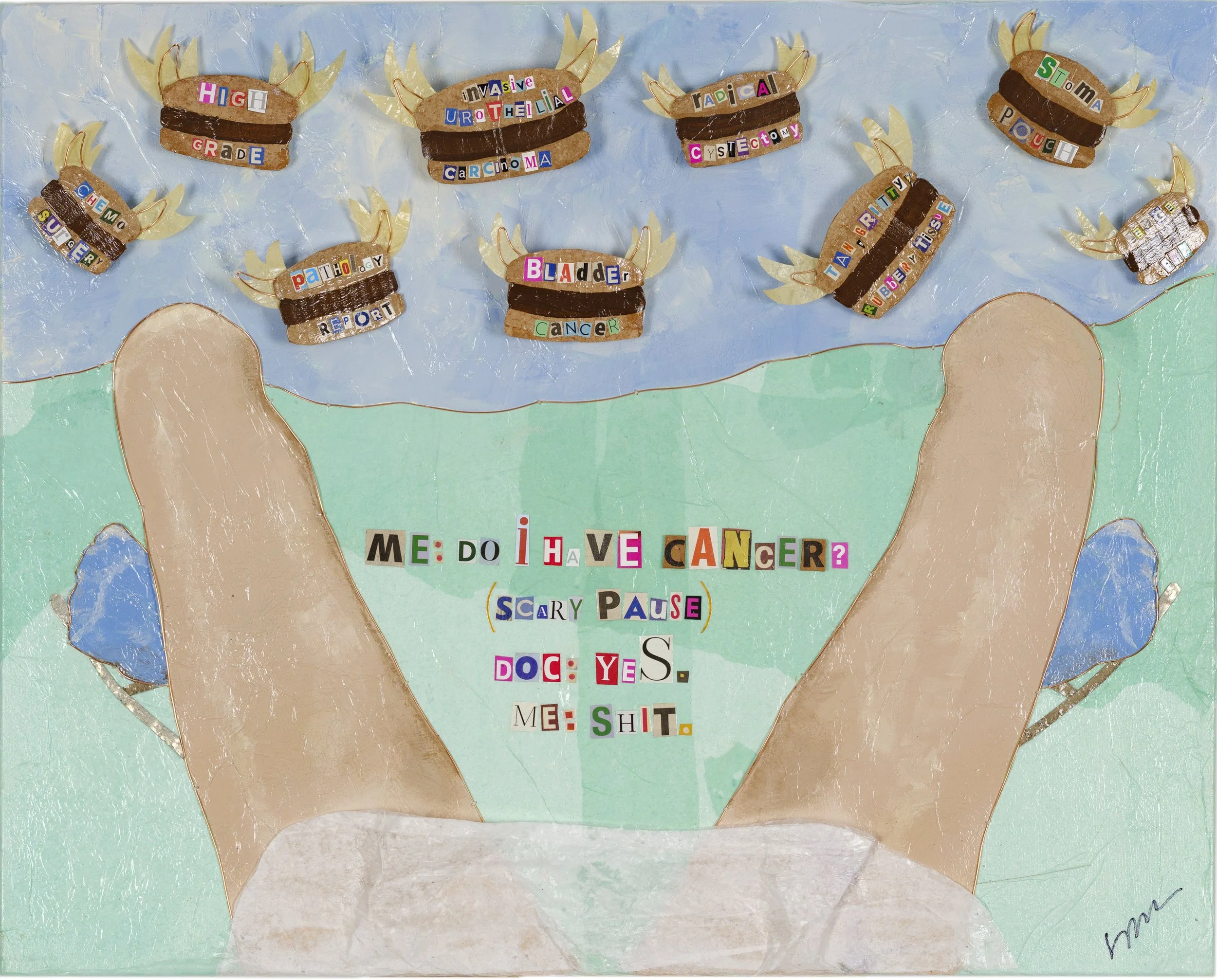
After many tests, McInerney was sent home with a catheter, the diagnosis of a bladder obstruction of, at the time, unknown origin, and an appointment the next week with a urologist. A writer, journalist, and visual artist, McInerney approached her urologist at her first appointment with the characteristic directness that has defined her career. “… I asked him, point blank. ‘Do I have cancer?’ He stopped short, looked at me intently. ‘Yes,’ he said. ‘Shit,’ I replied.”
The doctor explained that she would need 12 weeks of chemotherapy, starting immediately, followed by a radical cystectomy, or removal of the bladder. He went on to clarify that her urinary system would be rerouted from her kidneys, … “so that my pee would come out of a hole in my abdomen which was called a stoma, and which would be made with a part of my small intestine. He said I would wear a pouch over the stoma to catch the pee.”
If McInerney’s words sound blunt or jarring, or if the reader is less-than-comfortable with the directness with which she approaches such intimate topics, it’s no surprise.
As a former writer for The State newspaper as well The Gwinnett Daily News in Atlanta and the Chronicle Independent in Camden, McInerney’s writing style reflects her approach to moving through life. “Yes, my writing is blunt, to the point,” McInerney says. “In the case of Riding Out the Storm, there are two reasons for this. The first - during my 9-to-5 working years, I was a journalist, writing many stories on daily deadlines in big newsrooms. There was no time or space for flowery language. The job at hand was to tell the story as clearly, correctly, and quickly as possible. Concise language. Simple sentences. Get in, get out.”
“The second source for the bluntness,” McInerney continues, “is that bladder cancer seems to be one of those diseases that doesn't get talked about in ‘polite company.’ It's an intimate subject about body waste, and, in my case, forevermore peeing into a bag stuck to my belly. As I delved into the subject on the internet - specifically muscle-invasive cancer and bladder removal - I discovered that the unpleasant specifics of the ordeal tended to be glossed over. As I began work on Riding Out the Storm, I was determined not to do that. I wanted to be brutally honest about every facet of the disease. It's one reason I painted a self-portrait of my naked body with my stoma visible and my pee bag attached to my belly. Here I am, folks, bag and all.”
Hints of McInerney’s to-the-point methodology are found throughout the book via her written words and her visual art as she details the stages of her experience with honest precision. “As chemo drugs dripped into me week after week, I watched fall approach, the leaves on the trees turning yellow, orange, and red. And with every visit , my body grew weaker.”
After she had completed the chemotherapy course in December 2021, her oncologist recommended that she take the nest month, January, to gain weight and grow stronger before the surgery, she says. Her husband wanted her to take the month to relax and recover, saying, “Can’t we just enjoy this month?” But McInerney remembers that “the waiting was horrible.” And she became more and more aware of an “emotional distance spreading even wider” between her and her husband of more than forty years.
“Unlike me,” she writes, “he was able to compartmentalize the mess we were in. January ‘he felt’ should be a pleasant month. I … was only able to do one thing: count down the days left until I could no longer pee like a normal person.”
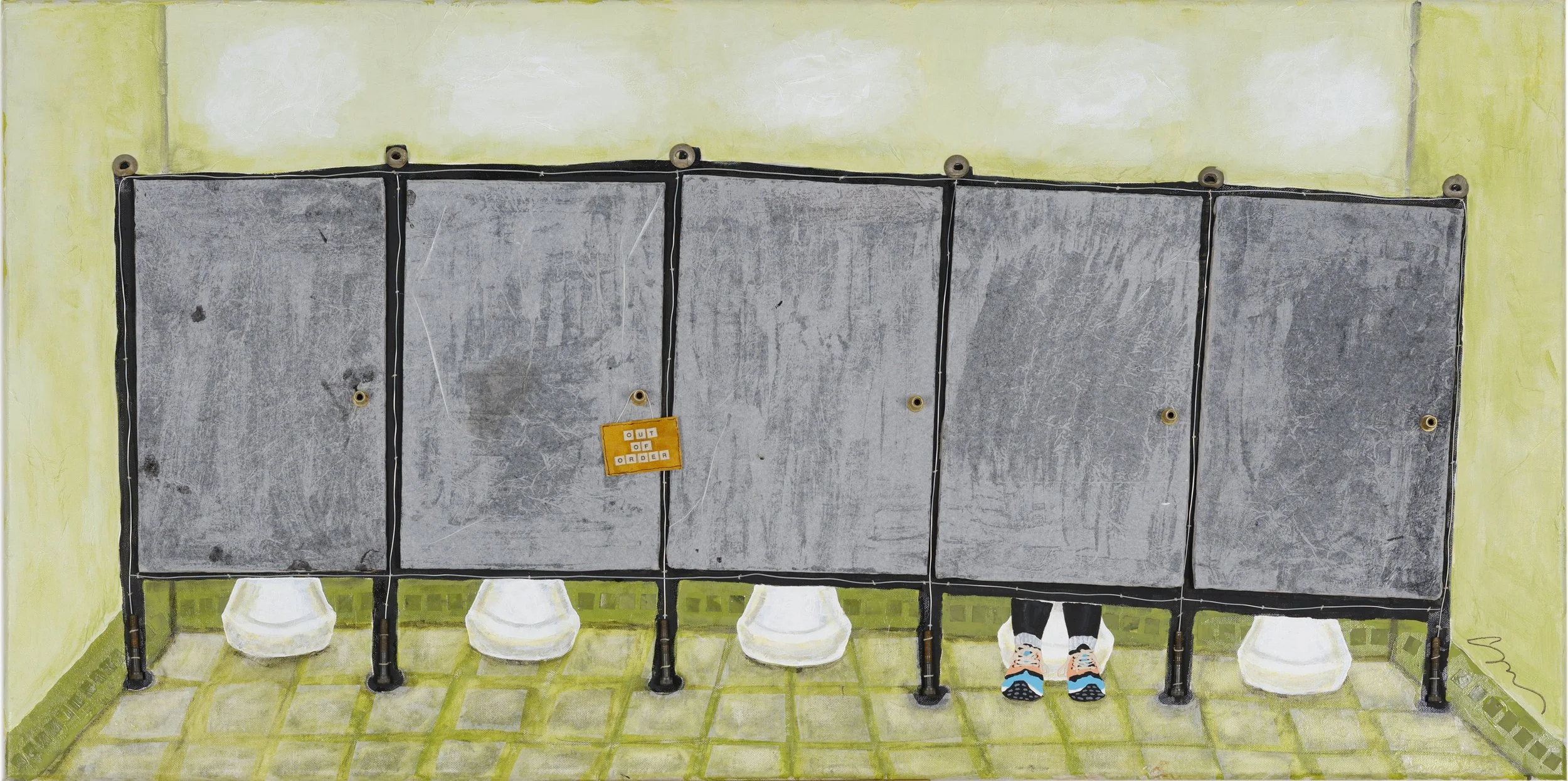
The Last Pee by Salley McInerney
McInerney recounts the last days before the cystectomy remembering that when she was a child, she always made a point of committing to memory her last swim of the summer from the SC beaches where her family vacationed. Acknowledging that once her surgery was performed, she would never again urinate the way she had all her life, she applied the same practice to going to the bathroom.
“I sat on the toilet seat and let what little fluid was left in me come out. I felt the warmth of it leaving my body. I heard the trickle. I watched as the last drops of pee created concentric circles in the toilet water. … I stood and pulled my pants up, running my hands across a smooth belly that would soon be opened and excavated by a surgeon’s tools. I flushed the toilet. I gave thanks to a body part I’d hardly ever thought about. And that was that. The last normal pee.”
While her surgery was successful, the artist still had to remain a patient at the Medical University of South Carolina in Charleston for seven days, after which she and family members settled in at a beach house, close to her physicians and treatment facilities, for recuperation. One of the images in the book depicts a pair of feet in cozy socks propped against a railing, legs draped with a warm blanket, and the beach and ocean beautifully rendered behind them.
Throughout this unthinkable chapter in her life, McInerney relied on family and friends to sustain her, “I was not in control,” she writes. “At one point, I curled up in my sister’s lap and wept.”
Ultimately, McInerney returned home to Camden, but she was no longer the woman she once was. “I was sure that life as I knew it was over. I would never be able to ride horses,” she writes. A horsewoman all her life, McInerney rides as a “whipper-in” with the Camden Hunt, a role that includes the vital responsibility in fox hunting of keeping up with the foxhounds during a chase. (“We do not kill game, but we chase it,” she writes in her book.)
“When I announced to a close friend that my husband and I had separated a mere five months after surgery to remove my bladder, she, who had experienced cancer herself, said ‘It’s the cancer,’” the artist writes.
“… My friend was partially right about cancer rocking my marriage. The illness was catastrophic for me. Every coping skill, every reserve of patience and energy had been spent on battling cancer and learning to live without a bladder,” she writes. “Shortly before we divorced a year later, … my husband told our divorce mediator that I had ‘gone to a very dark place.’ He was right. … The place was dark and grasping, and when I returned from its grips, a startling light shed itself over what was left of my life. My future came into sharp focus. I was determined to live that future, if not happily, at least peacefully.”
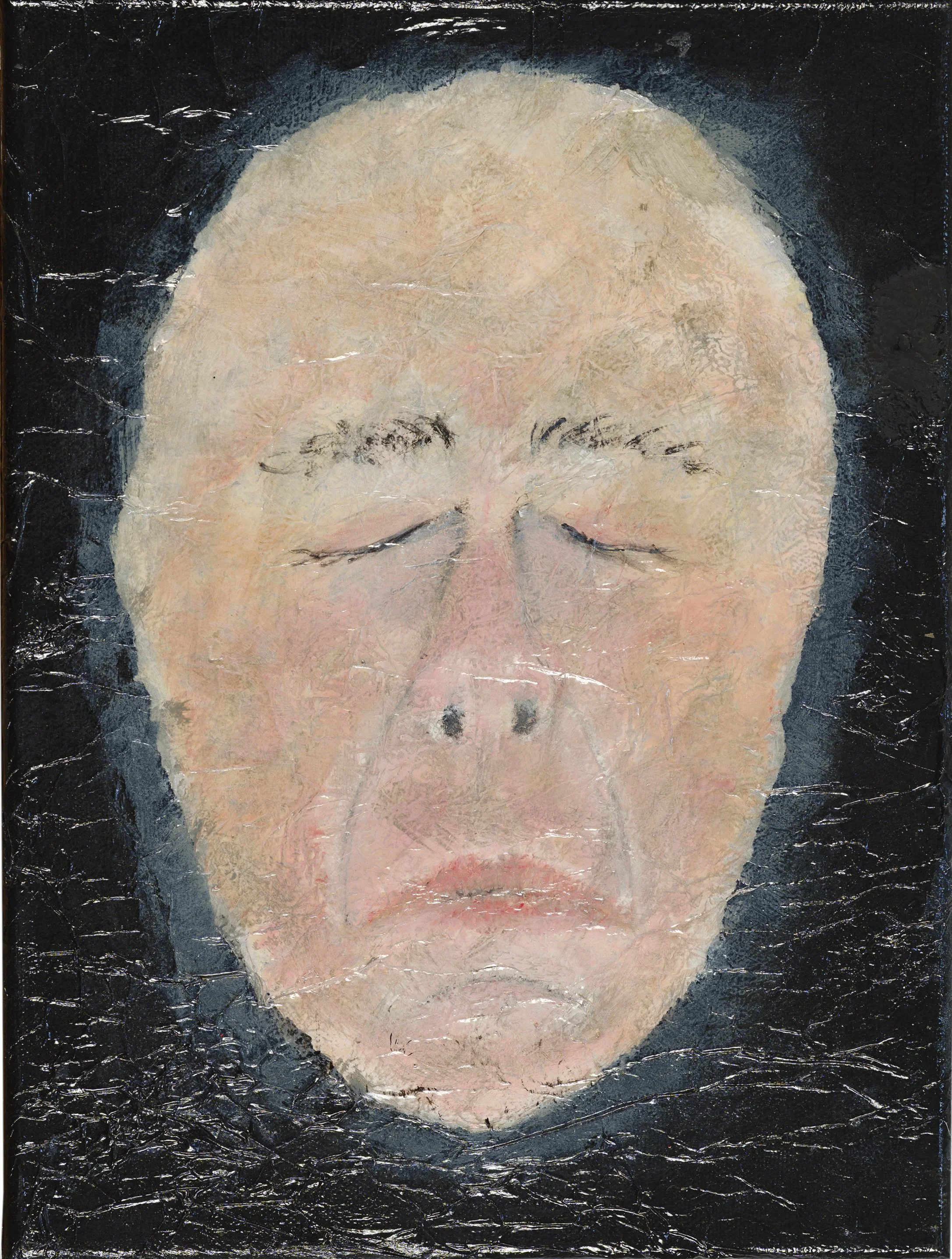
While in many ways her divorce was liberating, it also came with new burdens and responsibilities for McInerney to carry along with recovery. “I was a naïve woman who was suddenly trying to drink life’s water from a firehose,” she says. “But here’s the thing: I had survived cancer. I had met that battle head-on. When I felt like I couldn’t manage my own life, I remembered that struggle, and I gathered my strength. … I put one foot in front of the other and kept moving.”
According to the American Cancer Society, bladder cancer accounts for 4% of all U.S. cancers. It is the 10th leading cause of cancer death in the country and the five-year relative survival rate is approximately 79%. As McInerney faces the five-year anniversary of her illness, she says that she is doing well physically and that, emotionally, most days are good. She is back in the saddle at the Camden Hunt with her beloved horse, Lee, “who carries me safely through thick and thin. I swim. I walk my dogs. I do my art, …my volunteering. I write,” she says.
“I have always expressed myself best through my writing and through my art,” McInerney explains. “That said, I also believe that my writing and my artwork act as a way of me ‘talking to myself.’ Both mediums make more clear to me things about myself and my world. It's almost as if I'm in a classroom of one, a classroom of me, where the teacher is the art or the writing or both.”
It is for this reason that she embarked on the multidisciplinary art project, Riding Out the Storm. The exhibition will be presented at Stormwater Studios in Columbia, SC October 7th through the 18th, with an opening reception on Thursday October 8th from 5:30 – 7:30 pm.
She continues, “The best way for me to understand the complexities of what happened in a two-year span - bladder cancer, divorce - was to let my writing and my art do the work, unravel the gravity of it all and tell the story to me and, as it turns out, to others.”
It’s a story worth telling; a story of the importance of support and the role art can play in survival.