Wilma King
by Cindi Boiter
Photography by Brad Martin
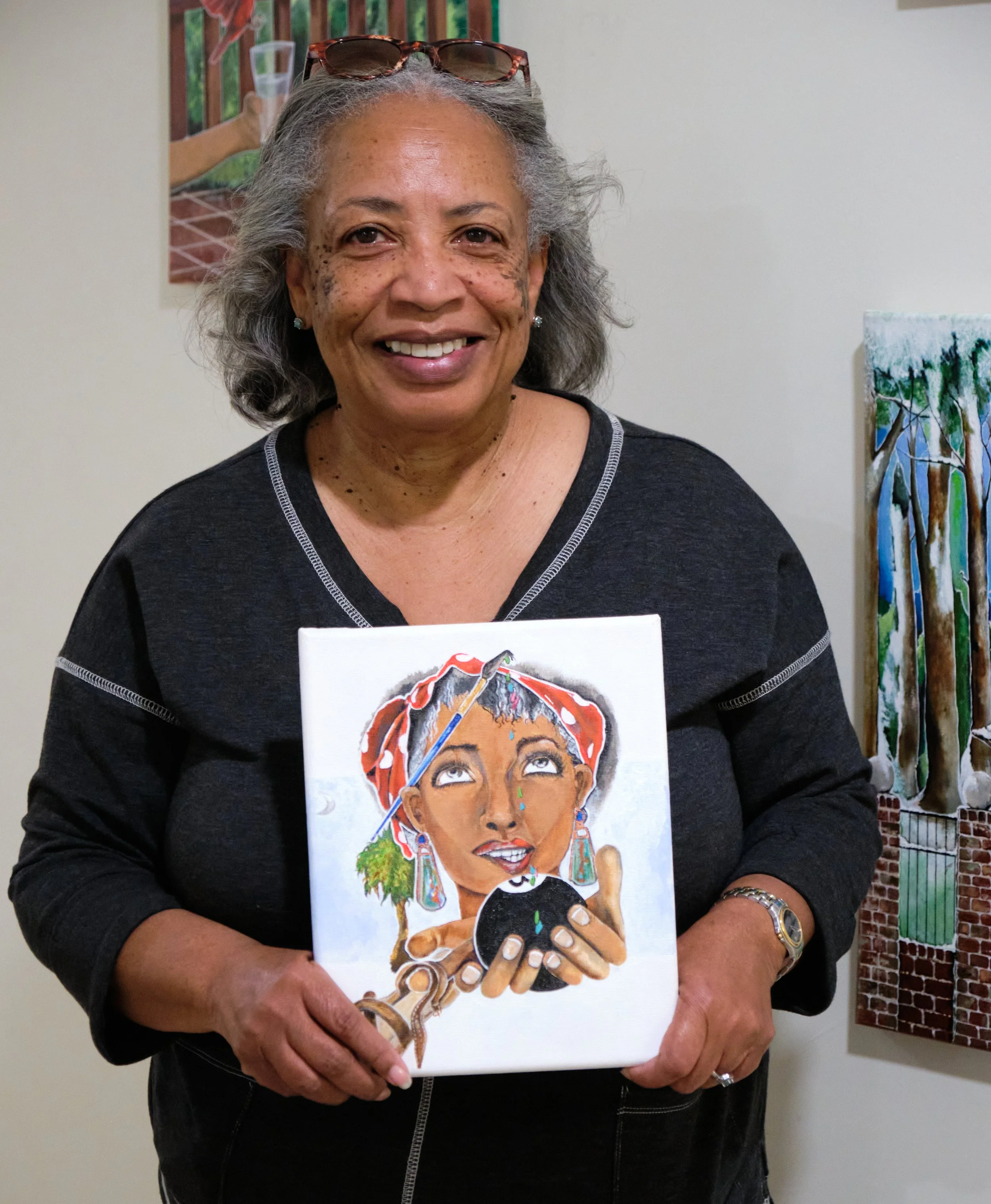
“I remember an incident in fourth grade that helped me focus in on my love of art and design,” Columbia-based visual artist and winner of the 2022 Draw Jasper competition, Wilma King begins. “My teacher, Ms. Hendrix, knew how to inspire and cultivate creativity. She read to us, held in-class competitions, and infused applied learning into our coursework way back then. Our school was on a military base in Fort Greely, Alaska. My mind was full of dreams of being a nurse like Clara Barton until Ms. Hendrix announced a fashion design competition. My classmates convinced me that I would surely win – but I didn't. So, I launched this compulsion to design paper dolls for my sisters, friends, and anyone who would let me do so. It was an experience that allowed me to delve deeply into individual, and cultural preferences for design, color, shape, size, and form.”
That lesson, to persevere despite all odds, has served King well as a guiding force driving her to accomplish a life full of achievements and broken barriers that serves as an inspiration to artists and women and people of color today.
Born in Lexington, SC, King, who has a BA in studio art from the University of SC and a MA in journalism from Texas Southern University in Houston, says she grew up both in Lower Richland County and Alaska. “I have lived in 11 different states and done domestic and international sabbaticals that took me to a cumulative 9 months of slow travels and teaching abroad in Italy and in Canada. After more than 30 years of doing some of the things I found interesting and exciting, and to become my mother's primary caregiver, I moved back home to SC.”
But that was not before teaching art at the Art Institute in Houston, O’More College in Franklin, TN, SUNY, and serving as an associate professor in PR at both Western Kentucky University and well as the Rochester Institute of Technology in upstate New York. “I always felt there should be a collaboration between words and images. I taught graphic design, computerized design, or some form of public relations design most of my career, beginning with launching, teaching, and designing the first courses and curriculum in commercial art here in Columbia at Benedict College.”
King was the first Black faculty member in the Department of Journalism and Broadcasting, and she stayed there for 16 years where “they allowed me to do things I never dreamed I could do.” One of those dreams-come-true was launching an international conference on diversity and inviting groundbreaking photojournalist Gordon Parks to the school for three days of lectures and hands-on learning. “It was then that I started to specialize in art and storytelling,” King says, reflecting on her time with Parks, whose documentary style photography was instrumental in the fight for civil rights but who went on to be the first Black person to produce and direct major motion pictures, including 1971’s revolutionary film, Shaft.
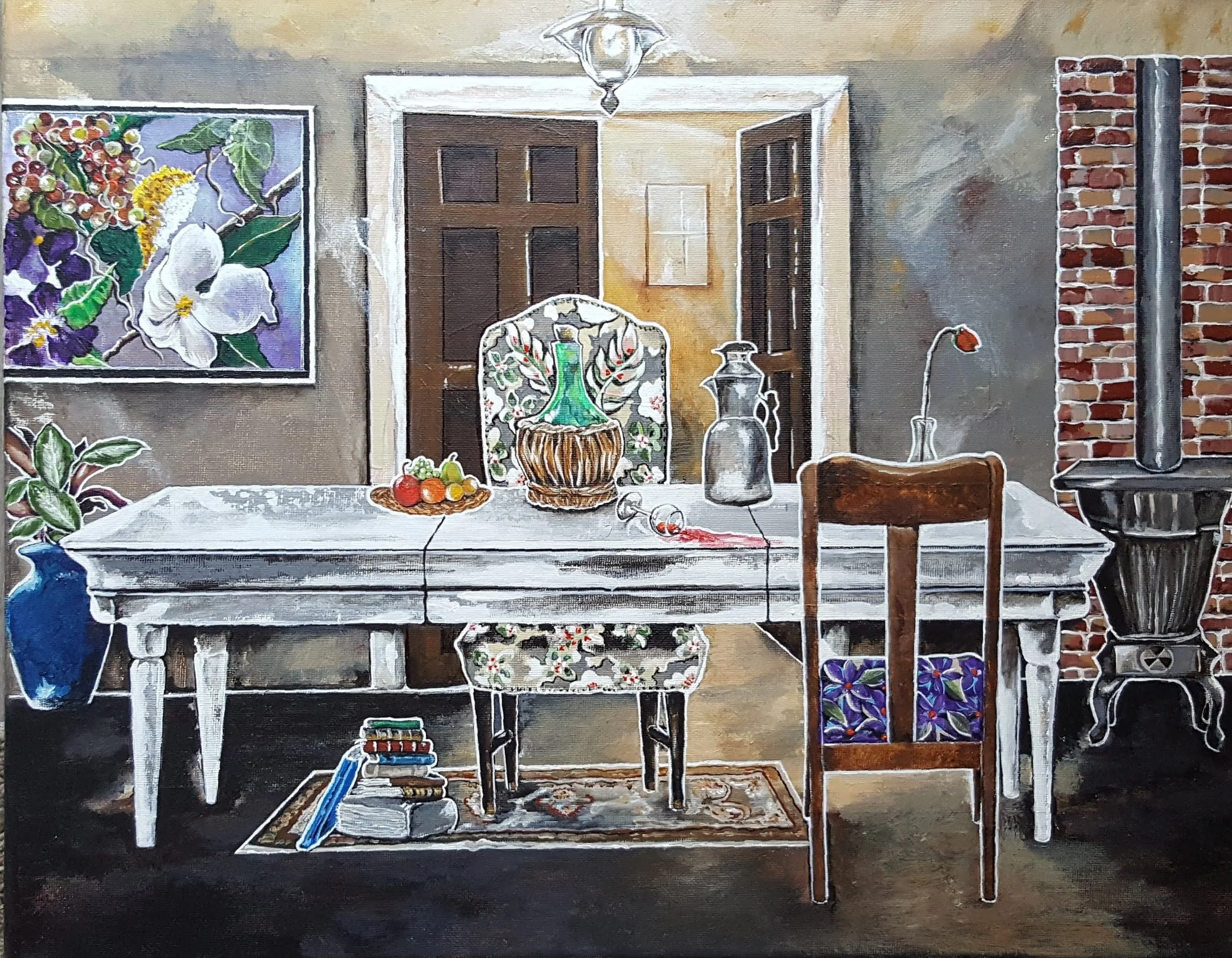
I came to love a very well-written painting,” King says, adding that “art should tell a story,” an endeavor she strives for in her own work. “I enjoy telling my stories as well as those of people I have met along the way. An avid nonfiction reader, I try to incorporate a level of authenticity, through descriptive and narrative detail in my paintings. I focus on the story to give it broader meaning – that is, the painting’s relationship-building potential. People often comment on my style. I paint from memory, not photos (unless commissioned to do so), and I rarely use references. Various elements in each painting are carefully outlined to show that the story is a composite of different places and spans of time.”
King’s medium of choice is acrylic. “My very wonderful art professors at USC, particularly Jim Edwards, taught me that acrylics are extremely adaptable and can convincingly disguise as other paint mediums.” And as for her technique, “I would say that I have either a ‘gentle’ realism or perhaps a somewhat ‘rigid’ surrealism style,” she says. “I am not painting from photographs unless I’m commissioned to or as reference. The white outlined objects in my work come together in my memories from myriad places and times.”
Among her greatest influences are Dony Mac Manus, sculptor/founder of the School for Sacred Art in Florence, Italy, and Giancarlo Polenghi, the school's director of the master’s program who is an Italian art historian and teaches theology of the body. “They both helped me to understand that the purpose and power of art is to elevate the status of individuals in communities and in society.”
“Now, each day, before I begin to paint, I study some of the great Christian art. I enjoy Biblical stories through the eyes of Michelangelo di Lodovico Buonarroti Simoni, Michelangelo Merisi da Caravaggio, Peter Paul Rubens, Cristofo de Predis, Rogier van der Weyden, Rembrandt, Vincent Van Gogh, and even Salvador Dali.”
But she adds that, “Jonathan Green has given me some very good advice and critique on my work, as well,” counting Greene as one among her three favorite SC artists. “I love his use of color and form, and the stories of the African American experiences in the South. He depicts an enjoyment, pride, and love for life that is seldom seen these days. His viewpoint and perspective are necessary against a backdrop of sadness, anger, and bitterness in the world.”
Her other two favorite home-state artists are Gerard Erley and Phillip Mullen. Of Erley she says his technique is “akin to that of the ‘great masters,’ not only in his artistic ability, but also in the way he commands his storytelling.” From Mullen, her former drawing professor whose work she says she “has always loved,” King says, “I learned to be meticulous in the details and still develop a style distinguishable from everyone else.”
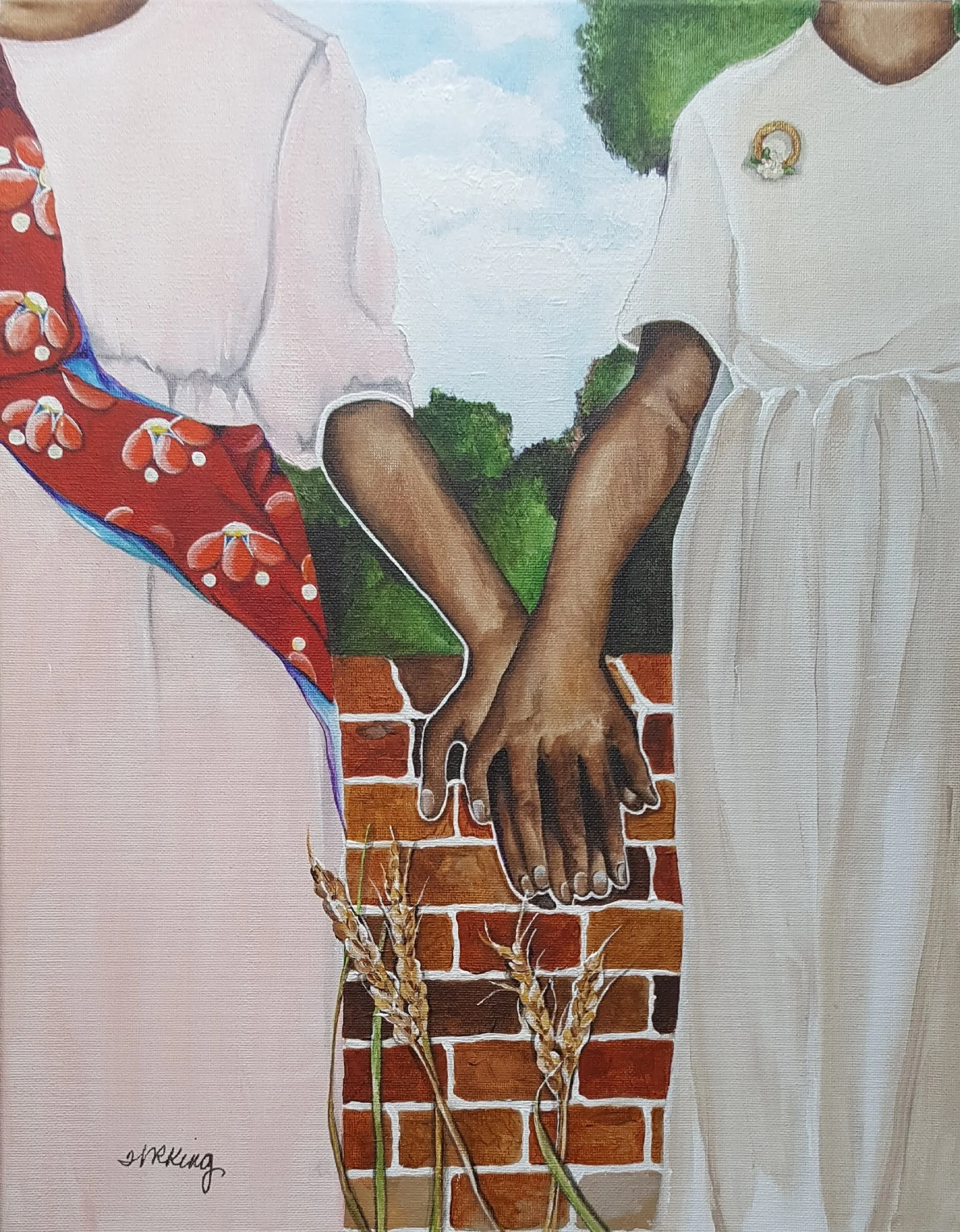
With a CV replete with honors, awards, grants, and fellowships, listings of lectures given, international conferences organized and attended, publications in books and esteemed journals as well as listings of books and publications she designed, and truly, more accomplishments than can be recorded here, King’s humility is overwhelming. It is beyond anticlimactic to mention her recognition as the winner of a competition as prosaic as the Draw Jasper contest, but it must be done.
It is on the cover of this issue of Jasper Magazine that Wilma King’s painting, Jasper is published, the winning entry in the 2022 Draw Jasper Competition. “My art is of hindsight, unable to catch up with the present – because the present becomes the past too quickly. Nonetheless, each of us are where we need to be when it comes to our art,” King says. “The Jasper painting expresses the joy of being where I am now, and the struggle of recognizing significant moments and collaborative memories from multiple sources. Through the colors and imagery, I try to describe my vision of a world that is seeded and then grows from my South Carolina and Louisiana Creole cultural roots. It also speaks of my age that notices and shares the pivotal history of two generations before me.”
“These days, I read less than I used to (a book each week), and paint more,” King continues. “I am painting each day, whether it is on canvas or glassware. Art is a way of praying. It helps me find positivity in whatever I am confronted with throughout the day – good or bad. I am seeking ways to put the events of the day in proper perspective and finding a way to reconcile my day in gratitude. I began what I hope will become a series of painting based on contemplative and spiritual exercises. I believe art should elevate the status of persons and communities. Finally, I have had a happy life, despite a few calamitous events I certainly hope the happiness is what my art passes on to others.”
Wisdom from Wilma King: I think there's a need to not only expose the world to Columbia arts, but to also expose Columbia arts to the world! There are ideas and opportunities for collaborations that are not being explored. Let's create some opportunities for collaborations and universality through perhaps Sister Cities for starters.
On my wish list? It's time for a women's museum, a children's museum, and an independent art school. The spirit and excitement of art is apparent in Columbia’s eclectic art community. Still, the more we venture out, explore, and study the universal art world, the less repetitive we become.
This article appeared in the Fall 2022 Print issue of Jasper Magazine.