From the print issue: The Runout – Creating Music and Community In Different Ways By Kevin Oliver

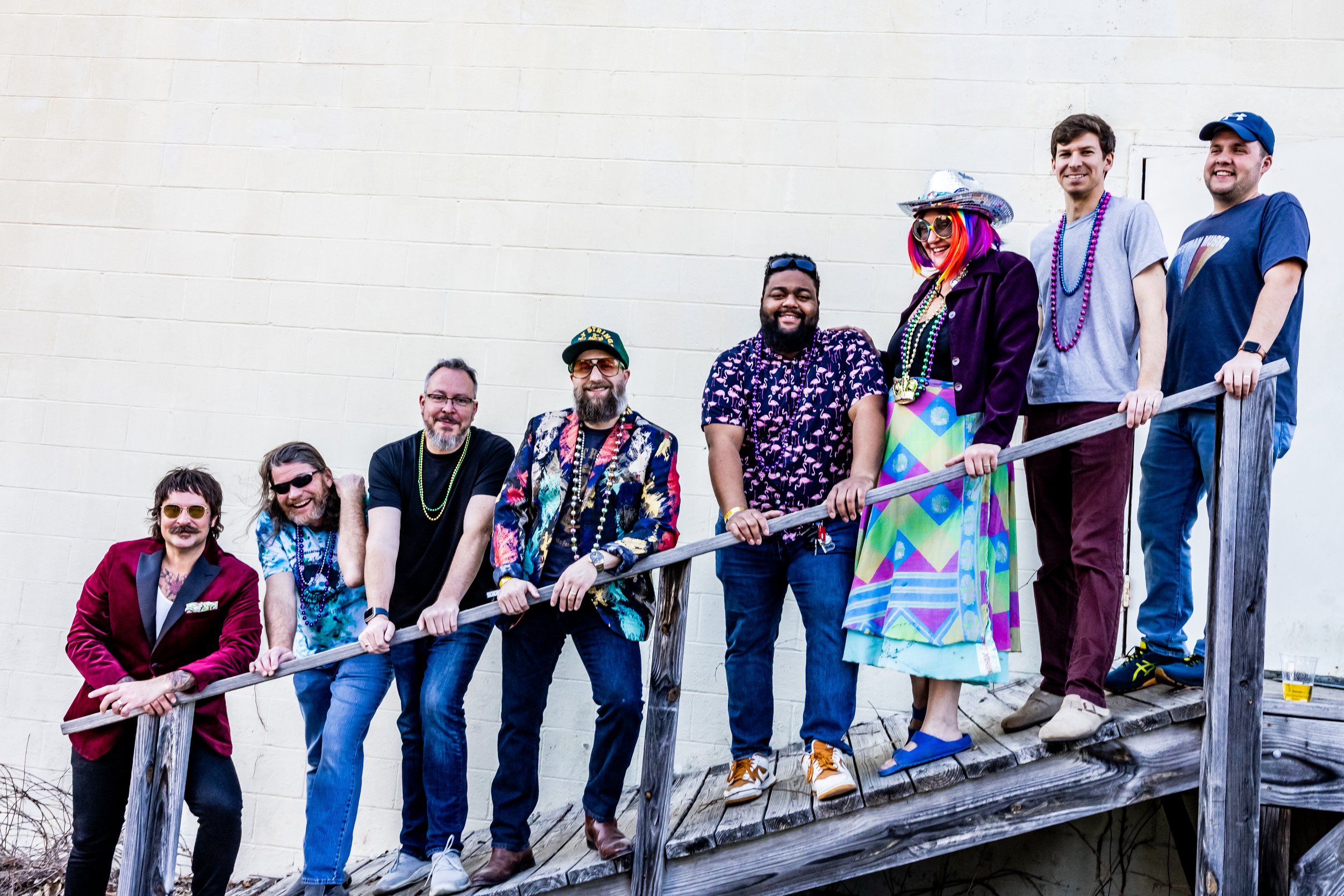
There’s a moment on the new album from The Runout, Just As Real, that may sum up the past four years of the band’s existence. On “Light a Fire,” Jeff Gregory sings, “Do you think we could light a fire and stand around until we feel better? I’ll leave it to you now.” They lit a fire back in 2021 with their last full-length record, With Your Eyes Closed, and while they haven’t exactly been standing around, the band has spent the better part of the interim exploring what it means to make music together, and separately, and where they fit in the context of the greater community. 

“There was writing all along, and intention,” says Gregory, the band’s principal songwriter, singer, and guitarist. “The whole while, I was making music, and getting pissed off about making music, like we all do. There were some of these songs that we played live for a couple of years or more, too. And then it got to a point where it was just that we needed to record, that I was dragging my heels, it felt like.” 

Outside of some infrequent singles put online, the first project to see release over the summer was Hidden Variable, a short EP of songs featuring the acoustic duo version of the group, just Gregory and his wife Kelley B. Gregory, who provides crucial, sound-defining harmony vocals. Her presence softens Jeff’s sometimes stark, percussive style in ways that are hard to describe without hearing them together, as the voices intertwine in ways that only true intimacy and connection can muster. The duo arrangements really bring out the pair’s influences, with “When” evoking classic Simon and Garfunkel harmonies, and “The Millstone” possessing the plainspoken profundity of Dawes. It’s also an indicator of the upward progression of Gregory’s songwriting, which stands tall even in the unflinchingly exposed acoustic format. Take these opening lines from “The Millstone”: 

i'm grateful for the grain

even Tuesday mornings never felt the same without the pain

i can picture raindrops falling on the blades of green

now the oats roll in my hands above this screen

like we rolled out in the fields in younger days

 In one verse he’s expressed gratitude, a work ethic, and nostalgia for a more innocent time; the song goes on to describe, in the words of the introduction on the album’s Bandcamp page, “that blue collar urge to just survive and be a fucking good person in the modern era of perverse capitalism.” It’s a delicate balancing act, but one that Gregory has seemingly mastered. 

Working this time around with producer and fellow musician Todd Mathis on the full band recordings, the parts were done in some different ways, Gregory says.

“My guitar parts and Kelley’s vocals were done in our kitchen on both the duo EP and the full band songs,” He says. “The EP was put out as-is, just us. For the band songs we shipped everything over to Todd, who put all the pieces together in his studio.” 

Perhaps the biggest change in the way things were being done in recent years was the addition of the Runout Duo, putting Jeff and Kelley in places the band had never gone, and exposing them, their sound, and their original music to more and more audiences. 

“The organic thing that has happened really slowly, but really surely with this is that we’re seeing people who are coming to a duo show at Columbia Craft, for example, and the next full band show they’re also showing up to see us as a full band.” The two feed off each other, in Gregory’s opinion.  

“When we started doing the duo three years ago, I cut back to a two day a week job, from full time, so we could schedule more shows,” He says. “I’ve worried less about having a digital presence, playing the algorithm game, and building a huge social media crowd, and leaned more into the shows, the live music side of things.” 

Gregory feels it has paid off in a more connected, loyal audience. “I’m finding that people are showing up, buying the shirts, wanting to have a physical CD or to be able to listen to the songs they hear us play,” He says. “It’s not hundreds of people–but it’s 45, or 50 people, that keep showing up.” 

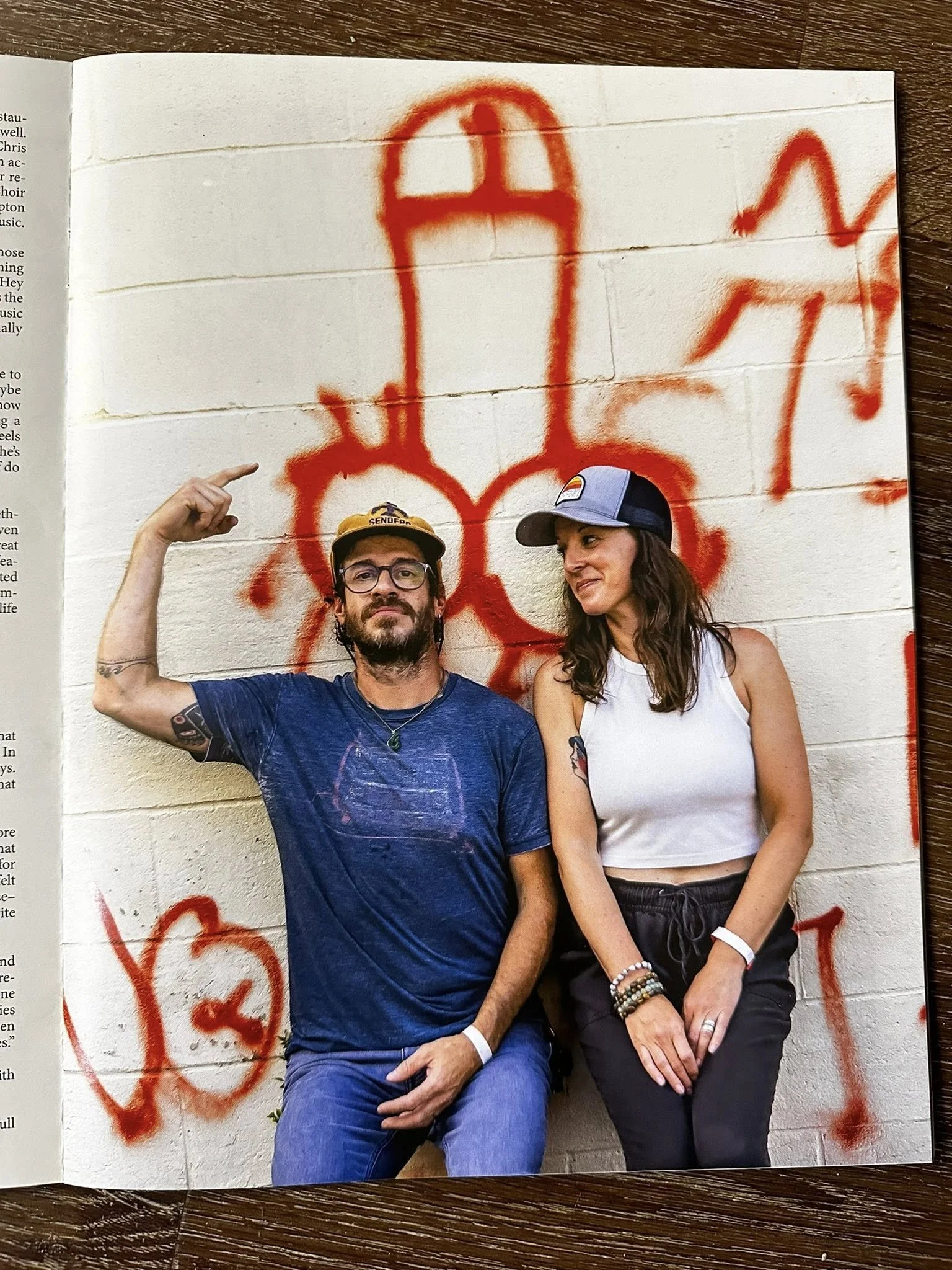
Those duo show experiences, playing covers for the bar and restaurant crowds alongside the original music, have fed the band as well. With Moses Andrews on bass, Mike Scarboro on drums, and Chris Compton on lead guitar, those other band members have been active outside of the Runout as well, with Andrews in particular releasing solo albums and playing in Patrick Davis’s Midnight Choir band, Scarboro playing drums with a host of others, and Compton has a long discography of his own excellent songwriting and music. 

“We’re all creative individuals,” Andrews says. “You bring all those other experiences back here and now you’re at rehearsal jamming on a cover that Jeff and Kelley have been doing as a duo and ‘Hey let’s see what it sounds like with the whole band,’ and that grows the sound of the band that way. It’s also a function of how the music community in Columbia makes it easy, whether it’s professionally branching out, or just creative opportunities.” 

“We try to have the culture of a family,” Scarboro says. “We like to set up practices with food, have a hangout session, and then maybe try to play some music. When you know each other so well, know each other’s personalities, you’re more comfortable delivering a new line, or an opinion or a thought on a song–So everybody feels like they can toss something out and see what Jeff says, and he’s really good about leaving a lot of openness for us to just kind of do our thing.” 

Those close personal connections and years of playing both together and apart lend the band’s songs an easygoing familiarity, even if they’re new like the latest release. “Me and the Lord” is a great example, and one of the most fully fleshed out arrangements featuring the whole band. Over a rollicking organ and piano accented tune that’s straight out of the Leon Russell school of 1970s ensemble rock, Gregory declaims a non-materialistic way of living life and practicing one’s spiritual faith.


 “and I ain't got money much

it gets between me and the lord

that may sound funny but

there ain't that much I can't afford”


“There seems to be a way that we do things, and I don’t know what culture this comes from–is it church culture? Nashville culture? In terms of music with formal stuff like lead sheets,” Gregory says. “Sometimes it just happens, sometimes songs are more format based and we can work them out like that.”   

Then there are the ones that are more difficult, requiring more work. “Sometimes songs take a long time; ‘Currency’ was one that I wrote three times thinking that the guitar lick was going to be for something else,” Gregory says. “Then finally some other words felt better with it, and it settled, and never turned into anything else–and that was over the course of years. But then, some songs I write in five minutes.”  

One result of the recent recording sessions is that they have found some things that really work well for them, Gregory says. “We realized that we really enjoy recording our vocals live, around one microphone, to get the harmony,” he says. “Because our harmonies lock differently in the timing if we try to record separately and then blend it in later. So it has just been moving us forward, on all sides.” 

There’s even more movement in the works, Gregory says, with more releases planned out.

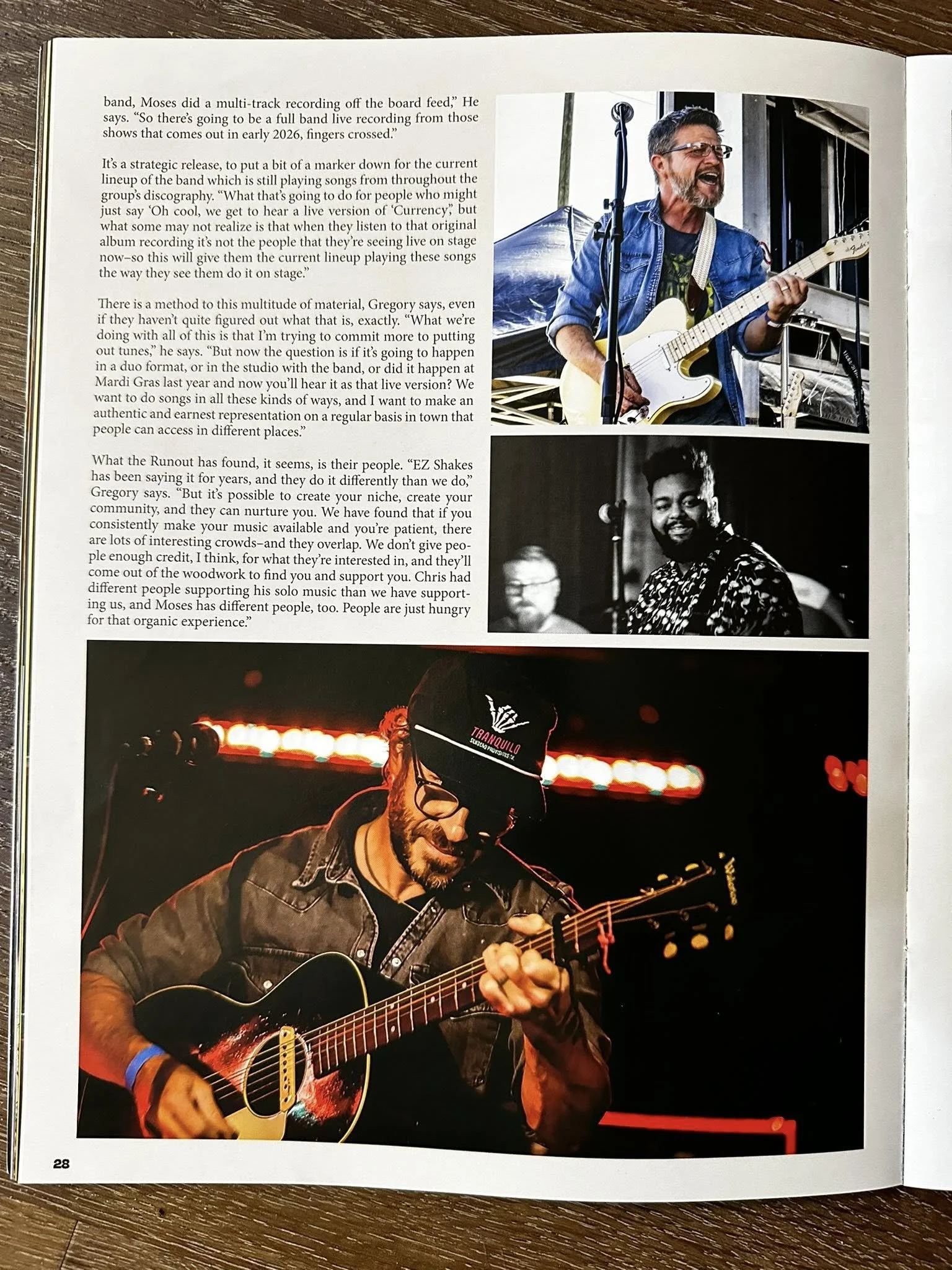
“All of the live shows that we did this past spring that were full band, Moses did a multi-track recording off the board feed,” He says. “So there’s going to be a full band live recording from those shows that comes out in early 2026, fingers crossed.”


It’s a strategic release, to put a bit of a marker down for the current lineup of the band which is still playing songs from throughout the group’s discography. “What that’s going to do for people who might just say ‘Oh cool, we get to hear a live version of ‘Currency’,’ but what some may not realize is that when they listen to that original album recording it’s not the people that they’re seeing live on stage now–so this will give them the current lineup playing these songs the way they see them do it on stage.” 

There is a method to this multitude of material, Gregory says, even if they haven’t quite figured out what that is, exactly. “What we’re doing with all of this is that I’m trying to commit more to putting out tunes,” he says. “But now the question is if it’s going to happen in a duo format, or in the studio with the band, or did it happen at Mardi Gras last year and now you’ll hear it as that live version? We want to do songs in all these kinds of ways, and I want to make an authentic and earnest representation on a regular basis in town that people can access in different places.”

 What the Runout has found, it seems, is their people. “EZ Shakes has been saying it for years, and they do it differently than we do,” Gregory says. “But it’s possible to create your niche, create your community, and they can nurture you. We have found that if you consistently make your music available and you’re patient, there are lots of interesting crowds–and they overlap. We don’t give people enough credit, I think, for what they’re interested in, and they’ll come out of the woodwork to find you and support you. Chris had different people supporting his solo music than we have supporting us, and Moses has different people, too. People are just hungry for that organic experience.” 

Jasper Magazine photos by Perry McLeod

Don’t miss your next chance to see, hear, & enjoy

The Runout

Dec 20th at Greener Pastures Brewing 6-9p

Camden, SC


From the print issue - REVIEW: THE WEIRD GIRL, Weirdness Becomes Witness—And a Way to See Our Own City Clearly

By Christina Xan

Carla Damron writes with one foot in the world of fiction and the other in the very real, very personal world of social work. In Columbia, SC where Damron herself is deeply rooted, her books feel less like imported thrillers and more like dispatches from our own streets. Her last novel, The Orchid Tattoo (Koehler Books, 2022), introduced readers to Georgia Thayer, a social worker caught up in a case involving human trafficking. With The Weird Girl (Stillwater River Publications, 2025) Damron continues Georgia’s story, this time shifting the focus to the fentanyl epidemic. The message is clear: these crises don’t just happen out there. They are happening here, woven into the fabric of Columbia. And even more striking, these crises don’t just happen but are willfully created and supported.

The plot begins with a party. Sara Clark, a high schooler, leaves the Hawthorne family’s gathering impaired by fentanyl and is struck by a Hawthorne car. Who was behind the wheel remains unclear at first, and the uncertainty becomes central to the novel’s unraveling. It looks at first like a teenage tragedy compounded by privilege, the kind of scandal that might be swept aside by lawyers and money. But in Damron’s telling, this hit-and-run becomes the key to a much larger story about how fentanyl seeps into schools, families, and emergency rooms. By the time Sara is stabilized in the ER where Georgia works, we’ve already seen this community is tainted: Cooper’s father Fletcher, a solicitor with political ambitions, will do anything to protect his son, even if it means leaning on Marcus Landry, a local drug boss. What follows isn’t so much an investigation as a slow peeling back of how deep the rot goes.

As in The Orchid Tattoo, Georgia is the heart of the novel. She is a foster mother as well as a social worker, and that dual role makes the crisis achingly personal. Her teenager Tessa hovers at the edges of temptation, just one bad decision away from the ER cases Georgia sees night after night. And Georgia herself isn’t a flawless hero: she struggles with the stigma of her own mental health history, and DSS officials question whether she is “fit” to foster at all. That tension—between how institutions judge and how individuals care—gives the book its power.

Pulling from her own experience in care work, Damron writes in short, fast-moving chapters that keep the pages turning. Her style isn’t about excess lyricism or flourish but about clarity and momentum. Conversations carry much of the weight, and sometimes you can feel the exposition slip in a bit too neatly. But the accessibility is the point: the book is designed to move, to pull you through the overlapping crises with emotional immediacy. She also shifts perspectives, weaving between Georgia, the teenagers, the Hawthornes, and even those entangled in the drug trade. That kaleidoscopic structure keeps the story from narrowing into a single vantage point and forces us to see the crisis as it ripples across every layer of the community. The result is a thriller that doesn’t just keep you hooked but keeps you alert to what’s at stake. You don’t forget that Georgia’s exhaustion mirrors that of real ER staff, or that Sara’s overdose echoes the tragedies that have played out in real schools.

What continues to help The Weird Girl stand out from more formulaic crime fiction is how it blends genre with social realism. The bones of a police procedural are here—an abduction, a cover-up, a climactic raid—but Damron keeps pulling us away from the lone-wolf detective narrative. Georgia is no hard-bitten cop; she’s a woman whose strength lies in care, in community, in refusing to look away from suffering. Even the simmering tension between her and Detective Lou, which could feel like a genre cliché, is rooted in trust and mutual reliance rather than sweeping romance. The book isn’t interested in distracting us with passion so much as reminding us that these characters are human, bruised and still reaching for connection.

The strongest thread of all is the way Damron interweaves the personal and the systemic. On one side, our characters each have their own struggles: Georgia holding onto her foster daughter, Sara fighting for her life, Lily Grace abducted after witnessing too much, Tessa wavering between rebellion and trust. These are characters—often women and girls—who do not fit, whose weirdness becomes their power. Their voices are distinct and their struggles tangible, which prevents the fentanyl crisis from collapsing into abstraction. On the other hand, you have the structural forces: Fletcher’s backroom deals, Marcus’s grip on the supply chain, DSS threatening to rip a family apart on a technicality. What could feel like two novels occurring side by side, Damron expertly merges together through her cast of distinct characters and interactions. A party overdose ripples into political corruption, a vigilante firebombing underscores the desperation of citizens abandoned by institutions, and every small story reveals the larger system grinding in the background. The book doesn’t let readers rest with the easy conclusion that drugs are bad, one we can easily separate ourselves from. Instead, it insists we reckon with how entrenched power protects the pipeline, and how entire communities are complicit in the harm.

Reading The Weird Girl feels urgent because Damron refuses to exoticize the crisis. She writes Columbia as Columbia, with no comforting distance. And while that specificity makes the book hit especially hard for those of us here, its urgency isn’t limited by geography. The networks of privilege, corruption, and exploitation Damron exposes are recognizable in cities and towns everywhere. The point isn’t just that it happens here, it’s that it can, and does, happen anywhere. The result is a thriller that doesn’t just entertain but unsettles, reminding us that these networks of corruption and compromise are not only possible but present. It’s a crime novel that asks readers to face the realities behind the headlines, and to consider what it means to fight for care in systems designed to fail.

If The Orchid Tattoo announced Georgia Thayer as a protagonist worth following, The Weird Girl confirms it. Damron has carved out a space in the crime genre that is less about puzzle-solving and more about moral witnesses, less about lone heroes and more about collective survival. For readers in Columbia, the novel lands close to home, but its reach extends well beyond these stories could unfold in any city where privilege shields the powerful and fentanyl devastates the vulnerable. Damron’s accomplishment is to make us see both at once.


Christina Xan is a former intern and member of the board of directors for the Jasper Project and is currently assistant professor of English at Northwestern Oklahoma State University.

The original version of this review appears in the Fall 20025 issue of Jasper Magazine.

Exploring Jasper Tiny Gallery Artist Tennyson Corley’s Whimsical and Charismatic Ceramic Creations

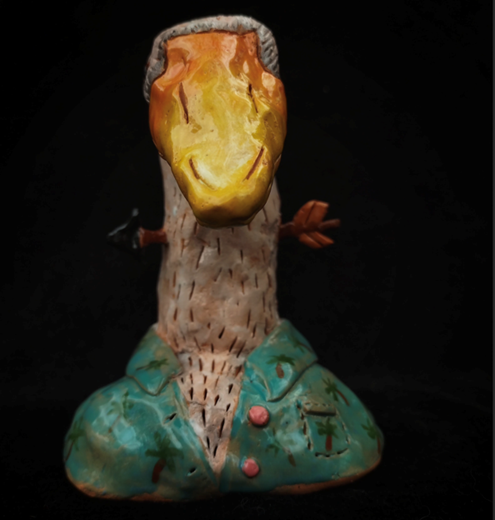
Tennyson Corley has been making art in Columbia for years, but in the past couple of years, a chance encounter with clay led to an exciting journey rife with whimsical characters. Her current Tiny Gallery show features a snack-hoarding hoodie-wearing raccoon, a photography-loving frog in stripes and a young opossum boy playing a dead cowboy. 

A few years ago, when Corley signed her son up for a homeschool clay class at the Columbia Art Center, friend, and artist Bohumila Augustinova convinced Corley to take her own beginner wheel throwing class—and she did—eventually having her own wheel at the center. 

“By the end, I didn't want to stop so I put my name on a very...very long waiting list and a year later I was playing in the mud again. Cut to 2022, I had just completed a mural for The Audubon Society at Folly Beach and that felt like a completion to my painting journey,” Corley shares, “I began experimenting with sculpting creatures and I gave them little stories. Like a golem, or something, they needed a story to bring them to life.”  

Though her 2D art may not always have made this evident, Corley has “always been drawn to the illustrative art of children's books, and even deeper, descriptions of folkloric creatures and mythology,” made even more evident by her penning of companion stories.

“I never felt like those concepts fit easily into my 2D work. Clay opened a door for my true, weird essence to flow in some respect. I also have a dark sense of humor. I think giving my creatures certain traits acts upon a social commentary of society,” Corley intimates, “Like, is it ok to act like this just because they are cute? Or this one is quite different, but hey, they're just like me! Can we look past appearances and accept what is below the surface. I enjoy coming at it in a playful way.” 

The process for making these creatures is always different. Corley jokes that her mind is always running to the point she wishes she could shut it off. She may start with a specific animal and then create a story around it, or she may have a story in her mind that needs a creature. Something as simple as a song lyric or a quote may “ignite a spark that becomes a flame that [she] can't damper until it is out of the kiln.”  

Though all art has a story, Corley’s pieces have full narratives pulled right from her imagination that describe the identities, characteristics, and backgrounds of the characters. While everyone, including her, tended to ask, “what is this painting about,” she wanted the characters to speak for themselves. 

“I wanted to open the introductory door, so-to-say, for the viewer, the patron, to be able to compile upon the story. I also like the idea of making them more like a quick read children's story for adults. And maybe hope that if a child reads them, they wouldn't get the dark bits,” Corley details, “It's also fun to see people at events linger over the sculpture and their stories and even strike up conversations with complete strangers.”  

In this show, Lulu Leatherhead, Otis the Opossum, Snack-coon, and Artemis are Corley’s current favorites—but her decision always fluctuates: “It is actually really hard for me to pick a favorite. I spend so much time with each piece. From idea, to construction, to glazing, and story. I feel like they are all my weirdo children. I know them, and then I have to see them off to collectors.” 

Corley’s creations have been catching eyes even beyond Cola lately. She was recently published in San Antonio’s Pepper Magazine and asked to be an Arts Contributor. Each magazine will feature one of her ceramic illustrations (sculptures) along with its story as an evolved/revolutionized comic strip.  

You can find her works on Jasper’s Tiny Gallery until May 31st and continue to follow her on her Instagram @tennyson_corley_art. Corley is currently planning a small workshop with the Columbia Art Center for the fall to introduce people to her process.

Dr. Baker Rogers Opens South Carolina’s Only Queer Independent Bookstore

Cola book lovers are still buzzing with excitement from the opening of All Good Books, and soon there will be an additional space to explore that offers not just a unique literary environment, but a safe space curated with queer people in mind: Queer Haven Books. 

Baker Rogers, MSW, PhD has recently founded what is presently South Carolina’s only queer independent bookstore. The store just opened online, and Rogers is fundraising to get a brick-and-mortar location on Main Street. 

As a queer person themselves—and with a masters in social work, a doctorate in sociology, and a position as Director of Arts in Social Science at Georgia South University—Rogers is deeply familiar with the experiences of LGBTQIA+ individuals and how various histories and situations impact them.  

When Rogers lived in South Carolina previously, they knew there needed to be a safe space for queer people—a place where their community could be seen and see each other. Their first dream was to open a gay bar, but as they grew older, left South Carolina, and came back, Rogers realized what the city truly needed. 

In Rogers’ time in academia, they have published a plethora of work in gender and sexuality in the US South with titles under their belt such as Conditionally Accepted: Christians’ Perspectives on Sexuality and Gay and Lesbian Civil Rights and King of Hearts: Drag Kings in the American South. With their work in literary texts, Rogers’ vision for Columbia crystallized: we needed a bookstore

For them, a queer bookstore is the perfect intersection of education and community. Beyond having stock rife with queer texts—which is thus a space where queerness is the norm—Rogers plans to host a plethora of events, such as queer book club, queer-centered recovery groups, and classes on sex positivity.

 As they work on this goal, they are continuing to expand their selection. Every book currently stocked in their online store is written by and/or either portrays the narrative of a queer individual or in some way addresses the experience of being queer. Queer Haven has sections for nonfiction, local authors, and children’s literature. They also sell a handful of gifts, such as keychains and cards.  

Presently, Rogers is running the store out of their home—getting books from online bulk retailers and distributors and storing them in their house. Fortunately, the investment is already showing promise: Rogers shares that they have already begun to sell books online and at some of the events the bookstore has been present at, like NoMa Flea. 

Unfortunately, Rogers and Queer Haven have received their share of pushback and negative feedback—particularly on social media and Facebook. However, Rogers is undeterred and asserts that this is only more proof that this space is necessary. The majority of feedback, though, has been positive, and Rogers intimates that they have received a good amount of support from locals. 

Rogers has already met with All Good Books, and they are working in tandem with each other. All Good Books has a queer section in their store and can offer Queer Haven as a path for patrons interested in diving into those texts even deeper, while Queer Haven can direct patrons to All Good Books for various reading needs. 

For the bookstore to take off and really begin supplying the area with queer space and queer literature, though, they need a physical place, and for that, they need financial support. Rogers has started a Kickstarter that ends on June 8. If they can raise $50,000 by then, the bookstore should open physically by the end of 2023. 

If you can’t donate but want to support, you can browse their website, which houses their current stock and holds an Event Calendar with all upcoming places you can find them. They are also currently hosting a Logo Content for any interested artists.

Rogers named this place a haven because that’s what it will be. It will be a safe space, set apart from the harmful spaces queer individuals have to navigate in their daily life, especially in the South. Among current harmful political climates, it will serve as a refuge but also as an informative, educational space for both LGBTQIA+ individuals and allies. 

As Rogers emphasizes, “This is a place Columbia needs, now more than ever, to provide education on the queer experience and to give queer people in South Carolina a place to go.”