From the print issue: The Runout – Creating Music and Community In Different Ways By Kevin Oliver

There’s a moment on the new album from The Runout, Just As Real, that may sum up the past four years of the band’s existence. On “Light a Fire,” Jeff Gregory sings, “Do you think we could light a fire and stand around until we feel better? I’ll leave it to you now.” They lit a fire back in 2021 with their last full-length record, With Your Eyes Closed, and while they haven’t exactly been standing around, the band has spent the better part of the interim exploring what it means to make music together, and separately, and where they fit in the context of the greater community. 

“There was writing all along, and intention,” says Gregory, the band’s principal songwriter, singer, and guitarist. “The whole while, I was making music, and getting pissed off about making music, like we all do. There were some of these songs that we played live for a couple of years or more, too. And then it got to a point where it was just that we needed to record, that I was dragging my heels, it felt like.” 

Outside of some infrequent singles put online, the first project to see release over the summer was Hidden Variable, a short EP of songs featuring the acoustic duo version of the group, just Gregory and his wife Kelley B. Gregory, who provides crucial, sound-defining harmony vocals. Her presence softens Jeff’s sometimes stark, percussive style in ways that are hard to describe without hearing them together, as the voices intertwine in ways that only true intimacy and connection can muster. The duo arrangements really bring out the pair’s influences, with “When” evoking classic Simon and Garfunkel harmonies, and “The Millstone” possessing the plainspoken profundity of Dawes. It’s also an indicator of the upward progression of Gregory’s songwriting, which stands tall even in the unflinchingly exposed acoustic format. Take these opening lines from “The Millstone”: 

i'm grateful for the grain

even Tuesday mornings never felt the same without the pain

i can picture raindrops falling on the blades of green

now the oats roll in my hands above this screen

like we rolled out in the fields in younger days

 In one verse he’s expressed gratitude, a work ethic, and nostalgia for a more innocent time; the song goes on to describe, in the words of the introduction on the album’s Bandcamp page, “that blue collar urge to just survive and be a fucking good person in the modern era of perverse capitalism.” It’s a delicate balancing act, but one that Gregory has seemingly mastered. 
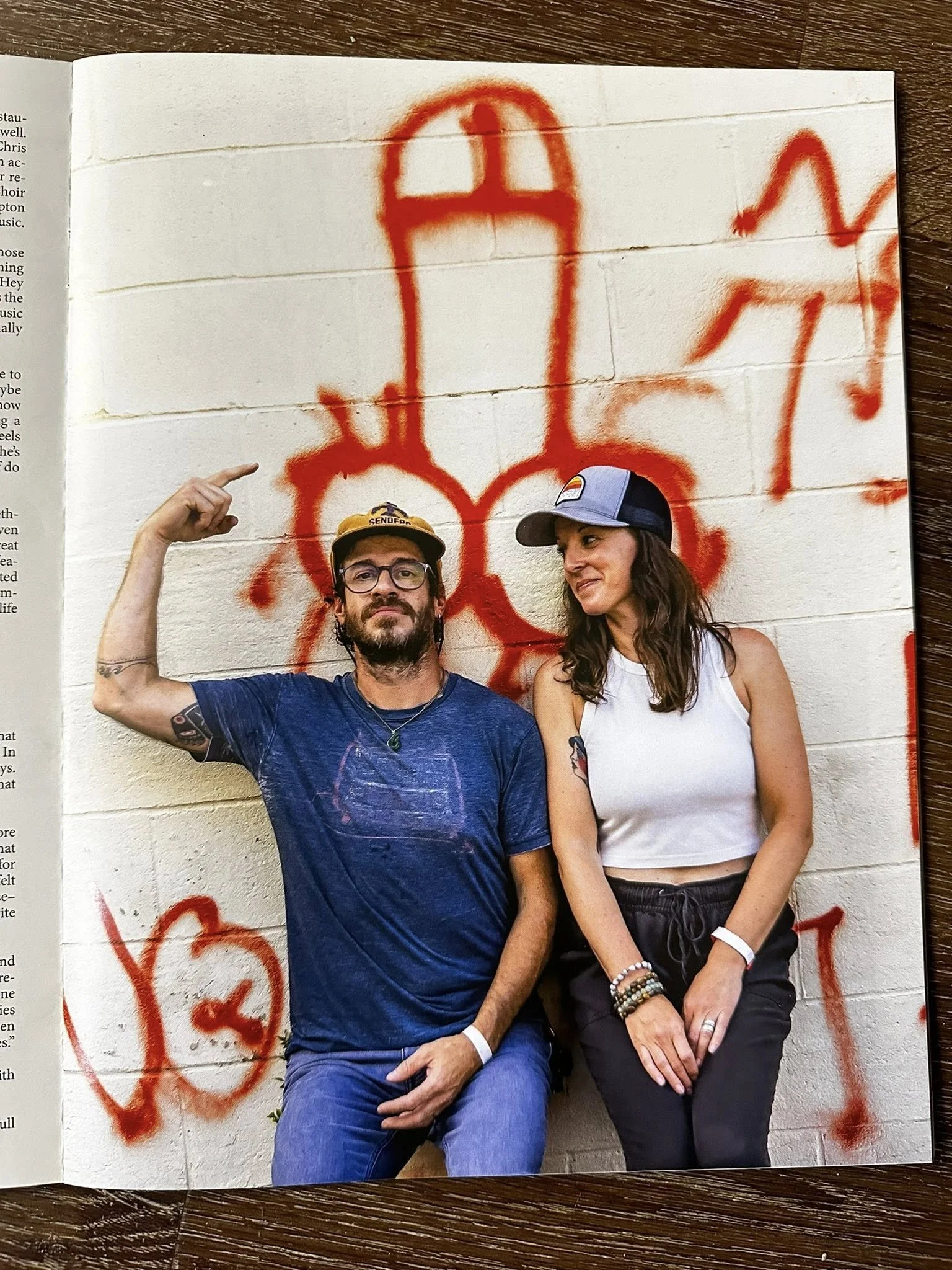
Working this time around with producer and fellow musician Todd Mathis on the full band recordings, the parts were done in some different ways, Gregory says.

“My guitar parts and Kelley’s vocals were done in our kitchen on both the duo EP and the full band songs,” He says. “The EP was put out as-is, just us. For the band songs we shipped everything over to Todd, who put all the pieces together in his studio.” 

Perhaps the biggest change in the way things were being done in recent years was the addition of the Runout Duo, putting Jeff and Kelley in places the band had never gone, and exposing them, their sound, and their original music to more and more audiences. 

“The organic thing that has happened really slowly, but really surely with this is that we’re seeing people who are coming to a duo show at Columbia Craft, for example, and the next full band show they’re also showing up to see us as a full band.” The two feed off each other, in Gregory’s opinion.  

“When we started doing the duo three years ago, I cut back to a two day a week job, from full time, so we could schedule more shows,” He says. “I’ve worried less about having a digital presence, playing the algorithm game, and building a huge social media crowd, and leaned more into the shows, the live music side of things.” 

Gregory feels it has paid off in a more connected, loyal audience. “I’m finding that people are showing up, buying the shirts, wanting to have a physical CD or to be able to listen to the songs they hear us play,” He says. “It’s not hundreds of people–but it’s 45, or 50 people, that keep showing up.” 

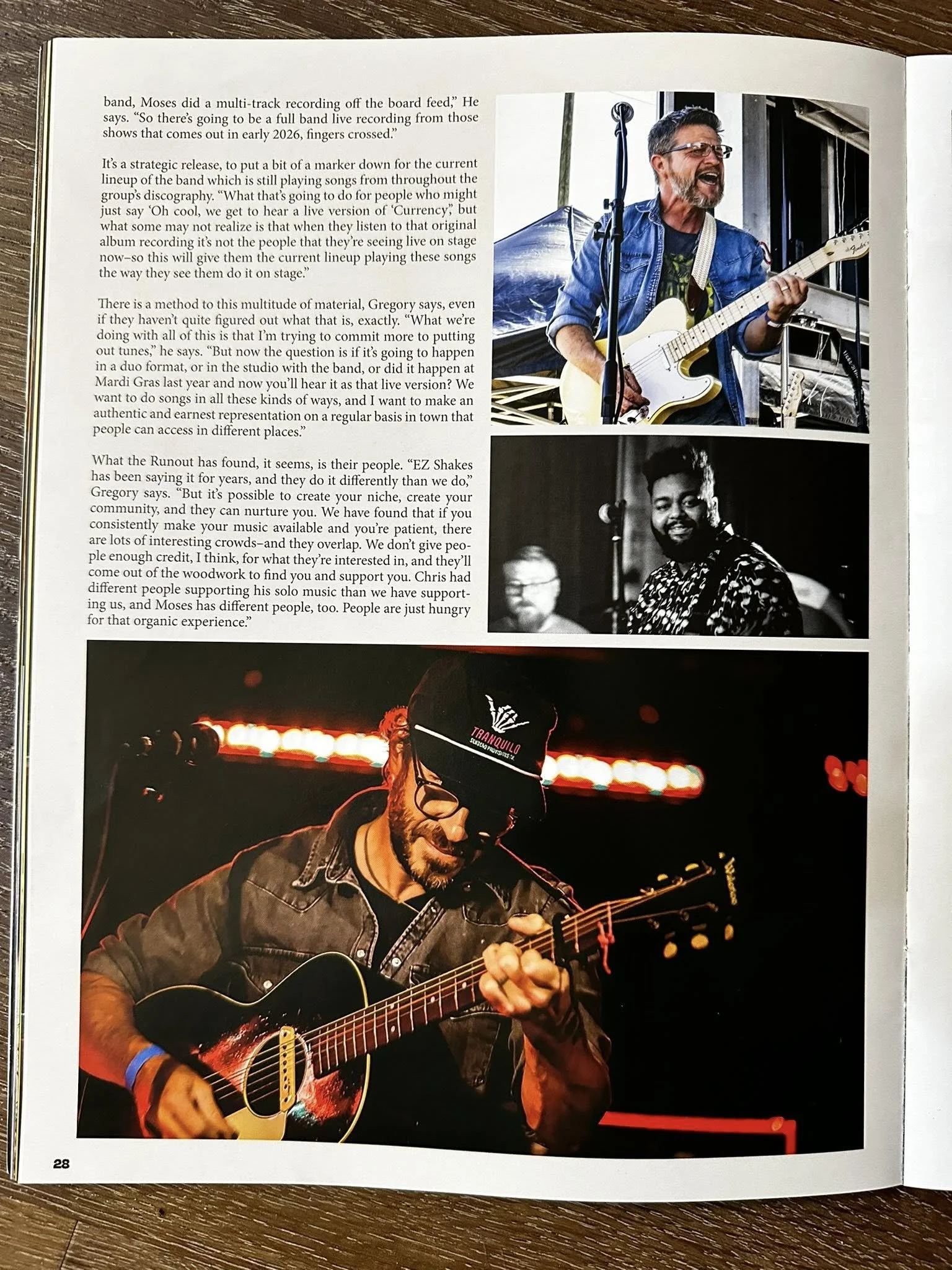
Those duo show experiences, playing covers for the bar and restaurant crowds alongside the original music, have fed the band as well. With Moses Andrews on bass, Mike Scarboro on drums, and Chris Compton on lead guitar, those other band members have been active outside of the Runout as well, with Andrews in particular releasing solo albums and playing in Patrick Davis’s Midnight Choir band, Scarboro playing drums with a host of others, and Compton has a long discography of his own excellent songwriting and music. 

“We’re all creative individuals,” Andrews says. “You bring all those other experiences back here and now you’re at rehearsal jamming on a cover that Jeff and Kelley have been doing as a duo and ‘Hey let’s see what it sounds like with the whole band,’ and that grows the sound of the band that way. It’s also a function of how the music community in Columbia makes it easy, whether it’s professionally branching out, or just creative opportunities.” 

“We try to have the culture of a family,” Scarboro says. “We like to set up practices with food, have a hangout session, and then maybe try to play some music. When you know each other so well, know each other’s personalities, you’re more comfortable delivering a new line, or an opinion or a thought on a song–So everybody feels like they can toss something out and see what Jeff says, and he’s really good about leaving a lot of openness for us to just kind of do our thing.” 
Those close personal connections and years of playing both together and apart lend the band’s songs an easygoing familiarity, even if they’re new like the latest release. “Me and the Lord” is a great example, and one of the most fully fleshed out arrangements featuring the whole band. Over a rollicking organ and piano accented tune that’s straight out of the Leon Russell school of 1970s ensemble rock, Gregory declaims a non-materialistic way of living life and practicing one’s spiritual faith.


 “and I ain't got money much

it gets between me and the lord

that may sound funny but

there ain't that much I can't afford”


“There seems to be a way that we do things, and I don’t know what culture this comes from–is it church culture? Nashville culture? In terms of music with formal stuff like lead sheets,” Gregory says. “Sometimes it just happens, sometimes songs are more format based and we can work them out like that.”   

Then there are the ones that are more difficult, requiring more work. “Sometimes songs take a long time; ‘Currency’ was one that I wrote three times thinking that the guitar lick was going to be for something else,” Gregory says. “Then finally some other words felt better with it, and it settled, and never turned into anything else–and that was over the course of years. But then, some songs I write in five minutes.”  

One result of the recent recording sessions is that they have found some things that really work well for them, Gregory says. “We realized that we really enjoy recording our vocals live, around one microphone, to get the harmony,” he says. “Because our harmonies lock differently in the timing if we try to record separately and then blend it in later. So it has just been moving us forward, on all sides.” 

There’s even more movement in the works, Gregory says, with more releases planned out.

“All of the live shows that we did this past spring that were full band, Moses did a multi-track recording off the board feed,” He says. “So there’s going to be a full band live recording from those shows that comes out in early 2026, fingers crossed.”


It’s a strategic release, to put a bit of a marker down for the current lineup of the band which is still playing songs from throughout the group’s discography. “What that’s going to do for people who might just say ‘Oh cool, we get to hear a live version of ‘Currency’,’ but what some may not realize is that when they listen to that original album recording it’s not the people that they’re seeing live on stage now–so this will give them the current lineup playing these songs the way they see them do it on stage.” 

There is a method to this multitude of material, Gregory says, even if they haven’t quite figured out what that is, exactly. “What we’re doing with all of this is that I’m trying to commit more to putting out tunes,” he says. “But now the question is if it’s going to happen in a duo format, or in the studio with the band, or did it happen at Mardi Gras last year and now you’ll hear it as that live version? We want to do songs in all these kinds of ways, and I want to make an authentic and earnest representation on a regular basis in town that people can access in different places.”

 What the Runout has found, it seems, is their people. “EZ Shakes has been saying it for years, and they do it differently than we do,” Gregory says. “But it’s possible to create your niche, create your community, and they can nurture you. We have found that if you consistently make your music available and you’re patient, there are lots of interesting crowds–and they overlap. We don’t give people enough credit, I think, for what they’re interested in, and they’ll come out of the woodwork to find you and support you. Chris had different people supporting his solo music than we have supporting us, and Moses has different people, too. People are just hungry for that organic experience.” 

Jasper Magazine photos by Perry McLeod
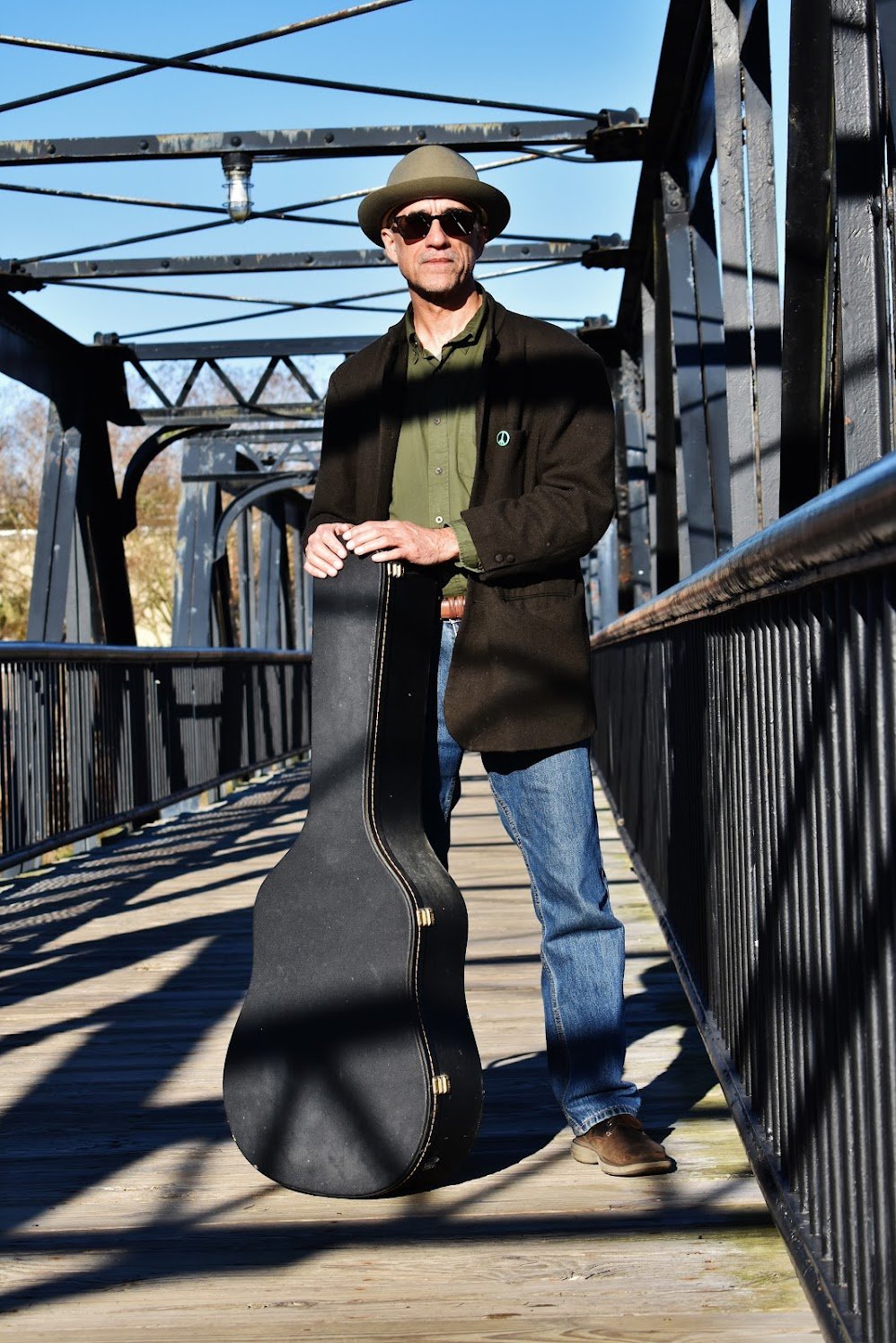
Don’t miss your next chance to see, hear, & enjoy

The Runout

Dec 20th at Greener Pastures Brewing 6-9p

Camden, SC


THE BEAT: Both Sides Now Lang Owen explores stories and sounds on his new album "She’s My Memory"

By Kevin Oliver

Columbia singer-songwriter Lang Owen’s new album She’s My Memory is a relationships album, but not in the classic boy-meets-girl pop music mold. Rather, the sixty-something Owen has collected what amounts to a lifetime of thoughts here on friendships of all kinds, from romantic partners new and old to co-workers and the people we see on TV screens and newspaper bylines. In putting the album together, he also relied on musical relationships built over the past five years since he emerged onto the local scene. 


Owen enlisted fellow songwriter and guitarist Todd Mathis as his producer, with a diverse cast of additional players on board and additional recording and mastering from Carl Burnitz. The result is a shimmering statement of purpose, a beautifully rendered collection of songs that tell stories in a way that captures the heart and the imagination. Musical touchstones from James Taylor to Joni Mitchell, Emmylou Harris, Todd Rundgren, and more reveal themselves upon repeated listens, but Owen has firmly established his own sound and style with this new album.


There are stories both told and implied here, from the simple work ethic of “Man With A Broom,” to the internal evaluation of “Where Does The River Start?” Of the latter, Owen says, “On the surface the narrator is dealing with a breakup, but in my mind, he’s questioning himself–how did I get to this point, where am I going from here, and especially, how have I made some of the choices I did along the way?” 


Some of the choices Owen made in recording these songs included expanding his musical palette well beyond just himself, with the assistance of producer Todd Mathis. It was all in the preparation, Owen says.

“We sat down with scratch tracks of the songs I recorded on my own and brainstormed what kind of instrumentation would work with each,” He recalls. Guest musicians who ended up participating include drummer Mike Scarboro (The Runout), guitarist Zach Bingham, and backing vocals from Becca Smith of Admiral Radio. Bass duties were split between Chris Paget, Jeff Gregory (The Runout), Mathis’ former bandmate Kevin Kimbrell, and Mathis himself, who also filled multiple other instrumental roles. 


Being in a “band” situation isn’t exactly a new thing for Owen, though it had been a while, he admits.


“I played in bands in the 1980s, and I enjoyed playing with other people,” He says. “When I picked music back up in 2017(after decades as a teacher, visual artist, and social worker), I played by myself mostly because I just didn’t know any other musicians.” 


There are story songs here that those who have followed Owen’s solo acoustic shows the past few years will recognize as falling directly in his usual style, such as the topical “Last Gasp Of The News.” This time around there are also songs where the sound falls more toward the “band” side of things, with a particular vibe that a simple acoustic guitar arrangement wouldn’t be able to achieve as vividly.


“Collection Day” is one such tune, with an unhurried, yet rhythmic indie rock feel not too far from bands such as Yo La Tengo. “Smile From You” leans on Owen’s strummed guitar, but the other elements contribute to the song’s unsettled, foreboding atmosphere of an uncomfortable snapshot in time.

“We spent a lot of time on working out that one,” Owen says. “It went through a lot of different variations to get where it did–any time you work with great musicians, they’ll come up with great ideas.” 


Even with the expanded arrangements and feel of the recording sessions, Owen’s flair for narrative shines through. The title track “She’s My Memory” is a story song about telling stories, where a comment from a co-worker about remembering his life better than he does prompted a story of a person losing their memory who is still able to remember it through his wife’s anecdotes.


“I think that song sets the tone for the album,” Owen concludes, “which in part is about the importance of relationships to our well-being.” 


In “Everybody Here” the opening lines, in their own way, reach that same conclusion–we all help each other, whether we realize it or not: 


“Everybody here’s my therapist

I need all the help I can get

I look around, I’m losing my ground

I don’t like what I see one bit

I float by like a whisper, you hand me a megaphone

In our own little worlds somehow, we’re not alone

We’re not alone”


Lang Owen releases “She’s My Memory” officially on all platforms June 17th. The release show, featuring a full backing band of many of the players on the album, happens at Curiosity Coffee on Saturday, June 18th, from 5-8 p.m. $10 


Facebook Event with ticket link

Kevin Oliver's THE BEAT: Caught Up In a Feeling--The Runout and Jeff Gregory Build Community Around Music

“We discovered that we like eating, and we like drinking, and we like making music, preferably all at the same time,” - Jeff Gregory

For many people the ongoing pandemic has been a rollercoaster ride, but for Jeff Gregory and his band The Runout it was the catalyst for a creative community which birthed the band’s latest album With Your Eyes Closed. Early on, as artists found their footing online with live streaming to replace live in-person shows, Gregory and his wife Kelley hit upon a simple format of the two of them, a guitar and occasional piano, repeated on Wednesday nights, that resonated with them and a core group of friends and fans.  

“The pandemic really had us down, so Kelley and I found something to do to make ourselves happy and remember what singing together in high school was like,” Jeff Gregory says. 

The Runout was already a band with a couple recording sessions and a first album out, along with a number of live shows featuring an evolving lineup that currently includes Mike Scarboro on drums, Moses Andrews on bass guitar, keyboards, and organ, and Chris Compton on electric guitar alongside Jeff and Kelley Gregory. But as the pandemic dragged on and Gregory took some soul-searching, nonmusical personal time, the community drew him back in, he says.

“Thank God for Chris Compton, Patrick Leitner, Lang Owen, all of those guys asked me to get involved on their projects, just a song here and there,” Gregory says. “It spurred me on to wanting to do music again myself.” 

The community that gathered around the Gregorys shared one crucial thing, and, surprisingly, it wasn’t music–it was food. 

“We discovered that we like eating, and we like drinking, and we like making music, preferably all at the same time,” Gregory says. “It sounds silly, but a lesson we’ve learned is that when you have friendship, and good vibes, then you can have some creativity and exploration in what you’re doing.” 

The musical result of this camaraderie was The Runout’s latest album With Your Eyes Closed. The record pulls together the intimate feeling of those livestream nights with an expanded lineup that allows for full band arrangements. The tracks progress through deceptively feel-good anthems such as the bouncy Americana-esque opener, “Feelings,” and more raucous, rocking rave-ups like “Coffee and Weed.” Gregory also delves into deeper territory on tracks like the ethereal “Crooked Canyon,” a metaphorical journey to the center of one’s psyche that’s equal parts terrifying and glorious in its imagery.  

Gregory has that rarest of qualities–the ability to turn a clever phrase, but also imbue its delivery with raw, honest emotion that connects on a deeper level than the average pop song. The centerpiece of the album is “Give Up,” an irresistible tune that began life on those now long-ago livestreams with just Jeff and Kelly harmonizing to an acoustic guitar. The album version adds shimmering electric guitar to the natural connection their voices make on lyrics that anyone in a long-term  relationship can relate to: “I’ve been wanting to give up, I’ve been thinking it through…it seems I need a few more hours down this road with you.”  

Those few more hours have become months now, in pandemic times. In lieu of a club gig for the album release, The Runout staged a mini-festival they dubbed “Stump Fire Fest at a friend’s property. They invited a hundred of their fans and friends to come celebrate outdoors with them, a culmination of the community that had sustained the band to that point.

“We’re thankful for that community,” Gregory says now. “We weren’t really aware of it until that night–I think it was the result of the pandemic filtering out everything that didn’t matter, and the music was what was left.” 

The Stump Fire Fest may have set an unrepeatable precedent; in addition to the Runout, several other bands played on a small stage built just for the night, poet Al Black read between sets, and Dick Moons and his drum circle formed up around a nearby campfire as participants ate, drank, and moved between the different moving parts of the evening.  

“It really crossed scenes and generations,” Gregory says of the festival. “It wrapped up what had been a really meaningful time of making the record, too–Hanging out with Chris Compton, Sean Thomson, Patrick Leitner, Moses Andrews, that meant more to me than I realized at the time.” 

It’s the mentality of helping others, Gregory concludes, that has to survive the pandemic.

“People are wondering what’s going on in the world right now, and the answer is that nobody knows,” He says, “So what must our response be? It has to be art.”