Welcome to the second article in our series on the Koger Center Project’s Winning Artists. You can get the background on this series in yesterday’s article on Kate Timbes, and learn more about the project and the other winners from an earlier Jasper Online post. Today we’re featuring Colleen Cannon-Karlos and sharing the article by Emily Moffitt that appears in the spring issue of Jasper Magazine!
~~~
Colleen Cannon-Karlos:
Left Brain, Right Brain – One Artist
By Emily Moffitt
Photography by Perry McLeod
The intersection of art and science is sometimes explored only in name, particularly in academic settings. However, for Colleen Cannon-Karlos, the two fields are inextricably intertwined both in her art and her personhood.
Cannon-Karlos' upbringing took her across the country to both coasts—born in Los Angeles to native New Yorker parents, she ended up moving to New York after her parents divorced. During her school years, she excelled in all subjects, participating in gifted student programs and having a strong handle on both sides of her brain. The left brain seemed to dictate her path slightly more as she had not considered being an artist when she was younger. She still enjoyed creative endeavors, however. According to Cannon-Karlos, “I never had a formal art class growing up in school, and the gifted programs in the Bronx that I participated in had music as the cultural enrichment.” This did not stop Cannon-Karlos from pursuing artistic hobbies at home as her mother taught her how to knit, sew, and crochet. At home, she made her own art projects that combined her budding fiber arts skills with recycled materials like popsicle sticks and old fabrics. This resourcefulness has resurfaced years later in the Cannon-Karlos work we see today.
Even as the designated artist of the family, Cannon-Karlos still initially enrolled in schooling oriented toward a career in math or science. “I went to the Bronx High School of Science and had an affinity for math and physics,” says Cannon-Karlos. “There was a drafting class available if anyone wanted to be an architect or engineer, … I absolutely loved taking it. The precision, tools, and learning how to transfer schematic drawings into three-dimensions—I use these skills in my work today all the time.”
Precision is the key to much of Cannon-Karlos' artistic practices today. She developed these tools even further when she studied at Stanford University and worked in the physics lab. Her curriculum was strenuous and extremely scientific, but she always had art in the back of her mind. While in college at Stanford, the artist’s aunt asked her to make some art for her. This became an “a-ha” moment for Cannon-Karlos, whose time spent in the lab, identifying subatomic particles of smashed atoms, did not leave much time for creative hobbies. “I rediscovered my love for making stuff, using materials as simple as magic markers,” she remembers. It was time for her to find her path not only as someone with a knack for science, but also as an artist.
Cannon-Karlos decided to take a gap year from her Stanford studies and moved back to New York City to, hopefully, establish a career as an artist. She spent her days teaching herself how to paint, exploring museums and creative communities, and communing with playwrights, artists, and musicians. “This was during the 70s, so a lot of the community’s creative endeavors coalesced with different sociopolitical movements of the era,” Cannon-Karlos says. “There was this explosion of creative, dynamic energy that was so immersive and different from today.”
Working on her art career paid off early as she had her first gallery representation when she was 19-years-old. She began dabbling in photography and even convinced the staff photographer at the Studio Museum of Harlem to let her work with him in the darkroom. After spending the year building her portfolios in a variety of media, drawing, painting, and photography, she went back to Stanford and switched her major from sociology to art with a concentration in photography.
She flourished in the field while also continuing to experiment with other media. The inquisitive Cannon-Karlos always had a knack for trying and learning something new and says that “some artists do the same thing for decades, but it is my nature to explore.” In her twenties, she began to bring back her fiber arts skills to simultaneously turn a profit and make some serious work; she was introduced to fabric design by her former husband, a fellow artist. She began to sell her handmade fabrics and clothing in flea markets, then boutiques and stores in New York. Eventually, Cannon-Karlos took the lessons she had learned practicing her art and began to apply them to something new: academia.
Throughout her career, Cannon-Karlos has instructed students of all ages, from elementary school through college. Since her methods of problem-solving combine both artistic and scientific approaches, she uses this thought process to her advantage in the classroom. She teaches her students that they may have analytic tools but they still need to be able to think outside the box.
The artist has also created curricula based around projects in which students can learn scientific concepts by making art. In Durham, NC, for example, she worked with the local art council and taught classes to elementary schoolers in which they studied ocean science through technical concepts but also had opportunities to create sculptures like jellyfish and tube worms with plastic bags, paper tubes, and other recycled materials that can, unfortunately, easily be found in oceans and bodies of water.
While she lived in Hawaii, she created curricula that truly captured the intersection of her interests. “I was finally able to make a proposal for an Art, Science, and Technology Class that collaborated with the marine science department,” says Cannon-Karlos. “We had a mix of art and science majors in the class, and we were allowed to use lab equipment, including their scanning electron microscopes. This allowed us to see the intricacies of the designs of a particular specimen at a microscopic level and beyond.” The designs found on the plates were only black and white, so the students would then learn how to use Photoshop to add color to their discoveries. While this was an art project in essence, Cannon-Karlos made sure that all students flexed both sides of their brains and wrote explanations of each step of their project, including why they dissected the image in a particular way, how they manipulated the image, and what they learned from the experience. The science-minded students loved the opportunity to express their inner creativity, and the arts students jumped at the opportunity to exhibit their talents on an academic level.
Thess lessons were among the many ways that Cannon-Karlos exhibited her proficiency in seeing things beyond the material plane and comprehending, on a deeper level, the use of an object or material for something completely different. Using recycled materials for creating artwork started in her childhood, and it has manifested contemporaneously as her preferred medium.
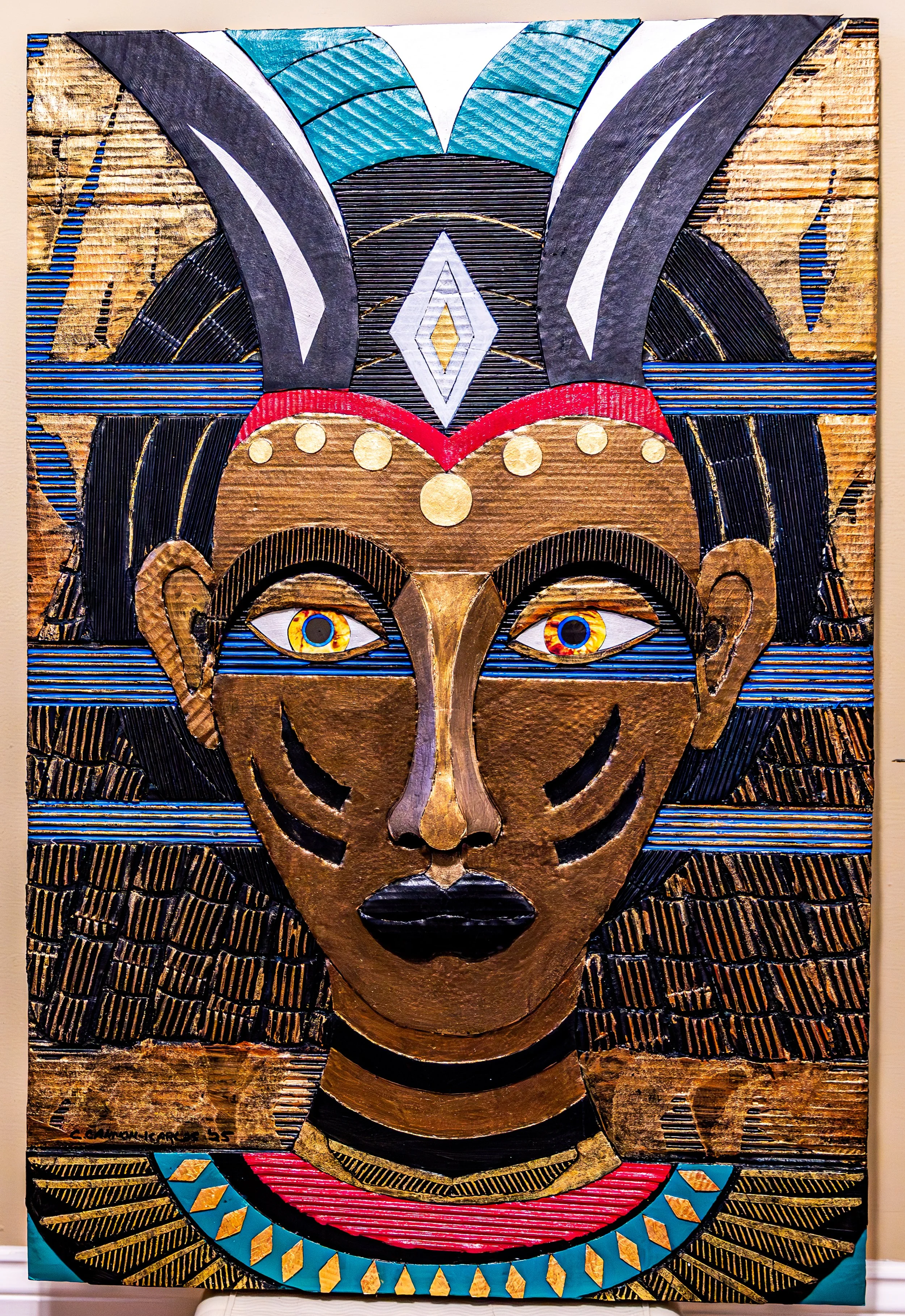
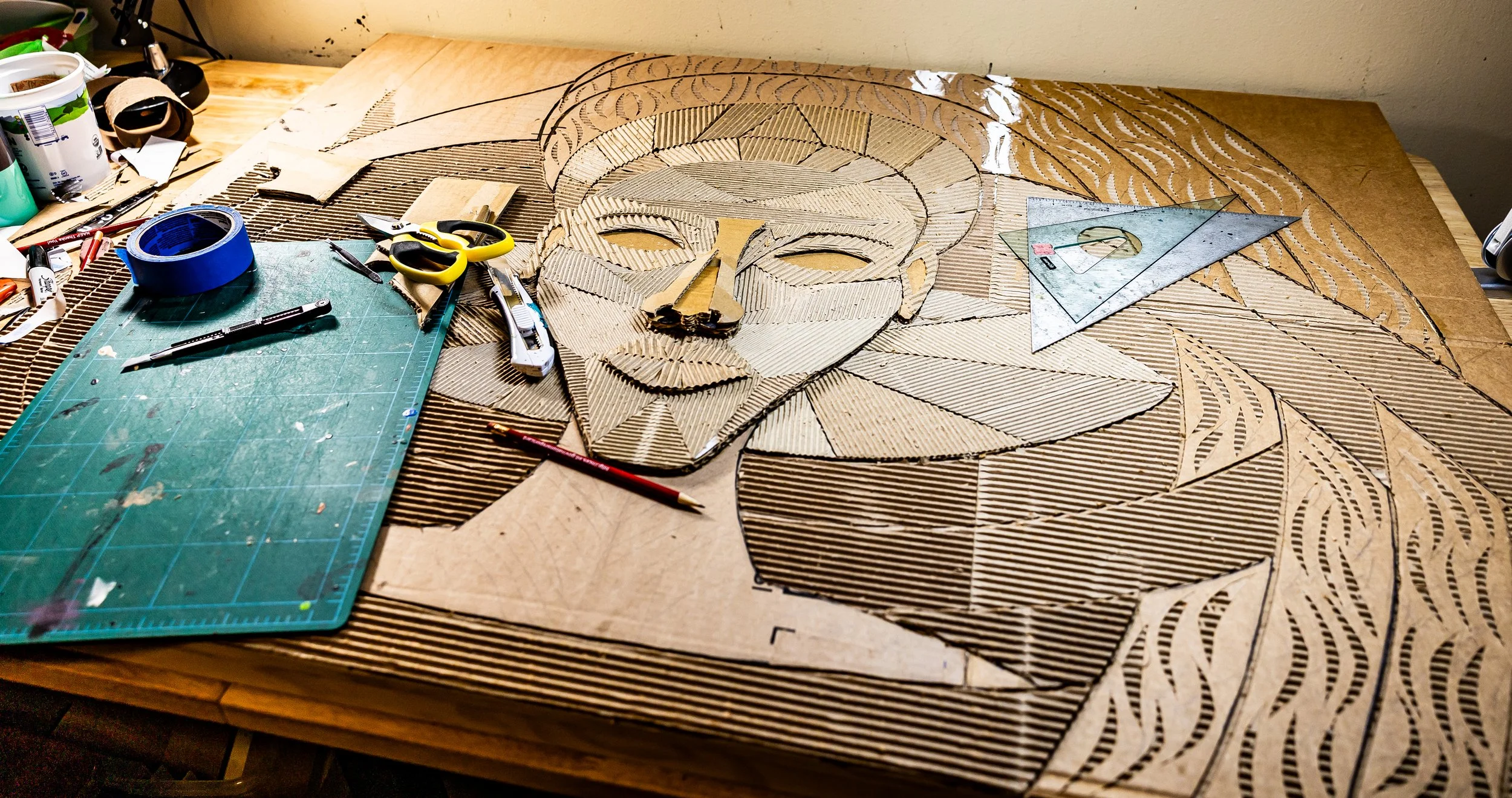
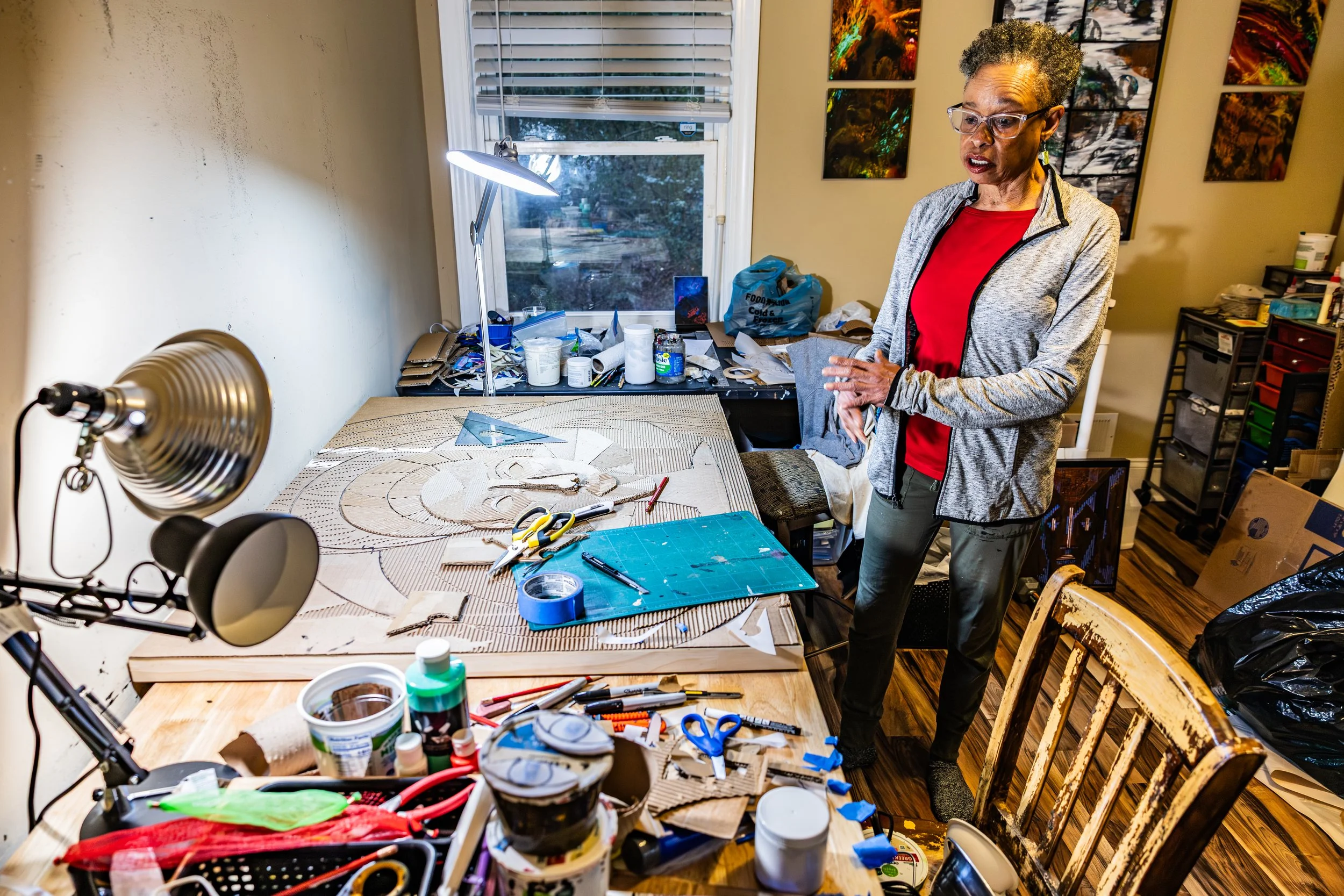
Piles of cardboard boxes inevitably piled up across Cannon-Karlos' cross-country moves. After collecting so many, but not wanting to throw them in the waste, she decided to express her resourcefulness by stripping, cutting, and tearing the boxes apart. “Being a science aficionado, I like to experiment with my materials and am always in that mindset of play,” says Cannon-Karlos. “I realized I could make some imagery with these strips.”
Cannon-Karlos had started to experiment with cardboard in 2019, but it was not until after the pandemic and a final move to Columbia that she seriously started to create with it. The cardboard allows Cannon-Karlos to work as a scientist again, finding ways to challenge herself and test new hypotheses regarding how she can use the cardboard and adapt the surface to do different things. One such test of skill was born out of observing sweetgrass basket weaving. “When I saw the weavers … I asked myself if I could simulate the weaving process with the corrugated cardboard.” This process also made Cannon-Karlos reflect on the resourcefulness of African artists, especially with recycled materials of their own. Her work is a constant conversation between culture and science, always looking to explore what that conversation could look like on a surface with one of the most accessible materials available. “A lot of recycled materials are brought over and dumped into Africa,” notes Cannon-Karlos. “The artists are very resourceful; they can go to the dump and pull fabrics, electronics, and other trash then turn it into the most amazing work. I am very inspired by people who look at things differently and turn them into something new.”
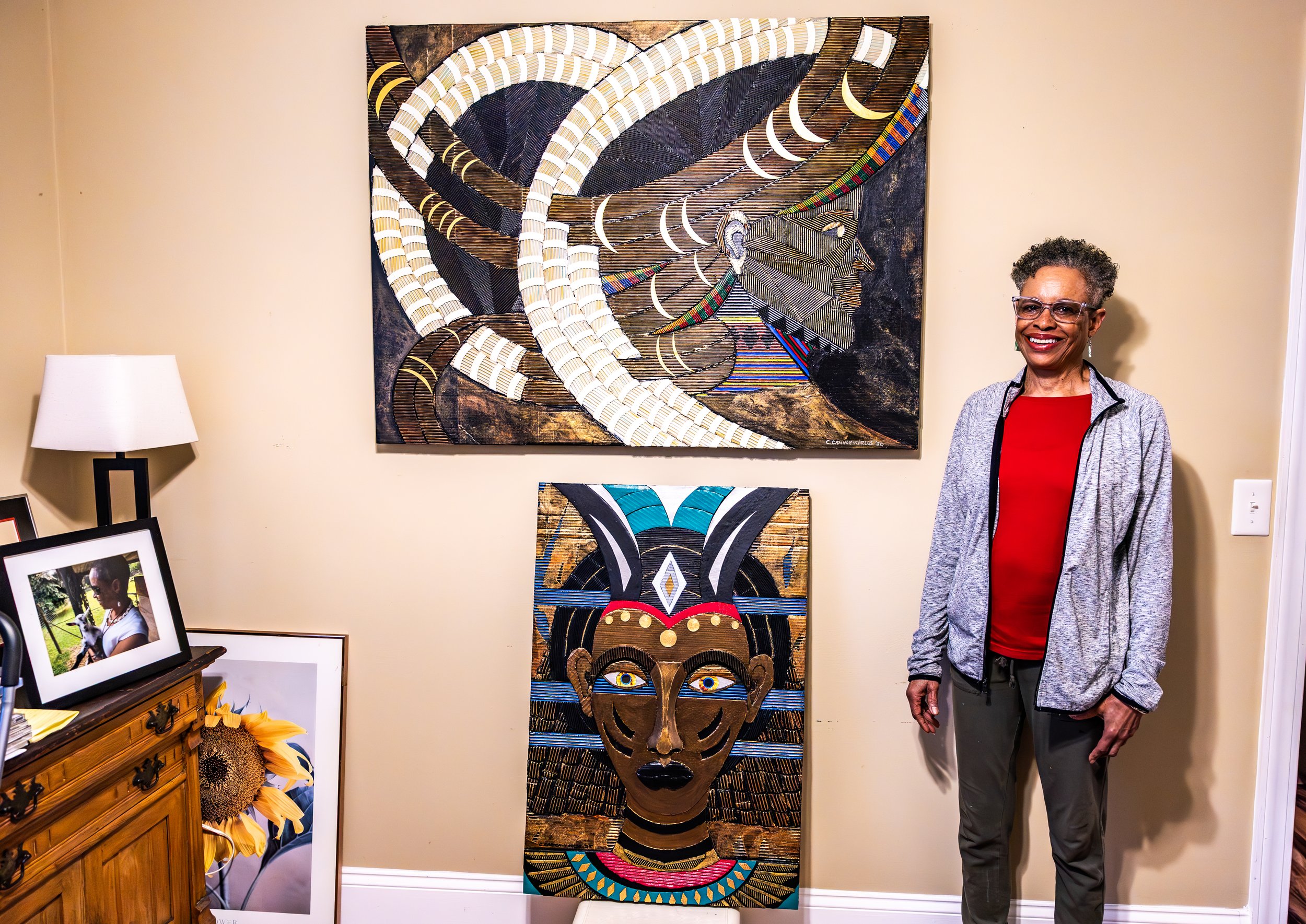
Like many other artists, Cannon-Karlos' career path did not follow a straight trajectory. The moves, twists, and turns provided great opportunities at each bend, but nothing necessarily consistent. “If I followed my trajectory out of grad school in the 90s, I may have become more prominent in the art world,” says Cannon-Karlos. “I have had to put my career aside working as a single parent. It is hard to be an artist when you are taking care of a family.” While working in Hawaii, she had first-hand experience with the exorbitant costs of shipping artwork, and the transience of teaching positions in higher education. Her trips across the country, while pursuing her dreams, created different bumps along the road. But when asked if she had the chance to do everything all over again, Cannon-Karlos admits that she may not change anything at all. Her life experiences and her way of approaching art, as both an academic and a creative, are what make her portfolios so alluring, with viewers waiting with anticipation to see what she’ll create next.