
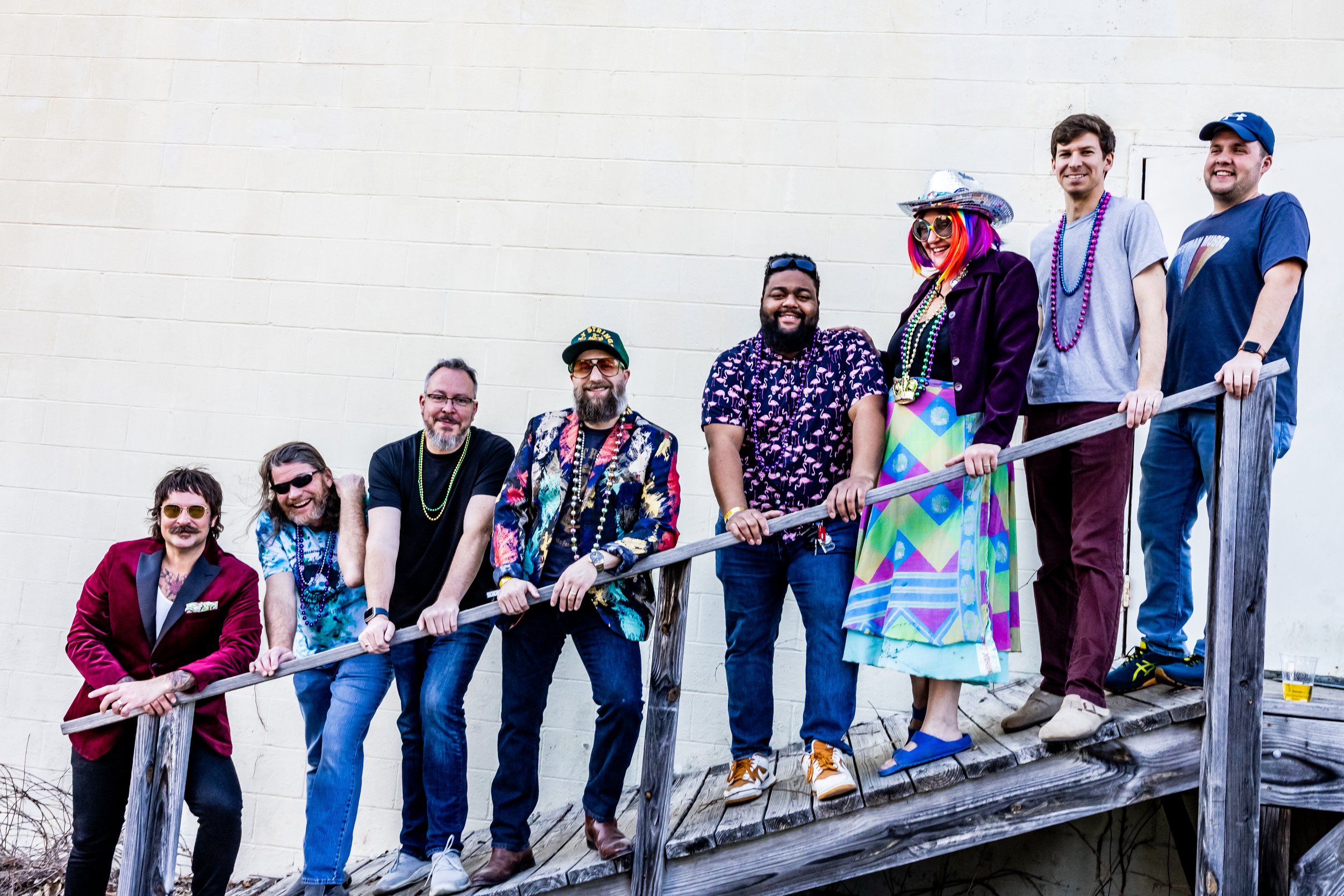
photo by Perry McLeod
In local clubs and at festivals like St Patrick’s Day and Mardi Gras, George Fetner is well known for his funky party band George Fetner and the Strays, or the improvisational rock ensemble TenMileRide. His background, and his day job, is a bit more serious, however. Fetner holds a Bachelor’s and Master’s in Music Composition from the University of South Carolina, as well as a Master of Science in Data and Communication. He’s currently working as the school’s director of Donor Experience, but he’s never stopped creating music. Summer of 2025 saw the release of EPOCH, an instrumental soundscape of tones and textures that couldn’t be more different from his rock band, but it does connect elsewhere in his artistic endeavors. Fetner recently fielded questions from Jasper about all of his various musical personas.
JASPER: You've now been playing with George Fetner and the Strays (GFATS) for almost a decade, how has that changed for you over the years--has it accomplished what you first envisioned musically?
GEORGE FETNER: It's always changing! Initially I wanted a two-guitar rock band with my friends. Then we added percussion, then horns, then keyboards, then did more vocal harmonizing, and more shows out of town. The influences and strengths of the band started guiding our live shows more and more, with the goal of having fun remaining a priority. Musically the band has blossomed. We're all much more confident in what GFATS is, in what works and what doesn't. I'm ok with doors that didn't open because others did that I wasn't expecting. When I look out from the stage, I see people who want us to deliver, and I take that responsibility seriously. Now, I'm almost 40, which is close to the median age of the band members. We all enjoy GFATS while also playing music outside of the band, and I'm thinking more about how to continue recording and performing graciously as we age.
J: You've added TenMileRide, a looser, smaller ensemble with a different sound--what does that group do for you that your other outlets may not?
GF: Have you ever seen the videos of skydivers joining hands and forming a circle while they're in the air? That's how playing in TenMileRide feels. I'm used to being a band leader in GFATS, but I don't do that much in TenMileRide. And every time we try to make a plan or follow a map, we lose the whole essence of in-the-moment playing. We've been trying it out in front of Grateful Dead fans and jam band fans but have picked up a lot of passionate fans who don't like the dead or the jam band sound. So, that's kind of a lesson in seeing where this ride takes us, too. I think people are deeply in need of real, shared experiences right now.
J: Epoch, your latest project, is very different; explain how that one came about and how it fits in the George Fetner musical universe?
GF: I wrote the piece as a sound installation in 2011, where people would wander into a room and be able to sit for a minute and experience it. But it didn't feel meaningful outside of that setting, so I put it away. I revived it last year to accompany a screening of silent home movies. It gave me an opportunity to experience it with fresh ears, a seasoned perspective, and the ability to fully support what it's trying to say. A big influence of mine, Pat Metheny, has a wide musical output in terms of style and ensemble. I've heard him talk about his career as "one long tune". I like that sentiment. What I release really is part of one larger statement. It's easier to see that after a few different albums, and very easy to see when I look back on all the music I've written. Epoch certainly fits into my electronic solar system with “Beneath the Ice” and other electronic media pieces I've written.
J: Your extensive compositional work has covered a lot of ground itself; and you graduated from the USC School of Music. How has that foundation helped you develop musically--the connections you have there?
GF: It's hard to answer this question without going on tangents of gratitude, because I owe my musical and professional development to many, many people at the School of Music. But these people are inspiring. To be around people you admire musically, intellectually, and professionally is rare. These people also taught me to remain curious, to push myself creatively, and to be efficient with my creative time. I'm a natural daydreamer, so that last one has been particularly helpful as I've gotten older.
J: What makes a good classical or instrumental composition, versus what makes a good rock song? Or are there crossover points that you've discovered after doing both?
GF: If the songwriter or composer's intent is clear through the work itself, it's as close to "good" as you're going to get. You should concern yourself with making your intent clear using all the musical tools you have. Then challenge yourself by listening to what the piece is trying to say or do and support that. At a certain point you realize you're a translator of sorts: it's your job to translate what already exists in the music of the spheres and deliver it to your friends. I think that goes with any creative work. It's real.
And if you're a participant, can you recognize a "good" work that you don't like? That doesn't move you? That's "taste" and it is constructed by every part of your history with music. If music moves you, what's the purpose of concerning yourself with what's "good"? It doesn't really matter. Music is language. Sometimes the message is simple and sometimes it's complex. There's nothing more important than the meaning you get from it, except of course sharing it.
The above article appeared in the fall 2025 print issue of Jasper Magazine.