Film - Revisited, Reviewed, Reflected: Lauren Wiggins and Discovering "But I'm a Cheerleader" in Small Town SC

jasper screens.png

It’s strange, but logical, that film has become such a large part of our lives during these pandemic days even for folks who don’t identify as cinephiles.

Stranger still is the recognition that, as hungry as we are for film art, a lot of what we’re getting from the plethora of studios producing work now is leaving us dissatisfied. (Watch this space for more on this subject coming soon.)

Consequently, many of us are going back to the vaults and revisiting films from earlier days that we either missed when they came out or that came out before we were even born.

In the case of the former, it’s impossible to approach these movies with truly fresh eyes (is this ever really possible?) because we don’t just watch a movie, we experience it with all the temporal baggage (and the lack thereof) that accompanies being a human of a certain age.

Lauren Wiggins, a friend and former student of mine (USC class of ‘09 WGST) found this to be the case when she revisited the 1999 comedy, But I’m a Cheerleader, starring the intoxicating Natasha Lyonne (check her out in ORANGE IS THE NEW BLACK and RUSSIAN DOLL) and directed by the equally brilliant Jamie Babbit. We happened upon Wiggins’ blog post detailing this experience and wanted to share it, with her permission, with our readers (below). - CB

***

You Can't Make This Up, #4: Discovering But I'm a Cheerleader in Small Town SC

A queer camp cult classic anniversary celebration extravaganza!

bit i'm a cheerleader.jpeg

The year 2000 is a fine vintage for movies that I still love. Drowning MonaMementoAmerican Psycho - all classics! With the exception of darker titles like, Requiem for a Dream, several of the best ones from that year were inspirational for young women. They were the kind of films that made teenage girls want to become something and trust their instincts. Center Stage left me to ponder if 14 was too old to start ballet lessons. Coyote Ugly taught me that I could be a badass bartender on the side and the compensation from that one job would surely bankroll my passions and cost of living. Miss Congeniality showed me that I didn’t have to be girly to make friends that were girls. Let me tell you, it was a real coming of age summer.

When I entered Freshman year of high school that fall, my cousin Tiffany took me under her wing. She was a cheerleader and she played soccer. She was a senior with a million friends, and she was about to get a car! Plus, she let me hang out when her friends were around and they said I was funny, which of course cinched a top spot in the hierarchy of cool Freshmen.

When we got bored in our three stoplight town, as all apathetic teenagers across the USA did; we flocked to the beautiful blue and yellow beacon known as Blockbuster. There, amongst the over-priced candy, we’d sometimes spend an hour selecting our film. One particular visit to our local Blockbuster, But I’m a Cheerleader caught Tiffany’s eye. She was chasing the Bring It On high from that summer, and the word ‘cheerleader’ was all she needed to read; certainly no reason to flip it over and read the synopsis. 

Allow me to pause the story to tell you what But I’m a Cheerleader actually is. It’s a queer camp film directed by Jamie Babbit, which follows a protagonist who doesn’t know she’s a homo, as she’s forced by families and friends to go to ‘True Directions’, a conversion therapy camp run by Cathy Moriarty and RuPaul. And this past year, this movie turned 20 years old. Vintage queer camp. 

Again, since I had proven my coolness, I was invited to come along to Tiffany’s ultra-cool friend’s house. Jessica did pageants, but she had the kind of sense of humor that made you think she was doing them ironically, like a joke that only she was in on. She was tall, her hair was always pretty, and she had an endless supply of Roxy t-shirts that I silently coveted. I studied them and all the hair products I had no idea existed strewn across her room, as we cozied up on a floor pallet with snacks. 

Flags were quickly raised that this was not a movie about cheerleading, but there were pom-poms, so I kept my mouth shut. Just to see. I could be wrong. Nobody else had said anything yet, and in my angst, I quietly hoped they’d want to watch the whole thing. 

We did end up watching the whole thing, mostly because up until the end of the movie, I think we were all still expecting that it would eventually work out to be the farce on cheerleading that we rented. After all, I might not have been the cinema hound I am today, but I knew about parody and the low-budget looks of the box were on par with a poster for a Leslie Nielsen movie. 

The longer I waited for the movie to be more relatable for my cousin the cheerleader, the more it struck me that this movie was a kind I had never seen before. I had seen Rocky Horror Picture Show a million times with my mom, but that was blatant, flagrant queerness. This movie was speaking some new language, and even though I was missing a few words, it was a language made for me. The entire duration of the film evoked that weird feeling that was a bit like watching a sex scene with your parents, and we passed through the real moments that made us feel awkward by acknowledging the other movies we had seen these actors in. 

“Holy shit, it’s Rufio! What’s that guy been up to?!”

“Is that Stokely from The Faculty?!” 

“Oh, it’s the chick who dances with the vibrator in Slums of Beverly Hills!”

“Yeah, she’s the friend in American Pie too!”

I concealed my interest during the actual sex scene, but if there had been any doubt in my mind before I watched that very thoughtfully directed moment between two women, I knew I was gay then and there. I also wondered if my mom paid very close attention to our Blockbuster rental history.

I remember the first time I secretly studied it alone in my room. Not a euphemism. I wanted to understand the color coding but was so nauseated by all the blue and pink. I was equally repulsed at the pukey browns in the parents’ house, but I mainly took issue with the queer characters being stuck in these institutionalized style uniforms of what I felt were baby shower colors. It wasn’t until many years later that I got to talk to other queer people and unpack Dir. Babbit’s commentary on gender roles being artificially grown in a heteronormative laboratory. 

Conversion therapy was back in the news a few months ago, for good reasons. If you haven’t heard, 370 religious officials signed a declaration to ban conversion therapy. In my mind, it’s unconscionable that anyone would still support such a crazy idea. I’m friends with deeply religious people, but I can’t imagine that they’d look at me and think there was any “going back” or some different life for me. Then again, I don’t know what they say when I’m not queerly taking up space in a room.

On the 20th anniversary of this excellent piece of film, I celebrate But I’m a Cheerleader, not only as my root and an instant classic in queer camp, but as something that made me begin to analyze everything I watched and listen out for the languages of the oppressed. After all, those are the tools I have now to truly own the space in the room.

Thanks for coming to my super gay Ted Talk.

READ MORE FROM

LAUREN WIGGINS AT

YOU CAN’T MAKE THIS UP.

Announcing the 2021 Tiny Gallery Artist Line-Up!

TENNYSON CORLEY K. WAYNE THORNLEY

SHELBY LEBLANC BETSY KAEMMERLEN

B.A. HOHMAN GINNY MERRETT

RON HAGELL ASHLEY BENNETT

BOHUMILA AUGUSTINOVA RENEE ROUILLIER

LORI ISOM

Tiny Gallery Series Graphic 1 JPG.jpg

Jasper’s Tiny Gallery began in October 2018 as a fresh opportunity for artists and art lovers alike. With the goal of offering small pieces at small price points, the Tiny Gallery series provides artists the chance to create special worlds in compact dimensions and provides patrons, who may have smaller budgets, be burgeoning collectors, or longtime collectors with little remaining wall space, to enjoy new artwork.

In June of last year, Jasper decided to re-focus Tiny Gallery into a virtual show so that artists could tell their stories and continue to do the work they love in challenging, unprecedented times. We are so glad that, in 2021, we will be able to continue this journey with over 12 wonderful artists. 

Get to know them and their work below, and be sure to mark your calendars for their shows!


January: Tennyson Corley

Tennyson Kovach Corley_1609530124.jpeg

Our year has already kicked off with Tennyson’s Corley’s show, Microcosm. Her show of nature paintings sold so quicky, she had to add more pieces to her exhibit.. You can still view and purchase pieces from her show until January 31st: https://the-jasper-project.square.site/tiny-gallery  

Corley is a contemporary painter living and working in Columbia, South Carolina. Showing professionally since 2010, she has been honing her painting style in acrylics and mixed media. She works out of her studio on her small farm minutes from city proper. Corley attended Columbia College for a degree in Fine Art. 

Tennyson captivates her audience with depiction of native flora and fauna. Her pieces pay homage to her work as a horticulturalist and love of nature. Seeking out new inspirations through her travels, she strives to portray the beauty of the South East region to her viewers.

You can see more of her art on Instagram at @tennyson_corley_art and on Linktree at linktr.ee/TennysonCorleyArt

February: K. Wayne Thornley

TG K. Wayne Thornley.jpg

K. Wayne Thornley’s show is coming up in just over a week, starting Monday, February 1st.  

Figure Studies serves as an initial purview into larger works that will be shown at Stormwater Studios in May 2021 alongside the clay work of Lucy Bailey. They also continue a theme he has worked on for many years, “figures surrounded by or floating within minimal, barren landscapes—emerging from my father’s Alzheimer’s experience.”  

Thornley is an artist working in mixed media painting and assemblage and is a graduate of the University of South Carolina where he studied art, design and marketing. His award-winning work has been shown in group and solo exhibitions throughout the Southeast and purchased for several private and corporate collections including The Greenwood Genetics Center and Wells Fargo. 

Recent juried exhibitions include the South Carolina Watermedia Society Annual Exhibition (Signature Member) and the Greenville Artists Guild Annual Small Works Exhibition. Mixed media work by the artist has been selected for exhibition at Artfields (2018 & 2019), an annual art competition and survey of Southeastern art held annually in Lake City, SC. 

Check out Wayne’s work on his Instagram: https://www.instagram.com/kwaynethornley/?hl=en


March: Shelby LeBlanc

TG Shelby LeBLanc.jpg

Shelby LeBlanc’s bright colors and beautiful imagery will decorate “little pieces” in the month of March. 

LeBlanc is a contemporary painter from Columbia, SC, and has been active since 2015. She favors acrylic paint for most of her work, however some of her works delve into watercolor, inks, crayons, or mixed media incorporating book pages, maps, or glass.  

Much of her works are inspired by the time spent away from home, from the Low Country of South Carolina to her trips to Africa, Costa Rica, Mexico, Europe, and Thailand. LeBlanc paints in a variety of styles and mediums over many different subject matters, however, her work is always recognizable- beautiful, dramatic, and demands attention.  

You can see Shelby’s work on her Facebook and Instagram as well as her website: https://www.shelbyleblancart.com


April: Betsy Kaemmerlen


TG Betsy Kaemmerlen.jpg

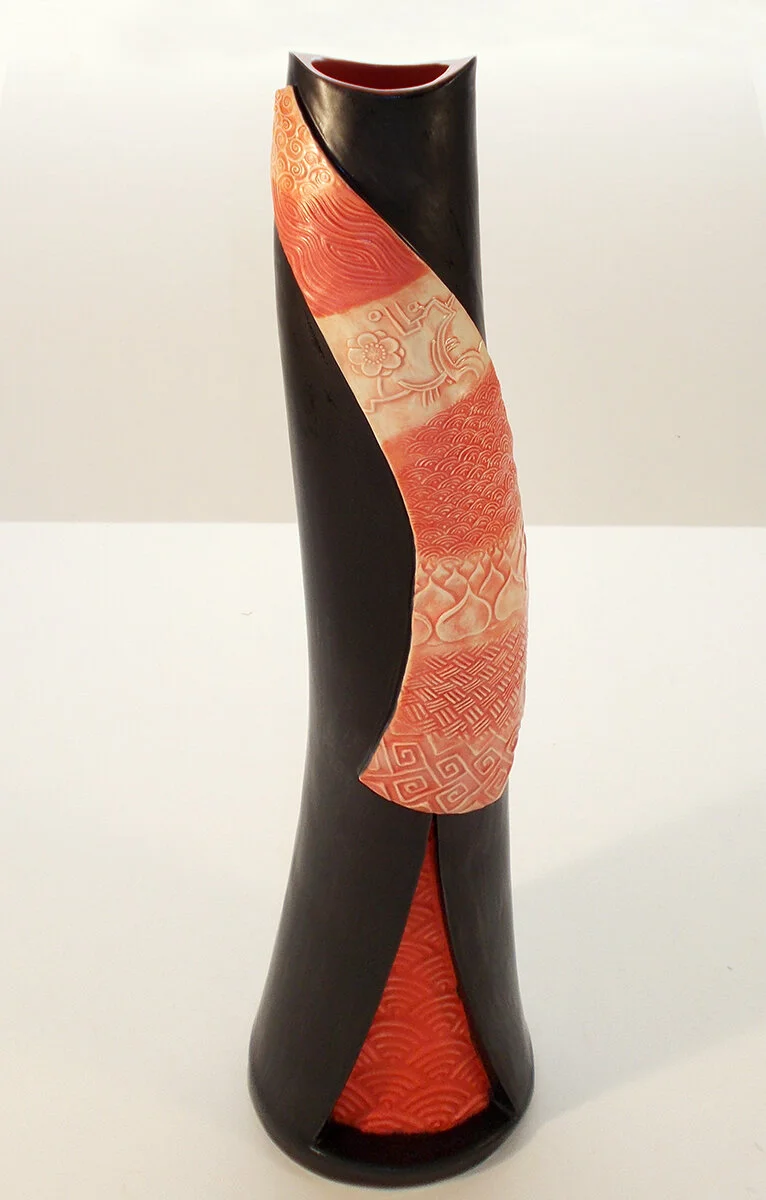
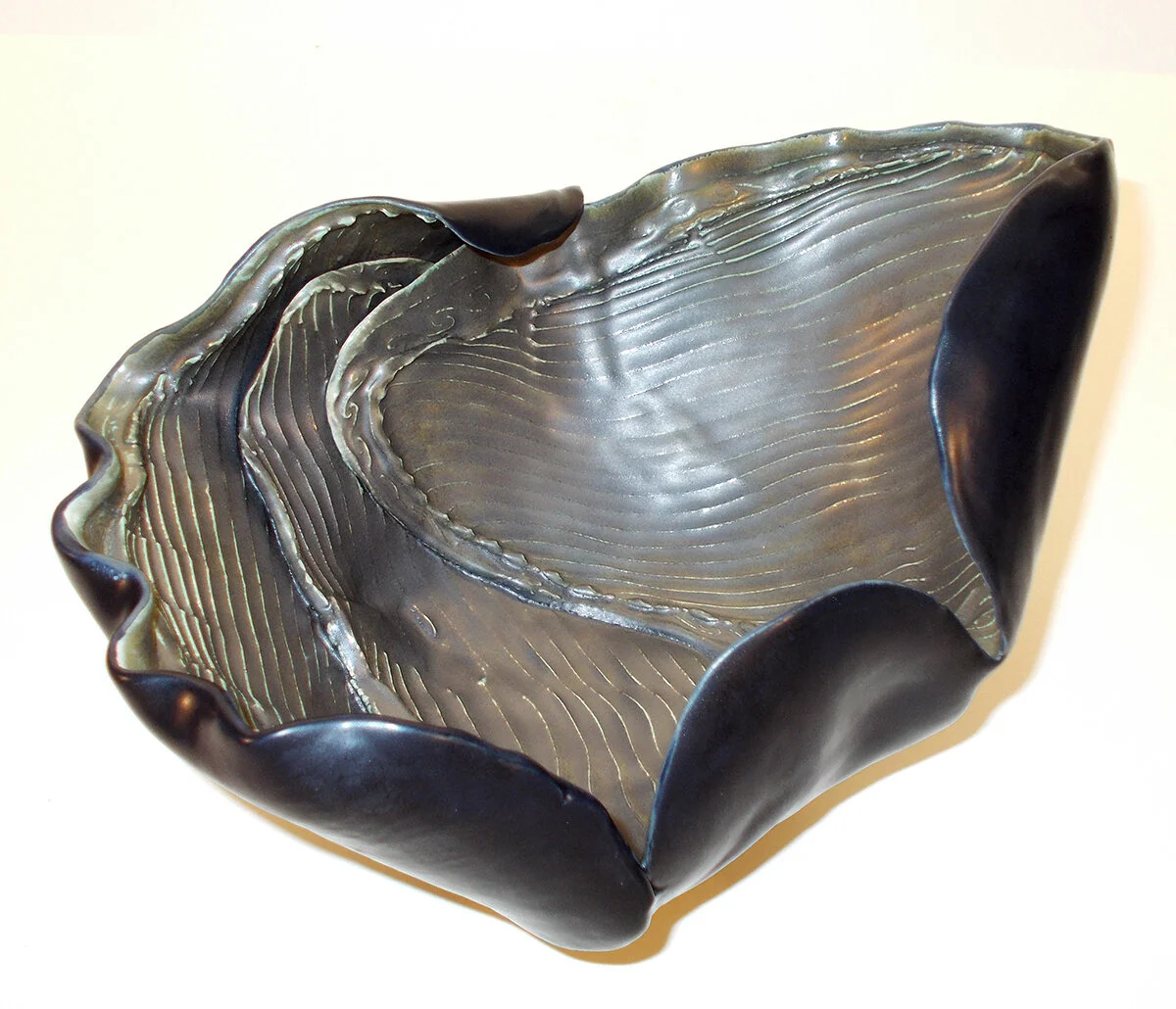
Betsy Kaemmerlen’s striking ceramic creations will take us through the month of April. 

Kaemmerlen is a Landscape Architect with strengths in graphics and planting design. As an outgrowth of her profession, she has been working in clay since 1994. Originally taught on the wheel by John Macomber of Greenleaf Pottery, Betsy turned to hand built forms soon afterwards. She originated an active potters group called Clay Arts East in Connecticut and organized the Open Studio Tour of Northeast CT with up to 75 artists, for many years before moving south in 2006.  

Concentrating on functional ware, surface texture and decoration are key to her clay forms, with transparent glazes pooling in the depths. Her inspiration for exploring textured surfaces comes from the origins of pottery when clay was used to protect cooking baskets from the fire. As food was cooked, the clay was fired and so the basket weave impression remained.   

In 2013, Betsy won an Artist Residency in Little Switzerland, NC at Wildacres Retreat to work on both functional pots and sculptural pieces. She enjoys both taking and giving workshops and has learned many hand building and carving techniques. As a garden designer, leaves and natural designs play heavily in her work. And having studied the gardens in Kyoto Japan for five months in 1979, her fascination with Asian motifs is ongoing. She carves roller stamps with cloud, water, Chinese, and Celtic motifs to add richness to her pottery. Lately her focus has been on tiny teapots and vases, along with Ikebana vessels for Japanese flower arranging. 

You can check out some of Betsy’s work on an interview Jasper did with her last year: http://jasperproject.org/what-jasper-said/tag/Betsy+Kaemmerlen


May: Ginny Merett


TG Ginny Merrett.jpg

Known for her quirky collage pieces, Ginny Merett has been an artist in the Columbia community for over thirty years. She has used various media to create art but for the last decade chooses collage techniques and processes to represent what she calls “characters.” These characters will be ready to walk into your life throughout May. 

Ginny’s work has won several awards and accolades. Recently, Ginny exhibited her work in the Alumni Exhibit at the University of South Carolina School of Visual Arts and Design McMaster Gallery. She is the cover and featured artist in The Jasper Magazine, Spring 2019 edition; and received First Place and Second Place Awards at the Rosewood Art and Music Festival, Best in Show at Time for Art sponsored by the Jasper Project; and participated in Women Speak Art Gallery at SC State Library 2017, ArtFields 2019, and numerous other exhibits.   

Ginny was born and raised in Denver and has lived in South Carolina since 1987. Art sustained Ginny throughout her life and is the cause for her every success. She constantly sewed, created, and treasured drawing as a child, and sought out every art opportunity in school. Because art was such a passion of Ginny’s youth, she pursued a BS in Art Education from the University of Georgia. She later went on to earn an MA in Art Education and MEd in Educational Administration from The University of South Carolina, where she also served as adjunct for several years. Among some of her greatest accomplishments, Ginny taught art in public schools for 30 years.   

Her influences include David Hockney’s joiners, Robert Rauschenberg’s combines, Hannah Hoch’s timeless collages, and the beautiful execution of John Singer Sargent’s portraits. Ginny is a member of FigurativeArtists.org, the SC Arts Alliance, and South Carolina Artists groups.  

You can preview Ginny’s work at Facebook, Instagram, Twitter, and at www.ginnymerett.com 


June: B.A. Hohman

TG BA Hohman.jpg

B.A. Hohman’s unique and soulful perspective on life, often seen in grand murals, will make their way into smaller selections in the summer month of June. 

Hohman grew up in Ohio and graduated cum laude from Ohio University with a BFA. Art has always been her ground. She met her husband, Bob, there, and after her graduation they married and embarked on a new life, moving to West Columbia, SC, in 1981. Their two girls, Haley and Taryn, were born here several years later. She moved back and forth across the country before settling back in SC where she taught. Teaching Art was both gratifying and frustrating due to the vast scope of student abilities and behaviors grouped together in often overcrowded classes. Several years later, B.A. made the decision to leave teaching and become a successful muralist and trompe l’oiel artist, painting for clients too numerous to mention, across the state. As the subject matter knew no bounds, B.A. discovered her hidden ability to adapt both subject and style to client desires. Her Art had never had a specific style so this vocation fit well. 

Painting murals was lifesaving before, during, and after the sudden death of her husband Bob in 2005. Her amazing friends are more precious than gold. Attending art and music events kept her sane and provided well needed inspiration. Finally selling the family home in Irmo, finding her perfect little West Columbia home and studio in 2015 was tonic for the soul. She met more and more of the creative folks who encompass the Art community in and around Columbia and lasting friendships were formed. She continues to revel in their caring inspiration.

B.A. has struggled to create during this past year. Searching for a deeper connection has helped find a sense of peace and hope. Her current artistic goal is to focus on the little things that bring joy as well as the rambling depictions of a mind grasping for meaning. Her new pieces will be depictions of her inner wanderings and glimpses of the small things that keep her mind from spinning off into the gaping chasm. 

Check out B.A.’s work on her Facebook: https://www.facebook.com/bahohman/?ref=page_internal


July: Ron Hagell


TG Ron Hagell.jpg

Ron Hagell’s artwork, which is largely narrative based on social issues, portraiture and dance, will take us through July. 

Hagell is a media artist. His primary work in the past was in film and photography.  Ron became an artist so that he could work more individually and creatively across a variety of media.  He taught media art practice at Royal Holloway - University of London and at the Rhode Island School of Design, Columbia University and on a Fulbright grant in Germany. He has exhibited work in Europe, Canada and the US. His most recent exhibitions were in the UK, Berlin and South Carolina at Artfields 2016, 2018 and 2019. 

Recently Ron has been experimenting with bold color figurative and portrait works in acrylic on canvas as well as revisiting still images from his former dance productions as small individual statements on creative movement. 

Ron has a Master of Fine Art degree from Columbia University and studied at UNC, Rhode Island School of Design and American University. He now lives in Columbia, SC, and has a studio at the Tapps’ Outpost where he invites visitors to see his work by appointment. 

In another life, Ron was an Army Captain with service in Vietnam after which he created many hours of arts and documentary programs for PBS stations including the only ever nationally produced jazz music series, At the Top

You can see Ron’s work on his Facebook and his website: http://www.ronhagell.com/

August: Ashley Bennett


TG Ashley Bennett.jpg

Spirited dancer and jewelry artist, Ashley Bennett, will finish off the summer with her August show. 

Bennett moved to Columbia, by herself, in 2007 and made it her home. She danced in the city's first fringe arts company, Columbia Alternacirque, and became a well-known performer at the Art Bar. For several years, Ashley was a staple shop girl for secondhand store, Sid & Nancy, where she consumed countless iced cappuccinos from Adriana's and smoked a small mountain of cigarettes on the busy sidewalk in front of Delaney's Irish pub.  

Over a decade later, she opened her own artist studio at Tapp's Arts Center, started the Movement Arts Co-op there, and later served a short term as Director of Operations. In 2019, Ashley opened her own communal artist space in West Columbia, Sage Studios. Thanks to the pandemic, the company's vital signs are weak, but stable. She spent the majority of 2020 pacing her house, homeschooling her 5-year-old, eating cheese, and soldering jewelry from sterling silver.  

Check out Ashley’s jewelry on her Instagram: https://www.instagram.com/covenitesilver/

September: Bohumila Augustinová


TG Bohumila Augustnova.jpg

Bohumila Augustinová’s fantastical wire work, often coupled with her clay creations, ranges from mugs and bowls to gallery pieces. This unique variety of work will be featured in her September show. 

Augustinová was born and raised in communist Czechoslovakia, now Czech Republic. She has a degree in fashion design, and she was always an artist. Bohumila came to the United States in 1998, and after winning Runaway Runway, she quickly became part of the Columbia Art scene. In 2015, she took over Anastasia & Friends Gallery, which closed in 2019. Bohumila is a leader of Yarnbombers of Columbia. She works at the Columbia Art Center where she not just makes art, but also teaches art to others.  

See Bohumila’s art on her Instagram: https://www.instagram.com/art_by_bohumila/  

October: Renee Rouillier

Renee Rouillier - Nervous Nelly.jpg

Renee Rouillier’s sculptural explorations will unravel their stories in October. 

Rouillier has been involved in the arts since her twenties. Raised in upstate New York, she received an MFA in Ceramic Sculpture and 3D Study from the University of South Carolina, BFA with a concentration in Ceramics and a BS in Interdisciplinary Arts for Children from SUNY College at Brockport, and a Certificate of Fine Arts from Rochester Institute of Technology.  

She strongly feels art not only defines who she is, but also mirrors her personal life as well as worldly events and outcomes.  In reflection on 2020, she is emphatic that the deeds of humanity will continue to have a profound effect on harmonious existence and the survival of all. The past year, 2020, has proven that nature and all forms of wildlife can flourish without human interaction and she questions this relationship within her artwork. Rouillier also believes a resurgence of mythology, folklore, magic, and wonder would add a positive dimension to today’s world. 

You can explore Renee’s art on her website: https://www.reneerouillier.com

November: Lori Isom

TG Lori Isom.jpg

Lori Isom’s distinctive reflections on life through portraiture will be up to view throughout November. 

Isom has experienced a varied career as an artist, dedicating years to professional dancing, singing and acting. A figurative and portrait artist for over 20 years, she has been commissioned to do hundreds of individual & family portraits.  

Lori's work has been featured in a plethora of places including American Art Collector. She recently completed a one-year artist residency for the City of North Charleston, during which she had the privilege to work on several community-focused projects. She is currently working to grow in greater artistic expression that moves beyond the influence of societal values. 

Check out Lori’s work on her Instagram and her Facebook: https://www.facebook.com/artinthenow/

December: Multiple Artist Ornament Show


For December, we are offering a holiday-oriented show sure to get you in the spirit for your favorite holiday, whichever it may be. Whether you want something to hang on your tree, set on your mantle, or show as a keepsake from 2021, support a local artist with an irreplaceable piece.

Look out for our upcoming announcement of our list of artists for our December show!

Tennyson Corley Invites All to Experience the Natural World Anew in Jasper’s First Tiny Gallery of 2021

In 2020, Jasper moved its Tiny Gallery online to give artists a space to tell their stories safely during the COVID-19 pandemic. This month, native South Carolinian Tennyson Corley has kicked off a new year of these stories with her show, Microcosm.

Corley was born and raised in Columbia, dwelling with her family on a large horse farm on the outskirts of the city. She has never felt a pull to leave the state she calls home, sharing, “I have a strong connection to our state, the landscape, the proximity to the mountains, the forest, the beaches, the wildlife.”

Amongst these connections to the natural world, art also surrounded a young Corley. Her mother was a prominent illustrator and portrait artist who Corley had the fortune to watch create, collaborate, and travel. She now watches the same stories unfold in her own life.

“I got to witness firsthand all the inner workings of being an actual ‘working’ artist,” Corley says, “It definitely had a glamorous side, but I wasn’t jaded to all the other things that go along with it, long nights, rejection, unhappy clients—those experiences really taught me things I could never learn in a formal setting.”

Being steeped in these experiences resulted in Corley deciding to pursue a career in art herself, attending Columbia College to study Fine Art before taking time off to grow into the role of mother to her son, Jasper. When Corley returned to work, it was as a horticulturalist, but one day her husband arrived home with a surprise—a new easel. And that was the push she needed to re-envelop herself in art.

Busy Bee #3

Busy Bee #3

As an artist, Corley lends herself to experimentations. She has worked in printmaking, acrylic, oils, gauche, watercolor, ceramics, indigo art, and more. For Corley, though, painting is her home, what she always returns to.

“I specifically love working in acrylics—the way you can manipulate the paint is practically endless,” she explains, “Recently I have been playing with textures, building up my canvas with recycled materials and different mediums. The process has been cathartic.”

One theme Corley continually finds herself returning to is rooted in the home she has never left—nature and the natural world, specifically within the Southeastern United States. Even outside of visual art, Corley is a strong supporter of protecting the environment and the living beings that dwell in them.

Sparrow

Sparrow

“Through my work, I want to highlight the places and animals we pass by in our daily lives in hopes that connection leads to preservation,” Corley contends, “I hope my paintings can bridge a connection without being too in your face, because sometimes only the quietest voice is heard.”

Her Tiny Gallery show, Microcosm, is an exploration of the natural world via a uniquely insightful lens. As you take a virtual walk through the show, you will see portraits of birds caught in reverie, bees dancing circles around flowers, open oysters marked to receive something unknown, and more.

Visitors

Visitors

The show sold out half of its items in the first week. Overwhelmed by the wonderful response, Corley has decided to add 8 more pieces to the show, which will have just gone live when this article is published.

“This show is, in its essence, a compendium of my work through 2020, arranged by various series inspired by travel, work, and my affinity for texture and the evolution it has taken in my recent work,” Corley says. “I want to use the show to highlight my growth as an artist over this past year.”

Reflecting on this past year, Corley admits she was frightened when the pandemic started, not just for herself but the entire art world. However, she gave herself daily painting goals and challenged herself to create small scale work, leading to Microcosm, among other new adventures.

Oyster #6

Oyster #6

“I ended up being a part of The Crisis Residency, with other artists going through the same gambit of emotions and it helped me find my footing,” Corley accounts, “I mean, artist are innovators and hold the ability to constantly evolve in changing circumstances, right?”

Corley also had the privilege of being the Artist in Residence at Oconee Parks, which she notes as a highlight in her artistic career. Her favorite memory as an artist, though, has been the magic of watching her son follow in her footsteps as she once did her mother’s. 

“He has been to my art openings, worked alongside me daily, studied the same books, and had long ‘art talks’ with me,” Corley shares, “It brings back my memories for me to bask in from childhood, and I hope that I leave these we are making with him so that he can one day pass that on if he decides to take that path as well.”

Corley is not sure what the future holds, but one concrete plan she has is an upcoming show with 701’s Hallway Gallery in March.

For now, you can experience Corley’s walk through nature with her show, Microcosm. You can view all the pieces, sold and available, at any time, and you can purchase the available pieces 24/7 as well, up until the gallery’s close on January 31st: https://the-jasper-project.square.site/tiny-gallery

If you want to follow Corley after the show, you can check her Instagram at @tennyson_corley_art and her Linktree at linktr.ee/TennysonCorleyArt


Welcome Tennyson Corley to Jasper's Tiny Gallery

Tennyson Kovach Corley_1609530124.jpeg

We’re loving the precious little pieces of art Tennyson Corley is sharing with you this month via Jasper’s Tiny Gallery.

Tennyson Corley is a contemporary painter living and working in Columbia, South Carolina. Showing professionally since 2010, she has been honing her painting style in acrylics and mixed media. She works out of her studio on her small farm minutes from city proper. Corley attended Columbia College for a degree in Fine Art.

Tennyson captivates her audience with depiction of native flora and fauna. Her pieces pay homage to her work as a horticulturalist and love of nature. Seeking out new inspirations through her travels, she strives to portray the beauty of the South East region to her viewers.

Iridescence and Iron

Iridescence and Iron

Oyster #1

Oyster #1

These small pieces are offered at an affordable price and, while they stand alone beautifully, they also complement gallery style displays of larger pieces by adding interest and detail.

We’ll be writing more about Corley later in the month but , since her work is selling fast, we wanted to make sure Tiny Gallery lovers don’t miss out on this lovely art.

Visit MICROCOSM BY TENNYSON CORLEY at the Jasper Project’s Tiny Gallery.

Roger Reed’s Tiny Gallery Show, The Magic Universe, Invites All Into Its Celebration of Color, Shape, and Perception

By Christina Xan

Ever since Jasper took its Tiny Gallery Series online in June, we have received an outpouring of love for our artists. We are grateful for all the artists who have shared their stories and to the community that has joyously received them. And we’re excited to wrap up our year with a magical show from local artist, Roger Reed

Reed was born and raised right here in Columbia and attended CA Johnson High School before moving to Richmond for college. “My father loved to draw when he was in grade school, and my stepmother loved to fool around with puzzles, “Reed shares, “But for the most part, art was not in my family.”   

“…it was so beautiful it made me want to create something beautiful myself,”

Regardless, the now 69-year-old started drawing when he was only five or six. “A big brother friend of mine showed me a walking stick that he had just made, and it was so beautiful it made me want to create something beautiful myself,” Reed reflects. “The universe must have sent him to me because I was very poor and needing something to believe in.”

Whirlwind

Whirlwind

After this interaction, the then elementary school boy experimented with drawing before moving onto soft pastels in high school. Though he enjoyed a variety of genres, portraits were what he practiced in the most. “When anybody needed artwork for their class project, they would come to me,” he recalls. 

Due to this, Reed considered art school, but fate had different plans. “My art teacher in high school wanted me to go to art school, as did I, so I went to Virginia Union University thinking they had an art school and they didn’t,” he reveals, “They told me a lie to get me to play football for them.”  

Since then, the self-taught artist has experimented with a variety of mediums. While he has worked with pencils, charcoals, ballpoint pens, oil pastels, and soft pastels, acrylics are his current go-to. “Acrylic on canvas gives me what all the other mediums give me and more,” Reed explains. “Acrylics dry rock hard, are cleaner, and the canvas is more durable; with acrylic I can paint over what I do not want and replace it with what I do.”  

The Vines

The Vines

Reed has chased his passion in a plethora of ways, and for sixty years, he did realist work—portraits, buildings, houses, and still-lifes. However, recently, he decided he wanted to switch the normal up, and for nearly 5 years, he’s been growing with abstract work.  

“I went to abstract because I wanted to play a little bit more, not be so serious,” Reed says. “Sometimes I feel I'm working on the same subject all the time, but on the other hand, I keep moving to a new ideal—I have heard it said that real art has nothing to do with realism.”  

Reed’s current show, aptly titled The Magic Universe, is a fresh interaction of color and shape. Startling turquoises weave within honeyed yellows. Sunset bulbs sit among twisting vines. Slivers of blue slip between collaged teardrops. Tendrils, spirals, and spheres reach out and invite you into their world.  

The Piece

The Piece

“I hope what people get art out of the show is nothing but art. I hope my art brings them joy and no pain. I hope they have fun just like I do,” Reed says. “I call the show Magic Universe because I see the magic in the work, and I see the Universe also.”  

Reed has been sharing his love with Columbia for years and reflects back on a highlight of his career—a large acrylic painting he donated to an art auction in West Columbia was auctioned off for three thousand dollars. “The money was used to pay for scholarships,” Reed remembers, “The painting was a picture of the Kids Museum on Gervais Street.” 

When it comes to the future, while Reed does not know what it will hold, he can say one thing confidently: “I do not think I will stop creating.”

Magic Movement

Magic Movement

Two weeks are left to treat yourself or a loved one to a unique and irreplaceable holiday gift.

The Magic Universe, will be up until December 31st on the Jasper website: https://the-jasper-project.square.site/tiny-gallery  

After the show, you can view Reed’s work on his Artrepeneur site: https://artrepreneur.com/p/7H9wnth9qMtTX9vME


Tiny Gallery will continue in 2021! The purpose of the Tiny Gallery Series is to allow artists an opportunity to show a selection of their smaller pieces of art offered at affordable price points attractive to beginning collectors and arts patrons with smaller budgets. If you are interested in showing at Tiny Gallery, please email Christina Xan at jasperprojectcolumbia@gmail.com


Gina Langston Brewer Expands Her Popular Tiny Gallery Show Incohesive, A Collection Rife With the Importance of Creation

“Mostly I create out of a need to process my emotions about the world around me.” 

Tiny Gallery Featured Artist Gina Langston Brewer

Tiny Gallery Featured Artist Gina Langston Brewer

We are halfway through our November Tiny Gallery with Gina Langston Brewer, a local multi-media artist. We’ve been overwhelmed by the love towards the show so far—in just the first 24 hours, nearly 50% of her show, Incohesive, sold out. 

Brewer was a self-proclaimed “army brat” towards the beginning of her life, but she spent most of her formative years in West Columbia. Her family home was filled with art, but the idea of having a career as an artist never presented itself as an option. 

Regardless, Brewer found herself continually inspired by her Grandmother Langston, a multi-media artist herself, who worked with themes surrounding nature, flowers, and the ocean. 

“She made art out of everything. My dad was a contractor and brought her scraps of wood, that he beveled, to paint on,” Brewer recalls, “She gave me a love and appreciation for art, nature, and using what you have available to you.” 

However, when Brewer first ventured to Winthrop University, she wasn’t planning on going down the same path–her eyes instead set on teaching. Then, she started taking art classes as electives, and before long, she graduated with a B.A. in Art. 

“Though I have taken college courses, I feel somewhere between a fine and a folk artist,” Brewer ruminates, “Mostly I create out of a need to process my emotions about the world around me.” 

White Wash by Gina Langston Brewer

White Wash by Gina Langston Brewer

Like her grandmother, Brewer works with the materials that are closest to her in the moment. “I will, can, and have worked in most mediums, yet I mostly work with acrylic paints,” Brewer shares, “I have also been working on several copper wire sculptures, recycled lightbulb/cork insects, wood assemblages, and altered books.” 

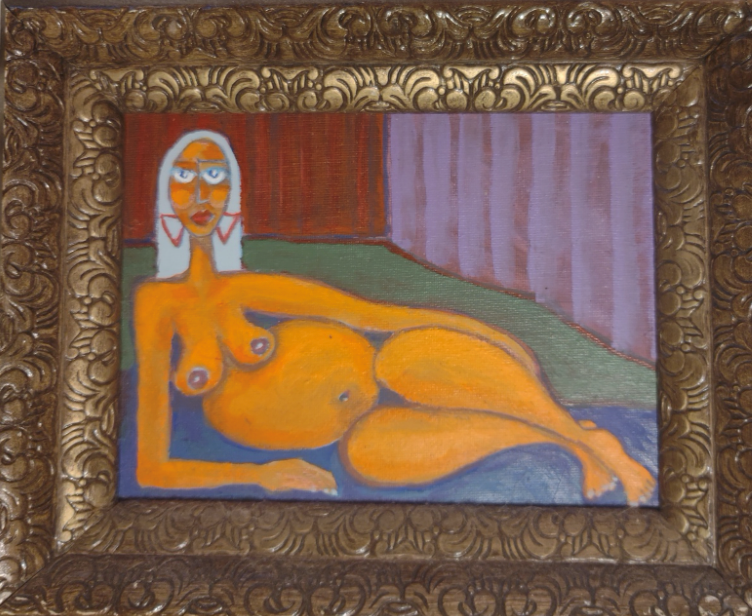
Within these various creations, Brewer seems to often return to one dominant theme: the female form. “Mother and child, Life, the creators of life,” Brewer intimates, “I have always painted voluptuous women, body positive, having always been quite zaftig, myself.”

Orange Recline by Gina Langston Brewer

Orange Recline by Gina Langston Brewer

Brewer also reflects on how her art is a powerful tool of distraction in the time of COVID and worrisome news updates pervasive across multiple channels. This collection stems from both Brewer’s standing loves and these new emotions. 

“I told a friend when I had my next show it would be called Incohesive, because my work has just been all over the place,” Brewer remarks, “I've chosen mostly smaller recent works and a few pieces just to show the spectrum of what I've been up to.”  

Two of Brewer’s pieces are COVID Collaborations that she started with Kristine Hartvigsen just before lockdown, who wrote Brewer’s artist bio and statement for the show. Brewer also has featured a handful of her new recycled insect experiments, and ruminations on the female pervade the show.

Cork Toggle Fly by Gina Langston Brewer

Cork Toggle Fly by Gina Langston Brewer

As mentioned earlier, the show has been largely popular, and upon bathing in her gratefulness, Brewer has made an exciting decision: she will be adding a handful of new pieces to the show.  

“Being a part of [this show] has, in a way, reinvigorated my interest in being a part of the art ‘world,’” Brewer admits, “The past four years, I have shut down with my engagement and the art community—I'm very thankful for this opportunity and for the patrons of this incredible venue.” 

Throughout this week, on the Jasper Project social medias, we will be announcing and showing some of the new pieces Brewer has chosen to add to her gallery. While an inconhesion, all these pieces come together to tell a story: about femininity, about life, and about survival.  

“I never really plan what I am about to create. All that I know is that I must.” 


Mermaid Dance by Gina Langston Brewer

Mermaid Dance by Gina Langston Brewer

Gina Langston Brewer’s Tiny Gallery show runs through November 30th on the Jasper website and is the perfect opportunity to support local art and get your special someone an irreplaceable gift for the holidays.


Be sure to follow Brewer’s Instagram @metamorphosisters for updates on her art during and after the show.

By Christina Xan

CORONA TIMES - Jasper Talks with Dre Lopez about Designing During COVID

Please don’t give up.  Your worst days will always pass, even if that is difficult to see sometimes.  If you won’t do it for yourself anymore, do it for your loved ones.  Always keep fighting. 

Dre Lopez

Dre Lopez

In keeping with Jasper’s coverage of arts and artists during these weird quarantine times, we had the fun of a virtual interview with Columbia-based artist Dre Lopez last week. Catch up with Dre below & see what he’s been up to in this parallel universe we’re calling 2020.

JASPER: Dre, you’ve been a stalwart figure on the Columbia arts scene for a while now, but not everyone knows your story. Can you tell us about where you grew up and how you came to be the artist you are now?

DRE: Thank you for having me!  Well, my family moved around a good bit when I was a child so there’s several places that I sorta grew up in.  That said, I moved to Columbia from Miami.  In regards to my journey as an artist, it’s a big mixed bag of experiences and influences.  I’m self-taught so I’ve been creating since I was a kid and have pulled my lessons from all over the place.  Illustration of different kinds, renaissance painters, Graffiti writers, animation, graphic design, fashion design, etc.  I’ve always been a student of the craft so I just kept practicing and experimenting but forayed into professional waters as a freelance illustrator in 2003 and started doing professional graphic design around 2007.  I’m lucky to have dove into so many mediums and methods which allowed me to become a fairly versatile artist. I’ve been able to work in several different fields which is so important as a freelancer, to stay productive and busy.  I’m still learning (which I love), so the journey to “master” what I do will end when I die.  That feeds me, keeps me excited, seeing that there is so much more that I can add to my tool belt as I see improvements still after all these years.


DRE: You are a designer, illustrator, graphic artist and more – where do you spend the bulk of your time and what would you rather do if you could do whatever you wanted?

DRE: The bulk of my time is split between graphic design and illustration.  Depends on the season, it varies.  I love doing it all and prefer the variety.  It keeps things fresh and challenges my mind to work in different ways, from one project to the next.  Helps with boredom as well, my mind gets bored easily.  Now, if I had the ideal conditions, I would add even more variety, lol.  More illustration, more design, more painting, murals, sculpting, custom fashion, etcetera, etcetera.


JASPER: Do you mostly do freelance work or do you have a regular day job?

DRE: Yeah, for the most part I’m a freelancer.  I’ve had other jobs throughout the years that are both in my field, as well as other areas that have nothing to do with being a creative.

 One thing I’ve learned is that your goals can change as you go through your career, and allowing that perspective to take hold will open up so many other opportunities and accomplishments that you may not have realized were possible when you started.

JASPER: Who have been your greatest influences as an artist and what have you learned from them?

DRE: Hmm, that’s a tough question.  I’ve researched, studied, and pulled inspiration and lessons from SO many creators and creative fields.  With illustration most of my influences come from comic books, anime and editorial illustrators.  I still use a sense of storytelling with most of the work I do, this being part of what I learned specifically from sequential illustration and animation.  With my painting, the masters of the Renaissance and the Baroque Period were the main sources I looked to for technique and foundation to better my process.  My graphic design is probably most influenced by German minimalist aesthetics.  I would also say that Street Art and Graffiti have influenced all of my mediums as well.  Honestly, I would say that all the fundamentals and techniques I’ve learned, no matter the concentration, all have crossed over into the many things I create on a daily basis.  All of them have made me a more fundamentally complete creator.

What’s Next? - drawing by Dre Lopez

What’s Next? - drawing by Dre Lopez

JASPER: Do you have any great goals out there on the horizon or are you chill doing what you’re doing now?

DRE: Definitely not chill where I’m at.  I’m not satisfied and know that there’s so much more to accomplish.  I will always freelance and continue to create my own work, so I will ride that wave wherever it takes me.  I’m also open and intrigued to work with art/design/illustration houses in the U.S.’s major cities, as well as Europe and Japan.  That’s one thing I haven’t done yet so the possibilities and challenges of that excite me.  I’ve done freelance work all over, but to work in one of those houses, especially overseas, would be amazing.  One thing I’ve learned is that your goals can change as you go through your career, and allowing that perspective to take hold will open up so many other opportunities and accomplishments that you may not have realized were possible when you started.


JASPER: How has the COVID-19 pandemic impacted your work as an artist?

DRE: It’s been weird.  I think the constant stress of it has at times affected my focus.  Many routines had to change as well, which threw off schedules and the consistency of how I did things.  That’s been an adjustment, but not the worst part of it.  With COVID and the turbulence of what this presidential election year has been, it really has been challenging some days to deal with both of those burdens riding you for months, on top of whatever my “normal” life stressors have been.  I’m used to working under a lot of pressure, but it’s been mentally and emotionally exhausting on some days.  Some of these heavier days have dwindled my creative energy, which has been something new and strange for me.  I’ve never lacked in the creative energy department.  That said, having done this work for many years, I’m thankful that I have picked up enough skills and experience to maneuver through creative slumps, pandemic and chaotic political climates be damned.  Take breaks when your mind needs them, power through when you have the chance.

Unidos - painting by Dre Lopez

Unidos - painting by Dre Lopez

JASPER: For those of us who don’t have your skill sets, what words of wisdom can you offer us that would help us communicate with design artists more successfully?

DRE: One of the first and most important things I was lucky enough to learn early on, is to study and learn fundamentals.  I always had natural ability and style, but I lacked in the fundamentals department which is common for many self-taught creators.  Depending on which creative field will make a difference as to which fundamentals to focus on, but the rule applies the same to all of them.  Then practice, practice, practice.  Repetition in any skill is paramount.  The idea is to get as natural and comfortable with the fundamentals, so that once you know them intimately, then you can play around, twist and bend them to your will.  The beauty of creative fundamentals no matter your concentration, there’s crossover for many of them so you can use them across the board regardless of the work you’re creating.  Examples like color theory, composition, the way you lead the viewers eyes on an image, texture, lighting, are among a few of the fundamentals that can be applied to most visual creations.  Oh, and grow a thick skin as quick as possible.

Talent lives here, determination and passion live here.  The money?  The money does not live here, unfortunately.  Figuring out how to embrace quality creatives that are serious about having a professional career and make Columbia their home base is the main problem. 


JASPER: Can you tell us about any arts organizations you are affiliated with and what their mission is?

DRE: My most consistent collaborations and affiliations are with Palmetto Luna.  They are a non-profit organization based in Columbia that focuses on the arts and Latinx artists in the southeast United States to expose communities to Latinx culture through art.  I’m a Latinx/Latino artist so the collaborations have been a natural fit (being that I’m passionate about both of those parts of my identity), thanks to the wonderful efforts that Ivan Segura and Alejandro Garcia-Lemos have put forth throughout the years for that organization.


Cocky Free Times Cover by Dre Lopez

Cocky Free Times Cover by Dre Lopez

JASPER: What one thing could we do in the Midlands – something that is actually within our power to do – that would make life here so much better for artists?

DRE: This is one I’ve been trying to figure out for the many years I’ve partaken in the Columbia art scene.  The main problem for most artists in this town is not being able to survive and succeed financially.  Many artists I’ve known here have burned out on creating and/or moved to other cities give at least an opportunity to make a decent living.  Talent lives here, determination and passion live here.  The money?  The money does not live here, unfortunately.  Figuring out how to embrace quality creatives that are serious about having a professional career and make Columbia their home base is the main problem.  I’ve seen several ideas implemented but nothing has been tangibly successful to make a real difference.  The support from both the city and the arts patrons has to be with real money, not just platitudes and high fives.


JASPER: Anything else exciting going on in your professional life these days you can share with us?

DRE: Sure thing!  The next thing I’m about to birth into the world and am excited about is an apparel line I’m releasing called Gutter Baby.  It’s gonna be a lifestyle brand/fashion line of shirts, hoodies, hats, accessories, one-of-a-kind customs, and prints inspired by many of my influences in Punk, Hip Hop, horror, sci-fi, lowbrow, pop art and street culture.  It’s more or less my uncensored, whatever the fuck goes art line.  The store link, soon to be released, is www.gutterbb.com


Benzel front cover illustration by Dre Lopez

Benzel front cover illustration by Dre Lopez

JASPER: And how can readers get in touch with you to learn more about your work?

DRE: Different ways, on IG look me up @infidel_castro_x and @gutter.baby.apparel and if you’re interested in my more corporate/conventional work my website is www.drelopezcreative.com

www.drelopezcreative.com 

JASPER: Anything else you want to say or suggest or complain about – here’s your platform!

DRE: No complaints.  Keep fighting, nothing is permanent.  Many people in general and especially in these times of uncertainty with COVID and political unrest are dealing with great amounts of pressure, anxiety, depression, and PTSD of some form.  Suicides are rising everywhere.  Please don’t give up.  Your worst days will always pass, even if that is difficult to see sometimes.  If you won’t do it for yourself anymore, do it for your loved ones.  Always keep fighting. 


https://www.facebook.com/palmettoluna/

https://www.facebook.com/palmettoluna/

In His First Show Since COVID, Christopher Lane Considers the Necessity of Unity in Dividing Times - by Christina Xan

 “A lot of people feel desperate out there,” Lane says. “And on a humanistic level, I get an idea of why people feel the way they do—they just feel helpless.”  

It’s unusual for Modern Surrealist painter Christopher Lane to take such a large break from exhibitions.  

Lane is no stranger to sharing the stories he weaves together on his canvases. In fact, 2020 started with a show in Minnesota, followed by acceptances to Art Fields in Lake City and Spoleto in Charleston.  

Then, the pandemic hit.  

Since the start of COVID-19, the painter has stayed mostly at home, quarantining with his partner, Lisa, and dogs, Loki and Samson. But that doesn’t mean he stopped painting. So, when friend and gallery-owner Rob Shaw asked Lane to do a show in his space, the fragments of United We Stand formed quickly.  

The collection is a mix of pieces old and new, and either way, ever relevant. The 52-year-old artist has been painting in response to social and political events for decades, both as a way of working through his own mind and of sharing those inner workings. In recent months, this has only become truer.  

“You know, I look around and ask what’s the disconnect,” Lane says. “I don’t understand the disconnect.” 

Originally, Lane had titled this most recent collection Divided We Fall as he responded to this increasing disconnect in our country. However, as he continued to paint and watch, which he often does as he watches the news, his mindset shifted. 

“I want to emphasize a unity amongst us, regardless of party, ethnicity, race, religion, and gender,” Lane shares, “My work observes the pitfalls of allowing division to thrive and grow amongst a people.”  

This body of work builds on top of seeds sewn in his Resist Division exhibition last year, new vines and tendrils wrapping around sensitive and poignant issues.  

“It’s election year, we are in the middle of a world pandemic, and we are so busy fighting amongst ourselves that we are no longer paying attention to them,” Lane says, “that small, yet powerful group of people who control our world.” 

Lane has always spoken for those small individuals, held an eye in his head and his heart for those details in both people and their surroundings.    

“A lot of people feel desperate out there,” Lane says. “And on a humanistic level, I get an idea of why people feel the way they do—they just feel helpless.”  

These concerns have pervaded not only Lane’s work but his life, the product of a military household whose father served in three wars and a veteran of the navy himself.  

“My greatest desire is that my paintings reflect the one truth, we are all the same. We are all one.  And United We Stand.”

Some fights exist within physical places, but this fight traverses boundaries. With this exhibit, Lane desires to speak to all, to promote inclusivity and share humanity regardless of the lines that often separate. 

“I like to paint to where someone in another country can look at my work and enjoy it,” Lane says. “You know, they don't need to speak English. They don't need to understand my colloquial behavior to get it.” 

“The Grifters”, a featured piece from the show, conveys this desire in a Tower of Babel-esque push and pull of color, conversation, and performance—a struggle we all suffer the repercussions of.

The Grifters by Christopher Lane

The Grifters by Christopher Lane

“My greatest desire is that my paintings reflect the one truth, we are all the same. We are all one.  And United We Stand,” Lane concludes. 

United We Stand opens this Friday, November 6th, and runs until December 1st.  The opening reception Friday evening begins at 6pm at the Rob Shaw Gallery in West Columbia. Masks, social distancing, and safety precautions will be in place. 

To follow Lane’s work during and after the show, follow his Facebook page, “Christopher Lane Art,” and check out his website for available works and prints: https://www.laneartworks.com/

Tiny Gallery Highlight: Jennifer Hill Shares Creatively Creepy and Cute Life Reflections with New Collection of Creatures

Woodland Nymph specimen

Woodland Nymph specimen

This month, Jasper is delighted to be hosting Jennifer Hill, aka Jenny Mae Creations, for our October Tiny Gallery show. Hill is featuring a delightful array of little creatures: 13 needle felted, two plush, and one voodoo. 

Hill grew up in Chapin on Lake Murray, and her aunt, an artist and a painter, introduced her to the Brian Froud Faeries book at a young age, which she claims left an impression that still affects her work today.

Before she found her way to dollmaking, Hill’s first love was theatre, which she started doing in middle school. “I can't really explain why I chose to do it; it was just something I thought I would enjoy,” Hill recalls, “And I didn't just enjoy it. I fell in love with it.”

Now, years later, Hill is a Company Member at Trustus Theatre, which she considers her home, and the people there, family. Since then, she also started performing on the street as a living statue.

“It's a whole other way of performing that I fell in love with,” she says on street performing, “There's nothing like sharing a theatrical moment on the street with a curious stranger — a performance that only requires me and whoever happens to walk by.”

This aspect of performance is similar to what Hill chases in her physical creations as well. “The relationship I draw between [performance and art] is that it's me expressing myself and putting it out to others and connecting with them,” she states, “Which is something I always feel the desire to do.” 

voodoo dolly

voodoo dolly

It was in her early twenties that Hill made the venture that resulted in this connection. Between her performance projects, she wanted another creative outlet and found her way to crafting collages and voodoo dolls with found objects.

“I started with collage because I love the practice of taking things a part and creating something new out of it”, she shares, further saying, “I've always been weirdly obsessed by the idea of voodoo dolls ever since I saw an episode of Scooby-Doo when I was a kid that featured one.”

This is just one example of themes from Hill’s childhood popping up in her work. Because of a love of dolls from childhood, she was led to a DIY sock monkey kit at Christmas one year. From there, her love for fiber art sparked, leading to a plethora of creations representing a reflection of Hill’s inner self.

“When I'm making things, I'm often processing something that's going on inside me. I think that's why creating is so essential to me,” she ruminates, “And I really like the juxtaposition of something being cute but also a little unsettling and raw. There's often a dose of humor in my work.”

two-headed woodland nymph

two-headed woodland nymph

When it comes to the art of making, Hill is completely self-taught. One day during the process of self-teaching and experimentation, she decided to walk into an art gallery with a box of dolls and see if they were interested – they were.

“My big break came when the art director for the film Mr. Magorium's Wonder Emporium emailed me that he saw my plush creations online and wanted to use them in some of their background shots,” she recalls, “I was STUNNED.”

Since then, Hill is always searching for new mediums and modes of inspiration, two years ago, she came across needle felting. For those who are unfamiliar with the process, Hill shares that you start with loose wool, mold it into a loose shape, and then stab it repeatedly with a barbed needle. As you stab more and more, the wool becomes more tangled and then firmer until you end up with a finished object.

“I really love the sculptural aspect of it. The freedom to start with a pile of wool and mold it into whatever I want,” she shares, “I love that it's fiber, but I can sculpt with it using a needle in a way I can't with regular fabric and sewing. I feel like I have more control in a way.” 

Whether with needle felting, plushes, or voodoo dolls, Hill keeps walking her “fine line” between cute and creepy, making wounded creatures that don't actually exist and often come from her childhood. 

Afraid

Afraid

Hill hopes that in showing these personal representations of her own hopes and fears, others might find a sense of reflection and thus comfort in her work.

“I hope that the wounded misfit inside them feels seen. That their inner child may be delighted or even soothed,” she pauses, “We're all strange and hurting in some way, and there's a human connection in that, and if nothing else, they may spend a few minutes with their childhood self that's still in there wanting to be seen.”

Hill has been opening this path to people for years, having been part of several art shows, some local, some in other parts of the country, and one in Italy. “The wonderful people at The Columbia Museum of Art gave me my first one night only solo show when Mr. Magorium's Wonder Emporium came out,” she remembers.

As uncertain as some aspects of living may be right now, Hill knows creating is her one constant.

“Since COVID, live theater, acting with others, and street performing has pretty much been put on hold,” she admits, “So, I feel very lucky to still have this other way of expressing myself creatively because it is essential in my life, and I plan to just keep creating anyway I can. It's what I need to do to be happy.”

mushroom specimen

mushroom specimen

You can follow Hill on her Instagram @jennymaecreations or her Facebook page @Jenny Mae Creations.

Hill’s show will be up until the end of October, so be sure to check out her strange and wonderful creations on the Jasper website—perfect for Halloween and for anytime you want a fun little version of a part of you sitting on your shelf.

Street performer Jenny Mae - photo by Crush Rush

Street performer Jenny Mae - photo by Crush Rush

Jasper Galleries Welcomes Thomas Washington to Motor Supply Co.'s Walls (Copy)

For more interviews with the many exciting Artists of Color in the Greater Columbia Arts Community,

please search for

BLACK ART MATTERS

in the search box on the Jasper Project Blog Page

Artist Thomas Washington aka Thomas the younger

Artist Thomas Washington aka Thomas the younger

Jasper Magazine visual arts editor and board member of the Jasper Project, Laura Garner Hine, has been busy installing a brand new show of art in the gallery spaces at Motor Supply Co in Columbia’s historic Congaree Vista. Our featured artist this quarter — Thomas Washington, aka Thomas the younger!

It was my sincerest pleasure to interview Mr. Washington just before his show was installed last week.

~~~

Hi Thomas, and thanks for spending some virtual time with the Jasper Project. We’re excited about the show of your artwork recently installed at Motor Supply in Columbia’s Vista. But first we want to catch up any readers who aren’t familiar with your work.

JASPER: Tell us, please, a little about your background. I know you’re from Springfield, Massachusetts, but what brought you to Columbia, SC and did you go anywhere else along the way?

WASHINGTON: We moved south when my father’s job laid him off, starting a classic cascade of loss. This included the house we’d always known (to foreclosure); friends; community. My mom’s from this area, so we were—in a real sense—following her “home”.

JASPER: How did you get into painting – are you self-taught or did you study under someone else?

WASHINGTON: I’m self-taught...but every piece I’ve ever seen informs me. One way or the other.

thomas washington 4.jpg
JP Galleries .jpg

JASPER: Who has influenced you most as an artist?

WASHINGTON: Amy Windland’s trees; Travis Charest’s details; Keith Tolen’s focus; Joe Madureira’s structuring; the tenebrism of Humberto Ramos; Stephen King’s storytelling, as well as Ann Patchett’s; Moebius (Jean Giraud); Giger; Whelan; everything about Lucas Sams; the depth of Darrell K. Sweets; Michael Krajewski’s economy; the exquisite technicians, Margaret & The Brothers O’Shea; The Brothers Hildebrandt; The Brothers Lopez; Michael Anastasion’s intensity; every woman I’ve ever loved too deeply, and every woman who returned it; my children; my sorrows and madnesses, too; every soul who ever appreciated anything I generated, especially when I want to wash my hands of it all—I owe much to many, and could not finish their naming in a sitting. 

JASPER: how would you describe your work in terms of genre and what mediums and format sizes do you prefer to work with and why?

WASHINGTON:  I must leave that “description” to others. I will work in any medium I can afford to acquire, and in any dimension(s).

JASPER: There is a dreamy, magical quality to so much of your work – as if you are telling a story with your paintings. Is there magic in your art? Are you telling stories? If so, what are your stories about?

WASHINGTON:  I have a universe. Every project is connected to The One Project...and I imagine this is actually true for most creators, though the degree to which each of us engages that truth...varies. The tale cannot be told, nor summed—it’s a web, and still being woven.

Thomas Washington 3.jpg

JASPER: You go by Thomas the younger – can you please elaborate on this name?

WASHINGTON: My father—Thomas the Elder—is an artist, as well. (I don’t use “Washington” when I use “the younger”, and I don’t capitalize the initial letters. On occasionally doffing the family name: I’m a black sheep, and I can acknowledge that. When we needed less names, we were more human—I use the archaic moniker because it isn’t dead. Just buried. Capitalization...feels wrong.)

JASPER: I know that your children also influence your work as an artist – can you tell us about your children and how they influence you?

WASHINGTON: My children were born into a dark world. I have no clue how to brighten it—I am, perhaps, too acquainted with its darkness. They, themselves, are lights. Their faces, their spirits, their tableaux—my work is infused with these. Sometimes, in direct homage.  

JASPER: You have a Jasper Project sponsored show up at Motor Supply Co. Bistro now. Talk to us about the art being exhibited at the restaurant. Did you paint specifically for the show or did you select from items from your inventory to show?

WASHINGTON: As of this writing, only new work is in the show. If 2020 serves up some 2020esque catastrophe—a flood; a fierce gale; a destructive fury, wherein which I destroy pieces—I’ll adapt. I’ve got too many pieces stacked up in here. Always. 

JASPER: If there is a theme to the show, what is it all about?

WASHINGTON:  I’m still tightening most of them...which means I’m afraid to commit to a theme. There’s more than one, anyhow. I suppose that description, too, should be left to others.

thomas washington 5.jpg

JASPER: How has the current BLM movement affected you and your work? Are you optimistic – why or why not?

WASHINGTON: There’s no victory without perfect victory...so there’s no victory. Humanity cannot grow out of this inhuman stage, it seems. That’s reality...and we don’t like reality. 

JASPER: Artists across the color, gender, and discipline spectrums are particularly challenged now by both the COVID pandemic and the lack of support from the state and federal government. There is no question that it is more difficult to practice your art and make a living at it if you are an artist of color, correct? Can you please address this reality and offer your opinions or ideas on how our culture can better support and promote artists of color?

WASHINGTON:  As long as we function under a capitalist model, people of color will merit “a blank check”. This will likely never be issued. Thus—without the interventions/intercessions of wealthy patrons and benefactors willing to pour millions (maybe even billions) into finally lending ballast to we outliers ... we outliers will predictably continue to flounder on the cusp of chaos. This is actually true for the entire swath of poor, marginalized, and systematically destroyed humans—not just “artists of color”. For now, we’re (instead) inundated via “trickle-down wreckonomics”. An incessant deluge. 

thomas washington 2.jpg

JASPER: How do you feel about the strength and efficacy of the Black artist in the Columbia arts community? Are Midlands area artists as unified across racial lines as we should be? What needs to happen to create and nurture a racially healthier community of artists?

WASHINGTON:  Humans are formatted to prefer an “us” over a “them”. It seems nearly impossible to convince “us” that “us” is the only category. Educate humans to that effect, however, and one could subsequently watch these issues rectify themselves. Effortlessly. There is one race. Regardless of what the colonialist elites enacted. Regardless of how well it worked on the freshly-minted category (“white”), turning them against their allies. Regardless of how we’ve been enculturated. One.

JASPER: What’s up next for you and your work and where can readers find your work on the internet?

WASHINGTON: My website’s thomastheyounger.com, and the work there is never done. Releases, updates, et cetera—betwixt that site and following my Facebook Page (“The Works of Water”), it’s relatively easy to keep up with pending projects.

— cb

Don’t miss a single one of Jasper’s profiles, interviews, or stories.

Subscribe to WHAT JASPER SAID today!

Jasper Galleries Welcomes Thomas Washington to Motor Supply Co.'s Walls

For more interviews with the many exciting Artists of Color in the Greater Columbia Arts Community,

please search for

BLACK ART MATTERS

in the search box on the Jasper Project Blog Page

Artist Thomas Washington aka Thomas the younger

Artist Thomas Washington aka Thomas the younger

Jasper Magazine visual arts editor and board member of the Jasper Project, Laura Garner Hine, has been busy installing a brand new show of art in the gallery spaces at Motor Supply Co in Columbia’s historic Congaree Vista. Our featured artist this quarter — Thomas Washington, aka Thomas the younger!

It was my sincerest pleasure to interview Mr. Washington just before his show was installed last week.

~~~

Hi Thomas, and thanks for spending some virtual time with the Jasper Project. We’re excited about the show of your artwork recently installed at Motor Supply in Columbia’s Vista. But first we want to catch up any readers who aren’t familiar with your work.

JASPER: Tell us, please, a little about your background. I know you’re from Springfield, Massachusetts, but what brought you to Columbia, SC and did you go anywhere else along the way?

WASHINGTON: We moved south when my father’s job laid him off, starting a classic cascade of loss. This included the house we’d always known (to foreclosure); friends; community. My mom’s from this area, so we were—in a real sense—following her “home”.

JASPER: How did you get into painting – are you self-taught or did you study under someone else?

WASHINGTON: I’m self-taught...but every piece I’ve ever seen informs me. One way or the other.

thomas washington 4.jpg
JP Galleries .jpg

JASPER: Who has influenced you most as an artist?

WASHINGTON: Amy Windland’s trees; Travis Charest’s details; Keith Tolen’s focus; Joe Madureira’s structuring; the tenebrism of Humberto Ramos; Stephen King’s storytelling, as well as Ann Patchett’s; Moebius (Jean Giraud); Giger; Whelan; everything about Lucas Sams; the depth of Darrell K. Sweets; Michael Krajewski’s economy; the exquisite technicians, Margaret & The Brothers O’Shea; The Brothers Hildebrandt; The Brothers Lopez; Michael Anastasion’s intensity; every woman I’ve ever loved too deeply, and every woman who returned it; my children; my sorrows and madnesses, too; every soul who ever appreciated anything I generated, especially when I want to wash my hands of it all—I owe much to many, and could not finish their naming in a sitting. 

JASPER: how would you describe your work in terms of genre and what mediums and format sizes do you prefer to work with and why?

WASHINGTON:  I must leave that “description” to others. I will work in any medium I can afford to acquire, and in any dimension(s).

JASPER: There is a dreamy, magical quality to so much of your work – as if you are telling a story with your paintings. Is there magic in your art? Are you telling stories? If so, what are your stories about?

WASHINGTON:  I have a universe. Every project is connected to The One Project...and I imagine this is actually true for most creators, though the degree to which each of us engages that truth...varies. The tale cannot be told, nor summed—it’s a web, and still being woven.

Thomas Washington 3.jpg

JASPER: You go by Thomas the younger – can you please elaborate on this name?

WASHINGTON: My father—Thomas the Elder—is an artist, as well. (I don’t use “Washington” when I use “the younger”, and I don’t capitalize the initial letters. On occasionally doffing the family name: I’m a black sheep, and I can acknowledge that. When we needed less names, we were more human—I use the archaic moniker because it isn’t dead. Just buried. Capitalization...feels wrong.)

JASPER: I know that your children also influence your work as an artist – can you tell us about your children and how they influence you?

WASHINGTON: My children were born into a dark world. I have no clue how to brighten it—I am, perhaps, too acquainted with its darkness. They, themselves, are lights. Their faces, their spirits, their tableaux—my work is infused with these. Sometimes, in direct homage.  

JASPER: You have a Jasper Project sponsored show up at Motor Supply Co. Bistro now. Talk to us about the art being exhibited at the restaurant. Did you paint specifically for the show or did you select from items from your inventory to show?

WASHINGTON: As of this writing, only new work is in the show. If 2020 serves up some 2020esque catastrophe—a flood; a fierce gale; a destructive fury, wherein which I destroy pieces—I’ll adapt. I’ve got too many pieces stacked up in here. Always. 

JASPER: If there is a theme to the show, what is it all about?

WASHINGTON:  I’m still tightening most of them...which means I’m afraid to commit to a theme. There’s more than one, anyhow. I suppose that description, too, should be left to others.

thomas washington 5.jpg

JASPER: How has the current BLM movement affected you and your work? Are you optimistic – why or why not?

WASHINGTON: There’s no victory without perfect victory...so there’s no victory. Humanity cannot grow out of this inhuman stage, it seems. That’s reality...and we don’t like reality. 

JASPER: Artists across the color, gender, and discipline spectrums are particularly challenged now by both the COVID pandemic and the lack of support from the state and federal government. There is no question that it is more difficult to practice your art and make a living at it if you are an artist of color, correct? Can you please address this reality and offer your opinions or ideas on how our culture can better support and promote artists of color?

WASHINGTON:  As long as we function under a capitalist model, people of color will merit “a blank check”. This will likely never be issued. Thus—without the interventions/intercessions of wealthy patrons and benefactors willing to pour millions (maybe even billions) into finally lending ballast to we outliers ... we outliers will predictably continue to flounder on the cusp of chaos. This is actually true for the entire swath of poor, marginalized, and systematically destroyed humans—not just “artists of color”. For now, we’re (instead) inundated via “trickle-down wreckonomics”. An incessant deluge. 

thomas washington 2.jpg

JASPER: How do you feel about the strength and efficacy of the Black artist in the Columbia arts community? Are Midlands area artists as unified across racial lines as we should be? What needs to happen to create and nurture a racially healthier community of artists?

WASHINGTON:  Humans are formatted to prefer an “us” over a “them”. It seems nearly impossible to convince “us” that “us” is the only category. Educate humans to that effect, however, and one could subsequently watch these issues rectify themselves. Effortlessly. There is one race. Regardless of what the colonialist elites enacted. Regardless of how well it worked on the freshly-minted category (“white”), turning them against their allies. Regardless of how we’ve been enculturated. One.

JASPER: What’s up next for you and your work and where can readers find your work on the internet?

WASHINGTON: My website’s thomastheyounger.com, and the work there is never done. Releases, updates, et cetera—betwixt that site and following my Facebook Page (“The Works of Water”), it’s relatively easy to keep up with pending projects.

— cb

Don’t miss a single one of Jasper’s profiles, interviews, or stories.

Subscribe to WHAT JASPER SAID today!

Melrose Heights Art in the Yard Epitomizes Grass Roots Arts Organization - Sunday, October 4th

all photos courtesy of Lee Ann Kornegay

all photos courtesy of Lee Ann Kornegay

JASPER loves nothing more than grass roots arts organizing, so we’ve been watching from behind our masks as MELROSE ART IN THE YARD has grown from its first small gathering of neighbors in need of sharing their art to an almost-but-not-quite full fledged arts festival.

The heart-child of Lee Ann Kornegay, Harriet Green, and Lila McCullough, Melrose Art in the Yard held its first gathering of artists in May when, after 6 weeks of sheltering in place, the women and their neighbors were beginning to not only experience cabin fever, but to yearn for the unique kind of mental and spiritual stimulation that viewing a collection of art can offer. With COVID-sponsored safety and social distancing being a top priority, the neighbors made use of the shared resource they have in abundance - the streets and yards that connect them. Melrose Art in the Yard was born.

“My motivation was that I really wanted to have something my elderly parents could participate in and look forward to,” Kornegay says. “Knowing we had many artists in the area, we picked a date and had a handful of folks participate. We brought in a food truck and invited the neighbors to get out with their families and stroll the historic community as a distraction from the lock down.” 

“People loved it,” she continues, “and now we are on our third event with over 30 participants.  Most actually live in the neighborhood while other artists have asked to join in, not having very many options at this time to show their work in a safe environment.”

Participating artists are spread throughout the neighborhood with most of the activity centered around Shirley, Hagood, and Gladden Streets. The list of artists includes but is not limited to Betty Kornegay-Kaneft and Jack Kaneft, Julie and Larry Webster, Betsy Kaemmerlin, Alex Ruskell, Bob Waites and Jenks Farmer, Rubin Garcia, Laura Ray, Melissa Ligon, Kathryn Van Aernum, Flavia Novatelli, Bohumila Augustinova, Valerie Lamott, Diko Pekdemir-Lewis, Jane Dillard, Laura Rav, and Rob Shaw. Elaine Delk and Hope McClure will have antiques and vintage items. Columbia City Ballet soloist Anna Porter will prove she is as talented in the kitchen as she is on the dance floor with her baked goods. And, in addition to Kids’ Tables, Historic Columbia and the League of Women Voters will be there along with noshes from Mary’s Arepas, Brown Sistaz Island Vibz, and Lick Pops.

Artist - Angela Hughes Zokan

Artist - Angela Hughes Zokan

Artist - Krissy Walters Militello

Artist - Krissy Walters Militello

There will even be music in the streets! Preach Jacobs will spinning from 3 - 5 pm on Melrose Street and The Defenders, featuring Rhodes Bailey and Jake Erwin, will perform on the corner of Hagood and Melrose from 5 - 7.

There is no admission to attend and Jasper isn’t sure if there will be potties available. Don’t count on being able to use your credit cards either, though some folx may have that capacity. This is truly grass roots, y’all. But we do know that hand sanitizing stations will be situated throughout the area and SOCIAL DISTANCING AND MASKS WILL BE REQUIRED.

Congratulations to all involved for this inspiring example of problem solving, cooperation, and community spirit. Let us know about other opportunities to enjoy the arts in the area and we’ll do our best to share the news.

Don’t miss a single chance to read about the

cool stuff going on

in the

Columbia area art community!

SUBSCRIBE to

WHAT JASPER SAID

today!

Jasper Talks with Benjamin Moore, aka Farticus, about the "Plandemic," Egon Schiele, Basquiat, BLM, His Parents, and the Way Forward for the Columbia Arts Community

“Brown artists in alignment with the BLM movement aren't asking to be placed on a pedestal until things somehow "blow over", we aren't asking anything at all. We're demanding that in exchange for our support (the black dollar) that we share the spaces where decisions formulated.”

- Benjamin Moore, aka Farticus

benjamin moore 3.jpeg

I first met Farticus a few years back when he was in the middle of installing a group show at the old Tapp’s Art Center on Main. Caitlin Bright, director of the center, introduced us and it was in those last few chaotic hours before First Thursday when the old building would absolutely pulse with the music and the energy of our favorite night of the month.

I’m not sure how or why I missed the opportunity to better get to know Farticus back then, but that is what it was - a missed opportunity.

The young artist and Columbia, SC native was kind enough to participate in a virtual interview with Jasper last week and we’re honored now to share his honest and evocative perspectives with our readers.

-Cindi Boiter

JASPER: First, tell us about the work you do -- what is your discipline/medium, how long have you been at it, are you formally trained (if so, where and when) or are you self-taught? 

MOORE: I am a self-taught, multi-disciplinary visual designer and creative director best known for my experimentation with texture, typography, semiotics, color theory and reinvention of pop culture references. I use nostalgic and sci-fi elements to translate an abstract perspective of daily life in an aesthetically consistent, distinct, and relatable format. I’m experienced in textile mediums (collaging, watercolor and acrylic painting, crayon, colored pencil, marker, and more). The spectrum of my pieces varies from detailed, layered and seemingly chaotic mixed media to clean and simplistic layouts emphasizing composition, juxtaposition, and effective advertisement. I’ve been experimenting with mediums of expression for nearly a decade. 


JASPER: How old are you and how would you describe yourself philosophically?  

MOORE: I’m not one to give age too much power. I feel it can misrepresent maturity in a lot of ways, so I tend to think of it purely as an indicator of inherited wisdom. Experience is just as good a term. Not to say that inherited wisdom and experience is always applied. I’m 29 but when most people ask, I just tell em I’m 8… turned to the side. Philosophically speaking, I’m a black man with heightened intuition. 

Benjamin moore 1.JPG

JASPER: Who have been your major influences as an artist?

MOORE: Artists that have had a major influence on me are: Jean Michel Basquiat, Romare Bearden, Frank Stella, Egon Schiele, Mark Rothko, Ellis Wilson, Vincent Van Gogh, Pablo Picasso, Hajime Sorayama, Tekashi Murakami, Kanye West, and of course my parents. 

JASPER: Can you talk about how your parents have influenced you as an artist?

MOORE: Well, outside of showering me with support and encouragement, they're two of the most resourceful, self-motivated, and inspiring people in my life. My father is an entrepreneur. That's a different level of creativity. And my mother is an interior designer. They're both sticklers about quality, thoroughness, and professionalism but they don't take shit from anybody. Their taste and attitude are most definitely hereditary.  

“I truly believe we navigate on a timeline of tasks. Some are born undoubtedly aware of their purpose and contributions to the human experience. Others like myself spend a lifetime figuring it out. As artists, we help those that are less expressive understand, appreciate, and better document their individual timelines.”

JASPER: It's super interesting that both sci-fi and nostalgia find voice in your art. Care to speculate on why that may be?

MOORE: Nostalgia is a lot like DNA. It's a shared consciousness to those that experienced whatever visual, sound, or event. I feel it's unavoidable being that history repeats itself. As for sci-fi, it's an alternate reality, oftentimes future tense. You mix memory with prophecy or premonition and you've got artwork that's timeless. When I incorporate these elements, I'm inserting my personal preferences into an agreed upon "reality" to create my own. 

benjamin moore 4.jpg

JASPER: I was glad to hear you mention Egon Schiele as one of your influences. You probably know that Schiele died at the young age of 28 during the Spanish flu pandemic. It's heartbreaking to think of the loss of such a powerful artist at such a young age -- and especially when we're experiencing a similar pandemic in 2020. Can you reflect on this as a young artist and share your thoughts with us?

MOORE: I hadn't realized the Spanish flu was his cause of death, but I too found his early demise interesting and unfortunate. It helped me appreciate self-portraits that much more. Inspired me to make as many of myself as I could. If you've ever heard of The 27 Club, Jean Michel Basquiat too had an untimely transition. I truly believe we navigate on a timeline of tasks. Some are born undoubtedly aware of their purpose and contributions to the human experience. Others like myself spend a lifetime figuring it out. As artists, we help those that are less expressive understand, appreciate, and better document their individual timelines. The way art appreciates once an artist transitions may have everything to do with the messages and documentation in which they dedicated themselves to, finally being exalted. It's all in divine and supreme timing.  

JASPER: Can you tell us about your pseudonym please? What is its origin and do you/will you continue to use it as an artist?

MOORE: The pseudonym is an icebreaker and an easy way for me to gauge personality types. Some refuse to call me it, some are apprehensive but accepting of it, others can't stop themselves from saying it. I have friends that abbreviate my name to PDF, honestly, both Fart and Farticus were given to me as nicknames. Of course, Fart came first. An ex-girlfriend began calling me Fart once we had gotten comfortable enough to fart around one another. It helped me realize we only fart around people we love. I've since referred to the moniker as me humbly saying I feel as though I'm the shit and that anything we feel deep in our gut is worthy of being expressed. As for the .PDF portion, I enjoy comparing humans to large computer files. All these aspirations, insecurities, abilities, secrets, and desires compressed into this single mind and body, we're more computer like than we'd like to admit.  Above all else, the name is unforgettable, and I have a theory that 3-5-character words have the highest success rate of being both popular and iconic.

benjamin moore 2.jpg

JASPER: How has the pandemic impacted you and your ability to work and share your work as an artist?

MOORE: This plandemic (not a typo) has been fruitful to those closest to me. As artists, rebirth and abrupt adaptation is nothing we're unfamiliar with. What this moment is allowing is a more purposeful and accurate perspective of life. Once again, my ideas of past and future welding into one are being presented all around me. I've always imagined at what point will the future have progressed so much so that it would become the past. I see people getting to the core of who and what matters most, individually, and collectively. We're divvying our days more wisely, giving attention to our diet, curating our abodes, enjoying our environments in a more mindful way, and promoting personal space. 2020 has pushed us into our own realities and broken us into tribes that build trust through health and wellness. My artworks are no more difficult or easy to share than before, but the connection with my audience is greater. My audience actually grew by several hundred. I used these moments of stillness to get more familiar with commerce and production, I discovered I have a passion for cooking and preparing brightly colored dishes, my determination to make my home double as a creative space even encouraged me to transform my front room into a functioning gallery. I can't describe how motivated that keeps me to produce full show concepts with ready to hang artwork, something I would never expect to be thinking about given the current predicament and recent events.

benjamin moore 5.jpg

JASPER: How can we, as a community of artists and arts lovers, support and promote the BLM movement in a way that you and your cohort of young artists of color would realize?

MOORE: The BLM movement (not the organization because we truly have no idea how that crowdfunded money is being used) is one of Utopian coexistence via equality and updated legislation. The thing is, abolishing privilege in a system and society founded on what can be viewed as injustices, would require a new system and society in its entirety. I don't like using words like oppressed to describe people that look like me, but that's the reality of it, and pacifying any specific group with minimal revisions to a system that rewards acts of oppression will never yield long term results. It's the equivalent of taping a dam with more leaks than logical for it to work efficiently but choosing to continue doing so rather than completely destroying and rebuilding the dam. Performative acts are counteractive. Brown artists in alignment with the BLM movement aren't asking to be placed on a pedestal until things somehow "blow over", we aren't asking anything at all. We're demanding that in exchange for our support (the black dollar) that we share the spaces where decisions formulated. We either need more companies and brands built on the premise of equal representation or more that represent only us. Enterprises founded before equality was worth mentioning, ones that failed to even the playing field and instead capitalized on our disadvantages are simply outdated. The standard of white supremacy be it beauty, success, whatever, is outdated. I guess what I'm saying is, including us (as much as I hate that word and sentiment) in the genesis of an idea rather than as an afterthought is the best way to support and promote our voices to those willing to listen. 

CORONA TIMES - Clay Artist & Landscape Architect Betsy Kaemmerlen Talks About Coming South, the Combination of Work & Art, and a Simpler Life Courtesy of COVID-19

“We Exist to Revere the Great Spirit of Life and Enjoy All the Beauty of Its Expression.”

Betsy Kaemmerlen and friends

Betsy Kaemmerlen and friends

Hi Betsy and thanks for taking the time to share some info on your art and work with the Jasper Project.

Let’s start by introducing you to the folks who might not have had the pleasure of meeting you yet.

JASPER: I know you’re from Rhode Island – can you talk about your background and how you came to live in SC?

KAEMMERLEN: I grew up in New England and was lucky to spend all my summers on a small island that (back then) didn’t have a ferry for cars.  If you could get a car over there, it generally stayed there – so we all drove around stripped down 1930-50s cars and felt like Bonnie and Clyde.  No license or insurance required.  When they finally cracked down one year, they tested your lights and brakes… if your car passed, you got a big number stenciled on the side of the driver’s door (if there was one.)  

The first time I came to SC was on a road trip to Florida when I was about ten.  Though my dad got caught in a speed trap on Route 301 (this was prior to 95 being completed) we all loved stopping for breakfast and the waitress’ sweet accent when asking if we’d ‘lahk’ any honeybuns!

Fast forward to 2005 when I moved here to work at my engineering firm’s branch office.  I’d applied to several firms down here when fresh out of college, but twenty-five years later, when the firm opened an office in Columbia that was my big chance.  I loved the historic neighborhoods, small downtown, and gorgeous gardens.  I quickly learned how to take jokes about Yankees (called a ‘Carpetbagger’ when I put solar panels on my house) and the ‘War of Northern Aggression.’  Who knew that moving 500 miles south of the Mason Dixon line would be like moving to another country?  The culture shock was unexpected.  But being a plant nerd, I could learn 3 new zones worth of flowers and shrubs!  Between pottery, horticulture, Ikebana, great neighborhoods, and the arts community I’ve met wonderful people here in Columbia. 

JASPER: And tell us please about your education.

KAEMMERLEN: Studying Landscape Architecture at SUNY College of Environmental Science and Forestry, I was also able to take wonderfully obscure courses at (huge) Syracuse University such as Japanese Aesthetics and Zen Buddhism.  Our BLA program was a five-year set up – the final one spent somewhere studying the cultural response to the environment in a foreign country.  Living and immersing myself in the centuries old treasure of Kyoto, Japan for six months was a peak experience in my life. 

JASPER: I’ve always known you as a clay artist and didn’t realize that you are also a landscape architect, which sounds like a fascinating career. Is it fascinating? Landscape architecture is an artform in itself. Can you talk about the challenges and rewards of doing this kind of work?

KAEMMERLEN: My dad was an architect and he took us to his sites where my brothers and I could play in the stockpiles and run around excavations.  I’ve always loved arts and crafts, construction projects, gardens, stone walls, rivers, lakes, trees… the landscape.  Having a profession that combines all those elements is a dream – definitely ‘pay for play!’  Spatial understanding was always stronger in my mind than math by the numbers.  When I first learned about topography I started dreaming in contours!  The geometry of civil engineering and the beauty of plants and the practicality of how people use the land all came together perfectly.

Loving to draw played into this, until everything became computer driven.  Though I hesitated to dive into CAD (computer aided design) I now love how easy it is to work this way and make changes – no more mylar and eradicator fluid!  But staring at a couple of computer screens all day, necessitates an internet free zone at home.  I much rather go out and pull weeds or play with clay than do any more time on Facebook or in i-prisons!

betsy kaemmerlen.jpg

JASPER: How do you balance your work with nature with your work as a clay artist? Does one inform the other? Which discipline takes up most of your time?

KAEMMERLEN: Clay and pottery is a natural extension of molding the earth.  It just takes a lot less time!  Coming up with an idea and creating that with a soft slab of clay is pretty immediate.  Starting a landscape architectural project, getting it designed, permitted, bid out, and finally seeing the site built and planted, usually takes one or more years!  When I worked at the City’s Art Center it usually meant a few weeks before something was made, fired, and glazed.  Now that I have to fill my own kiln up, it takes more like a few months for that process.  But that means I work more ‘in series’… making something several times with many variables is a great way to learn.  Presently I go to the office four days a week (since COVID started) and have a lovely un-interrupted three days to stay home and work in my studio and garden. 

JASPER: Do you mostly build with clay or do you sculpt or work on the wheel?

KAEMMERLEN: I started out learning to throw clay on a wheel from an amazing teacher who blew his hand up as a kid.  He lost most of his pinkie and had two fingers fused, but he could use that as a throwing tool better than anyone else I’ve known!  I stuck with the wheel for about six months, but then wanted to start working at my own pace, not being restricted to the studio’s availability.

Working first in my kitchen, rolling out slabs, making plates and simple functional items, I progressed into more elaborate forms and sculptural pieces over the years.  I’ve built three of my own studios now, but I still love making a simple plate with a good sturdy foot! 

JASPER: How long have you been working with clay and what do you enjoy most about it?

KAEMMERLEN: I started clay in 1994.  I’ve taken many workshops and organized them for several clay groups I’ve joined both here and New England.  Getting to know other studio potters and sculptors has been one of the most enjoyable aspects.  They are a different breed!

As far as a technique I absolutely love, it is carving.  I used to carve individual pieces but have changed to carving roller stamps out of porcelain. This is a very fine-grained clay with no big chunky particles to disturb the design.  After spending a couple hours getting it just right, I then fire that stamp and have that pattern to use on clay ad infinitum.  I like making ‘families’ of stamps and often utilize Asian, Celtic, and Greek motifs in the design.

Betsy k 2.jpg

JASPER: What is your signature style? Or how would a patron recognize a piece of art by you?

KAEMMERLEN: Since I carve my own stamps, those textures and patterns are unique to my pieces.  Transparent glazes, like celadon, pool in the depths of the impression and show off the surface of the clay beautifully.  I also love lots of color, so ‘brown pots’ are pretty rare in my repertoire.  Putting Fun into Functional ware is my forte.  Also, making vases that lend themselves to Ikebana or Japanese flower arranging is both challenging and rewarding. 

JASPER: Who has influenced you the most as an artist and why?

KAEMMERLEN: Gerry Williams was the founder of Studio Potter magazine.  He was a wonderful teacher, mentor, and publicist to many potters throughout the country.  For many summers I went to his “Phoenix Workshops” in New Hampshire where he would bring a world-renowned artist to teach a group of about twenty.  His generosity with his studio space, equipment, house, and fellow potters was a huge influence on my development as a clay artist.  Learning the background and inspiration of many successful artists was eye-opening.  He encouraged sharing and experimenting with a medium that is often disregarded in the fine arts world.

betsy k 4.jpg

JASPER: How has the COVID-19 pandemic impacted you as an artist – and how have you met the challenges it has presented?

KAEMMERLEN: Quarantining gave me more undivided time to work in the studio.  Being an introvert, I’m happy working on my own, though I do miss loading kilns at the City Art Center and being a part of the community that has developed there.  I sincerely hope that this pandemic has brought more people the simple joys of their own home and garden, instead of always seeking recreation by jumping on a plane or eating at the finest restaurant.  Growing what you eat, cooking it in a beautifully decorated kitchen, and serving out of a handmade bowl is a sustainable, deeply meaningful pleasure.  It improves the land, it keeps artists creating, and improves the mental health of everyone who appreciates your actions! 


The motto I have over my studio door: “We Exist to Revere the Great Spirit of Life and Enjoy All the Beauty of Its Expression.”

JASPER: How can patrons find more of your work?

KAEMMERLEN: I have a few pieces out in the Sumter County Gallery of Art, but you can find me on Facebook.  I post albums of my latest work and if you’re interested, send me a message!

betsy k 3.jpg

— CB

Did you enjoy reading about Betsy & seeing her work? Don’t miss another post from the Jasper Project about the Midlands area arts community & beyond by subscribing to our posts right over there to the right —->

Lindsay Radford Wiggins Uses Vulnerability to Inspire Self-Discovery in Her Tiny Gallery Show Fragments

Lindsay Radford Wiggins

Lindsay Radford Wiggins

Earlier this summer, Jasper transitioned its Tiny Gallery series online as an opportunity for artists to share their work during uncertain times and for members of the community to find a connection in the stories those artists tell.

This month we are featuring the spirited multimedia artist, Lindsay Radford Wiggins, with her oil painting show, Fragments.

Wiggins grew up in Montgomery, Alabama, and proclaims that art was part of her life since she was “old enough to hold a crayon”. Beyond an early passion for creating, Wiggins studied art at the Booker T. Washington Magnet Art School. In their photography program she learned a variety of techniques, including processing and developing film.

“I had a really good photography teacher, Andy Meadows, who basically gave us what was equivalent to a college photography program,” Wiggins shares, “Being in that program and school surrounded by so many artist friends really shaped me as an artist through my teenage years.”

Wiggins recalls working in all the local darkrooms in Montgomery during her high school years to make extra money. “Art was an escape for me even at an early age,” she recalls, “I always carried a sketchbook everywhere.” 

Lindsay Radford Wiggins - Birthday

Lindsay Radford Wiggins - Birthday

Wiggins moved to Columbia, SC when she was 18 to work in the same Dermatopathology lab where her grandmother once worked and got certified as a Histotechnologist, a field she still works in today. Several years after the initial move, she attended Columbia College, where she studied painting & drawing under Stephen Nevitt and Mary Gilkerson.

“Not only was I able sharpen my skills in drawing and painting at Columbia College, but I feel it opened the door to the local art community,” Wiggins reflects, “I then became immersed with local artists, and it was amazing to be surrounded by so many amazing creative minds again.”

In was in college that Wiggins found the artists and themes that would end up being of great importance to her. “I had an art history teacher named Dr. Ute [Wachsmann-Linnan], and she really introduced me to German Expressionism, and I think that is a major influence in my paintings,” she reveals, “Women surrealists like Frida Khalo, Dorthea Tanning, and Leonora Carrington are also influencing.”

Lindsay Radford Wiggins - Aspirations

Lindsay Radford Wiggins - Aspirations

Reflecting on her work now, Wiggins shares that it is “very narrative with lots of layers”; she continues, “symbols from nature, animals, family and my personal struggles are recurring themes. I feel like every piece of art I create is like a diary entry.”

In this show, Wiggins is focused on the female perspective and healing from her own struggles. “Nevitt used to say in art class that displaying your art is like running down the road in public completely naked and I do feel that way,” she expresses, “I think all artwork in some sense is a self-portrait.” It is her hope to use her vulnerability to create work that is positive and inspires others.

Fragments features 22 pieces, all of which are a self-reflection of some sort, and often feature the artist and her dog, Ziggy. In these 4x4 oil paintings, you may find a girl enjoying tea as her hair twists in lively coils around her, reflections and ruminations of the female body in vivid color, or women who reclaim their presence with affirmations of “I am enough.”  

Lindsay Radford Wiggins - Overcoming Insecurities

Lindsay Radford Wiggins - Overcoming Insecurities

Wiggins has been showing in Columbia for years and has had the privilege to experiment with a plethora of mediums and genres and collaborate with other local artists. Reflecting back onto her journey, she says the several shows she did with Anastasia Chernoff stand out in her mind.

“One of the memories I cherish is when I co-hosted a surrealism show with her several years ago, and I am so grateful to have been part of those experiences,” she recalls, “I miss showing art through different venues on First Thursdays and the inspiration you get through other artists.”

These days, with all going on in the world, it can be hard for artists to find that inspiration. Wiggins says she tries to focus on the positive. “I think the world has been given a chance to slow down in some ways and refocus & reflect on the things that are more important,” she illuminates, “I think human interaction is more meaningful when we have been isolated.”

It’s hard to know what the future holds, but Wiggins says she plans to continue exploring themes in this body of work. “I think for artists creating art is like breathing,” she intimates, “art is the physical manifestation of what is inside of us.” 

Lindsay Radford Wiggins - Be Brave

Lindsay Radford Wiggins - Be Brave

Artist or not, Wiggins believes within us all is the ability to love and better the spaces around us. “I think the only way you can really change the world is to change your own heart and through the interactions and relationships we have on a day to day basis,” she expresses, “We are all human and having struggles and need more compassion and less judgement.”

When it comes to Fragments, Wiggins wants to embody that very compassion. The artist plans to donate her portion of the proceeds from sold works to SisterCare, a local shelter that helps women & families dealing with domestic violence.

“This is what my heart felt moved to do,” she shares, “and I feel during the COVID-19 pandemic, they could use the help more than ever with so many people being homebound.” 

Wiggins’ show will be up until October 4th on the Jasper Website. You can support Wiggins’ purpose, spread compassion, find a reflection of yourself, and take home a new beautiful work of art 24/7 at the following link: https://the-jasper-project.square.site/tiny-gallery

The purpose of the Tiny Gallery Series is to allow artists an opportunity to show a selection of their smaller pieces of art offered at affordable price points attractive to beginning collectors and arts patrons with smaller budgets. If you are interested in showing at Tiny Gallery, please email Christina Xan at jasperprojectcolumbia@gmail.com

Award-Wining Photographer Crush Rush Shares the City We Know and Love Through a Fresh Lens

The artist - Crush Rush

The artist - Crush Rush

Earlier this summer, Jasper transitioned its Tiny Gallery series online to make viewing art accessible to all those seeking light in recent times. Recently, we marked the halfway point of our fantastic show with local photographer, Crush Rush.

Rush, 33, is featuring his collection, Eye Spy, an assemblage of photos that depict the city we all hold dear, both in ways we recognize and those we don’t.

For Rush, while art was not part of his family growing up, he came to it in unexpected ways early in life. “I got into photography rather young as I found a love for disposable cameras,” he recalls, “On Nintendo 64 I fell in love with the game Pokémon Snap.”

However, it was after his great grandmother’s experience with dementia that Rush’s taking and making photos transformed into a passion. Since then, he has continually honed his skills. “Traditional learning styles have never kept me captivated enough,” he shares on his journey as a self-taught artist, “And I’m fortunate for the success and access I have in that regard.”

Rush started professionally pursuing photography in 2008, following the economy crash. “I was unable to find employment after losing my job at Verizon Wireless, and a buddy of mine asked me to start doing the photography of the club that he was managing,” he continues, “One thing led to another, and here I am some 12 years later – a whole established full-time photographer.”

While photography has always been part of his life, it actually is not his first love on the art spectrum. “Music has and always will have a place in my heart,” Rush reveals, “I used to produce EDM before it gained the popularity that it has nowadays, and I also have played a few instruments in my time that range from brass instruments to percussion.”

Within photography itself, digital work is his forte. “I love photography because it is an instantaneous art medium,” he ruminates, “I can move in and out of moments in time and capture them in fractions of seconds. It almost makes me feel like I have superhero powers at times.”

Candy-Colored Murray Sunset by Crush Rush

Candy-Colored Murray Sunset by Crush Rush

Rush practices with both photojournalism and taking and editing photos for artistic purposes. “With my artwork I hope that I can open people's eyes to the beauty of nature, our city and our planet,” he professes, “With my photojournalism, I strive to show people just how different but insanely alike we all are in our pursuits of happiness.”

In this show specifically, which he has titled Eye Spy, Rush used his artistic talents to focus on a familiar scene. “The artworks that I have chosen to feature in this show are pieces that are native to our area,” he shares, “I really wanted to display the city in a beautiful way as we haven't been able to truly appreciate and go out in it due to the Covid-19 pandemic.”

Our city is a perfect example of what often inspires the photographer. “I generally think about places and themes that everyday people know and love. I then try to capture those places and themes at their absolute best moments,” Rush states, “Sometimes I'll add a creative spin to make something that is everyday normal extraordinary. I also like to focus on small things that people see every day but may not pay much attention to.”

Of course, the spaces around us are constantly fluctuating, especially as of late. “As a black photojournalist that has been covered everything from New Black Panther Party rallies to Neo Nazi/Klan Rallies since the Charleston Massacre in 2015, this year's BLM movement is just another day at the office,” Rush reflects, “I have covered about 90% of our local BLM movement happening here in the city so that it has made its way into my work would be an understatement.”

Observing humanity and freedom has led Rush to not just document the unprecedented times we currently find ourselves in but to reflect on his own practice. “COVID-19…has caused me to shift my technique to accommodate social distance practices and to find creative ways to show off raw emotion displayed by people who have half of their faces covered,” he notes, “I have unfortunately also covered anti mask / end quarantine rallies so the mask in itself or lack there off has become a political movement that I have documented.”

Bridging the Gap - Crush Rush

Bridging the Gap - Crush Rush

Rush’s passion for the people and places around him has not gone unnoticed. He received the Creatable Award from Able SC in 2019 for his work with the organization, documenting various causes and events over the years, and recently, he was awarded Best Photographer by Free Times Best Of 2020.

Even with the uncertainty of our current times, Rush is prepping for the future. “I have been having to completely recalibrate my system to make sure that I am able to remain a full-time photographer,” he shares, “You can probably expect to see me delving deeper into the noncommercial portrait photography side of things.”

To stay in touch with Crush Rush’s work, follow him on Instagram @CrushRushSC, check out his photoblog crushinthecity.com, and, of course, on follow him on Facebook.

Crush Rush’s show will be up until Sunday, September 6th at the Jasper Website.


The purpose of the Tiny Gallery Series is to allow artists an opportunity to show a selection of their smaller pieces of art offered at affordable price points attractive to beginning collectors and arts patrons with smaller budgets. If you are interested in showing at Tiny Gallery, please email Christina Xan at jasperprojectcolumbia@gmail.com

Corona Times - Photographer John Allen

JOHN ALLEN 1.JPG

Today’s Corona Times features Columbia-based photographer John Allen who has used photography for therapy, art, and as a business endeavor.

Welcome John!

JASPER: Can you tell us about your background, John? Where did you grow up and go to school and what part of the city do you live in now and how long have you been there? 

JOHN ALLEN: I have lived in Columbia my whole life, but my parents met in the military and I have family all over. Growing up, I went to Hammond School and then later attended Dreher High School. After that, I went to Midlands Technical College with ideas of being a history teacher, but I ended up in family business. Since then, I’ve been working at the university. I’ve been living on the Western Front (West Columbia) for about 17 years now.

 JASPER:  How did you get into photography -- when and where? Did you train or are you self-taught?

JOHN ALLEN: When I was teenager, I was hit by a car while biking and had to learn how to walk again. It was a near death experience that left quite an impact on me over the years (no pun intended). I shot a lot of photography from travels in the UK and Ireland using old SLR cameras and then stopped for a long time.  About ten years ago, I started working in a design department and learned a bunch of new tricks.

Prior to that, a dear friend of mine died and I spent a few years doing things I wouldn’t normally do; making photos again, art, being a little more adventurous, and social. Someone told me it was called exposure therapy. There’s a lot of people who think art therapy is nonsense, but I can tell you it helps tremendously – I am living proof.  It was really life changing for me.

JASPER: Who are your inspirations?

JOHN ALLEN:  Trey Ratcliff is probably the most prominent photographer I’ve followed. He’s known for HDR landscapes and the like. He was based in Austin, Texas and then eventually moved to New Zealand. He’s amazing. I follow a bunch of other photographers on the Viewbug photo community and a few around town, but that’s about it. I don’t really compare or compete with anyone, I just kind of like doing my own thing. Most of the time I take my camera with me while hiking and biking. It’s more of an activity for me and not just taking photos.

 JASPER: What type of photography do you mostly practice? What challenges you most?

JOHN ALLEN: Well, I have my work-work and then there’s my solo stuff I suppose. Most of the work I do on my own is geared toward a wide variety of photo art, landscapes, portraits, and local events.  I have a home studio and sometimes work on photo projects there as well but not as often. I also enjoy doing digital photo restoration.

The most challenging photography for me is probably photo restoration and night photography. Night photography requires solid knowledge of manual controls and restoration requires a lot of time and effort. When you master manual, in whatever weather, you are going to get a lot of great shots.

JASPER: Can you tell us about one of your favorite gigs and why you enjoyed it?

JOHN ALLEN: Not any single one in particular, but perhaps maybe a culmination of things. I enjoyed doing community events here such as the Runaway Runway fashion shows. The Colajazz City of Stars show was also quite fun especially when you know a lot of the participants already.  That was one was a fundraiser to raise money for children’s music education. Travel stuff. I’ve shot some landscapes in Canada and did a wedding there as well. I’ve also enjoyed collaborating with local artist friends.

I suppose a lot of people know me from sharing photos with Bohumila Augustinova and Diane Hare at the Anastasia & Friends art gallery on First Thursdays the past few years or so. There are many great memories captured from those days that might not otherwise have been recorded.   

I have participated in some of those photo communities like Viewbug and was interviewed a few times.  We used to spend weekends “photo hunting” around to submit to contests. It was fun watching how far our work would go in these online photo competitions.  It was a lot of sheer boyish-enthusiasm for the sake of making photos. Sometimes, friends and I would go on adventures and make art out of just pure enjoyment. I’ve also had a few of my photos accepted into the Artfields competition as well.

Aside from that, I’d say my other favorite “gig” was documenting the Take the Flag Down Rally back in 2015 as an activist. I’ll always remember that day and when the flag came down.

JASPER: What do you do when you aren't behind the camera?

JOHN ALLEN: I really like cooking and I’ve hosted some dinner clubs around town. I’m very much an outdoors person. I like hiking, mountain biking with friends, and occasionally camping and good music. A lot of people don’t know this, but I also do graphic design and tech/web stuff as well as some video work.

JOHN ALLEN 1.JPG
Model Alexis Doktor

Model Alexis Doktor

Subjects:  Lee Ann Kornegay, Ann Smith Hankins, Diane Hare, John Allen  (photog) Billy Guess, Bohumila Augustinova, Lauren Melton, Paul Kaufmann

Subjects: Lee Ann Kornegay, Ann Smith Hankins, Diane Hare, John Allen (photog) Billy Guess, Bohumila Augustinova, Lauren Melton, Paul Kaufmann

all photos courtesy of the artist

all photos courtesy of the artist

subject Tom Hall

subject Tom Hall

The Jasper Galleries at Meridian Features Timely Portrait Exhibit on Race and Authenticity

meridien 1.jpg

Since 2019, the Jasper Project has been showing art in the external gallery spaces of the Meridian Building in downtown Columbia as well as in the building's lobby. In one of the first major exhibits since the start of COVID-19, the gallery is presenting a timely and poignant portrait show by Dalvin Spann and Lee Ann Kornegay.

The show features a collection of black and white portraits of everyday people in various poses and places. Aptly titled Black and White, the show “came out of a desire to gain and promote a better understanding of people of different color,” the Artist Statement says.  

Spann, a black 36-year-old photographer, and Kornegay, a white 57-year-old filmmaker and photographer, together “envisioned it as a project that would challenge themselves, then ultimately viewers of their work, to learn new things about their subjects and talk about what it feels like to be black or white in the current times.”  

Each photographer agreed to photograph people of a different color.  

“The goal was to step outside of our comfort zones and shoot outside of our race. We wanted to spark change and conversation in all walks of life,” Spann reflects, “This was important then and now more important than ever with what we are seeing socially around the world.”

These portraits show people as themselves, as human beings. Through dance, sport, or a simple smile, the subjects of these photos express themselves authentically. The portraits present not just a reflection of the subject but a reflection of the witness.


“I think if we take the time to talk to people without stereotyping or having a classism approach, we would be further along in changing the world we live in,” Spann asserts, “It is important that we first look in the mirror at ourselves and accept the things we were misinformed about or taught to ensure we do not repeat the cycle again.”

The photos are set up throughout the window that lines Washington Street.

In addition to the portrait exhibit, Bert Easter, Jasper board member and manager of the gallery, has refreshed the space by adding a couple new UofSC student pieces and an extraordinary pottery piece by Virginia Scotchie as well as moving a few current pieces around to give a fresh look.

The Jasper Galleries at Meridian is located at 1320 Main Street, and interested individuals can drop in or drive by Washington and Sumter Streets to see the art.

With a message ever so important in today’s world, the show aims to say that regardless of race, we can never move forward with successful and positive race relationships until we get to know each other, share fears and joys alike, and have authentic relationships. 

“We produced Black and White in 2017 to create a vehicle for meaningful conversations between blacks and whites in our community,” Kornegay shares, “A way to get to know each other in a deeper way and to prompt dialogues of understanding.

-by Christina Xan

JP Galleries .jpg

July’s Virtual Tiny Gallery Features Lucas Sams’ Acrylic & Glass Ruminations on Past and Future

“If I can make any impact on other artists it would be just to encourage them to create whatever it is they want, create their own world, and don’t worry about how it will be perceived or try to compete with what is accepted or popular, or even if it ends up being ‘good.’ Make what makes you happy.”

—Lucas Sams

Artist Lucas Sams

Artist Lucas Sams

Last month, Jasper transitioned our Tiny Gallery series online in a show featuring ceramic artist Vanessa Hewitt Devore. This month, we’re thrilled to feature our longtime friend artist, Lucas Sams, and his new collection, Paintings on Glass.

Sams, 30, is an award-winning Columbia based multi-media artist working in painting, sculpture, film, digital/multimedia, and installation art.  He was born in Greenwood, South Carolina and has resided in SC for most of his life, except for a year spent in Tokyo, Japan. “I think both of these facts have greatly influenced me in ways I am not yet fully aware of,” Sams shares.

Sams has been drawing since he could hold a pen, constantly supported by his family; specifically, his father, Carroll Sams of Greenwood, SC, and grandfather, John Proctor, both of whom helped teach Sams some of the basics. Sams shares that a lack of art classes at his Christian school made him have to search for ways to be self-motivated. “I drew during most of my classes whenever possible,” he says, “Drawing cartoons and comics before slowly transitioning into a shudder ‘fine artist.’”

Despite the lack of classes, Sams exhibited work throughout middle and high school, going on to attend the SC Governor’s School for the Arts and Humanities and the University of South Carolina, where he graduated with a Bachelor of Arts in Painting and Art History.

Sams started showing work “professionally” in Columbia in 2009. In the past decade, he’s worked in a variety of 2D and 3D mediums, including film and installation art. These days, however, he’s mostly painting and drawing or working with ceramics. “This show with Tiny Gallery consists of paintings on glass,” Sams details, “using a technique of painting images in reverse directly on glass taught to me by my father when I was a kid.”

Madonna and Child

Madonna and Child

This technique, which Sams’ own father used extensively in his work nearly 50 years ago, is not the only thing he taught him. “My father taught me how to paint more than any art teacher or professor, by teaching me not to be afraid of painting,” Sams illuminates, “The worst that can happen when painting is something has to be painted over, and glass is an even more forgiving medium, where mistakes can be simply wiped away.”

This approach carved a new perspective of art for a young Sams, who admits once upon a time, he hated painting. “I couldn’t get a grasp on the medium despite excelling with pen and ink and other media, until I learned how to do it in reverse,” Sams reflects, “The painted surface itself is messy, layered over with many layers of paint, and there is no definition, but flip it over, and it makes sense – the image has clarity, depth, and definition.”

Fault and Fracture

Fault and Fracture

Many figures and ideas have emerged from the depth of the images on Sams’ glass, inspired by a mix of science fiction, anime, pop culture, modern art, religion, psychology, and history. Born in 1989, he grew up playing with '80s hand-me-downs, constantly experiencing a decade he never lived in. “I think nostalgia, even a hireath-like nostalgia for a world that never really existed, has always been under the surface,” Sams ruminates, “Being a small-town kid with big dreams and ideas led to creative world-building, of the past and future of imagined realities that are never fully realized.”

The imagined realities that exist in this crux of past and future are represented across panes of glass in Sams’ exhibit for Tiny Gallery. Drawing on memory, history, and current times, the paintings tread a multitude of different waters. In this collection, you’ll find various faces in different modes of contemplation, diptychs with bodies in conversation with one another, and vivid colors coming together to tell their own stories. Specifically, Sams works with an “almost manga-like visual style” that he’s been returning to recently. 

Masked Girl with Flowers

Masked Girl with Flowers

“My work draws from the unconscious, and from conscious repetitions and explorations of various interconnected but vastly diverse symbols and archetypes,” Sams shares,” Most of the figures or portraits are some of these archetypes, often a personal twist on a historical or mythological character/idea used as a framework to explore.”

Sams’ works have been exhibited locally and regionally in major art festivals, galleries and alternative spaces, and featured in Jasper Magazine, the SC State newspaper, Garnet and Black Magazine, and the Timber Journal of the University of Colorado, Boulder. He’s had about 30 formal shows, 8 solo shows, and 4 two-man shows with his good friend, and recent JAYS visual arts winner, Michael Krajewski

His favorite memory in all of these was the first time he won something. At the 2006 McCormick Arts Council’s Juried show, he won 1st place for an installation of ceramic masks, and somebody offered him a solo show at USC upstate…or at least they thought they did. “They actually offered it to my Dad, who they thought was me, and who was there accepting the award for me because I was in still high school, out of town,” Sams recalls, “When they found that out, the offer was rescinded. We laughed about that a lot and still do; it’s a good memory.”

Candy Colored Clown

Candy Colored Clown

Whether it’s experiments with new mediums or cases of mistaken identity, Sams has one piece of advice for fellow artists: “If I can make any impact on other artists it would be just to encourage them to create whatever it is they want, create their own world, and don’t worry about how it will be perceived or try to compete with what is accepted or popular, or even if it ends up being ‘good.’ Make what makes you happy.”

Lucas Sams’ show, which holds 17 pieces ranging from $75 - $150, will be up until August 9th. You can see the works 24/7 at the following link: https://the-jasper-project.square.site/tiny-gallery

While he says it’s impossible to know what the future holds, for further viewing you can visit his website https://lucastsams.wixsite.com/sams, his weekly updated webstore https://lucassams.bigcartel.com/, and follow him on Instagram @trianglezero.

-Christina Xan

*Are you an artist interested in showing your work for a Virtual Tiny Gallery show? Email Tiny Gallery Manager Christina Xan at JasperProjectColumbia@gmail.com.

To support the work of Jasper, including articles like the one above,

please consider becoming a member of the Jasper Guild at www.JasperProject.org


JasperProject72forWEB.jpg

Corona Times: Lauren Chapman Transforms Dining Room into a Whimsical Wonderland

Laren chapman house.jpg

In these constantly fluctuating times in which we live, Jasper continues to interview artists, checking in on them and their work and sharing their creations and processes with the community. I got the chance to talk to local artist, Lauren Chapman, about the three-month journey she took to paint a mural on all four walls of her dining room.

JASPER: You’re such a wonderful artist – what first got you into art?

CHAPMAN: I’ve always loved art since I was a child. My family always called me an “artist”, so I never questioned whether or not I was going to be an artist because I have considered myself one my entire life. They have been very supportive of my love for art, and my mom even went as far as to signing up for adult oil painting classes when I was twelve.

JASPER: Beyond your family, did you have other important supporters that helped define your work?

CHAPMAN: After moving to Iowa, I had two incredibly influential art teachers in high school who always treated what I was doing seriously. Hank Hall, whose work I would compare to the American Artist, Cy Twombly, would find creative ways for us to draw like tying string to pencils as we attempted shapes from still lifes and blind self-portraits where we would stare directly at ourselves in the mirror and draw without looking down at the piece paper. This taught me how to connect my eye with my hand so I’m not simply drawing what I believe is the shape but instead moving my hand with what my eye sees and creating that shape. 

My other high school art teacher, Brad Travis, made sure I could work with oils, going out of his way to find large boards for me to paint. I had total artistic freedom and painted with oil paint before I fully understood how the materials worked. We had several critiques each week, and I began to learn how to speak about my work and understand what it was I wanted to do with it. I would compare my work at this time to aboriginal art as it was vibrant with repetitive marks. 

JASPER: So you studied art professionally then?

CHAPMAN: I started becoming very serious about being an artist in 2015 when I switched my major from Art Education to Painting after studying abroad in Italy. Taking classes in the SVAD Painting department I learned much more about oil paint as a material and the process of working with this material. I took classes from Pam Bowers and Jaime Misenheimer who were the most integral part of my growth as an artist at USC. I developed a much broader understanding of the process of painting with oil paint as a material and what mediums worked best for me. 

JASPER: You say you’ve been creating art pretty much your entire life – how have recent events like COVID-19 challenged creating for you?

CHAPMAN: I was in New York City the week they began shutting everything down and started quarantine. My fiancé, Nathan Casassa, had proposed to me at the MET, and while we were taking engagement photos, we heard it was the last day they would be open. It was really crazy how quickly everything shut down and the fear of this virus settled in.

When I got back to Columbia, my work felt a bit pointless. I couldn’t get myself excited about what I had considered doing when I got back from my trip. I tried doing a large painting symbolic of COVID, but I ended up hating it. Although I’ve always felt this sort of judgement being an artist and not being an “essential” worker, I felt even less of a reason to be painting during a full out pandemic. 

JASPER: Was this project a way to break free of that? Or was it an endeavor you had been planning on?

CHAPMAN: I was feeling my work was rather pointless. I was running low on oil paint materials, and a house full of family pretty much killed my work ethic. This seemed to be a good time to slow down and take a little break from my normal studio days. 

Last August we purchased our first home, and we are still working on decorating the place. Having my mom, Tracy Howard, in town seemed like the perfect time to focus on picking paint colors for rooms since she is absolutely incredible at interior design. I painted the living room a royal green and our little library “magician’s cloak,” a deep manganese violet-reddish color. I want each room in the house to complement one another and feel like its own separate entity, and I always knew I wanted to do a mural in at least one room of our home.

 JASPER: So why the dining room then?

CHAPMAN: The dining room is where we spend the most time entertaining company in the house.  It is right off of the kitchen, and I’ve added a couch and two comfy chairs. I was inspired to add more seating to this room because of my grandparents’ house. Visiting their farm as a child, my Grandma Kay would always be in the kitchen, and we would all sit around her and talk for hours. They had a double seated rocking chair, and I can remember falling asleep on it while my mom, aunt, and grandma would talk long into the night. If I was going to do a mural in my home, I wanted it somewhere we would all congregate, so the dining room was the spot.

lauren chapman house 2.jpg

JASPER: Have you ever created a mural or something of this size before?

CHAPMAN: In 2017, I had a studio at Tapp’s, and Caitlin Bright came to me one day and asked if I’d like to do an exhibition. She said she was thinking something Alice in Wonderland inspired. There was a large wall at the entrance of Tapp’s, and I did my first mural on it. It was the entrance to the show, and the door was turned into a rabbit’s hole that one had to duck down to go through. Surrounding the door were massive snakes, stars, a rabbit eating one of the snakes, and the title of the show, written in a cursive style inspired by carnival writing, was “Wild in Wonderland.” For that particular mural I used acrylic paint.

 JASPER: What was different about the experience with your dining room?

CHAPMAN: For the dining room mural, I decided to try watercolor. I did a little research and found that the original paint I had in the dining room was a perfect prime for watercolor – a matte coat which allowed for the watercolor paint to absorb into. So, for me, this mural still felt like new territory as I was using a material I rarely use in the first place on a wall instead of paper. I have never painted anything large with watercolor before. In fact, anything I’d done in the past had been on a tiny piece of paper. Since I prefer working larger, being able to do this mural in watercolor and paint life size anatomical structures, I now feel a freedom and new confidence painting with this material and will most likely continue testing its waters. 

lauren chapman house 3.jpg

JASPER: There are so many wonderful colors and details in the paintings. How did you pick the theme?

CHAPMAN: As a child I lived in my imagination and was always pretending. You could find me deep in the ravines of the neighborhood creating characters and stories I told myself. Painting has become a way I can once again pretend and create narratives within fanciful realms.  Since I lived in my own fairytale land as a child, as an adult I have begun to recreate fairytale lands, although in my oil painting series the characters within them have been much darker as dragons become symbolic for rape culture, snakes the patriarch, crying unicorns who know innocence isn’t forever, and jaded sirens haunting the seas. Each piece a whimsical character and landscape filled with tropes and symbols I had created as warning signs - what I’ve learned about being a woman up to this point. With the mural for my dining room I wanted to create something whimsical and calming - a place that reminded me of where my imagination took off as a child, outside, in the woods.


JASPER: Did you sketch the scenes out, or did you let it come organically as you went?

CHAPMAN: I am not a fan of making plans. I guess I hold on to this child like quality in that way. Nothing exciting ever happens if you know it’s about to happen. 

I started on the right side of the door in the corner next to the window. I did a few different drawings, and then once one felt right, I continued on the Scientific Illustration path. The blue heron was the first figure. We have a pond in the backyard, and I’ve seen many herons scoping it out for fish. They’re magnificent.

lauren chapman house 4.jpg

JASPER: And did the rest of the mural continue like that? What was the process as a whole like?

CHAPMAN: I started with a little green caterpillar I had found in one of my favorite Alice in Wonderland editions illustrated by Salvador Dali; after that a butterfly; I painted over the caterpillar, left the butterfly. This is my normal process. Just jump right in and paint over whatever doesn’t work. I painted the eyes Saint Lucy holds in the painting by Francesco del Cossa and then a ton of flowers surrounding it. Although I wiped away the Saint Lucy piece – it reminded me of frescos. This made me consider the entire space I would be working with differently. Instead of painting one area at a time I began thinking of all of the walls as one composition and how one figure would react to another across the room.

For example, I painted the fox in the middle of the room. Originally, I painted her straightforward so when you turned to her, she was staring directly into your soul. Something about it seemed to break the circular motion of the mural so I wiped her away with water and recreated the fox on a hunt. The irony of the fox hunt is the rabbit, a Young Hare created originally by Albrecht Dürer, the German artist. The fox pushes onward unaware of the nice tasty treat right under her nose. I only worked on the hare once with plans to go back and work on her again. Alas, I abandoned the plans. This became a much bigger project than I ever could have imagined. 

lauren chapman house 5.jpg

JASPER: It is definitely a big project! How long did it take you?

CHAPMAN: People always ask me how long something takes. I never really know because time passes by so quickly when I’m working. For instance, I would work a whole day simply on tiny lines within leaves on the magnolia tree. I started the project mid-March and finished mid-June. So, a total of three months with most of my weekdays and a couple of weekends dedicated to it.

 JASPER: Would you do it again?

CHAPMAN: I most definitely want to do another. If only there were more of a market for murals, I’d love to make a business doing it! 

JASPER: What would you say has been the most special part about creating this?

CHAPMAN: There’s a quote from my favorite book, The Chronology of Water, by Lidia Yuknavitch that says, “If I could go back, I'd coach myself. I'd be the woman who taught me how to stand up, how to want things, how to ask for them. I'd be the woman who says, your mind, your imagination, they are everything. Look how beautiful. You deserve to sit at the table. The radiance falls on all of us.” This quote has really followed and pushed me through the past decade of my life as I continue to remind myself that I am deserving to sit at the table in all aspects of life. To have my own table, surrounded by something beautiful that I’ve created, I like to believe would make my favorite writer, Yuknavitch, proud. 

lauren chapman house 6.jpg

JASPER: Has the journey taught you anything about yourself as a person or creator?

CHAPMAN: It’s crazy – three months isn’t much time, but it’s felt like an entire year. Doing this mural has been such a great experience. I feel like I let myself try something new, and because of it I have evolved as an artist. It can be hard to do as sometimes you feel stuck defining yourself as this or that, “Oh I’m an oil painter.” Now I can add experience with watercolor and creating a mural. I’m glad I continued creating during a time I desperately needed and decided not to give up even though it felt so pointless to me at times. It’s given me purpose and kept me calm when I feel like I could just scream most of the time. 

JASPER: For creators who are also struggling with motivation or the feeling of creating being pointless, what advice would you give them?

CHAPMAN: My only advice: paint the walls! If you’re going through a rut of inspiration and motivation right now, I can definitely relate. These past few months have felt like a restart button for most artists I know, but also on that note a restart for our country, and the entire world!  It’s a wonderful time to humble oneself and be open to learning. Educate yourself on the Black Lives Matter movement, wear a mask, stay home as much as you can, and use art as a form of therapy.

lauren chapman house 7.jpg

— by Christina Xan

Christina Xan is a writer, a doctoral student at the University of SC, and a member of the board of directors of the Jasper Project where she manages the Tiny Art Gallery Project.

To support the work of Jasper, including articles like the one above,

please consider becoming a member of the Jasper Guild at www.JasperProject.org