701 CCA presents - South Arts Southern Prize & State Fellows 2021

Shared by our friends at 701 Center for Contemporary Art

Marielle Plaisir R. Bridges.

An exhibition series that in 2019 originated at 701 Center for Contemporary Art in Columbia, S.C., and is rapidly becoming the most important annual show of contemporary art made in the U.S. South is coming to 701 CCA for the second time. South Arts Southern Prize & State Fellows 2021 will open at the center on January 20 and run through March 6, 2022. Due to an increase in COVID-19 cases in South Carolina, there will be no opening reception, but 701 CCA hopes to present several events to accompany the exhibition. The show will include Charleston, S.C., artist Fletcher Williams III, who was the 2021 Southern Prize Finalist, or runner-up, and Florida’s Marielle Plaisir, the 2021 Southern Prize Winner. After 701 CCA, the 2021 exhibition’s second stop, the show will travel to North Carolina and Florida.

701 CCA initiated the first Southern Prize exhibition in 2019 in partnership with South Arts, the umbrella organization for state arts agencies in nine Southern states. South Arts launched the Southern Prize & State Fellows awards project in 2017, the first two years without an exhibition component. The inaugural 2019 exhibition traveled from 701 CCA to the Bo Bartlett Center in Columbus, Ga., which since also has hosted the 2020 and 2021 exhibitions.

“Each year that South Arts makes these awards, we are awed by the depth and artistry in our region,” South Arts president and CEO Suzette M. Surkamer, a former head of the South Carolina Arts Commission, wrote in the exhibition catalogue. When South Arts in 2017 launched the first cycle of Southern Prize and State Fellowships recipients, Surkamer wrote, “we did not know what to expect and were positively blown away by the response.” The current cohort, Surkamer wrote, reminds us “what it means to be resilient.” The emotionally taxing times of COVID-19, political upheaval and urgent calls “for long overdue justice and equity” did not stop the 2021 South Arts fellows, Surkamer added. “Each artist took what 2020 gave them and declared that 2021 will be brighter and stronger.”

For the Southern Prize, artists from Alabama, Florida, Georgia, Kentucky, Louisiana, Mississippi, North and South Carolina and Tennessee can submit a portfolio of their work. An independent jury selects one fellow from each state, from which a second jury panel selects two finalists for the Southern Prize. Each state fellow receives $5,000, the Southern Prize runner-up receives and additional $10,000, and the winner, and additional $25,000. Both finalists also receive a residency at the Hambidge Center for Creative Arts and Sciences in Rabun Gap, Ga. South Arts has so far awarded $400,000 through the project to contemporary artists living and working in the South.

Joyce Garner Pears

In addition to Williams and Plaisir, the artists in the current exhibition are Tameca Cole of Alabama, Raheleh Filsoofi of Tennessee, Joyce Garner of Kentucky, Myra Greene of Georgia, Jewel Ham of North Carolina, Ming Ying Hong of Mississippi and artists duo Keith Calhoun and Chandra McCormick of Louisiana.

The 2021 cohort of South Arts fellows is the most diverse group to date. Of the six American-born artists, all but Garner are African American. Filsoofi is from Iran, Plaisir was born in France but has roots in Guadeloupe and Hong was born in China but raised in Los Angeles.

Saturday, January 20 – March 6, 2022

More about SC artist Fletcher Williams III

North Charleston, SC, native and resident Fletcher Williams III (b. 1987) has shown his work in more than two dozen exhibitions since receiving his BFA at New York’s Cooper Union in 2010. Among the mixed media artist’s five solo exhibitions are Traces at 701 Center for Contemporary Art in Columbia, SC, in 2018 and Promise Land in 2020 at the historic Aiken-Rhett House in downtown Charleston, SC. The latter was a venue-wide exhibition in which Williams engaged the urban plantation’s grounds and indoor spaces with his paintings, sculptures and installations. Among the group shows that included Williams’ work are those at the Museum of Contemporary African Diasporan Art, the Caribbean Cultural Center and Cooper Union, all in New York City; Gateway Project Spaces in Newark, NJ; the San Diego Museum of Contemporary Art + African American Museum of Fine Art in California; the Mint Museum and Hodges Taylor Gallery in Charlotte, NC; the Mann-Simons Site and McKissick Museum in Columbia, SC; and several venues in Charleston and elsewhere in South Carolina. At the Mint Museum, Williams was included in Coined in the South, a 2019–2020 overview of art in the US South. Williams’ work is in the permanent collection of Charleston’s Gibbes Museum, where he was a visiting artist in 2019. He worked on the set of the Amazon Prime series The Underground Railroad, and his work has been discussed in some two-dozen publications, including the Wall Street Journal and the New York Times.

This Month in the Jasper Project's Tiny Gallery -- Welcome Back GINA LANGSTON BREWER!

After a nearly sold-out show in 2019, Gina Langston Brewer returns to Tiny Gallery with a new, intimate show.

The Columbia-based artist has created nearly her whole life and has been painting in our city since returning in 2018. Though proficient in multiple mediums and styles, she is known for her abstract paintings.

This collection of 10 paintings homes in on Brewer’s belief system that inspiration and creativity can be found everywhere. From a stain-glassed face with eyed closed as they bathe in the light refracted on them to a white cat, curious and intent, as it prances across the canvas to a woman donned in blue, sitting tilted forward on a chair, beckoning, each piece is as mystical as it is real.

The pieces are all acrylic on either canvas or wooden board, save for one acrylic mixed media piece, and range from $30 - $75. 3 of 10 have already sold, and the show will remain up until the evening of January 31st. View the show at Jasper’s virtual gallery.

Catching up with Visual Artist Abdullah Fairoozan

JASPER: How long have you been in the US and where did you live before coming here?

FAIROOZAN: I lived in USA for more than 12 years, before I move to USA I lived in Baghdad – Iraq


JASPER: What brought you to the US?

FAIROOZAN: I came to USA to pursue my dream as an artist and to become a global artist.


JASPER: Were you an artist in your homeland, too?

FAIROOZAN: Yes, I am a former art teacher with more than 15 years of experience, I finished a bachelor’s degree from the College of Fine Arts at the University of Baghdad, in Baghdad, Iraq


JASPER: When did you first begin your life as an artist?

FAIROOZAN: My artistic talents started from a young age and then developed during the study period, as I received support from the school and my family. During my university studies in the field of art, I received a lot of encouragement from my professors at the university to pursue the profession of drawing


JASPER: Are you self-taught or did you take lessons or go to school?

FAIROOZAN: Including to my talent in art, I finish 4 years bachelor degree in art from Baghdad university of art. also my former job as an art teacher and interact with students for many years helped me improve my art skill


JASPER: Who inspires you?

FAIROOZAN: I was always impressed by the different colors of nature (like trees leaves colors, flowers, sky and many others) so nature is my inspiration


JASPER: Do you have any shows or events coming up that we can help promote?

FAIROOZAN: My artwork "Everything has changed" has been accepted into Artfields 2022 at Lake City, South Carolina. I also planning my personal art exhibit in Charleston SC.

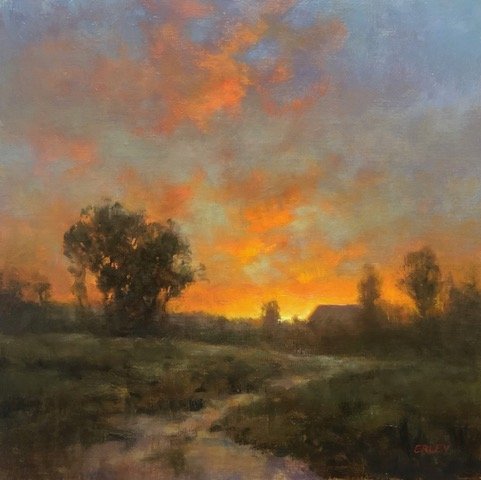
Catching up with Visual Artist Gerard Erley

“A work of art which did not begin in emotion is not art.”  - Paul Cezanne

 Homeward - oil on linen panel - 10 x 10 inches

Jasper: Can you tell us about your background - where you were born and raised, where you went to school, and how you came to live in Columbia?

 Erley: I was born in Springfield, Illinois. Progressing through a Catholic grade school and an all-boys Catholic high school, I went to college an hour from home, getting my undergraduate - and later my graduate - degree in art from Illinois State University. I worked various jobs, my longest (other than self-employed artist) being as a graphic artist for the Illinois Department of Corrections. 

Over ten years ago, I came to Columbia with my partner (now husband) Lemuel Watson when he accepted a deanship at the University of South Carolina. I taught art at USC for a few semesters, before devoting myself solely to painting. I felt the role of teacher could be filled by another, whereas only I could create the paintings signed with my name.

Matter-of-Fact Nude - oil on linen panel - 14 x 11 inches

Jasper: Where does your life as an artist fit into this trajectory? 

Erley: I was drawn to art making early on as a way of comprehending the world. If I could picture something, I felt I could begin to understand it. As one of eight kids, drawing also allowed me a quiet retreat away from the bustling family, a place where I could get to know myself as an individual and not just one of the herd. 

When the idea of choosing a profession later presented itself, I was debating between the life of a Catholic priest and that of an artist. Contemplating a future life of celibacy just as I was beginning to explore my own sexuality quickly turned my career choice toward the arts. Nonetheless, I do regard art as a spiritual calling, the studio as a church. I can’t help recalling Van Gogh’s failed attempt as a preacher before becoming a painter. 

Once I was set on the life of an artist and I got my college education, I worked part-time at various jobs, which allowed time in the studio. When fortune smiled, art sales alone sustained me.  

Aside from landscape painting, which is my bread and butter (though the slices can be thin at times!), I also paint still lifes, figures, portraits, and the occasional abstract piece. While generally my landscapes and abstracts are totally invented, the other work uses a different muscle, one requiring a deep look into what lies immediately before me. Meditating on an apple or a face, the world opens up in a surprising way. That has worked to my advantage in winning the ArtFields portrait competition in Lake City where I needed to complete three consecutive one-hour portrait in three rounds.

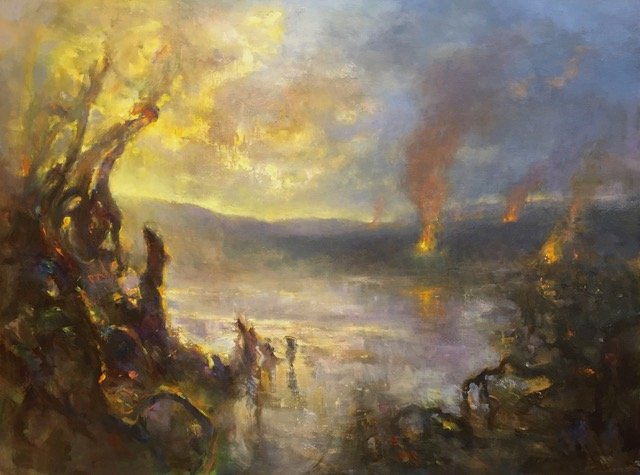
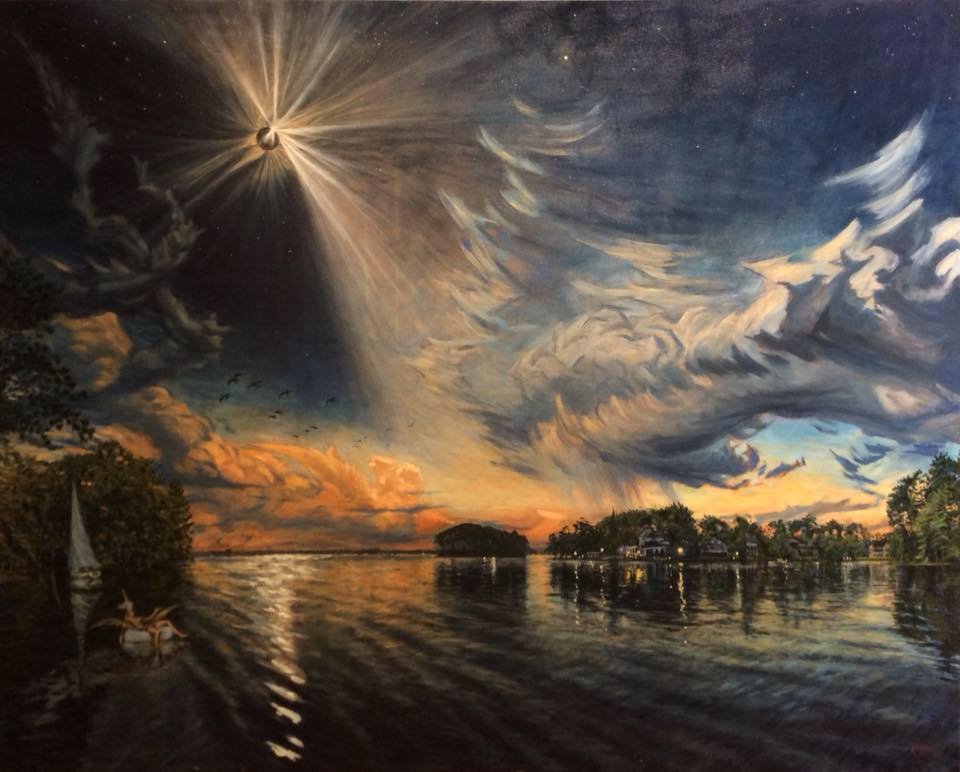
Dark Day Dawning - oil on canvas - 36 x 48 inches

In exploring the idiom of landscape painting, my vision sometimes takes a somber tone. "Dark Day Dawning" is perhaps a cautionary tale, an omen of a future born of present-day missteps.

Jasper:  When did you start realizing accolades as an artist and, of them, what has been most  meaningful to you? 

Erley: I received a silver dish (engraved with the obscure phrase “Best in Junior Miscellaneous”) for a drawing at the Illinois State Fair when I was fourteen or so. Since then, I have been the recipient of over 120 prizes, grants, and purchase awards. I am most proud of those I received from representatives of the St. Louis Art Museum, the Indianapolis Art Museum, the Fogg Art Museum (Harvard University) and the Metropolitan Museum of Art. To have those “in the know” get your work is indeed validating. However, it is the hundreds of people who have chosen to live with my paintings that holds the most meaning for me. I truly believe my job as a painter is not finished when a work leaves my studio. Instead, it requires an engaged viewer to complete it, to coax out its ultimate meaning. To know that so many people have chosen to take on that task is indeed humbling. 

Jasper: Who have been and continue to be your greatest artistic influences, how have they influenced you, and do you see them in your own work? 

Erley: Perhaps my greatest artistic influence has been George Inness, the 19th-century American landscape painter. His poetic and painterly approach sets him apart from earlier landscape painters. He chose to steer away from detail for detail’s sake, as well as the grandiose compositions favored by his contemporaries of the Hudson River School, such as Frederic Edwin Church and Albert Bierstadt. Instead, he focused on semi-abstract compositions based on an underlying spiritual philosophy. Light infuses the scene to create a sometimes-mystical mood, though it is often married with an undeniable veracity to nature. 

Aside from him, there is J. M. W. Turner (British), Jean-Baptiste-Camille Corot (French), and Caspar David Friedrich (German). All share a romantic vision centered on a transcendent quality of light.  

A contemporary painter whose work I enjoy is Joan Nelson. She will “quote” pieces of old master paintings in her intimate paintings. When I feel myself stretching in a more abstract direction, Brian Rutenberg’s colorful compositions inspire me.


Jasper: What have been your greatest artistic challenges and how have you met them or how are you meeting them? 

Erley: My biggest challenge is to remain fully engaged and juiced by the process of painting. Like any act of love, it requires an openness and awareness to what is called for in that moment. I fall short of the mark when I am distracted, uncertain, when I’d rather be someplace other than in the studio. 

I know that viewers will only be excited by my work if I am. That’s something that can’t be fudged. I’ve seen so many glib, slick, uninteresting paintings in my life, I just feel it does the profession a real injustice. To be invested emotionally and to embed those emotions in paint is always my goal.  

To learn more about Erley’s work and see additional paintings visit his website at gerarderley.com.

PRINTWORTHY! Michaela Pilar Brown is in the Right Place at the Right Time

Reprinted from Jasper Magazine Fall 2021

by Cindi Boiter

Over the past decade, Jasper Magazine has written about Columbia-based multi-media artist Michaela Pilar Brown many times. This passage of time has witnessed Brown become a leader in our community, not only as a result of her myriad accomplishments but also by the now-international stature she commands across the most-sophisticated fine arts circles.

Brown’s career has been punctuated by a steady continuum of shows, awards, residencies, and related experiences that have helped shape the 50-something artist into the fierce icon she is becoming. Taking home the 2018 Artfields Grand Prize for her mixed-media installation She’s Almost Ready is upmost among her accolades, as is being awarded the inaugural Volcanic Residency at the Whakatano Museum in New Zealand that same year.

Born in Bangor, Maine, and raised in Denver, Brown became an influential member of the Columbia arts scene soon after she moved here in 2013. Having spent many a childhood summer visiting the Fairfield County farm where her father lived, Brown had returned to SC a dozen or so years earlier to help care for her aging family patriarch. His land and its legacies were a part of who Brown was even when the she first left home to study at Howard University in the ‘80s and ‘90s.

“Howard felt like family. My professors let me continue my work even when I couldn’t afford tuition,” Brown says. “I spent a lot of time learning outside of academia.”

Critically influenced by such trailblazing American artists as Frank Smith and Jeff Donaldson, Brown identifies world-renowned sculptor Richard Hunt as impacting her work ethic the most.

Hunt, who may be the most highly accomplished contemporary Black American sculptor and creator of public art in the country, visited Howard to install a piece of his work during Brown’s time as a student. When a piece of his art was damaged, Brown was recruited to help with the repair. A burgeoning artist-protégé relationship led to an invitation to study with Hunt for a summer in Chicago.

“I was green and just so honored,” Brown says. “He worked fervently all the time and I worked all the time,” noting that she initially wanted to make public art herself. In fact, the young artist had interned at the International Sculpture Center, part of the Washington Project for the Arts, as well as the Smithsonian Institution.

The emphasis on family and the support systems it can naturally provide had followed Brown to Howard, where the faculty became supportive elders for the young artist. The intimacy and sacredness of her ancestral home not only informed Brown as an artist but also provided her with a profound understanding of the strengths and challenges of southern Black art writ large, as well as with the workings of the local arts community specifically.

After her father died in 2007, Brown’s mother soon also came to depend on her and her brothers for what ultimately would be end-of-life care. It was a crushing loss that further strengthened Brown’s resolve to take command of her platform like never before. The artist continued to bring the roots and wings she had embraced — on her home turf, in DC, and in Chicago — into an enduring relationship with Columbia-based theatre artist Darion McCloud and his daughter more than ten years ago.

“All these experiences changed the shape of the work I was doing and what I wanted to do,” Brown says. “My work became much more personal and honest. My focus came to include what it means to me to be Black in SC, but it also focuses a great deal on love and how we grieve.”

Among her major accomplishments over the last decade has been taking on the position of executive director of 701 CCA – Columbia’s Center for Contemporary Art. 701 CCA is located on the second floor of the historic 701 Whaley Street complex and featured on page XX of this magazine.

Arguably the perfect person for this position due to her local and international profile, Brown is the first Black woman to have this role, and she handles the responsibility with a resolute intensity. “701 [CCA] has historically been a place of inclusion,” Brown says. “I am engaged in protecting that and expanding it through exhibitions, programming, community dialogue, and programs outside our walls that engage the community directly in neighborhoods and through community partnerships. … We had a challenging moment recently, and I'm proud of who we are on the other side of it. I'm proud of the public statement we made and the manner in which we supported our artist.”


Brown is referencing the night of May 17, 2021. John Sims, an artist-in-residence at the gallery was living in an apartment assigned to him in the building at 701 Whaley Street when he was accosted, handcuffed, and held at gunpoint as a “suspicious person” by the Columbia Police Department. Brown released a statement in response to the attack, saying the incident was not the first time a resident at 701 had encountered the police. “It was the first time, however, such an encounter led to hostile confrontation, detention, cuffing, and a records check. On the contrary, such previous encounters have resulted in courteous apologies from officers. The difference? Race. Mr. Sims is a Black man; the other incidents involved a white man.”

“Like other community-based, nonprofit institutions,” Brown continues in her statement, “CCA has the responsibility to shine light on injustice it encounters and to be part of an active dialogue to make real and discernible change. We cannot ignore the relationship between white supremacy that permeates our culture and the racial profiling we believe infected John Sims’ treatment by CPD officers. … What we can and will do is support the efforts of John Sims as the CCA artist in residence to tell his story, to provide context for that story through his artistic expression, and to seize the opportunity to join with him and the greater Columbia community as we continue the struggle for racial justice.”

It is Brown’s intimate knowledge of the patrons of 701 CCA and the community it supports that informs this position so well. “I am optimistic about the Columbia art scene,” she says. “This is a community that wants change, that's ready to face the challenges of the moment with art leading the discussions. I am hopeful that our politicians recognize the value of art for the betterment of this community, for the comfort it brings, for the space it makes for challenging conversations, and for the expansive learning opportunities it offers young people. I also hope they support it with dollars, and not just the legacy institutions, but in an expansive, inclusive way.”


ESSAY: Thinking and Acting Radically About Climate and the Art World by Will South

“This is a real problem, with real consequences. The art world, as it turns out, is far from green.”

2017 Venice Biennale sculpture - SUPPORT - by Lorenzo Quinn reminds participants of rising sea levels that threaten Venice and all coastal cities around the world. The installation, first unveiled by Quinn at the Venice Biennale in 2017 and commissioned by Halcyon Art International, shows two gigantic hands of a child emerging from the Grand Canal in Venice to protect and support the historical building of the Ca’ Sagredo Hotel. "Venice, the floating city of art and culture that has inspired humanity for centuries, is threatened by climate change and time decay and is in need of the support of our generation and future ones”, said Quinn. “Let's join 'hands' and make a lasting change”. (United Nations Climate Change webpage)

Thinking and Acting Radically about Climate Change and the Art World

The positive effects of art on civilization would be difficult to list. Art and civilization are intimately entwined, each giving birth to the other in a continuous spiral of creative regeneration: that is, Leonardo produced the Renaissance at the moment it was producing him.

People all over this planet better understand now how tradition and innovation coexist, that tradition underscores identity and yet artistic innovations allow for inevitable changes. Art identifies what we value, and gives sound, narrative, movement, color, and shape to these values. As both process and product, we cannot remove art from the complexities of the human experience. It is fundamental to how we understand the world: To see a glorious sunset is one experience; to read exactly the right words to relive that experience is a minor miracle.

Readers of the present magazine will find no fault whatsoever with these two introductory paragraphs. This is a journal devoted to the support of art and artists in our community. Which may make the following statement a bit of a shocker:  The art world is a significant and unapologetic contributor to global warming.

No! you say, how can this be? Artists are the sensitive ones, the ones most open to change and action and to spreading the word (through art) that we all must act to create a sustainable, healthful world.

Relax. Of course, you, the artist/collector/reader of this journal are a proponent of mitigating the horrific symptoms of a heating planet—floods, fires, droughts, and virtually every other form of molecular mayhem.

Still, this holds: The art world is a bad actor when it comes to climate change. And here is why:            The art world is comprised of hundreds of thousands of galleries, museums, studios, art fairs, and private art collections worldwide. All of these entities ship art. Art is heavy, often, and needs to crating and boxing before it travels. To ship one two-hundred-pound crate by air from New York to London puts a thousand pounds of carbon into the air.

That is one shipment, one-way, a thousand pounds of carbon emitted.

One hundred such objects would result in fifty tons of carbon released into the air. The typical American car puts out about 4.5 tons of carbon, in a year. If those one hundred crates of art come back to New York (which they will, if they were on loan), then the emissions add up to a whopping one hundred tons of carbon requiring a mere eleven total hours of flight time to be released.

The art world thrives on shipping. Museums crate exhibitions and ship them not just to one venue, but to three or four before those crates return home. Now the math gets fuzzy, because there are so many museums, galleries, collectors, and art fairs shipping stuff and no one keeps track of it all vis-a-vis the climate. Someone should be, or a group of someones, as in a consortium of registrars.

There are 55,000 museums in the world. Not all are shipping monsters, but all of the big ones are—the Louvre, the Met, the Tate, etc. Let’s say, for sake of argument, that a mere .5 percent of all museums are “big.” That would be 225 museums. Further, let’s assume that each of the big museums hosts half a dozen traveling shows per year. That’s 1,350 shows, each with round trip shipping, let’s say, based on the New York to London numbers above—one hundred tons. That adds up to 135,000 tons of carbon in a single year. And let me assure you this: The actual art world number would be much higher—our example doesn’t include galleries, or projects from the other over 50,000 museums that are shipping more than a few things here and there all the time.

This is a real problem, with real consequences. The art world, as it turns out, is far from green. Like every other business, they are interested in green, a bit more it seems than the natural kind. Museums (and galleries, and art fairs) need cold, hard cash (or, warm, either way) to survive. The effects of non-visitation are instant and lethal. In 2020, worldwide museum attendance dropped a breathtaking 77%, from 230 million in 2019 to 54 million in 2020. Museums reduced hours, cancelled traveling shows, and laid off staff. Yes, many museums closed. Not any of our lovely little museums here in Columbia, but the pandemic isn’t over yet.

To get back to the vital, bustling businesses they were two years ago, museums will work to ramp up their schedules. Museums need money. It’s the fuel that drives their engines. But driving is the problem that is making the art world a carbon criminal. Getting all that art, all the time, from one place to another.

Is there a solution?

As with most enormous crises: Maybe.

For starters, museums can organize smaller, more lightweight exhibitions, which consume less energy to ship. Not all exhibitions need to be the theatrical behemoths they have become and to which museumgoers have become habituated. Most museum goers, however well intentioned, suffer fatigue after looking at 60 or 70 works and reading the labels and sharing comments with friends. Trying to experience 150 works of art is a job, not a treat. Museums, in their efforts to out-museum each other, have made shows ever bigger and ever more ponderous and, in many cases, a whole lot less fun. Get smaller. That’s the first and most obvious thing to do.

Build crates out of lighter material. Make use of crush-proof masterpacks when possible, as opposed to wood and steel. If an object requires tons of packaging, how about don’t send it anywhere. A tough choice, sure. But we’re in a crisis, and crises require sacrifices. Serious sacrifices.

Host fewer traveling shows. Yes, that will hurt any museum’s bottom line. On the other hand, it might inspire in-house innovation. What kinds of projects are possible with the permanent collection that are not boring collection surveys?

Some museums sponsor “close looking,” where a painting is set up to be looked at for over half an hour, up to an hour. Imagine what you could see, if you stared at an object that long, looking for every subtlety and nuance you could find. An hour won’t reveal them all. Close looking is just one idea. Be creative—that’s what the art world is good for.

Get people in the community to physically recreate their favorite paintings during a festival dedicated to just that—the tableau vivant, the living painting. Tableau vivants are fun to do, awards may be given out, and of course no art event is complete without booze, and that can be purchased locally.

And now, for the really radical idea: The big museums have way more art than they will ever be able to show. In America, the Met, MoMA the Art Institute of Chicago, all have collections numbering in the hundreds of thousands to the millions. If the largest collections gave away (not loaned, gave) a few thousand pictures each (which they wouldn’t even miss) they could greatly enrich the many small-to-midsized museums in the U.S. Point being, if the museums in South Carolina, Georgia, New Mexico, Utah, North Dakota, etc. etc. all had better art, they might increase visitation while reducing the number of traveling shows they, too, feel compelled to do.

That would be real change. The ridiculously enormous art collections are already teetering on unsustainability and would do themselves a spectacular favor by spreading their riches around.

Wait—what? This sounds like socialism. Well, yes, I suspect this idea does have a whiff of fairness, practicality, and sustainability about it. Mostly, though, it is a radical idea, submitted here in the spirit of let’s all be thinking radically.

Would such a proposal really “work”? Truthfully, I don’t know. But for an idea to be explored, it has to first be on the table. Sure, such an idea would be problematic. But the problems would be nothing compared to the devastating problem we are now facing.

At a distant point, and let’s hope there is one, future art lovers will be able to look back and say that early 21st-century art activists got radical in response to climate change, and the result was not just smart strategies to help cool the planet, but its radicality led to spreading art and its magic more equally throughout the world.

Not a bad legacy, however socialistic.

— Will South

Will South is an independent artist, curator and writer based in Columbia.

New Art by Bonnie Goldberg - An Online Jasper Exclusive

Jasper is delighted when we see treasured artists in the Greater Columbia Arts Community take their talent in different directions, so we were thrilled when figurative artist Bonnie Goldberg agreed to share some of her work with us.

Jasper asked visual artist Bonnie Goldberg to take an assessment of her life as an artist as we all find our ways through what is, hopefully, some of the final months of Covid concerns. This is what Bonnie had to say:

In the beginning of the pandemic, I did stay home and paint a lot. I created a space upstairs in my house and spent a lot of time working on drawings and paintings. Because I had already decided to work in a more abstract manner and use my own paintings and photographs as reference material, I had no need of a model, so it was not a problem not being able to hire someone to model for me. I find that working this way allows me freedom to create new iterations of former work and also work pure abstraction focusing on color and line and shape. Because I had no social life, I was able to throw all of my attention into my work and focus on innovative ideas and new directions. I love the new work that I am doing...I often paint without using a brush...applying the paint with various tools and edges, making marks, and finding new ways to draw and create line without a brush or pencil. There is a lot of layering and "lost and found" color and edges and I find it both challenging and exciting.  

I am back to painting in my studio in the Arcade on Main...I have a small space upstairs and it allows me to paint and allow limited access to the studio from people who visit the building. I am still careful, but fully vaccinated and able to focus on my art in a very intense and personal way. Creating art is always an inner experience for the artist and for me, with music playing and light from the beautiful skylights in the hallway, I am doing my best work ever. I have taken more chances, done more experimenting, and painted more abstractly. And I love it. I do still incorporate the figure into a lot of my work, but sometimes it is only a line or a gesture or a suggestion of a figure, leaving the interpretation to the viewer.  


I am still represented by galleries and interior designers, but I retain the right to sell my own work and I show a lot of my work on social media...Facebook and Instagram reach thousands of people and allow me to show images of my work to many people who in turn often reach out and purchase work. This is a boon to artists to be able to show and sell work in this manner. Instagram has allowed me to not only show and sell work but connect and share ideas with artists around the world. The art world has changed, and I sell more work and see more art from other artists than ever before. 

I love the small studio space that allows me to see everything that I need and work on. You can see from the images that I am creating and layering and abstracting in many sizes and shapes and this is inspiring me to do more in this direction. Art and artists are always evolving, and I look forward to seeing where I can take my work next....just open that door, walk through it, and see what happens....


Featured CCA Biennial Artist Reclaims the Feminine Through “Monstrous” Installation

“…rather than reiterating these narratives throughout history of what makes women ‘women,’ or what makes women monstrous, I think women should be the ones to decide and to retell those narratives.”

Think of your favorite werewolf. Are you a traditionalist watching American Werewolf in London? Maybe your high school years were filled with Team Jacob debates or MTV made you a Scott McCall fan. Regardless, think about what all these representations have in common. What would these look like if the main monsters were women? 

This is what new South Carolinian, artist Marina Shaltout, asks in her installation Bad Bitch. Told best in her own words, this installation is a “meta-camp, multi-channel video installation that tells the story of a female werewolf exhibiting three symptoms of PMS (Ravenous, Reckless, and Raging).” 

A female werewolf being new or surprising is inherently ironic—women are no strangers to being portrayed as monsters. However, the feminine monster is typically just that: feminine. Think Uma Thurman’s Poison Ivy or Jennifer Lawrence’s Mystique; even in a non-human form they remain feminine, complete with sexual organs and rife with sensuality.

 If women are ever portrayed as fur-covered monsters, they are rarely allowed to be seen as women, losing all sense of femininity. This is the dichotomous relationship of the female monster, either too feminine or not feminine at all.

 Shaltout relates this in part to the experience of women portrayed by the media, saying, “It's this really interesting process where we women have this notion of, ‘I want to be this woman, but society hates this woman and deems her crazy or problematic or undesirable, so I also hate this woman and therefore I hate myself.’”

 With her own body, Shaltout resists this patriarchal narrative that defines the feminine by its standards. In these installation videos, she dons a full-body wolf costume and dresses it up with wigs, jewelry, and nails. She refuses to let the monster lose its femininity and refuses to let that femininity be comfortable.

“I explore mythologies of females throughout history and the way that we conflate femininity with evil and societal problems. I specifically consider how female monsters are sexualized while male monsters are bad-ass grotesque figures, and I'm interested in flipping those gender notions of what a monster has to be,” Shaltout reveals, “But rather than reiterating these narratives throughout history of what makes women ‘women,’ or what makes women monstrous, I think women should be the ones to decide and to retell those narratives.” 

This narrative consists of three videos, featured on three individual, decorated TVs. Each video presents the main character—Shaltout in costume—in three action sequences: in one, she is eating cakes messily, surrounded by purple fur and the moon that beckons her; in the second, she is putting on makeup at a light blue vanity with its shattered pieces creating the frame itself; and in the third, she is dancing, moving with glitter and framed by the oxymoronic exotic yet inherently natural foliage. All three parts of this installation coalesce at a peak wherein the character at their center stops existing to please the watcher.

 All the materials seen in the videos and on their frames are either handmade or personally sourced by Shaltout. The vanity was found, while the pieces on the frame were created to simply look like the broken furniture in the video. The cake fixtures actually came first with the pastries in the video baked by Shaltout to match. These “moments of artifice,” as she calls them, are key to her work and bridge the faux with authenticity. 

Learning what to create and what to reuse is key to ensuring her process moves along seamlessly, and Shaltout’s varied artistic background surely helps. Though born in Missouri, she grew up in Illinois where she went to college and received her BFA in Jewelry and Metalsmithing before doing a residency at New Mexico State University and finally becoming an MFA candidate in 3D and Extended Medium at the University of Arizona.

 Her work with 3D sculpture aids in hands on work, like wrapping violet fur or placing robin egg blue wood on a TV frame. Her work creating appendages supports her visual eye, seen in the careful cultivation of wardrobe or recreation of baked goods. And her work with body-based installation and performance allows her to blur the line between self and other. 

“Visuals is my favorite part. It's me saying does this glittery dress work for this? It's a gathering of materials and then kind of playing around to see what will work, and a lot goes into it,” she intimates, “I think I debated about the color of the wig for two weeks straight. These little things—they're arbitrary and yet hold so much weight—and at the end of the day, I get to make those decisions myself, which is really cool.” 

Video installation adds a fresh layer to performance in this ability to shift visuals and have multiple takes and edits. There are never many cuts, but Shaltout is able to play with lighting and color, even recreating sound. There always is an organic element, however, to what happens when the camera is turned on, and some things, like breaking the vanity, can only happen once.  

“I do script; I storyboard. But I'm more of a writer, so I'll write out the sequence of actions that I plan to take in my videos. And I kind of have that as like a blueprint, but a lot of times my work is improv,” Shaltout describes, “I set myself up with my props and with the general idea, but a lot of it is just kind of going with the feeling in the moment.”

 Donning these costumes and props both makes Shaltout appear as if she could be anybody and specifically embodies a particular part of femininity and perception of the feminine. What at first glance could appear as a strange, silly Halloween costume is a rumination on the very control of women’s bodies and personas, and by turning our expectations of both storytelling and genre on their head, Shaltout is able to reclaim the monstrous feminine.  

In the future, Shaltout aims to continue these stories in different, yet perpetually linked, personas. Her current idea involves mimicry, flowers, and phallic-shaped foods, but that’s your sneak peek for now. Regardless, she will continue to assert that if you’re going to represent me as a monster, I’m going to make you look at me as the “monster” I truly am. It is her, and our, narrative now. 

So—why are there no woman werewolves? They make people in a patriarchal world uncomfortable. They represent a breaking of boundaries and a power that makes people scared. But they should be. And we, as women, should be comfortable and proud of our power, fur and claws included. 

Bad Bitch is currently on display at 701 Whaley’s Center for Contemporary Art as part of their “Biennial Part 1,” which is up until November 14th. Read more about the Biennial here:

Shaltout now resides in Hartsville, South Carolina, teaching at Coker University as a Visiting Assistant Professor. You can follow her journey at her website.

-Christina Xan

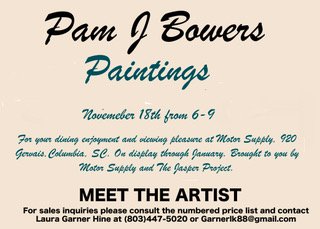
Jasper Galleries presents Pam Bowers at Motor Supply

The Jasper Project is delighted to welcome the work of renown visual artist Pamela Bowers to the Jasper Galleries space at Motor Supply in Columbia’s historic Vista.

A Chicago native, for the past 20 years Pam Bowers has divided her time between in Columbia, South Carolina, the Umbrian hill town she calls her second home, and her world wide wide travels.

She has exhibited her work internationally at venues that include the Guilin Academy of Chinese Painting in China, the University of Fine Arts in Budapest, numerous venues in Italy, University of Newcastle in Australia, and the Ecole Nationale in Rabat, Morocco.

Nationally she has exhibited at the Bowery Gallery, New York, Blue Mountain Gallery New York, ARC and WMG galleries in Chicago, and many other university or museum venues including the the State Museum of South Carolina, City Gallery at Waterfront Park In Charleston, the University of North Carolina, Charlotte, and St. Mary's College of Notre Dame among others.

This is one of the first solo exhibits of her work in Columbia for many years.

Pam has lectured on her work and conducted numerous workshops both here and abroad. Her work is represented in numerous public and private collections. Additional works can be seen at pamjbowers.com.

About this exhibition and her work, in general, the artist says:

The work in this exhibition spans decades of my career as a painter and my life as an artist. As a kind of lifelong travel journal, these works express my passion for color and materials while reflecting my personal stories and imaginative musings on nature. Mine is a playful but serious practice rooted in the experience of the senses. I often paint directly from life outdoors; celebrating its elemental beauty through observation––watching the play of light across a flower, the flow of water over rocks, a storm at sea or the subtle movements of animals. I then bring these perceptual works into my studio where they inspire more elaborate pieces that allow for layers of imagination, meaning, and metaphor. Through a process of free association I enter into an almost sacred feeling, intimate kind of mental space within my psyche.  In this, I create works that speak to the experiences, emotions and thoughts present in my life’s journey.. In pursuit of this inspiration I have travelled widely working and exhibiting in many enchanting places across the globe. However, the watery Southeastern coastal areas remain closest to my heart. My studio in the woodlands between Columbia and the coast serves as basecamp for many adventures and excursions to explore our beautiful landscapes’ flora and fauna both here and beyond. I hope you enjoy this show.

The Jasper Project

will host a

Meet the Artist Evening

in the Motor Supply Bar on

Thursday, November 18th from 6 - 9pm

during Vista Lights.

Please come by, say hello to Pam, pick up the newest copy of Jasper Magazine, and have a drink or dinner at Motor!

Closing Reception for Nikolai Oskolkov's Art Exhibit at Motor Supply

Thursday, October 28th at 5 pm

Motor Supply

Friends and Patrons! Come out to Motor Supply restaurant downtown Columbia upcoming Thursday for an informal drop-in closing and art sale...meet the artist, order a drink or two from the bar and check out a large selection of NikO Art currently on display...Blessings and Inspiration to all and see y'all soon!

As Niko has returned from a recent trip to his homeland he has this to say:

“The recent trip to Russia is as always nostalgic, which is an emotion that is very dear to me.. .it is where my roots are, memories of childhood, when life is naturally brighter, more colorful, happier, so its always very healthy to revisit...the nature and people there are very close to the heart, even though Carolina has always been a great home, with many loving caring people who love art and music and allow artists a practical opportunity to develop and express themselves in any way they see fit for themselves...”

About this exhibition of his work at Motor Supply:

“The show is passively thematic...meaning it has a fairly benign focus on landscapes and scenes of our South Carolina, and the place that enchants me quite a lot...Venice...I am absolutely in love with Venice and love to revisit it through painting so I can possess it with sight and touch...so I can extend my time there...The advantages of a restaurant setting is of course the traffic of new fans and potential patrons is more regular, and that it doesn't have to be anyone looking for fine art in particular, so they can be surprised and truly inspired, instead of looking for inspiration or art intentionally, and feeling unsophisticated or inadequate when visiting an often exclusive, lofty commercial fine art galleries...I believe art is for EVERYONE...”


Renee Rouillier Explores Joy and Freedom Through Sculpture in New Tiny Gallery Show

October is a month of transition: first cool mornings of the year, beginning of turning leaves, and the first thoughts of holiday get-togethers. Renee Rouillier explores the larger transitions of freedom and confinement, loss and joy, in her Tiny Gallery show, Messages from Nature. Learn more about her and her show, which is in its final week, below!

Renee Rouillier grew up in rural Upstate New York as one of four siblings in a time where “the world felt like a safer place to live.”

Rejecting any safety nets, however, young Rouillier embarked on a brief journey to an Airline Academy before settling in Rochester and enrolling in its Institute of Technology’s evening art program. At this time, she mainly worked with two-dimensional art and received a Certificate of Fine Arts.  

A new path opened after Rouillier underwent major surgery in her early 40’s. At this time, she decided to quit her job and return to school, choosing the Arts Program at SUNY Brockport.

“This is where everything began to come together,” Rouillier recalls. “I found myself evolving into the person I was meant to be and realized what a difference it made when someone believed in your capabilities and provided unconditional support.”

Soon, this blanket of enlightenment spread wings when Rouillier became immersed in and inundated by sculpture and clay, which she felt unlocked a connection she had never been able to find in 2D art. She began exploring interests and ideas, finally settling in a pocket of inspiration around Surrealism and German Expressionism.

“I began winning awards and honors and more importantly,” Rouillier asserts, “I began to believe in myself…drawing from art with an edge, dark side, or unforeseen side of reality.”

Not long after, Rouillier graduated with a BFA and a BS in Interdisciplinary Arts for Children with Honors and was offered a fellowship at the University of South Carolina concentrating in Ceramics and Sculpture, both studying and acting as a Teaching Assistant and Instructor of Record in Ceramics and Three-Dimensional Study.

“This is also another time-period I will always treasure,” Rouillier intimates, “The total involvement and atmosphere created between undergraduates, graduate students, instructors, and professors to create a whole interactive community; I cherished teaching and my students.” 

This experience culminated in an MFA, followed by an additional eight years of teaching at USC Columbia, USC Aiken, Columbia College, and South Carolina State University, before fully settling into the art community in Columbia, participating in events like The Supper Table, where she designed the place setting for Dr. Matilda Evans.

In preparation for her Tiny Gallery show, Rouillier turned to pieces sculpted before the pandemic but not completed. When the studio she sculpts at reopened, she began selecting pieces and adding surface treatments, which is “accomplished using oxides, underglazes, and glazes with multiple firings.”

Rouillier’s process for this show reflects both her baseline as an artist and her emerging feelings from the COVID-19 pandemic.

“I find myself continuously observing my surroundings, interactions, and world events,” Rouillier shares, “This series focuses on the freedom and joy, or my so-called interpretation of it, that I felt animals and wildlife experienced during our confinement.” 

Messages from Nature is filled with ruminating animals, not revealing their thoughts, but staring straight ahead as if beckoning you into conversation. Monkeys and hippos float as avian and amphibian friends perch on their rounded heads. Leopards and rams sit in an excess of both their own patterns and patterns not inherent to them. All the while, these ruminating animals are punctuated by the occasional face of a girl or goblin.

Rouillier’s personal favorites from the show are “Unusual Friends” and “Mystical,” the former of which reflects a challenge she faces—adding that little additional touch that completes the piece.”

“When I built the hippo, I liked it by itself, but it needed an additional element: the hummingbird,” Rouillier reflects, “When I underglazed (matte) the hummingbird and initially fired it, something still wasn't quite right—I put that little touch of gloss glaze on the beak and that did the trick.”

Renee Rouillier’s Messages from Nature will be available to peruse and to purchase from 24/7 on the Jasper virtual gallery space until October 31st: https://the-jasper-project.square.site/tiny-gallery. If you are looking for a unique holiday gift, a handcrafted sculpture is irreplaceable.

As for the future, Rouillier “can’t wait to see what evolves,” and you can follow her journey in the community as she takes on new adventures with her three-dimensional creations.

- - Christina Xan

Zachary Diaz and the Recycled Parts of Life

“If you’re always following the recipe, that’s as good as it’s ever going to taste.”

Zachary Diaz’s upcoming Stormwater show started with a ball of paper.

Years ago, Diaz wrote (and quickly discarded) an emotional letter to an ex, only to find the wadded paper months later. Capturing the words he had written on the page in a still life, Diaz hesitantly included the drawing of the letter in an earlier exhibition at Stormwater Studios. 

Several people pointed out the piece to him in the show, and Diaz started to realize a point of connection. “If that’s one way that I can connect with total strangers, how many more ways can we connect with other people? What other experiences or memories or reflections do we have that coincide with how someone else has felt?” Diaz asks. From that moment, a residency was born.

Diaz’s residency at 701 Center for Contemporary Art expanded this idea of unsent letters by outsourcing writing. Participants wrote letters to people or experiences, which were published anonymously on Diaz’s website. Several were selected to be the subjects of drawings that will be featured in his upcoming exhibition, which shows at Stormwater Studios from October 8-17.

This show is a combination of work from this residency and an earlier show called Cloudwalker, both of which were partially released online due to the pandemic.

Cloudwalker features clouds, as its title suggests, birds, and varying figures hidden in the compositions. “I like creating narrative stories that the viewer can make up themselves… I sort of lay the groundwork — I give them all the accents— and they can kinda come up with their own imagination what’s really going on,” Diaz says. He likes making work that makes people think.

The Letters portion of the show is ongoing throughout the duration of the exhibition. Viewers will be invited to submit their own letters, all of which will culminate in an installation that will be featured in the show’s closing reception on October 17 from 6-8pm.

While Diaz is still conceptualizing how the installation will look, he plans on ordering the letters in a way that reflects their content, identifying themes such as love, forgiveness, and varying emotions.  

Since starting the Letters project, Diaz says he’s become a lot more interested in how he feels when he’s making. His earlier creative process involved stricter planning and reference sketching. Now, Diaz works more intuitively, which, in turn, has made projects go faster and made him more aware of what he’s creating.

Diaz tends to mix mediums in nontraditional ways, layering oil paint over gessoed paper and drawing on top with charcoal. “I don’t think there’s any concrete way to create something” Diaz says. “If you’re always following the recipe, that’s as good as it’s ever going to taste.”

By making the letters in this show anonymous, Diaz says that he gives people a shield to really be honest. This openness displays his belief that so many experiences in life are shared, whether you know it or not.

Diaz describes the exhibition as a dive into his mind. “If you’re interested in learning more about everyone around you through the eyes of an artist, then come to the show,” Diaz says. “It’s a story in two parts… Cloudwalker is about how I see the world and everything around me. Letters is about how you see the world and learning more about the people around you.”

The opening reception for the exhibition is October 9 from 5-8pm. Whether by attending the show or submitting an anonymous letter yourself, Diaz wants to help create connections.

“Artists are gardeners. We make roses from the recycled parts of life,” Diaz says. To see how one crumpled piece of paper turned into a show, stop by Stormwater Studios before October 17.

 - Stephanie Allen

Bohumila Augustinova Carves Shapes and Stories into Clay in New Tiny Gallery Show Layers

As we enter the second half of September and inch closer to fall, so do we mark the halfway point of Jasper’s Tiny Gallery show with Bohumila Augustinova. The show, Layers, presents 20 pottery pieces that highlight, mainly, the Scraffito technique.   

Augustinova spent her childhood in Czechoslovakia, now known as the Czech Republic. She recalls that her younger years were spent always making something and that she could “never keep [her] hands still.” 

“My mom and dad were very supportive, so even as a small child they taught me how to knit, crochet, sew, cook, and use power tools,” Augustinova remembers. “My mom and I used to make all the costumes for me and my brothers, and I was making my own clothes by the time I was 9.” 

Augustinova used this experience and passion to pursue fashion design, which she received a degree in, but soon after, she desired a fresh artistic venture and has since worked with primarily wire art and pottery, being self-taught in both.  

Currently, clay is her preferred medium, but she insists that her and wire are simply on a “break” and that she hopes to integrate them in the future. When it comes to her current technique, Augustinova has been utilizing Scraffito, a “surface decoration technique where color (underglaze) is applied on leather-hard (raw) clay and designs are carved though the color, exposing the clay underneath.”

“When my work closed last year, I figured I needed to stay busy. I could throw a full bag of clay in one day, but then what?” Augustinova pondered, “I took a Scraffito workshop but never had time to explore the technique, so I figured I would just play, and I immediately fell in love with it.” 

Augustinova’s first experiments with Scraffito were doodles from her childhood, and soon, new designs began blossoming before her eyes. Sometimes she already has in mind how she desires a piece to look and pulls it into existence, while sometimes the clay takes shape and flows together into its own identity.  

“Last year I made a mug for my partner inspired by mid-century design, and it was a big hit, so I started messing around with different mid-century designs, which I still love,” Augustinova shares. “I was also working on piece where I was just free handing lines and patterns and then I realized it looks like water, so clearly sitting by the pond inspires me too.”  

Augustinova notes that beyond being inspired to make art, the process of making is inspiring and therapeutic all on its own. She insists that the mutable clay sliding under her hands and the constant hum of the wheel moving is meditative, and she often throws with her eyes closed. 

“After throwing, you apply the underglaze, which I like doing before the actual carving…the carving is where I get lost in my own world,” she says. “I can sit there for hours, listening to whatever I am listening to and work. There have been times when I worked till 2 am or just until I ran out of things to carve.”  

Scraffito is an extremely detailed and precise process that balances this space of being outside and fully within oneself. Even the coloring and glazing process is multilayered—literally—and requires great attention, focus, and a bit of luck with the kiln.  

“I am always looking for good balance of the color I applied and the exposed clay. With pottery and Scraffito, how the piece looks when you finish carving is very different from how it will look after both firings,” Augustinova explains. “After the first firing, the colors will be more vibrant but still a matte finish, and after glazing the colors will come out even deeper and shiny.” 

For this show, specifically, Augustinova has gathered a combination of new and old work, with the goal of offering a large range of sizes and prices for various audiences, but a few pieces were made specifically with this show’s goal in mind. 

“What I hope is that people will see my pottery as usable art. Almost all of my pottery is fully glazed and food safe. I love seeing flower arrangements in my vases, and I love people drinking out of my cups,” Augustinova effuses. “One of my favorite pottery moments was when a friend told me that he was visiting a friend and his tea was served in one of my mugs.” 

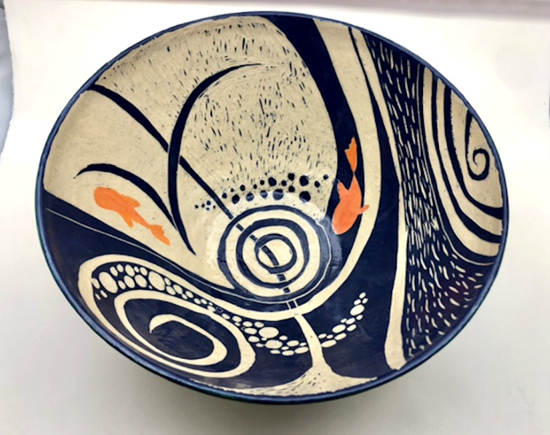
If you enter the virtual gallery space, you will see small vases with vibrant designs in pinks and greens, large bowls with detailed carvings in deep jeweled tones, and smooth geometric vases looped with wires that reach to the sky.  

While new to showing pottery, Augustinova is far from new to the Columbia art scene, having managed Anastasia and Friends gallery for several years, worked at the Columbia Art Center (her current occupation), helped lead the Yarnbombers, and won Runaway Runway twice. Her favorite memories as an artist surround this process of making and sharing art. 

“As I am sitting here and answering these questions, I am waiting for the kiln to cool down. I value the moment something comes out of the kiln, and you love it so much you may tear up,” she says. “But it’s also hearing from people how much they love my work. There are few of my friends that have serious collections of my stuff and I just feel so honored by it.”  

In the near future, Augustinova hopes to do new fall and winter shows, and though specific plans are not in place, she will post updates to her Instagram @art_by_bohumila 

To explore Bohumila Augustinova’s pottery, which is only available until the end of September, head over to Jasper’s virtual Tiny Gallery: https://the-jasper-project.square.site/tiny-gallery

Stephanie Allen Questions Perceptions of the Female Form in First Solo Show

“Who owns [the female body]? What does that mean? …begin challenging the way that we look at art versus the way that we look at human beings” — Allen

If you enter Cool Beans to grab an afternoon coffee, waiting in line with you will be a vibrant triptych of the female form. As you find a place to sit, you may cozy up by stark black sketches of a hauntingly familiar—yet distant—woman’s face.

 This rumination on femininity and the body is the work of Stephanie Allen, a senior in Drawing and English at the University of South Carolina (UofSC). Active in the art community, Allen has served as an intern for the Columbia Museum of Art and The Jasper Project as well as edited for The Daily Gamecock. A previous participant in juried and group exhibitions, this is her first solo show. 

Allen is a South Carolina native, having spent her childhood in Charleston before moving to Columbia to attend UofSC. In the past three years, she has experimented with various styles and mediums, and as she grows into herself as an artist, she finds herself circling around questions of gender and connections between the exterior and interior self, based specifically on perceptions of the female body.   

This show is rooted in these questions and presents a journey through the work Allen has created during undergrad, mostly in the past 2 years. The selected pieces are mostly in her two preferred mediums: oil painting and India ink sketches, the latter of which she uses a bamboo stick to create.

 “Oil is so vibrant and saturated, and it also takes much longer to dry, so I'm able to take my time and really work through both the colors and the piece as a whole,” Allen reflects, “When it comes to ink, I like that the drawings are very transparent in that I can't hide when I mess up. There's no erasing, there's no going over—you have to be able to work with mistakes.”

In terms of her evolving style and what she has grown into, Allen finds herself leaning more towards the abstract even though realism is what she most often explored in her early years. Though all the pieces in the show are clearly bodies, they may not always be “realistic” or even show the full body—faces are rarely a part of Allen’s work.  

“Hands are something that I’ve begun to do a lot of. Hands have a capacity to be very emotive, but in a way that’s still anonymous,” Allen explains, “When you see a face emoting, and you're wondering, ‘What is that person thinking about?’, hands still have that and can be evocative in a very similar way without you immediately wondering, ‘Who is that person?’ It gives a much broader definition that takes the focus away from a singular experience.” 

Whereas the feminine form in body or hand allows for an experience that relies less on identity and more on message, two pieces in the show are sketches of a female face. “I think it's the eyes that make it,” Allen says in relation to their bridge between anonymity and identity. The faces, while clearly faces, being sketched over in ink so many times makes them appear both distinctly human yet somewhat inhuman and monstrous at the same time. 

Sitting in this interstitial space between the real and imagined, both as a woman who teaches women’s fitness classes and as an artist who perceives the female body, Allen has had to reckon with her own mindset about women’s bodies, even her own. 

“I think one of the things that I have to try to remember is that there is a gear shift. When I look at drawings or paintings or the feminine form, it’s easy to say, ‘This is art and something beautiful,’” Allen effuses, “But then you see those in real time, and they tend to judge and pinpoint imperfections that simply aren't there. The body is the art, and the body is the person, which is so much more pertinent.”  

With a collection of past work on display, Allen turns her focus to her Honors Thesis and Senior Show, which will expand on these same themes but with a focus on queer women and non-binary people and their relationships with their bodies and femininity. 

“It's going to be an interview-based series, where I interview a subject about their relationship with their body,” Allen divulges, “Then I'll have them pose for me or send a picture of their body for me to sketch. I'm not planning on doing faces in this either.” 

Though it’s still months away, Allen is considering layering the art with realistic drawings based on the individuals’ photographs in the background and abstract paintings derived from the interview responses on plexiglass hanging in front. 

Whether you encounter Allen’s work at Cool Beans or her Senior Show this spring, she hopes you’ll ponder the following: “I hope my work leads to questioning of how we perceive the female form. Who owns it? What does that mean? And then, in that perspective, I hope others begin challenging the way that we look at art versus the way that we look at human beings.”

 Allen’s show will be up until Sunday, October 3rd. Cool Beans, located at 1217 College Street, is open weekdays from 7a - 10p and weekends from 9a - 10p.


Jasper Galleries Welcomes Nikolai Oskolkov to Motor Supply Company

Nikolai Oskolkov (NikO) is a painter and musician based in Columbia, SC. He graduated from University of South Carolina in 2006 and has been active in the local art scene for the past 15 years.

Niko 2.jpg

A seasoned traveler, NikO chooses subjects that are reflections of personal experiences ranging from Southern landscape and dreamy scenes of Venice to portrait figures and surrealism.

Niko1.jpg

Rich, natural colors in oil invite the viewer to familiar and distant places.

Lately NikO has been exploring the concept of commission artwork and is most eager to engage in a wide range of projects

The show will run until mid-October.

Ron Hagell Weaves Personal and Collective Pasts into a Common Future with “Acrylidemic”

“As artists, it's our duty to do things like this—to use our voices to point out mistreatment and wrongdoing.”

— Ron Hagell

As we turn the corner on July and its sweltering days, consider exploring Ron Hagell’s Tiny Gallery show, “Acrylidemic,” from the cool four walls of your home. To learn more about the show, which runs until the end of this month, and about Hagell’s life, keep reading! 

Hagell’s father and grandfather were both artistic creators who inspired him, and the stories of his grandfather’s work linger still today. Hagell’s grandfather was a Canadian cowboy and artist, born in Alberta in the late 19th century, who painted adventures inspired by the natural landscape of the West.  

While Hagell always loved art, drawing throughout his childhood and school-age years, he didn’t go to school for it. The first official art classes he took were electives in college after he joined the army who sent him to school in the late 60s. 

After the army, and with a family to support, Hagell sought a career in film and television. His creative work bloomed in this realm of digital media, directing and creating films and taking and editing photographs. Hagell was a producer and director with PBS for several years before moving onto more hands-on work, making art for films and his own short films.  

“I did a lot of different kinds of artwork in this period, mainly making short films, various kind of experimental films related to time,” Hagell imparts, “I did a lot related to how you tell a story that is constantly jumping around in time.”  

Moving away from the administrative work at PBS, Hagell taught in universities in London before returning to South Carolina where he pursued an MFA in Film at the University of South Carolina. Being in the digital industry for so long means Hagell has grown along the timeline of film, from developing in darkrooms to digital manipulations, all while reveling in the expansion of creative limitations.  

This desire to push the boundaries of creativity was what led Hagell back to painting, exploring watercolor, oil, and acrylic–the latter being what he sits within the most these days. He also pursued many interests, inspirations, and subject matters, seeing the ways his hands could create stories refracted within and away from the films he spent years on.  

Some of Hagell’s art stems directly from his film adventures. His Dancer on Glass Series, specifically, was inspired by short films he made involving choreography and dance design in tandem with the female body. This tension between how fluid the body’s movements are and how individual movements appear when frozen in one moment is featured in several pieces in “Acrylidemic.”


TG Ron violet.png

In addition to 7 of these dancers, Hagell’s show features a mix of portraits, still lifes, and socially perceptive creations, altogether presenting a culmination of Hagell’s past experience and present experimentation.  

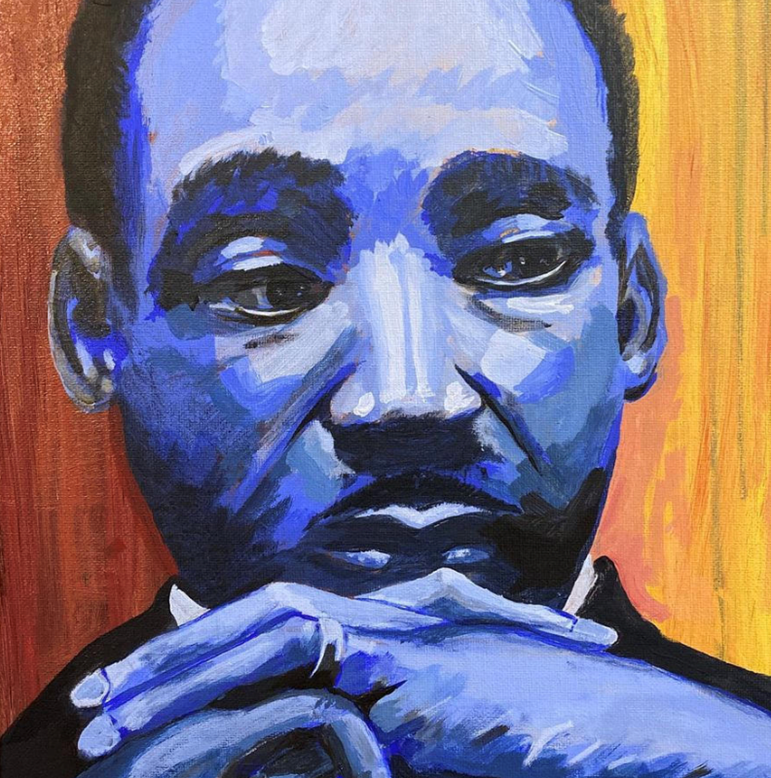
Portraiture is not an unfamiliar genre to Hagell, but he has been exploring new avenues of it in the past year, especially since he started as a non-degree seeking graduate student in the art department at the University of South Carolina. Specifically, these portraits use tones and colors that are “unnatural” like the blue skin in his MLK portrait.  

TG Ron mlk.png

“I had that photograph of him stuck on my bulletin board and, and when George Floyd happened, I decided to paint it,” he shares, “I've changed it a bit, of course—he’s on high looking down, and he’s blue, which I feel is a representative wash of today.” 

Along the same lines, some of the still lifes emerge as a photographer’s take on capturing a moment no longer present yet still relevant. His pieces “Carolina 1950” and “Colored” are inspired by the era of Jim Crow and segregation that he lived through. While a photograph of this exchange can no longer be taken today, its effects are still felt, and images like this collapse past and present.  

Hagell is not a stranger to including sociopolitical messages in his work. “Bite the Bullet,” his large-scale American flag detailed by bullets, is one of his best-known pieces. For him, pieces with these messages are distinctly important as artists are the only ones who can tell stories with the power of their medium. 

“When I first was living in the South, I was really quite turned off to here, but when I came back, I witnessed change and started commenting on it” he asserts, “As artists, it's our duty to do things like this—to use our voices to point out mistreatment and wrongdoing.” 

While Columbia still has growing to do, Hagell is proud to be here and proud of the ways our city has grown over the years, intimating that “Columbia has come a long way, both in the city’s interest in art and in a social sense—I hope this is just the beginning of things getting better.” 

Hagell’s show can be viewed anytime between now and July 31st via Jasper’s virtual Tiny Gallery site: https://the-jasper-project.square.site/tiny-gallery 

To follow Hagell’s future work, which includes a burgeoning collaborative effort where he is weaving an AR-15 into elements of a church, follow his Facebook @artbyronhagell.


— Christina Xan

Local Poet, Musician, and Painter Will Pittman Unveils First Gallery Show

 “Art is life and life is art, and like it's like closure to have these materials and put in the time and the execution of the vision of what you're trying to” — Will Pittman

Will Pittman

Will Pittman

Will Pittman thrives in the interstices of poetry, music, and painting. A longtime lover of the arts and dweller of the city, he is finally revealing his first art show at State of the Art in Cayce next month.  

Pittman was born in Arkansas, but his family moved to Cayce when he was only 2, and he has long considered South Carolina his home. Even after leaving for college, travel, and experience, he came back to Cayce, where he resides now.  

Pittman, now 32, recalls his first encounter with art being comic books, joking that he used to fill his head with stories and images of Wolverine and Spiderman during class. While he took drawing classes in high school, it would be several years until Pittman began dedicating himself to this craft. 

While working in the distribution center of an Amazon factory, Pittman made a deal with himself: on his off days, he would dedicate 10 hours to painting, which he started by imitating the artists he admired most like expressionists Kokoschka, post-impressionist Van Gogh, and founder of impressionism Monet.

“My work is categorically original—it's still, in my opinion, similar of the beauty of perception in nature,” Pittman reflects, “You know, the thing about the expression of nature is that it can't be totally objective—documentation can't be totally separated from the artist's own mark inside of that.” 

In this interweaving of old and new, Pittman expresses with oil paints and portraiture. He roots part of his style in his relationship with John D Monteith, a local painter who Pittman worked with as an “informal protégé” before building a friendship. As for inspiration, it comes from all over, Pittman never quite placing where it might strike.  

“I'll put it like an author—it's whatever turns a phrase. When I write poetry, sometimes I'll take out books and just flip through and look for words, and then it's like an engine for creativity,” Pittman explains, “That's what portraiture is like for me; it wasn't something that I consciously saw out. And at the same time, it's a reason to load your brush, get that viscosity, and put it on a canvas.  

These ruminations follow Pittman across a number of disciplines, specifically writing and singing. He remembers first reading the American transcendentalist poets and feeling like a “tornado blew his windows out.” He started writing and performing soon after, opening for artists like Justin Townes Earle, Shovels and Rope, and Dex Romweber. 

“My love for literature feeds into songwriting, and those two are like sister arts, and then the painting and drawing, speak to each other, I think, in their craftiness, their intelligence,” Pittman relates, “When I approach a canvas, it's like being a carpenter's apprentice again.” 

Upon desiring forming these experiences into a show, Pittman walked directly into State of the Art and made conversation with gallery owner, Levi Wright, saying it was a form of “American neighborly friendliness.” Pittman showed Wright his art, and Wright knew it was the kind of stories he wanted to help tell. 

“Sometimes you see someone’s work and know they have something special,” Wright says. “And I believe Will is one of those people—he has that something.” 

Pittman is the gallery’s featured July artist. Around 12 canvases of various sizes and prices will be featured, including the two photographed above and a painting of the Hunley, a Confederate submarine Pittman just happened to stumble across last year and knew he had to record. The show is titled “Intervening Time: Facsimile and Ragbag.” 

“I decided to go all out and call it ragbag because the whole main kernel of painting and visual art is that it imitates life. You know, if I were to paint your portrait I would consider elements of art, like line and value and sort of render that with tools,” Pittman details, “But it's really like illusions—your face really doesn't have lines, your face has forms. And I have to make these sort of falsehoods on the canvas, and then that produces the image.” 

The show runs from the 1st to the 31st, and the Opening Reception is Thursday, July 8th from 3:00pm – 6:30pm. During this time, there will be pop-up vendors with food, vintage clothes, and jewelry outside, and Pittman will play his music. 

As the show turns towards its opening, Pittman has eyes set forward even beyond: painting more, playing his music, writing, and reminiscing on the overlaps—and—he’s currently in school to become an art teacher. 

“Art is life and life is art, and it's like closure to have these materials and put in the time and the execution of the vision of what you're trying to,” Pittman effuses, “Maybe having a show will be like a form of emphasizing a period of my life and then putting it away to move onto other material.”  

To support Pittman, follow him on social media (like his YouTube where he shares music, readings, and ruminations) and stop by State of the Art in the month of July to see his intimate reflections of the world around us, a world you might come to learn you didn’t know quite as well as you once thought.


—Christina Xan

South Carolina Potter Levi Wright Brings Life, Art, and Storytelling to Cayce

“It’s special being able to show that pride in a non-selfish way that says, ‘I'm proud of these people—this is our art that we make in South Carolina.’” – Levi Wright

Levi Wright

Levi Wright

Levi Wright, 32, is a South Carolina native and longtime art lover and maker, who, in the past several years, he has used his passion to breathe new life to Cayce’s art scene with gallery State of the Art. 

Before this though, Wright grew up moving between Lexington and Cayce, where his parents owned an adult daycare center. His first prominent experience with art happened in school when he made a sculpture based on a Native American tradition for an art class.  

“One Native American tribe had a tradition that when a great chief would die, they would have a sculpture made of his face, and they would put the ashes in there and throw it off the cliff,” Wright tells, “And that was their final goodbye.”  

This uniquely inspired piece was entered into the State Fair. Wright reveled in this praise, recalling that, not being particularly outstanding at school, this was one of the first times he received praise and felt accomplished in work he cared for—and he stuck with it. 

If you look around Wright’s work now, you’ll be setting yourself up for a lot of staring back—that’s because Wright’s work mostly involves sculpting faces, which started in his art class but blossomed when he encountered Peter Lenzo—prominent Columbia sculptor—while taking classes at Southern Pottery.  

“I would see him during my lessons, and the whole time I was thinking, ‘That's what I want to do,’” Wright recalls, “We ended up doing a private session, and it grew into an apprenticeship and then a friendship.”  

Their friendship continued, and a wall at Wright’s house is intermixed with pieces he made and pieces Lenzo made for him, a space that Wright refers to as a “reflection of himself.” Lenzo’s care pushed Wright to become a better artist and pursue different elements of pottery. 

“I really didn't know how to throw because I was just throwing a form big enough for me to put a face in it,” Wright remembers, “You need to learn your fundamentals better before you can grow as an artist.” 

Lenzo’s encouragement resulted in Wright going on to study pottery at the Piedmont Technical College in Edgefield where he received two certificates. While there, he also began teaching classes, something he quickly fell in love with. 

“When I see that smile a person who wanted to throw a plate gets upon successfully throwing a plate, it’s instant satisfaction,” he intimates, “I mean, who doesn't want to be a person to celebrate when people accomplish a goal? If you don't celebrate the small things in life, then life's going to be a big disappointment.”

Wright with Peter Lenzo-inspired art

Wright with Peter Lenzo-inspired art

Now, Wright offers classes at his very own gallery, one that came to be in 2019 after years of planning. As Wright dwelled in Cayce, he felt one thing was missing: bright, local art. Then, a friend—potter John Sharpe—approached Wright and Valery Smith—a local artist whose vision aligned with his—with the idea of opening a gallery. Together, Wright and Smith opened State of the Art.  

Soon after the birth of her first child, Smith left the gallery, and Wright has continued their initial trajectory. The gallery proudly shows only South Carolina artists and hosts around 20-25 artists at any given time, takes part in city events, has monthly featured artists, and offers pottery classes.  

“That's one thing I take pride in, in having a gallery that only carries South Carolina artists because I've always grown up a little bit of just a proud South Carolina boy,” Wright effuses, “It’s special being able to show that pride in a non-selfish way that says, ‘I'm proud of these people—this is our art that we make in South Carolina.’” 

When it comes to selecting work, Wright shows artists that he loves and brings in his family to add an external opinion and aid in selecting pieces he may not have picked on his own. Some artists are reached out to directly, and some walk right in the front door. 

“I've tried to ensure this isn’t a gallery where you go in and even though there are different artists, it all has an identical vibe or feel,” he shares, “I love the fact that you come in here and there is such different stuff.” 

As mentioned previously, Wright shares this love in part through offering community pottery classes at the gallery—one-on-one lessons, several-week courses, and group parties. His classes are for throwing, but another artist can be called in for people who request sculpting classes, and Wright hopes to include painting soon as well.  

Currently Wright is re-vamping the gallery’s website to make scheduling classes easier, but people can still book online or call Wright directly. As he says, “you should never be too old or too smart to learn.” 

If you want to support State of the Art, go by the gallery, share their posts social media, and spread some word-of-mouth love. Their next event will be the opening reception for July artist of the month, Will Pittman, on Thursday, July 8th from 3 – 6:30pm. 

If you want to support Wright and his work, of course support the gallery, take one of his classes, and maybe take one of his heads home too.


—Christina Xan


Jasper Galleries Presents New Gallery Space at McDonnell & Associates with Exhibition By Lauren Chapman and Pam Bowers

The exhibition opens on Thursday, June 24th

reception from 6 - 8 pm

McDonnell and Associates

2442 Devine Street - Columbia

The event is free and the public is invited to attend.

Lauren Chapman and Pam Bowers

Lauren Chapman and Pam Bowers

The Jasper Project is excited to announce a new gallery space for local artists at McDonnell and Associates law firm, 2442 Devine Street, in Columbia. We’ll be opening the gallery with an exhibition of work by Lauren Chapman and Pam Bowers. Reception is Thursday night (TONIGHT!) from 6-8 pm.

This collaboration with McDonnell and Associates came about when the organization reached out to Jasper and asked if we could help them find artists who would exhibit their work in the law office lobby and conference rooms. Of course, Jasper jumped at the opportunity to help fine art make its way into the homes of art lovers and we immediately booked Lauren Chapman, who we had previously worked with in our gallery at Motor Supply, and Pam Bowers, who previously taught Chapman at the University of SC.

The women’s relationship began as that of mentor and protege but developed into a close collegial friendship.

A native of Tulsa, Oklahoma, Chapman received her BFA in Painting at the University of South Carolina and has been awarded the Scholastic Art & Writing Gold Key Award for excellence in Visual Arts, the Yaghjian Studio arts scholarship at USC, and the 2018 Artfields Solo Award Exhibition at Jones-Carter Gallery. She has been featured in Garnet and Black, Daily Gamecocks, The State, Free Times, Susie Magazine, and Jasper Magazine. She has lectured for classes at USC, SC State University, and spent a summer residency in Monte Castello, Italy. Exhibitions include group shows in Italy, New York, South Carolina and solo shows in Iowa and South Carolina. 

Chapman says, “I create immersive environments via vibrant thick textured romantic paintings telling short stories, in the forms of fables, folklore, and fairy tales challenging our current cultural climate through the eyes of feminine figures and personified creatures. The narrative of the work promote lessons from my personal experiences and question dangerous themes within American society.”

Artist - Lauren Chapman

Artist - Lauren Chapman

Bowers, who earned a BFA from the School of the Art Institute of Chicago and an MFA from Indiana University-Bloomington, has a distinguished career as an artist and an educator that has taken her all over the world for lectures, residencies, unique academic opportunities, and pleasure, including China, Hungary, and throughout Italy. Her work is in many private collections both in the US and internationally from Morocco to Greece.

According to her artist’s statement, “Bowers work explores nature as a connecting force in the intersection of art, science and mythology and express her affection for the wilderness and biological forms. There is an emphasis in her work, teaching and research on the interrelationship between environment, culture and individual material usage in the formation of visual meaning and metaphor.”

Artist - Pam Bowers

Artist - Pam Bowers