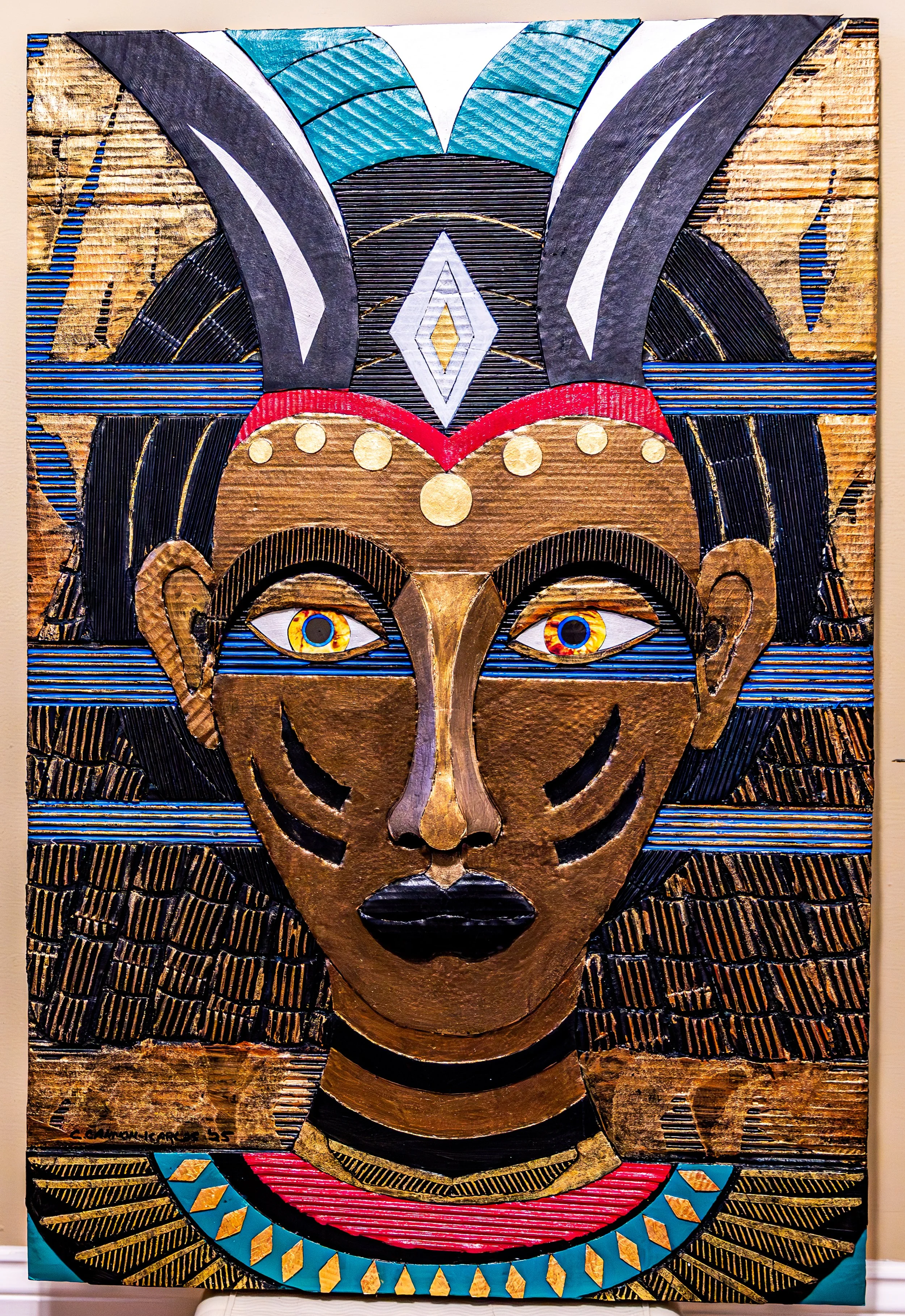
FROM THE PRINT ISSUE - PART TWO IN OUR SERIES ON KOGER CENTER PROJECT WINNING ARTISTS featuring COLLEEN CANNON-CARLOS

Welcome to the second article in our series on the Koger Center Project’s Winning Artists. You can get the background on this series in yesterday’s article on Kate Timbes, and learn more about the project and the other winners from an earlier Jasper Online post. Today we’re featuring Colleen Cannon-Karlos and sharing the article by Emily Moffitt that appears in the spring issue of Jasper Magazine!

~~~

Colleen Cannon-Karlos:

Left Brain, Right Brain – One Artist 

By Emily Moffitt

Photography by Perry McLeod


The intersection of art and science is sometimes explored only in name, particularly in academic settings. However, for Colleen Cannon-Karlos, the two fields are inextricably intertwined both in her art and her personhood.

Cannon-Karlos' upbringing took her across the country to both coasts—born in Los Angeles to native New Yorker parents, she ended up moving to New York after her parents divorced. During her school years, she excelled in all subjects, participating in gifted student programs and having a strong handle on both sides of her brain. The left brain seemed to dictate her path slightly more as she had not considered being an artist when she was younger. She still enjoyed creative endeavors, however. According to Cannon-Karlos, “I never had a formal art class growing up in school, and the gifted programs in the Bronx that I participated in had music as the cultural enrichment.” This did not stop Cannon-Karlos from pursuing artistic hobbies at home as her mother taught her how to knit, sew, and crochet. At home, she made her own art projects that combined her budding fiber arts skills with recycled materials like popsicle sticks and old fabrics. This resourcefulness has resurfaced years later in the Cannon-Karlos work we see today.

Even as the designated artist of the family, Cannon-Karlos still initially enrolled in schooling oriented toward a career in math or science. “I went to the Bronx High School of Science and had an affinity for math and physics,” says Cannon-Karlos. “There was a drafting class available if anyone wanted to be an architect or engineer, … I absolutely loved taking it. The precision, tools, and learning how to transfer schematic drawings into three-dimensions—I use these skills in my work today all the time.”
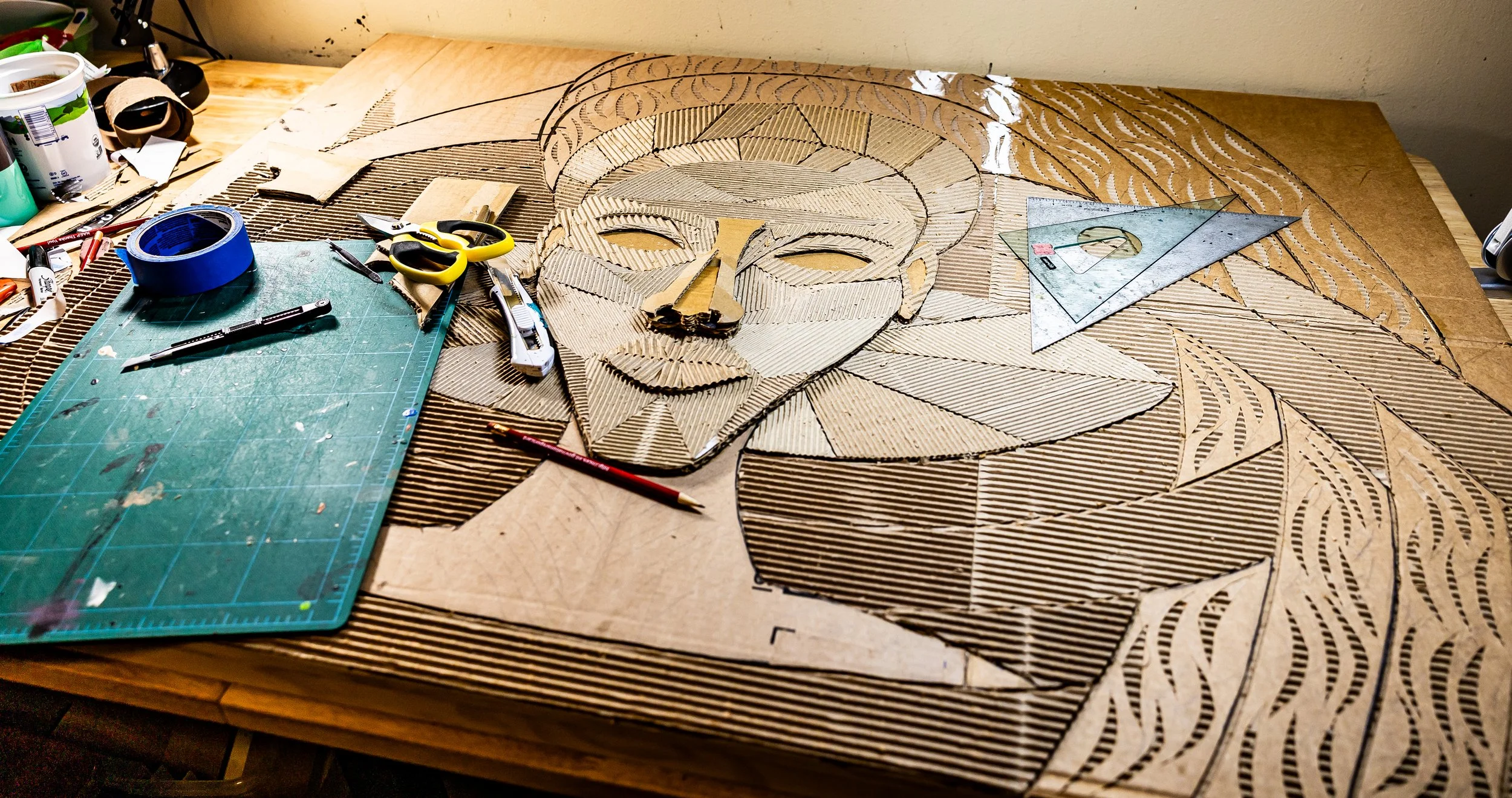
Precision is the key to much of Cannon-Karlos' artistic practices today. She developed these tools even further when she studied at Stanford University and worked in the physics lab. Her curriculum was strenuous and extremely scientific, but she always had art in the back of her mind. While in college at Stanford, the artist’s aunt asked her to make some art for her. This became an “a-ha” moment for Cannon-Karlos, whose time spent in the lab, identifying subatomic particles of smashed atoms, did not leave much time for creative hobbies. “I rediscovered my love for making stuff, using materials as simple as magic markers,” she remembers. It was time for her to find her path not only as someone with a knack for science, but also as an artist.

Cannon-Karlos decided to take a gap year from her Stanford studies and moved back to New York City to, hopefully, establish a career as an artist. She spent her days teaching herself how to paint, exploring museums and creative communities, and communing with playwrights, artists, and musicians. “This was during the 70s, so a lot of the community’s creative endeavors coalesced with different sociopolitical movements of the era,” Cannon-Karlos says. “There was this explosion of creative, dynamic energy that was so immersive and different from today.”

Working on her art career paid off early as she had her first gallery representation when she was 19-years-old. She began dabbling in photography and even convinced the staff photographer at the Studio Museum of Harlem to let her work with him in the darkroom. After spending the year building her portfolios in a variety of media, drawing, painting, and photography, she went back to Stanford and switched her major from sociology to art with a concentration in photography.

 She flourished in the field while also continuing to experiment with other media. The inquisitive Cannon-Karlos always had a knack for trying and learning something new and says that “some artists do the same thing for decades, but it is my nature to explore.” In her twenties, she began to bring back her fiber arts skills to simultaneously turn a profit and make some serious work; she was introduced to fabric design by her former husband, a fellow artist. She began to sell her handmade fabrics and clothing in flea markets, then boutiques and stores in New York. Eventually, Cannon-Karlos took the lessons she had learned practicing her art and began to apply them to something new: academia.

Throughout her career, Cannon-Karlos has instructed students of all ages, from elementary school through college. Since her methods of problem-solving combine both artistic and scientific approaches, she uses this thought process to her advantage in the classroom. She teaches her students that they may have analytic tools but they still need to be able to think outside the box.

The artist has also created curricula based around projects in which students can learn scientific concepts by making art. In Durham, NC, for example, she worked with the local art council and taught classes to elementary schoolers in which they studied ocean science through technical concepts but also had opportunities to create sculptures like jellyfish and tube worms with plastic bags, paper tubes, and other recycled materials that can, unfortunately, easily be found in oceans and bodies of water.
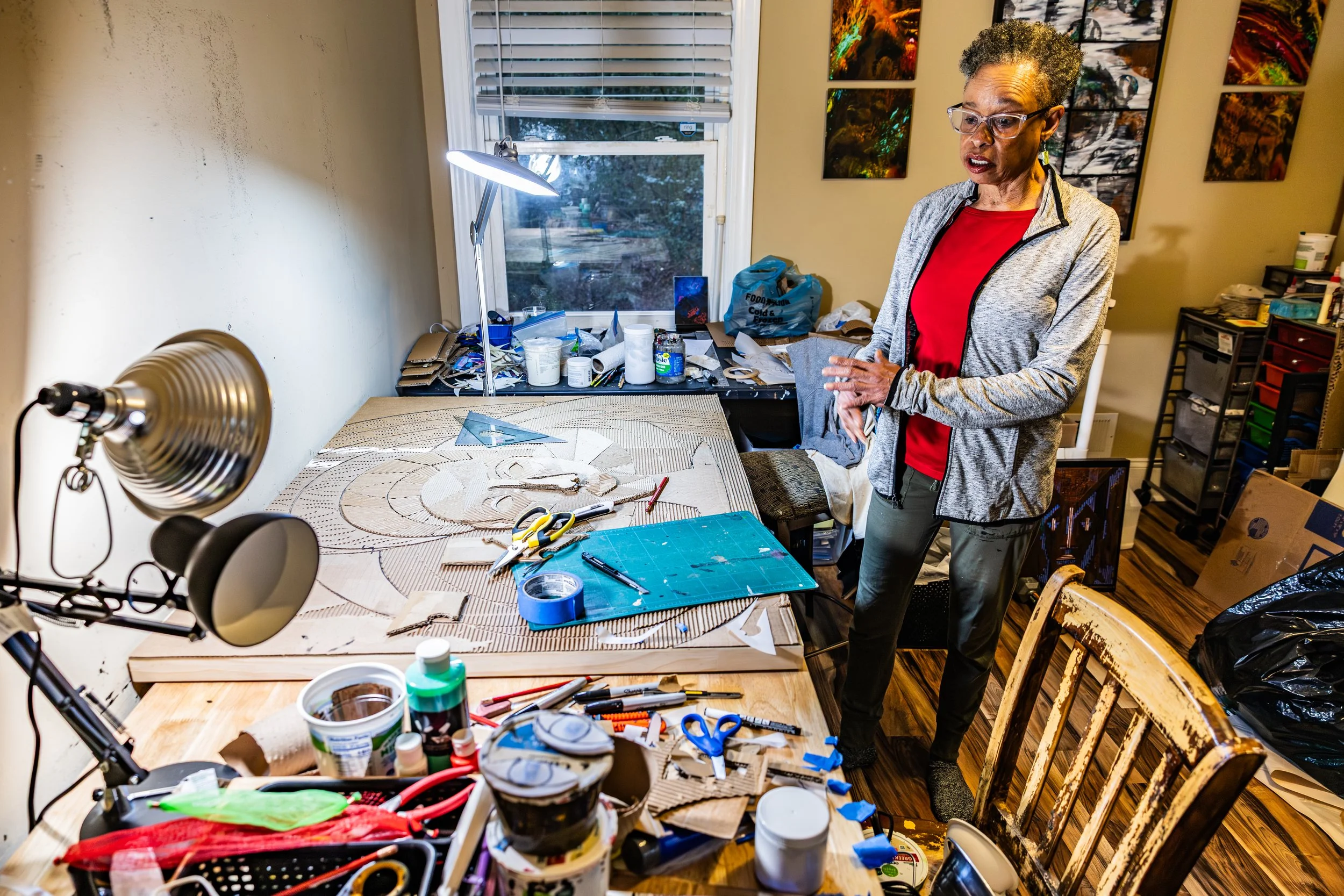
While she lived in Hawaii, she created curricula that truly captured the intersection of her interests. “I was finally able to make a proposal for an Art, Science, and Technology Class that collaborated with the marine science department,” says Cannon-Karlos. “We had a mix of art and science majors in the class, and we were allowed to use lab equipment, including their scanning electron microscopes. This allowed us to see the intricacies of the designs of a particular specimen at a microscopic level and beyond.” The designs found on the plates were only black and white, so the students would then learn how to use Photoshop to add color to their discoveries. While this was an art project in essence, Cannon-Karlos made sure that all students flexed both sides of their brains and wrote explanations of each step of their project, including why they dissected the image in a particular way, how they manipulated the image, and what they learned from the experience. The science-minded students loved the opportunity to express their inner creativity, and the arts students jumped at the opportunity to exhibit their talents on an academic level.

Thess lessons were among the many ways that Cannon-Karlos exhibited her proficiency in seeing things beyond the material plane and comprehending, on a deeper level, the use of an object or material for something completely different. Using recycled materials for creating artwork started in her childhood, and it has manifested contemporaneously as her preferred medium.

Piles of cardboard boxes inevitably piled up across Cannon-Karlos' cross-country moves. After collecting so many, but not wanting to throw them in the waste, she decided to express her resourcefulness by stripping, cutting, and tearing the boxes apart. “Being a science aficionado, I like to experiment with my materials and am always in that mindset of play,” says Cannon-Karlos. “I realized I could make some imagery with these strips.”

Cannon-Karlos had started to experiment with cardboard in 2019, but it was not until after the pandemic and a final move to Columbia that she seriously started to create with it. The cardboard allows Cannon-Karlos to work as a scientist again, finding ways to challenge herself and test new hypotheses regarding how she can use the cardboard and adapt the surface to do different things. One such test of skill was born out of observing sweetgrass basket weaving. “When I saw the weavers … I asked myself if I could simulate the weaving process with the corrugated cardboard.” This process also made Cannon-Karlos reflect on the resourcefulness of African artists, especially with recycled materials of their own. Her work is a constant conversation between culture and science, always looking to explore what that conversation could look like on a surface with one of the most accessible materials available. “A lot of recycled materials are brought over and dumped into Africa,” notes Cannon-Karlos. “The artists are very resourceful; they can go to the dump and pull fabrics, electronics, and other trash then turn it into the most amazing work. I am very inspired by people who look at things differently and turn them into something new.”
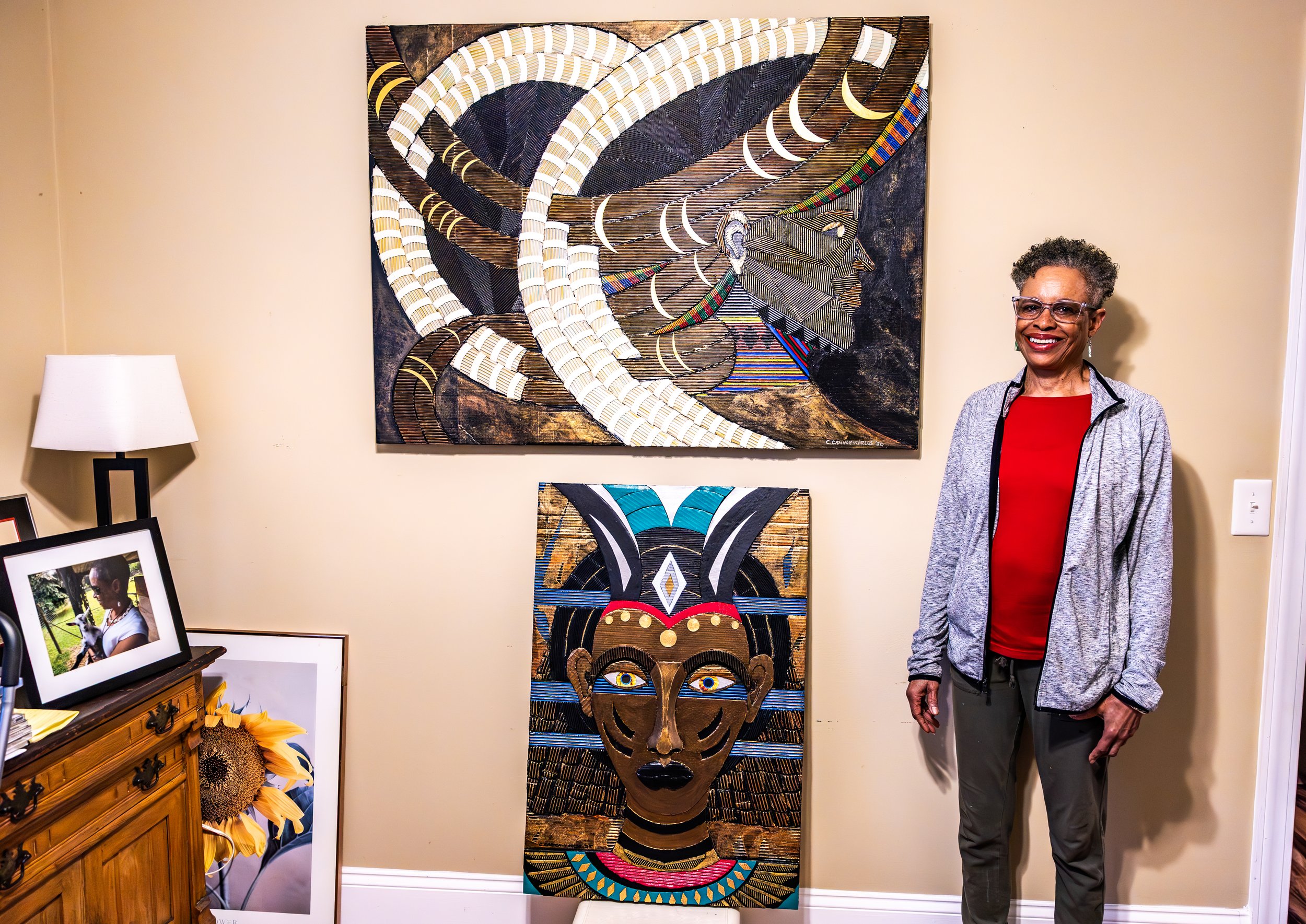
Like many other artists, Cannon-Karlos' career path did not follow a straight trajectory. The moves, twists, and turns provided great opportunities at each bend, but nothing necessarily consistent. “If I followed my trajectory out of grad school in the 90s, I may have become more prominent in the art world,” says Cannon-Karlos. “I have had to put my career aside working as a single parent. It is hard to be an artist when you are taking care of a family.” While working in Hawaii, she had first-hand experience with the exorbitant costs of shipping artwork, and the transience of teaching positions in higher education. Her trips across the country, while pursuing her dreams, created different bumps along the road. But when asked if she had the chance to do everything all over again, Cannon-Karlos admits that she may not change anything at all. Her life experiences and her way of approaching art, as both an academic and a creative, are what make her portfolios so alluring, with viewers waiting with anticipation to see what she’ll create next.
FROM THE PRINT ISSUE -- Jasper Writes About 5 of the 6 Koger Center Project Winning Artists (and we're adding the 6th to our story bank!)

At the Jasper Project we have nothing but praise and appreciation for the work the Koger Center for the Arts has done to bring more diverse arts disciplines to their halls. In addition to providing Jasper with a designated space called The Nook to offer monthly openings in conjunction with The Vista’s Third Thursday celebration (thanks Koger!), over the past few years they have elevated SC visual arts appreciation by sponsoring their own visual arts contest (sort of awkwardly) titled The Koger Center Project. Jasper has written about this year’s winners already via Jasper Online, but we were happy to find that we have already written about 5 out of 6 of the winning artists in the pages of Jasper Magazine. Let’s take a look back at these stories by visiting the Jasper Magazine archives.

Photo by Perry McLeod

Kate Timbes: Right Places, Right Times

By Emily Moffitt


Ten days after Kate Timbes graduated from Wofford University, she moved halfway across the world to Germany. This was a decision that became integral not only to her career, but to her life as an artist.

Timbes graduated from Wofford’s studio art program in 2023 with a minor in business and film. She grew up in a creative household, amongst a sister with an affinity for art and a father who worked as an architect. The creative spirit of her family spanned multiple generations; Timbes’ grandfather is an artist as well, and her mother often brought her to bead crafting shows growing up. “I credit my parents and their support and belief in me to be an artist,” says Timbes. “They never questioned my career choice.” Her parents were there to watch her artistic abilities flourish from coloring with crayons, to creating commissions for their family friends. Even now, Timbes’ studio where she perfects her craft is at her parents’ house.

Growing up, Timbes knew she wanted to pursue art after spending her childhood years painting and making jewelry, but she originally considered graphic design as a career. It was not until her undergraduate years at Wofford that she discovered and fell in love with studio art. While studying studio art, she got to explore with a variety of mediums and pursued as many opportunities as possible to learn what she could. “I accepted a work study at a school in Tennessee where I learned to spin my own wool,” says Timbes. “I saw so many other artists honing their craft, and they were all so encouraging and eager to share their knowledge with me.”

Photo by Perry McLeod

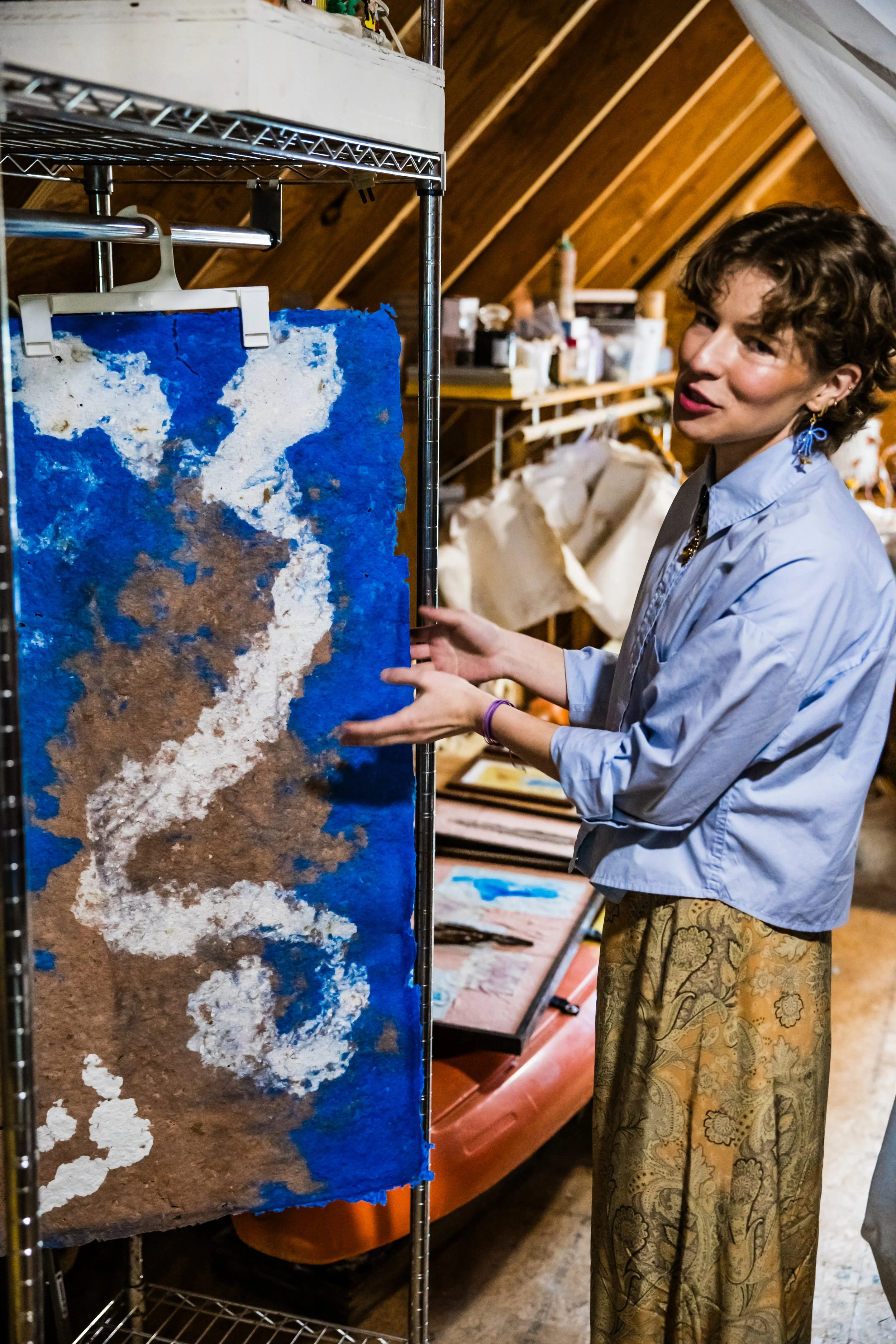
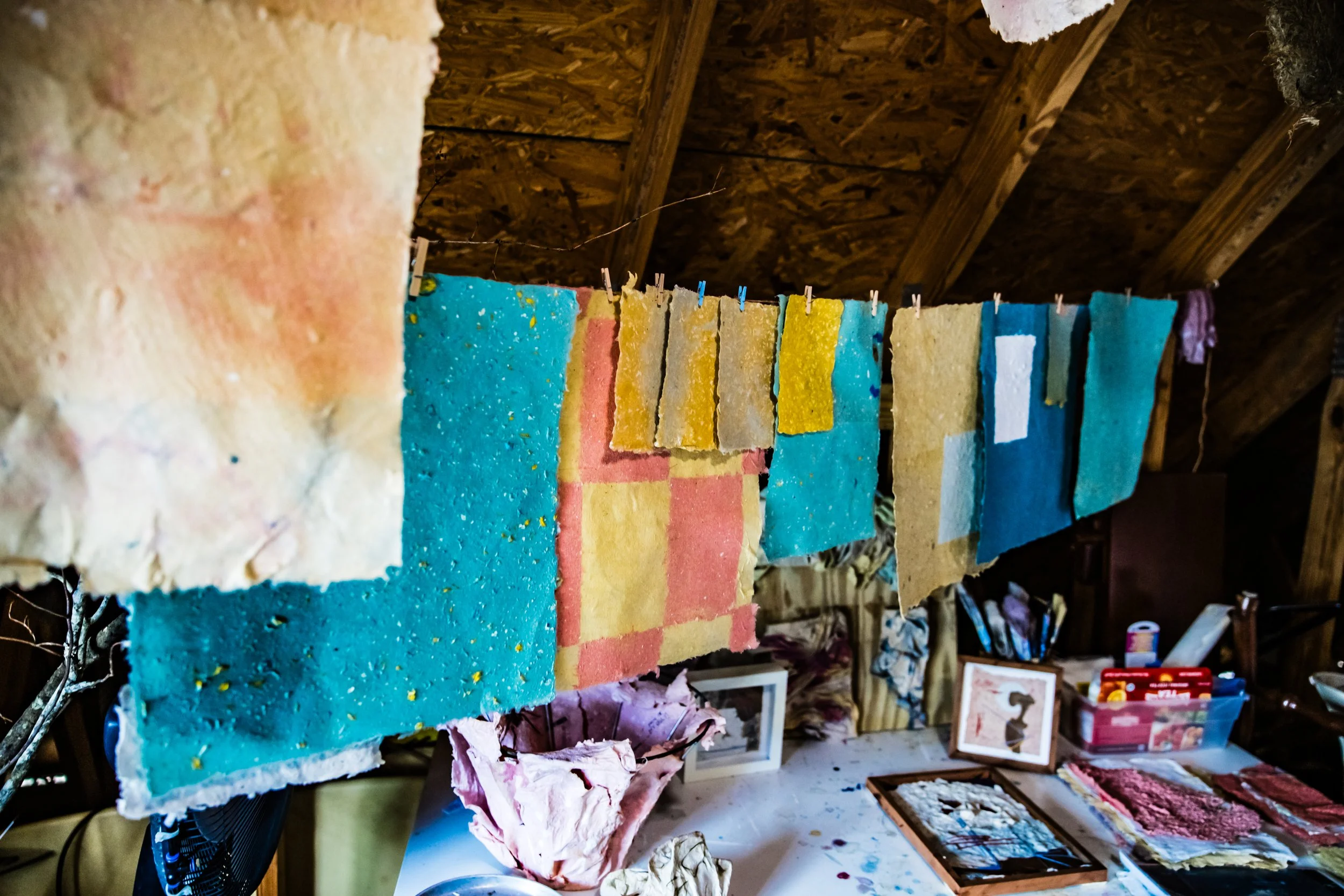
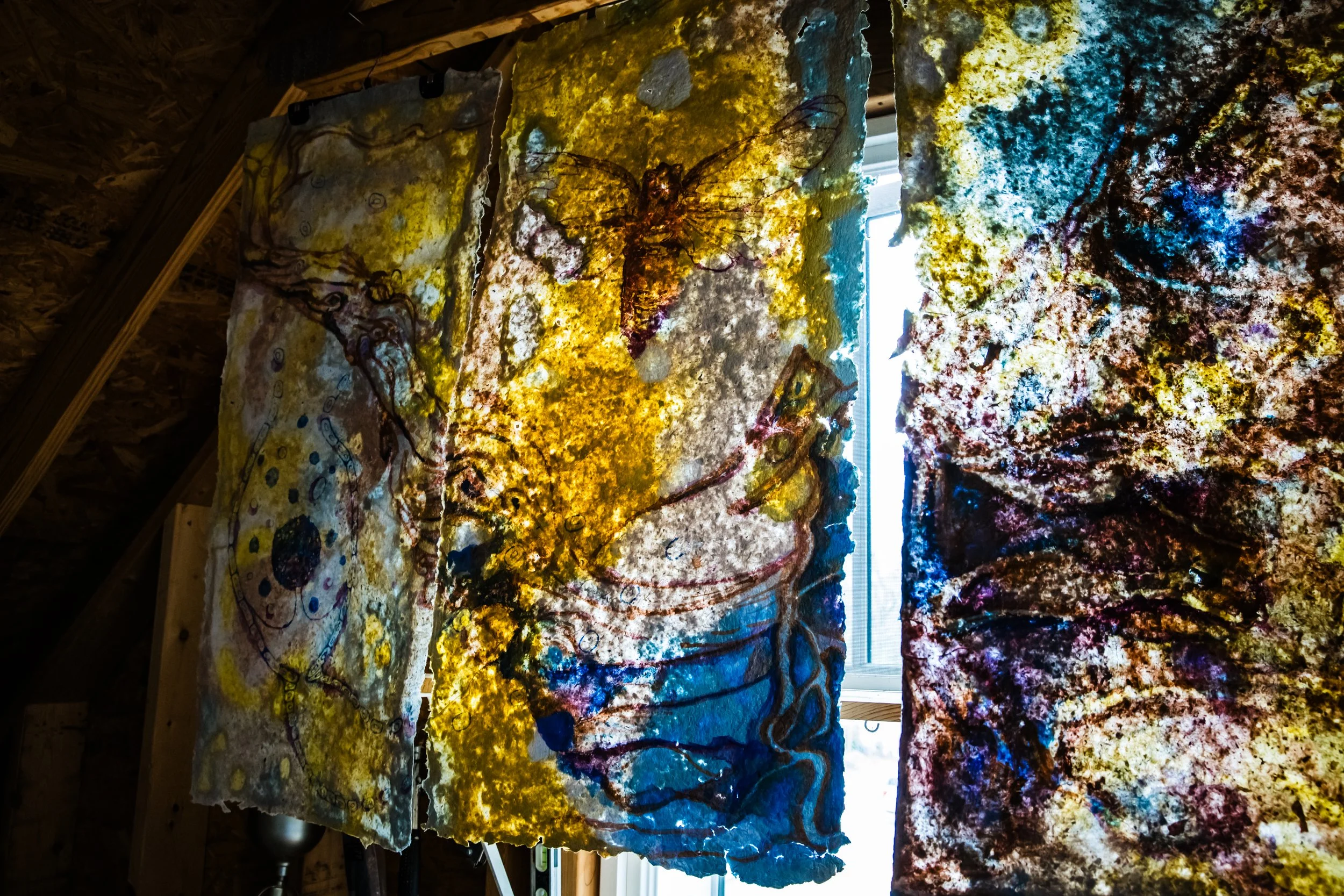
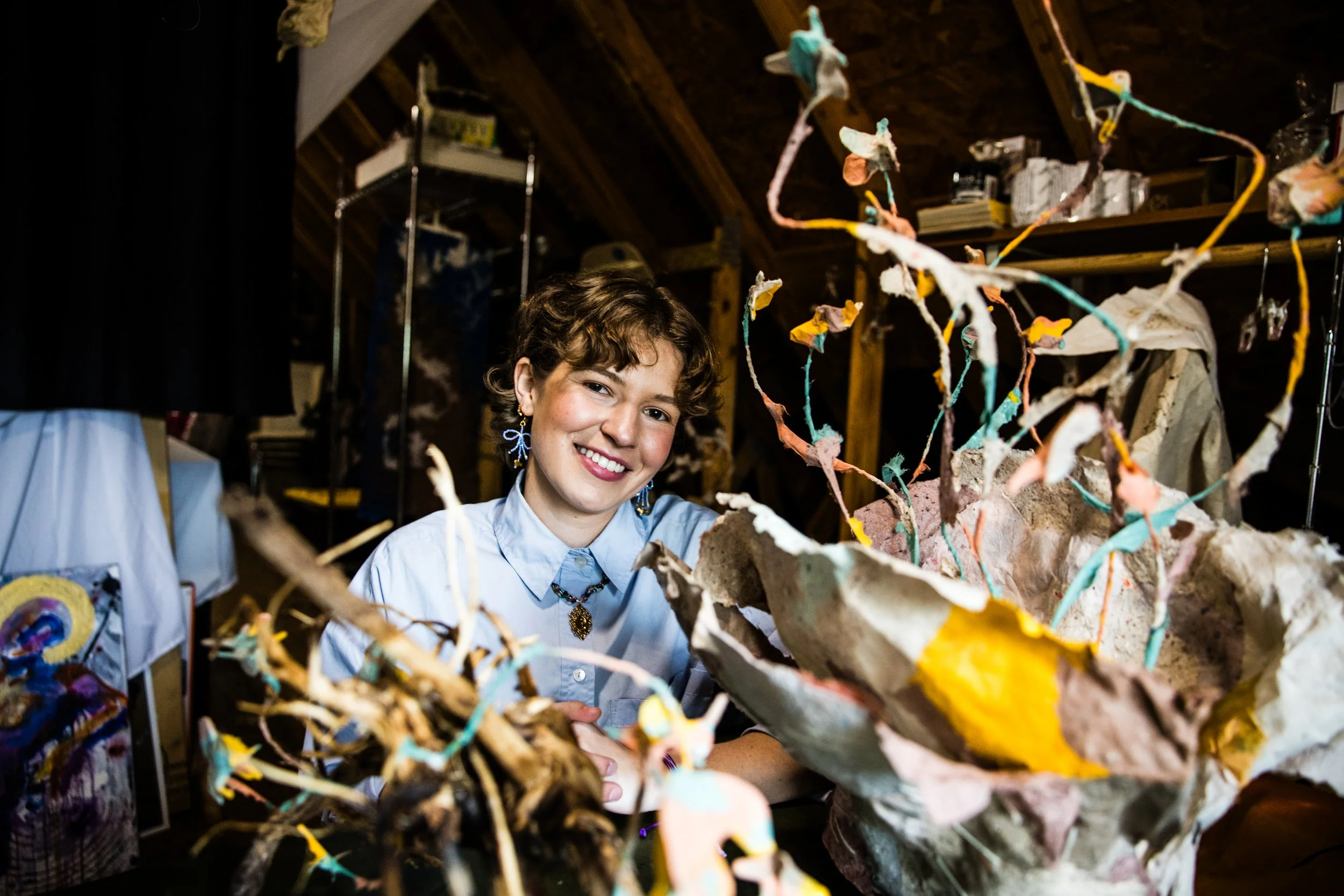
As her studies progressed, one of her professors at Wofford approached her and asked if she had any experience making paper. “I told her I had seen it be made, and I spent the next two months learning as much as I could about the medium,” Timbes says. “I was going to help lead a class on how to make your own paper. The next thing I knew, I could not get my hands out of paper baths.”

Awakened with a sense of wonder in how to push the limits of this newfound medium, Timbes started to see motifs from her existing practice reawakened. She found that she resonated with the low-to-zero waste practice of making paper from scratch and wanted to learn how to use plant fibers to make new sheets. Timbes says, “I felt very connected to a tradition that is starting to disappear in certain places around the world.”

At the beginning of her papermaking practice, Timbes would experiment with sheet pulling to see what would happen, figuring out if the sheet would be used for painting, sculpture, or just exist as a sheet of paper. Now, just a few years later, paper making is Timbes’ primary method of creating building blocks for her art in her daily routine. “When I am on the journey to find what possibilities exist within paper, and what it is going to do to push me...I find it to be a very conversational art practice.”

Photo by Perry McLeod

Conversation itself is integral to many of Timbes’ artistic endeavors. The paper that Timbes creates is made through a conversation of intention: what will a specific piece of paper be used for, what kind of fibers are needed for the sheet, and how will it react to the additives? Timbes even casts her own body in handmade paper for some of her projects. The resourcefulness of the artist is not reserved for making paper from scratch, however, as she is proficient in using fabric to create stunning installation and performance work. One notable medium that Timbes has visited multiple times in her career is a simple bedsheet. “In 2022, when I was working on my senior project, Roe V. Wade was overturned,” says Timbes. “I looked for an outlet for rage, and turned to tearing up bed sheets, weaving the strips into rage rooms.” The accessibility of bedsheets made the project’s foundation easy to start. Using leftover paint from a previous mural project, the rage room installation came to fruition by throwing the watered-down paint all over the stripped, cut, and torn bedsheets until they dried. Afterwards, she created circular installations with the strips by weaving them together to create a microcosm of rage and relief.

The experience with this project followed her from Spartanburg to Garmisch. In a setting with no formal studio or ample space to create like she had in college, Timbes made sure to immerse herself in the culture of the small ski resort town she worked out of. After spending time researching the local ecology and energy of the town, it prompted her to reflect on her own desires as an artist. “I had to ask myself, ‘What am I passionate about? How do I narrow everything down? Am I a sculptor, painter, or something else?’” She ended up cultivating all these thoughts and experiences with her surroundings into her notable performance piece/sculpture/photography series, “I Cut My Arms Off So That I Could Fly.” In her hotel room, Timbes found an ample number of bedsheets once again to be her canvas. “The piece is a fiber sculpture turned performance that was inspired by a glacier that melted off the top of the highest mountain in Germany,” says Timbes. “There were so many tours going up there, but no acknowledgment of the glacier itself. It was almost like a tourist attraction that did not exist.” Some church groups in the area hosted funerals for the glacier, which pushed Timbes to create a remembrance of her own. After tearing and dyeing the bed sheets, she wove them into a set of arms she could wear. It was not until right before the ski season ended that Timbes came up with the perfect idea: “I took the piece up into the mountain and decided to ski down while wearing it. That’s where the photos came from.” What resulted was a stunning coalescence of movement, reverence, and originality that has reappeared throughout Timbes’ portfolio.

Now in the present day, Timbes has taken all of her life experiences and creative endeavors and melded them into a path she is sure to take with aplomb. Timbes has joined an artist collective named Zerospace, participated not only in exhibits across South Carolina, but as far away as California and Denmark. Building a community and participating in one that exists amongst her artist peers is the most important thing to Timbes’ artistic practice. At Woven Studios, Timbes creates murals and takes commissions, emphasizing the importance of understanding her clients. Building relationships with clients fosters trust, while collaborating with other artists inspires creativity and new ideas, especially now that she's returned to South Carolina. “Within the last year, tapping into the Carolinas’ creative communities has really fueled my practice, and I have acknowledged how important creative spaces are,” says Timbes.

Photo by Perry McLeod

Upcoming projects for Timbes include participation in the Koger Center’s annual art competition exhibit, where a jury-selected panel of SC artists is featured and Timbes was awarded first place. Additionally, Timbes is developing a new collection of fiber and paper-based works inspired by German folklore. Timbes’ explores subject matter and artistic concepts with the originality and passion of someone who has given themself the grace to create without self-imposed boundaries: a tenet passed down from her father. “It is hard to navigate the world right now, let alone as an artist in her 20s,” says Timbes. “But I have to be okay with failure, comfortable with vulnerability, and just reiterate to myself that whatever happens, I got this.” With a knack for storytelling and working with intention, she is well on her way to fashioning herself as one of the young artists to watch in Columbia, SC or wherever her journey takes her.

 This article appears in the current issue of Jasper Magazine, Spring 2026.

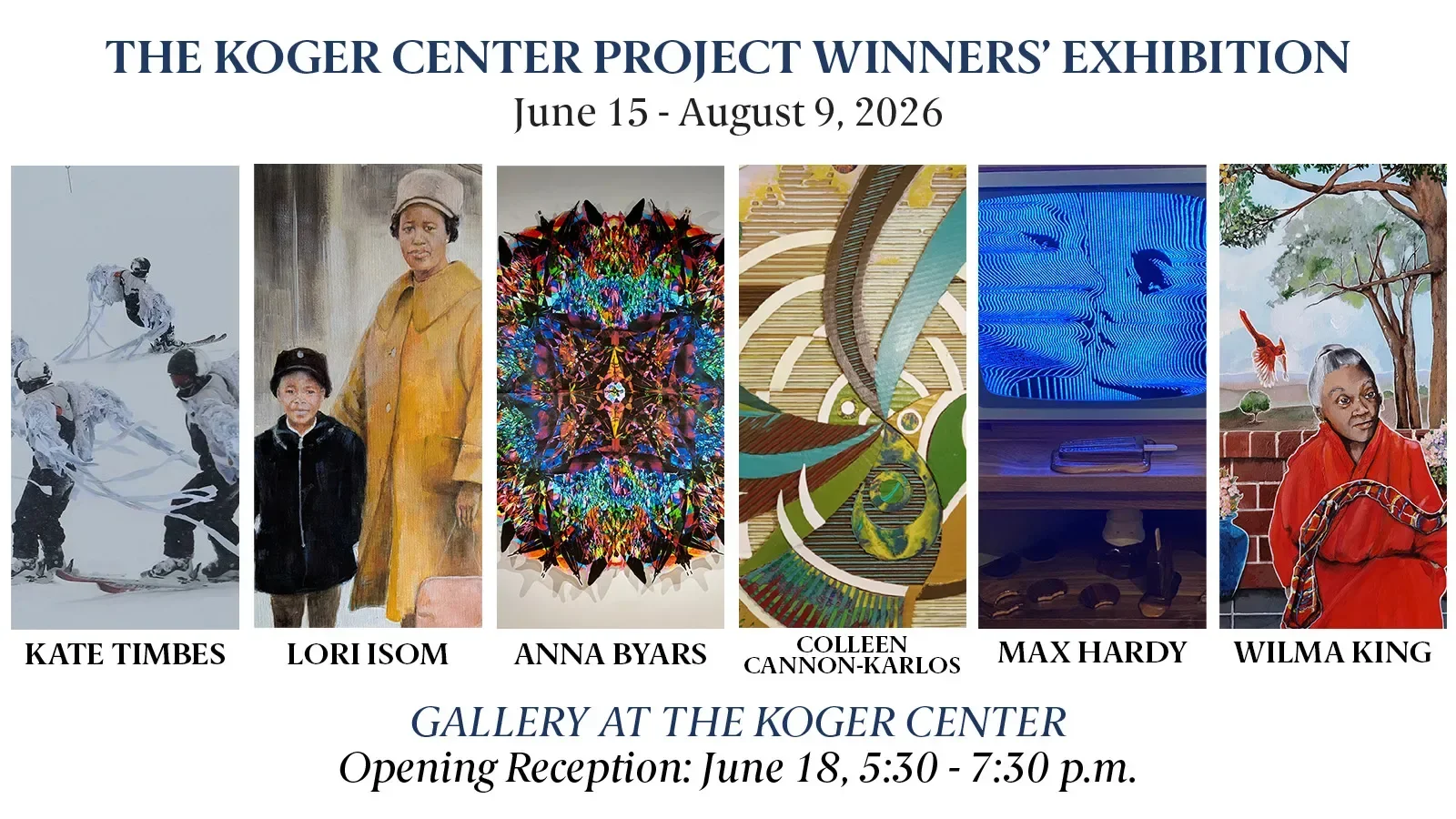
Return to this space to read about Koger’s Featured Artists Anna Byars, Lori Isom, Wilma King & Colleen Cannon-Karlos. And to keep up with Jasper’s ALL-ARTS news & articles between print issues, go to JasperProject.org, find Magazine on the front page, then scroll down for Jasper Online. Recent articles have included local theatre reviews, news about Columbia Classical Ballet, calls for art, the SEPF, SCSM artist talks & everything about our current Big Thing,

Jasper’s Play Right Project.

ESSAY: The Free Times 2024 Power List, A Response by Cindi Boiter

The yearly designation of the Midlands’ most powerful people, provided by our friends at the Post and Courier’s Free Times, always creates ambivalent feelings for me, as well as others, I’ve been told. This year, I was happy to play a small part of the nomination process and see recognition given to many of the folks I nominated. But, as always, I was perplexed by the concept of the project and what its purpose is.

The Free Times Power List 2024, published December 18th, seeks to recognize 30 of the Midlands’ most influential arts, food, and cultural leaders. The criteria for acknowledgement are growth, innovative programming, and bringing national attention to the area, like Lula Drake’s Tim Gardner whose rightful place on the list was established when he won Columbia’s first ever James Beard award and the Kiki and Tyrone Cyrus team at Kiki’s Chicken and Waffles, who also received acclaim in the James Beard competition. Robbie Robinson of City Limits Barbeque was recognized, as well.

Clearly, restaurant owners who frequently put their own financial livelihoods on the line are deserving of praise, especially those like Kristian Niemi who is committed not just to his patrons but also to the local farmers who provide the food for his restaurants. Restaurants are essentially small businesses but they can have a large impact on their communities by providing gathering spaces where we all feed both our appetites and our culture. The team at Transmission Arcade is a great example of a group seeing a city need and addressing it head-on with fun and innovative programming. But missing from this year’s list are the owners of coffee houses, like Greg Slattery and Sandra Moscato of Curiosity Coffee Bar, who provide places where patrons gather to scheme and collaborate on projects that make us better. Slattery and Moscato are absolute warriors for the health and care of their corner of Columbia. Jasper honors them.

Some of the most deserving recipients of this year’s honors were organization leaders like Nate Terracio (Koger Center for the Arts) and Kristin Cobb (Harbison Theatre) who have used their pivoting power to open their stages to local artists and arts organizations and they have done so without slapping their names on the logos of the organizations they represent. Of  late, we’ve seen free concerts and performances on Koger’s new stages and in their lobby. Harbison Theatre has welcomed many local artists and arts groups onto their stage. And both theatres are the homes to Jasper Gallery sites where we are privileged to present the work of exclusively Midlands area artists.

Kudos to Free Times for shining a light on the work and generous spirits of a nice handful of local artists like Ija Monet, Terrance Henderson, Michaela Pilar Brown, Sean Rayford, and the unofficial mayor of the Congaree Vista, Clark Ellefson. The list of powerful artists could have included dozens of names, but I am thankful for what we got and honor those recipients with pride and admiration.

It was also encouraging to read that Dr. Bobby Donaldson was included in this year’s list as perhaps the most deserving recipient of the honor. Donaldson’s accomplishments represent the best example of an individual working for the greater good without asking for anything in return. I’d love to see more folks like Donaldson recognized for their visions for a better Columbia and a better South Carolina.

But how does one separate and compare the work of rectifying history, like Donaldson does,  with that of making menus and making art? Food, arts, and culture, the three areas where Free Times looked for leaders, are overlapping zones in the Venn diagram of community life with food and art being among the most meaningful contributors to culture.

I have other questions.

Does a Power Person have to be well-paid or even paid at all for their work? Where does volunteerism come into play? I ask this because, and I’m only a little tongue-in-cheek here, I personally know an entire board of directors who work the equivalent of part-time jobs and more to support their organizations and the people they serve. I bet you do, too, and I bet you’re not even thinking of the same organization I am. (Yes, I’m unapologetically thinking of the Jasper Project team and how much I love to sing their praises for the tireless efforts they make to nurture the arts.)

Does the Power Person have to do the work themselves or does the work of the minions below them count as their contribution, too? I mean there’s a lot of dollar signs represented by some of this year’s power people. A lot of fur coats, fancy cars, and trips to Mexico, too. Can a Power Person do the exact same job year after year after year and still be recognized? Does it matter if the organization a Power Person represents is a frequent advertiser with the Post and Courier? I hope not, but I’ve heard that rumor, too. And while we’re at it, should a Power Person be recognized for essentially doing the job they are paid to do? How much money do some of these 501c3 Power People make anyway and how much of their salaries comes from the pockets of Soda Citizens?

Finally, what exactly is the point of the Power List? It harkens me back to school days when popularity was weirdly the goal for so many people. I know few people who didn’t suffer at least a little angst about whether they would be accepted or rejected by their peers. I’d like to think most of us have grown out of that by now. Singling out individuals who, if you followed the rules of the popularity pecking order, were even better than their peers via projects like “senior superlatives,” which I see as the seed of projects like the Power List, was an even more stark way of separating the bad from the good and the good from the better. That said, I married a “Most Likely to Succeed” high school senior superlative recipient and, what can I say? He was and is, so what do I know?

To those who deservingly found themselves on this ostensibly elite list of individuals, congratulations and keep it going. We are genuinely proud of and happy for you. To those who found themselves there whether they deserved to be or not, this means we’re watching you and what you do with your power even more. And to those who were completely overlooked, go forward with the knowledge that  your work matters if it matters to you. Arbitrary lists and accolades are less important than the people you affect with your talents, generosity of spirit, and good work.

~~~

Merry Christmas from all of us at the Jasper Project. We love what we do, and we’re trying to grow better without growing bigger so we can stay true to our mission to be public servants of the arts in the greater SC Midlands Community. Thank you for your support and thank you for reading Jasper Magazine and Jasper Online!

HAPPY HOLIDAYS!

(Full Disclosure: Kristin Cobb, executive director of Harbison Theatre at MTC is a board member of the Jasper Project Board of Directors. There is no financial exchange related to the profits made for artists or Jasper between any of Jasper’s Gallery sites and the businesses that host them. Also, this column was offered to Free Times as an installment in this writer’s regular column, Further Consideration, but was pleasantly and respectably passed on)

Jeffrey Miller’s Exploration of Life Through Humor, Audacity, Absurdity and Juxtaposition

I was once told by someone that they did not know if they liked my work because I wasn't doing what everybody else was doing. I have never before been so complimented— Jeffrey Miller

Jeffrey Miller’s work traces a handful of related themes, ideas, and images through a variety of mediums. He is an artist always exploring and keeping options open—and he is Jasper’s featured Tiny Gallery artist for the month of September. 

Miller grew up in small-town Campbellsville, Kentucky, a “typical child except for an oversized imagination and an unrelenting curiosity.” While he did not grow up around art, he often drew in the margins of his mom’s old textbooks—deterred from marking up the walls of his home instead. Of all things, though, it was an encyclopedia that began the blossoming of Miller’s identity as an artist. 

“One day my father drew a polar bear sketch that he copied from those encyclopedias; excited, I asked him to do it again but instead he gave me the pencil and told me to do it myself,” Miller recalls. “That was all the encouragement I needed. I was about 5 years old then, and I got my first real commission at the age of 12—I earned $100 for painting a logo for a truck driver on both doors of his truck.” 

From this moment, Miller went on to commit himself to art, receiving an art scholarship from Campbellsville University and finishing his art degree at Murray State University 

“At University I was introduced to and gained more knowledge about materials and art history; as far as process, though, it seems more I just learned the name to call what I was already doing,” Miller says. “The biggest and most influencing thing was the atmosphere and the presence of so many other people involved in the creative process…that I really miss!”

BLACK CAT BLUES

Since getting his degree, Miller has continued to grow and expand his horizons. One of his greatest fears is being trapped in a box. As he says, there are “too many possibilities to explore.” In his mind, work predicts medium, so the more mediums one is familiar with, the more the subject matter can spread its wings. 

“Being a good painter or good in whatever chosen medium is a technical evaluation—creativity is something more,” he says. “Besides which, good is a relative term so it literally tells you nothing about an art piece.” 

And art is something Miller is always doing. When asked what he does when not creating, he says that he sees everything he partakes in within his everyday life as some form of artmaking. In that vein, Miller does not have a specific theme he chases—in fact, he sees this as one of the limitations people place around artists and their work. 

In his mind, work predicts medium, so the more mediums one is familiar with, the more the subject matter can spread its wings. 

“People ask what I was thinking when I did this piece or that piece. The only answer is my thinking was absorbed in the piece I'm working on at the time. Anything else is an afterthought,” he says. “The work is complete when I've done my job as an artist and I'm on to the next canvas. The important thing is what [the viewer] brings to the piece, what do [they] think. A piece of art is not complete without the viewer, and each viewer will bring thoughts of their own.” 

If he could find a throughline in his piece, he would say it is all, in some way or another, a celebration of life in all its forms, regardless of the themes and emotions within. If art is in his every day, his art also shows the everyday.

VENUS OF THE BAYOU

“There is an ebb and flow, a push and pull, a transitoriness about life that must be reflected in one's art if that art is about life. The imagery, ideas, and concepts are a reflection of day-to-day life which I personally tend to express through humor, audacity, absurdity, and juxtaposition,” Miller says. “I was once told by someone that they did not know if they liked my work because I wasn't doing what everybody else was doing. I have never before been so complimented.” 

In this Tiny Gallery show, Miller shows off these juxtapositions of life in his newest medium: printmaking, of which he has had an introductory class and, so far, is “finding nothing about it that [he doesn’t] like.” Adjacently, he has started exploring digital art, and he has found himself particularly connected to a new digital image he made—the cover photo of this article.  

“[The piece] totally reflects the art that is me—the art just described to you in the above paragraphs. I usually work from a fleeting mental image in response to something I've seen, heard, or read,” he says. “The mental image may or may not come immediately but it always comes in the same way, like a light brush across the cheek or a fast, flashing image like from the old slide projectors. I turn to get a better look and it is gone. There are times when I only see it when the piece is done—I like it that way.”

THE FALCONER

Perhaps it is this mindset that has led to Miller winning a handful of art contests, including an advertising award from Doe Anderson Advertising Co., as well as serving as an educator for the Lexington Library Adult Education Program for four years.

 Today, he displays at various festivals and community sponsored events, and you can see—and purchase—his work 24/7 until the end of September at Jasper’s online gallery space. After the show, interested patrons can follow his journey on Facebook and Instagram @ Jeffrey Miller Artworks.

Storyboarding Workshop with Corey Davis at 701 CCA

Corey "Roc Bottom" Davis Storyboarding Workshop

701 Center for Contemporary Art

Saturday, July 15, 2023

1 pm to - 3 pm

Join multi-talented creative, Corey “Roc Bottom” Davis for a workshop exploring the process of storyboarding. In conjunction with Tyrone Geter’s Artist in Residence at 701 Center for Contemporary Art, Corey will guide the participants through the history of graphic novels while helping them develop their own hero’s storyline.

Corey Davis has vast knowledge and expertise in utilizing ink and pencils to create comics. He will explain how to communicate ideas through visual scenes in a sequence during this workshop. You will learn the step-by-step creative process to create your own storyboard. By the end of the session, you will have a storyboard outlined to take home and use again to develop your own characters and stories and share the new worlds you create with the community.

For more information on Roc Bottom and to view his work please visit https://www.rocbottomstudios.com

For more information about the workshop please visit https://www.701cca.org/.../storyboarding-workshop-with.../

We are located at 701 Whaley Street, Columbia, SC 29201. Please take the elevator to the second floor to the Main Exhibition Gallery.

Rocbottom Studios

New Art by Bonnie Goldberg - An Online Jasper Exclusive

Jasper is delighted when we see treasured artists in the Greater Columbia Arts Community take their talent in different directions, so we were thrilled when figurative artist Bonnie Goldberg agreed to share some of her work with us.

Jasper asked visual artist Bonnie Goldberg to take an assessment of her life as an artist as we all find our ways through what is, hopefully, some of the final months of Covid concerns. This is what Bonnie had to say:

In the beginning of the pandemic, I did stay home and paint a lot. I created a space upstairs in my house and spent a lot of time working on drawings and paintings. Because I had already decided to work in a more abstract manner and use my own paintings and photographs as reference material, I had no need of a model, so it was not a problem not being able to hire someone to model for me. I find that working this way allows me freedom to create new iterations of former work and also work pure abstraction focusing on color and line and shape. Because I had no social life, I was able to throw all of my attention into my work and focus on innovative ideas and new directions. I love the new work that I am doing...I often paint without using a brush...applying the paint with various tools and edges, making marks, and finding new ways to draw and create line without a brush or pencil. There is a lot of layering and "lost and found" color and edges and I find it both challenging and exciting.  

I am back to painting in my studio in the Arcade on Main...I have a small space upstairs and it allows me to paint and allow limited access to the studio from people who visit the building. I am still careful, but fully vaccinated and able to focus on my art in a very intense and personal way. Creating art is always an inner experience for the artist and for me, with music playing and light from the beautiful skylights in the hallway, I am doing my best work ever. I have taken more chances, done more experimenting, and painted more abstractly. And I love it. I do still incorporate the figure into a lot of my work, but sometimes it is only a line or a gesture or a suggestion of a figure, leaving the interpretation to the viewer.  


I am still represented by galleries and interior designers, but I retain the right to sell my own work and I show a lot of my work on social media...Facebook and Instagram reach thousands of people and allow me to show images of my work to many people who in turn often reach out and purchase work. This is a boon to artists to be able to show and sell work in this manner. Instagram has allowed me to not only show and sell work but connect and share ideas with artists around the world. The art world has changed, and I sell more work and see more art from other artists than ever before. 

I love the small studio space that allows me to see everything that I need and work on. You can see from the images that I am creating and layering and abstracting in many sizes and shapes and this is inspiring me to do more in this direction. Art and artists are always evolving, and I look forward to seeing where I can take my work next....just open that door, walk through it, and see what happens....