REVIEW: Chapin Theatre Company's HOW TO SUPERVISE WOMEN

By Cindi Boiter

At the Jasper Project, we are committed to supporting, promoting, and celebrating new art wherever we can find it. Last night I found an outstanding example of new theatre just down the road from me at Chapin Theatre Company in the dress rehearsal for Lou Clyde’s new play, How to Supervise Women.

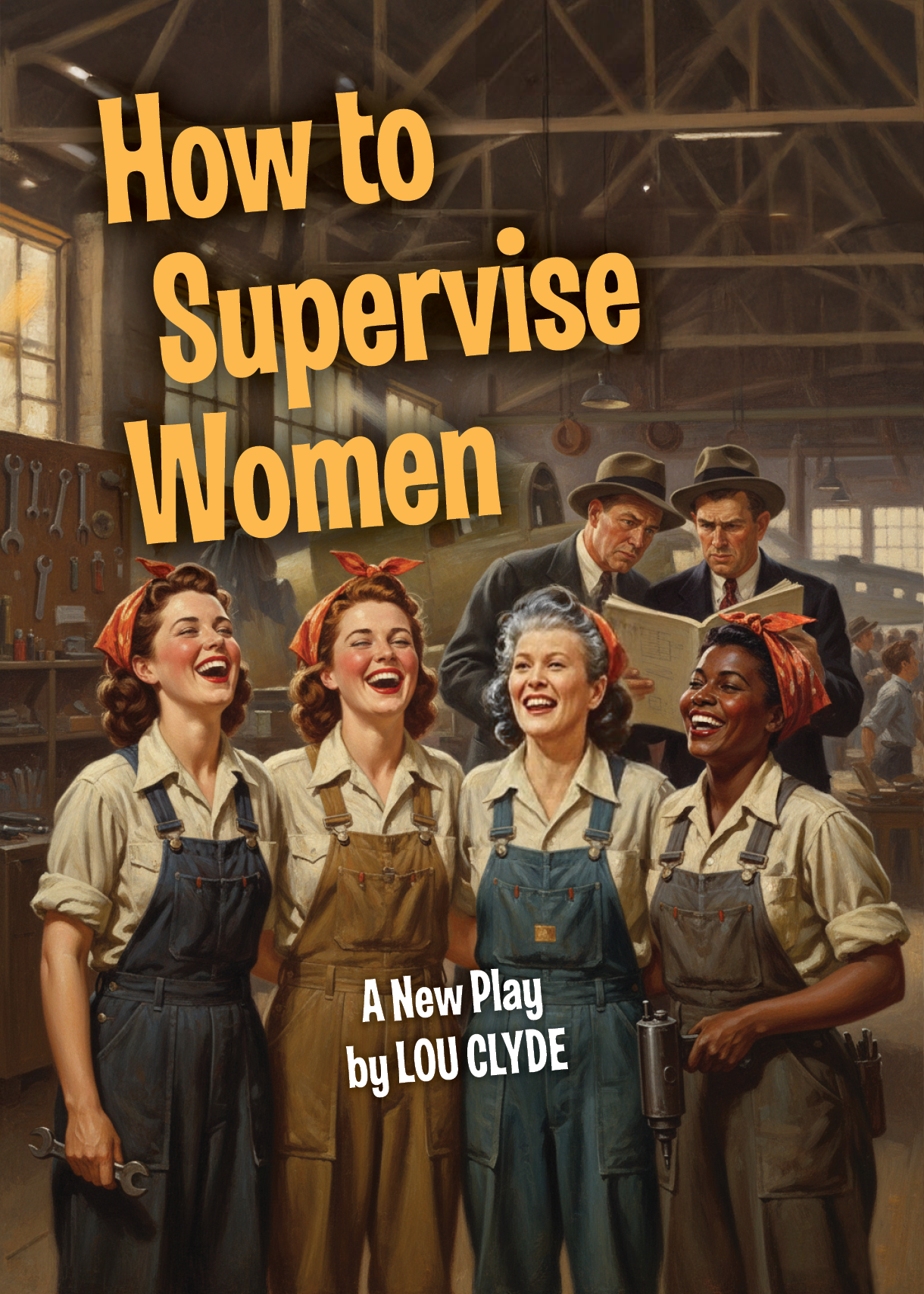
A tight two-act comedy, How to Supervise Women features an equally tight ensemble cast of loveable characters who make one of the most important cultural changes in the history of American women cogently understandable even for folks who might be hesitant to identify as feminists. Set in an aircraft assembly plant in San Diego in 1942, the play introduces us to four women who, though demographically different, find commonality and community during World War II. The women are answering the call to leave their lives as homemakers and take on the responsibilities of the men in the workforce who left to fight in the war.

The playwright does a fine job of representing four recognizable domestic situations in the backgrounds of her lead characters. Shirley Kaminski, played by Debra Haines Kiser, is a widow with three sons serving overseas. The wisdom of knowing what is at stake in the country weighs heavily on Shirley, but Clyde gives her the defense mechanism of humor, which she readily shares with her cohort, helping them all to cope. Loretta Beutel, played by the perpetually cute Zanna Mills, is a young woman with a secret reflective of the limited options available to women at the time. Millie Kram, played by Jill Brantley, is a young mother with a third baby on the way and a husband overseas.

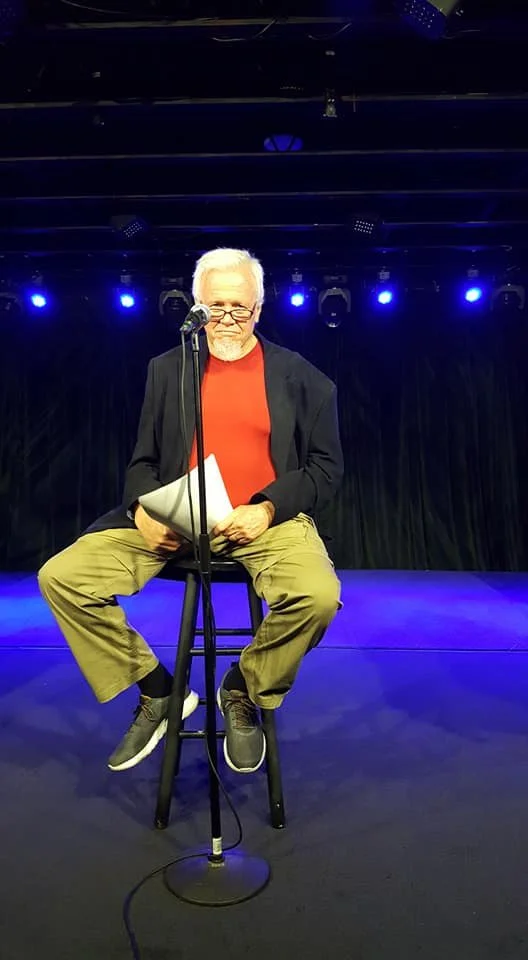
But my favorite character was Joyce Johnson,  a young Black woman who starts out relegated to the role of custodian but clearly has much more to offer Consolidated Electronics, if not the world. Played by poet, singer, songwriter, and now actor, Alyssa Stewart, Joyce is aware of the power her almost invisibility in the workplace affords her and uses it to her and her work mates’ advantage. But Joyce is all-seeing. Her smirks, chuckles, and knowing glances are priceless. Having worked for years at Consolidated Electronics, her awareness that poor women and women of color were already a part of the labor force long before the war even started, informs her approach to her job and to dealing with the men in supervisory positions. Let’s hope Alyssa Stewart, the actor, finds herself on another stage soon!

Speaking of the men, the characters Herman Mueller, played adorably by Jack Bingham, and his supervisor and the play’s antagonist George Perroni, played by CTC executive director Jim DeFelice, served the play’s narrative well. While George’s character is somewhat informed by the stereotypical mid-century husband, who offers much sound and fury on the job but ultimately submits to his powerful wife, DeFelice gives his role the kind of humility that makes his character receptive to growth and change. George’s long-awaited epiphany that women are strong, capable, and let’s face it, amazing is facilitated by the pure kindness of Herman’s character. In his words and actions, Herman consistently conveys the message that everyone is really just doing the best that they can under world-altering conditions. In this role, Bingham could not have been more authentically open and vulnerable. I look forward to seeing Bingham on a local stage again, as well.

The cast is rounded out by Samantha Hansford playing the role of Phyllis and Barry Smith as the announcer/messenger, both of whom took smaller roles and made them meaningful. Jamie Carr Harrington directed the play with sound and lights by Simon Marchant. Tiffany Dinsmore and Abby Mathias did an excellent job with costume design, not only remembering to make the characters’ shoes fit the time period but giving some of the characters charming spectator styles that made even a non-shoe person like me swoon a little.

Similarly, Jane Peterson took no short-cuts with the show’s props, putting her graphic design skills to good use wherever she could. To that end, don’t miss the pin-up calendar she designed for the first act! (Full disclosure, Peterson is a member of the Jasper Project board of directors and theatre editor for Jasper Magazine.) And kudos again to DeFelice and Dinsmore for creating an appropriately industrial set complete with uncomfortable aluminum chairs à la The Whig.

How to Supervise Women is more than a comedic play. Lou Clyde has created a rich narrative full of grace notes that subtly pepper the play with hints that give nuance to the culture in which the story is set. Whether it be an off-the-cuff comment by a female character that after working a double shift she still works a third shift when she gets home, or notes left in the women’s un-locked lockers with messages like, “Broads belong on their backs,” or the bathroom signage that changes from MEN to WOMEN to POWDER ROOM, How to Supervise Women is a portrait of a period in American history that spurred changes in gender roles, workplace dynamics, the way women viewed their value, and so much more.

In her Playwright’s Note, Lou Clyde writes, “My mom was one of the six million women who worked in a factory while my dad served in World War II. … This play is meant to honor these trail-blazing women who proved they could not only do the jobs of men but do them well.” Not only does How to Supervise Women accomplish Clyde’s mission, but it does so with an abundance of humor and theatre artists who bring their meticulously designed characters to life with sensitivity and finesse.

Go see How to Supervise Women at Chapin Theatre Company

February 7,12,13,19, and 20 at 7:30 pm

and February 8, 14, 15, 21, and 22 at 3 pm.
Visit Chapin Theatre Company for tickets.


Announcing Fall Lines Vol. X Winners and Launch Date

May 19th 2:30 pm Richland Library

The Jasper Project is delighted to announce the winners of our Fall Lines Volume X poetry and prose prizes, our newest prize for a South Carolina writer of color, and the date of the Fall Lines Volume X book launch and reading.

Please join Jasper on Sunday May 19th at 2:30 pm in the auditorium of Richland Library as we welcome the 10th volume of Fall Lines – a literary convergence to the world. Previously announced accepted contributors are invited to read from their published work and copies of Fall Lines will be available for further distribution throughout the state. Contributors and guests are invited to attend.

Congratulations to the following prize winners.

Alyssa Stewart, winner of the Combahee River Prize for a SC Writer of Color for her poem “a black boy dreams of water” sponsored by the SC Academy of Authors.

Liz Newall, winner of the Broad River Prize for Prose for her short fiction “Red Hill Fans” sponsored by the Richland Library Friends and Foundation.

Brian Slusher, winner of the Saluda River Prize for Poetry for his poem “Improv 101” also sponsored by the Richland Library Friends and Foundation.

This year’s judges were Jennifer Bartell Boykin, poet laureate for the city of Columbia, SC (Combahee River  Prize), Ed Madden, Fall Lines co-editor and former poet laureate for the city of Columbia SC (Saluda River Prize), and Cindi Boiter, co-editor of Fall Lines and Jasper Magazine (Broad River Prize).

In writing about “a black boy dreams of water” by Alyssa Stewart, Boykin says, “It is not a coincidence that the winner of the Combahee River Prize is a poem overflowing with water. Water can be healing. Water can be dangerous. But what is water to a Black boy? What is the role of water in the Black psyche? In “a black boy dreams of water” Alyssa Stewart explores these questions and more. She pens a well-crafted poem in which the Black boy experiences water in a pool, in a pond, a river, a broken fire hydrant and infuses them with memories of the Atlantic Ocean and the Middle Passage. Boykin continues, “There is joy in the water that ‘has the power / to make his auntie’s hair curl’ and danger in water that can ‘turn hardened men into narcs.’ This poem deals with the legacy of water and Blackness, the not knowing how to swim (‘we do not go in’) and water as a path to freedom. It’s a call and response that beckons us to dream with this Black boy and to dream of/in water.”

Ed Madden, who is the Jasper Project’s literary editor, having selected poetry contributors to Fall Lines since our begging, writes about adjudicating the Saluda River Prize for Poetry. “While I love the meditative language of Randy Spencer’s "Reading Ann's Poem..." and the unemotional attention to the things we do in Worthy Evans’ "Blues Song...," and the humor of Debra Daniel’s "Studies in Reproduction"—all that to say this is a tough decision—I decided on Brian Slusher’s "Improv 101" as the winner of the Saluda River Prize for Poetry this year. While there is so much to love in all of the finalist poems, this poem has such a playfulness that almost-but-not-quite distracts from its serious lessons, every instruction for improv comedy also resonating with so many other possibilities. Say yes and....  Why don't we just let it go?” Madden continues, “The wild pacing of the poem suggests the wild pacing of improv--as if to suggest that poetry itself is a kind of improvisation. (And isn't it?) And that last double simile is so so delightful.”  

For Boiter, it was an honor, though also a challenge, to read and adjudicate this volume’s prose submissions. “As a prose and creative non-fiction writer myself, I find that I always learn something from reading the widely varied contributions to Fall Lines. In Suzanne Kamata’s ‘Community Building,’ for example, I vicariously learned about the awkward enthusiasm of actively participating in a culture foreign to one’s own. As a person who had once felt so out of touch with the portion of my peer group that valued conformity, Evelyn Berry’s “The Home Party” reminded me of the darker days of my early thirties and the frustration and shame of trying to fit in among people for whom I had no admiration and little respect. I think many readers will commiserate with the satisfying sense of personal growth I felt, and Berry’s main character begins to feel, at having extracted oneself from the kind of dangerous women Berry writes about and ensconced oneself in a community of forward-thinking artists and progressives. But it was in Liz Newall’s ‘Red Hill Fans’ that I was most carried away by the storytelling and the plot twists that have always inspired me both as a writer and a reader. For that reason, and more, I selected Newell’s ‘Red Hill Fans’ as the winner of the Broad River Prize for Prose.” 

The Jasper Project wants to thank Richland Library, Lee Snelgrove, One Columbia for Arts and Culture, Xavier Blake, the South Carolina Academy of Authors, Wilmot Irving, Mary Beth Evans, Ed Madden, and Jennifer Bartell Boykin.

Congratulations to Liz Newell, Alyssa Stewart, Brian Slusher, and all the accepted contributors to this historic issue of Fall Lines – a literary convergence.


 Mark your calendars!

Sunday May 19th 2:30 pm

Richland Library

1431 Assembly Street, Columbia, SC


Virginia Russo Joins Saul Seibert for Artists Showing Artists THIS THURSDAY


For the first installation of the Jasper Project’s Artists Showing Artists series taking place this Thursday night at 7 at The Living Room, Saul Seibert chose Artist Virginia Russo as one of the artists he would like to feature. 

Kara Virginia Russo is a visual and performance artist who grew up in the tiny lake towns of 1980's central Florida, before moving north and earning a BFA from Converse College in Spartanburg, SC. After living for a while in both Asia and Europe, she returned to settle with her husband and two children in South Carolina, where she splits her time as an artist between Columbia and Greenville. Her work has been shown in solo and group exhibitions from Charleston to Asheville.  

Most recently, she collaborated on Zion: a Composition by Saul Seibert, contributing album art, projection visuals, merchandise design and creation, and live ritual based performance art.


According to Russo, “My job as an artist is primarily to SEE, and only secondarily to communicate what I see. In expressing what is unseen (both within and without), I have found it helpful to use the visual language of an inner world I think of simply as The Planet. I like to explore the tension of navigating the wild terrain of the unseen from the safety of the imaginary. Think of my work as paintings, photographs, and explorer’s notes from a place you’ve never been, but one which feels immediately familiar.

“My pieces are built of layers upon layers of wet in wet watercolor and ink, relying on long experience to predict what the unleashed media might do, while staying open to surprise. Over the wet media (or occasionally under), I layer pencil, oil and chalk pastel, collage, and embroidery. I think of the wet media as attempts to paint mystery, and the dry media as attempts to expound and interpret to myself what I have painted, like notes in the margin of a well-loved book.” 

Russo continues, “My collaboration with Saul on Zion happened one day while he was looking at some of my recent work. I remember him sending me a message in response to some pieces that read simply, "I know this place."  I felt the same way the first time I heard the beginnings of the music. The work we've done together has been based on that ever since. We are artistically walking the same landscape. I see my role as simply making visible what is already there inside the music. When I listen to Zion, I'm transported to this place that is unique to Zion but is set in some other corner of my own imaginary world that all my work comes from. I can walk around, explore, see the features of this world, and then come back and paint it. The performance art is the same, I use the body as an instrument to convey visually the emotions and narrative of the piece in real time for the audience at live shows. I contribute all visual art for the project, from designing and hand printing the shirts, to the album art, to the bank of film that Ash Lennox, who does our live visual sets, pulls from. It's an incredible piece of music, and I still can't believe I get to collaborate on it. The musicians are phenomenal, I'm blown away every single time they play it.  

“Zion as a project was more or less part of my life as an artist for two years, from the very beginning of the project. It provided the steady thread all through an overseas move back to America, and all the transition that came with it. Zion stayed the same, I think the project kept me sane.  

“When the collaboration began, I had only been making art again for a year after a decade long hiatus. Zion provided the framework I needed to find my voice and confidence. I would ask Saul his opinion, and he would just say that he trusted me completely. I had complete artistic freedom, which was intimidating at first, but challenged me to grow as an artist in ways I'm grateful for. I grew into the project, in a sense. Every now and then, Saul would say something like "wouldn't it be cool if..." and I knew I was about to learn to do something I didn't think I could do. I picked up whole skill sets I had never tried before, ranging from stop motion, to illustration, to block printing. Saul had such confidence in my abilities, anything seemed possible. On top of that, Columbia has welcomed me into the creative community, and I can't imagine making art without all this support.” 

Join Jasper on Thursday night as we facilitate Rebekah Corbett’s project, Artists Showing Artists with Saul Seibert. Saul has invited poet-songwriters, Alyssa Stewart, and NoN (Keith Smyly), as well as his band King Saul and the Heretics. Art will be on display and available for sale by Virginia Russo, Adam Corbett, and Emily Moffitt. 

Tickets are $12 in advance and $15 at the door. 

The Living Room, 6729 Two Notch Road #70, Columbia, SC, 29223

Tickets

jasperproject.org/artists-showing-artists/tickets


Refillable Jasper cups for beer and wine will be available for $10 as well as hotdogs and a selection of baked goods. 

All proceeds go toward supporting the Jasper Project’s mission.