Artists for Africa Hosts 9th Annual PostCard Event in Support of Original Art and Kenyan Youth

When Cooper Rust traveled to Nairobi, Kenya, in 2012 as a volunteer dance instructor, she didn’t expect the experience to stick so strongly to her skin. It did, however, and soon after her return to the states, she founded Artists for Africa, a non-profit organization that supports and provides dance, new experiences, education, and shelter to Kenyan youth.

 In the past decade, the organization has grown, led by C. Rust (Executive Director) and her sister Brie Rust (President), and now hosts a plethora of events in both Kenya and South Carolina, such as bringing dancers from Nairobi to study and perform at the University of South Carolina. 

One of these events, almost as old as the organization itself, is the PostCard Art Event, an evening that pairs small, postcard sized art with drinks and finger foods for a collaborative, community-oriented experience. Next week, the 9th annual PostCard will be held at the Hilton Garden Inn. 

The evening begins with a cocktail hour and appetizers in the spacious lobby, and at 7:00pm, the ballroom will open to reveal the art donated from various established and emerging artists across the United States. Patrons can peruse the art for around an hour as they continue to enjoy drinks and snacks. 

Over 50 artists are included in this show, including some familiar Columbia names like Bonnie Goldberg, Bill Davis, Rob Shaw, Rebecca Lynn Horne, and the Honors Art Students at Dreher High School

The art is available first come, first serve, for $65 per 4” x 6” piece. While the artists sign each piece, these signatures are on the back. Thus, before purchasing, the artist remains anonymous, and patrons are able to select art based on individual desire and attraction. Beyond the small art, larger pieces will also be available, including jewelry and ceramics, each appropriately priced. 

PostCard Art is one of two major annual fundraisers for Artists for Africa, making it one of the organization’s vital events. “100% of the profit goes to support our mission of providing arts and educational opportunities to vulnerable children in some of the world’s poorest slums in Kenya,” B. Rust shares. 

The organization is particularly looking forward to this year’s event after having to move online during the pandemic. “We are very excited to see everyone and share the evening,” B. Rust says. “We have moved our event to the Hilton Garden Inn downtown and are really excited to share this newly renovated space with everyone.” 

B. Rust credits and thanks the group’s Board of Directors, plus their friends and family, for the time they have and will donate to “organize each detail, set everything up, and get it all wrapped up at the end of the evening.” Further, the expenses of the event are generously covered by sponsors, so all money from ticket sales will go directly to Kenya and C. Rust’s efforts in Nairobi. 

If you want to see unique art and support education and opportunity for African youth, be sure to attend this year’s PostCard Art. The event will be Wednesday, February 16th at 6:00pm at the Hilton Garden Inn in Columbia. Tickets are $30 in advance and $35 at the door and can be purchased here: https://www.brownpapertickets.com/event/5344995  

CALL for Site Specific Visual Art via Our Friends at CCA

701 CENTER FOR CONTEMPORARY ART 

MILL DISTRICT PUBLIC ART TRAIL OPPORTUNITIES 

We were excited to hear about this unique opportunity for visual artists to break into site specific/public art offered by the good folks at 701 CCA that we wanted to help them spread the word.

Here’s what we know —

701 Center for Contemporary Art (CCA) is seeking artists to develop and execute site-specific works for five gate houses located on the grounds of the historic Granby and Olympia Mills as part of CCA’s Mill District Public Art Trail. The mills are twin Romanesque Revival style, four-story structures designed by W.B. Smith Whaley & Company - the leading mill architects of their time. Once considered two of the most architecturally significant textile mills in South Carolina, today the two massive buildings have been repurposed for residential mill living.  

The application deadline is Wednesday, March 9, 2022.

Budget 

The budget for each gate house is $3,000

Public Art Opportunities

Five gate houses located in front of the two mill buildings offer unique opportunities for site-specific works. The structures were built during WWII.  Designed to compliment the architectural elements of the mill buildings, the Olympia Mill gate houses feature arch-shaped windows and a frieze consisting of terracotta arches. The less decorated Granby Mill gate houses feature dentil brick molding and sash windows.  

The gate houses will function as changing exhibition spaces for temporary public art projects. The projects will be installed for a minimum of one year.  Each gate house is 10’x10’ with a modest interior and lighting. Access to the interior is through doors on the rear or side of each structure. The gate houses are not air-conditioned or heated. Artwork must be able to withstand extreme weather conditions. 

The exteriors of the gate houses are protected under the City of Columbia historic preservation ordinance. Attachments to the exterior are not allowed. 

Eligibility 

Artists working in media appropriate for non-conditioned environments and styles are eligible for consideration. Artists may submit individually or as a team. Artist teams must designate one artist as the lead contact. This opportunity is open to professional artists 18 and over. 

Selection Process

A panel of arts professionals will review artists qualifications and make a selection of artists who will be invited to submit a full proposal. Selections will be based on artistic merit, experience with public art commissions and/or installation art and the ability to complete and install the project by June 20, 2022.

RFQ Requirements

  1. Images of up to five completed commissions/installations that demonstrate your qualifications for the project. Please include the title, medium, dimensions, year completed, location, and a short description. 

  2. Artist resume demonstrating a minimum of five years of professional visual art experience. If submitting as a team, a current resume should be submitted for each team member.  Please compile resumes into one document.

  3. Statement of interest in this particular Mill District opportunity

  4. References that include the names and current contact information for three individuals with whom you have worked, collaborated, or who have commissioned your work in the past. References may be contacted for artists invited to develop a proposal for the commissions

    Timeline

Call for RFQ - February 9, 2022

Zoom Q&A - February 14

Zoom Q&A - February 28

Deadline for RFQ - March 12 

Panel Review & Selection - March 13

Notification to Artists - March 15

Deadline for Proposals - April 4

Finalist(s) Notification - April 8 

Finalist(s)  Interviews/Presentation of Proposals on Zoom - April 11

Notification to Finalists - April 13

Site Availability - April 14

Deadline for Installed Works - June 20

Please submit questions to Michaela Pilar Brown at director@701cca.org. Questions and answers will be posted on our website at www.701cca.org


February's Tiny Gallery Features Adam Corbett

It’s always exciting to us at Jasper when we get to witness artists cross genre lines to dip their toes in disciplines other than what they are known for. This month, musician and music educator Adam Corbett is doing just that by participating in the Jasper Project’s Tiny Gallery Series. But this isn’t the first time Corbett has wandered from music to visual arts waters. Corbett has been participating in several of the pop up community arts festivals that have become so popular since Covid grounded most of our gallery showings. In fact, Corbett’s little Christmas gnomes, offered as part of Jasper’s Tiny Gallery Ornament Show were so popular that we sold out of his creations.

Corbett is back in the Tiny Gallery this month with a collection of watercolors and mixed media portraits with sizes ranging from 8 x 10 to 12 x 14 and price points from $30 to $125.

Visit Corbett in the Tiny Gallery and snap up one of his original pieces while they’re both accessible and affordable.

Red by Adam Corbett

ABOUT THE ARTIST: Adam Corbett is a multi-instrumentalist, singer-songwriter and visual artist from Lexington, South Carolina. After releasing numerous records, helping to produce a musical, and taking a break from his career as a music teacher, Adam branched out into visual art as a way to cope with the COVID-19 lockdown. Throughout this period, he has experimented with various mediums in a variety of formats focusing always on exploration, play, and following his muse.

The Other One by Adam Corbett

Check out the rest of Adam Corbett’s Show at

Jasper’s Tiny Gallery

Mark Your Calendars! Jasper Announces 2022 Tiny Gallery Lineup

In 2021, Tiny Gallery hosted 15 artists in a vast variety of styles and mediums. In 2022, we’re featuring an even greater array of mediums with a collection of wonderful local talent. Learn more about each artist below and be sure to mark your calendars for your favorite shows. All shows begin the first of the month and end on the final day of the month, accessible 24/7 to peruse and purchase via Jasper’s virtual gallery.

January: Gina Langston Brewer

Though unconventional in guise and approach, Brewer is a teacher first, having been formally educated at Winthrop University in Rock Hill and later securing a master’s in divergent learning from Columbia College. She has the requisite ‘book-learning’” but is much more interested in life-learning and sharing with others the lush explorations that beckon each and every day in libraries, forests, farmer’s markets, junk yards, and roadside poppy fields. All are creative spaces in her eyes.

After marrying her best friend, Kevin Brewer, in 2008, she assumed the nomadic life of a military wife, moving from post to post and home-schooling their son, George. During that time, she operated two art studios, one in Columbus and the other in Augusta. Brewer also has two grown sons by previous relationships, Nathan and Dylan. The Brewer family moved back to Columbia in 2018, and Gina recently opened a studio in downtown Columbia, away from the interruptions, distractions, and demands of family and household.

Though she works in many mediums, Brewer is best known locally for her lushly colored, abstract paintings that, to many people, are reminiscent of (to select well-known artists for reference) Picasso or Klimt. The subjects she paints are alternately curvy and geometric, simple and lavish. She has had solo exhibitions at multiple venues, including Tapp’s Art Center in Columbia and the University of South Carolina-Beaufort art space.

Headshot of Gina
One of Gina's paintings

February: Adam Corbett

Adam is a multi-instrumentalist, singer-songwriter and visual artist from Lexington, South Carolina. After releasing numerous records, helping to produce a musical, and taking a break from his career as a music teacher, Adam branched out into visual art as a way to cope with the COVID-19 lockdown. Throughout this period, he has experimented with various mediums in a variety of formats focusing always on exploration, play, and following his muse.

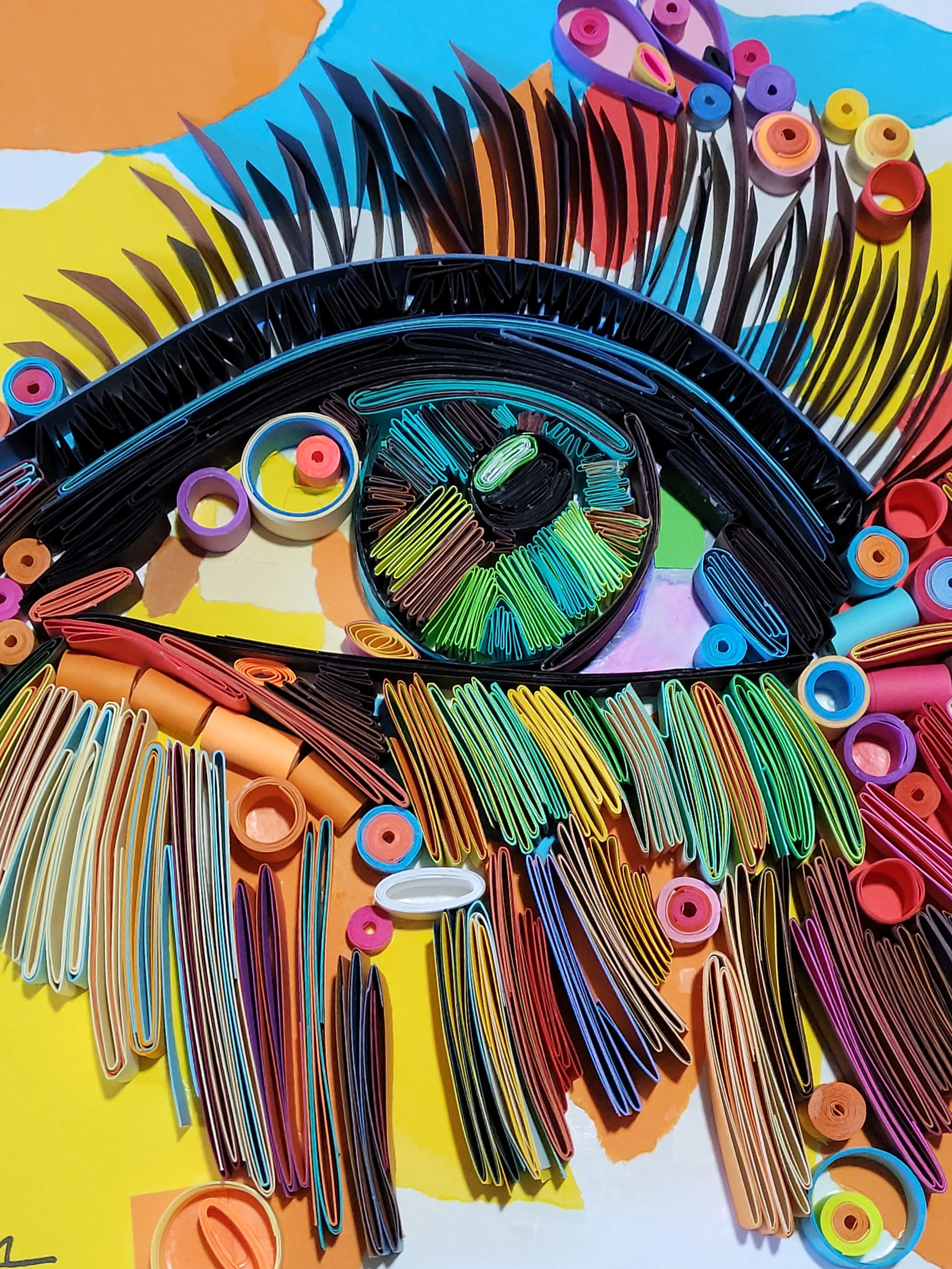
March: Fairoozan Art

Ms. Fairoozan is a paper artist and illustrator. She has been interested in various forms of papercraft since her school years, it took her quite a while to find her own way of bringing together her love of paper with her experience in painting.

She has actually discovered a new way of using the basic paper technique as she is drawing with paper instead of on it, at that time point she has no idea it was called (Paper Quilling) and she made the quilling process interesting and modern.

These paper artworks can take from a few days to a few weeks or even longer – it all depends on the level of details, size and design, the largest paper artwork she ever made took her around 6 weeks.

A former art teacher with more than 15 years of experience, she finished a bachelor's degree from the College of Fine Arts at the University of Baghdad, in Bagdad, Iraq.

Her artworks have been shown in many exhibitions in various countries around the world and in different states all over the USA.

April: Valerie Lamott

Valerie Lamott is a Columbia, SC, based jewelry artisan, but can rarely be found there. She's more likely to be hiking or camping or kayaking in any one of America's state parks. She uses these places as inspiration for her artwork and hopes it inspires others to play outside too.

May: Lucy Bailey

Lucy Bailey’s ceramic sculpture centers around the figure, with liberal use of layered textures and mixed media elements. Additional work explores combinations of ceramics and wood or wire, and earthenware altar boxes that create narratives through assemblages of found objects.

In 2021 one of her sculptures was exhibited at ArtFields in Lake City, SC. Her work was awarded the Best in Show distinction in exhibitions by the Annual Artist’s Guild of Spartanburg (SC) Juried Show and the Arts Council of York County (SC) Annual Juried Competition. Bailey’s work has twice been selected for the 701 Center for Contemporary Art’s South Carolina Biennial show. Her work was published in Lark Books’ 500 Figures in Clay-2.

Follow Lucy Bailey’s work on Instagram @lucybaileyclay   

June: Cindy Saad

Cindy Saad considers herself to be a multimedia artist creating art in various mediums that include painting, photography and jewelry making with jewelry being her main form of artistic expression. Whether sculpting a necklace or painting on canvas, she likes to work spontaneously, creating pieces that evoke the senses.

A native of Sumter, SC, Saad has a Bachelor of Arts degree in Sociology from the University of South Carolina and is mainly a self-taught artist. She has exhibited throughout the Carolinas in numerous juried art shows and exhibitions and is currently represented by the City Art Gallery in Columbia and the SC Visitor’s Center in Walterboro.

www.cindysaad.com  
Instagram @cindysaadart

July: Thomas Washington

Perhaps the most important pursuit of an artist is the facilitation of Escapism. Perhaps each project is the equivalent of a Narnian door…or that lamppost beyond, coaxing a wanderer into another realm.

Thomas Washington Jr. (thomas the younger) functions on that premise. Since his childhood, he has produced multitudinous works in this vein—from being hired (out of high school) to illustrate in a local graphic anthology, he has subsequently striven to bring stories in every medium; to breathe life into the fantastical by imbuing it with the familiar…and, of course, to find fun and fulfillment along the way.

As a result, it required the birth of his children to make him care about money. (He still struggles with this.) –For years, he was perfectly fine living as a Bohemian: he laid his head in strange places among strangers, eventually becoming a pleasant strain of strange in the process. He thus entertains all sorts of bizarre notions—the importance of world peace, an unshakeable belief in fundamental similarities that make Humanity one big family, intense opinions on interstellar travel, and so-forth.

Recently, he took the leap of emerging in his local scene. He has sat on panels, joined the instructor roster for community arts centers, partaken in various shows, (finally!) founded a website, and essentially joined the dialogue of Art’s Place in Society.

August: Chilly Waters

Chilly Waters has a high level of creativity and a passion for art. He channels his creativity into creating one of kind clay sculptures that often include reclaimed mixed media materials. These sculptures are 3D representations of his imagination in action and allow him to empty his mind of all the additives that collect in there. They are his imagination coming to life.

His goal is to make things that invoke feelings of joy or curiosity. Well, that and to become a space cowboy or a Marvel superhero - whichever comes first.  He sees “junk” or discarded items as components of art that have yet to reach their full potential.  

Chilly has been working as a clay artist for 5 years (after retiring from a long-term career) and is predominately self-taught, having molded his skills and style through various workshops and networking with other artists. He is a member of the Midlands Clay Art Society, and his work has been shown in galleries in Aiken and Columbia, SC as well as various arts festivals in South Carolina and Delaware.

He finds inspiration in listening to people, observing what they say or do. Often times when he hears a work or a phrase, he visualizes it in his mind and has to create a 3D image of it. He also sees discarded “junk" and wonders what it could be if it had a second chance. Once an idea is realized, he grabs a chunk of clay and starts to create.

September: Amber Machado

Amber Machado is a painter from Columbia, SC. She began painting as a teenager, hoping to emulate her sister and father who have always been her biggest artistic role models. It took nearly a decade of painting sporadically before her personal relationship with art began. At the onset of being diagnosed with Lupus, she began to paint more frequently, and what began as a welcome distraction, has now become her full-time job. More importantly though, she credits painting to being her primary means of coping with a chronic illness. 

Over the last three years her aim has been to develop new skills and grow as an artist. Her main area of focus is landscapes, primarily watercolor. She is greatly inspired by nature, natural light, and color. When she’s not painting, she is usually dancing with her cats or pestering her spouse.

**materials from https://www.ambermachado.com

October: Maya Smith

South Carolina based artist, Maya Smith, has been honing her skills as a freelance artist for the past fourteen years. She graduated from the Savannah College of Art and Design in 2006 with a BFA in Illustration. 

Her work celebrates people of color and women with shape. Using pencils and paint to create imagery that counters negative stereotypes and provokes conversation. 

Maya’s work has been commissioned by Oscar Award winning director, Steve McQueen for the film, Widows. Her work is part of the New York Public Library archives through the Schomburg Center for Research in Black Culture in Harlem, NY. 

November: Sean Rayford

Sean Rayford is a freelance photojournalist and documentary photographer in Columbia, SC, where he works with Getty Images, The New York Times, The Associated Press and many others. He is a 2001 graduate of the University of South Carolina. His work was recently featured in the Hindsight 20/20 exhibition at the Columbia Museum of Art and as part of Time Magazine's Best Photos of 2021.

December: Ornament Show

Last year, we did our first ever Tiny Gallery Ornament show, which was a great success thanks to our ever-wonderful patrons. In 2022, we’ll be showcasing new artists for another ornament show. These artists have yet to be selected, so stay tuned for another announcement later on!

We are grateful to the artists and patrons who come together to make Tiny Gallery possible, and we look forward to our 2022 journey together. To ensure you don’t miss out on further gallery announcements, sign up for Sundays with Jasper!


Mark Your Calendars for Another Melrose Heights Art in the Yard coming up in April

From our friends in the Historic Melrose Community …

The Historic Melrose Art in the Yard will welcome nearly one hundred artists and artisans to show and sell their original work in the historic, downtown Columbia neighborhood. The event will be held on Sunday, April 10, 2022, from noon to 5 pm with art, food and entertainment for visitors.

Historic Melrose Art in the Yard (AITY) held the first art event in 2020 at the beginning of the pandemic. The idea was to provide local artists and artisans with a safe place to show and sell their wares while also showcasing the historic neighborhood. The event drew hundreds of people to explore the neighborhood. Based on this success and the demand for local art, AITY has become a regular event. The April 10th AITY will be the seventh time the event has been held.

“The Historic Melrose neighborhood is looking forward to welcoming visitors and supporting the local arts scene on April 10th,” said organizer Lila McCullough.  “We will showcase a wide variety of artists and artisans in yards throughout the neighborhood and we will have something for everyone,” said McCullough. 

This event is entirely outdoors and spread over several city blocks, but social distancing and masks are encouraged.

Due to the success of the past events, this one will feature more artists and more food vendors than previous events. The event will also be followed by live music starting at 5 pm. The event is FREE and open to the public. Information and maps will be available on Facebook and Instagram. 

The Snow Came Down and Our Hearts Burst with Joy

Snow comes to Columbia and, at Jasper, we honor the fresh new prism it lends us for the needed respite of seeing the world in the light that was intended - cleanly and with introspection and joy.

A blue sky and a white day.

This is all we need for a moment.

Wilma King

"Snow was falling,
so much like stars
filling the dark trees
that one could easily imagine
its reason for being was nothing more
than prettiness.”
Mary Oliver

Green Eyes - Clark Ellefson

“I love you because no two snowflakes are alike, and it is possible, if you stand tippy-toe, to walk between the raindrops.”
Nikki Giovanni

Laura Garner Hine

“I wonder if the snow loves the trees and fields, that it kisses them so gently? And then it covers them up snug, you know, with a white quilt; and perhaps it says, "Go to sleep, darlings, till the summer comes again.”
Lewis Carroll, Alice's Adventures in Wonderland / Through the Looking-Glass

courtesy of Ed Madden & Bert Easter

“The snow doesn't give a soft white damn whom it touches.”
E.E. Cummings

Paul R. Moore & Rusty Sox

“A lot of people like snow. I find it to be an unnecessary freezing of water.”
Carl Reiner

Snow Bunny - Tim McLendon

“The more I see, the less I know, the more I'd like to let it go.”
Red Hot Chili Peppers

Jay Hubbell - Change for Change - Muddy Ford

“It is growing cold. Winter is putting footsteps in the meadow. What whiteness boasts that sun that comes into this wood! One would say milk-colored maidens are dancing on the petals of orchids. How coldly burns our sun! One would say its rays of light are shards of snow, one imagines the sun lives upon a snow crested peak on this day. One would say she is a woman who wears a gown of winter frost that blinds the eyes. Helplessness has weakened me. Wandering has wearied my legs.”
Roman Payne

courtesy of Dick Moons

“I think a lot of snowflakes are alike...and I think a lot of people are alike too.”
Bret Easton Ellis

Dick Moons

“It snowed last year too: I made a snowman and my brother knocked it down and I knocked my brother down and then we had tea.”
Dylan Thomas, A Child's Christmas in Wales

Julie Seel

“This is my first snow at Smith. It is like any other snow, but from a different window, and there lies the singular charm of it.”
Sylvia Plath, The Unabridged Journals of Sylvia Plath

Artist unknown - Muddy Ford

“As he looked out and saw the grey landscape through the gently falling snow, he could not help thinking how much better it would be if people could go to sleep like the fields; could be blanketed down under the snow, to wake with their hurts healed and their defeats forgotten.”
Willa Cather, One of Ours

With thanks to Clark, Bert and Ed, Julie, Dick, Paul and Rusty, Tim, Laura, and Wilma.

Artist Profile: Noelle Brault Makes A Statement with Light

JASPER: When did you first begin to pursue visual art? Where and when did you train, or are you self-taught?

BRAULT: I first began to pursue visual art in 2008 when I started taking lessons from Michel McNinch. I was always interested in art but never did anything about it until then. I took 5 years from Michel and then took several workshops from other artists.


JASPER: What mediums in visual arts do you typically use and why?

BRAULT: I paint in oil. I like the rich colors and how you can mix them. They feel natural to me.


JASPER: Where do you work now and where do you show your work?

BRAULT: I work as a Manager of Software Development at Southeastern Freight Lines. I show my work currently at Over The Mantel gallery. 


JASPER: Who have been your greatest influences as an artist?

BRAULT: Other contemporary artists have influenced my greatly including my teacher, Michel. Also, Shannon Smith Hughes of Charleston, Jason Sacran and Randall Sexton influence me just to name a few.


JASPER: What do you feel makes your art unique?

BRAULT: What makes my art unique is the way I manage light.


JASPER:  Who is your favorite SC-based visual artist and why?

BRAULT: I suppose my favorite SC based artist is Shannon Smith Hughes of Charleston. I love the energy and excitement in her pairings and also the way her paintings glow.


JASPER:  What are you working on now, will we get to see it, and if so, where, and when?

BRAULT: I am always working on a new painting. Right now, I'm working on a nocturne of the Jekyll Island Hotel and also an old truck at Price's tree farm. They will be available at the Cottontown Art Crawl on March 13th.

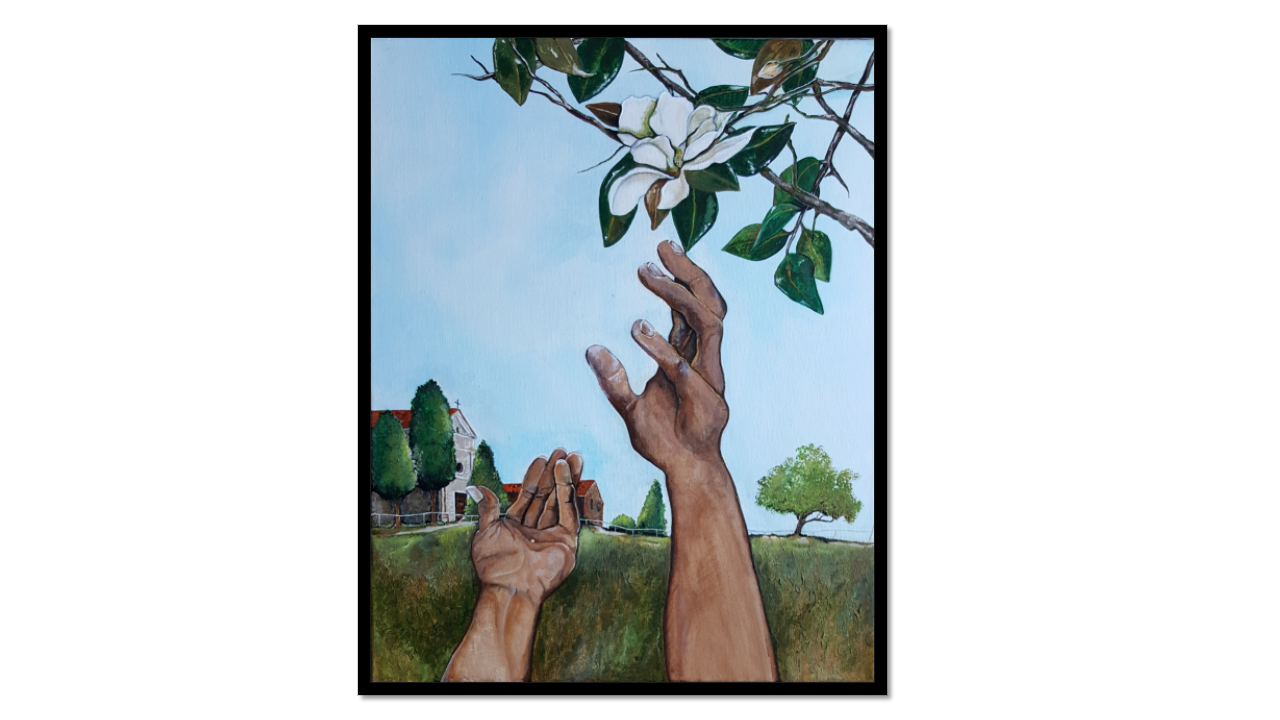
PROFILE: Visual Artist Wilma King Uses Rich Colors & Clever Object Juxtapositions to Create Warm & Inviting Images

If you haven’t seen the work of Cottontown visual artist Wilma King now is your chance.

Check out this virtual exhibition of King’s art and read about her background and inspirations below.

Jasper had the great pleasure of touching base with visual artist Wilma King this week and we asked her a few questions about her work. We’re delighted to share details of our exchange with you.

~~~~

Jasper:  When did you first begin to pursue visual art? Where and when did you train, or are you self-taught? 

Wilma King: I  remember an incident in fourth grade that helped me focus in on my love of art and design. My teacher, Ms. Hendrix, knew how to inspire and cultivate creativity and internationalism. She read books to us, held in-class competitions, and infused applied learning into our coursework way back then. Our school was on a military base in Fort Greely, Alaska which helped in the spirit of all of these concepts. My mind was full of dreams of being a nurse like Clara Barton, until she announced a fashion design competition for us girls. My classmates who saw my design convinced me that I would surely win – but I didn't. So, I launched this compulsion and intrigue to design paper dolls for my sisters, friends, and anyone who would allow me to do so. It was an experience that allowed me to delve deeply into individual, and cultural preferences for design, color, shape, size, and form. 

But it was in junior high school that my art teacher helped and encouraged me to see a broad range of ideas and topics from which to draw and paint. In eighth grade, I won a scholarship to what was then the Columbia Art School (a part of the museum), and sold my first painting that year, as well.

My first job, literally two weeks after graduating from the University of South Carolina, was with an international trade magazine, while still learning about cultural preferences and communication design. 

I have a BA degree in art studio (advertising design) from the U of SC and went on to earn a MA in Journalism (PR and Advertising) from Texas Southern University (Houston, Texas), because I always felt that there should be a collaboration between words and images. I taught graphic design, computerized design, or some form of public relations design most of my career, beginning with launching, teaching, and designing the first courses and curriculum in commercial art here in Columbia at Benedict College. From that point, I taught at the Art Institute (Houston, TX), O'More College (Franklin, TN), and was an Associate Professor in PR at both Western Kentucky University (Bowling Green, KY), and Rochester Institute of Technology (Rochester, NY).


Jasper: Where did you grow up?  

King: I was born in Lexington, SC, and continued to “grow up” in Alaska, and Columbia (Lower Richland area near Hopkins). My father was born and raised in Louisiana, ten miles outside New Orleans (St. John Parrish), so that's also part of the “growing up” experience. I have lived in eleven different states and did domestic and international sabbaticals that took me to a cumulative  nine months of slow travels and teaching abroad in Italy. 

After more than 30 years of doing some of the things that I found interesting and exciting, and to become my mother's primary caregiver, I moved back home to SC.


Jasper: What mediums in visual arts do you typically use and why? 

King: My very wonderful art professors at USC, particularly Jim Edwards, taught me that acrylics are extremely adaptable and can convincingly disguise as other paint mediums, so as a painter, which is my medium of choice. 

At the beginning of the COVID pandemic, I sought ways to bring people together over a meal, coffee, or drinks. Nursing homes and hospitals were closed to visitors making it impossible to share meals with elderly, ill, or hospitalized family and friends -- so I began painting on glassware -- wine glasses, wine bottles, mugs, vases, etc. (using oils): Table Companions was born! A "table companion" is someone that you enjoy sharing a meal or drink with. 

Jasper: Who have been your greatest influences as an artist? 

King: Dony Mac Manus, sculptor/founder of the School for Sacred Art in Florence,  Italy, and Giancarlo Polenghi,  the school's director of the master’s program who is an Italian art historian and who also teaches theology of the body. They both helped me to understand that the purpose and power of art is to elevate the status of individuals in communities and in society!

Jonathan Green has given me some very good advice and critique on my work, as well.

Now, each day, before I begin to paint, I study some of the great Christian art. I enjoy Biblical stories through the eyes of Michelangelo di Lodovico Buonarroti Simoni, Michelangelo Merisi da Caravaggio, Peter Paul Rubens, Cristofo de Predis, Rogier van der Weyden, Rembrandt, Vincent Van Gogh, and even Salvador Dali. 

I have had the great privilege and opportunity to visit many churches and museums across the US and Italy, particularly the Uffizi, The Vatican Museum and St. Peters Cathedral several times, on numerous occasions, as well as the Prado in Madrid. I also love two fashion museums focused on telling the stories of the family: Ferragamo and Gucci. A yet-to-realize goal is to see Rembrandt’s The Return of the Prodigal Son in the Louvre.

Jasper: What do you feel makes your art unique?

King: I enjoy telling my stories as well as those of people I have met along the way. An avid nonfiction reader, I try to incorporate a level of authenticity, through descriptive and narrative detail in my paintings. I focus on the story to give it broader meaning – that is, the painting’s relationship-building potential. People often comment on my style. I paint from memory, not photos (unless commissioned to do so), and I rarely use references. Various elements in each painting are carefully outlined to show that the story is a composite of different places and spans of time.

Of course, I believe Table Companions fills a different type of need and experience than merely doing handprinted glassware because I am finding a unique way for people to share being together and building memories over meals. I am still telling their stories through perhaps flowers, colors, etc.

Jasper: Who is your favorite SC-based visual artist and why? 

King: There are three. I am watching and loving Gerald Erley's paintings! His technique and artistic ability are unapologetically akin to that of the "great masters,” not only in his artistic ability, but also in the way he commands his storytelling.

Jonathan Greene has been a favorite for a very long time. I love his use of color and form, and the stories of the African American experiences in the south. He depicts an enjoyment, pride, and  love for life that is seldom seen these days. His viewpoint and perspective are necessary against a backdrop of sadness, anger, and bitterness in the world.

Finally, I have always loved the works of my former drawing professor, Phillip Mullen. I learned to be meticulous in the details and still develop a style distinguishable from everyone else.

Jasper: What are you working on now, will we get to see it, and if so, where, and when?

King: I try to produce at least one painting a week. I sometimes take time out to tell my own family's stories. To that end, I ended 2021 with an addition to my private collection titled: “Grandparents” 12/30. 

I began 2022 with a painting titled: “Wings to fly,” to be included in an upcoming exhibit along with six other paintings at the Richland Library’s “The art of being: Woman” exhibit  – February. 

4th Annual Cottontown Art Crawl is Coming Up - Saturday, March 12, 2022, from 10 am to 3 pm

The fourth annual Cottontown Art Crawl will welcome 115 artists to show and sell their original work in the downtown Columbia neighborhood. The event will be held on Saturday, March 12, 2022, from 10 am to 3 pm with more art, more artists, more food and more fun for visitors.

In 2019, the historic neighborhood in downtown Columbia, S.C. held the first Cottontown Art Crawl. The event drew hundreds of people to explore the neighborhood and its businesses and garnered the 2019 Neighborhood Program of the Year from the Columbia Council of Neighborhoods. The event has seen significant growth since. The 2022 event will be the largest yet sponsored by the neighborhood.

“The Cottontown neighborhood is looking forward to supporting the Columbia arts scene on March 12th,” said organizer Julie Seel. “Artists will be selling their work throughout the entire neighborhood. Some of the artists are emerging, some are quite accomplished, and some are award winning, juried artists. So, we truly have something for every level of art enthusiast,” said Seel.

This event is entirely outdoors and spread over several city blocks, but social distancing and masks are encouraged. The organizers of the event are committed to creating a safe and welcoming environment for all and providing an opportunity for artists to showcase and sell their work safely.

Due to the success of the last three Art Crawls, this year boasts many more artists than previous years, as well as an accessibility and entertainment corridor on the 2200 block of Sumter Street with artists, food vendors and entertainment. While artists are located throughout the neighborhood, the corridor is intended to be more accessible to individuals with mobility issues. 

The event is FREE and open to the public and will also feature live music featuring local bands and performers at Indah Coffee’s outdoor stage. The main host station will be located at 2200 Sumter Street, where information and maps will be available. Maps will also be available at specially marked post boxes throughout the neighborhood.

For more information about CAC and to see work by artists, please visit the Facebook and Instagram pages, or email jseel1@sc.rr.com.


May Peace Prevail on Earth -- The Vista Peace Pole by Eileen Blyth

“I was really pleased at how the work was accepted by the committee and the public. Everyone was very excited about the design and for such a large committee, they were delightful to work with. I think if anyone could do it, those people could make and sustain peace.” – Eileen Blyth

On Tuesday of this week, Columbia unveiled a new contribution to the Peace Pole project, an endeavor started in 1955 by Masahisa Goi in Japan after the bombing of Hiroshima. The Vista Peace Pole was funded by the Quaker community of the Columbia Friends, a committee of about thirty people who did all of the fundraising for the project and tapped visual artist Eileen Blyth to design and construct her unique version of an interactive Peace Pole.

The world-wide peace pole movement encourages the planting of poles on which the message “May peace prevail on Earth” is written in many languages. The Vista Peace Pole is located on the nine hundred block of Senate Street between Lincoln and Assembly Streets.

Blyth’s equally interactive drum-like sculpture, “Hanging” on Main Street adjacent to Drip coffee, sponsor of the installation, is already a local favorite among both children and adults.

Jasper spoke with Blyth about the opportunity to create this permanent addition to Columbia’s cityscape.


Jasper: How long did you work on this project?

Blyth: Probably one year start to finish with several bumps in the middle. Meeting with language experts, technical drawings. fabrication. Supply chain issues, and all the fun stuff that happens when doing a piece of public art.

Jasper: Can you tell us about the construction? 

Blyth: The body is Cor-ten steel and the letters are stainless steel. The body is formed around a rebar structure. It is 8”x8” at the base, 8”x22” at the top and 8’ tall. The bell is the cut off top of a gas C02 tank.


Jasper:  How deep is the pole in the ground? 

Blyth: About three feet below the surface and 8ft tall


Jasper: Did you have much freedom in your design?  

Blyth: The sculpture looks 100% like the original drawing. I had total freedom to come up with my own design within the parameters of what a peace pole is. 


Jasper: How did you make your Peace Pole unique to you as an artist? 

Blyth: I added the bell and the curve at the top. I wanted it’s to represent peace as a noun and a verb. The committee chose the languages. I met with each language expert several times to be sure I got every detail correct. The letters were cut out with a water jet and each piece was attached to the surface individually.  

701 CCA presents - South Arts Southern Prize & State Fellows 2021

Shared by our friends at 701 Center for Contemporary Art

Marielle Plaisir R. Bridges.

An exhibition series that in 2019 originated at 701 Center for Contemporary Art in Columbia, S.C., and is rapidly becoming the most important annual show of contemporary art made in the U.S. South is coming to 701 CCA for the second time. South Arts Southern Prize & State Fellows 2021 will open at the center on January 20 and run through March 6, 2022. Due to an increase in COVID-19 cases in South Carolina, there will be no opening reception, but 701 CCA hopes to present several events to accompany the exhibition. The show will include Charleston, S.C., artist Fletcher Williams III, who was the 2021 Southern Prize Finalist, or runner-up, and Florida’s Marielle Plaisir, the 2021 Southern Prize Winner. After 701 CCA, the 2021 exhibition’s second stop, the show will travel to North Carolina and Florida.

701 CCA initiated the first Southern Prize exhibition in 2019 in partnership with South Arts, the umbrella organization for state arts agencies in nine Southern states. South Arts launched the Southern Prize & State Fellows awards project in 2017, the first two years without an exhibition component. The inaugural 2019 exhibition traveled from 701 CCA to the Bo Bartlett Center in Columbus, Ga., which since also has hosted the 2020 and 2021 exhibitions.

“Each year that South Arts makes these awards, we are awed by the depth and artistry in our region,” South Arts president and CEO Suzette M. Surkamer, a former head of the South Carolina Arts Commission, wrote in the exhibition catalogue. When South Arts in 2017 launched the first cycle of Southern Prize and State Fellowships recipients, Surkamer wrote, “we did not know what to expect and were positively blown away by the response.” The current cohort, Surkamer wrote, reminds us “what it means to be resilient.” The emotionally taxing times of COVID-19, political upheaval and urgent calls “for long overdue justice and equity” did not stop the 2021 South Arts fellows, Surkamer added. “Each artist took what 2020 gave them and declared that 2021 will be brighter and stronger.”

For the Southern Prize, artists from Alabama, Florida, Georgia, Kentucky, Louisiana, Mississippi, North and South Carolina and Tennessee can submit a portfolio of their work. An independent jury selects one fellow from each state, from which a second jury panel selects two finalists for the Southern Prize. Each state fellow receives $5,000, the Southern Prize runner-up receives and additional $10,000, and the winner, and additional $25,000. Both finalists also receive a residency at the Hambidge Center for Creative Arts and Sciences in Rabun Gap, Ga. South Arts has so far awarded $400,000 through the project to contemporary artists living and working in the South.

Joyce Garner Pears

In addition to Williams and Plaisir, the artists in the current exhibition are Tameca Cole of Alabama, Raheleh Filsoofi of Tennessee, Joyce Garner of Kentucky, Myra Greene of Georgia, Jewel Ham of North Carolina, Ming Ying Hong of Mississippi and artists duo Keith Calhoun and Chandra McCormick of Louisiana.

The 2021 cohort of South Arts fellows is the most diverse group to date. Of the six American-born artists, all but Garner are African American. Filsoofi is from Iran, Plaisir was born in France but has roots in Guadeloupe and Hong was born in China but raised in Los Angeles.

Saturday, January 20 – March 6, 2022

More about SC artist Fletcher Williams III

North Charleston, SC, native and resident Fletcher Williams III (b. 1987) has shown his work in more than two dozen exhibitions since receiving his BFA at New York’s Cooper Union in 2010. Among the mixed media artist’s five solo exhibitions are Traces at 701 Center for Contemporary Art in Columbia, SC, in 2018 and Promise Land in 2020 at the historic Aiken-Rhett House in downtown Charleston, SC. The latter was a venue-wide exhibition in which Williams engaged the urban plantation’s grounds and indoor spaces with his paintings, sculptures and installations. Among the group shows that included Williams’ work are those at the Museum of Contemporary African Diasporan Art, the Caribbean Cultural Center and Cooper Union, all in New York City; Gateway Project Spaces in Newark, NJ; the San Diego Museum of Contemporary Art + African American Museum of Fine Art in California; the Mint Museum and Hodges Taylor Gallery in Charlotte, NC; the Mann-Simons Site and McKissick Museum in Columbia, SC; and several venues in Charleston and elsewhere in South Carolina. At the Mint Museum, Williams was included in Coined in the South, a 2019–2020 overview of art in the US South. Williams’ work is in the permanent collection of Charleston’s Gibbes Museum, where he was a visiting artist in 2019. He worked on the set of the Amazon Prime series The Underground Railroad, and his work has been discussed in some two-dozen publications, including the Wall Street Journal and the New York Times.

This Month in the Jasper Project's Tiny Gallery -- Welcome Back GINA LANGSTON BREWER!

After a nearly sold-out show in 2019, Gina Langston Brewer returns to Tiny Gallery with a new, intimate show.

The Columbia-based artist has created nearly her whole life and has been painting in our city since returning in 2018. Though proficient in multiple mediums and styles, she is known for her abstract paintings.

This collection of 10 paintings homes in on Brewer’s belief system that inspiration and creativity can be found everywhere. From a stain-glassed face with eyed closed as they bathe in the light refracted on them to a white cat, curious and intent, as it prances across the canvas to a woman donned in blue, sitting tilted forward on a chair, beckoning, each piece is as mystical as it is real.

The pieces are all acrylic on either canvas or wooden board, save for one acrylic mixed media piece, and range from $30 - $75. 3 of 10 have already sold, and the show will remain up until the evening of January 31st. View the show at Jasper’s virtual gallery.

Catching up with Visual Artist Abdullah Fairoozan

JASPER: How long have you been in the US and where did you live before coming here?

FAIROOZAN: I lived in USA for more than 12 years, before I move to USA I lived in Baghdad – Iraq


JASPER: What brought you to the US?

FAIROOZAN: I came to USA to pursue my dream as an artist and to become a global artist.


JASPER: Were you an artist in your homeland, too?

FAIROOZAN: Yes, I am a former art teacher with more than 15 years of experience, I finished a bachelor’s degree from the College of Fine Arts at the University of Baghdad, in Baghdad, Iraq


JASPER: When did you first begin your life as an artist?

FAIROOZAN: My artistic talents started from a young age and then developed during the study period, as I received support from the school and my family. During my university studies in the field of art, I received a lot of encouragement from my professors at the university to pursue the profession of drawing


JASPER: Are you self-taught or did you take lessons or go to school?

FAIROOZAN: Including to my talent in art, I finish 4 years bachelor degree in art from Baghdad university of art. also my former job as an art teacher and interact with students for many years helped me improve my art skill


JASPER: Who inspires you?

FAIROOZAN: I was always impressed by the different colors of nature (like trees leaves colors, flowers, sky and many others) so nature is my inspiration


JASPER: Do you have any shows or events coming up that we can help promote?

FAIROOZAN: My artwork "Everything has changed" has been accepted into Artfields 2022 at Lake City, South Carolina. I also planning my personal art exhibit in Charleston SC.

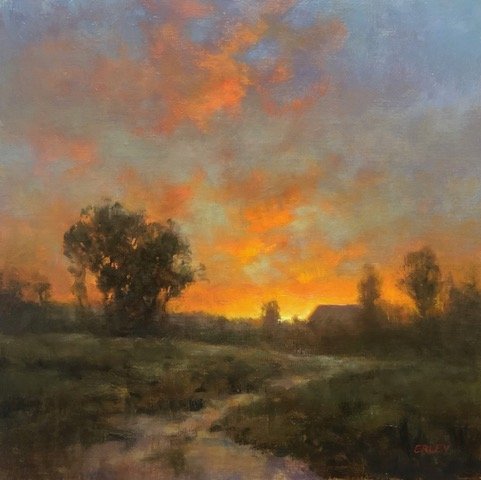
Catching up with Visual Artist Gerard Erley

“A work of art which did not begin in emotion is not art.”  - Paul Cezanne

 Homeward - oil on linen panel - 10 x 10 inches

Jasper: Can you tell us about your background - where you were born and raised, where you went to school, and how you came to live in Columbia?

 Erley: I was born in Springfield, Illinois. Progressing through a Catholic grade school and an all-boys Catholic high school, I went to college an hour from home, getting my undergraduate - and later my graduate - degree in art from Illinois State University. I worked various jobs, my longest (other than self-employed artist) being as a graphic artist for the Illinois Department of Corrections. 

Over ten years ago, I came to Columbia with my partner (now husband) Lemuel Watson when he accepted a deanship at the University of South Carolina. I taught art at USC for a few semesters, before devoting myself solely to painting. I felt the role of teacher could be filled by another, whereas only I could create the paintings signed with my name.

Matter-of-Fact Nude - oil on linen panel - 14 x 11 inches

Jasper: Where does your life as an artist fit into this trajectory? 

Erley: I was drawn to art making early on as a way of comprehending the world. If I could picture something, I felt I could begin to understand it. As one of eight kids, drawing also allowed me a quiet retreat away from the bustling family, a place where I could get to know myself as an individual and not just one of the herd. 

When the idea of choosing a profession later presented itself, I was debating between the life of a Catholic priest and that of an artist. Contemplating a future life of celibacy just as I was beginning to explore my own sexuality quickly turned my career choice toward the arts. Nonetheless, I do regard art as a spiritual calling, the studio as a church. I can’t help recalling Van Gogh’s failed attempt as a preacher before becoming a painter. 

Once I was set on the life of an artist and I got my college education, I worked part-time at various jobs, which allowed time in the studio. When fortune smiled, art sales alone sustained me.  

Aside from landscape painting, which is my bread and butter (though the slices can be thin at times!), I also paint still lifes, figures, portraits, and the occasional abstract piece. While generally my landscapes and abstracts are totally invented, the other work uses a different muscle, one requiring a deep look into what lies immediately before me. Meditating on an apple or a face, the world opens up in a surprising way. That has worked to my advantage in winning the ArtFields portrait competition in Lake City where I needed to complete three consecutive one-hour portrait in three rounds.

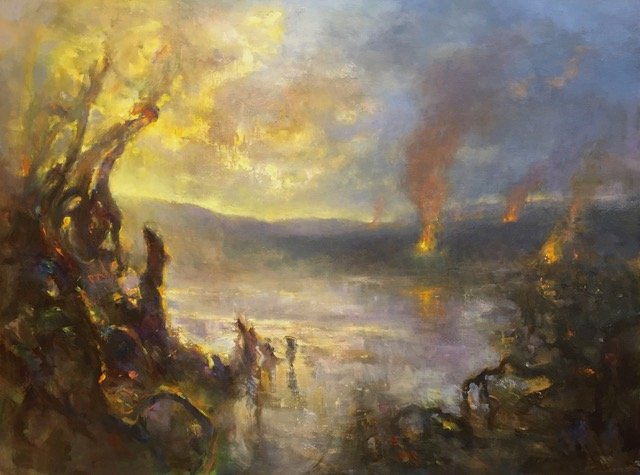
Dark Day Dawning - oil on canvas - 36 x 48 inches

In exploring the idiom of landscape painting, my vision sometimes takes a somber tone. "Dark Day Dawning" is perhaps a cautionary tale, an omen of a future born of present-day missteps.

Jasper:  When did you start realizing accolades as an artist and, of them, what has been most  meaningful to you? 

Erley: I received a silver dish (engraved with the obscure phrase “Best in Junior Miscellaneous”) for a drawing at the Illinois State Fair when I was fourteen or so. Since then, I have been the recipient of over 120 prizes, grants, and purchase awards. I am most proud of those I received from representatives of the St. Louis Art Museum, the Indianapolis Art Museum, the Fogg Art Museum (Harvard University) and the Metropolitan Museum of Art. To have those “in the know” get your work is indeed validating. However, it is the hundreds of people who have chosen to live with my paintings that holds the most meaning for me. I truly believe my job as a painter is not finished when a work leaves my studio. Instead, it requires an engaged viewer to complete it, to coax out its ultimate meaning. To know that so many people have chosen to take on that task is indeed humbling. 

Jasper: Who have been and continue to be your greatest artistic influences, how have they influenced you, and do you see them in your own work? 

Erley: Perhaps my greatest artistic influence has been George Inness, the 19th-century American landscape painter. His poetic and painterly approach sets him apart from earlier landscape painters. He chose to steer away from detail for detail’s sake, as well as the grandiose compositions favored by his contemporaries of the Hudson River School, such as Frederic Edwin Church and Albert Bierstadt. Instead, he focused on semi-abstract compositions based on an underlying spiritual philosophy. Light infuses the scene to create a sometimes-mystical mood, though it is often married with an undeniable veracity to nature. 

Aside from him, there is J. M. W. Turner (British), Jean-Baptiste-Camille Corot (French), and Caspar David Friedrich (German). All share a romantic vision centered on a transcendent quality of light.  

A contemporary painter whose work I enjoy is Joan Nelson. She will “quote” pieces of old master paintings in her intimate paintings. When I feel myself stretching in a more abstract direction, Brian Rutenberg’s colorful compositions inspire me.


Jasper: What have been your greatest artistic challenges and how have you met them or how are you meeting them? 

Erley: My biggest challenge is to remain fully engaged and juiced by the process of painting. Like any act of love, it requires an openness and awareness to what is called for in that moment. I fall short of the mark when I am distracted, uncertain, when I’d rather be someplace other than in the studio. 

I know that viewers will only be excited by my work if I am. That’s something that can’t be fudged. I’ve seen so many glib, slick, uninteresting paintings in my life, I just feel it does the profession a real injustice. To be invested emotionally and to embed those emotions in paint is always my goal.  

To learn more about Erley’s work and see additional paintings visit his website at gerarderley.com.

PRINTWORTHY! Michaela Pilar Brown is in the Right Place at the Right Time

Reprinted from Jasper Magazine Fall 2021

by Cindi Boiter

Over the past decade, Jasper Magazine has written about Columbia-based multi-media artist Michaela Pilar Brown many times. This passage of time has witnessed Brown become a leader in our community, not only as a result of her myriad accomplishments but also by the now-international stature she commands across the most-sophisticated fine arts circles.

Brown’s career has been punctuated by a steady continuum of shows, awards, residencies, and related experiences that have helped shape the 50-something artist into the fierce icon she is becoming. Taking home the 2018 Artfields Grand Prize for her mixed-media installation She’s Almost Ready is upmost among her accolades, as is being awarded the inaugural Volcanic Residency at the Whakatano Museum in New Zealand that same year.

Born in Bangor, Maine, and raised in Denver, Brown became an influential member of the Columbia arts scene soon after she moved here in 2013. Having spent many a childhood summer visiting the Fairfield County farm where her father lived, Brown had returned to SC a dozen or so years earlier to help care for her aging family patriarch. His land and its legacies were a part of who Brown was even when the she first left home to study at Howard University in the ‘80s and ‘90s.

“Howard felt like family. My professors let me continue my work even when I couldn’t afford tuition,” Brown says. “I spent a lot of time learning outside of academia.”

Critically influenced by such trailblazing American artists as Frank Smith and Jeff Donaldson, Brown identifies world-renowned sculptor Richard Hunt as impacting her work ethic the most.

Hunt, who may be the most highly accomplished contemporary Black American sculptor and creator of public art in the country, visited Howard to install a piece of his work during Brown’s time as a student. When a piece of his art was damaged, Brown was recruited to help with the repair. A burgeoning artist-protégé relationship led to an invitation to study with Hunt for a summer in Chicago.

“I was green and just so honored,” Brown says. “He worked fervently all the time and I worked all the time,” noting that she initially wanted to make public art herself. In fact, the young artist had interned at the International Sculpture Center, part of the Washington Project for the Arts, as well as the Smithsonian Institution.

The emphasis on family and the support systems it can naturally provide had followed Brown to Howard, where the faculty became supportive elders for the young artist. The intimacy and sacredness of her ancestral home not only informed Brown as an artist but also provided her with a profound understanding of the strengths and challenges of southern Black art writ large, as well as with the workings of the local arts community specifically.

After her father died in 2007, Brown’s mother soon also came to depend on her and her brothers for what ultimately would be end-of-life care. It was a crushing loss that further strengthened Brown’s resolve to take command of her platform like never before. The artist continued to bring the roots and wings she had embraced — on her home turf, in DC, and in Chicago — into an enduring relationship with Columbia-based theatre artist Darion McCloud and his daughter more than ten years ago.

“All these experiences changed the shape of the work I was doing and what I wanted to do,” Brown says. “My work became much more personal and honest. My focus came to include what it means to me to be Black in SC, but it also focuses a great deal on love and how we grieve.”

Among her major accomplishments over the last decade has been taking on the position of executive director of 701 CCA – Columbia’s Center for Contemporary Art. 701 CCA is located on the second floor of the historic 701 Whaley Street complex and featured on page XX of this magazine.

Arguably the perfect person for this position due to her local and international profile, Brown is the first Black woman to have this role, and she handles the responsibility with a resolute intensity. “701 [CCA] has historically been a place of inclusion,” Brown says. “I am engaged in protecting that and expanding it through exhibitions, programming, community dialogue, and programs outside our walls that engage the community directly in neighborhoods and through community partnerships. … We had a challenging moment recently, and I'm proud of who we are on the other side of it. I'm proud of the public statement we made and the manner in which we supported our artist.”


Brown is referencing the night of May 17, 2021. John Sims, an artist-in-residence at the gallery was living in an apartment assigned to him in the building at 701 Whaley Street when he was accosted, handcuffed, and held at gunpoint as a “suspicious person” by the Columbia Police Department. Brown released a statement in response to the attack, saying the incident was not the first time a resident at 701 had encountered the police. “It was the first time, however, such an encounter led to hostile confrontation, detention, cuffing, and a records check. On the contrary, such previous encounters have resulted in courteous apologies from officers. The difference? Race. Mr. Sims is a Black man; the other incidents involved a white man.”

“Like other community-based, nonprofit institutions,” Brown continues in her statement, “CCA has the responsibility to shine light on injustice it encounters and to be part of an active dialogue to make real and discernible change. We cannot ignore the relationship between white supremacy that permeates our culture and the racial profiling we believe infected John Sims’ treatment by CPD officers. … What we can and will do is support the efforts of John Sims as the CCA artist in residence to tell his story, to provide context for that story through his artistic expression, and to seize the opportunity to join with him and the greater Columbia community as we continue the struggle for racial justice.”

It is Brown’s intimate knowledge of the patrons of 701 CCA and the community it supports that informs this position so well. “I am optimistic about the Columbia art scene,” she says. “This is a community that wants change, that's ready to face the challenges of the moment with art leading the discussions. I am hopeful that our politicians recognize the value of art for the betterment of this community, for the comfort it brings, for the space it makes for challenging conversations, and for the expansive learning opportunities it offers young people. I also hope they support it with dollars, and not just the legacy institutions, but in an expansive, inclusive way.”


ESSAY: Thinking and Acting Radically About Climate and the Art World by Will South

“This is a real problem, with real consequences. The art world, as it turns out, is far from green.”

2017 Venice Biennale sculpture - SUPPORT - by Lorenzo Quinn reminds participants of rising sea levels that threaten Venice and all coastal cities around the world. The installation, first unveiled by Quinn at the Venice Biennale in 2017 and commissioned by Halcyon Art International, shows two gigantic hands of a child emerging from the Grand Canal in Venice to protect and support the historical building of the Ca’ Sagredo Hotel. "Venice, the floating city of art and culture that has inspired humanity for centuries, is threatened by climate change and time decay and is in need of the support of our generation and future ones”, said Quinn. “Let's join 'hands' and make a lasting change”. (United Nations Climate Change webpage)

Thinking and Acting Radically about Climate Change and the Art World

The positive effects of art on civilization would be difficult to list. Art and civilization are intimately entwined, each giving birth to the other in a continuous spiral of creative regeneration: that is, Leonardo produced the Renaissance at the moment it was producing him.

People all over this planet better understand now how tradition and innovation coexist, that tradition underscores identity and yet artistic innovations allow for inevitable changes. Art identifies what we value, and gives sound, narrative, movement, color, and shape to these values. As both process and product, we cannot remove art from the complexities of the human experience. It is fundamental to how we understand the world: To see a glorious sunset is one experience; to read exactly the right words to relive that experience is a minor miracle.

Readers of the present magazine will find no fault whatsoever with these two introductory paragraphs. This is a journal devoted to the support of art and artists in our community. Which may make the following statement a bit of a shocker:  The art world is a significant and unapologetic contributor to global warming.

No! you say, how can this be? Artists are the sensitive ones, the ones most open to change and action and to spreading the word (through art) that we all must act to create a sustainable, healthful world.

Relax. Of course, you, the artist/collector/reader of this journal are a proponent of mitigating the horrific symptoms of a heating planet—floods, fires, droughts, and virtually every other form of molecular mayhem.

Still, this holds: The art world is a bad actor when it comes to climate change. And here is why:            The art world is comprised of hundreds of thousands of galleries, museums, studios, art fairs, and private art collections worldwide. All of these entities ship art. Art is heavy, often, and needs to crating and boxing before it travels. To ship one two-hundred-pound crate by air from New York to London puts a thousand pounds of carbon into the air.

That is one shipment, one-way, a thousand pounds of carbon emitted.

One hundred such objects would result in fifty tons of carbon released into the air. The typical American car puts out about 4.5 tons of carbon, in a year. If those one hundred crates of art come back to New York (which they will, if they were on loan), then the emissions add up to a whopping one hundred tons of carbon requiring a mere eleven total hours of flight time to be released.

The art world thrives on shipping. Museums crate exhibitions and ship them not just to one venue, but to three or four before those crates return home. Now the math gets fuzzy, because there are so many museums, galleries, collectors, and art fairs shipping stuff and no one keeps track of it all vis-a-vis the climate. Someone should be, or a group of someones, as in a consortium of registrars.

There are 55,000 museums in the world. Not all are shipping monsters, but all of the big ones are—the Louvre, the Met, the Tate, etc. Let’s say, for sake of argument, that a mere .5 percent of all museums are “big.” That would be 225 museums. Further, let’s assume that each of the big museums hosts half a dozen traveling shows per year. That’s 1,350 shows, each with round trip shipping, let’s say, based on the New York to London numbers above—one hundred tons. That adds up to 135,000 tons of carbon in a single year. And let me assure you this: The actual art world number would be much higher—our example doesn’t include galleries, or projects from the other over 50,000 museums that are shipping more than a few things here and there all the time.

This is a real problem, with real consequences. The art world, as it turns out, is far from green. Like every other business, they are interested in green, a bit more it seems than the natural kind. Museums (and galleries, and art fairs) need cold, hard cash (or, warm, either way) to survive. The effects of non-visitation are instant and lethal. In 2020, worldwide museum attendance dropped a breathtaking 77%, from 230 million in 2019 to 54 million in 2020. Museums reduced hours, cancelled traveling shows, and laid off staff. Yes, many museums closed. Not any of our lovely little museums here in Columbia, but the pandemic isn’t over yet.

To get back to the vital, bustling businesses they were two years ago, museums will work to ramp up their schedules. Museums need money. It’s the fuel that drives their engines. But driving is the problem that is making the art world a carbon criminal. Getting all that art, all the time, from one place to another.

Is there a solution?

As with most enormous crises: Maybe.

For starters, museums can organize smaller, more lightweight exhibitions, which consume less energy to ship. Not all exhibitions need to be the theatrical behemoths they have become and to which museumgoers have become habituated. Most museum goers, however well intentioned, suffer fatigue after looking at 60 or 70 works and reading the labels and sharing comments with friends. Trying to experience 150 works of art is a job, not a treat. Museums, in their efforts to out-museum each other, have made shows ever bigger and ever more ponderous and, in many cases, a whole lot less fun. Get smaller. That’s the first and most obvious thing to do.

Build crates out of lighter material. Make use of crush-proof masterpacks when possible, as opposed to wood and steel. If an object requires tons of packaging, how about don’t send it anywhere. A tough choice, sure. But we’re in a crisis, and crises require sacrifices. Serious sacrifices.

Host fewer traveling shows. Yes, that will hurt any museum’s bottom line. On the other hand, it might inspire in-house innovation. What kinds of projects are possible with the permanent collection that are not boring collection surveys?

Some museums sponsor “close looking,” where a painting is set up to be looked at for over half an hour, up to an hour. Imagine what you could see, if you stared at an object that long, looking for every subtlety and nuance you could find. An hour won’t reveal them all. Close looking is just one idea. Be creative—that’s what the art world is good for.

Get people in the community to physically recreate their favorite paintings during a festival dedicated to just that—the tableau vivant, the living painting. Tableau vivants are fun to do, awards may be given out, and of course no art event is complete without booze, and that can be purchased locally.

And now, for the really radical idea: The big museums have way more art than they will ever be able to show. In America, the Met, MoMA the Art Institute of Chicago, all have collections numbering in the hundreds of thousands to the millions. If the largest collections gave away (not loaned, gave) a few thousand pictures each (which they wouldn’t even miss) they could greatly enrich the many small-to-midsized museums in the U.S. Point being, if the museums in South Carolina, Georgia, New Mexico, Utah, North Dakota, etc. etc. all had better art, they might increase visitation while reducing the number of traveling shows they, too, feel compelled to do.

That would be real change. The ridiculously enormous art collections are already teetering on unsustainability and would do themselves a spectacular favor by spreading their riches around.

Wait—what? This sounds like socialism. Well, yes, I suspect this idea does have a whiff of fairness, practicality, and sustainability about it. Mostly, though, it is a radical idea, submitted here in the spirit of let’s all be thinking radically.

Would such a proposal really “work”? Truthfully, I don’t know. But for an idea to be explored, it has to first be on the table. Sure, such an idea would be problematic. But the problems would be nothing compared to the devastating problem we are now facing.

At a distant point, and let’s hope there is one, future art lovers will be able to look back and say that early 21st-century art activists got radical in response to climate change, and the result was not just smart strategies to help cool the planet, but its radicality led to spreading art and its magic more equally throughout the world.

Not a bad legacy, however socialistic.

— Will South
Will South is an independent artist, curator and writer based in Columbia.

New Art by Bonnie Goldberg - An Online Jasper Exclusive

Jasper is delighted when we see treasured artists in the Greater Columbia Arts Community take their talent in different directions, so we were thrilled when figurative artist Bonnie Goldberg agreed to share some of her work with us.

Jasper asked visual artist Bonnie Goldberg to take an assessment of her life as an artist as we all find our ways through what is, hopefully, some of the final months of Covid concerns. This is what Bonnie had to say:

In the beginning of the pandemic, I did stay home and paint a lot. I created a space upstairs in my house and spent a lot of time working on drawings and paintings. Because I had already decided to work in a more abstract manner and use my own paintings and photographs as reference material, I had no need of a model, so it was not a problem not being able to hire someone to model for me. I find that working this way allows me freedom to create new iterations of former work and also work pure abstraction focusing on color and line and shape. Because I had no social life, I was able to throw all of my attention into my work and focus on innovative ideas and new directions. I love the new work that I am doing...I often paint without using a brush...applying the paint with various tools and edges, making marks, and finding new ways to draw and create line without a brush or pencil. There is a lot of layering and "lost and found" color and edges and I find it both challenging and exciting.  

I am back to painting in my studio in the Arcade on Main...I have a small space upstairs and it allows me to paint and allow limited access to the studio from people who visit the building. I am still careful, but fully vaccinated and able to focus on my art in a very intense and personal way. Creating art is always an inner experience for the artist and for me, with music playing and light from the beautiful skylights in the hallway, I am doing my best work ever. I have taken more chances, done more experimenting, and painted more abstractly. And I love it. I do still incorporate the figure into a lot of my work, but sometimes it is only a line or a gesture or a suggestion of a figure, leaving the interpretation to the viewer.  


I am still represented by galleries and interior designers, but I retain the right to sell my own work and I show a lot of my work on social media...Facebook and Instagram reach thousands of people and allow me to show images of my work to many people who in turn often reach out and purchase work. This is a boon to artists to be able to show and sell work in this manner. Instagram has allowed me to not only show and sell work but connect and share ideas with artists around the world. The art world has changed, and I sell more work and see more art from other artists than ever before. 

I love the small studio space that allows me to see everything that I need and work on. You can see from the images that I am creating and layering and abstracting in many sizes and shapes and this is inspiring me to do more in this direction. Art and artists are always evolving, and I look forward to seeing where I can take my work next....just open that door, walk through it, and see what happens....


Featured CCA Biennial Artist Reclaims the Feminine Through “Monstrous” Installation

“…rather than reiterating these narratives throughout history of what makes women ‘women,’ or what makes women monstrous, I think women should be the ones to decide and to retell those narratives.”

Think of your favorite werewolf. Are you a traditionalist watching American Werewolf in London? Maybe your high school years were filled with Team Jacob debates or MTV made you a Scott McCall fan. Regardless, think about what all these representations have in common. What would these look like if the main monsters were women? 

This is what new South Carolinian, artist Marina Shaltout, asks in her installation Bad Bitch. Told best in her own words, this installation is a “meta-camp, multi-channel video installation that tells the story of a female werewolf exhibiting three symptoms of PMS (Ravenous, Reckless, and Raging).” 

A female werewolf being new or surprising is inherently ironic—women are no strangers to being portrayed as monsters. However, the feminine monster is typically just that: feminine. Think Uma Thurman’s Poison Ivy or Jennifer Lawrence’s Mystique; even in a non-human form they remain feminine, complete with sexual organs and rife with sensuality.

 If women are ever portrayed as fur-covered monsters, they are rarely allowed to be seen as women, losing all sense of femininity. This is the dichotomous relationship of the female monster, either too feminine or not feminine at all.

 Shaltout relates this in part to the experience of women portrayed by the media, saying, “It's this really interesting process where we women have this notion of, ‘I want to be this woman, but society hates this woman and deems her crazy or problematic or undesirable, so I also hate this woman and therefore I hate myself.’”

 With her own body, Shaltout resists this patriarchal narrative that defines the feminine by its standards. In these installation videos, she dons a full-body wolf costume and dresses it up with wigs, jewelry, and nails. She refuses to let the monster lose its femininity and refuses to let that femininity be comfortable.

“I explore mythologies of females throughout history and the way that we conflate femininity with evil and societal problems. I specifically consider how female monsters are sexualized while male monsters are bad-ass grotesque figures, and I'm interested in flipping those gender notions of what a monster has to be,” Shaltout reveals, “But rather than reiterating these narratives throughout history of what makes women ‘women,’ or what makes women monstrous, I think women should be the ones to decide and to retell those narratives.” 

This narrative consists of three videos, featured on three individual, decorated TVs. Each video presents the main character—Shaltout in costume—in three action sequences: in one, she is eating cakes messily, surrounded by purple fur and the moon that beckons her; in the second, she is putting on makeup at a light blue vanity with its shattered pieces creating the frame itself; and in the third, she is dancing, moving with glitter and framed by the oxymoronic exotic yet inherently natural foliage. All three parts of this installation coalesce at a peak wherein the character at their center stops existing to please the watcher.

 All the materials seen in the videos and on their frames are either handmade or personally sourced by Shaltout. The vanity was found, while the pieces on the frame were created to simply look like the broken furniture in the video. The cake fixtures actually came first with the pastries in the video baked by Shaltout to match. These “moments of artifice,” as she calls them, are key to her work and bridge the faux with authenticity. 

Learning what to create and what to reuse is key to ensuring her process moves along seamlessly, and Shaltout’s varied artistic background surely helps. Though born in Missouri, she grew up in Illinois where she went to college and received her BFA in Jewelry and Metalsmithing before doing a residency at New Mexico State University and finally becoming an MFA candidate in 3D and Extended Medium at the University of Arizona.

 Her work with 3D sculpture aids in hands on work, like wrapping violet fur or placing robin egg blue wood on a TV frame. Her work creating appendages supports her visual eye, seen in the careful cultivation of wardrobe or recreation of baked goods. And her work with body-based installation and performance allows her to blur the line between self and other. 

“Visuals is my favorite part. It's me saying does this glittery dress work for this? It's a gathering of materials and then kind of playing around to see what will work, and a lot goes into it,” she intimates, “I think I debated about the color of the wig for two weeks straight. These little things—they're arbitrary and yet hold so much weight—and at the end of the day, I get to make those decisions myself, which is really cool.” 

Video installation adds a fresh layer to performance in this ability to shift visuals and have multiple takes and edits. There are never many cuts, but Shaltout is able to play with lighting and color, even recreating sound. There always is an organic element, however, to what happens when the camera is turned on, and some things, like breaking the vanity, can only happen once.  

“I do script; I storyboard. But I'm more of a writer, so I'll write out the sequence of actions that I plan to take in my videos. And I kind of have that as like a blueprint, but a lot of times my work is improv,” Shaltout describes, “I set myself up with my props and with the general idea, but a lot of it is just kind of going with the feeling in the moment.”

 Donning these costumes and props both makes Shaltout appear as if she could be anybody and specifically embodies a particular part of femininity and perception of the feminine. What at first glance could appear as a strange, silly Halloween costume is a rumination on the very control of women’s bodies and personas, and by turning our expectations of both storytelling and genre on their head, Shaltout is able to reclaim the monstrous feminine.  

In the future, Shaltout aims to continue these stories in different, yet perpetually linked, personas. Her current idea involves mimicry, flowers, and phallic-shaped foods, but that’s your sneak peek for now. Regardless, she will continue to assert that if you’re going to represent me as a monster, I’m going to make you look at me as the “monster” I truly am. It is her, and our, narrative now. 

So—why are there no woman werewolves? They make people in a patriarchal world uncomfortable. They represent a breaking of boundaries and a power that makes people scared. But they should be. And we, as women, should be comfortable and proud of our power, fur and claws included. 

Bad Bitch is currently on display at 701 Whaley’s Center for Contemporary Art as part of their “Biennial Part 1,” which is up until November 14th. Read more about the Biennial here:

Shaltout now resides in Hartsville, South Carolina, teaching at Coker University as a Visiting Assistant Professor. You can follow her journey at her website.

-Christina Xan

Jasper Galleries presents Pam Bowers at Motor Supply

The Jasper Project is delighted to welcome the work of renown visual artist Pamela Bowers to the Jasper Galleries space at Motor Supply in Columbia’s historic Vista.

A Chicago native, for the past 20 years Pam Bowers has divided her time between in Columbia, South Carolina, the Umbrian hill town she calls her second home, and her world wide wide travels.

She has exhibited her work internationally at venues that include the Guilin Academy of Chinese Painting in China, the University of Fine Arts in Budapest, numerous venues in Italy, University of Newcastle in Australia, and the Ecole Nationale in Rabat, Morocco.

Nationally she has exhibited at the Bowery Gallery, New York, Blue Mountain Gallery New York, ARC and WMG galleries in Chicago, and many other university or museum venues including the the State Museum of South Carolina, City Gallery at Waterfront Park In Charleston, the University of North Carolina, Charlotte, and St. Mary's College of Notre Dame among others.

This is one of the first solo exhibits of her work in Columbia for many years.

Pam has lectured on her work and conducted numerous workshops both here and abroad. Her work is represented in numerous public and private collections. Additional works can be seen at pamjbowers.com.

About this exhibition and her work, in general, the artist says:

The work in this exhibition spans decades of my career as a painter and my life as an artist. As a kind of lifelong travel journal, these works express my passion for color and materials while reflecting my personal stories and imaginative musings on nature. Mine is a playful but serious practice rooted in the experience of the senses. I often paint directly from life outdoors; celebrating its elemental beauty through observation––watching the play of light across a flower, the flow of water over rocks, a storm at sea or the subtle movements of animals. I then bring these perceptual works into my studio where they inspire more elaborate pieces that allow for layers of imagination, meaning, and metaphor. Through a process of free association I enter into an almost sacred feeling, intimate kind of mental space within my psyche.  In this, I create works that speak to the experiences, emotions and thoughts present in my life’s journey.. In pursuit of this inspiration I have travelled widely working and exhibiting in many enchanting places across the globe. However, the watery Southeastern coastal areas remain closest to my heart. My studio in the woodlands between Columbia and the coast serves as basecamp for many adventures and excursions to explore our beautiful landscapes’ flora and fauna both here and beyond. I hope you enjoy this show.

The Jasper Project

will host a

Meet the Artist Evening

in the Motor Supply Bar on

Thursday, November 18th from 6 - 9pm

during Vista Lights.

Please come by, say hello to Pam, pick up the newest copy of Jasper Magazine, and have a drink or dinner at Motor!