Stormwater Announces Group Exhibition as part of BIPOC Residency Program

From our friends at Stormwater Studios

Stormwater Studios is thrilled to announce a group exhibition titled "Cultural Heritage | Creative Expression” which showcases the finalists of the inaugural Stormwater one-year Residency Program, designed to support and celebrate diverse voices within the artistic community. The program was made possible by the generous contribution of an anonymous donor with matching funds from One Columbia, to help foster an inclusive culture at Stormwater. The exhibition will be on display July 19-30th, with an Opening Reception on July 20th, from 5-8pm, and an Artist Talk and Closing Reception on July 30th, from 1-3pm.

The Stormwater Residency aims to provide a professional working environment that welcomes all forms of visual creative expression. As part of this year-long residency, the selected artist will have the opportunity to step outside their usual creative settings, allowing for reflection, research, experimentation with various materials, and the creation of a comprehensive body of work, which will culminate in a solo exhibition.

To identify the resident artist, Stormwater engaged prominent leaders in the art community to form a dedicated committee. Drawing upon their extensive expertise, the committee thoughtfully nominated and meticulously narrowed down the selection, culminating in the final selection process at Stormwater.

In recognition of the exceptional talent among all the residency finalists, Stormwater will proudly host a two-week art exhibition that will serve as a platform to showcase their extraordinary work. The participating artists include Nakisa Beigi, Malik Greene, Raishad Glover, Lori Starnes Isom, Quincy Pugh, Maya Smith, and Cedric Umoja. Through a diverse range of artistic expressions, the artists comment on their respective cultures, the immigrant experience, and convey emotions through poignant and nostalgic narratives. The themes explored will revolve around identity, culture, and politics, facilitating a deeper connection between the viewers and the artwork.

The exhibition will be open to the public from July 19th to July 30th, providing an opportunity for art lovers and the wider community to experience the powerful and thought-provoking artworks created by these exceptional artists. To kick off the exhibition, an opening reception will be held on July 20th from 5-8pm, allowing attendees to engage with the artists and gain deeper insights into their creative processes. Furthermore, a closing reception and artist talk will take place on July 30th from 1-3pm. Art historian and critic, Frank C. Martin, II, Ph.D., a member of l’Association Internationale des Critiques d’Art (AICA - an international art critics’ association) will act as moderator. Dr. Martin will provide an opportunity for attendees to engage in meaningful conversations with the individuals whose works will be on display, intending to enhance their understanding of the artists' visions.


This program is sponsored by South Carolina Humanities, a state program of the National Endowment for the Humanities; inspiring, engaging and enriching South Carolinians with programs on literature, history, culture, and heritage.


Storyboarding Workshop with Corey Davis at 701 CCA

Corey "Roc Bottom" Davis Storyboarding Workshop

701 Center for Contemporary Art

Saturday, July 15, 2023

1 pm to - 3 pm

Join multi-talented creative, Corey “Roc Bottom” Davis for a workshop exploring the process of storyboarding. In conjunction with Tyrone Geter’s Artist in Residence at 701 Center for Contemporary Art, Corey will guide the participants through the history of graphic novels while helping them develop their own hero’s storyline.

Corey Davis has vast knowledge and expertise in utilizing ink and pencils to create comics. He will explain how to communicate ideas through visual scenes in a sequence during this workshop. You will learn the step-by-step creative process to create your own storyboard. By the end of the session, you will have a storyboard outlined to take home and use again to develop your own characters and stories and share the new worlds you create with the community.

For more information on Roc Bottom and to view his work please visit https://www.rocbottomstudios.com

For more information about the workshop please visit https://www.701cca.org/.../storyboarding-workshop-with.../

We are located at 701 Whaley Street, Columbia, SC 29201. Please take the elevator to the second floor to the Main Exhibition Gallery.

Rocbottom Studios

“Record Keeping” Through Paint: A Q&A with Malik Greene By Liz Stalker

Resilience, 2022, Oil on Canvas, 36 x 36 in

Over the weekend of July 6th-9th, Stormwater Studios will host Malik Greene’s visual art show, My Eyes. The opening ceremony will take place on Thursday, July 6th from 6-8 p.m., and the closing ceremony will take place on Sunday, July 9th from 3-6.


Greene, a Columbia-based painter, is Stormwater Studios’ first artist-in-residence in their year-long BIPOC Residency Program. He seeks to capture the realities of his life and perspective of the world around him. He describes using painting as a form of “record keeping,” allowing for the permanence of a fleeting moment, thought, or action, and describes his work as a “bridge between creativity and capturing his own personal epic.”


Jasper: The central theme of the show, the neglect of Black children, especially young Black boys, within the American public school system, is incredibly interesting. What inspired this focus for this collection of works? Was there any personal or interpersonal experience you drew from?  

Greene: A lot of my work is really inspired by whatever needs that I believe should be addressed within the communities I am a part of. So before I sit down and think of what it is exactly I am creating I ask myself if is this an issue that is relevant to myself and even those within my community at large. The body of work originally started off as No One (Ever) Really Fails (There May Be A Reason Why) and it addresses systemic negligence regarding Black boys within life and more specifically the public education system. In time I will go further into what this body of work genuinely entails but with my residency at Stormwater I really wanted to give that exhibition its own life and room to grow and develop as a call to those whom I grew up with and those who can put themselves in my shoes; it’ll be unveiled officially at the conclusion of my residency. It really feels like my current magnum opus because I've been progressively painting my development as a man and an artist, so this body of work really feels like the next step in my career The concept of taking developmental milestones is also a prominent theme of this exhibition because it brings into question the fate of those who are stripped of those developmental milestones and how society at large may be responsible for some of these shortcomings. I relate that back to my days of adolescence and observe how those who I grew up with took a multitude of routes. Some for the better and some for the worst and although we share so many spaces, experiences, and memories we ultimately tailor our lives to what best suits our needs. Some aren't able to delineate which route best suits them and without proper guidance on the possible ways, some simply stop searching altogether. In my mind, it started off as a very bleak concept, but I've come to the conclusion that there is no true failure in life, I guess one can call it predestination, but I think everything that is meant for us ultimately falls into our grasp. The exhibition in July, My Eyes is a prequel to this next step of my narrative which is conveyed through paintings. It really chronicles my perception of the world, really the world that I’ve created inside of my mind because that's where I live most of the time. Some works tackle issues of race and class while some are pages from the notebook of my mind. It also serves as a welcome to the new residency that I have been awarded and is almost like a personal studio tour for those familiar and unfamiliar with me alike.


Jasper: In your artist statement, available on the Stormwater Website, you mention that the subjects of your work hold a kind of power that "does not rely on systemic pain, trauma, or past offenses." How do you accomplish this while still reflecting on the real-world struggle? Furthermore, are you aiming for your subjects to hold the complexity of living individuals? If so, what sort of technique do you use to "flesh them out"?  

Greene: For me, the easiest way to do this is by having a true understanding of the subjects I am painting and genuinely being connected to their circumstances, it almost feels like concern for their circumstance at times… I want to feel how they feel. Everything is subjective but my goal is to make it where my subjects feel as if they are seen and can identify with themselves through the work. If I am able to do that, I think that in itself conveys the nuanced experience of life these individuals are going through. Oftentimes these subtleties are achieved by actually experiencing these circumstances with the individuals I paint, which is why I enjoy using archival and personal references; sometimes I experienced these moments firsthand and it allows me to truly reflect on the feelings involved in these moments. Another way to achieve this is by simply engaging in a conversation and being able to see the subject from their perspective. I desire to create empathetic work that allows the viewer the opportunity to feel the figure and not simply what is happening to them. We all experience pain and misfortune in life but we all respond to it differently, it alters the way we see the world differently and I believe the work becomes successful when one can show discernment and capture the individual in their most vulnerable form. I think the power lies in simply being. I want my subjects in the work I create to simply be, I don't want them to be victims, martyrs, or slaves to their circumstances. I think keenly observing gives an indication to the world that my subjects are a part of, and those minute inferences can say more than simply regurgitating a pain-ridden narrative. I want my subjects to be in settings that are familiar to them, native to the world they know and within that viewers are allowed to connect their own dots as to what their conditions are. I flesh my subjects out by putting myself in their shoes and conveying them as they are not as the world wants them to be, I think that is the highest respect I could pay to anyone willing to be a part of my artistic journey. I could never compare my work to anyone else's because I believe the hand is unique but being a Southern-based artist a lot of work I’ve wanted to counteract convey Black people being slaves to circumstance as opposed to masters of their own domains despite the strife that life may be providing them at a moment. I think the pain only lasts for a moment. If my plan is to immortalize someone through my art, I want to show their strength and not trap them within a fleeting pain.

Three Fingers One Thumb (3F1T), 2022, Oil on canvas, 36 x 48 in


Jasper: Additionally, a lot of the way you talk about creating art in your statement makes it seem like a lot of it is a balancing act of realism and artistry. How did you manage to find the balance you landed on as an artist? 

Greene: Honestly, I just started creating the artwork that I personally wanted to see, really just filling the need that I saw within my community. Along the way of creating what I wanted to see I discovered a lot of artists who follow the same code and it's basically like I was able to develop a family tree of artists I'm working to get a branch on. That tree is really based on research and preference, the old saying goes there is nothing new under the sun and I wholeheartedly agree. I find a new artist every day who has a different perspective on topics that have been touched on all throughout time, and that’s beautiful. To me, that really boils down to two things. 1. We have so much more in common than we may give each other credit for and 2. There is always something to be learned from our predecessors. It’s so many different art styles and eras and it can be intimidating at first but I'm positive that there is a lane and a tribe for everyone looking to find community through art. I have a lot of influences and artists that I respect from a creative standpoint and my biggest takeaway that I get from them is to create what I like and those who resonate with it will. The moment I attempt to create for anyone other than myself it shows within the work. For me, I was influenced heavily by manga and high animation, and it just catches my eye in a way that pure realism doesn't so I tailor a lot of my work based on my past experiences and influences that pique my interest. That's not to say that it won’t change my direction along my artistic journey but as of now, I am extremely compelled by emotive figuration that is able to convey a story through the brushstrokes. Also, I think my beginning my career as a self-taught artist actually helped force me to develop an identity based on what I enjoy, as opposed to developing technique before finding style; I’ve always had my own style, and now I'm able to compile new techniques that amplify my style. Plus the biggest benefit of creating artwork for me is to create how I feel, that's the baseline that has helped me balance my style, being original. In my case that is conveyed through bold opaque colors and textural emphasis, but I envision my creative style and medium developing as I progress. The biggest underlying facet that I wish to maintain is creating my ways and bending the rules to fit my creative need.


Underneath The Veil, 2023, Oil on linen, 16 x 20 In

Greene: Honestly, I'm most excited to put my art out into the world, allowing it to exist outside my mind and studio. I know about myself, and I know I share this feeling with a lot of artists but, putting yourself out there is really the toughest part. Being able to paint, the very act of being creative is innate to me, it isn't really something I have to try hard at because it's a part of my identity without it I don’t know who I would be, but showing the work relates to a part of me that I haven't fully come into yet. It’s really surreal that this is my life, and I haven't grasped that in totality I must admit. Being able to work up the nerve to say this is me, this is what I've put my all into for the past so and so the amount of time is really an unearthing experience and at times I overthink how my perception will be received by those who witness it. So to answer the question I'm just really excited that I'm providing myself the opportunity to share a part of myself with anyone who chooses to receive it. To paint in my studio is one thing, it is my thing but I'm excited that all of the work that I have been putting in to create an experience is about to come to fruition. Being able to see supporters face to face, exchange stories with one another and really connect on a level that words simply can't convey excites me and I'm just extremely blessed that my art is giving me the opportunity to make those connections that last a lifetime.


For more information on Malik Greene and his work, visit his website at malik-greene.com

Grammy-Winning American Songster DON FLEMONS at Columbia Museum of Art

From our friends at Columbia Museum of Art —

The Columbia Museum of Art presents More Than Rhythm: A Black Music Series Featuring Dom Flemons, the season two finale of the popular concert and conversation program, on Friday, June 23, from 7:00 to 9:00 p.m. The evening features The American Songster himself, Dom Flemons, GRAMMY Award winner, two-time EMMY Award nominee, and 2020 United States Artists Fellow. In the pre-show conversation, series host and ethnomusicologist Dr. Birgitta Johnson and Flemons discuss his passion for storytelling through old-time music, his experiences with the award-winning Carolina Chocolate Drops, and his current projects that champion the Black contributions to American folk music.
 
“For two years, the More Than Rhythm train has passed through a myriad of genres and celebrated the indelible impact of Black artists and musicians on the rich fabric of American music,” says Dr. Johnson. “From sacred music to the blues, soul to hip-hop, classical to jazz, we have experienced some of today’s most innovative and genre-expanding artists from around the country. For our season finale event at the CMA, we are pulling into our final stop and digging into the ebony roots of American folk music with The American Songster, Dom Flemons.” 
 
Flemons is a songwriter, multi-instrumentalist, producer, actor, music scholar, historian, record collector, and the creator, host, and producer of American Songster Radio Show on 650 AM WSM in Nashville, Tennessee. He is considered an expert player on the banjo, guitar, harmonica, jug, percussion, quills, fife, and rhythm bones. Co-founder of the beloved Carolina Chocolate Drops, Flemons left the group in 2014 to pursue his solo career.
 
In 2018, Flemons released a solo album titled Dom Flemons Presents Black Cowboys on Smithsonian Folkways and received a nomination for “Best Folk Album” at the 61st GRAMMY Awards. This record is part of the African American Legacy Recordings series, co-produced with the Smithsonian National Museum of African American History and Culture in Washington, D.C. In 2020, Flemons was selected for the prestigious United States Artists Fellowship Award for the Traditional Arts category, which was generously supported by The Andrew W. Mellon Foundation. Available now, Traveling Wildfire is Flemons’ first new album since Black Cowboys and second for Smithsonian Folkways. In it he turns to an important, overlooked voice that he's proudly rediscovered: his own. Flemons is on tour this year traveling across the country.

“Be it string band, old-time music or Piedmont blues, Flemons is a GRAMMY winning multi-instrumentalist and storyteller who has been a part of amplifying the often-erased contributions of African Americans to American roots music styles,” says Dr. Johnson. “As a founding member of the acclaimed Carolina Chocolate Drops and as a solo artist and board member of the Music Maker Relief Foundation, Dom is a leader in connecting people — young and old — to Black folk music pioneers in the blues and country music. His recent album Black Cowboys illuminates another hidden gem in American music and folklore — the songs and stories of the original cowboys of America’s westward expansion. Our season finale show with Dom will also be a time to thank our More Than Rhythm audience regulars who have helped the series grow and make a powerful mark in Columbia’s thriving art and music scene for the last two years.” 
 
Series host Birgitta J. Johnson, Ph.D, is a jointly appointed associate professor of ethnomusicology in the School of Music and African American Studies Program at the University of South Carolina. Her research interests include music in African American churches, musical change and identity in Black popular music, and community archiving. She has published articles in the Black Music Research Journal, Ethnomusicology Forum, Liturgy, Oxford Bibliographies in African American Studies, and the Grove Dictionary of American Music.
 
Dr. Johnson’s recent publications include a chapter about 21st-century gospel archiving in The Oxford Handbook of Musical Repatriation, a chapter about gospel remixes of Beyoncé songs in Beyoncé in the World: Making Meaning with Queen Bey in Troubled Times, and sacred themes in the music of Outkast in An OutKast Reader: Essays on Race, Gender, and the Postmodern South. She has been quoted or featured in media and news outlets such as Rolling Stone Magazine, NPR, Vox, Public Radio International, and South Carolina ETV. 
 
A multi-instrumentalist and singer, Dr. Johnson has performed professionally and/or recorded with artists and ensembles from a variety of genres including the Southeast Symphony Orchestra of Metropolitan Los Angeles, the Gospel Music Workshop of America, Francisco Aguabella’s AfroCuban Folkloric Group, and the ESPY Awards with Justin Timberlake, The O’Jays, Yolanda Adams, Talib Kweli, and BeBe Winans. At USC she teaches courses on world music, hip-hop, the blues, African music, Black sacred music, Beyoncé, and the history of ethnomusicology.
 
More Than Rhythm: A Black Music Series Featuring Dom Flemons
Friday, June 23 | 7:00 – 9:00 p.m.
Conversation at 7:00 p.m. | Concert at 8:00 p.m.
Galleries and bar open at 6:00 p.m.
Free admission

 
Presented by the Baker & Baker Foundation. This program has been made possible in part by the National Endowment for the Humanities: Democracy demands wisdom. This program is supported by a Connected Communities grant from Central Carolina Community Foundation.

NiA Celebrates 25th Anniversary with Lonetta Thompson's Play Jump at the Sun

The NiA Company will celebrate its 25th anniversary in conjunction with Family Fun Night at the Columbia Museum of Art on Friday, May 26, beginning at 5:00.  There will be DJ sets from DJ B Folks, arts activities, design challenges, scavenger hunts, and food and drink available for purchase.  At 6:00, NiA will reprise Lonetta Thompson’s family-friendly play “Jump at the Sun,” which it first performed ten years ago.  The play explores the historical events of the Great Migration and the Harlem Renaissance along with key artistic figures like legends Zora Neale Hurston and Jacob Lawrence.

Lonetta’s play “Therapy” is next in line for the Jasper Project’s Play Right Series.  Through July, she, her cast and an audience of Community Producers will meet to discuss the creation, development and marketing of a play, culminating in a public staged reading at the CMFA on August 6

Jasper sat down with Lonetta and NiA founding artistic director Darion McCloud for a quick Q and A:

Lonetta Thompson

JASPER:How did you get involved with JUMP AT THE SUN?  I realize you’re the author, of course, but what led you and NIA together for this project?

THOMPSON: If memory serves, NiA had the opportunity to perform during the time Jacob Lawrence's The Migration Series was on exhibit at the museum and Darion graciously allowed me write something (since I was running around calling myself a writer all the time).  

JASPER: Is this play connected to Alicia Williams children’s book?    Or does it come straight from Zora? 

THOMPSON: I wrote this over ten years ago, and I Alicia Williams' book was published in 2021. I was researching the artists from the Harlem Renaissance and came across a quote from Zora Neale Hurston where her mom used to always tell her to "jump at de sun" and thought that was the perfect title.  (The full quotation is: “Jump at the sun. You might not land on the sun, but at least you’ll get off the ground.”)


JASPER: What do you hope is the principal message an audience member might come away from the play with?  What do you want them to know or do or feel?

THOMPSON: First and foremost, I just want people to know these wonderful artists (a lot of whom came from the south) and how they came together and created magic. They were so gifted and talented and passionate and that community they created is still at the top of my list of times and places I would go if I had a time machine.  Beyond just exposing our audience to these artists, I want people to be inspired by all forms of art and the impact it has on our lives whether we realize it or not. 


JASPER: Your career as a playwright is suddenly getting a lot of sunlight, what with THERAPY going into development this summer by the Jasper Project.  How does this chapter of your life feel to you as a creative person?  And are there more developments afoot we should know about?

THOMPSON: I am definitely in awe of my reality right now! I've always fancied myself a writer but was hesitant to put myself out there. I was lucky to find a satisfying creative outlet by being on stage. I do have a few things I'm working on and just plan to continue to develop my voice (and confidence!). 


DARION McCLOUD

JASPER: What occasioned NIA’s performing this play ten years ago?  And why is now the right time to remount it?

MCCLOUD: I think it was more than ten years even but we’ll go with that. At that time I had a day gig as the Outreach Manager with CMA. And the Jacob Lawrence (one of my artistic heroes) Migration Series was on exhibit.  So I approached Lonetta with the idea of creating a piece about The Harlem Renaissance with Lawrence’s Migration Series at the center   


JASPER: Is NiA involved in/at the heart of the other activities going on at the CMA on the 26th?  Or is this a consortium of many other good organizations?

MCCLOUD: NiA is one of the museum’s offerings on that day including creation stations and of course access to the permanent collection.


JASPER: Now that COVID is lifting maybe, what can we look forward to next from NiA?  What changes will see from the pre-COVID NiA?  Perhaps a better way to put that: it’s been 25 years for NiA: how have you grown?  What have you learned?  Where are you going? 

MCCLOUD: After twenty-five years we grown exponentially. We first came together to give black actors opportunities. Now that mission has expanded with opportunities as the engine. That means opportunities for all kinds of actors, for audiences that don’t always get the type of work we present or can’t afford it. This idea of providing opportunities for those with little still drives us.

JASPER: You, personally, could rest on your many many laurels.  Why don’t you?   What motivates you?  This question never expires.  Your answer may change as time goes by, and if it doesn’t it needs repeating.

MCCLOUD: First, thanks for the kind words. But there is so much need. I still believe “art makes everything better” and the world is always in need of better experiences. We hope to contribute to making better fathers, better mothers, better leaders, better followers.. Yeah, all through the shared experiences of theatre…of Art.  


Q&A with Cedric Umoja: Alchemical Change Through Art -Third Thursday at Koger Center by Liz Stalker!

This Thursday, May 16th, Third Thursday with Jasper presents a reception at the Koger Center for the Arts featuring the work of artists Cedric Umoja and Jarrett Jenkins. Umoja is a multidisciplinary artist based in Columbia who works in a wide variety of mediums, including painting, drawing, sculpting, filmmaking, installation work, and performance art. Jenkins (AKA Lefty Unz) is also a Columbia based multidisciplinary artist as well as a tattoo artist. He describes his art as “largely focused on majestic depictions of Black people, reimagining subjects from popular culture, and sociopolitical commentary on current events.” 

The art shown at the reception will have a focus on Black culture, Hip Hop culture, the tattoo scene, and the corresponding overlap of cultural attitudes and ideas.  

The event will also feature Fat Rat da Czar, current president Love, Peace & Hip Hop, the organization responsible for Hip Hop Family Day, who will deliver a special announcement about that upcoming event.  

Before the show, Jasper was given the opportunity for a virtual interview with featured artist Cedric Umoja.


Jasper: Your work takes on quite a variety of mediums! What was the first medium(s) you found yourself drawn to when you began to create art? And how would you characterize your progression as an artist? 

Umoja: Pencils, pens and printer paper were the most accessible as a child. These made me feel as if I had graduated from being just a child, especially since crayons and markers were more age appropriate.


Jasper: how would you characterize your progression as an artist?  

Umoja: I went from thinking I understood how to make Art to reimagining what the Art I make could be. These ideas and practices are worlds apart from each other. There was a time when I was just a painter, but the need to convey my thoughts and ideas expanded as did my practice. Since then I’ve been a multidisciplinary artist for over five years. I’m constantly expanding how I engage others through my work. I see it as being able to speak different languages. The more languages you can speak, the more people you can communicate with. My Art is about engaging and communicating with its participants.


Jasper: In your artist bio on your website, I noticed that you say you seek to "enact alchemical change," which is a really interesting and expansive concept. Could you explain a bit about what that means to you? 

Umoja: Enacting alchemical change when it comes to my work has to do with aligning my intentions to impact there for positive growth in themselves with the proper visual stimuli that conjures those conditions which cause emotion to arise. It’s through medium, intention and imagery that this becomes possible!


Jasper: It's really cool that this show seems to be a reflection on really neat elements of Black culture, like Hip Hop. I think it's really cool that there is this sort of duality intertwined in Hip Hop as the music and the culture sprung up as a reaction to state sanctioned disenfranchisement and strife, but much of the genre, both early on and in the present, is also able to demonstrate a certain lightheartedness and lively fun. I found your art, with all of its vibrancy and, in many places, its pointed political messaging, very similar in that way. How do you find yourself balancing severity with playfulness as you create?  

Umoja: The balance is found in life itself! The opening to one of my favorite anime flicks “Fist of The North Star” speaks to this. The pendulum swinging in one direction must eventually swing in favor of its opposite. So, playfulness is necessary as it allows those who participate with my work the space to deal with what I’m communicating without feeling all the heaviness of the subject matter loaded into my work. I took a page from my Granny’s book, put the medicine in the candy. This is how you can guarantee it will be consumed!


Jasper: Lastly, for what about the upcoming show are you most excited? 

Umoja: I’m most excited to hear what Love Peace & Hip Hop’s President, Fat Rat Da Czar aka Masta Splinta, has to say. I know it’s gonna be some great news!

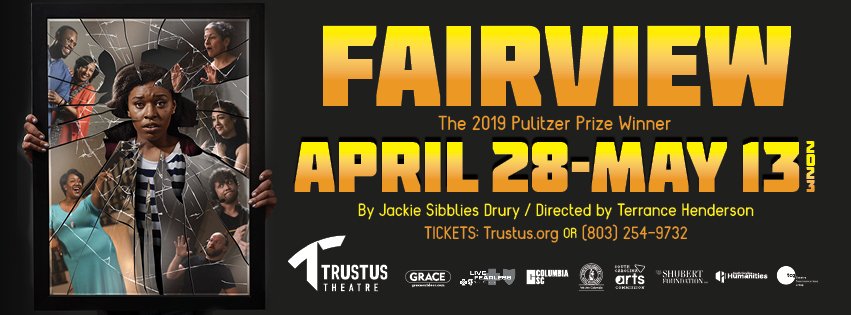
REVIEW: Fairview at Trustus Theatre

So as not to “bury the lede,” this show must be seen. By everyone. More than once.

I went into Trustus Theatre’s production of Fairview with no expectations. I knew nothing about the script, except that it had a brilliant cast and director. What I got in return was one of the best productions and some of the best performances I’ve ever had the pleasure of witnessing.

Fairview has multiple definitions here. You can’t pick just one.

The play opens in the dining room of an upper-middle class family. Beverly, played by Marilyn Matheus, is preparing a dinner party to celebrate her mother’s 80th birthday. The rest of the family trickles in, some to help, some to hinder. Dayton, Beverly’s husband, Beverly’s sister, Jasmine, and Beverly & Dayton’s daughter, Keisha. It’s a pleasant, unassuming scene. (I was reminded of the Huxtable family). This is the easiest act to discuss.

Beverly is obsessed with the perfection of this dinner. More than once (or twice or thrice) she mentions she wants the evening to go well. The relationship between Beverly and her husband, Dayton, is charming. Dayton is sweet, flirty, supportive, and playful. Their affection for each other is evident, though there are numerous opportunities for Dayton to fail (intentionally and unintentionally) at some of Beverly’s requests for assistance. Jasmine, Beverly’s sister, joins the party. If Beverly is the “responsible” sister (and she absolutely is), then Jasmine is the “fun” sister. (She’d rather not admit it, but Jasmine is a bit envious of Beverly). The energy, the banter, the spirit of these three characters is infectious. Keisha, Beverly, and Dayton’s daughter, appears and that energy goes through the roof. A high school senior with a bright future ahead of her, but she’s less than excited at the prospect. The path laid out for her is not necessarily the path she would choose. So far, so…. Comfy and cozy.

Scene change. Except that the scene is exactly as the opening, sort of. This time, however, the cast members go through the identical motions but are pantomiming the scene. Their voices are not heard. Instead, the onstage scene is overlaid by the voices of individuals giving  commentary about race and how those very white voices perceive it. The repeated question in this commentary is “if you could choose to be a different race, what race would you be?”  The answers are cringe-inducing. Every stereotype/assumption/contradiction you’ve ever imagined is tossed about. I was embarrassed by the fact that comments such as those were being spoken aloud. The effect was one of watching a television show or movie and having people around you speak over the action.

Scene change. In which the disembodied white voices of the previous scene appear as caricatures of Black individuals, specifically Mama (Grandmother) and Tyrone, Beverly’s brother. The dinner party grows increasingly surreal, even absurdist. The pace, the energy, gets faster and faster and culminates in a bizarre food fight.

Keisha, watching in amazement/horror from the sidelines, stops the madness. And I can’t really tell you anything else or it spoils the ending. Suffice to say the watcher becomes the watched.

Exhausting. Provocative. Uncomfortable. This Pulitzer Prize winning piece takes a hard look at racism, family, privilege, and racial perspective.

Terrance Henderson’s direction is ferocious, and his casting impeccable. There wasn’t a weak link anywhere. Marilyn Matheus (Beverly) brings strength and insight to every role she plays. Deon Turner (Dayton) continues to grow from strength to strength in every show in which he’s cast. Katrina Garvin plays Jasmine to tipsy, smart-mouthed perfection. Rayana Briggs’ energy and intensity, from her entrance to show’s end, is electric. Ilene Fins, Brandon Martin, Katie Mixon, and G. Scott Wild all bring strong thought-provoking performances to the story.

Fairview runs May 4 through 7 and May 11 – 13. The May 7 show is a 2:00 p.m. matinee, other performances begin at 8:00 p.m. Talkback sessions will take place after the May 7 and May 11 performances. A grant from the NEA  has been used for training sessions and support for the cast and crew.


Housekeeping:  The show runs nearly 2 hours without intermission. I promise it won’t feel like it.

Libby Campbell

Jasper Magazine Theatre Editor


Jasper Announces New FALL LINES Literary Prize for SC BIPOC Writers

Announcing the Combahee River Prize, a new prize for SC Writers of Color who submit their prose or poetry to the Jasper Project’s annual literary journal, Fall Lines – a literary convergence.

Approaching its 10th volume, Fall Lines – a literary convergence is a journal of poetry and prose presented by The Jasper Project in partnership with Richland Library and One Columbia for Arts and Culture. The Combahee River Prize will join the Saluda River Prize for Poetry and the Broad River Prize for Prose. All contributors will be asked to indicate if they are members of the BIPOC community when they complete their Cover Letter Template to submit their Fall Lines contributions. BIPOC writers will be eligible for the Combahee River Prize as well as the Saluda and Broad River prizes. Like the existing prizes, the Combahee River Prize is a cash prize of $250 and a framed commemorative certificate.

The title for the Combahee River Prize was selected to honor the freed woman and Underground Railway engineer, Harriet Tubman, whose raid at the Combahee Ferry on June 2, 1863 during the American Civil War resulted in the rescue of 750 enslaved individuals

Fall Lines will accept submissions of previously unpublished poetry, essays, short fiction, and flash fiction from April 15, 2023 through July 31, 2023.


ENTER FALL LINES 2023

The Watering Hole Announces Registration for The Listening Party throughout May

What is it?

↳ A FREE Virtual Craft Talk Series

↳ A peer-led group of 6-10 Tribe members, where each member presents a 15-30 minute Craft Talk to the group.

↳ At the end of the presentation, the group asks questions and gives feedback.

!

When is it?

↳ Zoom meetings will be 75 minutes once a month, scheduled around the availability of the group members.

!

Why do it?

↳ You’ll get to attend several sessions of Craft Talks and learn from your peers!

↳ You’ll create your own Craft Talk!

↳ You’ll get thoughtful feedback for revision!

↳ Hopefully, you’ll revise your idea and get it published or use it to for paid lectures. (Maybe TWH can even pay you to present the talk.)

↳ Plus, can (re)connect with Tribe!

!

Register HERE & Now

Registration should take less than 3 minutes

for most people.

Monday Night - ONE NIGHT ONLY - Join 701 CCA for SWIM, a Unique Puppet Pool Experience by Tarish Pipkins

Tarish Pipkins, also known as Jeghetto, presents his newest installation and puppet show SWIM, at the 701 Center for Contemporary Art’s swimming pool. This will be a one night performance with limited capacity on April 10, 2023 from 7 p.m. to 9 p.m.

Pipkins has been using found materials to create puppets since the late 90s in Clairton, Pennsylvania. Currently, he is an Artist in Residence at the 701 Center for Contemporary Art. However, he got his start at the BridgeSpotters Collective, where he staged puppet street performances.

Some of Pipkin’s most major puppet projects include the Amazon Echo commercial featuring puppets of Alec Baldwin and Missy Elliot, as well as a Pharell Williams puppet in Elliot’s music video “WTF (Where They From).”

SWIM will be a performance dedicated to exploring the myth of the Dogon and Mer-People, and how these myths currently relate to our present collective history. As the 701 Center for Contemporary Art says, “This performance is a poem of hope and determination that will undulate through the glass floor under which it is performed and crash into the hearts of the audience.” 

You can find tickets for the one time, special event at by clicking here.

Last Week to See the Supper Table at Myrtle Beach Art Gallery

Where should the Supper Table GO NEXT?

Artist Mana Newitt created this place setting honoring SC native Eartha Kitt

April 16th is the last day to see the Supper Table exhibited at the Myrtle Beach Art Museum where it has been on display since January 26th.

Read more about the gallery’s exhibition of this massive Jasper Project project and how it is displayed here and, while you’re at it, check out the upcoming exhibitions at this lovely space here.

The Supper Table is the largest and grandest project ever sponsored by the Jasper Project, involving the multidisciplinary art of almost 60 SC women artists including the following:

Bohumila Augustinova • Eileen Blyth • Tonya Gregg • Mana Hewitt • B.A. Hohman • Heidi Darr-Hope • Lori Isom • Flavia Lovatelli • Laurie Brownell McIntosh • Michaela Pilar Brown • Renee Roullier • Olga Yukhno • Jennifer Bartell • Carla Damron • Joyce Rose Harris • Kristine Hartvigsen • Meeghan Kane • Monifa Lemons • Eva Moore • Marjory Wentworth • Qiana Whitted • Candace Wiley • Christina Xan • Claudia Smith Brinson • Kirkland Smith • Jordan Morris • Betsy Newman • Mahkia Greene • Vicky Saye Henderson • Lee Ann Kornegay • Brenda Oliver • Kathryn Van Aernum • Cindi Boiter • Joestra Robinson & Tamara Finkbeiner • Katly Hong • Laura Kissel • Roni Nicole • Lee Ann Kornegay • Ebony Wilson • Betsey Newman • Carleen Maur • Faye Riley • Jordan Mullen • Steffi Brink • Lillian Burke

The project was begun by the Jasper Project in 2019 as a celebration of both the 40th anniversary of Judy Chicago’s The Dinner Party, now housed on the Feminist Art Wing of the Brooklyn Museum of Art, built specifically to house the Dinner Party installation.

Featured Historical Subjects and the SC Artists Who Honored Them

Mary McLeod Bethune

Visual Artist: Flavia Lovatelli • Literary Artist: Christina Xan • Film Artist: Jordan Mullen • Theatrical Artists: Jocelyn Sanders

Alice Childress

Visual Artist:Tonya Gregg • Literary Artist: Marjorie Wentworth• Film Artist: Steffi Brink • Theatrical Artists: Bonita Peeples

Septima Clark

Visual Artist: Lori Isom • Literary Artist: Qiana Whitted • Film Artist: Faye Riley • Theatrical Artists: Annette Grevious

Matilda Evans

Visual Artist: Renee Roullier • Literary Artist: Candace Wiley • Film Artist: Carleen Maur • Theatrical Artists: Arisha Frierson

Althea Gibson

Visual Artist: Eileen Blyth • Literary Artist: Kristine Hartvigsen • Film Artist: Katly Hong • Theatrical Artists: Trell Brennan

Grimke Sisters

Visual Artist: Heidi Darr-Hope • Literary Artist: Claudia Smith Brinson• Film Artist: Josetra Robinson & Tamara Finkbeiner • Theatrical Artists: Dewey Scott-Wiley & Elena Martinez-Vidal

Eartha Kitt

Visual Artist: Mana Hewitt • Literary Artist: Christina Xan • Film Artist: Lee Ann Kornegay • Theatrical Artists: Sebastian Sowell

Sarah Leverette

Visual Artist: Olga Yukhno • Literary Artist: Carla Damron • Film Artist: Ebony Wilson • Theatrical Artists: Malie Heider

Julia Peterkin

Visual Artist: B. A. Hohman • Literary Artist: Meeghan Kane • Film Artist: Lillian Burke • Theatrical Artists: Patti Walker

Eliza Pinckney

Visual Artist: Laurie Brownell McIntosh • Literary Artist: Eva Moore • Film Artist: Carleen Maur • Theatrical Artists: Arisha Frierson

Modjeska Simkins

Visual Artist: Michaela Pilar Brown • Literary Artist: Candace Wiley • Film Artist: Laura Kissel • Theatrical Artists: Marilyn Matheus

Elizabeth Evelyn Wright

Visual Artist: Bohumila Augustinova • Literary Artist: Jennifer Bartell • Film Artist: Roni Nicole • Theatrical Artists: Jocelyn Walters Brannon

Accompanying the beautiful table created from indigenous SC woods and designed and built by Jordan Morris is a collection of original portraits of the honored women by Kirkland Smith.

Jordan Morris designed and hand built the Supper Table from woods indigenous to SC like Cherry and Sapele Mahogany

A young Sarah Leverette drawn by portrait artist Kirkland Smith


What’s Next for the Supper Table?

The Supper Table has traveled throughout the SC Midlands and Low Country, but is not ready to retire just yet! Where would YOU like to see the Supper Table travel to and how can we make that happen?


Let us know at JasperProjectColumbia@gmail.com


Detail of Heidi Darr-Hope’s place setting honoring the Abolitionist Grimke sisters from Charleston

REVIEW: The Light at USC Lab Theatre

Trigger Warning: sexual assault is a primary subject in this piece.

Spoilers ahead

You should see this show.

Loy A. Web’s script is a bit heavy-handed at times but the subject(s) and the conversations they can prompt override that. It’s filled with quick turns and twists and surprises. 

The show opens in an ordinary apartment. Rashad is rehearsing how he will propose to his girlfriend, Genesis. Asaru Buffalo plays the role of Rashad, and he is perfectly charming. This opening scene is lovely and joyful and playful, and I loved it. Genesis, played by Shakori Jennings-Shuler, enters her apartment, and is not in the same good spirits as Rashad. Genesis is a school principal and has discovered that one of her new teachers, someone she admires and respects, feels that Brett Cavanaugh is being judged unfairly. Genesis is disappointed and surprised at her new colleague’s stance and wonders whether how she can reconcile herself to their obvious political differences. (I daresay that at some point in the last 9 years we all have found ourselves in a similar situation.) 

Rashad tried to lift her spirits and his ploy begins to work. Genesis then accuses him of not knowing “today’s” significance. It’s revealed that it’s their anniversary. He has, of course, completely forgotten this. The engagement ring steps in as an anniversary gift. The proposal is gleefully and tearfully accepted. Joy ensues. He has planned to recreate their first date and has obtained at great cost tickets to a concert by her favorite artist. How happy can two people be?

Hold my beer. 

The headliner and producer of this concert is the fictional rapper Kashif. Kashif has been a source of conflict between Rashad & Genesis before. Genesis condemns Kashif for his misogyny. Rashad supports Kashif for the good he does for the community. Genesis initially tells Rashad Kashif raped a friend of hers in college. She admits her friend did not report the rape. Rashad has been falsely accused of domestic assault; he had been a football player with a bright future. These dreams evaporated with the false accusation. He is also the custodial parent of his daughter.  

Rashad implores Genesis to understand his existence as a Black man who is never afforded the benefit of the doubt. Genesis implores Rashad to understand her position as a black woman in an unending struggle to be seen and valued as being black and as a woman.  

Spoiler alert: Genesis reveals it was not a friend who was raped, but herself.  The opening scene set the stakes really high. I won’t tell you how it ends. 

It was nice to see two young actors honing their craft. There were no bios in the program, so I have no idea about the work the actors have done previously. Ms. Jennings-Shuler needs to watch her volume and energy. There were times I lost what she was saying because she spoke so softly. Her final soliloquy was powerful, and she delivered it with anger and frustration. Mr. Buffalo needed to kick up the volume a bit; he may have been suffering from a cold or allergies. His focus on Ms. Jennings-Shuler’s monologue never faltered. He remained focused on her the entire time. 

The set was completely serviceable. It would be nice to have a coat rack or a hook on the back of a door for Rashad to hang his jacket. Otherwise, there was nothing to really detract from the performances. 

I saw the Thursday performance with friends who are also actors. It was a diverse group; one Black man, two Black women, and one white woman. We went out afterwards and talked and argued and discussed the show for over two hours. The disrespect and devaluation of Black men and women, the irreparable damage of false accusations, the very personal perceptions of what constitutes “rape”… it was enlightening on many levels. That’s what good theatre does - it opens the door to conversation and debate, which is how we all move forward. Unfortunately you have only two more chances to see this show. Take one of those opportunities. You won’t be disappointed.                               

An event in honor of Vic Carrabotta featuring Sanford Greene

6 p.m., Thursday, January 19

Hollings Library, enter through Thomas Cooper Library

1322 Greene Street

University of South Carolina

Columbia SC 29208

Free and open to the community

Award-winning comics illustrator Sanford Greene counts Marvel illustrator Vic Carrabotta among his most important influences. At this event, Greene will talk about his years-long friendship with the late visual artist.

Please join us for this special look inside mentorship in the comics world.

A South Carolina native and Benedict College graduate, Sanford Greene has worked professionally in the illustration and related industries for more than 18 years. He has worked for mainline publishers such as Marvel, DC, Dark Horse and Image Comics. He helped reshape the Marvel Comics characters Powerman and Iron Fist, as well as illustration work for Black Panther and Luke Cage, published by Marvel Comics.

His most recent work can be seen in the two-time Eisner and Ringo award-winning Bitter Root, an action/horror fantasy set during the Harlem Renaissance, published by Image comics. Bitter Root is slated to become a film produced by Ryan Coogler, the director of the acclaimed Black Panther, and directed by Oscar award winner Regina King. Sanford also has won the 2020 and 2021 Ringo Award for outstanding artist.

To register go to: 

https://www.eventbrite.com/e/an-event-in-honor-of-vic-carrabotta-featuring-sanford-greene-tickets-510857808457

WOW Presents The World You Left Behind – A New Play by Tangie Brickhouse-Beaty

WOW Theatre is back after a three-year absence from the main stage with a new play by Tangie Brickhouse-Beaty premiering November 11th at MTC’s Harbison Theatre.

The World You Left Behind is billed as an inspirational play about trust, reconciliation, and more. WOW’s synopsis reads, “Trusting people hasn't come easy for SC Top Radio Personality, Brian Green, especially since the one person he loved the most, betrayed him. After 6 years of praying, he thinks that his prayers have finally been answered. However, not everyone is sharing in his excitement, especially his 16-year-old daughter, Diamond. After some careful digging, Diamond has found out the true reason for this reunion. Now she has to decide if revealing the truth is worth the expense of breaking her father’s heart.”

Featuring Andre Dorsey, Elicia Moore, Morgan Belton, Arlene Pollock-Salley, Christina Morganelli, Lachelle Shelly Rodriguez, Rob Alton. Kristina Alderman, Shavetta Belton, Gabby Johnson, D’yanna Daniels, Vanzell Haire,  Kyerrah Robinson, Knakea Robinson Macon, Roderick Haynes, Jr., and Joshua Ballard.

Walking on Water Productions, also known as WOW Productions, is an urban inspirational entertainment company founded by Tangie Beaty in Norwalk, CT in 2005. Currently based in Columbia, SC, Tangie (CEO) has created a company that would produce original inspirational productions that empower individuals to rebuild family values, effect change, encourage the lost and restore self-esteem.​

Since 2005, WOW has been performing stage plays, improv, and dinner theaters within 9 cities and 3 states. Directing almost 1200 actors, WOW has held 125 performances in both stage and film projects in front of over 26,000 audience members.  

WOW has been nominated as Best Theatre Production Company, Awarded Black Arts Jazz & Film Best Theatre Company in Atlanta, and Best Stage Play Directors at the Kingdomwood Christian Film Festival. In addition to being affiliated with various associations such as SC Film Commission, SC Theater Association, Urban Playwrights United, and more.

The Jasper Project featured WOW’s Secrets in Plain Site in the Spring 2022 issue of Jasper Magazine.

The World You Left Behind runs from November 11-13 with the following showtimes:

FRIDAY, NOVEMBER 11, 2022 @ 7:30pm

SATURDAY, NOVEMBER 12, 2022 @ 3pm & 7:30pm

SUNDAY, NOVEMBER 13, 20222 @ 7:30pm

For more information check out this video.

Tickets are available now at www.wowproduction.org

Special Pre-Show Performance on November 11th by Andre Delaine

Hear Me Now: The Black Potters of Old Edgefield, South Carolina on view at the MET

… what it means to have and express agency while creating “art through coercion.”  

On view at the Metropolitan Museum of Art in New York City until February 5th, 2023, Hear Me Now: The Black Potters of Old Edgefield South Carolina features work from African American potters in the 19th-century. The exhibition features roughly 50 items of pottery and stoneware from the Old Edgefield District, a locale for stone masonry in the decades leading up to the Civil War.

Literate enslaved person David Drake, who was a poet as well as a potter, has a couple of storage jars in the collection. Many of his works come from Stony Bluff Manufactory. The collection also features the slightly mysterious face vessels, whose creators are unknown. These vessels speak for themselves, however, with their specific yet enigmatic style.

The uniqueness of this exhibition corroborates the skill, knowledge, and artistic agency of the enslaved people of the American South. Coupled with modern scholarship, this exhibition offers insight into what it means to have and express agency while creating “art through coercion.”  

The exhibition features a catalogue and an audio guide to offer supplemental information on these materials. The audio guide is composed of dialogue from Black artists, scholars of African American history, an archaeologist, and even South Carolina’s own Tonya M. Matthews, CEO and President of the new International African American Museum in Charleston.  

As one unnamed scholar says in the audio guide introduction, “When we don’t interrogate enslaved artisans in the same way we interrogate all of our other artisans and craftspeople, we lose a very big part of the story. Not just the story then, but the story that we’re living now.”   

Visit the MET before February 5th, 2023, to hear this part of our very own South Carolina story.

A Look in the Mirror: Black Nerd Mafia Talks Identity and Black Opportunity in the Columbia Music Scene

Black Nerd Mafia was born out of frustration– frustration with stereotypes and people’s ignorance about Black people. Choosing to not be named or be the focus of this article, the creator and founder desired to showcase the diversity within the Black community and provide a place for those who don’t fit in society’s boxes– a safe and inviting space for independent Black artists and fans. Originally started as a Facebook group in 2014 for Black people tired of being typecast, Black Nerd Mafia has grown into so much more.


JASPER: Best dad joke you've heard? 

BNM: A dyslexic man walks into a bra. 


JASPER: So, the Facebook group was the original manifestation of it, but how did Black Nerd Mafia come to be what it is today? 

BNM: I always pushed entrepreneurship on my sons and then one day in 2021 I’m talking to my son and I’m pressing upon him to be an entrepreneur and he very frankly just asked me, “Well, you always tell us to own our own business, why don't you own your own?” He said it just like that, and I said, son, you're right. The next day we went and did the LLC paperwork and that's how Black Nerd Mafia came to be. 


JASPER: You do lots of things today: you have merch, you organize shows, poetry readings, and trivia just to name a few. Where did you start?  

BNM: The first year it was completely different than what it looks like now. We were doing website building for people, we were doing interviews, we were doing photography, videography – doing just a lot of things that I knew how to do and pretty much anything that I knew how to do to try to make it a business.  

It really didn't start becoming what you see it as now until about a year ago. In 2021 we had our first shows in November after I met Greg at Curiosity… I went to Greg with the idea that I wanted to host shows for independent local artists. He loved the idea, and he pretty much just gave me like carte blanche to do whatever I wanted to do. 


JASPER: Tell us a little more about the logo you sent in place of a photo.  

BNM: The little person isn't like a little mascot… it isn't just something that looks cool—it's all intentional. The very first thing you see he's holding like a big water gun. The water gun is a Super Soaker and Super Soaker was invented by a Black person, a Black scientist; his name is Lonnie Johnson. A lot of times people associate Black people with violence and guns and everything. I wanted to take a spin on that and have a gun but a gun that was created to be this amazing child’s toy that was created by a Black person, so that's where the little gun thing comes in. He also has a mirror face… basically that says there's no face to Black Nerd Mafia. He has a mask on so you can't see his face, but also, it’s a reflective mask so if you did look at the character, all you would see is yourself in the reflection. This is to say that Black Nerd Mafia is all of us.


JASPER: Tell us about some of the shows and events you have put on. Any that were particularly special to you?  

BNM: It's going to be hard to say, and this is gonna sound like cliché, but all the shows that we've had are dope. I will say that that's the one thing that I do well. I can curate shows well, and I know how to match artists together well, so I quite frankly think that all of our shows have been really dope– really talented people.  

I don't want to like single any of the guys out either, but I would say our first show. It was Eezy Olah and Tam The Viibe. MidiMarc and Airborne Audio did beat sets. It was our first show, so it was really dope and that's always gonna be special to me.


JASPER: What do you look for when putting together a lineup for a show, what is your process?  

BNM: I don't pick artists because they have a name. I don't pick artists because they have a lot of followers. I pick artists because I watch, I listen to their music, and I watch their Instagram profiles, and I see their energy, you know, and I go off that. I look for just dopeness first, like I'll come first and foremost… That’s the first thing I look for– the talent. Once I find that and it's easier than you would think, there's a lot of very talented people here in Columbia and the surrounding areas.  

I also listen to the subject matter of the music. I don't want to censor people, but I also just don't 

want to promote music that has just arbitrary violence, just random doesn't make any sense violence. If you can make it artistic, if you can make it great art about your life and why it’s so hard and why you had to do these things, I’ll listen to it and I'll put you on stage.


JASPER: What are you looking forward to? What does success look like for Black Nerd Mafia? 

BNM: I'm looking forward to people becoming more aware of the artists that perform at our shows… and Black artist getting to perform comfortably at any venue in Columbia just like anybody else. I want to be a non-biased, platform where the only thing that matters is if you're dope, no politics, nothing. 


JASPER: What advice do you have for other artists? 

BNM: Make the music that you love, make the music that you like. Don't try to copy what's cool on the radio. Don't try to sound like Drake. Don't try to sound like anybody else. Make the music that you like and talk about the things that are in your life. You don't have to live some kind of fake lifestyle in your music. Write the music that you know and write about the things that you are passionate about. Just don't give up. I come from a different generation, and it was like if you turned 30 and you were still rapping at 30 years old, you were a loser. I let that type of thing stop me from making music and I want to say if you really really love it and it's really really in you, you gotta dedicate yourself to it and not listen to anybody else. 

The biggest thing I tell all the artists—you need to have some type of merch. Get T-shirts, get stickers and get something that you can sell to finance the things that you're going to need as a musician. You can pay for your studio time, for photo shoots, for anything else you need to pay for by selling merch, and that's something that you can make yourself for very cheap.

Ultimately, it's not the artist fault, it's the venues and the publications. They just keep regurgitating the same people because they don't want to do the work to go find the real dope artists around here, and that is what I do. So hopefully if people come out on November 4th, they can see that.


JASPER: What are your thoughts on Columbia's Art Scene?  

BNM: I just gotta be honest about this. I wasn't going to do this, but I gotta be honest– not a fan of Columbia's scene. The music scene here, the art scene, it can be very discouraging and anti-Black.

That’s kind of why I like doing what I do, and that's why I'm doing what I do. I've lived in Columbia ever since I was a kid, and It's always been the same thing. A lot of these venues, downtown Vista, Five Points—quite frankly—don't want Black people in their venues. They don't want Black people in their establishments, so they make rules and do their best to try to keep Black people out of these spaces. If you talk to a lot of Black artists around here, they're like it's very hard to get to play downtown or all these other places, because essentially the owners don't want a house full of Black people, and that's really sad.  

I'm sure some people say “no, that's not true, because I saw this and that person.” There are a few that they let through, and it seems to me—not just me; I talk to a lot of other Black artists—that they only pick Black artists that have a primarily white fanbase… Another reason I know venues treat people bad is because after shows, Black people come to me all the time like, “Man, I love Curiosity, I love it here. Everybody was so respectful to us and was so nice to us. Everybody treated us like people.” That very simple thing—“they treated us like people.” That’s why I’ll always love, Greg and Sandra. 'Cause you can tell that it's a culture that they bring top down, that everybody that works there is always nothing but nice, nothing but respectful to any and everybody. No matter if you're gay, Black, white, male, or female like, everybody is treated fair and equally there. ­ 

[Black Nerd Mafia] are creating an environment to where Black indie artists, get to perform “downtown,” and I think that we've been successful at proving their fears wrong– that Black people are going to be there and there is going to be some kind of violence and fighting or something stupid. We've been doing shows for a year…with zero violence, zero fights, zero calling the cops, zero tempers flared. There's not been one person to even get angry at one of our shows. No pushing, no yelling, no throwing a drink or whatever, nothing negative whatsoever has happened at any of these shows, and the majority are black, and the crowds are all majority black, and so I think that if people can see what we do at Curiosity and what Black Nerd Mafia does maybe it'll let these other venue owners know that, hey, we should be more tolerant and we should be more open to black artists.  

Ultimately, it's not the artist fault, it's the venues and the publications. They just keep regurgitating the same people because they don't want to do the work to go find the real dope artists around here, and that is what I do. So hopefully if people come out on November 4th, they can see that. Right here in Columbia, there's dozens of super talented amazing artists that make positive music that's not about killing people or selling drugs or things like that. You can come to our shows and feel safe. You can bring your wife and you can bring your kids. They are people that bring their whole families to our shows, and I take pride in it. 


JASPER: Tell us about the anniversary party. What can we expect?  

BNM: If you've ever seen Dave Chappelle's Block Party, it will be a block party, like a big jam session where we have a bunch of artists that are really good performers lined up and on deck, ready to go. A freestyle type of vibe, but controlled… I like things that just feel organic. They don't just feel like this person is gonna perform and then this person. Let’s do something different here, use some creativity and give the crowd something they haven't seen before.  

I don't wanna talk about some of the artists because I'm just gonna like leave people out, but Midi Marc is a producer from Columbia and he's just amazing and he really is the key to all of this. I've known Midi for a long, over 10 years. The majority of people that you see on this list make all of their own music at home and in a home studio with very cheap equipment, but they’ve mastered it, and they know how to make the music sound good. I feel confident saying that you could pick anybody off this list, and they're dope in their own right. They're all very different, but they're all dope, and that's really all that matters. 

Come to Black Nerd Mafia’s one year anniversary show at Curiosity Coffee Bar Friday November 4th from 5-10pm featuring everyone that has performed for them this past year. Attend the show for free by donating one item from the Oliver Gospel Mission list of winter needs.


Drink Small at the Koger Center

Wednesday, October 26th at 7:30 pm

Koger Center for the Arts

Drink Small is famous for many things, not the least of which is his modeling career. Right in the heart of Five Points sits Drink Small in the “V” of the iconic Five Points mural.

A native of Bishopville, SC, Small has been playing the guitar since his childhood. He has made a huge name for himself through his stage presence, his vocal tonality, and the ease with which he masters different musical styles. Now approaching his 90th birthday, even after losing his eyesight, Small continues to perform for audiences with aplomb. Small is known for his signature “Drink-isms,” a mixture of aphorism, stage banter, and charm that you cannot find with anyone else.

On October 26 at 7:30 PM, come to the Koger Center for the first of a brand-new concert series: “Koger Center Presents: Onstage With...” which Drink Small will introduce.

The concert is a result of the continued partnership between the Koger Center and the ColaJazz Foundation. South Carolina ETV and Public Radio are also partnering with these groups to record and videotape the entirety of the performance. The concert will include performances from other blues performers like the Randy Newton Trio and Brittany Turnipseed while also featuring the SC State University Choir. The audience will continue to stay on stage for each of these performances so they get an even more intimate concert experience than they may be used to.

“We’re really excited to bring such a legend to the Koger Center,” says Nate Terracio, Director of the Koger Center. “This new concert series is something we have been looking forward to putting on for a while and starting it off with such a musical powerhouse is really encouraging.”

The Koger Center has been dedicating itself to continuing and improving the diversity of its performance catalog. The directorial staff of Koger knows just how diverse the Midlands are (and the rest of South Carolina altogether) and aims to consistently accommodate the interests of everyone involved with the arts or music. The University of South Carolina has been making headway with their own Diversity, Equity, and Inclusion expectations, and Koger hopes to not only fulfill those expectations but exceed them. Supporting the arts of all audiences is integral for the growth of the art industry, and the Koger Center hopes that the celebration of such an important artist as Drink Small will bring in support for both the Columbia jazz scene and Mr. Small himself.

News from 701 CCA

Tarish Pipkins | Isaac Udogwu | Cedric Umoja

Happy to Share this News from our friends at 701 CCA:

n Oppositional Free Gazing Tarish Pipkins, Marcel Taylor, Cedric Umoja and Isaac Udogwu disrupt the power dynamics of American visual culture through traditional portraiture, artificial intelligence and machine learning, Afro futurist visual renderings of Black language, and narrative portraiture through puppetry.

The white gaze has long determined whose stories are seen, what artists' voices are valued. Taylor, Pipkin, Udogwu and Umoja create work that speaks directly to the Black experience from ordinary to the extraordinary. They speak directly to Black audiences in unapologetic fashion, locating their work in largely ignored cultural, historical and political experience that operates outside of a response to white supremacy.

With algorithms and machine learning as the media, Udogwu uses what scholar Nettrice Gaskins describes as “techno-vernacular creativity” Possessed of reappropriation, remixing, and improvisation. With nods to both Francis Bacon and Jacob Lawrence Udogwu centers the Black male figure seen through Black male eyes. In fact Umoja, Taylor, Pipkin and Udogwu each use these tools that form the foundation of America’s two original music forms, Jazz and Hip hop and are firmly rooted in Black cultural and creative practices.

Marcel Taylor uses an interplay of acrylic paint, transparent paper, photographic collage, remixes images of Black people living in urban centers and seeks to capture the vibrancy, joy and life found in these spaces. Taylor’s socially-critical abstract work depicts urban landscapes and portraits inspired by rampant gentrification processes occurring in his home city of Washington DC, and many other cities across the nation. These paintings conjure images of urban dynamism, commotion, pandemonium, and chaos. Tarish Pipkins continues this tradition in performance work that centers Black stories and draws the line between historic calculation and contemporary experience.

This artists conversation will be moderated by Dr. Frank C. Martin, II. Martin is a graduate of Yale University and the City University of New York, Hunter College, with additional study in contemporary art at the Institute of Fine Arts of New York University, and a Ph.D. in Philosophy from the University of South Carolina. After working for more than 12 years as an Associate Manager of Education Services for the Department of Education Services in the Uris Center of the Metropolitan Museum of Art, Martin transitioned to a position as Curator of Exhibitions and Collections, at South Carolina State University's I. P. Stanback Museum & Planetarium, where Martin currently serves as Director.

Art historian, art theorist, and critic of cultural interpretation, Martin has served as an academic advisor for the PBS documentary, Shared History and as contributing critic in the fine arts for The Charleston Post and Courier, one of the South’s oldest newspapers. Appointed as a Carolina Diversity Professors Doctoral Scholar in the Department of Philosophy at the University of South Carolina, Dr. Martin’s area of specialization is the study of axiology, concentrating in the field of aesthetics.

Martin, Pipkins, Udogwu & Umoja

September 28, 2022

6:30 PM

701 CCA Gallery

701 Whaley Street, 2nd floor

Columbia, SC 29201

Coming Up at CMA--Adia Victoria and More than Rhythm: A Black Musical Experience

It’s nice when successful artists come home. Sure, there are sometimes sour grapes in the back (what some like to call the anti-Hooties), but for the most part South Carolinians welcome their success stories back with pride and grace. That will be easy to do on Friday, August 26th when Columbia Museum of Art welcomes Adia Victoria to their Conversation and Concert titled More Than Rhythm: A Black Music Series Featuring Adia Victoria.

Singer-songwriter and poet, Adia Victoria, was born in Spartanburg, SC and lived in the upstate until she left high school and moved from New York City to Atlanta and finally to Nashville where she resides today. She released her first album, Beyond the Bloodhounds, a reference to Harriet Jacob’s autobiography, Incident in the Life of a Slave Girl, in 2016, followed by Silences in 2019 and A Southern Gothic in 2021, which was written mostly in Paris.

Having toured internationally for the past few years and performing some gigs in the US with Jason Isbell and the 400 unit, Victoria is performing in Columbia as part of a multidisciplinary event that will include song, poetry, dance, and discourse. Dr. Mason Hickman, musician and civil engineer with a uniquely math and science approach to his guitar work, will be performing with Victoria and Dr. Birgitta Johnson, professor and ethnomusicologist at the University of SC will be performing host duties.

According to the CMA, the “More Than Rhythm series returns for its second season with a special performance from South Carolina native and globally recognized blues musician Adia Victoria. On break from her world tour, Victoria joins host and ethnomusicologist Dr. Birgitta Johnson to discuss her journey as an eclectic 21st-century blues artist before taking the stage with guitarist Mason Hickman. Their performance includes original poetry paired with dance interpretations by Columbia-based dancer Erin Bailey.”

The CMA galleries and bar will open at 6 pm with a Conversation at 7 pm, followed by an 8 pm concert. The event is free, but seats must be reserved by contacting the museum.

ART AT HOME: McKissick Museum Offers Digital Exhibit - Piece by Piece, Quilts from the Permanent Collection

“Some women don’t care how their quilts look. They piece the squares together any sort of way, but she couldn’t stand careless sewing. She wanted her quilts, and Joy’s, made right. Quilts stay a long time after people are gone from this world, and witness about them for good or bad.”

Julia Peterkin, Pulitzer Prize winning novelist from Fort Motte, South Carolina, author of Scarlet Sister Mary

Double Irish Chain

Designed by Tabitha Meek Campbell (1822-1889) 
Spartanburg County, SC
ca. 1860
Gift of Sarah M. Norton

The desire to create is a powerful force that will fight its way out of you even when you try to suppress it or pretend it isn’t there. Lord knows that traditionally impoverished Southern women rarely found their way to store bought canvasses on which to paint. But their talent and creativity poured forth in other ways, not the least of which was the way they kept their families warm with homemade quilts fashioned from cast-off clothes and pieces of fabric put aside for a rainy day.

Homemade quilts are more than family heirlooms to store in a linen closet.

Homemade quilts are story tellers and canvasses and books with chapter after chapter to be explored in square after square of their making.

And if the heat or germs or whatever personal reason of your own is keeping you home right now, you can still enjoy an incredibly comprehensive and enlightening virtual trip to the museum right from your own computer screen by visiting McKissick Museum’s Digital Exhibition, Piece by Piece - Quilts from the Permanent Collection.

In Piece by Piece, the exhibition introduces the visitor to a variety of quilts dating as far back as the early 1800s and as recently as 2015 with a quilt crafted by Summerville’s Peggie Hartwell, recipient of the Jean Laney Harris Folk Heritage Award presented by the SC Arts Commission. Ms. Hartwell is a founding member of the National Women of Color Quilters Network.

Wisdom 11 “To Thee I Give You Our Past”

Peggie Hartwell (1939-present)
Summerville, SC
2015

McKissick Museum Collection 2017.20.01

The McKissick Museum website writes, “The McKissick Museum collection includes over two hundred quilts, featuring examples of appliquéd, whole cloth, and pieced works from the Southeast. Since the 1980s, McKissick has documented and celebrated quilting traditions, produced several publications, and developed programs exploring the topic. The quilts in this exhibition illustrate the evolution of this textile tradition over the past two hundred years. From the early use of chintz fabrics to the widespread popularity of solid colors, these quilts reflect traditions with roots in Europe, Africa, and the American South.

“Quilting traditions in the Southeast were not uniform. Quilters were influenced by geographic, economic, and cultural circumstances. Many of the quilts displayed here illustrate characteristics distinctive to individual makers, while others reflect the influence of popular styles and trends. Quilts are as varied and diverse as the women and men who make them. They can evoke powerful memories and provide tangible connections to loved ones or specific events. More important, makers often use quilts to express social commentary, communicate personal narratives, or document family or community history.”

The Virtual Exhibit features distinct sections on Southern Quilts, primarily from the Carolinas and Georgia; the Makers’ Voice, which profiles known quiltmakers; the eponymous Crazy Quilt, and the University’s Quilt History Project from 1883-86. Included is a quilt created in 1986 by Hazel Ross depicting scenes from Columbia’s history to celebrate the city’s bicentennial.

Columbia Bicentennial Quilt

Designed by Hazel Rossl
Columbia, SC
1986
Gift of Logan Lap Quilters

McKissick Museum Collection 2012.08.01

For more exhibits at McKissick Museum, both virtual and physical, please visit this link and continue to enjoy the meaningful connection between art and history.

-Cindi Boiter