Colby Quick Wins Play Right Series and You're Invited to Join the Play Right Project Team as a Community Producer

The Jasper Project is proud to announce the winner of our 2nd PLAY RIGHT SERIES project—Colby Quick for his play, Moon Swallower

Colby Quick is a thirty-one-year-old writer, singer, musician, actor, husband, and father of two. He is the lead singer and guitarist of a Stoner Doom band known as Juggergnome and in the development phase of a rap duo project called Ski & Beige. Colby played Ebenezer Scrooge in Northeastern Technical College’s stage production of A Christmas Carol in 2019 and is currently in his final semester at Francis Marion University as an English Major and Creative Writing Minor. “I have mostly written poems, songs, and short stories, as well as an unpublished novel.: Quick says. “When I was young, I would make stop-motion videos and I wrote scripts for all of them. I think this helped a lot with writing the Moon Swallower.”

Now it’s your chance to join the Jasper Project’s Play Right Series as a Community Producer.

Are you the kind of person who always wants to know more about the art you experience?

  • Why did the playwright make their characters the way they did?

  • What was the director trying to accomplish by having an actor move across stage, turn their back to the audience, or break into dance?

  • How did an actor make me feel the way they did simply by turning their head?

If you have a passion for knowing more, understanding process, inspiration, and impetus, and seeing how a virgin play goes from page to stage, you are a good candidate for becoming a Jasper Project Play Right Series Community Producer.


What is a Community Producer?

Community Producers are important members of the Play Right Series Team who, in exchange for their investment of a modest amount of funding, ($250 each or $500 per couple) become engaged in the development of a virgin play from the first time the actors meet until the production of a staged reading of the play in front of an audience.

Between February and August 2022, Community Producers will gather monthly to explore the process of a play moving from page to stage with presentations that include

  • ·         Meet the Playwright: Colby Quick

  • ·         Meet the Director: Chad Henderson

  • ·         First Table Reading with your host, Jon Tuttle

  • ·         Behind the scenes with the Cast of Moon Swallower

  • ·         Stage managing, props, costumes, lighting, & sound with your host, Jon Tuttle

  • ·         And finally, a Staged Reading before a live audience with the Community Producers front and center as our esteemed Guests of Honor*

You’ll enjoy wine, cheese, socializing, and an assortment of other unique snacks at every event, as well as Jasper Project swag bags and FREE admission to the Jasper Project 10th Birthday Celebration rescheduled for Thursday April 14th at 701 Whaley!

* For the Staged Reading, Guests of Honor will be seated in the best seats in the house, acknowledged from the stage and in all programming, promotions, and press releases, as well as on the Jasper Project website and in the Fall 2022 issue of Jasper Magazine.

Play Right Series History

The Play Right Series is an endeavor to enlighten and empower audiences with information about the process involved in creating theatrical arts, at the same time that we engineer and increase opportunities for SC theatre artists to create and perform new works for theatre. Our first project in the Play Right Series was in 2017 when Larry Hembree led project members to ultimately produce a staged reading of Sharks and Other Lovers by SC playwright Randall David Cook. Sharks went on to win a number of awards and has been produced off-Broadway. SC Playwright Professor Jon Tuttle of Francis Marion University is overseeing this project for 2022 with a new team of theatre artists including Chad Henderson (director), Colby Quick (playwright), Cindi Boiter and Christina Xan (Community Producer Liaisons), and more.

The Jasper Project is currently recruiting 10 individuals to join the Play Right Series as Community Producers. Click here or write to Cindi@Jasper Columbia.com for more information.

Kevin Oliver's THE BEAT: Caught Up In a Feeling--The Runout and Jeff Gregory Build Community Around Music

“We discovered that we like eating, and we like drinking, and we like making music, preferably all at the same time,” - Jeff Gregory

For many people the ongoing pandemic has been a rollercoaster ride, but for Jeff Gregory and his band The Runout it was the catalyst for a creative community which birthed the band’s latest album With Your Eyes Closed. Early on, as artists found their footing online with live streaming to replace live in-person shows, Gregory and his wife Kelley hit upon a simple format of the two of them, a guitar and occasional piano, repeated on Wednesday nights, that resonated with them and a core group of friends and fans.  

“The pandemic really had us down, so Kelley and I found something to do to make ourselves happy and remember what singing together in high school was like,” Jeff Gregory says. 

The Runout was already a band with a couple recording sessions and a first album out, along with a number of live shows featuring an evolving lineup that currently includes Mike Scarboro on drums, Moses Andrews on bass guitar, keyboards, and organ, and Chris Compton on electric guitar alongside Jeff and Kelley Gregory. But as the pandemic dragged on and Gregory took some soul-searching, nonmusical personal time, the community drew him back in, he says.

“Thank God for Chris Compton, Patrick Leitner, Lang Owen, all of those guys asked me to get involved on their projects, just a song here and there,” Gregory says. “It spurred me on to wanting to do music again myself.” 

The community that gathered around the Gregorys shared one crucial thing, and, surprisingly, it wasn’t music–it was food. 

“We discovered that we like eating, and we like drinking, and we like making music, preferably all at the same time,” Gregory says. “It sounds silly, but a lesson we’ve learned is that when you have friendship, and good vibes, then you can have some creativity and exploration in what you’re doing.” 

The musical result of this camaraderie was The Runout’s latest album With Your Eyes Closed. The record pulls together the intimate feeling of those livestream nights with an expanded lineup that allows for full band arrangements. The tracks progress through deceptively feel-good anthems such as the bouncy Americana-esque opener, “Feelings,” and more raucous, rocking rave-ups like “Coffee and Weed.” Gregory also delves into deeper territory on tracks like the ethereal “Crooked Canyon,” a metaphorical journey to the center of one’s psyche that’s equal parts terrifying and glorious in its imagery.  

Gregory has that rarest of qualities–the ability to turn a clever phrase, but also imbue its delivery with raw, honest emotion that connects on a deeper level than the average pop song. The centerpiece of the album is “Give Up,” an irresistible tune that began life on those now long-ago livestreams with just Jeff and Kelly harmonizing to an acoustic guitar. The album version adds shimmering electric guitar to the natural connection their voices make on lyrics that anyone in a long-term  relationship can relate to: “I’ve been wanting to give up, I’ve been thinking it through…it seems I need a few more hours down this road with you.”  

Those few more hours have become months now, in pandemic times. In lieu of a club gig for the album release, The Runout staged a mini-festival they dubbed “Stump Fire Fest at a friend’s property. They invited a hundred of their fans and friends to come celebrate outdoors with them, a culmination of the community that had sustained the band to that point.

“We’re thankful for that community,” Gregory says now. “We weren’t really aware of it until that night–I think it was the result of the pandemic filtering out everything that didn’t matter, and the music was what was left.” 

The Stump Fire Fest may have set an unrepeatable precedent; in addition to the Runout, several other bands played on a small stage built just for the night, poet Al Black read between sets, and Dick Moons and his drum circle formed up around a nearby campfire as participants ate, drank, and moved between the different moving parts of the evening.  

“It really crossed scenes and generations,” Gregory says of the festival. “It wrapped up what had been a really meaningful time of making the record, too–Hanging out with Chris Compton, Sean Thomson, Patrick Leitner, Moses Andrews, that meant more to me than I realized at the time.” 

It’s the mentality of helping others, Gregory concludes, that has to survive the pandemic.

“People are wondering what’s going on in the world right now, and the answer is that nobody knows,” He says, “So what must our response be? It has to be art.” 


Artist Profile: Noelle Brault Makes A Statement with Light

JASPER: When did you first begin to pursue visual art? Where and when did you train, or are you self-taught?

BRAULT: I first began to pursue visual art in 2008 when I started taking lessons from Michel McNinch. I was always interested in art but never did anything about it until then. I took 5 years from Michel and then took several workshops from other artists.


JASPER: What mediums in visual arts do you typically use and why?

BRAULT: I paint in oil. I like the rich colors and how you can mix them. They feel natural to me.


JASPER: Where do you work now and where do you show your work?

BRAULT: I work as a Manager of Software Development at Southeastern Freight Lines. I show my work currently at Over The Mantel gallery. 


JASPER: Who have been your greatest influences as an artist?

BRAULT: Other contemporary artists have influenced my greatly including my teacher, Michel. Also, Shannon Smith Hughes of Charleston, Jason Sacran and Randall Sexton influence me just to name a few.


JASPER: What do you feel makes your art unique?

BRAULT: What makes my art unique is the way I manage light.


JASPER:  Who is your favorite SC-based visual artist and why?

BRAULT: I suppose my favorite SC based artist is Shannon Smith Hughes of Charleston. I love the energy and excitement in her pairings and also the way her paintings glow.


JASPER:  What are you working on now, will we get to see it, and if so, where, and when?

BRAULT: I am always working on a new painting. Right now, I'm working on a nocturne of the Jekyll Island Hotel and also an old truck at Price's tree farm. They will be available at the Cottontown Art Crawl on March 13th.

PROFILE: Visual Artist Wilma King Uses Rich Colors & Clever Object Juxtapositions to Create Warm & Inviting Images

If you haven’t seen the work of Cottontown visual artist Wilma King now is your chance.

Check out this virtual exhibition of King’s art and read about her background and inspirations below.

Jasper had the great pleasure of touching base with visual artist Wilma King this week and we asked her a few questions about her work. We’re delighted to share details of our exchange with you.

~~~~

Jasper:  When did you first begin to pursue visual art? Where and when did you train, or are you self-taught? 

Wilma King: I  remember an incident in fourth grade that helped me focus in on my love of art and design. My teacher, Ms. Hendrix, knew how to inspire and cultivate creativity and internationalism. She read books to us, held in-class competitions, and infused applied learning into our coursework way back then. Our school was on a military base in Fort Greely, Alaska which helped in the spirit of all of these concepts. My mind was full of dreams of being a nurse like Clara Barton, until she announced a fashion design competition for us girls. My classmates who saw my design convinced me that I would surely win – but I didn't. So, I launched this compulsion and intrigue to design paper dolls for my sisters, friends, and anyone who would allow me to do so. It was an experience that allowed me to delve deeply into individual, and cultural preferences for design, color, shape, size, and form. 

But it was in junior high school that my art teacher helped and encouraged me to see a broad range of ideas and topics from which to draw and paint. In eighth grade, I won a scholarship to what was then the Columbia Art School (a part of the museum), and sold my first painting that year, as well.

My first job, literally two weeks after graduating from the University of South Carolina, was with an international trade magazine, while still learning about cultural preferences and communication design. 

I have a BA degree in art studio (advertising design) from the U of SC and went on to earn a MA in Journalism (PR and Advertising) from Texas Southern University (Houston, Texas), because I always felt that there should be a collaboration between words and images. I taught graphic design, computerized design, or some form of public relations design most of my career, beginning with launching, teaching, and designing the first courses and curriculum in commercial art here in Columbia at Benedict College. From that point, I taught at the Art Institute (Houston, TX), O'More College (Franklin, TN), and was an Associate Professor in PR at both Western Kentucky University (Bowling Green, KY), and Rochester Institute of Technology (Rochester, NY).


Jasper: Where did you grow up?  

King: I was born in Lexington, SC, and continued to “grow up” in Alaska, and Columbia (Lower Richland area near Hopkins). My father was born and raised in Louisiana, ten miles outside New Orleans (St. John Parrish), so that's also part of the “growing up” experience. I have lived in eleven different states and did domestic and international sabbaticals that took me to a cumulative  nine months of slow travels and teaching abroad in Italy. 

After more than 30 years of doing some of the things that I found interesting and exciting, and to become my mother's primary caregiver, I moved back home to SC.


Jasper: What mediums in visual arts do you typically use and why? 

King: My very wonderful art professors at USC, particularly Jim Edwards, taught me that acrylics are extremely adaptable and can convincingly disguise as other paint mediums, so as a painter, which is my medium of choice. 

At the beginning of the COVID pandemic, I sought ways to bring people together over a meal, coffee, or drinks. Nursing homes and hospitals were closed to visitors making it impossible to share meals with elderly, ill, or hospitalized family and friends -- so I began painting on glassware -- wine glasses, wine bottles, mugs, vases, etc. (using oils): Table Companions was born! A "table companion" is someone that you enjoy sharing a meal or drink with. 

Jasper: Who have been your greatest influences as an artist? 

King: Dony Mac Manus, sculptor/founder of the School for Sacred Art in Florence,  Italy, and Giancarlo Polenghi,  the school's director of the master’s program who is an Italian art historian and who also teaches theology of the body. They both helped me to understand that the purpose and power of art is to elevate the status of individuals in communities and in society!

Jonathan Green has given me some very good advice and critique on my work, as well.

Now, each day, before I begin to paint, I study some of the great Christian art. I enjoy Biblical stories through the eyes of Michelangelo di Lodovico Buonarroti Simoni, Michelangelo Merisi da Caravaggio, Peter Paul Rubens, Cristofo de Predis, Rogier van der Weyden, Rembrandt, Vincent Van Gogh, and even Salvador Dali. 

I have had the great privilege and opportunity to visit many churches and museums across the US and Italy, particularly the Uffizi, The Vatican Museum and St. Peters Cathedral several times, on numerous occasions, as well as the Prado in Madrid. I also love two fashion museums focused on telling the stories of the family: Ferragamo and Gucci. A yet-to-realize goal is to see Rembrandt’s The Return of the Prodigal Son in the Louvre.

Jasper: What do you feel makes your art unique?

King: I enjoy telling my stories as well as those of people I have met along the way. An avid nonfiction reader, I try to incorporate a level of authenticity, through descriptive and narrative detail in my paintings. I focus on the story to give it broader meaning – that is, the painting’s relationship-building potential. People often comment on my style. I paint from memory, not photos (unless commissioned to do so), and I rarely use references. Various elements in each painting are carefully outlined to show that the story is a composite of different places and spans of time.

Of course, I believe Table Companions fills a different type of need and experience than merely doing handprinted glassware because I am finding a unique way for people to share being together and building memories over meals. I am still telling their stories through perhaps flowers, colors, etc.

Jasper: Who is your favorite SC-based visual artist and why? 

King: There are three. I am watching and loving Gerald Erley's paintings! His technique and artistic ability are unapologetically akin to that of the "great masters,” not only in his artistic ability, but also in the way he commands his storytelling.

Jonathan Greene has been a favorite for a very long time. I love his use of color and form, and the stories of the African American experiences in the south. He depicts an enjoyment, pride, and  love for life that is seldom seen these days. His viewpoint and perspective are necessary against a backdrop of sadness, anger, and bitterness in the world.

Finally, I have always loved the works of my former drawing professor, Phillip Mullen. I learned to be meticulous in the details and still develop a style distinguishable from everyone else.

Jasper: What are you working on now, will we get to see it, and if so, where, and when?

King: I try to produce at least one painting a week. I sometimes take time out to tell my own family's stories. To that end, I ended 2021 with an addition to my private collection titled: “Grandparents” 12/30. 

I began 2022 with a painting titled: “Wings to fly,” to be included in an upcoming exhibit along with six other paintings at the Richland Library’s “The art of being: Woman” exhibit  – February. 

4th Annual Cottontown Art Crawl is Coming Up - Saturday, March 12, 2022, from 10 am to 3 pm

The fourth annual Cottontown Art Crawl will welcome 115 artists to show and sell their original work in the downtown Columbia neighborhood. The event will be held on Saturday, March 12, 2022, from 10 am to 3 pm with more art, more artists, more food and more fun for visitors.

In 2019, the historic neighborhood in downtown Columbia, S.C. held the first Cottontown Art Crawl. The event drew hundreds of people to explore the neighborhood and its businesses and garnered the 2019 Neighborhood Program of the Year from the Columbia Council of Neighborhoods. The event has seen significant growth since. The 2022 event will be the largest yet sponsored by the neighborhood.

“The Cottontown neighborhood is looking forward to supporting the Columbia arts scene on March 12th,” said organizer Julie Seel. “Artists will be selling their work throughout the entire neighborhood. Some of the artists are emerging, some are quite accomplished, and some are award winning, juried artists. So, we truly have something for every level of art enthusiast,” said Seel.

This event is entirely outdoors and spread over several city blocks, but social distancing and masks are encouraged. The organizers of the event are committed to creating a safe and welcoming environment for all and providing an opportunity for artists to showcase and sell their work safely.

Due to the success of the last three Art Crawls, this year boasts many more artists than previous years, as well as an accessibility and entertainment corridor on the 2200 block of Sumter Street with artists, food vendors and entertainment. While artists are located throughout the neighborhood, the corridor is intended to be more accessible to individuals with mobility issues. 

The event is FREE and open to the public and will also feature live music featuring local bands and performers at Indah Coffee’s outdoor stage. The main host station will be located at 2200 Sumter Street, where information and maps will be available. Maps will also be available at specially marked post boxes throughout the neighborhood.

For more information about CAC and to see work by artists, please visit the Facebook and Instagram pages, or email jseel1@sc.rr.com.


May Peace Prevail on Earth -- The Vista Peace Pole by Eileen Blyth

“I was really pleased at how the work was accepted by the committee and the public. Everyone was very excited about the design and for such a large committee, they were delightful to work with. I think if anyone could do it, those people could make and sustain peace.” – Eileen Blyth

On Tuesday of this week, Columbia unveiled a new contribution to the Peace Pole project, an endeavor started in 1955 by Masahisa Goi in Japan after the bombing of Hiroshima. The Vista Peace Pole was funded by the Quaker community of the Columbia Friends, a committee of about thirty people who did all of the fundraising for the project and tapped visual artist Eileen Blyth to design and construct her unique version of an interactive Peace Pole.

The world-wide peace pole movement encourages the planting of poles on which the message “May peace prevail on Earth” is written in many languages. The Vista Peace Pole is located on the nine hundred block of Senate Street between Lincoln and Assembly Streets.

Blyth’s equally interactive drum-like sculpture, “Hanging” on Main Street adjacent to Drip coffee, sponsor of the installation, is already a local favorite among both children and adults.

Jasper spoke with Blyth about the opportunity to create this permanent addition to Columbia’s cityscape.


Jasper: How long did you work on this project?

Blyth: Probably one year start to finish with several bumps in the middle. Meeting with language experts, technical drawings. fabrication. Supply chain issues, and all the fun stuff that happens when doing a piece of public art.

Jasper: Can you tell us about the construction? 

Blyth: The body is Cor-ten steel and the letters are stainless steel. The body is formed around a rebar structure. It is 8”x8” at the base, 8”x22” at the top and 8’ tall. The bell is the cut off top of a gas C02 tank.


Jasper:  How deep is the pole in the ground? 

Blyth: About three feet below the surface and 8ft tall


Jasper: Did you have much freedom in your design?  

Blyth: The sculpture looks 100% like the original drawing. I had total freedom to come up with my own design within the parameters of what a peace pole is. 


Jasper: How did you make your Peace Pole unique to you as an artist? 

Blyth: I added the bell and the curve at the top. I wanted it’s to represent peace as a noun and a verb. The committee chose the languages. I met with each language expert several times to be sure I got every detail correct. The letters were cut out with a water jet and each piece was attached to the surface individually.  

The Beat Goes On -- Welcoming Kevin Oliver's Classic Music Column, THE BEAT, Back into Circulation via The Jasper Project

THE

BEAT

GOES

ON!

In keeping with the Jasper Project’s mission to showcase and spotlight the creative arts and entertainment scene in Columbia, we are happy to reveal a new partnership going forward that will increase Jasper’s coverage of the music scene in the clubs and small venues, from rock and metal to jazz, hip-hop, folk, bluegrass, blues, country, and more, by bringing back to local media a weekly music-centric column– “The Beat.” 

Originally a weekly print column created by longtime local freelance music critic Kevin Oliver to give him a framework for writing about the scene in the Columbia Free Times newspaper back in the mid-1990s, the early version of “The Beat” included news and reviews of local bands alongside previews of upcoming concerts. The column was supplanted by larger, separate features after a few years, but Kevin’s coverage of local music endured through his departure from those pages in early 2020. The only other appearance of “The Beat” and its focus on local music was an online blog version in the 00’s. 

So, consider this new take on “The Beat” to be not a resurrection of the original, but an extension of its concept as a space to write about all things relating to local music. It’s a throwback, sure, but also an acknowledgement of the long history of great local talent in the Columbia area and its importance to the continued existence of opportunities for the current generation of local musicians. 

Kevin is on board to direct this effort for Jasper and serve as the main writer and editor of the space, but he’s not alone–several other writers from the Jasper family and the greater Midlands area arts community  will be joining in to provide broad, diverse perspectives.  

“I’m excited to be back in the business of writing about local music here in Columbia,” Kevin says. “There is more to cover now than ever, and I look forward to being able to help sift through the many different opportunities out there to enjoy our local musical talent.” 

What should you expect from the new “The Beat”? We will offer up a rotating lineup of coverage to include local album reviews, in depth artist interviews and features, live show reviews, and anything else local music related that we can think of. If you have story ideas, or you’re a local musician, band, or involved with a local project that you think deserves some attention, drop Kevin a line at kevingoliver@gmail.com.  

Watch this space for our first full column, dropping next Sunday.

Welcome New Jasper Project Intern Emily Moffitt

Hello! My name is Emily Moffitt, and I'm an intern for The Jasper Project!

I am a student at the University of South Carolina pursuing a BA in both Studio Art and English. I was raised in an arts inclined household and as such have an affinity for fine arts-particularly music performance and visual arts-so I always search for creative outlets where I can exercise my appreciation and skill.

I've been a flute player since I was 11 and want to pursue a career in either fine arts or illustration, so I wanted to find a means to connect my passions with a third interest: writing and literature. I've had experience with social media outreach and press release marketing but wanted to expand my horizons into something more specialized and in tune with my passions. I'm especially interested in exploring the intersectionality between all facets of fine art and how to properly capture an experience through writing.

Jasper Magazine's mission statement and content align perfectly with my interests, so I'm super excited to experience the internship process with them!

701 CCA presents - South Arts Southern Prize & State Fellows 2021

Shared by our friends at 701 Center for Contemporary Art

Marielle Plaisir R. Bridges.

An exhibition series that in 2019 originated at 701 Center for Contemporary Art in Columbia, S.C., and is rapidly becoming the most important annual show of contemporary art made in the U.S. South is coming to 701 CCA for the second time. South Arts Southern Prize & State Fellows 2021 will open at the center on January 20 and run through March 6, 2022. Due to an increase in COVID-19 cases in South Carolina, there will be no opening reception, but 701 CCA hopes to present several events to accompany the exhibition. The show will include Charleston, S.C., artist Fletcher Williams III, who was the 2021 Southern Prize Finalist, or runner-up, and Florida’s Marielle Plaisir, the 2021 Southern Prize Winner. After 701 CCA, the 2021 exhibition’s second stop, the show will travel to North Carolina and Florida.

701 CCA initiated the first Southern Prize exhibition in 2019 in partnership with South Arts, the umbrella organization for state arts agencies in nine Southern states. South Arts launched the Southern Prize & State Fellows awards project in 2017, the first two years without an exhibition component. The inaugural 2019 exhibition traveled from 701 CCA to the Bo Bartlett Center in Columbus, Ga., which since also has hosted the 2020 and 2021 exhibitions.

“Each year that South Arts makes these awards, we are awed by the depth and artistry in our region,” South Arts president and CEO Suzette M. Surkamer, a former head of the South Carolina Arts Commission, wrote in the exhibition catalogue. When South Arts in 2017 launched the first cycle of Southern Prize and State Fellowships recipients, Surkamer wrote, “we did not know what to expect and were positively blown away by the response.” The current cohort, Surkamer wrote, reminds us “what it means to be resilient.” The emotionally taxing times of COVID-19, political upheaval and urgent calls “for long overdue justice and equity” did not stop the 2021 South Arts fellows, Surkamer added. “Each artist took what 2020 gave them and declared that 2021 will be brighter and stronger.”

For the Southern Prize, artists from Alabama, Florida, Georgia, Kentucky, Louisiana, Mississippi, North and South Carolina and Tennessee can submit a portfolio of their work. An independent jury selects one fellow from each state, from which a second jury panel selects two finalists for the Southern Prize. Each state fellow receives $5,000, the Southern Prize runner-up receives and additional $10,000, and the winner, and additional $25,000. Both finalists also receive a residency at the Hambidge Center for Creative Arts and Sciences in Rabun Gap, Ga. South Arts has so far awarded $400,000 through the project to contemporary artists living and working in the South.

Joyce Garner Pears

In addition to Williams and Plaisir, the artists in the current exhibition are Tameca Cole of Alabama, Raheleh Filsoofi of Tennessee, Joyce Garner of Kentucky, Myra Greene of Georgia, Jewel Ham of North Carolina, Ming Ying Hong of Mississippi and artists duo Keith Calhoun and Chandra McCormick of Louisiana.

The 2021 cohort of South Arts fellows is the most diverse group to date. Of the six American-born artists, all but Garner are African American. Filsoofi is from Iran, Plaisir was born in France but has roots in Guadeloupe and Hong was born in China but raised in Los Angeles.

Saturday, January 20 – March 6, 2022

More about SC artist Fletcher Williams III

North Charleston, SC, native and resident Fletcher Williams III (b. 1987) has shown his work in more than two dozen exhibitions since receiving his BFA at New York’s Cooper Union in 2010. Among the mixed media artist’s five solo exhibitions are Traces at 701 Center for Contemporary Art in Columbia, SC, in 2018 and Promise Land in 2020 at the historic Aiken-Rhett House in downtown Charleston, SC. The latter was a venue-wide exhibition in which Williams engaged the urban plantation’s grounds and indoor spaces with his paintings, sculptures and installations. Among the group shows that included Williams’ work are those at the Museum of Contemporary African Diasporan Art, the Caribbean Cultural Center and Cooper Union, all in New York City; Gateway Project Spaces in Newark, NJ; the San Diego Museum of Contemporary Art + African American Museum of Fine Art in California; the Mint Museum and Hodges Taylor Gallery in Charlotte, NC; the Mann-Simons Site and McKissick Museum in Columbia, SC; and several venues in Charleston and elsewhere in South Carolina. At the Mint Museum, Williams was included in Coined in the South, a 2019–2020 overview of art in the US South. Williams’ work is in the permanent collection of Charleston’s Gibbes Museum, where he was a visiting artist in 2019. He worked on the set of the Amazon Prime series The Underground Railroad, and his work has been discussed in some two-dozen publications, including the Wall Street Journal and the New York Times.

This Month in the Jasper Project's Tiny Gallery -- Welcome Back GINA LANGSTON BREWER!

After a nearly sold-out show in 2019, Gina Langston Brewer returns to Tiny Gallery with a new, intimate show.

The Columbia-based artist has created nearly her whole life and has been painting in our city since returning in 2018. Though proficient in multiple mediums and styles, she is known for her abstract paintings.

This collection of 10 paintings homes in on Brewer’s belief system that inspiration and creativity can be found everywhere. From a stain-glassed face with eyed closed as they bathe in the light refracted on them to a white cat, curious and intent, as it prances across the canvas to a woman donned in blue, sitting tilted forward on a chair, beckoning, each piece is as mystical as it is real.

The pieces are all acrylic on either canvas or wooden board, save for one acrylic mixed media piece, and range from $30 - $75. 3 of 10 have already sold, and the show will remain up until the evening of January 31st. View the show at Jasper’s virtual gallery.

Jasper Chats with Beethoven & Blue Jeans Special Guest Violinist - Rachel Lee Priday

The South Carolina Philharmonic presents Beethoven & Blue Jeans January 15, 2022 at 7:30 PM at the Koger Center for the Arts. This annual event is often the highest-attended concert for the orchestra each season, and this year’s installment features a blockbuster lineup of Beethoven’s Symphony No. 7 in A Major, Barber’s Violin Concerto, op. 14 and Carlos Simon’s contemporary composition Fate Now Conquers. The Barber will feature critically-acclaimed and internationally-known guest soloist Rachel Lee Priday on violin. All concerts this season are presented in person and livestreamed.

Barber’s Violin Concerto and Beethoven’s Symphony No. 7 were originally slated to be performed in January of 2021, but due to the orchestra’s need to pivot programming due to the pandemic, these pieces were postponed and programmed for this season’s Beethoven & Blue Jeans. Music Director Morihiko Nakahara was drawn to the exuberance and excitement of the Beethoven symphony paired with the lyricism and melancholy of the first two movements of the Barber concerto.

Guest violinist Rachel Lee Priday will be performing the Barber concerto with the SC Phil. As an artist who has toured internationally, she has been profiled in The New Yorker, The Strad, Los Angeles Times and Family Circle. Priday previously performed the Barber concerto with the SC Phil during the organization’s music director search which began in 2007. When Nakahara met Priday in Maine last season, he was enthusiastic to bring her back to Columbia for this season’s Beethoven & Blue Jeans.

The concert will open with Carlos Simon’s Fate Now Conquers. Commissioned by the Philadelphia Orchestra in 2020, Simon composed this piece as a direct response to Beethoven's Symphony No. 7, utilizing Beethoven's harmonic gestures in the 2nd movement of the symphony. The title, a quotation from Iliad, was found in one of Beethoven's journal entries. “Simon's piece is brief - around 5 minutes,” said Nakahara, “yet it packs so much power and drama. It is going to provide a perfect opener for this program.”

Jasper had the opportunity to chat with Priday about her upcoming show, which will be the third time the musician has performed with the SC Philharmonic. The first time was in 2005 when she performed the Bach Concerto with Nicholas Smith. In 2008 Priday performed the same piece she will be bringing back to SC for Beethoven and Blue Jeans on the 15th: the Barber violin concerto. Priday says that she is excited to be working with SC Philharmonic music director, Morihiko Nakahara, for the first time.

Priday studied with world famous violinist Itzhtak Perlman as a child and young adult, and continues a relationship with the conductor today. “He is an amazing human being,” she says of Perlman. “He is my favorite violinist, a huge mentor to me, and part of my life.”

Priday attended Perlman’s summer camp at Shelter Island on Long Island from age 13 to 18, and has continued to work and meet with artist as often as possible since her youth. “He has had a huge impact on my life,” she says.

Now the mother of a 4-year-old and a 10-month-old, Priday moved to Seattle in 2019 where she frequently performs locally , as well as traveling to perform in non-pandemic times.

She is looking forward to performing Samuel Barber’s Violin Concerto No. 1 in C minor, op. 35 because it is “such a poetic work – the 3rd movement is a bit crazy – the orchestral part is quite challenging as well, both musically and artistically. The challenge is in capturing the beauty and color of this work. Every phrase is shaped in a really subtle nuanced fashion.”

“When I’m playing my mind and heart are all about showcasing the musical quality of this piece.”

The concert is Saturday, January 15th at 7:30 pm at the Koger Center for the Arts

Tickets are available from the SC Philharmonic.

~~~

More About Samuel Barber

from the SC Phil

Concerto for Violin and Orchestra, Op. 14                                              Samuel Barber                                                                                                                            1910-1981 

In early 1939, Samuel Fels, a wealthy Philadelphia soap manufacturer, commissioned Samuel Barber to write a violin concerto for his protégé, the young violinist Isaak (changed to Iso) Briselli. Barber’s commission was a hefty $1000 and he received half of it in advance.

This was Barber’s first major commission, and he immediately set out to fulfill it. But commissions, while usually sought after by composers, clearly carry their own conditions and risks. Things did not go according to plan, and what actually happened became a Cause célèbre. Since all the protagonists have died, it remained for a paper trail to ascertain whose version was the true one. In the process, a lot of egos got nicked.

According to Barber’s biographer Nathan Broder, by the end of the summer of 1939 the composer sent Briselli the first two movements, written in a conservative lyrical and romantic style. Briselli, however, considered them “too simple and not brilliant enough” and refused to accept them. Barber supposedly took his revenge by making the third movement fiendishly difficult. When he resubmitted it, Briselli declared it unplayable, and Fels wanted his advance commission back. At that point in the story, Barber summoned Herbert Baumel, a young violin student from the Curtis Institute of Music and an excellent sight-reader, and gave him the manuscript and two hours to prepare. Accompanied by a piano, the student supposedly demonstrated that the movement was indeed playable. The unanimous verdict was that Fels had to pay the rest of the commission. Barber, however, forfeited the second half and, in exchange, Briselli relinquished his right to the first public performance and never performed the concert in public.

Briselli, some 40 years later, told a different story, and a paper trail collected by his friends and supporters has essentially corroborated his account. According to Briselli, he was enthusiastic about the first two movements but his violin coach, Albert Mieff, was not and even wanted to rewrite the violin part so that it would be more in keeping with the technical expectations for a concerto, citing Brahms collaboration with Joachim as a precedent. Moreover, Briselli found the third movement too lightweight – rather than too difficult – and suggested that Barber expand it. The composer refused and he and Briselli mutually decided to abandon the project with no hard feelings on either side. For a while there was even talk of Briselli suing Barber for defamation of character over the composer's version of the controversy. (A full account of Briselli's side can be found on his website www.Iso Briselli.com.) 

The Concerto was finally premiered by Albert Spaulding with the Philadelphia Orchestra in 1941 and was a popular success from the start. The first movement, Allegro, opens with an expansive, lyrical theme on the violin alone. The second theme, introduced by the woodwinds, continues the romantic mood although it is syncopated and more rhythmic. The whole tone of the movement is that of a quiet discussion, with only occasionally raised voices in the middle, and ending in a tranquil whisper.

An extended cantabile oboe solo over muted strings opens the aria-like second movement. The violin eventually enters with a second theme that develops the mood introduced by the oboe. The violin then returns to the opening melody, rising to a climax, after which the quiet mood of the beginning returns.

The terse and fiery rondo Finale, Presto in moto perpetuo, creates a stunning contrast, placing tremendous demands on the soloist, who has to play at a breathless tempo for 110 measures without interruption. Throughout the perpetual motion, Barber subtly changes the meter and every so often inserts a jazzy syncopated refrain.

Fall Lines Volumes VII and VIII FINALLY Releasing on Sunday January 23rd, at 2 pm at Drayton Hall

After too many Covid-related postponements, the Jasper Project is delighted to release the combined Volume VII and VIII issues of Fall Lines- a literary convergence on Sunday, January 23rd at Drayton Hall on the campus of the University of South Carolina. The event will begin at 2 pm.

Strict Covid protocols will be in place. Masks are mandatory except when reading. Only vaccinated contributors and guests are invited to attend.

Contributors to the 2020 and 2021 issues of Fall Lines are invited to choose one piece of their own poetry or prose from the dual-volume journal to read to the public.

Drayton Hall is located at 1214 College Street. Street parking is available. The public is invited to attend.

~~~

3 Easy Ways to Be a Bigger Part of the Jasper Family

The Jasper Guild

Team Jasper

The Jasper Project Board of Directors

Join us today!

Tune in and Turn on to the Poetry Society of South Carolina on Walter Edgar's Journal

Jim Lundy, outgoing president of the Poetry Society of South Carolina, sat down for an interview with Walter Edgar for his popular, long-running public radio show, Walter Edgar’s Journal to talk about his new book, The History of the Poetry Society of South Carolina, 1920-2021. The show was broadcast today (Friday, 1/7/22) at noon but you can listen online at anytime.

According to Edgar’s notes,

James Lundy's book, The History of the Poetry Society of South Carolina: 1920 to 2021, is a chronicle of the first 100 years of the oldest state poetry society in America, the Poetry Society of South Carolina. Founded in Charleston in 1920 by DuBose Heyward, John Bennett, Josephine Pinckney, Hervey Allen, and Laura Bragg, the Society's first 101 seasons run from the Jazz Age to the COVID era, where everyone from Carl Sandburg, Edna St. Vincent Millay, Robert Frost, Robert Penn Warren, Allen Tate, Ogden Nash, Billy Collins, Sherwood Anderson, Jericho Brown, Thornton Wilder, Robert Pinsky, and hundreds of others appeared before the membership. Talking with Walter Edgar, Lundy, also currently the Society's president, gives us an insider's view, with insights into the inner workings and disfunctions of the organization and its slow progress from a Whites-only organization of the segregated South founded in the aftermath of World War I and the Spanish Flu Pandemic, through the Roaring Twenties, into the darkness of the Great Depression, World War II, a resurgence during the Atomic Age, the turbulent Sixties, the decline of Charleston, its rebound into a tourist mecca, and into the present day.

The 378 page book was published in August, 2021 and is available for purchase at Amazon.

Three Ways to Join the Jasper Family

Catching up with Visual Artist Abdullah Fairoozan

JASPER: How long have you been in the US and where did you live before coming here?

FAIROOZAN: I lived in USA for more than 12 years, before I move to USA I lived in Baghdad – Iraq


JASPER: What brought you to the US?

FAIROOZAN: I came to USA to pursue my dream as an artist and to become a global artist.


JASPER: Were you an artist in your homeland, too?

FAIROOZAN: Yes, I am a former art teacher with more than 15 years of experience, I finished a bachelor’s degree from the College of Fine Arts at the University of Baghdad, in Baghdad, Iraq


JASPER: When did you first begin your life as an artist?

FAIROOZAN: My artistic talents started from a young age and then developed during the study period, as I received support from the school and my family. During my university studies in the field of art, I received a lot of encouragement from my professors at the university to pursue the profession of drawing


JASPER: Are you self-taught or did you take lessons or go to school?

FAIROOZAN: Including to my talent in art, I finish 4 years bachelor degree in art from Baghdad university of art. also my former job as an art teacher and interact with students for many years helped me improve my art skill


JASPER: Who inspires you?

FAIROOZAN: I was always impressed by the different colors of nature (like trees leaves colors, flowers, sky and many others) so nature is my inspiration


JASPER: Do you have any shows or events coming up that we can help promote?

FAIROOZAN: My artwork "Everything has changed" has been accepted into Artfields 2022 at Lake City, South Carolina. I also planning my personal art exhibit in Charleston SC.

Catching up with Visual Artist Gerard Erley

“A work of art which did not begin in emotion is not art.”  - Paul Cezanne

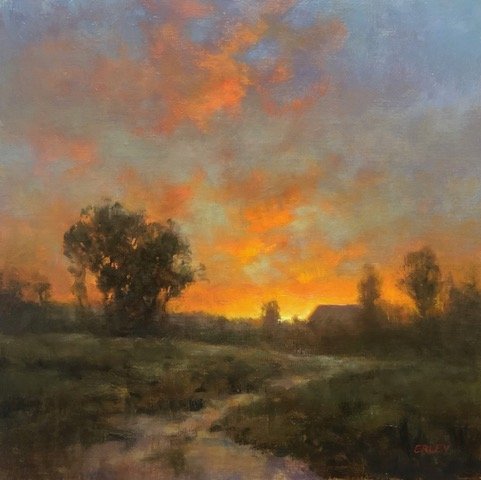
 Homeward - oil on linen panel - 10 x 10 inches

Jasper: Can you tell us about your background - where you were born and raised, where you went to school, and how you came to live in Columbia?

 Erley: I was born in Springfield, Illinois. Progressing through a Catholic grade school and an all-boys Catholic high school, I went to college an hour from home, getting my undergraduate - and later my graduate - degree in art from Illinois State University. I worked various jobs, my longest (other than self-employed artist) being as a graphic artist for the Illinois Department of Corrections. 

Over ten years ago, I came to Columbia with my partner (now husband) Lemuel Watson when he accepted a deanship at the University of South Carolina. I taught art at USC for a few semesters, before devoting myself solely to painting. I felt the role of teacher could be filled by another, whereas only I could create the paintings signed with my name.

Matter-of-Fact Nude - oil on linen panel - 14 x 11 inches

Jasper: Where does your life as an artist fit into this trajectory? 

Erley: I was drawn to art making early on as a way of comprehending the world. If I could picture something, I felt I could begin to understand it. As one of eight kids, drawing also allowed me a quiet retreat away from the bustling family, a place where I could get to know myself as an individual and not just one of the herd. 

When the idea of choosing a profession later presented itself, I was debating between the life of a Catholic priest and that of an artist. Contemplating a future life of celibacy just as I was beginning to explore my own sexuality quickly turned my career choice toward the arts. Nonetheless, I do regard art as a spiritual calling, the studio as a church. I can’t help recalling Van Gogh’s failed attempt as a preacher before becoming a painter. 

Once I was set on the life of an artist and I got my college education, I worked part-time at various jobs, which allowed time in the studio. When fortune smiled, art sales alone sustained me.  

Aside from landscape painting, which is my bread and butter (though the slices can be thin at times!), I also paint still lifes, figures, portraits, and the occasional abstract piece. While generally my landscapes and abstracts are totally invented, the other work uses a different muscle, one requiring a deep look into what lies immediately before me. Meditating on an apple or a face, the world opens up in a surprising way. That has worked to my advantage in winning the ArtFields portrait competition in Lake City where I needed to complete three consecutive one-hour portrait in three rounds.

Dark Day Dawning - oil on canvas - 36 x 48 inches

In exploring the idiom of landscape painting, my vision sometimes takes a somber tone. "Dark Day Dawning" is perhaps a cautionary tale, an omen of a future born of present-day missteps.

Jasper:  When did you start realizing accolades as an artist and, of them, what has been most  meaningful to you? 

Erley: I received a silver dish (engraved with the obscure phrase “Best in Junior Miscellaneous”) for a drawing at the Illinois State Fair when I was fourteen or so. Since then, I have been the recipient of over 120 prizes, grants, and purchase awards. I am most proud of those I received from representatives of the St. Louis Art Museum, the Indianapolis Art Museum, the Fogg Art Museum (Harvard University) and the Metropolitan Museum of Art. To have those “in the know” get your work is indeed validating. However, it is the hundreds of people who have chosen to live with my paintings that holds the most meaning for me. I truly believe my job as a painter is not finished when a work leaves my studio. Instead, it requires an engaged viewer to complete it, to coax out its ultimate meaning. To know that so many people have chosen to take on that task is indeed humbling. 

Jasper: Who have been and continue to be your greatest artistic influences, how have they influenced you, and do you see them in your own work? 

Erley: Perhaps my greatest artistic influence has been George Inness, the 19th-century American landscape painter. His poetic and painterly approach sets him apart from earlier landscape painters. He chose to steer away from detail for detail’s sake, as well as the grandiose compositions favored by his contemporaries of the Hudson River School, such as Frederic Edwin Church and Albert Bierstadt. Instead, he focused on semi-abstract compositions based on an underlying spiritual philosophy. Light infuses the scene to create a sometimes-mystical mood, though it is often married with an undeniable veracity to nature. 

Aside from him, there is J. M. W. Turner (British), Jean-Baptiste-Camille Corot (French), and Caspar David Friedrich (German). All share a romantic vision centered on a transcendent quality of light.  

A contemporary painter whose work I enjoy is Joan Nelson. She will “quote” pieces of old master paintings in her intimate paintings. When I feel myself stretching in a more abstract direction, Brian Rutenberg’s colorful compositions inspire me.


Jasper: What have been your greatest artistic challenges and how have you met them or how are you meeting them? 

Erley: My biggest challenge is to remain fully engaged and juiced by the process of painting. Like any act of love, it requires an openness and awareness to what is called for in that moment. I fall short of the mark when I am distracted, uncertain, when I’d rather be someplace other than in the studio. 

I know that viewers will only be excited by my work if I am. That’s something that can’t be fudged. I’ve seen so many glib, slick, uninteresting paintings in my life, I just feel it does the profession a real injustice. To be invested emotionally and to embed those emotions in paint is always my goal.  

To learn more about Erley’s work and see additional paintings visit his website at gerarderley.com.

The Lost Wiseman by Ed Madden

Editor’s Note: Every year since I have known him, my friend and Columbia, SC’s first ever city poet aureate, Ed Madden, has written a Christmas letter that, if you’re lucky enough, he shares with his friends. It is always a treat to read about what Ed and his husband Bert Easter, who is an antiques expert and a member of the Jasper Project board of directors, have been up to in the previous year and what Ed’s reaction to those experiences might be. Over the past few years Ed’s annual Christmas letter has taken on more of the qualities of an essay than a Christmas letter, which makes it an even better gift in my opinion. This year, Ed wrote about a lovely little wise man statuette that he found at one of Bert’s auctions. The wise man served as the catalyst for what would become Ed’s 2021 Christmas letter. Jasper appreciates Ed’s willingness to let us share this sweet missive with you, our readers.

The Lost Wiseman

Dec 2021


Friends, 

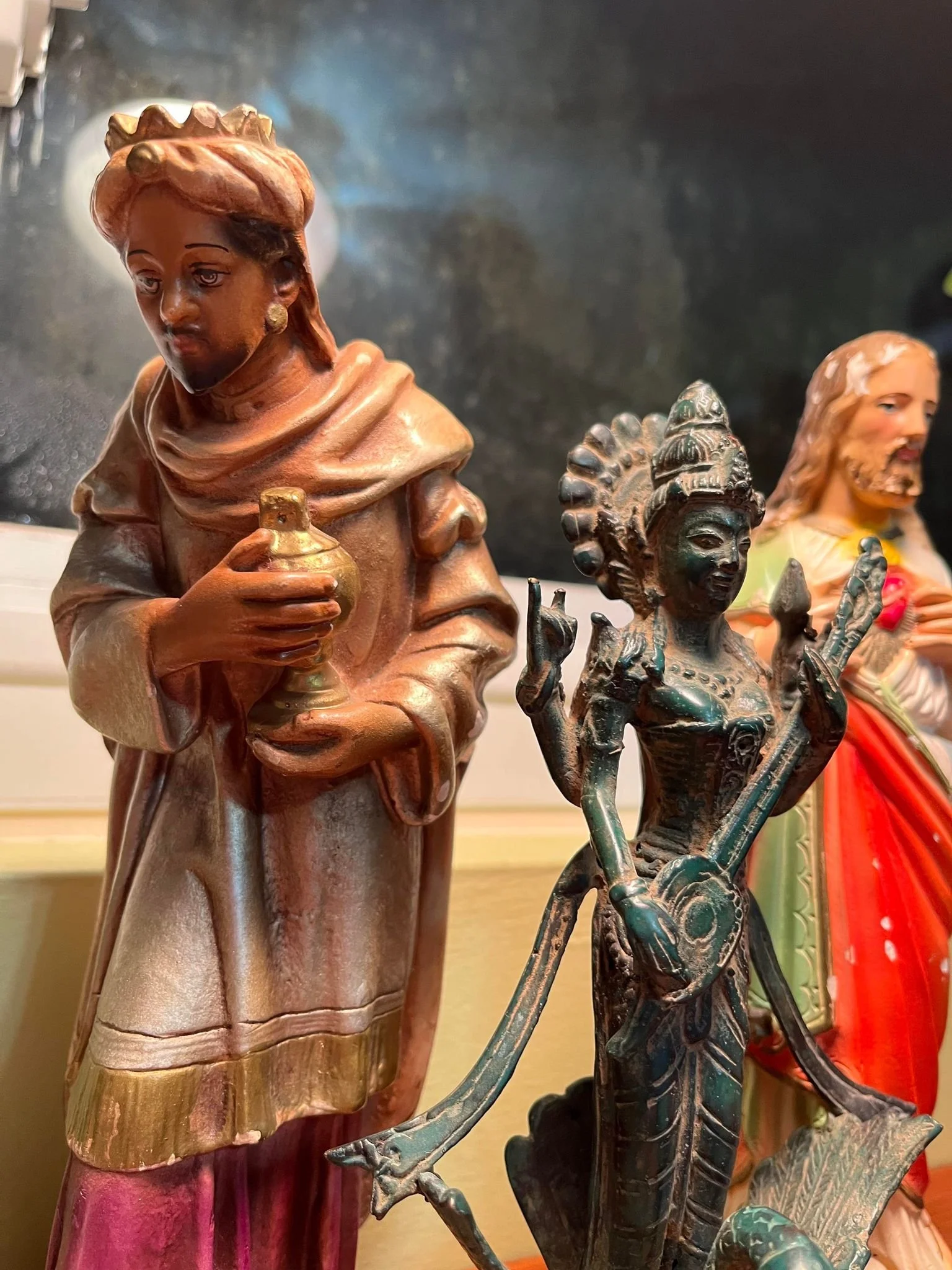
I found him at an estate sale Bert was running, a family so devoted to Christmas that one bedroom had to be set aside just to display the Christmas décor for sale. There were multiple artificial fold-out trees, boxes of ornaments and lights, each box lined with tinsel and glitter and broken glass. There were three nativities, complete, in good condition, and these sold, as did all the little Joseph-Mary-Jesus-in-the-hay trios. But this one was on his own, a wise guy separated from his two amigos. Whatever ensemble he had been part of was either long gone to someone else’s home, or more damaged even than he was and discarded. Chips on his back and arm, the knuckles of his left hand, a broken fold of cloak, all revealed the plaster, only sign of that greater disaster. Of everything in that room—the trees, the bells, figurines, strings of tiny lights—this was my favorite thing, an orphaned wiseman.  

I don’t know how old he is, how far he has come. He has earrings, a thin Van Dyke beard, brown skin. His dark eyes are tired and sad. He wears pointed blue shoes, each with a rough gold embellishment—a buckle, a fat tassel. His purple robe drags in the dirt, over that a knee-length tan tunic trimmed in gold, and over it all he has thrown a sand-brown cloak. The chips in the finish are mostly on the left, as if at some point he had fallen on his side against something hard, tipped over, or was stored unwrapped, banging about in a box as he ascended to the attic to wait in the darkness for another year. A turban is wound tight on his head and draped around his shoulders, topped by a flat gold crown the size of a quarter with ridges rather than points, like a worn-down reamer-juicer, a vintage cocktail muddler—or like a small star pressed onto his head, as if what he sought, what he followed, is who he is. 

To be clear, I’m not talking Artaban, the Other Wiseman, that contrived little Victorian fable about a fourth wiseman who sold all he had for jewels to give the new king, missed the boat (the caravan), got there too late, spent 33 years wandering the Holy Lands, selling off jewels and doing good deeds. When he finally made it back just in time for Golgotha (the symbolism is pretty heavy-handed), he got sidetracked, selling off his last big pearl to save a woman (“a daughter of the true religion”) from being taken into slavery, then got conked on the head by a falling roof tile and died. But not before Henry Van Dyke (a minister who believed slavery brought the Africans to Jesus) tied everything up in a sentimental Christian bow. No. Not that one. This wiseman is orphaned, left behind. He is lost, he is damaged. He has a gift, and wisdom. He has nowhere to go and nowhere he belongs.  

In first grade I was a wiseman in a blue bathrobe, carrying a box of wadded aluminum foil, the gift I would give the child, some classmate’s swaddled doll. I can see it in my head—that weird sense of seeing the past that could be a memory or a dream, or someone’s home movie I have seen. And I wonder now would my parents have allowed it. Growing up fundamentalist, we never had a nativity in our house. Maybe that’s a reason they fascinate me now. Churches in town—those denominations, a word we said with such contempt, since our church was the original, the primitive, the true—they had living nativities like roadside displays, cars driving by in the cold to honk their approval. But no, not us. We speak where the Bible speaks, we are silent where the Bible is silent. The Bible does not say Jesus was born in December. So, belligerent and right, we’d sing “Silent night” some midsummer Sunday just to make the point. Later I’d learn that the date had something to do with Constantine and effacing old faiths and Christianity linking arms with imperialism. That old story. But I knew none of that back then when I stood front of a class in a bath towel turban, holding jewels of crumpled foil. 

Our journeys this year were small. There was that window in the summer when it seemed like everything was going back to normal. People would get vaccinated. Things would turn around. We were, of course, so very wrong, but we were double-vaxxed and excited to see old friends and we drove up to North Carolina for a wedding outdoors, rows of chairs facing into a cathedral of trees. She did and he did and it was lovely and lovelier still to spend time with the parents of the groom—old friends from grad school and family trips to Kiawah Island. On the way back we only ever ate outside, pulled off for a couple of small-town antique shops, where we pulled our masks and caution back on. I taught online all spring. Afternoons we walked the small circuit of the neighborhood we’d rehearsed all year. Evenings we walked out to the new pond, fed the fish, watched the water falling. Then in August, it was with a weird joy I walked across campus into a class of masked students. A few weeks into the fall, we walked out to the main lawn. We pulled off our masks and saw each other’s faces as if for the first time. 

Almost two years ago, just before the pandemic hit, I sat in a hot room in an airless building at the end of dirt road, darkness filling the trees. The room was packed, we were all waiting for something to begin, an Afro-Brazilian religious ceremony. That night, two men were to come back from the dead. Their friends were there to celebrate their return. Macio, from Brasilia, who sat beside me on the men’s side and spoke some English, explained it to me. His friend, an initiate among the eguns, had died a few years before, and that night he would appear again. He explained that it was January 6, Epifania, the Epiphany, when the kings from Africa would come from over the ocean—such a long journey—and the dead would make themselves known. Macio and I were the only white men in the room; they had positioned us beneath the room’s only rattling fan—the guest, the tender visitor. Throughout the overnight ceremony—we were locked in, the heat and drumming intense, hallucinatory—the eguns, spirits of the dead, appeared in their beautiful garments, garments made to hide their human features, head and hands and feet. They were faceless beings, dancing, twirling, stopping only occasionally to address the congregated people in their thin, alien voices. The men in the room were terrified: if one touched you, you were sure to die. The women called to them, held children up for their blessing. The spirits of the recently dead, the aparacás, edged into the room along the back wall as the eguns danced. They looked like flags with men inside, their arms raised to hold up the corners. My friend Taylor compares them to the playing cards from Alice in Wonderland. The two new ones were black with strange faces painted on like masks—one looked like a radioactive Pac-Man, the other like a pirate flag. They moved sideways, always facing forward. Macio leaned over to say: this is my friend

That was my second time among the eguns. At the first, just before Christmas, before the ceremony could begin, my friends from the arts institute and I were summoned to the front of the room. There was a white bowl of water and oil with herbs. Beside it, to the right, there was a plate. Charles told us to take off our shoes. We took off our shoes. The women went first. My friend Laura quietly translated for me. I was far from home, nowhere to go and nowhere I belonged. We were to kneel at the bowl, we were to place our offering in the plate, and we were to wash our eyes three times. Only then, we were told, could we see the dead. I knelt on the floor. I put my donation in the plate. I dipped my fingers in the water and three times I wiped them across my eyelids and brows. I wanted to be able to see. I wanted to be open to what the night might bring. I watched the men around me and learned the ritual gestures. When the eguns fanned the lappets of their elaborate garments in front of you—a blessing, a spirit, the moving air—you were to scoop up the blessing with your cupped hands, pour it over your head. Together the rows of men, scooping, lifting up the blessing, pouring it out over our heads. 

The wiseman on my desk carries what looks like a gold funerary urn, left hand cupping the base, right holding the urn close to his chest, a thumb holding the top closed. What is inside? He leans forward as if tired, as if about to say something, as if leaning in to see. As if about to pour out all that he has carried for so long on the ground at his feet. He has nowhere to go and nowhere he belongs—other than here, on the desk, beside ET with his glow-in-the-dark finger, Saraswati with her swans, a wooden Jesus pointing at his heart. The wiseman is lost, he is damaged. He has a gift, and wisdom, and I start to wonder if these things are connected. The wisdom that comes from being damaged. The gift of being lost. Sometimes we carry things so very far. Sometimes we carry them for so very long. Sometimes we don’t know what it is we carry, ashes or something precious. Sometimes what we seek is who we are. Sometimes we take our masks off. Sometimes we pour ourselves out. Sometimes we lift up the blessings we are given, pour them over our heads.
May The Flowers Fall At Your Feet By Saul Seibert

This is what I said in the doctors’ office before everything went to shit. 

"If I were able to go back and talk to the person I was then.... when it all started, we wouldn't be working through how it's all gone and why I am here...where I am, with you, in this fucking room, asking me these stupid, hypothetical questions that lead me to what ifs and guilt and regret!"

I scratched at a week-old track mark and noticed my left shoe was untied.

I was insulted and defensive…. just like a Narcissist. Two weeks later everything went to shit. The pandemic hit and everyone got pregnant, divorced, or died.

Eventually I started listening to my therapist and two years later I have finally begun to talk myself. 

The irony is that you have to talk to yourself to get healthy or better or find peace. I'd like to talk to you about it and I'd like to listen to you about it......so we can see each other honestly, with transparency......in the right light….with love……as it should be.

A few weeks ago, I was able to attend a few performances by some up and coming younger artists doing a short regional tour. There was so much talent on the stage.  

Every night the energy was electric. 

They were all so beautiful. 

They were buzzing and brilliant and they were superstars and I loved them.  

They wanted loved. 

I worshipped them. I adored them and their youth. 

I yelled at them like an old, dumb, proud parent. 

My heart was full. 

They stood strong on stage and owned the space....hiding themselves and then exposing themselves....so cool and so vulnerable. 

They poured out like the Passion and shoved their blood and guts into my face. 

The movement, the music, this ancient art was shed for us, for you and for me! 

Each creator a craftsman, perfect in their nuances. 

I was voyeuristic while they were being crucified, died, and would rise again....every night....for us......for you, and for me and on the third day of the tour I recognized these saviors as myself and I cried in their faces........these future creators. 

It was beautiful. 

It was pure and toxic. 

It was heaven on earth. 

It was perfect and it is broken.


This is the absurdity. 

There is an absurdity to it all and here is the conversation I would have had with myself eight years ago. 

“The lights. Beware of the lights. They are beautiful but beware. The lights are violent and will pick a fight with anything that is perceived as a threat or competes with its illumination.... of you. The flowers will fall at your feet and valuable things can get left behind in the promise of potential future illuminations…….and more flowers and more lights. These illuminations will present options and the options are infinite and the infinite options that the illumination has enlightened you to promise to provide a pleasurable feast for you...to feast on.....forever.”


Here is the abridged version. 

“There will never be enough.

There will always be more. 

It will end."


Learn what it means to say,  

“This is my portion. 

It is enough and I am grateful.”


If I could go back and talk to myself (which I have) I would tell myself to try not to take myself too seriously and to know what matters and that, ultimately, the lights don't matter but they will show you who and what you truly are ...and that matters. 


For almost eight years I've been telling bars and clubs to please avoid using strobe lights during my shows.  

This is due to my Epilepsy. 

It triggers seizures. 

Last week while playing one of our last shows....the lights slapped me in the face.

It felt like I had been struck by a bolt of lightning. 

I collapsed on stage in the middle of a performance and had a seizure in front of not a few people. 

It’s never pretty.  

There’s piss and blood and slobber and I cry and contort  and convulse and crumble into myself a thousand times over.  

I am emptied and it hurts everywhere because now everyone knows I'm just another meat sack like them.  

I recall dragging my fingers across a sweety piece of wood strung with steal trying to find sounds that made people move while I was quaking inside and singing with a marbled mouth and blurry vision. 

The lights.

Those goddamn lights.


The next day I woke up bruised and sore and confused and grateful. 

I began to talk to myself…….my present self and my future self. 

I said these words, 

"This is my portion, and it is enough. I will live in light of that freedom right now, today."


This is what I said.

This is what I would say now to you my dear friend.


May the flowers fall at your feet. It is good to be celebrated but then 

Pick them up, smell them, breath it in deep……. and then throw them at a yonder stage and remember that this moment  is your  portion, and it is enough." 

Announcing a new Jasper Project Endeavor -- the Lizelia August Jenkins Moorer Poetry Chapbook Prize for SC BIPOC Poets

In honor of the 20th century poet, Lizelia Augusta Jenkins Moorer, the Jasper Project is delighted to announce a new project, the Lizelia Augusta Jenkins Moorer Poetry Chapbook Prize for SC BIPOC poets.

Lizelia Augusta Jenkins Moorer (1868-1936) was a teacher and social activist in Orangeburg, SC. Born in Pickens, SC, she taught at the Normal and Grammar Schools at Claflin College for 40 years. Her published anthology of poems Prejudice Unveiled and Other Poems (1907) examined the Jim Crow South’s propensity for lynching, racism, and social injustice. Moorer was also an advocate for women’s suffrage in South Carolina, especially in the Methodist Church. 

The purpose of the Lizelia August Jenkins Moorer Prize, affectionately called the Lizelia Prize, is to offer a first-time BIPOC poet from SC a publishing contract with Muddy Ford Press to publish their debut chapbook under the guidance of an established poet. The vision of Dr. Len Lawson, who is a member of the Jasper Project board of directors and the author, editor, or co-editor of four books of poetry, Lawson will also serve as project manager as well as editor of the winner’s chapbook and will collaborate with the winner on the construction of the book.

SC BIPOC poets who have yet to publish a book of poetry are invited to submit 30-40 single spaced numbered pages in Times New Roman 12pt and include a cover sheet with your name and manuscript title. Your name should not appear on the manuscript. The winning submission will receive publication via Muddy Ford Press, a cash prize of $250, and ten author copies of the book. Submissions should be in the form of a Word doc and should be sent to lizeliapoetry@gmail.com no later than February 28th, 2022.

JIM CROW CARS.

by Lizelia Augusta Jenkins Moorer

If within the cruel Southland you have chanced to take a ride,

You the Jim Crow cars have noticed, how they crush a Negro's pride,

How he pays a first class passage and a second class receives,

Gets the worst accommodations ev'ry friend of truth believes.

'Tis the rule that all conductors, in the service of the train,

Practice gross discriminations on the Negro—such is plain—

If a drunkard is a white man, at his mercy Negroes are,

Legalized humiliation is the Negro Jim Crow car.

'Tis a license given white men, they may go just where they please,

In the white man's car or Negro's will they move with perfect ease,

If complaint is made by Negroes the conductor will go out

Till the whites are through carousing, then he shows himself about.


They will often raise a riot, butcher up the Negroes there,

Unmolested will they quarrel, use their pistols,rant and swear,

They will smoke among the ladies though offensive the cigar;

'Tis the place to drink their whiskey, in the Negro Jim Crow car.

If a Negro shows resistance to his treatment by a tough,

At some station he's arrested for the same, though not enough,

He is thrashed or lynched or tortured as will please the demon's rage,

Mobbed, of course, by "unknown parties," thus is closed the darkened page.

If a lunatic is carried, white or black, it is the same,

Or a criminal is taken to the prison-house in shame,

In the Negro car he's ushered with the sheriff at his side,

Out of deference for white men in their car he scorns to ride.


We despise a Negro's manhood, says the Southland, and expect,

All supremacy for white men—black men's rights we'll not protect,

This the Negro bears with patience for the nation bows to might,

Wrong has borne aloft its colors disregarding what is right.

This is called a Christian nation, but we fail to understand,

How the teachings of the Bible can with such a system band;

Purest love that knows no evil can alone the story tell,

How to banish such abuses, how to treat a neighbor well.

Raena Shirali will be serving as the adjudicator for the Lizelia Prize.

Raena Shirali is a poet, editor, and educator from Charleston, South Carolina. Her first book, GILT (YesYes Books, 2017), won the 2018 Milt Kessler Poetry Book Award, and her forthcoming collection, summonings, won the 2021 Black Lawrence Press Hudson Prize. Winner of a Pushcart Prize & a former Philip Roth Resident at Bucknell University, Shirali is also the recipient of prizes and honors from VIDA, Gulf Coast, Boston Review, & Cosmonauts Avenue. She holds an MFA in Poetry from The Ohio State University Shirali and is an Assistant Professor of English at Holy Family University, where she serves as Faculty Advisor for Folio—a literary magazine dedicated to publishing works by undergraduate students at the national level. Her work has appeared in American Poetry Review, Academy of American Poets’ Poem-A Day, The Nation, The Rumpus, & elsewhere.

PRINTWORTHY! Michaela Pilar Brown is in the Right Place at the Right Time

Reprinted from Jasper Magazine Fall 2021

by Cindi Boiter

Over the past decade, Jasper Magazine has written about Columbia-based multi-media artist Michaela Pilar Brown many times. This passage of time has witnessed Brown become a leader in our community, not only as a result of her myriad accomplishments but also by the now-international stature she commands across the most-sophisticated fine arts circles.

Brown’s career has been punctuated by a steady continuum of shows, awards, residencies, and related experiences that have helped shape the 50-something artist into the fierce icon she is becoming. Taking home the 2018 Artfields Grand Prize for her mixed-media installation She’s Almost Ready is upmost among her accolades, as is being awarded the inaugural Volcanic Residency at the Whakatano Museum in New Zealand that same year.

Born in Bangor, Maine, and raised in Denver, Brown became an influential member of the Columbia arts scene soon after she moved here in 2013. Having spent many a childhood summer visiting the Fairfield County farm where her father lived, Brown had returned to SC a dozen or so years earlier to help care for her aging family patriarch. His land and its legacies were a part of who Brown was even when the she first left home to study at Howard University in the ‘80s and ‘90s.

“Howard felt like family. My professors let me continue my work even when I couldn’t afford tuition,” Brown says. “I spent a lot of time learning outside of academia.”

Critically influenced by such trailblazing American artists as Frank Smith and Jeff Donaldson, Brown identifies world-renowned sculptor Richard Hunt as impacting her work ethic the most.

Hunt, who may be the most highly accomplished contemporary Black American sculptor and creator of public art in the country, visited Howard to install a piece of his work during Brown’s time as a student. When a piece of his art was damaged, Brown was recruited to help with the repair. A burgeoning artist-protégé relationship led to an invitation to study with Hunt for a summer in Chicago.

“I was green and just so honored,” Brown says. “He worked fervently all the time and I worked all the time,” noting that she initially wanted to make public art herself. In fact, the young artist had interned at the International Sculpture Center, part of the Washington Project for the Arts, as well as the Smithsonian Institution.

The emphasis on family and the support systems it can naturally provide had followed Brown to Howard, where the faculty became supportive elders for the young artist. The intimacy and sacredness of her ancestral home not only informed Brown as an artist but also provided her with a profound understanding of the strengths and challenges of southern Black art writ large, as well as with the workings of the local arts community specifically.

After her father died in 2007, Brown’s mother soon also came to depend on her and her brothers for what ultimately would be end-of-life care. It was a crushing loss that further strengthened Brown’s resolve to take command of her platform like never before. The artist continued to bring the roots and wings she had embraced — on her home turf, in DC, and in Chicago — into an enduring relationship with Columbia-based theatre artist Darion McCloud and his daughter more than ten years ago.

“All these experiences changed the shape of the work I was doing and what I wanted to do,” Brown says. “My work became much more personal and honest. My focus came to include what it means to me to be Black in SC, but it also focuses a great deal on love and how we grieve.”

Among her major accomplishments over the last decade has been taking on the position of executive director of 701 CCA – Columbia’s Center for Contemporary Art. 701 CCA is located on the second floor of the historic 701 Whaley Street complex and featured on page XX of this magazine.

Arguably the perfect person for this position due to her local and international profile, Brown is the first Black woman to have this role, and she handles the responsibility with a resolute intensity. “701 [CCA] has historically been a place of inclusion,” Brown says. “I am engaged in protecting that and expanding it through exhibitions, programming, community dialogue, and programs outside our walls that engage the community directly in neighborhoods and through community partnerships. … We had a challenging moment recently, and I'm proud of who we are on the other side of it. I'm proud of the public statement we made and the manner in which we supported our artist.”


Brown is referencing the night of May 17, 2021. John Sims, an artist-in-residence at the gallery was living in an apartment assigned to him in the building at 701 Whaley Street when he was accosted, handcuffed, and held at gunpoint as a “suspicious person” by the Columbia Police Department. Brown released a statement in response to the attack, saying the incident was not the first time a resident at 701 had encountered the police. “It was the first time, however, such an encounter led to hostile confrontation, detention, cuffing, and a records check. On the contrary, such previous encounters have resulted in courteous apologies from officers. The difference? Race. Mr. Sims is a Black man; the other incidents involved a white man.”

“Like other community-based, nonprofit institutions,” Brown continues in her statement, “CCA has the responsibility to shine light on injustice it encounters and to be part of an active dialogue to make real and discernible change. We cannot ignore the relationship between white supremacy that permeates our culture and the racial profiling we believe infected John Sims’ treatment by CPD officers. … What we can and will do is support the efforts of John Sims as the CCA artist in residence to tell his story, to provide context for that story through his artistic expression, and to seize the opportunity to join with him and the greater Columbia community as we continue the struggle for racial justice.”

It is Brown’s intimate knowledge of the patrons of 701 CCA and the community it supports that informs this position so well. “I am optimistic about the Columbia art scene,” she says. “This is a community that wants change, that's ready to face the challenges of the moment with art leading the discussions. I am hopeful that our politicians recognize the value of art for the betterment of this community, for the comfort it brings, for the space it makes for challenging conversations, and for the expansive learning opportunities it offers young people. I also hope they support it with dollars, and not just the legacy institutions, but in an expansive, inclusive way.”


Rhodes Bailey and the Frosty Four bring you Columbia's newest Christmas song

“Climate Change don’t take my Christmas away”

We were delighted when Columbia attorney, musician, and former SC house of representatives candidate Rhodes Bailey shared one of his new projects with us – a powerful, yet fun new Christmas song – and could hardly wait to share it with you. We asked Bailey a few questions about the project, and he graciously shared how and why Climate Change is Killing Christmas” came to be: 


Jasper: What was the impetus or inspiration for this song?  

Bailey: My good friend Jake Erwin (whom I gig with from time to time) texted me not long before Thanksgiving and said we should record a Christmas song. I thought to myself "what if someone did a Christmas song about how it's too hot at Christmastime now because of climate change? No snow, no crisp air, etc., and the singer is pining for cold weather."  The more I thought about Christmas imagery, the more I thought about how 80-degree weather spoils the  mood. I sat down and banged this out in about 30 minutes. I sent an acoustic demo to Jake who laughed and said, "Oh man, I just meant we should cover 'Jingle Bell Rock' or something. I didn't know you were going to write a song."   


Jasper:  Are there more like it -- is this part of a collection or a solo piece? 

Bailey:  This is a solo piece for now. There's a pretty small window for holiday songs (between Thanksgiving and Christmas), so I had to record it, shoot the goofy video, and get it out fast. I'm at an age now where I only write lyrics when I have something original to say. I make up instrumental music all the time, but only spend time on lyrics if an idea strikes me as particularly interesting and I want to share it.


Jasper: Who are the Frosty Five

Bailey:  Spencer Collins (drums and backup vocals) 2) Jake Erwin (keyboards and jingle bells) 3) Evan Simmons (bass) 4) Zac Thomas (expert producer and sound engineer at the Jam Room in Columbia, SC) and 5) Me (12 string Rickenbacker guitar* and vocals). It should really be "Rhodes Bailey and the Frosty FOUR", but FIVE sounded better. We worked hard with Zac to get a vintage Christmas studio sound, like the ‘60s girl groups from the album "A Christmas Gift for You from Phil Spector" (which everyone should check out by the way) or the Mariah Carey classic. 

(editor’s note — we hear these words when we read them in the late great Tom Petty’s voice. If you know, you know.)


Jasper:  Was this just for fun or is there a serious motive involved? 

Bailey: This is for fun, but obviously climate change is serious and it's on our minds. I try not to be heavy-handed with lyrics. People respond better to humor than preachiness. An unseasonably warm Christmas is a bummer for everyone - even for folks like us in South Carolina that don't see much snow. It didn't snow a ton when I was a kid, but I remember having a white Christmas when I was in the fourth grade and that was "peak Christmas" for me. No subsequent Christmas could match it. As I grew up, my standards lowered to a "chilly Christmas."  Now we have to settle for "Not-hot Christmas."  We've seen 80-degree Decembers and they are a total buzz kill. The character in this song is lamenting the loss of a wintery holiday season but is still an optimist. He/she is holding out hope that snow and cold weather will return just like Darlene Love does for her baby in "Christmas  (Baby Please Come Home)".